DOCUMENTS
DIARY OF WILKES IN THE NORTHWEST
[Continued from Volume XVI., !Page 223]
[May, 1841.]
This is also the case with those who desire to remain 10 this
country and settle after the expiration of their terms they take a portion selected by themselves though doubtless by the Com-pany's counsel & incur debt to them by advances, still holding them under their subjection, for without the Company's aid and advances they must be ruined all their supplies and whereat to sell their crops is at the Fort, from this results much good for the welfare & condition of the settlement viz those men only who are industrious get along well, they are not allowed to be intem-perate no grog is sold them and a watchful eye is kept over them & circumspection maintained of their habits and moral con-duct.
Too much cannot be said in praise of the Company in their having done away with the trade in spirits. It is now entirely stopt, and they have very large quantities of it in store at Van-couver sustaining a great loss upon it. Nothing could have been done so well calculated to maintain their ascendancy over their People the Natives and the other settlers as this; and I have been informed since its disuse the settlers have been prosperous and the Natives less quarrelsome.
Dr. McLaughlin gave me the Thermometrical' observation for heighths throughout the route to Canada crossing the rocky Moun-tains. They also stated that [Ms. P. 79] little dependence was to be placed in the veracity of David Douglass the botanist.73 Mr. Douglass the Chief factor stated to me that he believes the observations of Mr. Thompson quoted by Irving in the appendix to Astoria in relation to the heights of the Rocky Mountains may be relied on.
I have passed a pleasant day and had agreeable conversation at the mess table after meals it is the custom to introduce pipes &tobacco it is said the practice is getting [illegible] but I should have concluded it was at its heighth.
30th [May]
73 'l'his entry is disconcerting as the memoryot David Douglns is most cordially cher-i~hed. c::::pecially hy thor-;c who know about his remarkable work in the field of botany. The context of the Dinry may indicate that reference was made to rather exaggerated estimates made by the botanist as to the heights of mountains.
Diary of Wilkes in the Northwest 291
This day was beautiful being Sunday I attended divine
Ser-vice in the Dining Hall Mr. Douglass read prayers and Mr.
Griffith one of the Missionaries gave us a Sermon-stupid man
& bad preacher.H
The orphans and
Y;;
breed boys who attended the schoolun-der [blank] chanted & sang. They have a chapel in which the
Catholic Priest officiates. Dr. MeL. and most of the servants of
the Company attend it quite a large congregation there does not
appear to be any jarring among the different creeds, and the ut-most liberality of Spirit exists.
Casenove the Indian chief of the tribe who formerly
pos-sessed this portion of the country Calipooyas is still living he is
a dependent of the fort's and has his meals at a side table
when-ever he chooses to partake of them his usual business is to
pro-vide Indians & canoes to dispatch passengers & letters up and
down the river. He is represented as a well disposed person,
seems to possess little or no influence with his tribe & it is said
with what truth I know not-that the Company have purchased all his lands from him for what consideration I am not informed.
[Ms. P. 79a]
Mr. Douglass gave me information relative to the Geological
formation' of the country in a N.E. line as far as Hudson Bay &
promised me specimens,
viz.,-Trap formation in the lower or western section to the Cas-cades, then Bulsallic [basalt?] then Sandstone, quartz, lime stone,
granite here & there cropping out of which the central range or
Peaks of the Rocky Mountains are composed-thence in a re-versed order to Hudson's Bay.
From all the information he has been able to gather no copper
is found south of 59° N. in this territory where the pure copper
is found in abundance and which the natives beat in large sheets
that are articles of trade on the coast & are there sometimes met
with by the traders.
Coal is said to be found near the foot of the Rocky
Moun-tains, on the Cowlitz and at Vancouver Island specimens of the
two latter I have seen and obtained that of the Cowlitz Lignite,
but from Vancouver Island it is a good quality of bituminous coal,75
The tumuli found on the prairies are ascribed by the Indians
74 In most cases, the frank jndgments in the Diary were omitted or toned down in the published Narrative.
292 Edmond
S.
Meanyto the effects of water there is no tradition of them measures
of one taken by Mr. Douglass was 30 ft. in diameter and 10 feet
high one has been opened by the company but nothing found in
it, subsequetly as I have elsewhere written I opened 3 others and dug deep in the one mentioned above but was not more
success-ful in making discovries.76
[Ms. P. 80]
The smaller tributaries of the CoIR. below the Cascade range of Mountains rise in early spring but the CoIR. itself rises in the
beginning of Summer caus~dby the melting of the snows on the
Rocky Mountains.
The salmon fishing is now in its most active operations at the Cascades & Willamette falls and this draws the Indian population
far and near to it. the tribe in whose territory or limits they are
exact a tribute to all who fish, the general average price of a sal-mon' is 10 cents tho' this will depend very much upon the wants
of the Indians. They refuse to sell any Salmon until after the
first run and then always without the heart they have many
superstitions in relation to them some of which I will give from the best authority I could derive them, but I am nevertheless well satisfied that there are very few who can understand these lan-guages sufficiently to obtain them & I further believe that very few of. the Indians now living are aware of or have any
know-ledge of their traditional stories. [Ms. P. 80]
Mr. Drayton & myself making a copy of a manuscript chart of this section of the country.
31st May.
Mr. Douglass was kind enough to carry me over the whole
establishment Great system evident in all the departments & I
felt well satisfied that without it little or no profits would be realized in the Fur or Indian trade at least on this side of the
Mountains the supplies and incident expenses to the service &
duties to be performed, the yvaste &c. &c. must render it now a very precarious business, the Fur trade, as far as I was enabled to gather from the happiest, those engaged in it having fallen off 50 per ct indeed so as to make scarcely worth while to follow it. The granary to which we passed contains wheat flour, barley,
buckwheat it is said wheat averages 63 lbs. the bushel. Barley
gives 20 bushels to the acre Buckwheat yields a good crop some
seasons it is by no means certain owing to early frosts oats do
76 Geologists have mentioned eighteen pos~ibleexplanations of those tumuli, the most plausible referring to gli'cial origin. The l"E'gion now known as ],{ound Prairie was by
. 77 Since Preston's Map of 1856 the large lake has heen charted Vancouver Lake and its connecting waterway LDke River. See Meany'S Ot'ioin of Washington Geographic Name8~ pages 139 and 325.
78 On .AllgU~t II, 1799, the United American Company was reorganized under the name of Russian American Company and that name was retained under the new charter ot 1802, See Bancroft's Hislo,'y of Alaska, pages 379 and 416.
79 The spelling is corrected in the Nan"afive, Volume IV., page 333.
not thrive well Peas, Beans, Potatoes yield generally abundantly. Little or no hay is made the cattle being enabled to feed all the winter nor do they require shelter thus 2/3rds of a farmer's time is saved and the difference of labour may be fairly estimated in the wasted hours there, by this fact.
Rode with Mr. Douglass to see the Fort Dairy. the ride was a beautiful one through fine prairies with large trees (oaks, & ash) grouped over them and the quantities of cattle feeding & at repose gave a civilisation to the scene that this country along [alone] wants to add to its natural beauties. the chain of Lakes before spoken of gave an extensive water view to the scene.71
The Dairy is removed every year, thus the manure & wear of meadows is equally divided, this is likewise the case with [Ms. P. 81] the feeding of sheep. I was told they have now about 300 brood mares, about 2500 sheep 3000 cattle, there were 70 milch cows at the dairy it seems well conducted by a Canadian his wife & 3 men They supply the milk & cream to the establish-ment and a large part of the butter for the Russian Company78 is put up here, some cheese-, the cattle all look well, (the churn-ing is by a barrel machine-) not killing any they rapidly in-crease.
To give some idea of the system of the Company and to accts. for their seeming great profits I will state here that they have all their articles classed-viz in articles of gratuity, those of trade and purchase-the first consists of knives & tobacco-2nd of blankets, gun powder & shot-clothes &c. 3rd. of sheets, handker-chiefs, beads, ribbons &c. &c. from this many persons who are told of the vast profits &c of the Company imagine that they get their valuable furs for a mere trifle-but this is seldom or never the case The Indians & settlers understand well the worth of each article and are not inclined to give it for less than its real value and a present to boot. Those who trade in this country are obliged to give or make allowances to trappers to obtain their services and to such a wreckless79 set as they are little opportunity of getting returns is practicable unless the persons are driven by necessity to follow the same trail of life. The Company in order to avoid losses by the desertion of their men generally send them 293
294 Edmond
S.
Meanyin large parties from 30 to 40. When they take their wives &
families with them and trap during the season on some favorable
ground where they remain for the season, they leave in October
& return again by Mayor June. They usually trap on shares &
this is according to the skill of the trappers.
All the packages for transportation in this country are made
up of 90 lbs. weight for the convenience of transportation across
portages &c. & it is inconceivable the ease with which a voyageur
will run off with several of them. [Ms. P. 81a]
Mr. Douglass having traveled extensively in this country being observing and having improved his opportunities of making
enquiries related some customs of the northern Indians Truly
remarkable among them are relating to the Telloles80 or Carrier
Indians as respects their dead. On the death of a Husband the
body is laid on the funeral pile burnt and their ashes preserved by the wife if she survives the experience she is subjected to--They are not burnt with their husbands, but are required to attend his body until it is consumed and to keep constant by patting his breast until the whole is consumed which severely burns them always, and are suffered to fall into the flames if his relatives do not withdraw her in time, they remain until the body is entirely consumed gather up the ashes and are obliged to carry them about for the period of 3 years during all which time they serve as slaves to the husband's relatives.
And what appears to render this practice more remarkable is the fact that all the nations, or tribes around these bury their
dead about 3 feet below the ground covering the body carefully
with boards to prevent its being hurt.
The above tribe dwell in the Interior East of Fort Simpson
in about Lat.
56
North.The Calipooyas tribe residing south of the Cola. and along the Willamette Valley bury their dead ornamenting the grave with poles, or with an affixed calabash, pots, pans &c. &c. whilst those North of and on the river place theirs in canoes above ground.
[Ms. P. 82]
In connection with this river ate its prairies along it in
some places they are of large extent with arms of the river flow-ing through them in various directions which are sufficiently deep
for boat navigation They are admirably adapted to grazing
pur-poses, but for agriculture the farmer would be in continual
Diary of Wilkes in the Northwest 295 prehension of losing his crop and always will sow in uncertainy
o~ account of the rise of the river, in the proportion to which the water rises on the wheat it perishes so that unless the Wheat should be actually overtopt a small harvest might be expected (seed wheat). It cannot but appear remarkable that a river of so great an extent should have no sediment, but the contrary. I understand as far as experience has gone it rather proves to ex-haust or deteriorate the soil.
In many places in the lower prairies quicksand exists which causes occasional slips of soil carrying with them trees of huge dimensions which are finally carried to the ocean to be in time lodged on some remote or Savage Island supplying his wants for the necessary means to construct his canoe. That part of the soil which is not rock on the river is a light sandy one through which the water on its rise in the Cola. percolates through, and overflows the low parts of the meadows adjoining. {Ms. P. 82a] June 1st, 1841.
Had today, a long conversation with two of the Missionaries Messrs. Clark and Griffin, (self supporting system) They stated that they were very much disappointed with the country and the only fit place they said for settlement in the Upper Country was the Grande Rounde prairie situated between the Headwaters of the Grande Rounde and Powder Rivers. Some 20 miles in extent this is about 60 miles to the Eastward of, Walla Walla. The in-formation they gave relative to the Population was about 10,000 West of Mountains.
Dr. McLaughlin &Mr. Douglass rate it about the same south of 50° some however rate it as high as 25,000. The following
1
believe the most correct data, and is obtained from a variety of sources & in some cases counted from my own information esti-mated upon the ability of the country to afford support and its offering the necessary facility for subsistence in their mode of life.
Population.
Vancouver Island 5000
between 50° & 54°.40. N 2000
7000 Clapest, & intermediate coast. . . 1250 Clalams- (Port Dis.) 150 (N. Dung.
?200 Port Tow ? 70)... 425
296
EdmondSo
MeanyFrazer's River .0 • •' 0 '• 0 • •0 0 . 0 . 0 • 0 0 0 •
500
Penn's Cove & Whidby's Is1.0 0 '• 0 0 • 0 0 0 0
650
Hood's Canal . 0• • • • • 0 0 0 • • • • • 0 0 0 • 0 0 • •
500
Nisqually 0 • •0 0 • 0 0 • • • • •0 • • • • •0 0 0 • • • • •
200
Port Orchard & Admiralty Inlet. 0
150
Chekilis & Puget Sound 0 0 • • 0 • • •
700
11,675
350
200
650
275
400500
300
500
600 400 of350
209
220
300
150
250
125
[Ms.P. 83]
brought forward 0 • •
11675
Cowlitz-including the head waters of Chekalis & also the Head waters
Cowlitz. (Klakatuck tribe) .
Chinooks . 0• • • • • • • • • • • • • •0 . 0 .0 • • • • •o.
Clatsops including [blank].0 0 0 • • •0 • • • • •
Pillar rock oak Pt. & Cola. River0 • •0 0 0 •
Canadn. . ..0 • • • • • • • • 0 • •0 • • • • • 0 0 0 . 0• •
Dalles Mro Lee's letter0 • 0 0 • • • • • 0 • • • • • •
Shutes river ...0 0 • • 0 0 • • •0 0 • 0 • • • • • •
Walla Walla including the Nez Perces
[illegible] &c to the south and
west of it. 0 0 • • • 0 • 0 0 • 0 0 0 0 •
1100
Yakima River 0 • • • •0 • • • • • •0 0 • • • • • 100
Colao River between Walla Walla &
Okanogan .0 • • • • • • 0 0 • • •0 0 0 . 0 . 0 0 .
At and about Okanogan0 • 0 • 0 0 • •0 • 0 • • •
The tribes about Spokane Colville & adjoining tribes. Towards the
mountains-Flat Heads ... o.... o'
Willamette throughout the valley0 • • • • • •
Muqua 0 • • • • • •0 • •0 0• •0 • • •0 • • • •0 . 0• • 0
Rogues .. 0 . 0 0 0 0• • • • •0 • • • • • • 0 0 0 0 .0 0 o.
Clamets ..0 . 0 0 0 • 0 0 • • • •0 0 • •0 0 . 0 0 0 0• • •
Shasty . 0 0 0• • • • • • 0 • • • • • •0 • • 0 . 0 0 0 0 0• • •
Kalapuyas ...0 • • • • • •0 0 0 0 0 0 • • • • • • • •
Killamouch, this side the Muqua river.. Black feet tribes that make excursions
West of Mountains and who
oc-cupy the Buffalo Country ...0 • • • • • • 1000
Total west of Mountains & in
Diary of Wilkes in the Northwest 297 There is a tribe called the Knikla; on the Sacramento River and adjoining the Shasty Indians supposed to be about 1500 souls.
The whole Oregon territory may therefore be set down as containing not over 20,000 inhabitants.
The whites in the country including the servants of the Hud-son's Bay Company & officers 350. [Ms. P. 83a]
Mr. Smith (Miss'y.) has been 3 years in the country resided part of the time at 'Sopkane & with Dr. Whitman has known the temperature 30° below zero in winter and at 100 above in Sum-mer. The country remarkably healthy grass green in Feby-& the pasturage for cattle good requires no housing they feed upon the tufts of grass that by the heat of the sun are con-verted if I may so express it into natural hay.s2
Dr. Whitman of same mission has had difficulty with the Indians as respects his water pow'er or rights for the irrigating the soi1.83 The Indians after granting him the privilege and be-coming aware of the use he made of it diverted it from him to their own use they are intelligent and when they see an improve-ment readily adopt it.
In the afternoon rode with Mr. Douglass to the Flour and Saw Mills84 the first is about 5 miles from the Fort but has one
run of stones, is well built of timber but in consequence of the heighth of the River causing back water it was not in action. it is amply sufficient for the wants of the country at present- The Saw Mill is 2 miles farther and likewise on the Banks of the Cola. and owing to the same circumstance of being placed too low part of the season it is out of use it has several runs of Saws and is as fine a pile as I have seen anywhere, and in few coun-tries could such material be procured for the framing of any building all of its frame timber is [blank] feet in height squaring [blank] feet. The description of timber used for cutting into boards is far inferior to what we should deem merchantable in the United States being of the quality or little better than our hemlock. [Ms. P. 84]
All the hardwood plank or boards that may be required is
81 'I'he statistics are valuable, compl'iS111g one of the most complete compilations up to that time. A slight revision was mnde in the published Narrative.. Volume V'I pages
140-141, the total tbere being 19,354. Some of the names are spelled differently in, the pnblished table.
82 Those familiar with the later cattle days will smile over this early reference to buuch grass.
83 Undoubtedly the first irrigation in the Pacific Northwest. See Meany's History
of the State of Wa8hington. pages 302-303.
298 Edmond
S.
Meanyyet cut by hand. Brig Wave was here taking on lumber for Sandwich Islands. The board!! sell at Oahu for 80$ the thousand could not ascertain their costs about 20 men are employed at this moment at the Mill some Sandwich Islanders &Canadians. They have a large blacksmith shop here whereat all the axes or hatchets for the trappers are made. the Iron & steel being im-ported. They are manufactured at a much less price and such as they can depend upon. it may appear somewhat surprising to some that a trapper's axe is his support and in it his success de-pends, for on its loss or breaking the trapper relinquishes his labours & returns without furs. One man can manufacture 50 of these daily 25 is said to be his labour. They are eagerly /" sought after by the Indians who are extremely particular that it
should be of a particular shape.85
From the mills we passed through the forest to the High Prairie and rode over it to one of the sheep walks-the soil is rather light but with manure will yield a good crop. These prairies are indeed beautiful covered with fine pines of gigantic heights, some whose branches are nearly touching the green sward, with oaks, maples, fir, & cedar, with intervening spaces of prairie covered with Columbines.
Lupines & Kamass flowers all seeming in the utmost order as if man had been ever watchful of its beauty and cultivation. We returned to the Fort by the High lands through the woods, saw the herds which had been driven from the low prairie or meadows on account of the rise of the water they add much to the interest & beauty of the scene. A certain number of brood-mares are assigned to each horse who is ever mindful of his flock keeping them from straying and ever jealous of them, most of the mares with young colts or with fold [foal]. We returned to the fort just at [Ms. P. 84a] sunset, and it was such a sunset as reminded one of home the air mild and a pleasant breeze from the West Mount Hood showed in all its glory overtopping the purple haze of the coming night. A long ride of some 20 miles ) good horses and little fatigue. Had some pleasant conversation
:with the Dr. & Mr. D.86 at their .hospitable board.
A small manual labour school is kept here for the education of the orphans & .~ breeds of the Company's servants and will
85 In the No,"rative, Volume IV., page 336, Wilkes says about the particular shape, usomewbat like a tomahawk."
Diary of Wilkes in the Northwest
299
be of much service to the rising flock. There are at present 23 boys. An examination of them was had altho they did not prove very expert at their exercises in reading & writing yet it gave sufficient evidence of their improvement to show that they were in a fair way to acquire the rudiments & some allowance was to be made as they had been for some weeks constantly employed in the field under their teachers. Dr. McL. estimated the work of 4 boys equal to that of a man. it was an interesting sight to see these little fellows side by side of all shades of color from the pure Indian to that of the white they all speak English and frencli, they are duly interested in the religious exercises in which I thought they were more proficient than in the other branches. These they are instructed in on Sundays and attend divine service in the Hall twice.
It was pleasing to see the interest that Dr. McL. & Mr. Douglass took in them and much credit is due to them for their snatching as it were these castaway boys from the vices & idleness of the savage life. much has been said about the disregard to morals & vices of this Company and I feel myself in justice to them to say that as far as my observation went to bear testimony to this and many other acts that will prove to the contrary-I must first [Ms. P. 85] bear testimony that the officers of the Hon. Compy. service have not only quieted the country but their operations have been so admirably conducted that they have opened the country to safe and secure emigration, and provided it with the means neoessary to the success of emigrants, and ren-dered the task an easy one to its peaceful possession and at a very moderate expense. a small force at any central point would in my opinion be sufficient to insure its tranquility and due pro-tection to its settlers in any part of it.
2 & 3rd June.
I had a visit from one of a party of 8 young Americans who after a years stay in the territory are discontented and intend to leave for California. They are building a boat on the Wil-lamette but find themselves without nails canvass rigging &c. I ad-vised them to take passage to the Islands but this not suiting their views they declined to take. I promised however to visit their place on may way up the Willamette.
300 Edmond
S.
Meanythis stonn was felt at the Ship at Nisqually87 it was rather un-usual this time of year.
Dr. McL. related to me the curious manner in which the wreck of a Japanese Junk was discovered a year since on the coast near cape Flattery. a small piece of rice paper was brought by an Indian on which was sketched a Junk crushed on the land and three figures standing near enquiry was set on foot, the fact proved true and subsequently an expedition was sent out the three Japanese removed who had been held in slavery by the In-dians and to whom a ransom was paid, they were sent to Eng-land and thence to Canton & Japan but were refused permission to land & are now in Canton under the Missionaries.88 [Ms. P. 85a]
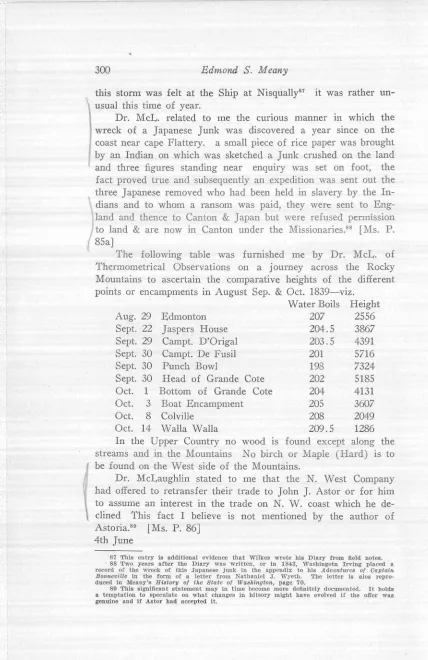
The following table was furnished me by Dr. McL. of Thermometrical Observations on a journey across the Rocky Mountains to ascertain the comparative heights of the different points or encampments in August Sep. & Oct. 1839-viz.
Water Boils Height
Aug. 29 Edmonton 207 2556
Sept. 22 Jaspers House 204.5 3867
Sept. 29 Campt. D'Origal 203.5 4391
Sept. 30 Campt. De Fusil 201 5716
Sept. 30 Punch Bowl 198 7324
Sept. 30 Head of Grande Cote 202 5185 Oct. 1 Bottom of Grande Cote 204 4131
Oct. 3 Boat Encampment 205 3607
Oct. 8 Colville 208 2049
Oct. 14 Walla Walla 209. 5 1286
In the Upper Country no wood is found except along the streams and in the Mountains No birch or Maple (Hard) is to be found on the West side of the Mountains.
Dr. McLaughlin stated to me that the N. West Company had offered to retransfer their trade to John J. Astor or for him to assume an interest in the trade on N. W. coast which he de-clined This fact I believe is not mentioned by the author of Astoria.89 [Ms. P. 86]
4th June
87 This entry is additional evidence that Wilkes wrote his Diary from field notes. 88 Two years after the Diary was written. or in 1843, Washingotn Irving placed a record of the wreck of this Japanese junk in tile appendix to his Adv6nt1l.1"CS of Oaptain
Bon,neville in the form of a letter from Nathaniel J. Wyeth. '£he letter is aIDs repro-dnced in Meany's Hi8tO"U of the Btate of Washington, page 70.
[image:11.443.6.434.9.669.2]Diary of Wilkes in the Northwest 301 This morning the weather was fine and we had during the day only an occasional showe~-At noon Mr. D. & myself took our departure for the Willamette Settlement. Dr. MeL. having furnished me with a boat and 9 men with everything that could render our traveling agreeable and supply our wants. I had thought myself well supplied with camp Equipage & things nec-essary from their stores but his kindness suggested many things that we were ignorant of & proved of great service & convenience to us & obviating all the delays vexations we should have other-wise have met with. Our boat or batteaux was the ordinary one of the flat-bottom kind and for boating on the river capable of containing about 300 bushels of whea~and admirably adapted for the purpose being flat bottom & of little draft of water. On the present occasion it was lined with mats and secured us against the showers as well as giving us space to move about in & with so strong a crew we felt satisfied we could contend with rapids falls
& Portages.
About 15 miles below the Falls we stopped at the Encall)p-ment of Revd
• Mr. Lee the head of the Oregon Mission with his
wife & mother Maj. G. W. Whitwell & wife. Mr. Lee is an or-dinary looking man and from what I have subsequently seen un-fit for his situation. He did well enough when he had the man-agement of a small Set. but his mind is not sufficiently compre-hensive neither has he the ability to manage as large mission as i is at present. The conversation we had was not of much import. We were going one way, they the opposite, we told all the news we had on both sides & separated90 Mr. L. giving me a warm
in-vitation [Ms. P. 86a] to visit the Willamette Settlement. They were ,encamped on the river banks annoyed with musquitoes &
sandflies-being Methodists however they were used to such ac-commodations before they left the U. States.