www.biogeosciences.net/13/3091/2016/ doi:10.5194/bg-13-3091-2016
© Author(s) 2016. CC Attribution 3.0 License.
Microbial co-occurrence patterns in deep Precambrian
bedrock fracture fluids
Lotta Purkamo1, Malin Bomberg1, Riikka Kietäväinen2, Heikki Salavirta1, Mari Nyyssönen1, Maija Nuppunen-Puputti1, Lasse Ahonen2, Ilmo Kukkonen2,a, and Merja Itävaara1
1VTT Technical Research Centre of Finland Ltd., Espoo, Finland 2Geological Survey of Finland (GTK), Espoo, Finland
anow at: Department of Physics, University of Helsinki, Helsinki, Finland
Correspondence to:Lotta Purkamo ([email protected])
Received: 13 September 2015 – Published in Biogeosciences Discuss.: 11 November 2015 Revised: 18 April 2016 – Accepted: 13 May 2016 – Published: 30 May 2016
Abstract. The bacterial and archaeal community com-position and the possible carbon assimilation processes and energy sources of microbial communities in olig-otrophic, deep, crystalline bedrock fractures is yet to be resolved. In this study, intrinsic microbial communi-ties from groundwater of six fracture zones from 180 to 2300 m depths in Outokumpu bedrock were characterized using high-throughput amplicon sequencing and metage-nomic prediction. Comamonadaceae-, Anaerobrancaceae -andPseudomonadaceae-related operational taxonomic units (OTUs) form the core community in deep crystalline bedrock fractures in Outokumpu. Archaeal communities were mainly composed of Methanobacteriaceae-affiliating OTUs. The predicted bacterial metagenomes showed that pathways in-volved in fatty acid and amino sugar metabolism were com-mon. In addition, relative abundance of genes coding the en-zymes of autotrophic carbon fixation pathways in predicted metagenomes was low. This indicates that heterotrophic car-bon assimilation is more important for microbial commu-nities of the fracture zones. Network analysis based on co-occurrence of OTUs revealed possible “keystone” genera of the microbial communities belonging to Burkholderiales andClostridiales. Bacterial communities in fractures resem-ble those found in oligotrophic, hydrogen-enriched environ-ments. Serpentinization reactions of ophiolitic rocks in Out-okumpu assemblage may provide a source of energy and or-ganic carbon compounds for the microbial communities in the fractures. Sulfate reducers and methanogens form a mi-nority of the total microbial communities, but OTUs forming
these minor groups are similar to those found in other deep Precambrian terrestrial bedrock environments.
1 Introduction
photosynthesis-independent carbon source for heterotrophic organisms in deep terrestrial biosphere (Proskurowski et al., 2008; McCollom et al., 2010; Etiope and Sherwood Lollar, 2013; Kietäväinen and Purkamo, 2015). This process may be triggered and enhanced by continuous H2 flux provided by, for example, serpentinization. Numerous studies have char-acterized microbial communities of deep Precambrian rock formations (e.g. Pedersen, 1996; Petersen et al., 2008; Hall-beck and Pedersen, 2008, 2012; Lin et al., 2006; Gihring et al., 2006; Silver et al., 2010; Itävaara et al., 2011; Nyyssönen et al., 2012; Purkamo et al., 2013, 2015; Osburn et al., 2014; Bomberg et al., 2015a, b). Although some of these studies have explored the energy and carbon sources or electron ac-cepting processes in these environments, attention has been focused mainly on chemoautotrophic organisms utilizing H2 and CO2. After all, abiotic synthesis of organic carbon could also provide a photosynthesis-independent source of carbon and thus support heterotrophic organisms in deep biosphere (Amend and Teske, 2005; Schrenk et al., 2013). However, heterotrophic involvement to the carbon cycling and energy production in the deep continental bedrock biosphere has been rather neglected (Amend and Teske, 2005), although it was recently suggested that heterotrophy might play a sig-nificant role in deep fluids of Fennoscandian crystalline rock (Purkamo et al., 2015).
While the microbial communities in deep marine subsur-face environments have been intensively characterized within the last decade with next-generation sequencing methods (Sogin et al., 2006; Biddle et al., 2008, 2011; Brazelton et al., 2012), high-throughput (HTP) sequencing techniques have only recently emerged in characterization of the terrestrial deep subsurface microbial communities (Nyyssönen et al., 2014; Bomberg et al., 2014, 2015a, b; Lau et al., 2014; Mu et al., 2014). A vast amount of data obtained from HTP se-quencing studies can be used to estimate ecological mea-sures such as species richness, abundance and β-diversity, but it also allows the exploration of significant relationships between microbial taxa and their coexistence in a specific environment (Zhou et al., 2011; Barberan et al., 2012; Lu-patini et al., 2014). These co-occurrence patterns, i.e. in-teractions between different microbial taxa and the com-plexity of the microbial communities, can significantly con-tribute to the processes that will take place in the ecosys-tem (Zhou et al., 2011). In addition, keystone organisms can be identified from co-occurrence patterns of the community (Steele et al., 2011). Keystone organisms often have a greater role in the ecosystem functionality than their abundance refers (Power et al., 1996). For example, in hydrogen-driven lithoautotrophic ecosystems, autotrophic methanogens can be responsible for primary production of the whole ecosys-tem (Pedersen, 2000; Nealson et al., 2005). Moreover, these diverse minority groups with low abundance, i.e. the so-called rare biosphere, can be an almost infinite source of ge-netic potential to be distributed through the microbial popu-lations via gene transfer (Sogin et al., 2006).
In this study, we used high-throughput amplicon se-quencing, metagenome prediction and co-occurrence anal-ysis (1) to describe the microbial community structure, (2) to detect key microbial genera of deep fracture fluids in Outokumpu, (3) to evaluate the possible carbon assimi-lation processes taking place in deep bedrock, and ultimately (4) to understand the origin of carbon and energy sources in Outokumpu Palaeoproterozoic deep bedrock and to estab-lish links between microbial communities and the geology and geochemistry in Outokumpu crystalline rock biosphere. Groundwater samples were collected from six different frac-ture zones located at depths ranging from 180 to 2300 m, and we characterized bacterial and archaeal communities in these fractures by their 16S rRNA genes and transcripts. In addition, we characterized two functional groups carrying out important electron-accepting processes in deep subsur-face, namely sulfate reduction and methanogenesis by dis-similatory sulfite reductase and methyl-coenzyme M reduc-tase genes, respectively.
2 Materials and methods
2.1 Sample collection and geochemistry
-Table 1.Hydrogeochemical characteristics of six fracture zones of Outokumpu. Concentrations for cations and anions are given in mg L−1, EC in mS m−1and alkalinity in mmol L−1.
Depth m Prevalent rock type Ca Fe Mg Na S Br Cl SO4 NO3 Sulfide TOC DOC TIC DIC pH EC1 Alkalinity
180 Mica schist, biotite gneiss 1060 0.34 16.7 1070 1.27 23 3280 1.5 < 20 0.057 12.8 9 0.7 0.6 7.4 1060 0.31 500 Chlorite–sericite schist 2250 < 0.03 12.9 1810 3.49 < 50 8180 1.0 < 100 b.d. b.d. b.d. b.d. b.d. 8.3 1900 0.19 967 Mica schist, chlorite–sericite schist 2000 < 0.03 0.8 1770 17.1 62.2 5790 0.6 < 40 b.d. 6.93 6.4 < 0.2 < 0.2 8.9 1740 0.29 1820 Mica and black schist, granite 11 800 0.03 15.1 3820 44.4 159 30 300 2.6 < 200 0.87 30.33 29.7 0.4 0.51 9.0 6930 0.37 2260 Biotite gneiss 8130 0.03 21 2630 4.8 < 1000 16 400 < 2 < 2000 b.d. b.d. b.d. b.d. b.d. 8.2 4890 0.25 2300 Mica schist, granite 9480 < 0.03 18.7 3120 7.42 123 24 500 < 2 < 200 0.086 34.33 34 0.4 < 0.2 8.6 4370 0.29
1Electrical conductivity at 25◦C; b.d.: below detection limit.
dominated water types above 2 km depth (Kietäväinen et al., 2013).
The fluid from each fracture zone was collected in the field into sterile, acid-washed glass bottles (Schott) in an anaero-bic chamber (MBRAUN, Germany). The anaeroanaero-bic condi-tions in the chamber were achieved as previously described (Purkamo et al., 2013). The biomass for RNA and DNA ex-traction was collected on nitrocellulose acetate filters (Corn-ing Inc., NY, USA) from 3×1 and 3×0.5 L of fracture fluid by vacuum suction. The filter was cut from the filter fun-nel with a sterile scalpel and placed immediately to dry ice in a sterile 50 mL plastic tube (Corning Inc., NY, USA). In the laboratory, the samples were preserved at−80◦C before processing. In addition, duplicate 100 mL fluid samples for microbial cell enumeration were obtained from each frac-ture zone. Sterile, acid-washed 120 mL serum bottles were flushed with a small amount of fracture fluid in the anaero-bic cabinet and subsequently filled with 100 mL of the sam-ple fluid, capped with butyl rubber stoppers, sealed with alu-minium crimp caps and kept refrigerated until further pro-cessing in the laboratory within 5 days after the sampling. 2.2 Enumeration of the total number of microbes In order to calculate the total number of microbes in frac-ture fluids, microbes were stained with 4’-6-diamidino-2-phenylindole (DAPI). Preparation of the duplicate samples for examination by microscopy was conducted as in Purkamo et al. (2013). Stained microbes were collected from 5 mL fracture fluid samples by filtering, rinsed, and the filter was placed on a microscopy slide. The total cell number in the samples was based on the sum of counted cells and the effec-tive area of the filter divided by volume of filtrated sample, number of randomly selected microscopy fields and the sur-face area of the field at 100×magnification.
2.3 Nucleic acids preparation
DNA and RNA were extracted from the biomass with a PowerSoil DNA or PowerWater RNA extraction kit (MO BIO Laboratories Inc., CA, USA) as previously described (Purkamo et al., 2013). An additional DNase treatment was applied to RNA extracts that had DNA contamination de-tected by PCR performed with P1 and P2 primers for the bacterial 16S rRNA gene (Muyzer et al., 1993) as
previ-ously described in Purkamo et al. (2013). RNA was reverse-transcribed in triplicate reactions with random hexamers us-ing the Superscript III Reverse Transcriptase kit (Invitro-gen, Thermo Fisher Scientific, MA, USA) as described in Purkamo et al. (2013). The triplicate reactions were pooled and subsequent cDNA as well as DNA were stored at
−80◦C. Negative controls for reagents were included in ev-ery extraction and translation step.
2.4 Quantitative estimation of bacterial and archaeal communities
The bacterial and archaeal numbers in each fracture were estimated with quantitative PCR from DNA extracts. The 16S rRNA gene copy number was used as a proxy of the quantity of bacteria and archaea. In addition, qPCR was con-ducted to calculate the abundance of genes representing the key metabolic processes in anaerobic subsurface environ-ments, namely sulfate reduction and methanogenesis with dissimilatory sulfite reductase (dsrB) and methyl-coenzyme M reductase (mcrA) genes, respectively. Bacterial 16S rRNA gene copy numbers were determined with V3 region-targeted primers P1 and P2 (Muyzer et al., 1993) resulting in a 190 bp product. A 370 bp fragment of thedsrBgene and transcript was amplified with the primer pair DSRp2060f and DSR4R (Wagner et al., 1998; Geets et al., 2006). Archaeal 16S rRNA genes were amplified with ARC344f (Bano et al., 2004) and Ar774r (modified from Barns et al., 1994) primers producing a 430 bp product. A 330 bp fragment of themcrAgene was amplified with the primer pair ME1 and ME3rc (Hales et al., 1996; Nyyssönen et al., 2012).
[image:3.612.50.545.98.160.2]denaturation step for 10 s at 95◦C followed by an annealing step at 65◦C for 1 min prior to a gradual temperature rise to 95◦C at a rate of 0.11◦C s−1during which the fluorescence was continuously measured. Amplification ofdsrB, archaeal 16S rRNA andmcrAgenes were performed in triplicate for each sample as described in Purkamo et al. (2013), Bomberg et al. (2015a) and in Nyyssönen et al. (2014), respectively. The gene copy numbers were calculated by comparing the amplification result to a standard dilution series. Bacterial 16S rRNA anddsrBgene copy numbers were determined in each sample by comparing the amplification result to a stan-dard dilution series ranging from 0 to 107of plasmid DNA containing the 16S rRNA gene of Escherichia coli ATCC 31608 or from 1.5×101to 1.5×10⁷copies of the Desulfob-ulbus propionicus DSM 2554 dsrB gene, respectively. Ar-chaeal 16S rRNA and mcrA gene copy numbers were de-termined by comparing the amplification result to a dilution series of genomic DNA ofHalobacterium salinarum DSM 3754 or to 5 to 5×10⁶copies of theMethanothermobacter thermautotrophicusDSM 1053mcrAgene, respectively. No-template controls as well as nucleic acid extraction and trans-lation reagent controls were analysed with the corresponding samples in the same run. The inhibition effect of the samples was evaluated by mixing a specified amount of standard di-lution to each sample DNA or cDNA. Spiked reactions were then subsequently amplified using the same protocols as de-scribed above. The inhibition in each sample could be evalu-ated by comparing the amplification efficiency of the sample-spiked standard DNA to the corresponding standard dilution quantity in the standard curve. Inhibition was found to be low in all samples (data not shown).
2.5 High-throughput amplicon sequencing
PCR amplicon libraries from hypervariable region V1–V3 of the bacterial 16S rRNA gene were generated with barcoded 8f and P2 primers (Edwards et al., 1989; Muyzer et al., 1993). Amplification of the dsrB gene fragment for dissimilatory sulfate reduction was done with 2060f and 4R primers with barcode sequences (Wagner et al., 1998; Geets et al., 2006). Archaeal libraries were produced with nested PCR method, first using A109f and A915r primers (Großkopf et al., 1998, and Stahl, 1991, respectively) to amplify a ca. 800 bp long fragment of the archaeal 16S rRNA gene and using the re-sulting product as template in PCR reaction with barcoded A344f and A744 primers (Bano et al., 2004, and modified from Barns et al., 1994, respectively).McrAamplicons were also produced with nested PCR, first applying mcrA463f and mcrA1615r primers (Nyyssönen et al., 2012) and sec-ondly barcoded primers Me1 and Me3 (modified from Hales et al., 1996). PCR reaction mix composed of one unit of proofreading Phusion DNA Polymerase (Thermo Scientific), 1×high-fidelity buffer and dNTP mix (2.5 mM each), filled to 50 µL with molecular biological-grade H2O. Dimethylsul-foxide was used in all PCR reactions to enhance the template
availability to polymerase. The amplification cycle consisted of an initial denaturation at 98◦C for 30 s; 35 (bacteria and dsrB), 30 (for the first PCR) or 40 (for the second PCR; ar-chaea andmcrA) repetitions of 10 s at 98◦C; 15 s at 55◦C and 30 s at 72◦C; and a final extension step of 5 min at 72◦C. Three samples were used for each fracture zone community (RNA or DNA) and two amplification reactions of each sam-ple replicate, thus resulting in a maximum of six positive re-actions (verified with agarose gel electrophoresis). Success-ful reactions were pooled prior to sequencing. PCR reactions were also performed for nucleic acid extraction and reagent control samples. The sequencing of the 180 m samples was performed at the Research and Testing Laboratory (Texas, USA) and the rest of the samples at the Institute of Biotech-nology (Helsinki, Finland) using the FLX 454 Titanium plat-form (454 Life Sciences, Branford, CT, USA).
2.6 Quality control, classification and phylogenetic analysis of sequences
ERS846389-ERS846397 (archaea), ERS846399-ERS846407 (dsrB) and ERS846408-ERS846414 (mcrA).
2.7 Ecological indices and statistical analyses
Chao1 richness estimates were calculated for the bacterial and archaeal communities with 97 % sequence similarity us-ing the alpha.diversity.py command in QIIME. The estimates of diversity, richness and rarefaction were calculated from random subsample of 3030 sequences per sample for bac-teria and 270 sequences per sample for archaea. The same
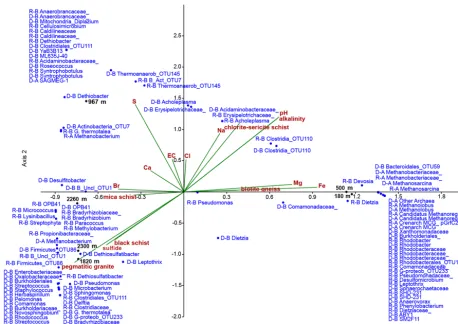
α-diversity estimates fordsrBandmcrAdata sets were calcu-lated in Mothur from subsamples of 115 and 1712 sequences, respectively. Due to the low number ofdsrBsequences (47) retrieved from the 180 m fracture, these data were not sub-sampled. The bacterial and archaeal OTUs with resolved tax-onomy were compared to the hydrogeochemical data as well as to the lithology of each fracture zone. Canonical corre-spondence analysis was performed with Past3 to the envi-ronmental metadata and taxonomical OTU matrix with all ar-chaeal OTUs and bacterial OTUs with more than 0.1 % abun-dance in the fracture communities (Hammer et al., 2001).
2.8 Prediction of functionality and co-occurrence analysis
De novo OTUs were removed from the 16S rRNA OTU tax-onomy file (.biom-table) prior to uploading to the Galaxy pipeline for PICRUSt analysis (Goecks et al., 2010; Blanken-berg et al., 2010; Giardine et al., 2005; Langille et al., 2013). PICRUSt compares 16S rRNA marker gene data to reference genomes and provides a prediction of the metagenome of a sample. Data in the biom file was normalized with the 16S rRNA gene copy number. Prediction of the functionality of the metagenome of each sample was done by multiplying the normalized abundance of each OTU by each predicted functional feature abundance. A weighted nearest sequenced taxon index (NSTI) was calculated for all samples. The NSTI value describes the average branch length that separates each OTU in the sample from a reference genome, weighted by the abundance of that OTU in the sample. For example, the NSTI value of 0.03 means that the OTUs in the sample are on average 97 % similar to the genomes in the database.
[image:5.612.328.527.65.155.2]Co-occurrence of OTUs in total and active microbial com-munities of Outokumpu bedrock fractures was analysed with the otu.association command in Mothur. Based on pairwise Pearson correlations with significantpvalue (< 0.01), visual-ization of the co-occurrence network was constructed using Fruchtermann–Feingold layout in the Gephi program (Bas-tian et al., 2009). The possible “keystone” OTUs were re-vealed with the betweenness centrality calculation and the connectivity of the network with the closeness centrality es-timate (Brandes, 2001). Modular structure of the community was evaluated with the modularity index calculation (Blondel et al., 2008; Lambiotte et al., 2009).
Figure 1.Total number of microbial cells in Outokumpu fracture fluids.
3 Results
3.1 Microbial density in the fracture zones
The total microbial cell numbers were highest in the 180 m fracture (2.97×10⁵) and declined according to the depth (Fig. 1; Table 2). A similar trend was observed with the copy numbers of the bacterial 16S rRNA gene ranging from 5.13×10⁶ in shallowest fracture to 9.00×10²in the deep-est fracture. Archaeal 16S rRNA gene copy numbers var-ied more, but the highest number of archaeal 16S rRNA gene copies was detected from the fracture at 180 m depth (6.24×10³; Table 2).
The number of dsrB andmcrA gene copies, used as an estimate for the amount of sulfate-reducing bacteria and methane-producing archaea, respectively, was assessed with quantitative PCR. The copy numbers were quantified also from RNA in order to estimate the activity of sulfate reduc-tion and methanogenesis. ThedsrBcopy numbers varied be-tween 3 and 6×10²copies mL−1in most fractures, with the exceptions of the 500 and 967 m fractures, where thedsrB copy number was 7.4×10³ and 1.5×101copies mL−1, re-spectively (Supplement Table S1). As a proxy of active tran-scription of dsrB genes, the number of mRNA transcripts was also quantified. The highestdsrBgene transcription was observed at 1820 m, where the number of dsrB transcripts was more than 6.0×10²transcripts mL−1. All other frac-tures had below 1.0×10²transcripts mL−1. Methanogene-sis marker gene copies were detected only from the upper three fractures (180, 500 and 967 m). ThemcrA gene copy numbers were just above the detection limit of the assay, i.e. less than 4.0×101copies mL−1in all.McrAgene transcripts were detected only from the 967 m fracture, where the copy number was just above 1.0×10²mL−1.
3.2 The structure of the microbial communities and correlation to geochemistry
nu-Table 2.The total number of cells and the 16S rRNA gene copy numbers of microbial communities in six fractures of Outokumpu. Values are given in mL−1.
Fracture depth Total cell amount Bacterial 16S rRNA gene Archaeal 16S rRNA gene
(m) cell number SEM1 copy number SEM1 copy number SEM1
180 2.97E+05 6.25E+04 5.13E+06 1.49E+05 6.24E+03 1.25E+00 500 5.72E+04 3.04E+03 1.88E+06 2.99E+05 8.62E+01 1.23E+00 967 1.00E+04 8.91E+02 1.26E+05 2.15E+04 4.90E+02 1.24E+00
1820 4.74E+03 1.17E+03 9.05E+02 2.29E+01 b.d. n.a.
2260 1.51E+03 3.52E+02 9.01E+02 3.72E+01 2.32E+01 1.07E+00
2300 6.30E+03 1.89E+03 9.00E+02 2.07E+01 b.d. n.a.
[image:6.612.104.492.97.198.2]1SEM: standard error of mean; b.d.: below detection limit; n.a.: not available.
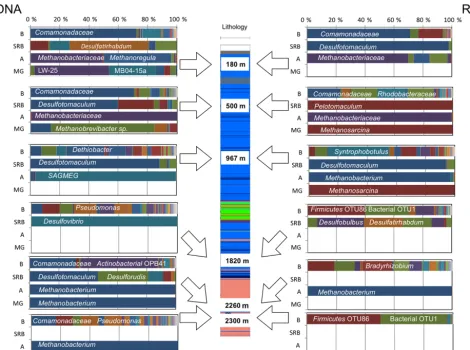
Figure 2.Microbial community structure at six different fractures in Outokumpu Precambrian crystalline bedrock. In the centre is a schematic presentation of the Outokumpu Deep Drill hole lithology (blue mica schist, green ophiolitic rocks, pink pegmatitic granite) with arrows pointing to the depths of the fractures studied. The composition of the total communities on the left and the active communities on the right side. The taxonomic classification of only the most abundant OTUs is shown. B: bacteria; SRB: sulfate-reducing bacteria; A: archaea; MG: methanogens.
cleic acid fractions as well as the sampling depth (Fig. 2). Pyrosequencing of the total and active bacterial communities based on the 16S rRNA gene resulted to 268 identified OTUs representing a total of 157 families in six fractures analysed
[image:6.612.63.534.233.583.2]communities were overall less diverse than the bacterial com-munities. Archaeal sequences (16S rRNA gene) were re-trieved from all fractures except the one at 1820 m. Only 17 different OTUs could be divided into 11 families (Table S3). Total methanogen communities were detected from 180, 500, 2260 and 2300 m fractures and active methanogen communi-ties from 500 and 967 m fractures.
Primers used in the archaeal nested PCR are reported to have frequent mismatch rate to some archaeal groups, such as SAGMEG (South-African Gold Mine Miscellaneous Euryarchaeal Group), leading to underestimation of these groups in the community structure (Teske and Sørenson, 2008; Wang and Qian, 2009). Using the Ribosomal Database Project’s probe match platform, we detected that although the overall coverage of the used archaeal primers in this study ranged from 33 to 31 % (first and second PCR, respec-tively), the coverage of the primers for phylumThermococci, to which SAGMEG archaea belong, was much higher, 81– 91 %.
3.2.1 The 180 m fracture
The bacterial communities in the upmost fracture zone anal-ysed in this study were dominated by OTUs resembling Co-mamonadaceae(Fig. 2). Thisβ-proteobacterial family con-stituted over 70 % of the OTUs in total and active commu-nities in the 180 m fracture (Table S2). The estimated rich-ness of the community was 69 % of the observed OTUs of the 180 m bacterial communities (Table S4a). Desulfatirhab-dum(54 % relative abundance) andDesulfotomaculum(98 % relative abundance) were most abundant in total and active sulfate-reducing communities, respectively (Fig. 2). The ar-chaeal community in the fracture zone at 180 m was dom-inated by OTUs affiliated with Methanobacteriaceae and Methanoregula, while Methanosarcina and methylotrophic Methanolobus OTUs represented minor groups (Table S3). This depth hosted the most diverse archaeal communities (the Shannon diversity index H’ 2.4 and 2.1 for total and active archaeal communities, respectively; Table S4b). Sim-ilarly, the methanogen community was the most diverse at this fracture, and the dominant groups were similar to un-classified, uncultured methanogen sequences retrieved from wetland soil (LW-25) and acidic peat bog (MB04-15a).
3.2.2 The 500 m fracture
The total bacterial community in the 500 m fracture was dominated by Comamonadaceae (70 %; Fig. 2, Table S2). The dominant OTUs in active bacterial community affil-iated with α-proteobacterial order Rhodobacterales with 38 % relative abundance; otherwise, this community com-prised OTUs affiliating withComamonadaceae(23 %), Di-etzia (23 %) and Pseudomonas (6 %). The number of ob-served OTUs captured 77–86 % richness of the commu-nities according to the Chao1 estimate at this depth
(Ta-ble S4a).Desulfotomaculum andPelotomaculum-affiliating OTUs were the most dominant sulfate reducers in this fracture (Fig. 2). The total and active archaeal communi-ties comprised almost solely of methanogenic Methanobac-teriaceae, while Methanobrevibacter and Methanosarcina dominated the communities detected with the methanogen-specific marker gene (mcrA; Fig. 2).
3.2.3 The 967 m fracture
The total bacterial community in 967 m fracture zone com-prised ofNatrananaerobiales,Clostridialesand other Firmi-cutesin addition to the mollicuteAcholeplasma. In the active bacterial community, peptococcal Syntrophobotulus domi-nated and otherwise the community resembled the total com-munity (Fig. 2). The observed richness was 84 or 88 % of the estimated richness of the total and active communities, re-spectively (Table S4a). Based on the Shannon diversity index H’ (2.3) the total archaeal community in the 967 m fracture was among the most diverse of the archaeal communities. It was dominated by OTUs affiliating with SAGMEG-1 Eu-ryarchaeota. In the active archaeal community in this frac-tureMethanobacteriaceaedominated and SAGMEG OTUs represented only a minority of the OTUs. Methanosarcina dominated the active methanogen community in the 967 m fracture (Fig. 2).
3.2.4 The 1820 m fracture
The number of observed bacterial OTUs was among the highest in both total and active bacterial communities in the fracture zone at 1820 m. Pseudomonadales (29 % relative abundance),Burkholderiales(22 %) withComamonadaceae andOxalobacteraceae, andClostridiales (13 %) comprised mainly ofDethiosulfatibacterand otherFirmicuteswith un-resolved phylogeny dominated the total community in this fracture zone. In the active community, OTU 86 belonging to Firmicutes was dominant, with 39 % relative abundance (Fig. 2). The sequenced communities at this depth were es-timated to have captured in average 80 % of the richness of the total communities (Table S4a). The total SRB commu-nity in this fracture was entirely composed ofDesulfovibrio -affiliating OTU. The estimated diversity was low because only 115 sequences were retained. On the other hand, the active SRB community was diverse, with OTUs affiliating withDesulfatirhabdum,DesulfobulbusandDesulfoarculus. Amplification of archaeal and methanogen communities was not successful from this fracture, indicating low abundance of these groups.
3.2.5 The 2260 m fracture
ob-served OTUs of the whole data set and best success in cap-turing the richness (91 %) of the community. OTUs belong-ing to α-proteobacterial Bradyrhizobium (20 %) and Rick-ettsiales (11 %) in addition toFirmicutes and Actinobacte-ria dominated this active community.Desulfotomaculumand Desulforudis-affiliating OTUs dominated the total SRB com-munity at this fracture and Methanobacterium dominated both archaeal and methanogen communities (Fig. 2). 3.2.6 The 2300 m fracture
The most frequent OTUs in the bacterial communities in the fracture zone at 2300 m representedBurkholderiales (31 % of the OTUs) andPseudomonadales(25 %) such as Moraxel-laceae andPseudomonadaceae. In addition, OTUs belong-ing to other Firmicutes,Clostridiales,Actinomycetalesand Natranaerobiales were detected (Fig. 2). The sequenced DNA community covered 86 % of the estimated richness. The active community of this fracture mainly composed of unclassifiable OTUs: only 4 % of the community could be determined to more specifically than to phylum level, while half of the community could be determined only to phylum level (Firmicutes), leaving the rest of the community, 46 %, unresolved. This also reflected the richness and coverage in-dicator values: only 51 % of the richness was captured and the coverage was barely half (51 %) of the total abundance of the community.
Sulfate reducers were not detected at this depth, and Methanobacterium dominated the total archaeal and methanogen communities.
3.2.7 The core microbial community in Outokumpu bedrock fractures
Only a few OTUs that were present in all communities con-stituted the core community in the Outokumpu deep bedrock. Pseudomonas and Dethiosulfatibacter in addition to two OTUs with uncertain taxonomic classification (Firmicutes OTU 86 and bacterial OTU1) were detected in all total and active bacterial communities. When observing only the total bacterial communities, most abundant members of the core community wereComamonadaceae,Dethiobacterand Pseu-domonas.
3.2.8 The relationship of the microbial community structure to geochemistry
Microbial OTUs formed three loose clusters in canonical cor-respondence analysis based on the depth where fracture fluid samples were retrieved (Fig. 3). A cluster of bacterial OTUs belonging to orders Burkholderiales and Rhodobacterales plotted near 180 and 500 m depths and correlated with bi-otite gneiss and concentration of its major elemental compo-nents – iron and magnesium. Microbial OTUs affiliating with the most abundant groups in the 967 m fracture ( Peptococ-caceae,Anaerobrancaceae,Thermoanaerobacterales,
SAG-MEG archaea) grouped loosely around the 967 m depth, with sulfur concentration pointing to this ordination. The depths of 1820 and 2300 m correlated with sulfide concentration and defining rock types were black schist and pegmatitic granite. ClostridialDethiosulfatibacterand otherFirmicutes -affiliating OTUs in addition to several Burkholderiales -affiliating OTUs clustered close to these depths.
3.3 The functionality estimation of the microbial communities
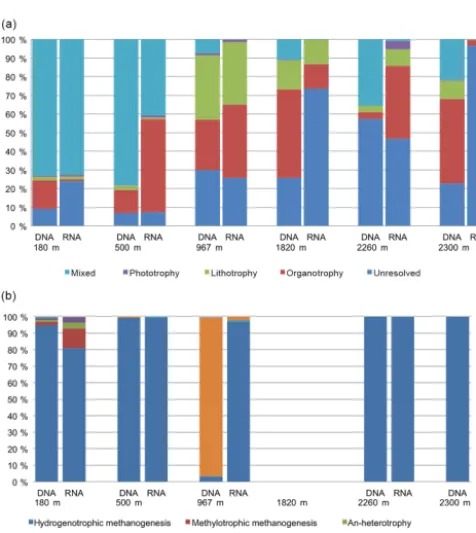
The physiology of the members of the microbial commu-nities was estimated from classified OTUs based on the prevalent physiology of the cultured representatives of each OTU at family level according to the Prokaryotes handbook (Dworkin et al., 2006; Fig. 4). Bacterial physiotypes with capacity to use versatile metabolic pathways for carbon as-similation and energy production were characteristic in the fracture communities at shallower depths (180 and 500 m), while lithotrophic bacterial physiotypes are more frequently detected in 967 and 1820 m fractures. Overall, physiotypes with unknown metabolism became more frequent in the com-munities at fractures located deeper in the bedrock due to the lack of exact taxonomic classification of the OTUs detected in these fractures (Fig. 4a). In the archaeal communities the most dominant archaeal physiotype was hydrogenotrophic methanogenesis, except in the 967 m fracture (Fig. 4b). The total archaeal community in this fracture was dominated by SAGMEG – affiliating OTUs with undetermined physiology.
3.3.1 Predicted bacterial metagenomes
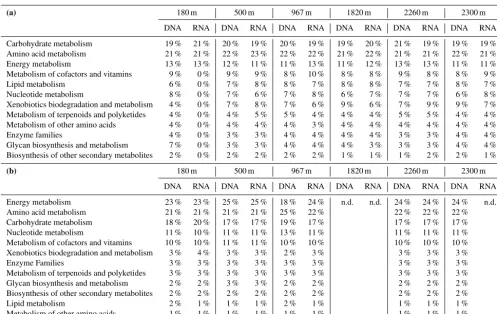
The metagenomes of the microbial communities of differ-ent fracture zones represdiffer-enting six differdiffer-ent biotopes were predicted from the 16S rRNA gene sequences, i.e. from the different OTUs with resolved taxonomy. In order to evaluate the accuracy of the prediction of metagenomes, nearest se-quenced taxon index (NSTI) was calculated for each sample (Table S5). The NSTIs varied between the bacterial commu-nities, from 0.07 (the communities in the 1820 and 2300 m fractures) to 0.30 (the community in the 2260 m fracture). The archaeal communities represented NSTIs from 0.04 to 0.07, with the exception of the total community in 967 m fracture, of which the NSTI was 0.29. Overall, the predicted metagenomes of the total communities did not vary greatly from the active community metagenomes. Top-level func-tionality estimates revealed differences between bacterial and archaeal communities. The average values for cellular pro-cesses and environmental information processing were more abundant in the predicted bacterial metagenomes than in the archaeal metagenomes. In contrast, genetic information pro-cessing and unknown features were more abundant in the predicted archaeal metagenomes (Fig. 5).
Figure 3.Canonical correspondence plot of the microbial OTUs (blue, with letters before the OTU name denoting the origin and the domain, i.e. D: derived from DNA; R: derived from RNA; B: bacteria; A: archaea), depths (black) and the geochemical parameters (red). The horizontal axis explains the 35 % of the variance of the data with statistical significance (p< 0.01), while the vertical axis explains 27 % of the variance of the data (p=0.11).
acid metabolism (21–22 % of all metabolism genes), carbo-hydrate metabolism (19–21 %) and energy metabolism (11– 13 % of all genes involved in metabolism; Table 3a). The predicted bacterial metagenomes differed mostly between 180 m and other fractures. In all fractures, the most abun-dant amino acid metabolism genes were amino acid-related enzymes and arginine and proline metabolism genes (11– 15 and 11–13 %, respectively; Table S6a). Gene predictions on carbohydrate utilization revealed a highly similar pattern in all other fracture communities than those at 180 m (Ta-ble S6a). Amino sugar metabolism genes were more abun-dant in the 180 m, while in other fractures propanoate and butanoate metabolism genes were dominant. The most abun-dant energy metabolism genes were involved in oxidative phosphorylation in the predicted metagenomes of the bac-terial communities (22–26 % in total bacbac-terial communities, and 20–28 % in active communities; Table S6a). Genes in-volved in carbon fixation pathways in prokaryotes were al-most as common, in addition to methane metabolism genes.
3.3.2 Predicted archaeal metagenomes
Table 3.The most abundant metabolism-related(a)bacterial and(b)archaeal genes in the predicted metagenomes.
(a) 180 m 500 m 967 m 1820 m 2260 m 2300 m
DNA RNA DNA RNA DNA RNA DNA RNA DNA RNA DNA RNA
Carbohydrate metabolism 19 % 21 % 20 % 19 % 20 % 19 % 19 % 20 % 21 % 19 % 19 % 19 %
Amino acid metabolism 21 % 21 % 22 % 23 % 22 % 22 % 21 % 22 % 21 % 21 % 22 % 21 %
Energy metabolism 13 % 13 % 12 % 11 % 11 % 13 % 11 % 12 % 13 % 13 % 11 % 11 %
Metabolism of cofactors and vitamins 9 % 0 % 9 % 9 % 8 % 10 % 8 % 8 % 9 % 8 % 8 % 9 %
Lipid metabolism 6 % 0 % 7 % 8 % 8 % 7 % 8 % 8 % 7 % 7 % 8 % 7 %
Nucleotide metabolism 8 % 0 % 7 % 6 % 7 % 8 % 6 % 7 % 7 % 7 % 6 % 8 %
Xenobiotics biodegradation and metabolism 4 % 0 % 7 % 8 % 7 % 6 % 9 % 6 % 7 % 9 % 9 % 7 %
Metabolism of terpenoids and polyketides 4 % 0 % 4 % 5 % 5 % 4 % 4 % 4 % 5 % 5 % 4 % 4 %
Metabolism of other amino acids 4 % 0 % 4 % 4 % 4 % 3 % 4 % 4 % 4 % 4 % 4 % 4 %
Enzyme families 4 % 0 % 3 % 3 % 4 % 4 % 4 % 4 % 3 % 3 % 4 % 4 %
Glycan biosynthesis and metabolism 7 % 0 % 3 % 3 % 4 % 4 % 4 % 3 % 3 % 3 % 4 % 4 %
Biosynthesis of other secondary metabolites 2 % 0 % 2 % 2 % 2 % 2 % 1 % 1 % 1 % 2 % 2 % 1 %
(b) 180 m 500 m 967 m 1820 m 2260 m 2300 m
DNA RNA DNA RNA DNA RNA DNA RNA DNA RNA DNA RNA
Energy metabolism 23 % 23 % 25 % 25 % 18 % 24 % n.d. n.d. 24 % 24 % 24 % n.d.
Amino acid metabolism 21 % 21 % 21 % 21 % 25 % 22 % 22 % 22 % 22 %
Carbohydrate metabolism 18 % 20 % 17 % 17 % 19 % 17 % 17 % 17 % 17 %
Nucleotide metabolism 11 % 10 % 11 % 11 % 13 % 11 % 11 % 11 % 11 %
Metabolism of cofactors and vitamins 10 % 10 % 11 % 11 % 10 % 10 % 10 % 10 % 10 %
Xenobiotics biodegradation and metabolism 3 % 4 % 3 % 3 % 2 % 3 % 3 % 3 % 3 %
Enzyme Families 3 % 3 % 3 % 3 % 3 % 3 % 3 % 3 % 3 %
Metabolism of terpenoids and polyketides 3 % 3 % 3 % 3 % 3 % 3 % 3 % 3 % 3 %
Glycan biosynthesis and metabolism 2 % 2 % 3 % 3 % 2 % 2 % 2 % 2 % 2 %
Biosynthesis of other secondary metabolites 2 % 2 % 2 % 2 % 2 % 2 % 2 % 2 % 2 %
Lipid metabolism 2 % 1 % 1 % 1 % 2 % 1 % 1 % 1 % 1 %
Metabolism of other amino acids 1 % 1 % 1 % 1 % 1 % 1 % 1 % 1 % 1 %
n.d.: not detected
Table 4.The “keystone genera” of the total microbial communities in Outokumpu fractures.
Keystone OTUs Closeness Betweenness Degree Family Relative
centrality centrality abundance1
OtherBurkholderiaceae 2.0 394 41 Burkholderiaceae 1 %
Desulfitobacter 2.4 302 4 Peptococcaceae 6 %
OtherClostridiaceae 1.7 302 20 Clostridiaceae 2 %
Dethiobacter 2.4 302 26 Anaerobrancaceae 25 %
Herbaspirillum 1.8 248 48 Oxalobacteraceae 6 %
Pelomonas 1.8 218 41 Comamonadaceae 72 %
Novosphingobium 1.1 162 46 Sphingomonadaceae 2 %
Comamonas 1.8 151 29 Comamonadaceae 72 %
Average 1.4 21 25
1Highest relative abundance in the family level in the community.
3.4 Co-occurrence of microbial OTUs in deep crystalline bedrock
From all detected microbial OTUs in deep crystalline frac-tures, only 15 % showed positive correlation (r> 0.8) with other members of the microbial communities. Only three sig-nificantly negative correlations (p ≤0.01,r> 0.8) were de-tected among the total microbial communities and none in
[image:10.612.111.486.440.580.2]Table 5.The “keystone genera” of the active microbial communities in Outokumpu fractures.
Keystone OTUs Closeness Betweenness Degree Family Relative centrality centrality abundance1
Curvibacter 1.8 797 41 Comamonadaceae 71 %
Comamonas 1.8 476 4 Comamonadaceae 71 %
Sphingomonas 1.7 474 20 Sphingomonadaceae 0.1 %
BacilliOTU87 1.1 294 26 Bacilli2 1 %
Flavobacterium 1.8 276 48 Flavobacteriaceae < 0.1 %
Williamsia 1.1 256 41 Williamsiaceae < 0.1 %
Staphylococcus 2.5 189 46 Staphylococcaceae 1 %
Oxalobacteraceae 1.8 172 29 Oxalobacteraceae 0.3 %
Herbaspirillum 1.9 155 57 Oxalobacteraceae 0.3 %
Average 1.3 21 37
1Highest relative abundance in the family level in the community.2Only identified to class level.
Figure 4.Binned(a)bacterial and(b)archaeal physiotypes accord-ing to the predominant metabolism of OTUs in the family level.
(BC) value, and these belonged to the Burkholderiaceae -like OTU,Desulfitobacterand theClostridiaceae-affiliating OTU, all of which had relatively low abundance (0–3 %) in the communities, in addition to Dethiobacter, with 0–5 % relative abundance in other total bacterial communities ex-cept in the 967 m fracture, in which the relative abundance of this OTU in the total bacterial community was higher, 25 % (Figs. 2a and 6). The most connected OTUs in the network belonged to RhodococcusandHerbaspirillum (48 connections each) in addition to OTUs resembling
Reni-bacterium,Gemellaceae,TrabulsiellaandNovosphingobium (46–47 connections each). The positively correlating OTUs of the active microbial community divided into 8 clusters with number of nodes ranging from 2 to 64 (Fig. 7). The ac-tive community network also had small variation in the CC values (variance 0.3). The “keystone” genera of the active microbial community network wereComamonas, Curvibac-ter and Sphingomonas, with BC values above 470 each. Comamonadaceae-affiliating OTU was determined to be part of the core community in this Fennoscandian deep subsur-face site, as it was frequently found in all depths with rel-atively high abundance ranging from 7 to 72 % of the to-tal community. Curvibacter and Sphingomonas were both present in the active communities, but with a very low rel-ative abundance.
4 Discussion
The bacterial community structure in the groundwater of Outokumpu fracture zones varies between the different depths. In addition, the structure of the total and active com-munities differs within the fracture zones. The core bacte-rial community of deep crystalline bedrock fracture fluids in Outokumpu was composed of few OTUs found in all micro-bial communities in the fractures. Most abundant of these were Comamonadaceae-, Firmicutes-, Anaerobrancaceae -andPseudomonadaceae-affiliating OTUs. However, the ma-jority of the bacterial OTUs discovered in this study could be regarded as members of the so-called “rare biosphere” with their relatively low abundance and uneven distribution throughout the fracture zones (Sogin et al., 2006).
[image:11.612.48.286.277.543.2]“key-Figure 5. The average predicted functionality of all(a)bacterial and(b)archaeal metagenomes reconstructed from 16S rRNA gene sequences.
stone species”. The most connected nodes of both the active and the total microbial community were representatives of Burkholderiales (e.g.Comamonas,Curvibacter, Oxalobac-ter, Herbaspirillum, Pelomonas, Cupriavidus), thus repre-senting the possible “keystone species” of deep bedrock frac-ture fluid communities in Outokumpu. In addition, some clostridial phylotypes were among the highly connected nodes. Several of these “keystone” genera detected with the co-occurrence networks were members of the rare biosphere, thus providing further evidence for the significance of the less abundant microorganisms for the whole community (So-gin et al., 2006; Brown et al., 2009). Hence, we propose that these have a major role in the functionality of the network. The species belonging toBurkholderialesare most likely in-volved in hydrogen oxidation in the deep subsurface and thus
are the potential primary producers in this oligotrophic en-vironment. Clostridial species, on the other hand, could be occupying the niche for heterotrophic carbon assimilation, possibly providing H2 produced in fermentation processes. Burkholderialesand clostridial species have been found in other serpentinite-hosted deep subsurface aquifers (Brazel-ton et al., 2012; Tiago et al., 2013). These studies have sug-gested thatBurkholderialesand clostridial species play a sig-nificant role in carbon and energy exchange between one an-other and an-other bacterial groups in these environments. The metabolic flexibility ofBurkholderialesspecies, for example the ability to use both autotrophic and heterotrophic carbon fixation mechanisms is beneficial in isolated deep biosphere environments where concentrations of different carbon sub-strates fluctuate over time (Moser et al., 2005; Magnabosco et al., 2016).
One of the most connected nodes in active microbial com-munity was Staphylococcus. We assume that this can be explained by contamination. Staphylococci are common in the human body, and while the number of sequences affil-iating with Staphylococcus was low, they were discovered in all samples. However, we cannot ascertain the physiol-ogy of an OTU from its taxonomic affiliation and these Staphylococcus-like OTUs might be true members of the deep biosphere.
4.1 Serpentinization as a source for energy in Outokumpu
[image:12.612.90.239.64.469.2]Figure 6. The co-occurrence network of the total(a)and active
(b)microbial community in Outokumpu bedrock. The size of each node corresponds to the betweenness of centrality value of the OTU. The modules are represented by different colours.
may affect the two shallowest fracture fluids and explain the similarity of the microbial results with other ophiolitic, ser-pentinizing environments.
The bacterial community of the 967 m fracture zone also resembles those of serpentinizing environments. One ma-jor member of the total bacterial community at the 967 m
fracture was hydrogen-oxidizingDethiobacterthat has previ-ously also been detected from groundwaters associated with ophiolitic rock sequence with active serpentinization pro-cesses (Tiago and Veríssimo, 2013). Brazelton et al. (2013) detected the acetyl-CoA synthase gene affiliating with De-thiobacter from bacterial shotgun-sequenced metagenomes from bacterial Winter House Canyon (WHCB) samples from Tablelands Ophiolite. Moreover, similarities between serpen-tinizing environments and the deep biosphere of Outokumpu bedrock include the detection of abundant clostridial phylo-types such asAnaerobrancaceae from the deeper parts of the bedrock (Itävaara et al., 2011; Brazelton et al., 2013; Purkamo et al., 2013; Nyyssönen et al., 2014). The “key-stone species” of the total and active microbial communi-ties detected in this study reflect the similarity between the serpentinizing environments and Outokumpu deep biosphere with Comamonadaceae, Burkholderiaceae, Clostridiaceae andDethiobacteras the recognized “keystone” families.
Overall, the spatial distribution ofBurkholderialesat shal-lower depths andClostridialesin the fractures located deeper in the bedrock can be explained to some level with the avail-ability of electron acceptors. Both of these groups are able to use H2 as an electron donor, but Comamonadaceae are mainly aerobic chemoorganotrophs using a vide variety of different organic carbon compounds for energy and using oxygen as a terminal electron acceptor (Willems et al., 1991), while Dethiobacteris a strict anaerobe that reduces sulfur compounds but not sulfate (Sorokin et al., 2008). However, as their co-occurrence in the 1820 m fracture suggests, these or-ganisms can prevail in the same environment. In Outokumpu, low concentrations of oxygen were measured during the pumping of the fracture fluids (< 0.1 mg L−1) (Purkamo et al., 2013). While oxygen can be introduced into water due to the atmospheric contamination, small amounts of oxygen can be produced in radiolysis of water in bedrock (Pedersen, 1997; Lin et al., 2005). This might explain the detection of aerobic bacteria such asComamonadaceaein the deep fluids of Outokumpu.
drilling operation; thus, a small fraction of this peat material may be present still at this depth.
The fractures located below 2 km depth, mostly domi-nated by unclassifiable phylotypes, might suggest that these depths harbour life that differs considerably from the cur-rently known microorganisms.
4.1.1 Comparison of the microbial community structure and functionality between different Precambrian deep subsurface sites
Bacterial and archaeal communities from the Outokumpu fracture zones resemble the drill hole water communities de-scribed in a previous study (Nyyssönen et al., 2014). This is not surprising, as drill hole fluids are a mixture of the differ-ent fracture fluids emanating to the drill hole from the frac-tures at different depths of the bedrock. Comamonadaceae form a major part of the bacterial community at most depths in the drill hole, as they are abundant in 180, 500, 2260 and 2300 m fracture communities. At 967 and 1820 m frac-ture communities, phylotypes affiliating with Clostridiales are dominant, while clostridial phylotypes represent a ma-jor fraction of the drill hole communities at 1000–1500 m. Many sulfate reducer phylotypes detected in this study were similar to those detected from the drill hole fluids (Itävaara et al., 2011; Purkamo et al., 2015) and from fracture zones (Purkamo et al., 2013) with DGGE. These included Desul-fotomaculum and Desulfovibrio. Archaeal communities in the fractures and in the drill hole are mainly dominated by Methanobacterium, but SAGMEG archaea are also abundant in the drill hole communities at 1000 m and above (Nyyssö-nen et al., 2014), possibly originating from the 967 m frac-ture, where SAGMEG archaea were dominant in the total ar-chaeal community.
Members of Comamonadaceae and Pseudomonadaceae belong to the core microbial community in Outokumpu. These were also detected from all studied microbial commu-nities in another Fennoscandian crystalline bedrock environ-ment in Olkiluoto fracture zones (Bomberg et al., 2015a). To emphasize the importance of these microbes to the total com-munities in deep crystalline bedrock environments, members ofComamonadaceaewere recognized as the “keystone gen-era” of the active microbial community in the Outokumpu deep biosphere.
The microbial communities in Outokumpu deep crys-talline bedrock share common features with those in the deep ecosystems in Witwatersrand Basin, South Africa. Clones af-filiating with Comamonadaceaehave been found in a deep drill hole outlet in Driefontein gold mine in South Africa. In addition, clostridial sulfate reducers, such as Desulfotomacu-lum, are dominant in the SRB communities in Outokumpu as well as the deep borehole communities in Driefontein (Baker et al., 2003; Moser et al., 2003, 2005; Silver et al., 2010). Candidatus Desulforudis audaxviator was a minor compo-nent (with 1–35 % relative abundance) of the SRB
communi-ties in Outokumpu fractures at depths of 180–2260 m, in con-trast to a microbial community whereD. audaxviatorformed a single-species ecosystem in deep bedrock fracture in Mpo-neng mine (Chivian et al., 2008).
The detection of a SAGMEG-dominated archaeal commu-nity in the 967 m fracture reinforces the results from previous study of Outokumpu deep fracture zone microbial communi-ties (Purkamo et al., 2013). These archaea were first discov-ered in gold mines in South Africa (Takai et al., 2001) and re-cently named as Hadesarchaea (Baker et al., 2016). The first clues about the carbon metabolism of these archaea came from a study of deeply buried ocean sediment, where SAG-MEG archaea were part of the mainly heterotrophic archaeal community (Biddle et al., 2006). A recent study of four ge-nomic bins of Hadesarchaea revealed the metabolic diver-sity of this new archaeal lineage. Although they share sev-eral characteristics with other Euryarchaeota, they lack the marker genes for methanogenesis (Baker et al., 2016). Cor-respondingly, the predicted metagenome of the total archaeal community at 967 m with 94 % of Hadesarchaea in our study demonstrated significantly lower number of methane metabolism genes than the other fracture fluid communities. The most probable energy-harvesting method for these ar-chaea is thought to be the oxidation of carbon monoxide cou-pled with H2O reduction (Baker et al., 2016). Thus, we as-sume that, in Outokumpu subsurface, these archaea may fill the niche of carbon monoxide utilizers and produce H2 for hydrogenotrophic part of the microbial community.
Furthermore, this study supports the biogeographical trend that methanogens in different deep Precambrian sites are similarly distributed within depth (Kietäväinen and Purkamo, 2015). Methanogens with wider substrate range were found in the fractures located at shallower depths both in Outokumpu and several deep subsurface sites in South Africa. On the other hand, obligately hydrogenotrophic methanogens were detected in the fracture zones located deeper (Moser et al., 2005; Gihring et al., 2006; Lin et al., 2006). Archaeal communities represented much less di-versity, and, interestingly, while almost all fracture zones were dominated by methanogenic archaea, the archaeal frac-ture community in the 180 m fracfrac-ture was the most diverse, where, for example, archaea belonging to Miscellaneous Crenarchaeal Group (MCG) and Terrestrial Miscellaneous Euryarchaeal Group (TMEG) were detected. In Olkiluoto, the highest archaeal species richness was detected from a fracture at a depth of 296 m (Bomberg et al., 2015a). In an-other study of archaeal communities in Olkiluoto, some indi-cation of correlation between increasing depth and decreas-ing diversity could be detected (Bomberg et al., 2015b). Low archaeal diversity may be due to the coverage of the primer pairs that were used in the nested PCR approach as well as the two-step PCR itself.
anaerobic respiration for energy conservation. Hence, de-pending on the available sources of energy and carbon, these organisms can switch to the best energy mechanism currently available. With the low relative abundance of the genes involved in autotrophic carbon fixation pathways in the predicted metagenomes, we propose that, in Out-okumpu, heterotrophic carbon metabolism is also as im-portant for the intrinsic fracture zone communities as it is for the drill hole water column communities (Purkamo et al., 2015). Archaeal communities in Outokumpu fracture zones are mainly methanogenic, most likely using the hy-drogenotrophic methanogenesis pathway from CO2to CH4.
5 Conclusions
The microbial communities of Outokumpu Precam-brian crystalline bedrock fractures share features with serpenization-driven microbial communities in alkaline springs and subsurface aquifers. These include members belonging to Burkholderiales and Clostridia. Additionally, these phylotypes were regarded as the “keystone species” in the Outokumpu deep biosphere. Additionally, Coma-monadaceae are part of the core microbial community in Fennoscandian crystalline bedrock environments. Sulfate-reducing microbes and methanogens are present, but they represent marginal groups of the microbial communities. The dominant taxa of the sulfate-reducing communities observed in this study are similar to the ones detected from the deep subsurface of Driefontein mine in South Africa. Similarly, the total archaeal community at 967 m fracture is dominated by SAGMEG archaea, initially described at deep gold mines of South Africa. Otherwise, hydrogenotrophic methanogens, mainly Methanobacterium, dominate the archaeal communities. The fracture zone at 180 m in Outokumpu hosts the most diverse archaeal communities. Many probable “keystone species” of the Outokumpu deep biosphere belong to the rare biosphere, with low abundance but a wide range of carbon substrates and a capacity for H2 oxidation. Metagenomic predictions of the bacterial communities revealed that heterotrophy is also important in the deep fracture zones in Outokumpu.
The Supplement related to this article is available online at doi:10.5194/bg-13-3091-2016-supplement.
Author contributions. Lotta Purkamo planned and conducted the
research, analysed the data and is the corresponding author. Ma-lin Bomberg aided in planning, sampMa-ling, analysis of the data and writing the manuscript. Riikka Kietäväinen took part in sampling, provided hydrogeochemistry data and participated in writing the manuscript. Heikki Salavirta assisted in analysing the data and ing the manuscript. Mari Nyyssönen took part in sampling and
writ-ing the manuscript. Maija Nuppunen-Puputti assisted in samplwrit-ing and aided in laboratory research. Lasse Ahonen assisted in plan-ning and executing the sampling and hydrogeochemistry analysis and writing the manuscript. Ilmo Kukkonen provided access to Out-okumpu Deep Drill Hole, supported sampling, assisted in writing the manuscript and provided funding. Merja Itävaara took part in sampling and writing the manuscript and provided funding.
Acknowledgements. Mirva Pyrhönen is acknowledged for
excel-lent laboratory skills and help in preparing the sampling trips. Arto Pullinen, Leea Ojala, Pauliina Rajala and Sirpa Jylhä are acknowledged for the professional sampling assistance at the Out-okumpu field site. This study was funded by Kone Foundation, the Academy of Finland (DEEP LIFE project, grant no. 133348/2009), the Foundation for Research of Finnish Natural Resources (grant no. 1718/09) and the Finnish research programme on nuclear waste management (KYT, grants GEOMOL, KABIO, SALAMI and RENGAS).
Edited by: A. Ito
References
Ahonen, L., Kietäväinen, R., Kortelainen, N., Kukkonen, I. T., Pullinen, A., Toppi, T., Bomberg, M., Itävaara, M., Nousiainen, A., Nyyssönen, M., and Öster, M.: Hydrogeological characteris-tics of the Outokumpu Deep Drill Hole, edited by: Kukkonen, I. T., Geological Survey of Finland, Special Paper, 51, 151–168, 2011.
Altschul, S. F., Gish, W., Miller, W., Myers, E. W., and Lipman, D. J.: Basic local alignment search tool, J. Mol. Biol., 215, 403–410, 1990.
Amend, J. P. and Teske, A.: Expanding frontiers in deep subsurface microbiology, Palaeogeogr. Palaeocl., 219, 131–155, 2005. Baker, B. J., Moser, D. P., MacGregor, B. J., Fishbain, S., Wagner,
M., Fry, N. K., Jackson, B., Speolstra, N., Loos, S., and Takai, K.: Related assemblages of sulphate-reducing bacteria associ-ated with ultradeep gold mines of South Africa and deep basalt aquifers of Washington State, Environ. Microbiol., 5, 267–277, 2003.
Baker, B. J., Saw, J. H., Lind, A. E., Lazar C. S., Hinrichs, K.-U., Teske, A. P., and Ettema, T. J. G.: Genomic inference of the metabolism of cosmopolitan subsurface Archaea, Hadesarchaea, Nat. Microbiol., 16002, doi:10.1038/nmicrobiol.2016.2, 2016. Bano, N., Ruffin, S., Ransom, B., and Hollibaugh, J. T.:
Phylo-genetic composition of Arctic Ocean archaeal assemblages and comparison with Antarctic assemblages, Appl. Environ. Micro-biol., 70, 781–789, 2004.
Barberan, A., Bates, S., T., Casamayor, E., O., and Fierer, N.: Using network analysis to explore co-occurrence patterns in soil micro-bial communities, ISME J., 6, 343–351, 2012.
Bastian, M., Heymann, S., and Jacomy, M.: Gephi: an open source software for exploring and manipulating networks, ICWSM, 8, 361–362, 2009.
Biddle, J. F., Lipp, J. S., Lever, M. A, Lloyd, K. G., Sørensen, K. B., Anderson, R., Fredricks, H. F., Elvert, M., Kelly, T. J., Schrag, D. P., Sogin, M. L., Brenchley, J. E., Teske, A., House, C. H., and Hinrichs, K.-U.: Heterotrophic Archaea dominate sedimen-tary subsurface ecosystems off Peru, P. Natl. Acad. Sci. USA, 10, 3846–3851, 2006.
Biddle, J. F., Fitz-Gibbon, S., Schuster, S. C., Brenchley, J. E., and House, C. H.: Metagenomic signatures of the Peru Margin sub-seafloor biosphere show a genetically distinct environment, P. Natl. Acad. Sci. USA, 105, 10583–10588, 2008.
Biddle, J. F., White, J. R., Teske, A. P., and House, C. H.: Metagenomics of the subsurface Brazos-Trinity Basin (IODP site 1320): comparison with other sediment and pyrosequenced metagenomes, ISME J., 5, 1038–1047, 2011.
Blankenberg, D., Von Kuster, G., Coraor, N., Ananda, G., Lazarus, R., Mangan, M., Nekrutenko, A., and Taylor, J.: Galaxy: a web-based genome analysis tool for exper-imentalists, Curr. Protoc. Mol. Biol., 19, 19.10.1–19.10.21, doi:10.1002/0471142727.mb1910s89, 2010.
Blondel, V. D., Guillaume, J.-L., Lambiotte, R., and Lefebvre, E.: Fast unfolding of communities in large networks, Journal of Sta-tistical Mechanics: Theory and Experiment, 2008.
Bomberg, M., Nyyssönen, M., Nousiainen, A., Hultman, J., Paulin, L., Auvinen, P., and Itävaara, M.: Evaluation of Molecular Tech-niques in Characterization of Deep Terrestrial Biosphere, Open Journal of Ecology, 4, 468–487, 2014.
Bomberg, M., Nyyssönen, M., Pitkänen, P., Lehtinen, A., and Itävaara, M.: Active Microbial Communities Inhabit Sulphate-Methane Interphase in Deep Bedrock Fracture Fluids in Olkilu-oto, Finland, BioMed Research International, 2015a.
Bomberg, M., Lamminmäki, T., and Itävaara, M.: Estimation of microbial metabolism and co-occurrence patterns in fracture groundwaters of deep crystalline bedrock at Olkiluoto, Finland, Biogeosciences Discuss., 12, 13819–13857, doi:10.5194/bgd-12-13819-2015, 2015b.
Brandes, U.: A Faster Algorithm for Betweenness Centrality, J. Math. Sociol., 25, 163–177, 2001.
Brazelton, W. J., Nelson, B., and Schrenk, M. O.: Metagenomic evidence for H2oxidation and H2production by serpentinite-hosted subsurface microbial communities, Front. Microbiol., 2, 268, doi:10.3389/fmicb.2011.00268, 2012.
Brazelton, W. J., Morrill, P. L., Szponar, N., and Schrenk, M. O.: Bacterial communities associated with subsurface geochemical processes in continental serpentinite springs, Appl. Environ. Mi-crobiol., 79, 3906–3916, doi:10.1128/AEM.00330-13, 2013. Brown, M. V., Philip, G. K., Bunge, J. A., Smith, M. C., Bissett,
A., Lauro, F. M., Fuhrman, J. A., and Donachie, S. P.: Micro-bial community structure in the North Pacific ocean, ISME J. 3, 1374–1386, doi:10.1038/ismej.2009.86, 2009.
Caporaso, J. G., Kuczynski, J., Stombaugh, J., Bittinger, K., Bush-man, F. D., Costello, E. K., Fierer, N., Pena, A. G., Goodrich, J. K., and Gordon, J. I.: QIIME allows analysis of high-throughput community sequencing data, Nat. Methods, 7, 335–336, 2010. Chivian, D., Brodie, E. L., Alm, E. J., Culley, D. E., Dehal, P. S.,
DeSantis, T. Z., Gihring, T. M., Lapidus, A., Lin, L. H., Lowry, S. R., Moser, D. P., Richardson, P. M., Southam, G., Wanger,
G., Pratt, L. M., Andersen, G. L., Hazen, T. C., Brockman, F. J., Arkin, A. P., and Onstott, T. C.: Environmental genomics reveals a single-species ecosystem deep within Earth, Science, 322, 275– 278, doi:10.1126/science.1155495, 2008.
Dworkin, E., Falkow, S., Rosenberg, E., Schleifer, K.-H., Stacke-brandt, E. (Eds.): The Prokaryotes, A Handbook on the Biology of Bacteria, Springer, New York, NY, USA, 2006.
Edwars, U., Rogall, T., Blocker, H., Emde, M., and Bottger, E. C.: Isolation and direct complete nucleotide determination of en-tire genes. Characterization of a gene coding for 16S ribosomal RNA, Nucleic Acids Res., 17, 7843–7853, 1989.
Etiope, G. and Sherwood Lollar, B.: Abiotic methane on Earth, Rev. Geophys., 51, 276–299, 2013.
Fish, J. A., Chai, B., Wang, Q., Sun, Y., Brown, C. T., Tiedje, J. M., and Cole, J. R.: FunGene: the Functional Gene Pipeline and Repository, Front. Microbiol., 4, 291, doi:10.3389/fmicb.2013.00291, 2013.
Geets, J., Borremans, B., Diels, L., Springael, D., Vangronsveld, J., van der Lelie, D., and Vanbroekhoven, K.:DsrB gene-based DGGE for community and diversity surveys of sulfate-reducing bacteria, J. Microbiol. Methods, 66, 194–205, 2006.
Giardine, B., Riemer, C., Hardison, R. C., Burhans, R., Elnitski, L., Shah, P., Zhang, Y., Blankenberg, D., Albert, I., Taylor, J., Miller, W., Kent, W. J., and Nekrutenko, A.: Galaxy: a platform for in-teractive large-scale genome analysis, Genome Res., 15, 1451– 1455, 2005.
Gihring, T., Moser, D., Lin, L. H., Davidson, M., Onstott, T., Mor-gan, L., Milleson, M., Kieft, T., Trimarco, E., and Balkwill, D.: The distribution of microbial taxa in the subsurface water of the Kalahari Shield, South Africa, Geomicrobiol. J., 23, 415–430, 2006.
Goecks, J., Nekrutenko, A., Taylor, J., and The Galaxy Team: Galaxy: a comprehensive approach for supporting accessible, re-producible, and transparent computational research in the life sciences, Genome Biol., 11, R86, doi:10.1186/gb-2010-11-8-r86, 2010.
Gold, T.: The deep, hot biosphere, P. Natl. Acad. Sci. USA, 89, 6045–6049, 1992.
Grosskopf, R., Janssen, P. H., and Liesack, W.: Diversity and struc-ture of the methanogenic community in anoxic rice paddy soil microcosms as examined by cultivation and direct 16S rRNA gene sequence retrieval, Appl. Environ. Microbiol., 64, 960–969, 1998.
Hales, B. A., Edwards, C., Ritchie, D. A., Hall, G., Pickup, R. W., and Saunders, J. R.: Isolation and identification of methanogen-specific DNA from blanket bog peat by PCR amplification and sequence analysis, Appl. Environ. Microbiol., 62, 668–675, 1996.
Hallbeck, L. and Pedersen, K.: Characterization of microbial pro-cesses in deep aquifers of the Fennoscandian Shield, Appl. Geochem., 23, 1796–1819, 2008.
Hallbeck, L. and Pedersen, K.: Culture-dependent comparison of microbial diversity in deep granitic groundwater from two sites considered for a Swedish final repository of spent nuclear fuel, FEMS Microbiol. Ecol., 81, 66–77, 2012.
Itävaara, M., Nyyssönen, M., Kapanen, A., Nousiainen, A., Aho-nen, L., and KukkoAho-nen, I.: Characterization of bacterial diver-sity to a depth of 1500 m in the Outokumpu deep borehole, Fennoscandian Shield, FEMS Microbiol. Ecol., 77, 295–309, 2011.
Kietäväinen, R. and Purkamo, L.: The origin, source and cycling of methane in deep crystalline rock biosphere, Front. Microbiol., 6, 725, doi:10.3389/fmicb.2015.00725, 2015.
Kietäväinen, R., Ahonen, L., Kukkonen, I. T., Hendriksson, N., Nyyssönen, M., and Itävaara, M.: Characterisation and isotopic evolution of saline waters of the Outokumpu Deep Drill Hole, Finland–Implications for water origin and deep terrestrial bio-sphere, Appl. Geochem., 32, 37–51, 2013.
Kukkonen, I. T., Rath, V., Kivekäs, L., Šafanda, J., and ˇCermák, V.: Geothermal studies of the Outokumpu deep drill hole, Out-okumpu Deep Drilling Project 2003–2010, edited by: Kukkonen, I. T., Geological Survey of Finland, Special Paper, 51, 181–198, 2011.
Lambiotte, R., Delvenne, J.-C., and Barahona, M.: Laplacian Dy-namics and Multiscale Modular Structure, Networks, 2009. Langille, M. G., Zaneveld, J., Caporaso, J. G., McDonald, D.,
Knights, D., Reyes, J. A., Clemente, J. C., Burkepile, D. E., Thurber, R. L. V., and Knight, R.: Predictive functional profil-ing of microbial communities usprofil-ing 16S rRNA marker gene se-quences, Nat. Biotechnol., 31, 814–821, 2013.
Lau, M. C., Cameron, C., Magnabosco, C., Brown, C. T., Schilkey, F., Grim, S., Hendrickson, S., Pullin, M., Lollar, B. S., and van Heerden, E.: Phylogeny and phylogeography of functional genes shared among seven terrestrial subsurface metagenomes reveal N-cycling and microbial evolutionary relationships, Front. Mi-crobiol., 5, 531, doi:10.3389/fmicb.2014.00531, 2014.
Lin, L., Hall, J., Lippmann-Pipke, J., Ward, J. A., Sherwood Lollar, B., DeFlaun, M., Rothmel, R., Moser, D., Gihring, T. M., and Mislowack, B.: Radiolytic H2in continental crust: nuclear power for deep subsurface microbial communities, Geochem. Geophys. Geosyst., 6, Q07003, doi:10.1029/2004GC000907, 2005. Lin, L., Hall, J., Onstott, T., Gihring, T., Lollar, B. S., Boice, E.,
Pratt, L., Lippmann-Pipke, J., and Bellamy, R. E.: Planktonic mi-crobial communities associated with fracture-derived groundwa-ter in a deep gold mine of South Africa, Geomicrobiol. J., 23, 475–497, 2006.
Lupatini, M., Suleiman, A. K., Jacques, R. J., Antoniolli, Z. I., de Siqueira Ferreira, A., Kuramae, E. E., and Roesch, L. F.: Network topology reveals high connectance levels and few key microbial genera within soils, Front. Environ. Sci., 2, 10, doi:10.3389/fenvs.2014.00010, 2014.
Magnabosco, C., Ryan, K., Lau, M. C., Kuloyo, O., Sherwood Lol-lar, B., Kieft, T. L., van Heerden, E., and Onstott, T.: A metage-nomic window into carbon metabolism at 3 km depth in Precam-brian continental crust, ISME J., 10, 730–741, 2016.
McCollom, T. M.: Laboratory simulations of abiotic hydrocarbon formation in Earth’s deep subsurface, Rev. Mineral. Geochem., 75, 467–494, doi:10.2138/rmg.2013.75.15, 2013.
McCollom, T. M., Lollar, B. S., Lacrampe-Couloume, G., and See-wald, J. S.: The influence of carbon source on abiotic organic synthesis and carbon isotope fractionation under hydrothermal conditions, Geochim. Cosmochim. Ac., 74, 2717–2740, 2010.
McMahon, S. and Parnell, J.: Weighing the deep continental bio-sphere, FEMS Microbiol. Ecol., 87, 113–120, doi:10.1111/1574-6941.12196, 2014.
Moser, D., Onstott, T., Fredrickson, J., Brockman, F., Balkwill, D., Drake, G., Pfiffner, S., White, D., Takai, K., and Pratt, L.: Tempo-ral shifts in microbial community structure and geochemistry of an ultradeep South African gold mine borehole, Geomicrobiol. J., 20, 517–548, 2003.
Moser, D. P., Gihring, T. M., Brockman, F. J., Fredrickson, J. K., Balkwill, D. L., Dollhopf, M. E., Lollar, B. S., Pratt, L. M., Boice, E., Southam, G., Wanger, G., Baker, B. J., Pfiffner, S. M., Lin, L. H., and Onstott, T. C.: Desulfotomaculum and Methanobacterium spp. dominate a 4- to 5-kilometer-deep fault, Appl. Environ. Microbiol., 71, 8773–8783, 2005.
Mu, A., Boreham, C., Leong, H. X., Haese, R. R., and Moreau, J. W.: Changes in the deep subsurface microbial biosphere result-ing from a field-scale CO2geosequestration experiment, Front. Microbiol., 5, 209, doi:10.3389/fmicb.2014.00209, 2014. Muyzer, G., de Waal, E. C., and Uitterlinden, A. G.: Profiling
of complex microbial populations by denaturing gradient gel electrophoresis analysis of polymerase chain reaction-amplified genes coding for 16S rRNA, Appl. Environ. Microbiol., 59, 695– 700, 1993.
Nealson, K., H., Inagaki, F., and Takai, K.: Hydrogen-driven subsur-face lithoautotrophic microbial ecosystems (SLiMEs): do they exist and why should we care?, Trends Microbiol., 13, 405–410, doi:10.1016/j.tim.2005.07.010, 2005.
Nyyssönen, M., Bomberg, M., Kapanen, A., Nousiainen, A., Pitkä-nen, P., and Itävaara, M.: Methanogenic and sulphate-reducing microbial communities in deep groundwater of crystalline rock fractures in Olkiluoto, Finland, Geomicrobiol. J., 29, 863–878, 2012.
Nyyssönen, M., Hultman, J., Ahonen, L., Kukkonen, I., Paulin, L., Laine, P., Itävaara, M., and Auvinen, P.: Taxonomically and functionally diverse microbial communities in deep crys-talline rocks of the Fennoscandian shield, ISME J., 8, 126–138, doi:10.1038/ismej.2013.125, 2014.
Osburn, M. R., LaRowe, D. E., Momper, L. M., and Amend, J. P.: Chemolithotrophy in the continental deep subsurface: Sanford Underground Research Facility (SURF), USA, Front. Microbiol., 5, 610, doi:10.3389/fmicb.2014.00610, 2014.
Paine, R. T.: A Conversation on Refining the Concept of Keystone Species, Conserv. Biol., 9, 962–964, 1995.
Pedersen, K.: Microbial life in deep granitic rock, FEMS Microbiol. Rev., 20, 399–414, 1997.
Pedersen, K.: Exploration of deep intraterrestrial microbial life: cur-rent perspectives, FEMS Microbiol. Lett., 185, 9–16, 2000. Pedersen, K.: Investigations of subterranean bacteria in deep
crys-talline bedrock and their importance for the disposal of nuclear waste, Can. J. Microbiol., 42, 382–391, 1996.
Pedersen, K., Arlinger, J., Eriksson, S., Hallbeck, A., Hallbeck, L., and Johansson, J.: Numbers, biomass and cultivable diversity of microbial populations relate to depth and borehole-specific con-ditions in groundwater from depths of 4–450 m in Olkiluoto, Fin-land, ISME J., 2, 760–775, 2008.
Proskurowski, G., Lilley, M. D., Seewald, J. S., Fruh-Green, G. L., Olson, E. J., Lupton, J. E., Sylva, S. P., and Kelley, D. S.: Abio-genic hydrocarbon production at lost city hydrothermal field, Sci-ence, 319, 604–607, doi:10.1126/science.1151194, 2008. Purkamo, L., Bomberg, M., Nyyssönen, M., Kukkonen, I., Ahonen,
L., Kietäväinen, R., and Itävaara, M.: Dissecting the deep bio-sphere: retrieving authentic microbial communities from packer-isolated deep crystalline bedrock fracture zones, FEMS Micro-biol. Ecol., 85, 324–337, 2013.
Purkamo, L., Bomberg, M., Nyyssönen, M., Kukkonen, I., Ahonen, L., and Itävaara, M.: Heterotrophic Communities Supplied by Ancient Organic Carbon Predominate in Deep Fennoscandian Bedrock Fluids, Microb. Ecol., 69, 319–332, doi:10.1007/s00248-014-0490-6, 2015.
Quince, C., Lanzén, A., Curtis, T. P., Davenport, R. J., Hall, N., Head, I. M., Read, L. F., and Sloan, W. T.: Accurate determina-tion of microbial diversity from 454 pyrosequencing data, Nat. Methods, 6, 639–641, 2009.
Schloss, P. D., Westcott, S. L., Ryabin, T., Hall, J. R., Hartmann, M., Hollister, E. B., Lesniewski, R. A., Oakley, B. B., Parks, D. H., and Robinson, C. J.: Introducing mothur: open-source, platform-independent, community-supported software for describing and comparing microbial communities, Appl. Environ. Microbiol., 75, 7537–7541, 2009.
Schrenk, M. O., Brazelton, W. J., and Lang, S. Q.: Serpentiniza-tion, carbon, and deep life, Rev. Mineral. Geochem., 75, 575– 606, doi:10.2138/rmg.2013.75.18, 2013.
Silver, B., Onstott, T., Rose, G., Lin, L. H., Ralston, C., Sherwood-Lollar, B., Pfiffner, S., Kieft, T., and McCuddy, S.: In situ culti-vation of subsurface microorganisms in a deep mafic sill: impli-cations for SLiMEs, Geomicrobiol. J., 27, 329–348, 2010. Sogin, M. L., Morrison, H. G., Huber, J. A., Mark Welch, D., Huse,
S. M., Neal, P. R., Arrieta, J. M., and Herndl, G. J.: Microbial diversity in the deep sea and the underexplored “rare biosphere”, P. Natl. Acad. Sci. USA, 103, 12115–12120, 2006.
Sorokin, D. Y., Tourova, T. P., Mußmann, M., and Muyzer, G.: De-thiobacter alkaliphilus gen. nov. sp. nov., and Desulfurivibrio al-kaliphilus gen. nov. sp. nov.: two novel representatives of reduc-tive sulfur cycle from soda lakes, Extremophiles, 12, 431–439, 2008.
Stahl, D.: Development and application of nucleic acid probes, Nu-cleic acid techniques in bacterial systematics, 1991.
Steele, J. A., Countway, P. D., Xia, L., Vigil, P. D., Beman, J. M., Kim, D. Y., Chow, C. E., Sachdeva, R., Jones, A. C., Schwal-bach M. S., Rose, J. M., Hewson, I., Patel, A., Sun, F., Caron, D. A., and Fuhrman, J. A.: Marine bacterial, archaeal and protis-tan association networks reveal ecological linkages, ISME J., 9, 1414–1425, 2011.
Szponar, N., Brazelton, W. J., Schrenk, M. O., Bower, D. M., Steele, A., and Morrill, P. L.: Geochemistry of a continental site of ser-pentinization, the Tablelands Ophiolite, Gros Morne National Park: a Mars analogue, Icarus, 224, 286–296, 2013.
Teske, A. and Sørensen, K. B.: Uncultured archaea in deep marine subsurface sediments: have we caught them all?, ISME J., 2, 3– 18, 2008.
Tiago, I. and Veríssimo, A.: Microbial and functional diversity of a subterrestrial high pH groundwater associated to serpentiniza-tion, Environ. Microbiol., 15, 1687–1706, 2013.
Wang, Y. and Qian, P.-Y.: Conservative fragments in bacterial 16S rRNA genes and primer design for 16S ribosomal DNA amplicons in metagenomic studies, PLoS ONE, 4, e7401, doi:10.1371/journal.pone.0007401 , 2009.
Wagner, M., Roger, A. J., Flax, J. L., Brusseau, G. A., and Stahl, D. A.: Phylogeny of dissimilatory sulfite reductases supports an early origin of sulfate respiration, J. Bacteriol., 180, 2975–2982, 1998.
Whitman, W. B., Coleman, D. C., and Wiebe, W. J.: Prokary-otes: The unseen majority, P. Natl. Acad. Sci. USA, 95, 657– 6583,1998.
Willems, A., De Ley, J., Gillis, M., and Kersters, K.: Comamon-adaceae, a New Family Encompassing the Acidovorans rRNA Complex, Including Variovorax paradoxus gen. nov. comb. nov. for Alcaligenes paradoxus (Davis 1969), Int. J. Syst. Bact, 445– 450, 1991.