A study to assess the acceptability of adding Home
Parent Support along with the Incredible Years®
parent programme
Dianne G. Lees
, University of Auckland New Zealand
David M Fergusson
, University of Otago Christchurch New Zealand
Abstract
Objective. To assess the acceptability of adding Home Parent Support (HPS) for parents of children aged 3-7 years with high-risk factors for conduct disorder, while they attend the Incredible Years® Parent programme (IYP).
Methods. Data from 48 high-risk parents attending IYP and receiving additional HPS were analysed. Data included pre-test and post-test scores on the Eyberg Child Behavior Inventory and Child Social Competence Scale, and responses from HPS follow-up questionnaire.
Results. HPS was highly acceptable for families with 94% of eligible participants recruited and 91% of these completing IYP. Average attendance was 80% of sessions and 5 participants dropped out. Families made significant progress across treatment for child behaviour and social competence (p<0.000). Effect sizes were between 0.72 and 1.10. Families were very satisfied with HPS intervention and reported positive changes in parent-child relationships and family functioning.
Conclusions. The addition of HPS alongside IYP was highly acceptable as evidenced by good recruitment and retention, significant improvement in child behaviour and high levels of parent satisfaction. The extra support in the home helped the most vulnerable families to implement parenting strategies and remain engaged in IYP. However, any additional effectiveness of HPS over and above IYP cannot be concluded from this study. A prospective randomised control trial to evaluate the efficacy of HPS is required.
Keywords: Conduct problems, Early childhood, High-risk families, Home coaching, Incredible Years®, Parenting management.
There is an increase in the incidence and intensity of child conduct problems affecting 5-10% of children internationally (Boden, Fergusson, & Horwood, 2010; Church, 2003; Maughan, Rowe, Messer, Goodman, & Meltzer, 2004; Pilling, Gould, Whittington, Taylor, & Scott, 2013; Scott, 2007). Severe conduct and behavioural problems in young children are an important predictor of later chronic antisocial and criminal behaviour in adolescents (Blissett et al., 2009; Boden et al., 2010; Church, 2003; Fergusson, Boden, & Hayne, 2011) and are costly to individuals, families
and communities (Bonin, Stevens, Beecham, Byford, & Parsonage, 2011; Church, 2003; M. Cohen, 2005; Scott, Knapp, Henderson, & Maughan, 2001). It is therefore, essential that evidence-based interventions are introduced early in the life of the child and are targeted at children with identified risk factors for developing serious conduct problems.
The Incredible Years® parent management programme (IYP) is an evidence based parenting programme designed to address conduct problems in young children. International research on the efficacy of IYP consistently demonstrates positive outcomes in
terms of fewer child externalising behaviours, improvements in parent-child relationships, parent-child problem solving skills, emotional regulation, and parental confidence (Bywater et al., 2011; Kaminski, Valle, Filene, & Boyle, 2008; Webster-Stratton, 2000). The literature also demonstrates the effectiveness of IYP programmes in New Zealand (Berryman, Woller, & Glyn, 2009; Fergusson, Stanley, & Horwood, 2009; Lees & Ronan, 2008; Sturrock et al., 2013; Sturrock, Gray, Fergusson, Horwood, & Smits, 2014).
While evidence based parent management programmes have good outcomes for most families, not all families make the same improvement. Follow-up studies show that up to one third of families still experience clinically significant child behaviour problems post-treatment, and this was a predictor of adolescent engagement in delinquent acts (Reyno & McGrath, 2006; Webster-Stratton, Rinaldi, & Reid, 2011). Identifying families vulnerable for poorer response to IYP and providing them with additional in home support is expected to improve outcomes.
Having support in the home enables the therapist to personalise the parenting strategies for the particular needs of each family and to implement them effectively. Additionally, the therapist is able to observe participants in their homes and support them to address barriers preventing change such as; substance abuse, poor parental mental health, and domestic violence (Gomby, 2005). It is expected that combining an evidence based parent programme with a home visiting intervention would improve outcomes.
Incredible Years® Parent Programme in New Zealand.
The Child and Adolescent Mental Health Service in the Bay of Plenty District Health Board was the first hospital service in New Zealand to introduce IYP as a treatment pathway for parents of children with conduct problems. IYP was first delivered and evaluated in 2001, and results showed improvement in child behaviour and family functioning (Lees & Ronan, 2008) which reflected international outcomes (Jones, Daley, Hutchings, Bywater, & Eames, 2008; Kaminski et al., 2008; Webster-Stratton, 2000). In 2004 Auckland University sponsored the first training for Incredible Years® facilitators in New Zealand. Since then, there has been a rapid expansion of training and an increase in the number of agencies delivering Incredible Years® programmes in New Zealand (Anstiss, 2013).
The Incredible Years® Specialist Service.
In recent years Government departments in New Zealand have been concerned about the increasing incidence and severity of conduct problems in young people. An expert advisory group recommended an interagency response to intervene early in the life of the child with an evidence based programme, and to provide extra support for the most vulnerable families (Church et al., 2007). In response to this advice the Incredible Years® Specialist Service was established in the Bay of Plenty region as a pilot service. This was a collaborative intervention between the Ministry of Education and the Ministry of Health to address conduct/antisocial
behaviour and associated mental health problems in young children (Church et al., 2007). The aim was to enhance the effectiveness of IYP by providing additional support in the home for the most vulnerable families.
Against this background, this paper reports on a pilot study of 48 families who received HPS as an additional intervention while they attended IYP. The aim of this study was to review the acceptability of adding HPS in terms of: (i) recruitment and retention, (ii) improvement in child behaviour, and (iii) parent satisfaction with HPS.
Method
Treatment
HPS is a home visiting intervention to support the most needy families to effectively implement the Incredible Years® parenting strategies in their family while they attend the group based Incredible Years® programme. All families who met the criteria for HPS were invited to participate. Health professionals who were also accredited IYP facilitators made weekly visits to participants in their home to review IYP content, rehearse skills, and address barriers for implementation. After the initial assessment session each visit was approximately 60 minutes and began by checking in with the family to hear what was working well and any challenges they were experiencing. Time was spent reviewing goals from their IYP group, and reviewing the key parenting principles. Barriers to making change were identified and families were supported to address these as appropriate. It was hypothesised that HPS would be acceptable and improve outcomes in terms of child behaviour, family functioning and retention in IYP.
HPS Participants
Participants were parents/carers attending IYP delivered by the Ministry of Education or Ministry of Health, had children aged 3-7 years with serious behaviour problems, and had signed consent to participate.
Inclusion criteria for HPS.
Participants were eligible for HPS if they had any of the following:
o Eyberg Child Behavior Inventory Total Problem scale T>70
o Eyberg Child Behavior Inventory Intensity scale T>70
o Social Competence scale < 17 o One of the following risk factors:
- Child Youth and Family involvement
- School exclusion
- Diagnosis of parental mental health
Measurements
IYP facilitators visited participants in the two weeks prior to the IYP course commencement and administered base line measures using the Eyberg Child Behavior Inventory and Social Competence Scale.
Eyberg Child Behaviour Inventory (ECBI) (Eyberg & Pinus, 1999).
The ECBI is a parent rating scale that measures total problem (type and frequency of behavior problems), and intensity (degree to which parents find the behaviours problematic) of child behaviour. The recognised clinical cut off for the Eyberg scale scores is T>60. For this study a T score of T>70 on either scale was set as the criteria for HPS to ensure the most challenging children were identified.
Social Competence Scale - Parent Version (SCS) (Corrigan, 2002).
The SCS is a 12-item measure that assesses a child’s pro-social behaviors, communication skills, and self-control on a five point Likert scale. A total score <17 identified poor social skills and was set as the criteria for HPS.
Follow-up questionnaire.
This is a 12-item questionnaire administered to all participants to assess participants’ views on helpful aspects of HPS and changes in family functioning.
Statistical Analysis
study the last observed score is used for all subsequent observation points. The statistical significance of changes in mean scores from pre-treatment to post-treatment was calculated using t test, and the effect size was assessed using Cohen’s d.
Results
Participants
The average age of HPS participants was 38 years with a range from 20 years to 60+ years. The largest proportion (40%) was in the 30-39 year age range. Women represented 75% of participants, however, boys were over represented (82%) as the focus child. This is consistent with international and national data showing a greater incidence of conduct problems in boys than girls (Church et al., 2007). The average age of the focus child was 4 years 9 months. Four participants (7%) identified as Maori and eight (17%) children were Maori.
Recruitment
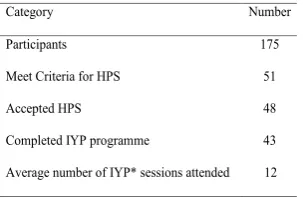
Table 1 shows recruitment for HPS. There were 12 IYP groups each of which received between 14-17 IYP sessions of two and a half-hours. The total number of participants in IYP was 175 and 51 (29%) met the criteria for HPS. HPS was offered to all those who meet the criteria and 48 (94% of those eligible) accepted. The main reason for not accepting additional support was due to the number of agencies already supporting these families.
Attendance and Retention
HPS attendance and retention in IYP is shown in Table 1. HPS participants had high levels of attendance with an
average attendance rate of 12 sessions (80% of sessions). High attendance was reflected in course completion with 43 (91%) participants completing the IYP programme. There were five participants who did not complete IYP due to family responsibilities, health and transport issues, and/or employment. HPS families participated in an average of 14 (range 12-15) home coaching sessions in addition to attending IYP. This suggests a high level of acceptability for HPS in addition to IYP.
Progress
Table 2 shows pre- and post-test mean scores on EBCI Problem and Intensity scales and the SCS for HPS participants. Participants made significant improvement across treatment on all scales. The EBCI Problem scale mean score improved to within the normal range at T=58.31 (p=0.00) at post-treatment. Improvement on the EBCI Intensity scale was also significant (p=0.000) but the post-treatment mean score remained in the clinical range at T=63.27. The SCS mean score improved significantly (p=0.000) to be in the normal range (17.73) at post-treatment. Cohen’s d for EBCI Problem Scale (d= 1.10) and SCS (d=1.09) indicated a large effect size. A medium effect size
was achieved for EBCI Intensity Scale (d=0.72) (J. Cohen, 1992).
Table 3 shows the number of participants with scores in the clinical range at pre- and post-treatment. At pre-treatment the number of participants with scores in the clinical range, ranged between 40 (83%) on the EBCI Intensity Scale, 41 (85%) on the ECBI Problem Scale and the largest proportion was on the Social Competence scale with 46 (95%) participants. Additionally there were 40 (83%) participants with scores in the clinical range on all three scales. At post-treatment the proportion in the clinical range decreased on all scales. However there were still 16 (33%) in the clinical range on all three scales. While most participants achieved post-treatment scores in the non-clinical range, not all participants were able to achieve this.
Satisfaction
HPS Evaluation Questionnaire.
[image:3.595.235.527.504.590.2]Responses showed 90% of participants found HPS helpful and reported positive improvements in their child’s behaviour, and in relationships within the family. Child behaviour improvements included less aggression, improved communication, and being more settled. Participants’ comments on
Table 1.
HPS Participant Recruitment and Retention
Category Number
Participants 175
Meet Criteria for HPS 51
Accepted HPS 48
Completed IYP programme 43
Average number of IYP* sessions attended 12
[image:3.595.58.210.591.690.2]*Total session range 14-17
Table 2.
Pre-Post-Test Mean Scores for HPS Participants
Pre-Test Post-Test
Scores N Mean (SD) Mean (SD) d p
ECBI Problem T Scores 48 69.46 (8.78) 58.31 (10.23) 1.10 0.000
ECBI Intensity T Score 48 69.60 (8.55) 63.27 (9.04 0.72 0.000
Social Competence 48 11.81 (4.74) 17.73 (6.08) 1.09 0.000
[image:3.595.238.505.645.763.2]
Note: Eyberg clinical range T>60. Social Competence Scale clinical range <17 Table 3.
HPS Participants with Scores in the Clinical Range at Pre-and Post-Intervention
Total Pre-Test Post-Test Scales N=48
n % n %
ECBI Problem T >60 41 85 16 33
ECBI Intensity T >60 40 83 10 20
Social Competence <17 46 95 18 37
ECBI Problem and ECBI Intensity and
Social Competence Scale
40 83 16 33
changes they noticed in themselves included “taking time to have fun”, “listening more”, “being calm myself”, and “having confidence to implement the strategies effectively”. Changes in parent behaviour indicated a greater understanding of child development and the importance of parents as role models for behaviour change. Five participants reported minimal or no change in child behaviour or in their own behaviour.
Discussion
This study shows that the addition of HPS was both acceptable and made a difference for most families with additional high risk factors. The high uptake and retention of HPS demonstrates that parents did not find the additional commitment to home visits onerous, but rather found it beneficial to have regular support, encouragement and coaching. Parents also achieved high course completion rates which is likely to result in better long-term outcomes as attendance at parent training programmes has been identified as a predictor of treatment outcomes, with poor attendance associated with poorer outcomes (Reyno & McGrath, 2006).
The HPS families in this study represent a sample of the most vulnerable families with high levels of behaviour problems. They represented 29% of the families attending IYP courses. These parents reported substantial improvement in their child’s behaviour that was similar to other outcome studies on efficacy of IYP (Fergusson et al., 2009; Jones et al., 2008; Sturrock et al., 2013; Webster-Stratton et al., 2011). For these families to match outcomes similar to other studies suggests the addition of HPS has benefits for high-risk families. However, there were still some participants with post-treatment scores in the clinical range. This is concerning, as post-treatment scores in the clinical range are an indication that children are more likely to engage in delinquent acts in adolescence and are a predictor of poorer long-term outcomes (Webster-Stratton et al., 2011). Further refinement of the intervention may improve effectiveness for more families.
Parents who received HPS were highly satisfied with the intervention and appreciated the regular encouragement
and support. Increasing parents understanding of behavioural principles and how they can support behaviour change helped parents reflect on their own behaviour and cognitions. This promoted more positive parent-child connections with fewer critical interactions. It is known that improving the parent-child relationship and reducing coercive interactions predicts better outcomes (Gardner, Hutchings, Bywater, & Whitaker, 2010; Webster-Stratton et al., 2011)..
In summary HPS was highly acceptable and was accompanied by good rates of retention and high parent satisfaction scores. There was evidence from both quantitative and qualitative measures that most of those receiving HPS experienced benefits that extended to the whole family. Improvement for HPS families is evident from this study, however it cannot be concluded that the additional support from HPS made the difference. The only definitive way to test this hypothesis is to carry out a prospective randomised controlled study. This is currently being carried out to test the additional benefit of adding HPS to IYP.
Limitations
There are a number of limitations to this study that need to be considered. Different people in various services collected the data. The timing of data collection and referral for HPS varied between group facilitators. There were no follow-up data to assess the maintenance of behaviour change. Some pre-course data were lost and these participants could not be included in the review resulting in a smaller sample size. The issues of retention were not always identified and addressed. Measures used were only parent report and thus vulnerable to reporting bias. Additional independent observations or reports would address this. The HPS intervention was exploratory and needs to be refined and standardised to ensure fidelity.
References
Anstiss, T. (2013). An overview of Incredible Years in New Zealand. from http://www. werrycentre.org.nz/506/An_overview_ of_Incredible_Years_in_NZ
Bagner, D., & Graziano, P. (2012). Barriers
to success in parent training young children with developmental delay: The
role of cummulative risk. Behavior
Modification, 37(3), 356-377. doi:
10.1177/0145445512465307
Berryman, M., Woller, P., & Glyn, T. (2009). The Incredible Years: Learning from the experience of Māori whanau and Māori staff in Special Education: Evaluation report prepared for Ministry of Education, Special Education. Tauranga, New Zealand Poutama Pounamu. Blissett, W., Church, J., Fergusson, D.,
Lambie, I., Langley, J., Liberty, K., . . .
Werry, J. (2009). Conduct problems:
Best practice report 2009. Wellington,
New Zealand: Ministry of Social Development.
Boden, J., Fergusson, D., & Horwood, L. (2010). Risk factors for conduct disorder and oppositional/ defiant disorder: evidence from a New Zealand birth
cohort. Journal of the American
Academy of Child and Adolescent
Psychiatry, 49, 1125-1133.
Bonin, E.-M., Stevens, M., Beecham, J., Byford, S., & Parsonage, M. (2011). Costs and longer-term savings of parenting programmes for the prevention of persistent conduct disorder: a modelling
study. BioMed Cental Public Health,
11(1), 803. doi:
10.1186/1471-2458-11-803
Bywater, T., Hutchings, J., Linck, P., Whitaker, C., Daley, D., Yeo, S., & Tudor Edwards, R. (2011). Incredible Years parent training support for foster carers in Wales: a multi-centre feasibility study.
Child: Care, Health and Development,
37(2), 233-243. doi:
10.1111/j.1365-2214.2010.01155.x
Church, J. (2003). The definition, diagnosis and treatment of children and youth with severe behaviour difficulties. Wellington, New Zealand: Ministry of Education. Church, J., Fergusson, D., Langley, J.,
Liberty, K., Poulton, R., Ronan, K., & Werry, J. (2007). The Inter-agency Plan for Conduct Disorder/Severe Antisocial Behaviour 2007 – 2012. Wellington, New Zealand: Ministry of Social Development. Cohen, J. (1992). A Power Primer.
Psychological Bulletin, 112(1),
155-159. doi: 10.1037/0033-2909.112.1.155
Cohen, M. (2005). The costs of crime and
justice. New York: Routledge.
Corrigan, A. (2002). Social Competence
Scale – Parent Version, Grade 1/Year
2. 2002 (Fast Track Project Technical
Eyberg, S., & Pinus, D. (1999). The Eyberg Child Behavior Inventory and Sutter-Eyberg Student Behavior Inventory:
Professional manual. Lutz, USA:
Psychological Assessment Resources. Fergusson, D., Boden, J., & Hayne, H. (
2011). Childhood conduct problems.
In P. Gluckman (Ed.), Improving the
transition: Reducing social and psychological morbidity during
adolescence (pp. 59-78). Wellington,
New Zealand: Office of the Prime Minister’s Science Advisory Committee. Fergusson, D., Stanley, L., & Horwood,
J. (2009). Preliminary data on the efficacy of the Incredible Years Basic Parent Programme in New Zealand. Australian and New Zealand Journal
of Psychiatry, 43(1), 76-79. doi:
10.1080/00048670802534382.
Gardner, F., Hutchings, J., Bywater, T., & Whitaker, C. (2010). Who benefits and how does It work? Moderators and mediators of outcome in an effectiveness
trial of a parenting intervention. Journal
of Clinical Child and Adolescent
Psychology, 39(4), 568-580. doi:
10.1080/15374416.2010.486315
Gomby, D. (2005). Home visitation in
2005: Outcomes for children and
parents. Washington, DC Committee
for Economic Development; 2005. Invest in Kids Working Paper No. 7 Retrieved from [http://legis.wisconsin.gov/lc/ committees/study/2008/SFAM08/files/ GombyHVoutcomes2005.pdf%5D. Jones, K., Daley, D., Hutchings, J., Bywater,
T., & Eames, C. (2008). Efficacy of the Incredible Years Programme as an early intervention for children with conduct problems and ADHD:
Long-term follow-up. Child: Care, Health
and Development, 34(3), 380-390. doi:
10.1111/j.1365-2214.2008.00817.x Kaminski, J., Valle, L., Filene, J., & Boyle,
C. (2008). A meta-analytic review of components associated with parent
training program effectiveness. Journal
of Abnormal Child Psychology,
36(4), 567-589. doi:
10.1007/s10802-007-9201-9
Lees, D., & Ronan, R. (2008). Engagement and effectiveness of parent management training (Incredible Years) for solo high-risk mothers. A multiple baseline
evaluation. Behaviour Change, 25(2),
109-128.
Maughan, B., Rowe, R., Messer, J., Goodman, R., & Meltzer, H. (2004). Conduct Disorder and Oppositional Defiant Disorder in a national sample:
developmental epidemiology Journal
of Child Psychology and Psychiatry,
45(3), 609-621.
Pilling, S., Gould, N., Whittington, C., Taylor, C., & Scott, S. (2013). Practice Guidelines Recognition, intervention, and management of antisocial behaviour and conduct disorders in children and young people: summary of
NICE-SCIE guidance. British Medical
Journal, 346:f1298. doi: 10.1136/bmj.
f1298(Published 27 March 2013) Reyno, S., & McGrath, P. (2006). Predictors
of parent training efficacy for child externalizing behavior problem-a
meta-analytic review. Journal of Child
Psychology and Psychiatry, 47,
99-111.
Scott, S. (2007). Conduct Disorders in
Children. British Medical Journal,
334(7595), 646.
Scott, S., Knapp, M., Henderson, J., & Maughan, B. (2001). Financial cost of social exclusion: follow up study of
antisocial children into adulthood British
Medical Journal, 323, 191-194.
Sturrock, F., Gray, D., Church, J., Fergusson, D., Horwood, J., Poulton, R., . . . McGovern, J. (2013). Incredible Years: Pilot Study: Evaluation report. Wellington: Ministry of Social Development.
Sturrock, F., Gray, D., Fergusson, D., Horwood, J., & Smits, C. (2014).
Incredible years: Follow up study:
Long-term follow-up of the New Zealand Incredible Years Pilot
Study Wellington New Zealand: Crown
copyright 2014 Retrieved from http:// www.msd.govt.nz/about-msd-and-our-work/publications-resources/evaluation/ incredible-years-follow-up-study/index. html.
Webster-Stratton, C. (2000). The Incredible
Years Training Series. Washington,DC:
United States Department of Justice, Office of Justice Programs, Office of Juvenile Justice and Delinquency Prevention.
Webster-Stratton, C., Rinaldi, J., & Reid, J. (2011). Long-term outcomes of Incredible Years Parenting Program: Predictors of adolescent adjustment.
Child andAdolescent Mental Health,
16(1), 38-46. doi:
10.1111/j.1475-3588.2010.00576.x
Corresponding Author
Dianne G Lees,
Child and Adolescent Mental Health Specialist Service,
Bay of Plenty District Health Board, Private Bag 12024,
Tauranga 3143. New Zealand.
Email: [email protected]. nz
Declaration of competing interests
The authors declare that they have no competing interests.
Acknowledgement
We would like to thank the New Zealand Ministry of Health for funding this pilot study.