Understanding Scientific Study via Process Modeling
Article Type: New Results
Robert W.P. Luk
Department of Computing, The Hong Kong Polytechnic University
Hong Kong
E-mail: [email protected]
Tel: +852 2766 5143
Fax: +852 2774 0842
Abstract
This paper argues that scientific studies distinguish themselves from other studies by a
combination of their processes, their (knowledge) elements and the roles of these
elements. This is supported by constructing a process model. An illustrative example
based on Newtonian mechanics shows how scientific knowledge is structured
according to the process model. To distinguish scientific studies from research and
scientific research, two additional process models are built for such processes. We
apply these process models: (1) to argue that scientific progress should emphasize
both the process of change and the content of change; (2) to chart the major stages of
scientific study development; and (3) to define “science”.
Keywords: Process Model; Methodology; Philosophy of Science; Knowledge
Management
Biography: Robert Luk received a B.Sc. degree, a Dip. Eng. and a Ph.D. degree from the
1. Introduction
“The misnaming of fields of study is so common as to lead to what might be general
systems laws. For example, Frank Harary once suggested the law that any field that
had the word ‘science’ in its name was guaranteed thereby not to be a science. He
would cite as examples Military Science, Library Science, Political Science,
Homemaking Science, Social Science, and Computer Science” (Weinberg, 2001). To
avoid misnaming of scientific fields making them explicit may help. In this paper,
they are regarded as studies that generate or apply scientific knowledge, but are they
the same or different from scientific research? This paper argues that:
Premise 1: Scientific studies, research and scientific research are
different processes that contain different interacting (knowledge)
elements.
We will argue later that the general types of scientific knowledge, called elements in
this paper, are theories, scientific models and experiments. Although these elements
may be regarded as components in General Systems Thinking (Weinberg, 2001), they
are regarded as entities in our process model which captures the essential knowledge
(as data) of the underlying scientific processes (e.g., hypothesis testing). In this sense,
our process models may be considered as entity-relationship (ER) diagrams
(Silberschatz et al., 2005) for physical realization and knowledge management use.
Nevertheless, Premise 1 uses the term ‘elements’ rather than entities in ER diagrams
for generality because such diagrams belongs to one type of conceptual tool in
General Systems Thinking.
Premise 1 is supported by construction, i.e., by building process models that define
and differentiate scientific studies, research and scientific research. These process
models put philosophical issues in their contexts rather than directly resolving these
issues. The premise can also help us to distinguish scientific studies and other types of
studies. However, for engineering studies that are closely related to scientific studies,
technical problems and science is about understanding (e.g., (Kosso, 2007)). Thus, we
draw the following conclusion from premise 1:
Conclusion 1: Scientific studies distinguish themselves from other
types of studies by their processes, their elements and the roles of
these elements.
This conclusion suggests that prior philosophical investigations about science, which
mainly focuses on either the scientific process or the knowledge elements of science,
are not sufficient to distinguish scientific studies from other types of studies. This
raises some questions about these prior philosophical investigations on science, i.e.:
(a) Is science solely concerned with scientific research?
(b) Does a scientific study have to have a hypothesis?
(c) Do scientists carry out their investigation using a single scientific method?
(d) Are paradigms (Kuhn, 1962) and the scientific method of the Vienna circle
applicable only to science?
Furthermore, these process models, themselves, pose more-basic questions about
recent philosophical investigations on science:
(e) Are theories and models approximately true (e.g., Weston, 1987)?
(f) Are all theories incommensurable (Kuhn, 1962)?
(g) Are all computational models complex versions of scientific models?
(h) How does a subject develop into a scientific study?
We argue that philosophy of science should neither just focus on the research
processes that are investigated in the conventional philosophy of science (e.g., Kuhn’s
paradigm and the Scientific Method of the Vienna Circle), nor just focus on the study
of scientific knowledge. To support this argument, we realized that simply relying on
the research process or the knowledge organization alone cannot differentiate
scientific studies from other studies. For examples about research processes, Kuhn’s
idea about paradigm shift is applicable to the history of the philosophy of science. The
scientific method is applicable to criminal investigation. Gauch’s (2003) PEL model
of scientific reasoning is applicable to law. For other examples about knowledge
organization, not only scientific knowledge is organized as theories with principles,
abundance of performance models. Philosophers have been using logic as a way to
organize their knowledge and making inferences. Some argued that science is about
understanding, but studies, by definition, seek to understand. Simply using the aim of
scientific studies is not sufficient to differentiate between scientific ones and studies
in other disciplines.
We argue that scientific studies are distinguished by the combination of their
processes, their way of organizing scientific knowledge and the roles that different
types of scientific knowledge serve. To support this argument, we develop process
models, more specifically data flow diagrams, in order to model scientific studies,
research and scientific research as separate processes. Because each process has
different knowledge elements, these processes are different. These different elements
are different types of knowledge, and each element has its own role in the process
model. The role of an element helps to distinguish itself from others, as well as
scientific processes and other processes.
The rest of this paper is organized as follows. Section 2 describes our process model
of scientific study. Physics is used as an archetype (rather than as a universal science
(Białkowski, 1998)) to illustrate the application of this process model. Section 3
develops the process model for research, and combines this model with the one for
scientific studies to form the process model for scientific research. Section 4 applies
the process models to explain scientific progress, whereas Section 5 applies these
models to chart a possible development of scientific study. Section 6 is about related
work. Finally, Section 7 draws our conclusion about what is science.
2. Process model
We argue that:
Definition 1: A scientific study has three (knowledge) elements:
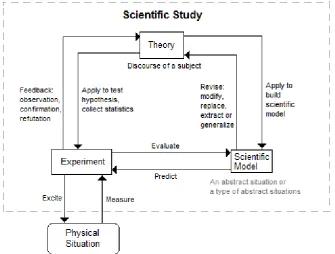
Figure 1: A process model of scientific study.
This is supported by providing evidence that these three (knowledge) elements are
important to science. For example, large sums of funding are used to build particle
accelerators in order to conduct experiments for particle physics research. Also, the
scientific model of nuclear fission behind nuclear power station is important to predict
the amount of energy released from certain amount of enriched uranium. The
scientific model of nuclear fission uses the famous equation, E = mc2, to calculate the
amount of energy released during fission. This equation is derived from the theory of
special relativity. Experiments (Franklin, 1981), scientific models (e.g., Swanson,
1967) and theories (e.g., Alexander, 1958) have also been extensively discussed in
philosophy of science. Therefore, they are important in both science and the
philosophy of science, but they are not integrated as elements in a process model as
described in this paper.
Our process model of scientific study is shown in Figure 1. It has entities (as
rectangles) and processes (as directed lines). It has four entities: the theory entity, the
model entity, the experiment entity and the physical situation entity. An entity is an
extension of a set of instances, and one instance of an entity is called an entity
instance (Silberschatz et al., 2005). For example, the theory entity can denote a single
hierarchy, for example) are hidden in the process model at this stage. Similar to
entities, a process can denote a single process instance or a set of process instances.
The physical situation entity is an external entity that is being studied and is not a part
of the scientific study. This is the only entity that is not a knowledge element in
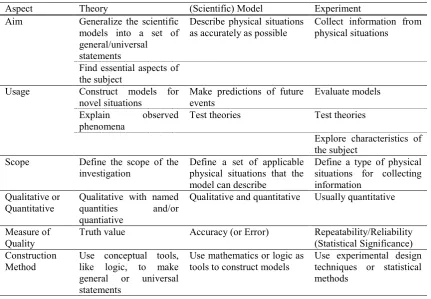
Figure 1. Table 1 shows some details about theories, models and experiments.
Table 1: A summary of various aspects of elements of science
Aspect Theory (Scientific) Model Experiment Aim Generalize the scientific
models into a set of general/universal statements
Describe physical situations as accurately as possible
Collect information from physical situations
Find essential aspects of the subject
Usage Construct models for novel situations
Make predictions of future events
Evaluate models
Explain observed phenomena
Test theories Test theories
Explore characteristics of the subject
Scope Define the scope of the investigation
Define a set of applicable physical situations that the model can describe
Define a type of physical situations for collecting information
Qualitative or Quantitative
Qualitative with named quantities and/or quantiative
Qualitative and quantitative Usually quantitative
Measure of Quality
Truth value Accuracy (or Error) Repeatability/Reliability (Statistical Significance) Construction
Method
Use conceptual tools, like logic, to make general or universal statements
Use mathematics or logic as tools to construct models
Use experimental design techniques or statistical methods
Details about the entities at this stage are deliberately hidden. The purpose is to
simplify the study so that we can identify what are the major elements of science and
how they interact. Scientists are not included in the model in Figure 1, because of
limited space, even though we recognize that scientists themselves are important
elements in the process of science. At this general level, it is customary not to model
the operators (i.e., scientists) in the process models. According to Figure 1, theories
and models can only get in touch with physical situations via experiments. Since an
entity and a process are sets, a theory entity instance that generalizes a set of scientific
model entity instances is represented only as a single process from theory to scientific
existence of the process (including its direction) between entities, leaving out its
details (e.g., one-to-one mapping, one-to-many mapping or many-to-many mapping).
Table 1 shows different aspects of different elements of scientific studies. The aims of
each element are specified in Table 1. These aims define the different roles that these
elements play. They help scientific studies to differentiate themselves from other
types of studies. The measures of quality of each element are different because the
aims of each element are different. The scope of an element specifies the regime in
which the element is applicable. The remaining aspects provide further differences
between different elements of scientific studies.
2.1. Instance Diagram
For more details in Figure 1, we can draw an instance diagram (Silberschatz et al.,
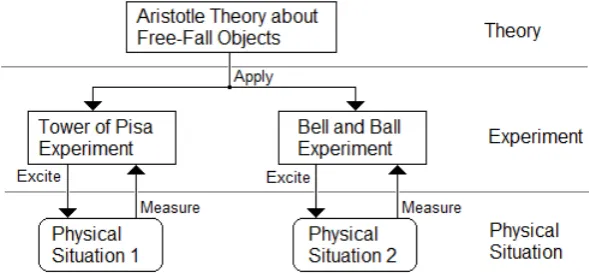
2005) that is a realization of the process model in Figure 1. For example, Galileo
carried out two well-known experiments that are called the Tower of Pisa experiment,
and the bell and ball experiment. These two experiments refute Aristotle’s theory that
the heavier object falls faster than a lighter object. Figure 2 shows a realization of the
process model of Figure 1 in this case. Figure 2 does not have any scientific models
because the experiments did not need complex calculations. These experiments only
need to measure the duration for the heavier and lighter objects to reach the floor, in
order to refute Aristotle’s theory.
Figure 2: An instance diagram of Galileo’s experiments.
For a more elaborate example than Galileo’s experiments, we chose Newtonian
mechanics, because it is well known and it is an archetype of a mature scientific study
of general relativity. In Newtonian mechanics, many experiments involve complex
quantitative relationships that are derived or constructed from the principles (or laws)
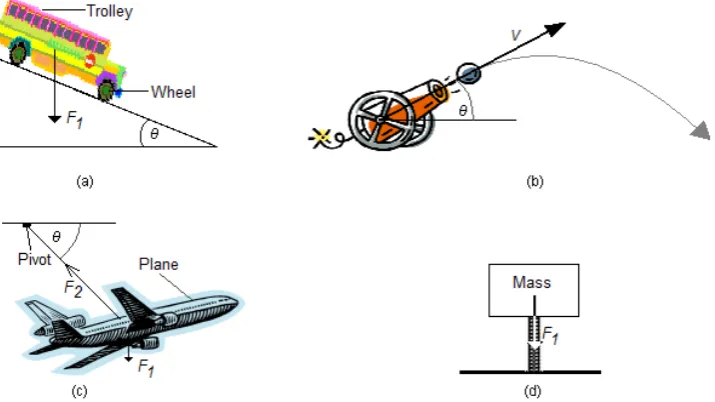
of the theory. For example, in Figure 3(a), a trolley is sliding down a slope with a
constant degree θ of inclination. Unlike the bell and ball experiment conducted by
Galileo, we are not simply interested in whether trolleys of different weights traveling
from the top to the bottom of the slope arrive at the same time. Instead, we are
interested in the quantitative relationship between θ and the time that the trolley
travels from the top to the bottom of the slope. If there is no friction, then
(
sin)
, (1) 21 2
t g
d = × θ ×
where d is the distance that the trolley travels in time t, and g is the acceleration due to
earth’s gravity. This equation is obtained by constructing a model as shown in Figure
3(a) using not only Newton’s three laws of motion but also Newton’s universal law of
gravitation. The same laws can be applied to the projectile experiment shown in
Figure 3(b). In this case, a canon fires a ball with θ degree of inclination. If the canon
ball is fired at the initial speed v, the quantitative relationship in this model will be
) 2 ( , sin cos 2 2
g v
dh = θ θ
where dh is the horizontal distance that the canon ball travelled.
Figure 3: Four models of physical situations where F1 is the gravitation force due to
the mass of the object. We call these models with the following names: (a) rolling
Figure 3(c) shows a model of a toy plane revolving around a pivot with constant
speed v at θ degree of declination. The tension on the string connecting the plane and
the pivot is F2 that both lifts the plane and provides the centripetal force for the plane.
If the string is d meters long, then using Newton’s laws and the mathematics of
rotating reference frame, the quantitative relationship will be:
) 3 ( . cos cot d g
v= × θ × θ×
This example shows that the law is applied in combination with other mathematical
techniques in order to produce some quantitative relationship that can be verified or
applied in practice.
Figure 3(d) shows a model of the vibration experiment that involves a mass and a
spring. When the mass is displaced by a certain vertical distance from its equilibrium
position then the mass under free vibration oscillates at a frequency f. Apart from the
laws in Newtonian mechanics, we need an empirical relationship, called Hooke’s law,
to specify the amount of force, S, that is exerted by a deformed spring with a distance.
According to Hooke’s law which only applies to certain material in certain
configuration, S = −kdv, where k is called the spring constant, and dv is the amount of
deformation of the spring. Using Newtonian mechanics with Hooke’s law, a
quantitative relationship is found for a freely vibrating rigid object attached of mass m
to a spring
) 4 ( . 2 1 m k f π =
This special case illustrates that Newtonian mechanics does not contain all laws
involved in the construction of a model. Instead, it contains laws that are commonly
found or those that are applied to a wide variety of situations. On the other hand,
Hooke’s law is applicable to a certain type of spring. More complex vibration systems
can be analyzed using Hooke’s law together with Newtonian mechanics. Together,
these laws form a focused theory that explains and quantifies vibration systems of
rigid bodies suspended by linear-elastic material.
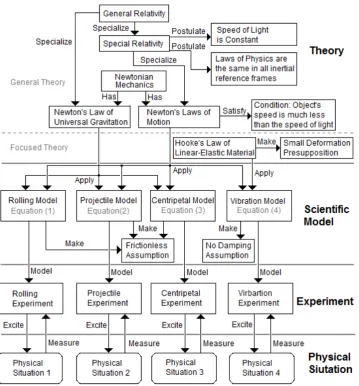
Figure 4 is an instance diagram showing the application of Newtonian mechanics to
subsumed by the theory of general relativity. Laws in Newtonian mechanics are
applied in all four models. Some suggested that these are universal laws that are
applicable to all situations. Later, the confirmation of the theory of special relativity
restricted Newtonian mechanics to the regime where the speed of objects is much less
than the speed of light. Scientists seek to establish laws or principles that are
applicable to many different situations within the regime of study. Contrasting with
Hooke’s law, its application is much more restricted than those for Newtonian
mechanics. As a result, there is a distinction between focused theories that explain
certain phenomena (like simple harmonic motion) and the general theories that are
applied to build models for a wide variety of situations.
Figure 4: An instance diagram describing the application of Newtonian mechanics
Figure 4 also shows that some theories do not have any model as part of the theory.
Instead, models are built when the situation arises. Earlier, each model in Figure 3 has
a quantitative relationship (i.e., equations 1-4) that is derived from the theory so that
this relationship can be quantified and verified in practice. However, not all models
are quantitative. For instance, Galileo’s experiments about free-fall objects refute
Aristotle’s theory by observing whether objects of different weights reach the floor at
the same time when these objects fall under the same conditions.
In Figure 4, the experiment entity instances and the (scientific) model entity instances
can be distinguished by information related only to those entity instances alone, where
such information is not shown in the diagram for clarity of presentation. For example,
some field experiments may have been carried out under specific conditions which are
recorded as part of these experiments and not part of the scientific models. Controlled
experiments may specify what instruments are used for making measurements which
are not documented with the scientific models. The detailed derivations of the
quantitative relationships are documented with the (scientific) model instances rather
than the experiment entity instances. In addition, a (scientific) model entity instance
may be used by different experiment entity instances to measure different quantities
(e.g. angle θ or distance travelled) in its quantitative relationship.
2.2. Scientific Study Elements
In this section, we relate philosophical issues with our description of the elements in
scientific studies. Our description of these elements does not resolve these issues, but
put them into the context of scientific study rather than scientific research.
What is a theory? There are at least two different types of scientific theories: general
and focused theories. A general theory aims to generalize (e.g., Nugavey, 1985;
Bailer-Jones, 2003) both models and more focused theories in order to provide a
parsimonious description of them. For example, the general theory of
electromagnetism as summarized by Maxwell’s equations combines the laws of
Faraday, Ampère and others. So, a theory consists of some general/universal
of interest (or within some regime). These statements can be ascribed with truth
values so that they can be tested empirically (as opposed to those that are not
falsifiable, e.g., (Magnani, 1999)). It also has its own concepts (e.g., momentum) that
are measurable or related to physical situation. A theory must have a statement about
the scientific discourse to define its scope. It may have some presupposition (Gauch,
2003) that the theory assumes. Also, it may have principles (Suppes, 1995) that
models or experiments are intended to obey. In the general case, these general
statements can be grouped into different types, such as principles, presuppositions,
conditions, and assumptions.
Statements in a theory are intended to be true (Psillos, 2000). Some statements are not
always true but they are stated in the theory in order to simplify the situation for
modeling or explaining a physical situation, thereby leaving out the details that are not
the focus of the inquiry (Nowak, 1972; Liu, 1998; Bailer-Jones, 2003). In addition,
this treatment of statements is useful to deduce new results for prediction, verification,
validation, falsification and model construction (Portides, 2005). This is also useful to
differentiate the qualifying measure of scientific knowledge as being true or false that
is applied to statements of a theory, as opposed to being accurate or not, which is
applied to scientific models. Statements that are intended to be true may be regarded
as belief (Psillos, 2000), but scientists may not necessarily believe in the statements of
a theory when they are testing the theory. We can summarize the notion of truth in
scientific knowledge as follows:
Definition 2: When a statement in a scientific theory is said to be
true, this means that the theory asserts that the objects or relations
specified in the statement are manifested and are operating within
the regime of study.
A theory may have general qualitative models, because they can account for a finite
number of types of situations to describe. Alternatively, a theory may not have any
qualitative models, because there are an unknown number of possible situations to
describe. In general, it is also possible that a theory contains a number of theories with
There are different kinds of theories. A mathematical theory is quantitative, and it
focuses on solving some mathematical problems. Some mathematical theories may
have been successfully applied across various disciplines (e.g., von Bertalanffy, 1950),
and many mathematical theories have been axiomized. While theory axiomization
(Liu, 1998) can distinguish the elementary concepts from the derived concepts, it
should be pointed out that a mathematical theory can be axiomized differently (i.e.,
there can be more than one set of axioms for a theory). A logical theory is a
qualitative theory based on logic. The focus of such a theory is on valid reasoning or
inferences based on its premises; PEL (Gauch, 2003) is a good example.
A scientific theory is a theory that has both qualitative and quantitative aspects, as
well as empirical significance. So, it is not unusual to find named quantities in
statements of a scientific theory. In some scientific theories, they have a set of general
equations (e.g., Maxwell’s equations) that can be used to develop scientific models.
While scientific theories are quantified mathematically, many scientific theories are
not axiomized, because of the fact that the axioms are more about the mathematical
properties rather than the scientific properties (i.e., the principles or laws) of the
subject of study. An established scientific theory must be self-consistent, so this
would demand good reasoning (Gauch, 2003). Otherwise, the theory needs to be
revised and replaced. The theory needs to be quantified because it involves some
measurements for validations and predictions. An established scientific theory must
relate to some physical events or their derivatives, so that it has empirical significance.
Some theories are based on more fundamental, and therefore more general theories.
For example, the theory of sound propagation in a solid can be built on Newtonian
mechanics. Usually the fundamental or general theories have a wider scope of
application than the more focused theories that explain certain physical phenomena.
What is a scientific model? A model is a description of a type of physical situations,
so it is an abstract or conceptual situation (Portides, 2005) that is constructed (Hennig,
2010) as an approximate version of the corresponding physical situation being
studied. On the one hand, a model aims to describe or predict the physical situation as
accurately as possible. So, a scientific model is usually quantitative, and it borrows
mathematics (Suppes, 1960) for the purpose of quantification (Davy, 2003). On the
to be insignificant or unrelated to the inquiry. So, a model typically has some
simplifying assumptions that are made (Achinstein, 1965), not because they are true
(Nowak, 1972; Morton, 1993) but because they are convenient for modeling and for
the scientific study. This kind of simplification provides a handle to the underlying
knowledge of the subject. Rarely, scientific models are more complex than necessary.
Such instances can occur when scientists borrow sophisticated mathematical models
handling as many factors as possible so that their models or some techniques can
discover the critical factors for predictions. Therefore, a scientific model sometimes
can be a simplification of or an over-complication (in certain respect) of the physical
situation. However, such a model is always intended to be a good approximation of
the physical situation.
It is not necessary that the description of an abstract situation has to be isomorphic or
similar (Suárez, 2003) to the corresponding physical situation. For example, the
descriptions may be simply describing just the input and output of a physical situation,
as well as their relationships, or the descriptions may be an elaborate one that entails
the detail and possibly hidden mechanics of the situation.
In mathematical terms, representation (more specifically, representation theorem) is
an isomorphism or a bijective map. A bijection has two properties: injection (i.e.,
one-to-one mapping) and surjection (i.e., onto mapping). Because a model leaves out
details of the physical situation, some objects or details in the physical situation are
not in the model. In this case, the mapping from the objects of the model to objects in
the physical situation will not be surjective, and therefore not bijective. Even if we
limit the physical objects that matter to the study, we cannot be sure whether the
mapping is surjective, because we do not know whether there are any hidden variables
or latent variables (Bartholomew and Knott, 1999) even though there are statistical
techniques (e.g., principal element analysis) to handle such variables.
Injective map is desirable because we can refer to objects in the physical situation
unambiguously. However, we are also not certain whether the mapping between
objects in the model and those in the physical situation is injective. This is because the
intended objects that are recognized as one type of objects in the physical situation
to map to objects on a one-to-one basis (i.e., injective) or in a stronger sense represent
the physical situation (i.e., a bijection). While science may appear to rest on shaky
foundations, we need to recall that a model does not survive on the basis that they
have a one-to-one mapping to the physical situation. Instead, it survives because it is
able to predict the outcomes accurately and reliably, able to predict more types of
physical situations and be consistent with (existing) theories. In order to increase both
accuracy and reliability of predictions, some scientists even investigate how these are
done using more variety of data (e.g., Kruse, 1997). Given that the mapping between
objects of the model and objects in the physical situation is usually intended to be
injective (or more strongly bijective), we prefer to say that models are approximate
versions of the corresponding physical situations. We summarize the previous
discussion about the role of scientific models, which is related to the philosophical
debate on realism:
Definition 3: A scientific model is said to be realistic when it can
predict quantities accurately and reliably in uncontrolled
experiments within the regime of study.
The level of accuracy and reliability makes reference to the current achieved level. As
the lowest baseline of comparison, this level of accuracy and reliability should be
better than the level predicted by a naive random model that forms the null hypothesis
for statistical tests of reliability. Such a random model has little domain-specific
knowledge, so it cannot claim to exhibit any understanding of the subject of study.
The development of scientific models involves ignoring details of the physical
situation or making assumptions for simplification. The justification of ignoring
certain details or including what are considered important factors may be based on
intuition, common sense (Miscevic, 2001), philosophical issues (Bailer-Jones, 2003)
past research issues or some creative process (Beveridge, 1957; Bailer-Jones, 1999).
For instance, formative research where little is known for certain about the particular
field of investigation may rely more on common sense to identify governing factors of
a model. Experiments can be designed to test which of these factors are important in
the subject of study. For some established area of science, existing theories, models,
model. Thought experiments may be particularly suitable in this kind of
knowledge-rich domain (Damper, 2006). In the case of the application of an existing theory to
develop new models for novel physical situations, the physical situation may provide
guidance to include additional details for accurate modeling (Bailer-Jones, 2003).
What is an experiment? An experiment is carried out in a physical situation. The aim
of doing an experiment is to collect information from the physical situation for
various purposes. The information can be used to support or deny a theory or its
elements. It may be used to evaluate a model. It may be used to find characteristics of
the phenomena for building models or theories. In order to obtain information from
physical situations, the experiment must do some measurement. An experiment may
directly excite the physical situation because it can control the excitation, or it may
make measurements using a natural excitation source (e.g., observation of stars). The
quality of an experiment depends on many factors (Franklin, 1981), and probability
and statistics are increasingly used to assess the reliability and repeatability of the
experimental outcomes (Suppes, 2007).
There are different types of experiments. Controlled experiments are usually used to
validate theoretical statements. The experiments are controlled so that the impact of
the intervening or interfering factors is reduced as much as possible. In some cases,
the controlled experiment becomes so simple (or so focused) that it is not necessary to
declare a scientific model is used to quantify the controlled experiment and predict its
outcomes. Instead, scientists directly show how the interested quantities are calculated
in order to show the manifestation of some theoretical statements (e.g., Rainville et al.,
2005), and the unnamed scientific model is literally hidden from communication.
Natural experiments belong to another type of experiments. The focus of such
experiments is to collect data in a practical situation rather than in controlled
environment. Such experiments may determine the inadequacy of scientific models or
theories in practical situations.
What is a physical situation? It is a state of affairs in which an experiment is carried
out. It is physical because the scientists designed the experiment to observe the “real
world” in a particular intended context. In other words, a physical situation is some
What is the real world? The real world refers to the totality of physical situations that
we, as a whole, experience in the past, in the present, as well as in the future.
Different people have different real worlds in mind because we are exposed to a
limited scope of the real world. Many scientists only deal with the limited physical
situations related to their subject of study (or a regime). Some scientists believe that
the real world is the same all the time and everywhere, because they believe that this
makes the real world objectively accessible and universally applicable. Some
scientists do not want to make a leap of faith to generalize their own daily and
scientific experience to the real world as a whole. However, all scientists would agree
that they intended their experiments to be conducted in objectively accessible physical
situations (and not necessarily the real world as a whole) so that their scientific work
can be communicated to others for verification and agreement (Hennig, 2010). This
objective accessibility includes subjective descriptions of mental phenomena (Nagel,
1974) since these descriptions may fall into certain categories or types when they are
collected from many (human) subjects and since descriptions are objectively
accessible.
2.3. Process
Having described the different entities, our discussion focuses on the processes. One
of the processes is the construction of scientific models based on theories (Bod, 2006;
Morrison, 2006). A scientific model should be consistent with the theory. The
applications of the theory to build the model should be based on valid reasoning to
ensure or demonstrate consistency between the application of the theory and the
scientific model. Since a theory is a discourse, selective statements, like principles
and assumptions, which can be ascribed with truth values, can be used for scientific
model construction. It is also not necessary that the entire theory be applied to build a
scientific model. For instance, the vibration model in Section 2.1 does not use all
three Newton’s laws of motion.
In the other direction, the revision process may modify a theory when its model is
being modified for better predictions. The revision process also generalizes successful
identified in the theory. These essential aspects may be the principles or assumptions
of the theory, which are independent of the models and are applicable to different
abstract and physical situations. For example, the principle of conservation of energy
is applicable to quantum mechanics as well as to Newtonian mechanics.
The processes between the scientific model and the experiment are the prediction and
evaluation of models. A model makes predictions of physical situations that it intends
to be applied to. A prediction is commonly understood to be a quantity but the
prediction can also be a dichotomous value. Evaluation involves collecting data where
the experiments are repeated a number of times for reliability assessment. The
collected data are processed to inform scientists on how accurate the model makes
prediction. Statistical tests can be carried out to give scientists some measure of
reliability of the outcomes, e.g., confidence levels. In view of the results in
experiments, a model may undergo revisions and possibly the theory also needs to be
revised.
The processes between theory and experiment are concerned with collecting data
from experiments to feedback information to the scientists for the support, denial,
revision or construction of the theory. What kind of data to collect depends on the
need of the scientist. For instance, when there is no established theory in the current
study, a scientist may collect statistical summary data in order to begin building a
theory. On another occasion, a scientist may want to test a certain part of an
established theory; a hypothesis about the theory can be formulated and tested by
experiments. This is the common notion of scientific method of the Vienna Circle,
which is originated from the inferences as observed by Pierce (1989) in science. This
inference includes abduction, deduction and induction. Abduction is to guess
plausible causes or explanations of the observed effect. To test which causes or
explanations, alternative outcomes serving as hypotheses are deduced from such
causes or explanations. Experiments are carried out to inductively infer which cause is
responsible for the observed effect. Such inference is being adopted in the emerging
cyberinfrastructure for geosciences (e.g., (Brodaric and Gahegan, 2006)).
Some historical scientists have been critical of the scientific method using induction
their experiments may not be able to be repeated in laboratory or may not be able to
be found in the field. Examples of historical scientific inquiries include the
meteorite-impact hypothesis for the extinction of the dinosaurs and big-bang theory of the origin
of the universe. Instead of repeating the experiments, scientists find pieces of
evidence from different sources or of different character, which are documented in the
experiment entity instances (called cases), to support the hypothesis or theory, and to
eliminate the alternative hypothesis or theories. Sometimes, scientific models are
needed to determine certain quantities that can be observed now (e.g., the background
radiation due to the primordial explosion according to the big-bang theory). Such
quantity provides a piece of evidence to support a particular hypothesis or theory. For
historical science the method of inquiry is very similar to criminal investigation, and
their differences are the aim of the investigation and their knowledge elements.
Computational Models
As computational models are becoming increasingly significant (e.g., weather
forecasting), we are motivated to include some computational models (Moor, 1978) as
scientific models. The digital computer, which is a computing device based on logic
and mathematics, is essentially executing a detailed version of some scientific models.
The problem with perceiving a computational model as a scientific model is the
complexity of a computational model. Many scientific models can be comprehended
by human but the complexity of a computational model may be very difficult to
understand. In addition, a computational model incorporates many details that are
considered not essential in a scientific model. This raises concern whether the
prediction problems are due to deficiencies in the basic scientific models, or due to
inappropriate, or irrelevant, or the lack of details in the computational model. We
believe that computational models which defy human understanding cannot qualify as
a scientific model.
We refer to computational models that are shown to correspond to scientific models
after simplifications as computational scientific models. Such models are regarded by
us as a type of scientific models. The other scientific models are called conventional
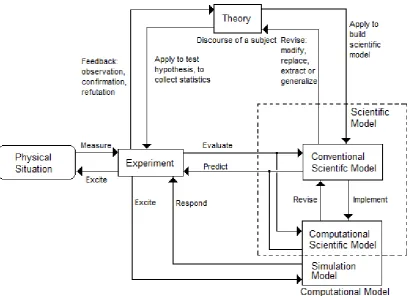
scientific models. Figure 5 shows a detailed diagram where the scientific model in
The purpose of developing computational scientific models is to produce simulated
experimental results (Boon, 2003) in order for the scientists to understand what are
the outcomes and their likelihood, as well as for appreciating the significance and
impact of these outcomes. The need of such appreciation and understanding is
because of the difficulties to carry out the experiment. Such difficulties may stem
from the scale of the experiment, the controllability of the experiment or the fatality
of the experimental outcomes.
Figure 5: A process model of scientific study that includes computational models.
Some computational models cannot be called computational scientific ones because
they drastically simplify the physical situation for controlled studies so that they can
be used for testing theories or hypotheses. These computational models are called
simulation models which may be used in the experiment. For example, the ELIZA
program (Weizenbaum, 1966) held conversations with human subjects in the
experiment, and some subjects considered that the program responses were by human
subjects. In this case, the ELIZA program was denied by Weizenbaum as a theory of
cues to respond. In addition, human subjects have access only to the ELIZA program
textual output. In such a controlled environment, this experiment using a simulation
model may be considered as testing the hypothesis that syntactic and semantic cues
are sufficient for holding conversations rather than testing the ELIZA program as a
computational scientific model of human conversation.
Simulation models belong to the experiment entity as such models are experimental
tools for investigation (Humphreys, 1995; Hartmann, 1996). However, the simulation
model entity is placed side-by-side with the computational scientific model entity in
Figure 5 in order to show that they are both computational models, and that
simulation models may become computational scientific ones when they are fully
developed for realistic simulation in more uncontrolled environments. Furthermore,
simulation models may be evaluated on how realistic they are, and computational
scientific models may be used to generate responds in the experiment.
Figure 5 illustrates the flexibility of the process model because each entity or
relationship can potentially be developed into more detailed process models
themselves. Effectively, the complexity of the process can be hidden or emerged
depending on the required level of details of the process. In the rest of this paper, we
will discuss the scientific model for generality, rather than its three detailed entities,
conventional scientific models, computational scientific ones and simulation models.
3. Scientific research
Some consider that scientific studies and research are synonymous, and empirical
results in research papers are demanded. However, some significant research papers
do not have any direct empirical support. For example, the paper by Einstein (1905)
on the theory of special relativity does not have any first-hand empirical results to
support the theory. Important research papers that survey particular fields of inquiry
also do not have any first-hand empirical results. In this section, we use our
understanding of scientific study to relate and differentiate between scientific studies
We believe that research, instead of scientific studies, is a problem-solving activity (or
more generally a question-answering activity), even though there are many ways in
which interest in research begins (Struan, 2001; Koshland, 2007). Research aims to
discover new ideas for solving problems. It can be framed as a scientific study
(Lauden, 1987) because it can involve building new theories or scientific models,
conducting new experiments, making new extension of a theory or a model, making
new observations of existing experiments, etc. However, some research cannot be
considered as scientific study. For example, there is research done in literature in
order to discover a new perspective or understanding of some classical literature. At
the other end of the spectrum, not all scientific processes are research. For example,
scientific processes may be used for forensic studies in criminal investigation, or for
monitoring the amount of toxic chemicals in food for public health and safety.
Instruments used for scientific studies are also used in these scientific processes but
they do not serve to find better models or theories as in research. Similar to scientific
research, trained scientists and laboratory technicians are employed to carry out these
experiments or tests in government laboratories. However, these confirmation studies
are carried out for monitoring purposes and they are not carried out as scientific
research for the better understanding and modeling of toxic chemicals. While research
and scientific studies have a significant overlap, they are not synonymous.
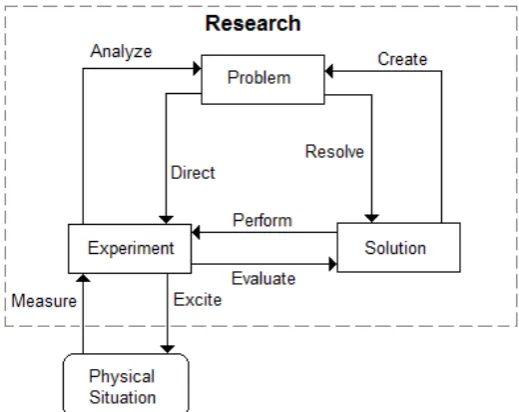
To substantiate that research and scientific studies are not synonymous, we developed
a process model of research (Figure 6). Our process model of research is similar to
our process model of scientific study (Figure 1). The experiment and physical
situation entities of research are the same as the experiment and physical situation
entities in Figure 1. The solution entity in Figure 6 corresponds to the model entity in
Figure 1. This is because sometimes the solutions involve mathematical models for
solving a research problem. Also, a solution solves a particular problem in a particular
situation, which is similar to a model that describes a specific situation. The problem
entity in Figure 6 corresponds to the theory entity in Figure 1. This is because a
problem can be considered as a kind of generalization of the different solutions for the
same problem, similar to a theory being a generalization of a number of scientific
Unlike scientific theories, a research problem does not necessarily need to have any
empirical significance. For example, some research in mathematics aims to discover a
solution for a well known mathematical problem (i.e., a conjecture). A mathematical
proof is needed. This means that some research does not necessarily have empirical
significance. For instance, survey-type research papers synthesize past research works
into a coherent account of current frontiers of knowledge and current issues of the
particular chosen research topic. Such reviews (e.g., papers in ACM computing
survey) seldom report any first-hand experiments about the physical world.
Figure 6: A process model of research.
Similar to scientific theories, a research problem also has a number of general
statements that describe the nature of the problem being solved. Therefore, statements
that define the scope of the problem are similar to the statements that define the scope
of a scientific theory. However, many types of statements of a research problem are
not related to statements in a scientific theory. For example, the constraints and
objective functions of a research problem are not necessary parts of a scientific theory.
The focus of many engineering research works is to find better solutions to a technical
problem (Boon, 2006). These solutions may involve some mathematical techniques or
experimental know-how. However, sometimes, these solutions are models of physical
situations. The parameters of these models are then optimized in order to solve the
normative models that prescribe the best action to take in the given situation. These
models are different from the descriptive models of science, which aims to describe
the situation accurately. Some solutions solve very specific problems, and others can
solve a variety of problems. Therefore, different names of solutions are created
depending on how general a problem that they can solve. The most specific solution is
called a technique, followed by algorithms, methods, approaches, and methodologies.
Similar to the common notion of scientific study (i.e., the “scientific method”
advocated by the Vienna Circle), research always starts with a research problem
(more generally, the research question) (Sintonen, 2004) that is not trivial to solve
(more generally, the answer). The research problem or question is similar to the
hypothesis in the scientific method (Sintonen, 2004). Unlike the scientific method that
demands a hypothesis to be related to some theory or some statement in a theory that
explains observed phenomena, the research problem or question does not need to be
related to any theory, nor related to any observed phenomena. For examples, scientists
(Rainville et al., 2005) can develop new instruments to make observations that is
much more precise than before or that cannot be observed before. Researchers can
carry out experiments to collect data about the size and the nature of the research
problem (and not the solution).
Figure 7: An instance diagram of an example research process. Note that the physical
Figure 7 shows an instance diagram of an illustrative, example research process, and
details about the physical situation instances are not drawn for clarity. In this example,
the original research problem is divided into two specific problems (i.e., A1 and A2).
Preliminary experiments (i.e., 1 and 2) are carried out. It is found that problem A1 is
not significant, so a simplifying assumption is made to ignore problem A1. Problem
A2 is significant, and solution 1 tries to solve this problem. Experiment 3 evaluates
whether solution 1 produces good results. By analyzing the results, it is found that
solution 1 has problem A3. Therefore, solution 2 is designed to solve problem A3.
Experiment 4 evaluates solution 2 and concludes whether a good solution is found.
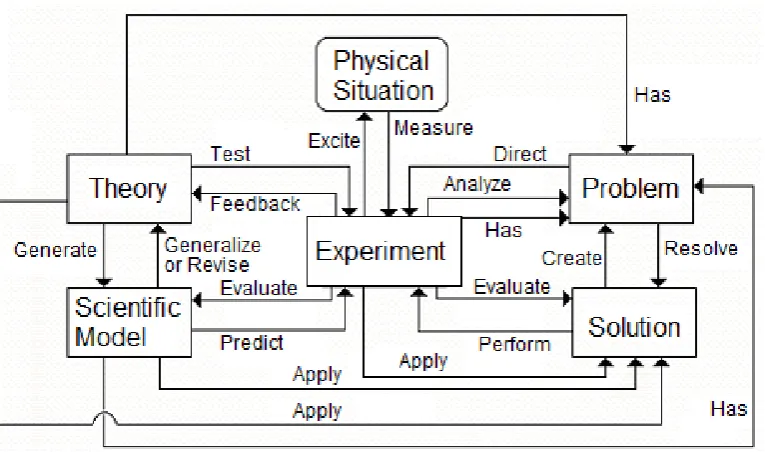
Figure 8: A unified process model of scientific research that combines the notion of
scientific studies, applied science and research.
Figure 8 shows a unified process model that combines the process model for scientific
study and the one for research. The unified process model added three processes that
apply either the theory entity or the scientific model entity to the solution entity.
These two processes are added in order to account for applied science (Boon, 2006;
Morrison, 2006) that applies known scientific models and theories to solve practical,
technical research problems. As Boon (2006) examined the case of fluid flows, known
scientific models and theories in hydrodynamics may not be adequate to predict
experiments in scientific studies) that the technical problem originates. Such model
and theories need to integrate technical knowledge in hydraulics to develop more
realistic models for solving technical problems in practical situations.
In Figure 8, three processes, with the label “has”, are added in the unified process
model in order to relate the theory and scientific model entities with the problem
entity. These three processes describe the case when the theory, scientific model and
experiment entities have unresolved problems. For example, classical theory could not
explain the black-body radiation spectrum. Such unexplained observation may
become research problems. Scientists may develop a completely new theory (i.e., the
quantum theory of Max Planck) or extend existing theory to explain the phenomena.
These two processes with the label “has” suggest the cause of the confusion that
scientific studies and research are synonymous. This is because the theory and
scientific model sometimes can be embedded as some parts of research. However,
there are many types of research that do not need a scientific model or a theory, for
example, philosophical investigations.
Figure 8 distinguishes between basic scientific research (or pure scientific research as
in Hansson, 2007) and applied scientific research. For basic scientific research, the
targeted research problem is related to the theories, scientific models or experiments.
This corresponds to three directed lines that are labeled “has” from the theory, the
scientific model or the experiment entity to the problem entity. Basic scientific
research may also resolve problems in experiments. For example, the research may be
involved in the use of more sophisticated instruments to obtain better precision in
experimental results. For applied research, the targeted research problem is not
concerned with problems with the established theory or scientific model. Instead,
applied scientific research uses the knowledge related to theories, scientific models or
experiments to solve the targeted research problems. This corresponds to three
directed lines that are labeled “apply” from the theory, the scientific model or the
experiment entity to the solution entity. The difference between basic and applied
scientific research is whether the scientific knowledge is a problem or is applied to
formulate the solution. For some scientific research problems, they have both basic
and applied scientific research elements, so these two types of scientific research
Scientific research is a kind of research, so we argue that:
Definition 4: A scientific research problem is a research problem
that is related to any elements of scientific studies (Figure 1, 5).
By definition, a scientific research problem is about basic scientific research because
the problem is related to the elements of scientific studies. A scientific research
problem is more general than a hypothesis of the scientific method advocated by the
Vienna Circle. For example, scientific instruments are designed and built for the
purpose of making observations of rare phenomena. Building such scientific
instruments may itself be a research problem because this may pose great technical
challenges. The data collected from such instruments provide the first evidence of
some unknown phenomena. There may be any theory at the time to justify the
research problem as a hypothesis. However, since the research problem is related to
gathering information to enable scientific studies, such activities should be classified
as scientific research. Moreover, such scientific instruments contain technical
knowledge that other scientists need to acquire and then replicate the results, as well
as using such instruments to study other phenomena. Thus, such research on building
scientific, precision instruments is also part of the scientific studies.
4. Scientific progress
Philosophy of science treated scientific studies as research. As a result, scientific
progress and change are also seen in the light of progress or changes in research rather
than scientific studies. The idea of paradigm shift (Kuhn, 1962) can be applied not
just to science subjects but also research in other non-science subjects (Bod et al.,
2006). For instance, philosophy of science was once dominated by the common
notion of scientific method. Later, the paradigm shifts toward the use of falsification
to determine the surviving theory (Popper, 1959) as the scientific method. Some (e.g.,
Hansson, 2006) seeks evidence from scientific literature to determine if falsification is
commonly used in science. Recently, science is thought to progress in a revolutionary
philosophy and not science, and yet they can be understood by Kuhn’s idea of
paradigm shifts. As in many research works, these studies are kept focused by the
research issues. On the other hand, scientific research (Figure 8) makes progress by
focusing on research issues related to producing better experiments, models or
theories. Experiments are better (Franklin, 1981) than older ones, for instance, if
better instruments will provide more precise information with less noise in the data.
Models are better than previous ones if they will make more accurate, reliable
predictions (Franklin et al., 1989) for a wide variety of experiments. Theories are
better than established ones if they will subsume or explain more models or
observations. Therefore, we argue that philosophy of science should have a better
balanced focus between the mechanism of and the content of scientific progress.
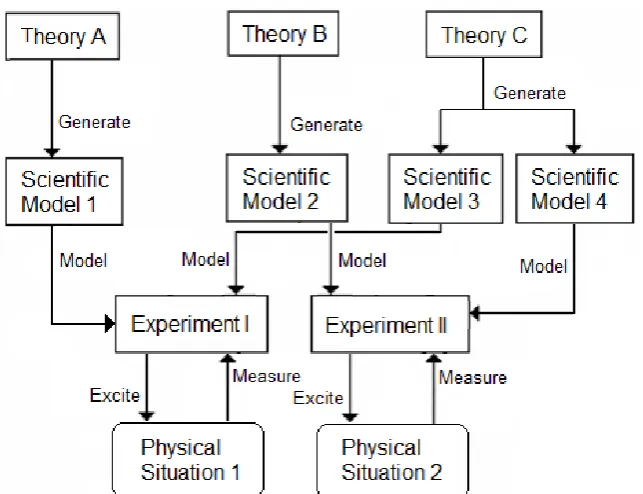
Applying our process model to understand scientific progress, Figure 9 shows an
illustrative example of multiple instances of the theory entity, the scientific model
entity and the experiment entity. This example has three theories: A, B and C.
Scientific model 1 is based on theory A and it models the physical situation 1 that
experiment I is engaged in. Likewise, scientific model 2 is based on theory B and it
models the physical situation 2 that experiment II is engaged in. Theory C appeared in
this case to be more general than theory A and theory B because two scientific models
(i.e., 3 and 4) are based on this theory; these two models describe two different
physical situations that experiment I and II are engaged in.
Figure 9 illustrates an example of how complex it is when comparing competing
theories to account for different phenomena observed in experiments. Figure 9 depicts
the theories as being distinct from each other. In practice, theories can overlap with
each other because they are describing the same subject of investigation. For instance,
theory A may share one principle with theory B but other principles are not shared.
Likewise, the scientific models in Figure 9 are shown as distinct but competing
models may be very similar with a large knowledge overlap and a small difference
(e.g., some assumptions) between them. Such an instance diagram like Figure 9 helps
us to appreciate better the possible complexities of research programmes (Lakatos,
Figure 9: An instance diagram of an example of multiple instances of the theory,
scientific model and experiment entities.
Models and experiments can be readily compared since they directly refer to similar
abstract or physical situations. However, philosophers (e.g., Kuhn, 1962) have
doubted whether theories can be compared because these theories are different
understanding of or different sets of belief of nature. Difficulties to compare theories
arise from the different terminologies of different theories, where different
terminologies are thought to be describing different things or aspects that cannot be
compared. While it is not straightforward to compare two different theories when they
have different terminologies, we believe that this does not mean it is impossible to
compare theories. Obviously, in order to compare two different theories, there must
be some commonality between them. Based on the commonalities of different
theories, scientists can come up with new methods of measurements or new quantities
for comparison. In addition, since scientific theories and scientific models are usually
formalized into some logical or mathematical descriptions, it may be possible to
deduce consequences from these commonalities for comparisons. In some cases, one
theory is found to be subsumed by another more general theory. For example,
Newtonian mechanics is shown to be an approximation of the theory of general
A theory may not be supported by every experiment against another theory in terms of
prediction accuracy, explanative power, simplicity, etc. If one theory is supported by
every experiment but the other theories are not, then scientists would switch their
allegiance (although this is not a logical necessity until proven because future
experiments may indicate otherwise). On the other hand, a stalemate situation may
occur where one theory is good at some experiments but not as good as another theory
in other experiments. In this situation, scientists may ponder whether there is a line
differentiating the applicability of different theories or wait until further evidence or
experiments or better theories to come. For example, Newton's theory of motion is not
abandoned completely. Newton's theory of motion is still the preferred one in solving
mechanical engineering problems in our daily life. While scientific change or progress
can be a very complex process as Feyerabend (1975) has pointed out, this does not
necessarily mean that there are no underlying forces that drive the scientific change or
progress. Scientists are faced with a complex decision to favor the use of a particular
theory, or model or experiment.
By using the guiding principles in the choice of theories, such as the principle of
parsimony, it is possible to link the process model with some theory of science (Beth,
1951) or with the choice of theory. The guiding principles that choose a theory can be
used by individual scientists in favoring a particular theory. However, the
pre-requisite to such a choice also depends on the set of experiments that the theory excels
compared with other competing theories. Scientists have the further option of not
forming any allegiance to any specific theory on the basis of appealing to these
guiding principles. Instead, scientists can design and carry out experiments in order to
select the surviving theory in question. Instead of viewing these guiding principles as
selecting a theory, they can be used as objectives in designing experiments to put
theories into acid tests (i.e., experiments). For example, in string theory, an
interpretation of the recent quest to unify all the known fundamental forces (i.e.,
electromagnetic force, gravitational force, weak nuclear force and strong nuclear force)
is driven by the desire to satisfy the principle of parsimony. This principle is
particularly noteworthy because it is related to the aim of developing theories, which
generalizes the scientific models into a set of general/universal statements (Table 1)
5. Scientific Study Development
We can also apply our process models to define and understand the different stages of
the development of a scientific study. Keeping in mind the development of physics as
an archetype of mature science, we propose that:
Definition 5: A mature scientific study is a scientific study that
contains at least one empirically established general scientific
theory and more than one empirically established scientific model.
This definition is consistent with definition 1, and it implies that a mature scientific
study has some experiments which support the empirically established theories and/or
models. Thus, a mature scientific study must have all the elements of a scientific
study, and these interlocking elements should provide a coherent, comprehensive
account of the subject of studies. A mature scientific study should have established
models to describe at least some of the physical situations accurately, in order to
demonstrate its predictive power or utility. These models should be subsumed by
some established general theory. This is because there are so many models to account
for so many different situations that a general theory is needed to identify the
underlying concepts and their relationships. Without a general theory and possibly
associated focused theories, these models appear as disconnected pieces of knowledge
of the subject.
A scientific model is established when it can make accurate predictions that other
models cannot. Also, the established models should be domain-specific rather than
random models used for hypothesis testing. This is because scientific models should
make use of domain-specific knowledge to demonstrate their close connections to the
subject of study, but such random models have little domain-specific knowledge that
shows understanding of the subject.
A scientific theory is said to be established when:
(a) many different types of experiments support it;
(b) it has constructed many models that made accurate predictions; and
Sometimes, (a) and (b) are combined together. For our example in Figure 4, results of
the four types of experiments support Newtonian mechanics by showing that the
models in Figure 3 can accurately predict the measurable quantities in equation (1) –
(4). A recent example is the theory of general relativity, which is supported by various
famous experiments (e.g., Eddington experiment, Gravity Probe B experiment,
Pound-Rebka experiment and Hafele-Keating experiment) that are carried out after
the publication of the theory of general relativity.
We propose that another type of scientific study is:
Definition 6: A developing scientific study is not a mature
scientific study (as in Definition 5) and contains either at least an
empirically established scientific model or an empirically
established scientific theory.
This definition also implies that a developing scientific study has some experiments
which support the empirically established scientific theory or scientific model, but not
both (in order to distinguish this type of scientific study from a mature one). For
instance, I consider that the study of emerging web science (Berners-Lee et al., 2008)
as a developing scientific study because (a) it has a well-known random surfer model
of web page visits and (b) it has well-known empirical relationships (e.g., the
frequency distribution of web page sizes follows Zipf law). I do not consider web
science as a mature scientific study because it does not have a general scientific
theory that covers wide ranging aspects of web science (e.g., web architecture, web
growth and web page visits).
Finally, we propose that:
Definition 7: A formative scientific study is not a developing
scientific study (as in Definition 6) but it is an empirical study with
some established empirical research methodology.
This definition specifies that a formative scientific study (e.g., (Oelkers, 1998)) has