RESEARCH LETTER
Long-term variations in the plasma sheet
ion composition and substorm occurrence
over 23 years
Masahito Nosé
*Abstract
The Geotail satellite has been operating for almost two solar cycles (~23 years) since its launch in July 1992. The satel-lite carries the energetic particle and ion composition (EPIC) instrument that measures the energetic ion flux (9.4– 212 keV/e) and enables the investigation of long-term variations of the ion composition in the plasma sheet for solar cycles 22–24. From the statistical analysis of the EPIC data, we find that (1) the plasma ion mass (M) is approximately 1.1 amu during the solar minimum, whereas it increases to 1.5–2.7 amu during the solar maximum; (2) the increases in M seem to have two components: a raising of the baseline levels (~1.5 amu) and a large transient enhancement (~1.8–2.7 amu); (3) the baseline level change of M correlates well with the Mg II index, which is a good proxy for the solar extreme ultraviolet (EUV) or far ultraviolet (FUV) irradiance; and (4) the large transient enhancement of M is caused by strong magnetic storms. We also study the long-term variations of substorm occurrences in 1992–2015 that are evaluated with the number of Pi2 pulsations detected at the Kakioka observatory. The results suggest no clear correlation between the substorm occurrence and the Mg II index. Instead, when the substorms are classified into externally triggered events and non-triggered events, the number of the non-triggered events and the Mg II index are negatively correlated. We interpret these results that the increase in the solar EUV/FUV radiation enhances the supply of ionospheric ions (He+ and O+ ions) into the plasma sheet to increase M, and the large M may suppress spontane-ous plasma instabilities initiating substorms and decrease the number of the non-triggered substorms. The present analysis using the unprecedentedly long-term dataset covering ~23 years provides additional observational evidence that heavy ions work to prevent the occurrence of substorms.
Keywords: Long-term variations of geospace environment, Plasma sheet ion composition, Substorm, Ionospheric ion outflow, Mg II index, Solar EUV/FUV irradiance, Geotail satellite, Pi2 pulsation
© 2016 Nosé. This article is distributed under the terms of the Creative Commons Attribution 4.0 International License (http:// creativecommons.org/licenses/by/4.0/), which permits unrestricted use, distribution, and reproduction in any medium, provided you give appropriate credit to the original author(s) and the source, provide a link to the Creative Commons license, and indicate if changes were made.
Introduction
The ion composition of plasma in the magnetosphere and the plasma sheet is one of important parameters in space physics, because it affects the Alfvén velocity that is a fun-damental physical quantity of plasma. When plasma con-tains ion species heavier than H+, such as He+ and O+, the plasma mass increases to more than 1 amu and the Alfvén velocity decreases. For example, the plasma mass with 95 % H+ and 5 % O+ is 1.75 amu, and the Alfvén velocity in this plasma decreases to approximately 76 %
of that in a proton only plasma. It is expected that various plasma phenomena are altered in such low Alfvén veloc-ity environments. Another aspect of the ion composition change is that the plasma acquires multiple spatial scales corresponding to the gyroradii of ions or increases in the effective ion gyroradius. This may affect the threshold of plasma instabilities.
Thus, information on the long-term change of the ion composition in terrestrial plasma is crucial in stud-ies of space weather or space climate. Previous studstud-ies using data of 2–7 years showed that the number densi-ties or energy densidensi-ties of He+ and O+ ions have a good correlation with the F10.7 index (e.g., Young et al. 1982;
Open Access
*Correspondence: [email protected]
Stokholm et al. 1989; Lennartsson 1989; Pulkkinen et al. 2001). More recently, using data obtained by the ener-getic particle and ion composition (EPIC) instrument onboard the Geotail satellite, Nosé et al. (2009) studied the variations of the ion composition in the plasma sheet for more than 16.3 years (from 17 October 1992 to 21 February 2009) to confirm that the He+/H+ and O+/H+ flux ratios depend on the F10.7 index with stronger cor-relation for O+/H+.
The Geotail satellite continues observations after the study of Nosé et al. (2009) and accumulates ion flux data up to the present (as of December 2015) that cover almost two solar cycles and are very valuable for the study of long-term variations of the ion composition in the plasma sheet. In this paper, we expand upon the work of Nosé et al. (2009) by using longer-term and updated data from the Geotail/EPIC instrument. Although Nosé et al. (2009) used the F10.7 index to measure the long-term variations of solar activity, we adopt the Mg II index, because it is a better proxy for the solar extreme ultraviolet (EUV) or the far ultraviolet (FUV) irradiance that directly affects the ionospheric ion outflow. We also introduce a new scheme to identify the effect of ion com-position on substorm occurrence by classifying the sub-storms into externally triggered or non-triggered events.
Data set Geotail/EPIC
The Geotail satellite was launched on 24 July 1992 to investigate the structure and dynamics of the geo-magnetic tail (Nishida 1994). Figure 1a and b show the variations of the Geotail location in XGSM and ZGSM for September 1992 to October 2015. Geotail surveyed the mid and distant tail regions (XGSM = −50 to −210 RE) for ~2.5 years after its launch, and then descended to a near-Earth orbit with a perigee of ~9 RE, an apogee of ~30 RE, and an orbital period of ~5.3 days, in March 1995. The near-Earth orbit has the apsidal precession with a period of ~1 year that can be clearly seen in the sinusoidal changes of the location in XGSM (Fig. 1a). Geo-tail exhausted its thruster fuel in 2002; since then, no orbit control has been possible, and its location largely deviated from the equatorial plane (ZGSM = 0 RE) in 2006–2012 (Fig. 1b).
Geotail carries the EPIC instrument that can meas-ure the energetic ion flux (9.4–212 keV) with mass and charge state information in almost full solid angle (~4π sr) (Williams et al. 1994). In this study, we use the omni-directional flux integrated over this energy range (Ia), where a represents ion species (H+, He+, O+, and He2+). A more detailed description of how to calculate Ia is given by Nosé et al. (2009). The data period is from Octo-ber 1992 to OctoOcto-ber 2015, covering the declining phase
of solar cycle 22, all of solar cycle 23, and the rising phase of solar cycle 24.
Mg II index
The Mg II index is derived from the ratio of the irradiance in the core of the Mg II emission around 280 nm (the h line at 279.56 nm and the k line at 280.27 nm) to the irra-diance at neighboring wavelengths (Heath and Schles-inger 1986). The ratio is used to reduce problems due to variations in instrumental sensitivity. The Mg II index is not a direct measure of the solar EUV/FUV irradiance (i.e., 10–200 nm), but strongly correlates (c.c. = 0.96– 0.99) with the solar EUV/FUV irradiance measured by the Solar EUV Monitor (SEM) or Extreme ultraviolet Imaging Telescope (EIT) on the Solar and Heliospheric Observatory (SOHO) satellite (Viereck et al. 2001; Floyd et al. 2005). The correlation coefficient between the F10.7 index and the EUV/FUV irradiance is 0.94–0.96, a little smaller than that for the Mg II index. Balan et al. (1994) reported that the EUV/FUV flux is saturated when the F10.7 index exceeds the threshold of ~150 sfu (solar flux unit, 1 sfu = 10−22 W/m2/Hz). Thus, the Mg II index pro-vides a better proxy for solar EUV/FUV radiation than the F10.7 index.
The solar EUV/FUV radiation is absorbed in the ter-restrial atmosphere at ~50–200 km altitude (Bowman et al. 2008) and affects the density and temperature of ionospheric ions. The long-term variations of EUV/FUV may control the supply of ionospheric ions into the space plasma and change the ion composition. In this study, we use the “Bremen composite” Mg II index (Snow et al. 2014) for January 1992 to October 2015 and compare them with the Geotail/EPIC observations.
Substorm occurrence
Pi2 pulsation at low-latitude is considered a good proxy for the onset of substorms; thus, we identify Pi2 pulsa-tions from the 1-s geomagnetic field data at Kakioka (27.5° geomagnetic latitude). The period of the 1-s data is from January 1992 to October 2015. Pi2 pulsations are selected in 2100–0100 magnetic local time by using the automated detection algorithm developed by Nosé et al. (1998).
Variations of plasma sheet ion composition for 23 years
Integral flux
Geotail Location
-250 -200 -150 -100 -50 0 50
XGSM
[R
E
]
a
1992 1994 1996 1998 2000 2002 2004 2006 2008 2010 2012 2014 2016
Year -30
-20 -10 0 10 20 30
ZGSM
[R
E
]
b
Geotail/EPIC 27-day Average Integral Flux
104 105 106 107 108
[1/(cm
2*s*sr)]
H+
c
101
102
103
104
105
[1/(cm
2*s*sr)]
He+
d
102
103
104
105
106
[1/(cm
2*s*sr)]
O+
e
1992 1994 1996 1998 2000 2002 2004 2006 2008 2010 2012 2014 2016
Year
101 102 103 104 105
[1/(cm
2*s*sr)
] He2+
f
Geotail/EPIC 27-day Average
1992 1994 1996 1998 2000 2002 2004 2006 2008 2010 2012 2014 2016
Year 1.0
1.5 2.0 2.5 3.0
[amu]
Plasma Ion Mass
g
Fig. 1 Geotail location in aXGSM and bZGSM for October 1992 to October 2015. Integral fluxes of c H+, d He+, e O+, and f He2+ ions for October
1992 to October 2015. The integral fluxes are averaged over 27 days corresponding to the synodic rotation period of the Sun. Open and filled circles
represent the integral fluxes measured in the mid-tail plasma sheet (XGSM=−32 to −100 RE and YGSM=−14 to 14 RE) and in the near-Earth plasma
we are interested in the ion composition in the plasma sheet. The integral fluxes before March 1995 (open cir-cles) are for the mid-tail plasma sheet at XGSM = −32 to −100 RE and YGSM = −14 to 14 RE, and those after March 1995 (filled circles) are measured in the near-Earth plasma sheet at XGSM = −8 to −32 RE and YGSM = −8 to 8 RE. It is natural that the former is smaller than the latter by approximately an order of magnitude, because the plasma becomes more tenuous as it moves farther away from the Earth. The integral flux in the near-Earth plasma sheet generally shows ~1-year periodical oscilla-tions since March 1995, which is caused by the change of the Geotail location in XGSM, as seen in Fig. 1a. We also note the suppression of the integral flux around 2006–2012 during which the ZGSM of the Geotail location mostly shifts to negative values (Fig. 1b). This reflects the longer presence of Geotail in the off-central plasma sheet or boundary plasma sheet, where the flux is smaller than that in the central plasma sheet. In addition to these changes, both the He+ and O+ integral fluxes show long-term variations with timescale of more than 10 years, that is, gradual increases in 1995–2001 and 2010–2015, and a gradual decrease in 2002–2008. The long-term variations are more significant for O+ than He+.
Plasma ion mass
To eliminate the flux variations caused by the Geotail position changes and to clarify the long-term variations, we calculated the plasma ion mass in the plasma sheet (M) with the following equation:
The results are shown in Fig. 1g. We find that M is around 1.1 amu during 1994–1997 and 2006–2010, whereas it increases to 1.5–2.7 amu during 1998–2004 and 2012–2015. The increases in M seem to have two components, that is, a raising of the baseline lev-els (~1.5 amu) and a large transient enhancement (~1.8–2.7 amu).
We suppose that the raising of the baseline levels cor-responds to the solar cycle and the transient enhance-ments are caused by geomagnetic activities. To test this supposition, M is compared with the Mg II index and the geomagnetic activity. Figure 2a presents the Mg II index averaged over 27 days. In Fig. 2b, M is reproduced with vertical orange bars that denote the 27-day time intervals when the minimum value of the Dst index is equal to or less than −150 nT. We note that the transient enhance-ments of M mostly occur during the time intervals of the orange bars. This supports the idea that sudden increases in M to 1.8–2.7 amu are caused by strong magnetic activities, and is consistent with the results for individual
M=
IH++4IHe++16IO++4IHe2+
IH++IHe++IO++IHe2+
magnetic storms reported by previous studies (e.g., Ham-ilton et al. 1988; Daglis 1997; Nosé et al. 2003, 2005). On the other hand, the changes in the baseline levels of M
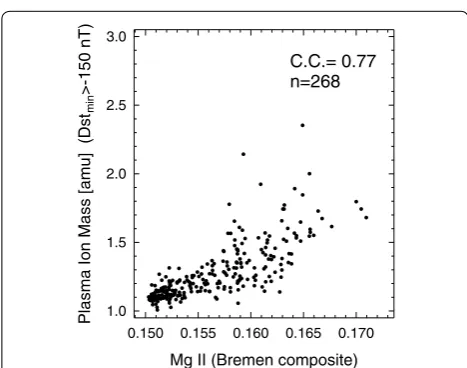
seem follow those of Mg II; M remains at ~1.1 amu dur-ing the solar minimum (1994–1997 and 2006–2010) and increases to ~1.5 amu during the solar maximum (1998–2004 and 2012–2015). It is noteworthy that the temporal decreases of the Mg II index in 2001 and 2014 coincide with the temporal low values of M, as indicated by vertical arrows. From Fig. 3, it is seen that the Mg II index and M are strongly correlated (c.c. = 0.77) when the data points of M in the orange bars are disregarded. These results suggest that the long-term variation of the ion composition in the plasma sheet is controlled by the solar activity measured by the Mg II index, that is, the solar EUV/FUV irradiance.
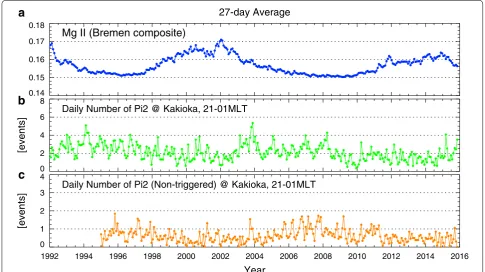
Variations of substorm occurrence for 23 years We investigate the long-term variations of the substorm occurrence in 1992–2015. The substorm occurrence is assessed by the daily number of Pi2 pulsations at Kak-ioka. The daily number of Pi2 pulsations is averaged over 27 days in the same way as the ion composition and the Mg II index. The results are shown in Fig. 4b with the Mg II index in Fig. 4a, which is identical to Fig. 2a, for easier comparison with the substorm occurrence. In Fig. 4b, the substorm occurrence peaks around 1994 and 2003– 2004, and decreases gradually until 2002 and 2014. These long-term changes of the substorm occurrence are not similar to the solar cycle. Figure 5a confirms the dissimi-larity between them by the small correlation coefficient (−0.28).
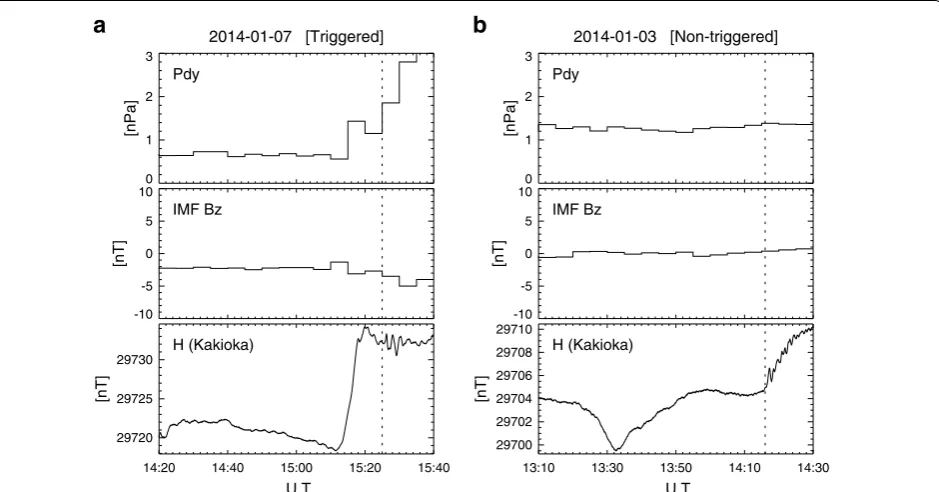
the 5-min resolution OMNI database. When a Pi2 pulsa-tion is preceded within 1 h by a ≥0.5 nPa jump in Pdy or a ≥1.5 nT jump in the IMF Bz, the Pi2 pulsation is attrib-uted to the external changes and the event is classified as a triggered substorm. When no such jumps are found in both Pdy and IMF Bz, the event is labeled as a non-trig-gered substorm. The 5-min resolution OMNI data are generally continuous after January 1995; thus the clas-sification is for January 1995 to October 2015. Figure 6a and b demonstrate typical examples of the triggered and non-triggered events, respectively. The event in Fig. 6a
follows the clear jumps of Pdy with ~1 nPa and IMF Bz with ~2 nT, whereas the event in Fig. 6b occurs during very steady solar wind conditions. Out of 13,495 events of Pi2 pulsations while the OMNI data are available, 8793 events (65.2 %) are triggered and 4702 events (34.8 %) are non-triggered. These percentages are consistent with the previous result reported by Hsu and McPher-ron (2003), in which the triggered and non-triggered events are ~60 % and ~40 % in the number of occurrence, respectively. Figure 4c shows the long-term variation of the daily number of the non-triggered events after aver-aged over the 27 days. The daily number of the non-trig-gered events seems to have peaks around 1995–1996 and 2007–2008, and troughs around 2001–2002 and 2014– 2015. This long-term variation looks inversely correlated with that of the Mg II index (Fig. 4a) with a correlation coefficient of −0.46, as shown in Fig. 5b, which is much improved from that in Fig. 5a. This result suggests that the non-triggered substorm occurrence is controlled by the solar EUV/FUV irradiance.
Discussion and conclusions
From Figs. 3 and 5b, we find that the Mg II index, a proxy of the solar EVU/FUV, is correlated with the plasma ion mass in the plasma sheet (c.c. = 0.77) as well as the occur-rence of the non-triggered substorms (c.c. = −0.46). We interpret this result to mean that (1) the increase in the solar EUV/FUV radiation raises the ionospheric ion den-sity and temperature, enhances the supply of ionospheric ions (He+ and O+ ions) into the plasma sheet, and increases M; and (2) the large M (i.e., heavy plasma sheet)
27-day Average
0.14 0.15 0.16 0.17 0.18
Mg II (Bremen composite)
a
1992 1994 1996 1998 2000 2002 2004 2006 2008 2010 2012 2014 2016 Year
1.0 1.5 2.0 2.5 3.0
[amu]
Dstmin<-150 nT=
Plasma Ion Mass
b
Fig. 2 a Mg II index (Bremen composite) averaged over 27 days for 1992–2015. b Plasma ion mass in the plasma sheet that is identical to Fig. 1g. Vertical orange bars denote 27-day time intervals when the minimum value of the Dst index is equal to or less than −150 nT. Vertical arrows in both panels point to a coincidence of temporal decreases in the Mg II index and the plasma ion mass around 2001 and 2014
0.150 0.155 0.160 0.165 0.170 Mg II (Bremen composite) 1.0
1.5 2.0 2.5 3.0
Plasma Ion Mass [amu] (Dst
min
>-150 nT)
C.C.= 0.77 n=268
may suppress spontaneous plasma instabilities that lead to the onset of substorms and decrease the number of the non-triggered substorms. Although the physical mecha-nisms of the suppression of plasma instabilities are not identified in this study, the inverse relation is identified
between M and the number of non-triggered substorm occurrence (Fig. 5c), which supports the second interpre-tation. The distribution of data points in Fig. 5c does not seem linear, but we find the linear correlation coefficient to be −0.37 that is statistically significant according to 27-day Average
0.14 0.15 0.16 0.17 0.18
Mg II (Bremen composite)
a
0 2 4 6 8
[events]
Daily Number of Pi2 @ Kakioka, 21-01MLT
b
1992 1994 1996 1998 2000 2002 2004 2006 2008 2010 2012 2014 2016 Year
0 1 2 3 4
[events]
Daily Number of Pi2 (Non-triggered) @ Kakioka, 21-01MLT
c
Fig. 4 a Mg II index that is identical to Fig. 2a. b Daily number of Pi2 pulsations observed at Kakioka at 2100–0100 magnetic local time for 1992– 2015. The number is averaged over 27 days in the same way as the integral fluxes and the Mg II index. c Daily number of Pi2 pulsations at Kakioka with no clear jumps in solar wind dynamic pressure and IMF Bz, which are considered non-triggered events
0.150 0.155 0.160 0.165 0.170
Mg II (Bremen composite)
0 2 4 6 8
Daily Number of Pi2 [events]
C.C.=-0.28 n=443
a
0.150 0.155 0.160 0.165 0.170
Mg II (Bremen composite)
0 1 2 3
Daily Number of Pi2 (Non-triggered)
[events]
C.C.=-0.46 n=283
b
1.0 1.5 2.0 2.5 3.0
Plasma Ion Mass [amu] (Dstmin>-150 nT)
0 1 2 3
Daily Number of Pi2 (Non-triggered)
[events]
C.C.=-0.37 n=257
c
the correlation coefficient test of Bevington and Robin-son (1992).
There has been a long discussion over the last 30 years about the role of heavy ions in substorm occurrence. Baker et al. (1982, 1985), Daglis and Sarris (1998), and Ono et al. (2010) concluded that heavy ions promote the occurrence of substorms. On the contrary, Lennartsson et al. (1993), Kistler et al. (2006), Nosé et al. (2009), and Liu et al. (2013) argued that the substorm occurrence is not related to the large abundance of heavy ions in the plasma sheet. Numerical simulations have examined the role of heavy ions in substorm occurrence. Using the multi-fluid Lyon-Fedder-Mobarry (MFLFM) global MHD code, Wiltberger et al. (2010), Brambles et al. (2011), and Ouellette et al. (2013) proposed a positive feedback loop in the magnetosphere-ionosphere system where the O+ ion outflow from the ionosphere facilitates the develop-ment of the next substorm. From numerical calculation using the multi-fluid Block-Adaptive Tree Solar-wind Roe Upwind Scheme (BATS-R-US) global MHD code, Yu and Ridley (2013) found opposite effects between the different ionospheric sources: O+ ions from the dayside cusp facilitate substorms, whereas those from the night-side auroral region hinder the development of substorms. As shown here, the influence of heavy ions on substorm dynamics is still a controversial issue and has not been
determined definitively. Review papers on this issue are also recently published (Wiltberger 2014; Kistler 2015).
From the statistical analysis of an unprecedentedly long-term dataset covering almost two solar cycles (~23 years), the present study provides additional obser-vational evidence that heavy ions work to prevent the occurrence of substorms. However, more theoretical studies are needed to comprehensively understand the role of heavy ions in the onset of substorms.
Acknowledgements
The Geotail/EPIC data are provided by A. T. Y. Lui and R. W. McEntire at the Johns Hopkins University Applied Physics Laboratory, and are available at
http://sd-www.jhuapl.edu/Geotail. The Mg II index is provided by the Uni-versity of Bremen and is available at http://www.iup.uni-bremen.de/gome/ gomemgii.html. The high-resolution OMNI data are provided by Space Physics Data Facility, Goddard Space Flight Center, and are available at http://omni-web.gsfc.nasa.gov/ow_min.html. The Dst index is provided by the World Data Center for Geomagnetism, Kyoto, and is available at http://wdc.kugi.kyoto-u. ac.jp. We are thankful to Y. Miyashita, K. Keika, and A. Ieda for their helpful comments. We thank S. R. Nylund for his help in processing the Geotail/EPIC data. This study was supported by the Ministry of Education, Culture, Sports, Science and Technology (MEXT), Grant-in-Aid for Scientific Research (B) (Grant 25287127).
Competing interests
The author declares that he has no competing interests.
Received: 6 December 2015 Accepted: 28 December 2015 2014-01-07 [Triggered]
0 1 2 3
[nPa]
Pdy
a
-10 -5 0 5 10
[nT]
IMF Bz
14:20 14:40 15:00 15:20 15:40 U T
29720 29725 29730
[nT]
H (Kakioka)
2014-01-03 [Non-triggered]
0 1 2 3
[nPa]
Pdy
b
-10 -5 0 5 10
[nT]
IMF Bz
13:10 13:30 13:50 14:10 14:30 U T
29700 29702 29704 29706 29708 29710
[nT]
H (Kakioka)
References
Baker DN, Hones W Jr, Young DT, Birn J (1982) The possible role of ionospheric oxygen in the initiation and development of plasma sheet instabilities. Geophys Res Lett 9:1337–1340. doi:10.1029/GL009i012p01337
Baker DN, Fritz TA, Birn J, Lennartsson W, Wilken B, Kroehl HW (1985) The role of heavy ionospheric ions in the localization of substorm disturbances on March 22, 1979: CDAW 6. J Geophys Res 90:1273–1281. doi:10.1029/ JA090iA02p01273
Balan N, Bailey GJ, Jenkins B, Rao PB, Moffett RJ (1994) Variations of ionospheric ionization and related solar fluxes during an intense solar cycle. J Geo-phys Res 99:2243–2253. doi:10.1029/93JA02099
Bevington PR, Robinson DK (1992) Data reduction and error analysis for the physical sciences, 2nd edn. McGrwa-Hill, Boston, pp 198–201 Bowman BR, Tobiska WK, Kendra MJ (2008) The thermospheric semiannual
density response to solar EUV heating. J Atmos Sol-Terr Phys 70:1482– 1496. doi:10.1016/j.jastp.2008.04.020
Brambles OJ, Lotko W, Zhang B, Wiltberger M, Lyon J, Strangeway RJ (2011) Magnetosphere sawtooth oscillations induced by ionospheric outflow. Science 332:1183–1186. doi:10.1126/science.1202869
Daglis IA (1997) The role of magnetosphere-ionosphere coupling in magnetic storm dynamics. In: Tsurutani BT (ed) Magnetic Storms, Geophys Monogr Ser, vol 98. AGU, Washington DC, pp 107–116
Daglis IA, Sarris ET (1998) Comment on “Experimental investigation of possible geomagnetic feedback from energetic (0.1 to 16 keV) ter-restrial O+ ions in the magnetotail current sheet” by Lennartsson OW,
Klumpar DM, Shelley EG. Quinn JM. J Geophys Res 103:29545–29548. doi:10.1029/98JA02268
Floyd L, Newmark J, Cook J, Herring L, McMullin D (2005) Solar EUV and UV spectral irradiances and solar indices. J Atmos Sol-Terr Phys 67:3–15. doi:10.1016/j.jastp.2004.07.013
Hamilton DC, Gloeckler G, Ipavich FM, Wilken B, Stuedemann W (1988) Ring current development during the great geomagnetic storm of February 1986. J Geophys Res 93:14343–14355. doi:10.1029/JA093iA12p14343
Heath DF, Schlesinger BM (1986) The Mg 280-nm doublet as a monitor of changes in solar ultraviolet irradiance. J Geophys Res 91:8672–8868. doi:10.1029/JD091iD08p08672
Hsu TS, McPherron RL (2003) Occurrence frequencies of IMF triggered and nontriggered substorms. J Geophys Res 108:1307. doi:10.1029/200 2JA009442
Kistler LM (2015) The impact of O+ on magnetotail dynamics. In:
Magneto-sphere-ionosphere coupling in the solar system, geophys monogr ser. AGU, Washington DC (in press)
Kistler LM, Mouikis CG, Cao X, Frey H, Klecker B, Dandouras I, Korth A, Marcucci MF, Lundin R, McCarthy M, Friedel R, Lucek E (2006) Ion composition and pressure changes in storm time and nonstorm substorms in the vicinity of the near-Earth neutral line. J Geophys Res 111:A11222. doi:10.1029/20 06JA011939
Lennartsson W (1989) Energetic (0.1- to 16-keV/e) magnetospheric ion com-position at different levels of solar F10.7. J Geophys Res 94:3600–3610. doi:10.1029/JA094iA04p03600
Lennartsson OW, Klumpar DM, Shelley EG, Quinn JM (1993) Experimental investigation of possible geomagnetic feedback from energetic (0.1 to 16 keV) terrestrial O+ ions in the magnetotail current sheet. J Geophys
Res 98:19443–19454. doi:10.1029/93JA01991
Liu Y, Kistler LM, Mouikis CG, Klecker B, Dandouras I (2013) Heavy ion effects on substorm loading and unloading in the Earth’s magnetotail. J Geophys Res 118:2101–2112. doi:10.1002/jgra.50240
Lui ATY, Chang CL, Mankofsky A, Wong HK, Winske D (1991) A cross-field cur-rent instability for substorm expansions. J Geophys Res 96:11389–11401. doi:10.1029/91JA00892
Lyons LR (1995) A new theory for magnetospheric substorms. J Geophys Res 100:19069–19081. doi:10.1029/95JA01344
Nishida A (1994) The GEOTAIL mission. Geophys Res Lett 21:2871–2874. doi:10.1029/94GL01223
Nosé M, Iyemori T, Takeda M, Kamei T, Milling DK, Orr D, Singer HJ, Worthing-ton EW, Sumitomo N (1998) Automated detection of Pi2 pulsations using wavelet analysis: 1. Method and an application for substorm monitoring. Earth Planets Space 50:773–783. doi:10.1186/BF03352169
Nosé M, McEntire RW, Christon SP (2003) Change of the plasma sheet ion composition during magnetic storm development observed by the Geo-tail spacecraft. J Geophys Res 108:1201. doi:10.1029/2004JA010930
Nosé M, Taguchi S, Hosokawa K, Christon SP, McEntire RW, Moore TE, Collier MR (2005) Overwhelming O+ contribution to the plasma sheet energy
den-sity during the October 2003 superstorm: Geotail/EPIC and IMAGE/LENA observations. J Geophys Res 110:A09S24. doi:10.1029/2004JA010930
Nosé M, Ieda A, Christon SP (2009) Geotail observations of plasma sheet ion composition over 16 years: on variations of average plasma ion mass and O+ triggering substorm model. J Geophys Res 114:A07223. doi:10.1029/
2009JA014203
Ono Y, Christon SP, Frey HU, Lui ATY (2010) Distribution of O+ ions in
the plasma sheet and locations of substorm onsets. J Geophys Res 115:A09220. doi:10.1029/2009JA015138
Ouellette JE, Brambles OJ, Lyon JG, Lotko W, Rogers BN (2013) Properties of outflow-driven sawtooth substorms. J Geophys Res 118:3223–3232. doi:10.1002/jgra.50309
Pulkkinen TI, Ganushkina NY, Baker DN, Turner NE, Fennell JF, Roeder J, Fritz TA, Grande M, Kellett B, Kettmann G (2001) Ring current ion composition during solar minimum and rising solar activity: Polar/CAMMICE/MICS results. J Geophys Res 106:19131–19148. doi:10.1029/2000JA003036
Roux A, Perraut S, Robert P, Morane A, Pedersen A, Korth A, Kremser G, Aparicio D, Rodgers D, Pellinen R (1991) Plasma sheet instability related to the westward traveling surge. J Geophys Res 96:17697–17714. doi:10.1029/91JA01106
Snow M, Weber M, Machol J, Viereck R, Richard E (2014) Comparison of Mag-nesium II core-to-wing ratio observations during solar minimum 23/24. J Space Weather Space Clim 4:A04. doi:10.1051/swsc/2014001
Stokholm M, Balsiger H, Geiss J, Rosenbauer H, Young DT (1989) Variations of the magnetospheric ion number densities near geostationary orbit with solar activity. Ann Geophys 7:69–76
Viereck R, Puga L, McMullin D, Judge D, Weber M, Tobiska WK (2001) The Mg II index: a proxy for solar EUV. Geophy Res Lett 28:1343–1346. doi:10.1029/ 2000GL012551
Williams DJ, McEntire RW, Schlemm C II, Lui ATY, Gloeckler G, Christon SP, Gliem F (1994) Geotail energetic particles and ion composition instru-ment. J Geomagn Geoelectr 46:39–57. doi:10.5636/jgg.46.39
Wiltberger M (2014) Review of global simulation studies of effect of iono-spheric outflow on magnetosphere-ionosphere system dynamics. In: Keiling A, Jackman CM, Delamere PA (eds) Magnetotails in the solar system, geophys monogr ser, vol 207. AGU, Washington DC, pp 373–392 Wiltberger M, Lotko W, Lyon JG, Damiano P, Merkin V (2010) Influence of cusp O+ outflow on magnetotail dynamics in a multifluid MHD model of the
magnetosphere. J Geophys Res 115:A00J05. doi:10.1029/2010JA015579
Young DT, Balsiger H, Geiss J (1982) Correlations of magnetospheric ion com-position with geomagnetic and solar activity. J Geophys Res 87:9077– 9096. doi:10.1029/JA087iA11p09077
Yu Y, Ridley AJ (2013) Exploring the influence of ionospheric O+ outflow on