The Thirty-Third AAAI Conference on Artificial Intelligence (AAAI-19)
A Neural Multi-Task Learning Framework to Jointly Model
Medical Named Entity Recognition and Normalization
Sendong Zhao,
∗Ting Liu,
‡Sicheng Zhao,
†Fei Wang
∗∗Weill Cornell Medical College, Cornell University, USA
†Department of Electrical Engineering and Computer Sciences, University of California Berkeley, USA
‡Research Center for Social Computing and Information Retrieval, Harbin Institute of Technology, China
{sez4001,few2001}@med.cornell.edu, [email protected], [email protected]
Abstract
State-of-the-art studies have demonstrated the superiority of joint modeling over pipeline implementation for medical named entity recognition and normalization due to the mutual benefits between the two processes. To exploit these benefits in a more sophisticated way, we propose a novel deep neural multi-task learning framework with explicit feedback strate-gies to jointly model recognition and normalization. On one hand, our method benefits from the general representations of both tasks provided by multi-task learning. On the other hand, our method successfully converts hierarchical tasks into a parallel multi-task setting while maintaining the mutual supports between tasks. Both of these aspects improve the model performance. Experimental results demonstrate that our method performs significantly better than state-of-the-art approaches on two publicly available medical literature datasets.
Introduction
Due to the large amount of electronically-available medical publications stored in databases such as PubMed, there has been an increasing interest in applying text mining and infor-mation extraction to the medical literature. Those techniques can generate tremendous benefits for both medical research and applications. Among the medical literature mining tasks, medical named entity recognition and normalization are the most fundamental tasks.
The goal of medical named entity recognition and nor-malization is to find the boundaries of mentioning from the medical text and map them onto a controlled vocabulary. State-of-the-art studies have demonstrated the superiority of joint modeling of medical named entity recognition and nor-malization compared to the pipeline implementation due to mutual benefits between them. There are two main limi-tations of pipeline models: (1) errors from the recognition tagging cascade into normalization errors, and (2) recogni-tion and normalizarecogni-tion are mutually useful to each other, but pipeline models cannot utilize these potential benefits. Joint modeling recognition and normalization can naturally alleviate these limitations and achieve better performance. For example, Leaman and Lu (2016) leveraged a joint scor-ing function for medical named entity recognition and
nor-Copyright c⃝2019, Association for the Advancement of Artificial Intelligence (www.aaai.org). All rights reserved.
malization. Lou et al. (2017) proposed a transition-based model to jointly perform medical named entity recognition and normalization, casting the output construction process into an incremental state transition process. However, these existing joint modeling methods (1) rely heavily on hand-crafted features and task specific resources thus fail to en-code complicated and general features such as character-level and semantic-character-level features; (2) use simplistic ways to jointly model medical named entity recognition and normal-ization, which cannot provide essential mutual supports be-tween these two.
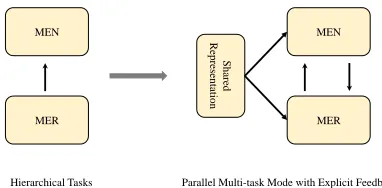
To improve the joint modeling medical named entity recognition and normalization (MER and MEN), we pro-pose a novel deep neural multi-task learning (MTL) frame-work with two explicit feedback strategies, which can make use of the mutual benefits between recognition and normal-ization in a more advanced and intelligent way. First, our method benefits from general representations of both tasks provided by multi-task learning, which enjoys a regulariza-tion effect (Collobert et al. 2011; Ruder 2017) that leads to more general representations to help both tasks. Specifically, it minimizes over-fitting to any specific tasks, thus makes the learned representations universal across tasks. Second, our method can successfully convert hierarchical tasks into a parallel multi-task setting while maintaining mutual sup-ports between tasks. Although the general concept of deep neural multi-task learning is not new, the innovation of our method is that it incorporates both the feedback strategies from the low-level task to the high-level task and vice versa, as shown in Figure 1. These two feedback strategies ex-ploit the output of entity recognition to improve entity nor-malization and vice versa. In addition, our method uses Bi-LSTM to boost the sequential modeling of text and CNN to encode clues hidden in character-level features such as
Zolmitriptan,ZomigandZomigon.
We evaluate our models across two corpora (the BioCre-ative V Chemical Disease Relation (BC5CDR) task corpus (Li et al. 2016) and the NCBI Disease corpus (Do˘gan, Lea-man, and Lu 2014)) of medical articles and outperform the state-of-the-art study by up to 4.53% F1 on medical named entity recognition and 5.61% F1 on medical named entity normalization.
Contribution.To make use of the mutual benefits in a more
multi-MER MEN
MER MEN
Share
d
Repre
senta
ti
on
Parallel Multi-task Mode with Explicit Feedback Hierarchical Tasks
Figure 1: From hierarchical tasks to parallel multi-task mode by incorporating explicit feedback strategies among tasks.
task learning framework with explicit feedback strategies to jointly model named medical entity recognition and normal-ization. This method incorporates both the feedback strate-gies from the low-level task to the high-level task and vice versa, which makes it possible to convert hierarchical tasks, i.e. MER and MEN, into parallel multi-task mode while maintaining mutual supports between tasks.
Related Work
MER and MEN. Several existing studies typically run a
medical named entity recognition model to extract entity names first, then run a medical named entity normaliza-tion model to link extracted names to a controlled vocab-ulary (Doan and Xu 2010; Sahu and Anand 2016). Such decoupled approaches used pipeline models to implement MER and MEN separately, leading to errors cascade and ab-sence of mutual benefits. There has been a line of research on joint modeling MER and MEN, which has demonstrated the superiority over pipeline implementation. For example, semi-CRF has been used for joint entity recognition and dis-ambiguation (Luo et al. 2015). Leaman and Lu (2016) lever-age a joint scoring function for MER and MEN. Leaman, Wei, and Lu (2015) developed a chemical named entity rec-ognizer and normalizer created by combining two indepen-dent machine learning models in an ensemble. Lou et al. (2017) propose a transition-based model to jointly perform disease named entity recognition and normalization.
Methodology of NER. Traditional approaches to
NER include handcrafted features for Maximum Entropy models (Curran and Clark 2003), Conditional Random Fields (McCallum and Li 2003), and Hidden Markov Mod-els (Klein et al. 2003). State-of-the-art neural NER tech-niques use a combination of pre-trained word embeddings and character embeddings derived from a convolutional neu-ral network (CNN) layer or bidirectional long short-term memory (LSTM) layer. These features are passed to a Bi-LSTM layer, which may be followed by a CRF layer (Lam-ple et al. 2016; Ma and Hovy 2016; Chiu and Nichols 2016). Strubell et al. (2017) proposed a faster alternative to Bi-LSTMs for NER: Iterated Dilated Convolutional Neural Networks (ID-CNNs), which have better capacity than tra-ditional CNNs for large context and structured prediction.
Neural Multi-Task Learning.Multi-Task Learning is a
learning paradigm in machine learning and its aim is to leverage useful information contained in multiple related
tasks to help improve the generalization performance of all the tasks. It has been used successfully across many tasks of NLP (Collobert et al. 2011). In the context of deep learning for NLP, the most notable work was proposed by Collobert and Weston (2008), which aims at solving multiple NLP tasks within one framework by sharing common word em-beddings. In recent years, the idea of neural deep multi-task learning becomes popular to sequence-to-sequence prob-lems with LSTM (Dong et al. 2015; Luong et al. 2016; Liu et al. 2016; Augenstein and Søgaard 2017). There are also a few studies which make use of multi-task learning for biomedical named entity recognition, such as cross-type biomedical named entity recognition (Wang et al. 2018) and multiple independent tasks modeling with MER in-volved (Crichton et al. 2017).
Problem Definition
This section gives formal definitions of the two tasks to be investigated: MER and MEN.
Medical Named Entity Recognition
The medical named entity recognition (MER) task is to find the boundaries of mentions from medical text. It differs from general NER in several ways. A large number of synonyms and alternate spellings of an entity cause explosion of word vocabulary sizes and reduce the efficiency of dictionary of medicine. Entities often consist of long sequences of tokens, making harder to detect boundaries exactly. It is very com-mon to refer to entities also by abbreviations, sometimes non-standard and defined inside the text. Polysemy or am-biguity is pronounced: proteins (normally class GENE) are also chemical components and depending on the context oc-casionally should be classified as class CHEMICAL; tokens that are sometimes of class SPECIES can be part of a longer entity of class DISEASE referring to the disease caused by the organism or the specialization of disease on the patient species. In this work, we follow the setup of the shared subtasks of BioCreative. Given a sentence s, i.e., a word sequencew1, ..., wn, each word is annotated with a
predi-cated MER tag (e.g., “B-DISEASE”). Therefore, we con-sider MER as a sequence-labeling task.
Medical Named Entity Normalization
Medical named entity normalization (MEN) is to map ob-tained medical named entities into a controlled vocabulary. It is usually considered as a follow-up task of MER because MEN is usually conducted on the output of MER. In other words, MER and MEN are usually considered as hierarchi-cal tasks in previous studies. In this paper, we consider MEN and MER as parallel tasks. MEN takes the same input with MER and have different output, i.e., for each word sequence
w1, ..., wn, MEN outputs a sequence of tags from a different
tag set. Therefore, we also consider MEN as a sequence-labeling task with the same input with MER.
signal indicating the beginning of a disease entity, making MEN to map the code of a disease. Conversely, the output of MEN, such as “D054549-P” which is a disease code tag, is very helpful to recognize it as a part of a disease named entity.
Our Method
Medical named entity recognition and normalization (MER and MEN) are hierarchical tasks and their outputs poten-tially have mutual benefits for each other as well. Specifi-cally, the output of MER, such as “B-DISEASE”, is a clear signal indicating the beginning of a disease entity, leading to reducing the searching space of MEN and vice versa. There-fore, we propose to incorporate two explicit feedback strate-gies into multi-task learning framework to model mutual en-hancement effects between tasks1. In addition, we exploit Bi-LSTM to power the sequential modeling of the text and CNN to encode clues hidden in character-level features such asZolmitriptan,ZomigandZomigon.
Notation.We usex1:nto denote a sequence ofnvectors
x1, ...,xn.Fθ(·)is a Bi-LSTM parameterized with
param-etersθ. We useFL(·)as a forward LSTM andFR(·)as a backward LSTM with specific sets of parametersθLandθR.
M ER(w1:n, i)is the function to represent medical named
entity recognition taking word sequencew1:nand indexias
input and output the corresponding named entity tagyi M ER. M EN(w1:n, i)is the function to represent medical named
entity normalization taking word sequencew1:nand indexi
as input and output the corresponding controlled vocabulary tagyiM EN. We use◦ to denote a vector concatenation op-eration.UandVare matrices to map the feedback of one task to the other. In this paper, we denote scalars by lower-case letters, such asx; vectors by boldface lowercase letters, such asx; and matrices by boldface uppercase letters, such asX.
CNN for Character-level Representation
Previous studies (Chiu and Nichols 2016) have shown that CNN is an effective approach to extract morphological in-formation (like the prefix or suffix of a word) from charac-ters of words and encode it into neural representations. Fig-ure 2 shows the CNN we use to extract character-level rep-resentation of a given word. The CNN is similar to the one in Chiu and Nichols (2016) except that we use only charac-ter embeddings as the inputs to CNN, without characcharac-ter type features. A dropout layer is applied before character embed-dings are fed into CNN.
Sequence-labeling with Bi-LSTM
The extracted features of each word, including pre-trained word embeddings from Word2Vec and character-level word representation from CNN, are fed into a forward LSTM and a backward LSTM. The output of each network at each time step is decoded by a linear layer and a log-softmax layer into log-probabilities for each tag category. These two vectors are then simply added together to produce the final output.
1
Our code is at GitHub (https://github.com/SendongZhao/Multi-Task-Learning-for-MER-and-MEN).
Padding Z o m i g Padding
Character Embedding
Convolution Layer
Max Pooling Layer
Char-level Word Representation
Figure 2: The CNN layer for extracting character-level word representation of word Zomig (another name of the DRUGZolmitriptanandZomigon). Dashed arrows indicate a dropout layer applied before character embeddings are fed into CNN.
We view LSTM as a parameterized function Fθ(x1:n)
mapping a sequence ofninput vectorsx1:n,xi ∈ Rdinto
outputnvectorsh1:n,hi∈Rdout. A Bi-LSTM is composed
of two LSTMs, denoted as functionsFLandFR. One
read-ing the sequence in its regular order, and the other readread-ing it in reverse. Concretely, given a sequencex1:n and a desired
indexi, the functionFθ(x1:n, i)is defined as:
Fθ(x1:n, i) =vi=hL,i◦hR,i hL,i=FL(x1,x2, ...,xi) hR,i=FR(xn,xn−1, ...,xi)
The vectorvi=Fθ(x1:n, i)is then a representation of the ith item inx1:n, taking into account both the entire history x1:iand the entire futurexi:n. Finally, in a deep Bi-LSTM,
bothFLandFRare k-layer LSTMs, andFℓ
θ(x1:n, i) =vi= hℓL,i◦hℓR,i.
In a sequence tagging task, we are given an input
w1, ..., wn and need to predict an output y1, ..., yn, yi ∈ yi
1:|L|, where L is a label set of interest; i.e., in a
medi-cal named entity recognition task,Lis the named entity tag set, andyi is the named entity tag for wordwi such as “B-DISEASE”.
If we take the inputsx1:nto represent a sequence of
sen-tence wordsw1, ..., wn, we can think ofvi=Fθ(x1:n, i)as
inducing an infinite window around a focus wordwi. We can then usevi as an input to a multi-class classification
func-tion f(vi), to assign a tagyˆi to each input locationi. The
Takotsubo syndrome secondary to Zolmitriptan
Embedding layer (word + character) B-DISEASE D054549-P
∑ ∑
U V
I-DISEASE D054549-P
∑ ∑
U V
O NULL
∑ ∑
U V
O NULL
∑ ∑
U V
B-CHEMICAL C089750
∑ ∑
U V
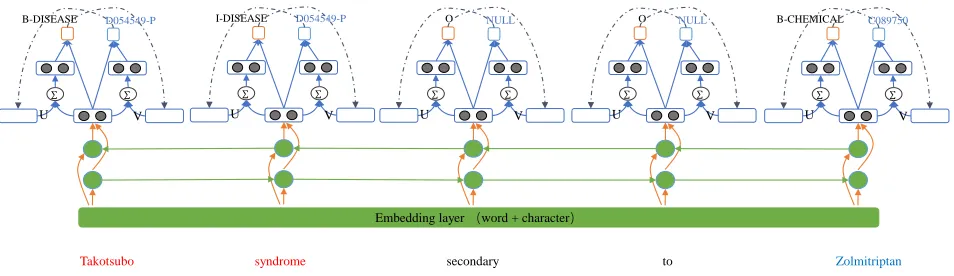
Figure 3: The main architecture of our neural multi-task learning model with two explicit feedback strategies for MER and MEN. The character embedding is computed by CNN in Figure 2. Then the character representation vector is concatenated with the word embedding before feeding into the Bi-LSTM. Dashed arrows from the left to the right is the feedback from MER to MEN. Dashed arrows from the right to the left is the feedback from MEN to MER. Orange arrows indicate dropout layers applied on both the input and output vectors of Bi-LSTM.
For a k-layer Bi-LSTM tagger for MER and MEN we get:
M ER(w1:n, i) =yiM ER= arg maxyiM ER
=fM ER(vki)
M EN(w1:n, i) =yiM EN = arg maxy i M EN
=fM EN(vki)
vik=F k
θ(x1:n, i)
x1:n=E(w1), E(w2), ..., E(wn)
where E as an embedding function mapping each word in the vocabulary into a d-dimensional vector, yi
M ER is
the log-probabilities vector with the length of MER tag space, yi
M ER is the output tag of MER, yiM EN is the
log-probabilities vector with the length of MEN tag space,
yM ENi is the output tag of MEN, andvik is the output of thekth Bi-LSTM layer as defined above. All the parameters are trained separately for MER and MEN because we model MER and MEN as different sequence labeling tasks.
Multi-task Mode with Explicit Feedback Strategies
The dependencies between MER and MEN inspire us to ex-plore their potential mutual benefits. In order to make the most of the mutual benefits between MER and MEN, we propose to feed the above mentioned Bi-LSTM and its vari-ants into multi-task learning framework with two explicit feedback strategies, as shown in Figure 3. This method (1) is able to convert hierarchical tasks into parallel multi-task mode while maintaining mutual supports between tasks; (2) benefits from general representations of both tasks provided by multi-task learning; (3) is effective in determining bound-aries of medical named entities through explicit feedback strategies thus improves the performance of both MER and MEN.
We experiment with a multi-task learning architecture based on stacked Bi-LSTM, CNNs and CRF. Multi-task learning can be seen as a way of regularizing model in-duction by sharing representations with other inin-ductions.
We use stacked Bi-LSTM-CNNs-CRF with task supervision from multiple tasks, sharing Bi-LSTM-CNNs layers among the tasks.
MER and MEN are hierarchical tasks and their outputs potentially have mutual benefits for each other as well. It means MEN can take MER results as input, while the re-sults of MEN can be also useful for MER. However, MER and MEN can be implemented independently as different se-quence tagging tasks. Therefore, we 1) follow the popular strategy of multi-task learning to share representations be-tween MER and MEN; and 2) propose to use mutual feed-back between MER and MEN, i.e., the result of MER is fed into the MEN as part of the input and the result of MEN is fed into the MER as part of the input. The multi-task learn-ing with two explicit feedback strategies for MER and MEN is defined as:
M ER(w1:n, i) =yiM ER= arg maxy i M ER
=fM ER(viM ER)
M EN(w1:n, i) =yiM EN = arg maxy i M EN
=fM EN(vM ENi )
vM ERi =vki ◦(vki +yiM ENU)
vM ENi =vki ◦(vki +yiM ERV)
vki =F k
θ(x1:n, i)
x1:n=E(w1), E(w2), ..., E(wn)
wherefM ER(vM ERi )is the MER multi-class classification function and fM EN(vM ENi ) the MEN multi-class classi-fication function. vM ERi is the input of MER multi-class classification function, which combines the output of the shared stacked Bi-LSTM-CNNs and the explicit feedback from MEN.vM EN
i is the input of MEN multi-class
classi-fication function, which combines the output of the shared Bi-LSTM-CNNs and the explicit feedback from MER. U
is the matrix to map the feedback from MEN to MER, V
(vki+yiM ERV)as a modification according to the feedback from MER, which could makevk
i a better vector to get the
correct label, the same asvk
i +yM ENi U.
In the multi-task learning setting, we have two prediction tasks over the same input vocabulary space. These two pre-diction tasks share k-layer Bi-LSTM-CNNs (i.e., hard pa-rameter sharing). Each task has its own output vocabulary (a task-specific tag set), but all of them map the lengthninput sequence into a lengthnoutput tag sequence.
The Multi-task training protocol.We assume to
sepa-rate training set intoT different subsets corresponding toT
different tasks. We labelT different subsets asD1, ..., DT,
where each Dt contains pairs of input-output sequences (w1:n,yt1:n),wi ∈ W, yti ∈ Lt. The input sets of words W is shared across tasks, but the output sets (tag set)Ltare task dependent.
At each step in the training process we choose a random taskt, followed by a random training instance(w1:n, y1:tn)∈ Dt. We use the tagger of tasktto predict the labelsyˆt
i, suffer
a loss with respect to the true labelsyt
i and update the
out-put log-probabilities vectoryt
i ofw1:nas well as the model
parameters. If we choose MER at the very first step, we take the feedback from MEN as a log-probabilities vector with the initialization of each element having the same value |L1t|
and vice versa, where|Lt|is the length of the tag set of task t. Notice that a task t (eg. MER and MEN in this paper) is associated with the stacked Bi-LSTM-CNNs. The update for a sample from tasktaffects the parameters offtand the sharedk-layer functionsF1
θ, .., Fθk, but not the parameters
offt′̸=t. This asynchronous training protocol makes it
pos-sible to implement our model in distributed way. We tried a synchronized way of training as well but did not lead to any difference in results.
Experiments
Datasets
We evaluate the performance of the MTL models on two corpora: BC5CDR task corpus (Li et al. 2016) and the NCBI Disease corpus (Do˘gan, Leaman, and Lu 2014). The BC5CDR corpus contains 1500 PubMed abstracts, which are equally partitioned into three sections for training, de-velopment and test, respectively. A disease mention in each abstract is manually annotated with the concept identifier to which it refers to a controlled vocabulary. The NCBI Dis-ease corpus consists of 793 PubMed abstracts, which are also separated into training (593), development (100) and test (100) subsets. The NCBI Disease corpus is annotated with disease mentions, using concept identifiers from ei-ther MeSH or OMIM. Table 1 gives the statistics of the two corpora. Due to the limit of the vocabulary of chemi-cal, we only consider mapping disease mentions to a con-trolled vocabulary of diseases. To map disease mentions to MeSH/OMIM concepts (IDs), we use the Comparative Tox-icogenomics Database (CTD) MEDIC disease vocabulary, which consists of 9700 unique diseases described by more than 67 000 terms (including synonyms).
Pre-trained word embeddings
We initialized the word embedding matrix with four types of publicly available pre-trained word embeddings respec-tively. The first is Word2Vec 50-dimensional embeddings trained on the PubMed abstracts together with all the full-text articles from PubMed Central (PMC) (Pyysalo et al. 2013). The second is GloVe 100-dimensional em-beddings trained on 6 billion words from Wikipedia and web text (Pennington, Socher, and Manning 2014). The third is Senna 50-dimensional embeddings trained on Wikipedia and Reuters RCV-1 corpus (Collobert et al. 2011). The fourth is the randomly initialized 100-dimensional embeddings which are uniformly sampled from
range [−√ 3 dim,+
√ 3
dim], wheredim is the dimension of
embeddings (He et al. 2015).
Evaluation Metrics and Settings
We perform experiments for both medical named entity recognition and medical named entity normalization. We utilize the evaluation kit2 for evaluating model perfor-mances. Metrics measured are concept-level precision, re-call and F1.
Our single- and multi-task networks are 3-layer, Bi-LSTM-CNNs with pre-trained word embeddings. For the neural multi-task learning model, we follow the training procedure outlined in Section . We use the word embed-dings setup in Section . Character embedembed-dings are
initial-ized with uniform samples from[−√ 3 dim,+
√ 3
dim], where
we setdim= 30. We follow (Søgaard and Goldberg 2016) in using the same dimension for the hidden layers. We use a dropout rate of 0.5 and train these architectures with mentum SGD with the initial learning rate of 0.001 and mo-mentum of 0.9 for 20 epochs.
Main Results
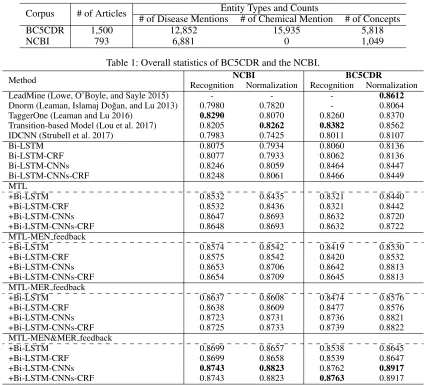
The first part of Table 2 illustrates the results of 5 previous top-performance systems for (medical) named entity recog-nition and normalization. Among these previous studies, LeadMine and IDCNN are pipeline models, while Dnorm, TaggerOne, and Transition-based Model are joint models. From the first part, it is clear that the joint models perform better than the pipeline models on both corpora. The sec-ond part of the table presents comparisons of Bi-LSTM and its variants for MER and MEN. Adding CRF layer on both Bi-LSTM and Bi-LSTM-CNNs can not bring significant im-provements. It might because the most of entity mentions in our data sets are single-word entities, i.e., entity with one word. CNN layer for char-level representation causes signif-icant improvements on Bi-LSTM and its variants for both MER and MEN. Bi-LSTM-CNNs and Bi-LSTM-CNNs-CRF significantly outperform Bi-LSTM and Bi-LSTM-Bi-LSTM-CNNs-CRF respectively, showing that character-level word representa-tions are important for both recognition and normalization. The improvents rely on two clues, 1) different medical enti-ties usually have the same prefix and suffix, such asacetate,
2
Corpus # of Articles Entity Types and Counts
# of Disease Mentions # of Chemical Mention # of Concepts
BC5CDR 1,500 12,852 15,935 5,818
NCBI 793 6,881 0 1,049
Table 1: Overall statistics of BC5CDR and the NCBI.
Method NCBI BC5CDR
Recognition Normalization Recognition Normalization LeadMine (Lowe, O’Boyle, and Sayle 2015) - - - 0.8612 Dnorm (Leaman, Islamaj Do˘gan, and Lu 2013) 0.7980 0.7820 - 0.8064 TaggerOne (Leaman and Lu 2016) 0.8290 0.8070 0.8260 0.8370 Transition-based Model (Lou et al. 2017) 0.8205 0.8262 0.8382 0.8562 IDCNN (Strubell et al. 2017) 0.7983 0.7425 0.8011 0.8107
Bi-LSTM 0.8075 0.7934 0.8060 0.8136
Bi-LSTM-CRF 0.8077 0.7933 0.8062 0.8136
Bi-LSTM-CNNs 0.8246 0.8059 0.8464 0.8447
Bi-LSTM-CNNs-CRF 0.8248 0.8061 0.8466 0.8449
MTL
+Bi-LSTM 0.8532 0.8435 0.8321 0.8440
+Bi-LSTM-CRF 0.8532 0.8436 0.8321 0.8442
+Bi-LSTM-CNNs 0.8647 0.8693 0.8632 0.8720
+Bi-LSTM-CNNs-CRF 0.8648 0.8693 0.8632 0.8722
MTL-MEN feedback
+Bi-LSTM 0.8574 0.8542 0.8419 0.8530
+Bi-LSTM-CRF 0.8575 0.8542 0.8420 0.8532
+Bi-LSTM-CNNs 0.8653 0.8706 0.8642 0.8813
+Bi-LSTM-CNNs-CRF 0.8654 0.8709 0.8645 0.8813
MTL-MER feedback
+Bi-LSTM 0.8637 0.8608 0.8474 0.8576
+Bi-LSTM-CRF 0.8638 0.8609 0.8477 0.8576
+Bi-LSTM-CNNs 0.8723 0.8731 0.8736 0.8821
+Bi-LSTM-CNNs-CRF 0.8725 0.8733 0.8739 0.8822
MTL-MEN&MER feedback
+Bi-LSTM 0.8699 0.8657 0.8538 0.8645
+Bi-LSTM-CRF 0.8699 0.8658 0.8539 0.8647
+Bi-LSTM-CNNs 0.8743 0.8823 0.8762 0.8917
+Bi-LSTM-CNNs-CRF 0.8743 0.8823 0.8763 0.8917
Table 2: F1 score of medical named entity recognition and normalization on two corpora.
acetone, antritisand pharyngitis. Modeling such character-level information can benefit recognition; 2) different names which refer to the same medical entity usually share the same character fragments, such asZolmitriptan,Zomigand
Zomigon. Modeling such character-level information can
benefit normalization.
From the third part of Table 2, we can see that MTL framework with Bi-LSTM and its variants significantly out-performs the pipeline use of Bi-LSTM and its variants, which indicates the contribution of general representations of MER and MEN provided by MTL. The fourth part and fifth part of Table 2 present the improvements by incorpo-rating the feedback from MEN and the feedback from MER. Both feedback strategies can improve the performance of MER and MEN on both corpora, but the feedback from MER performs better. It makes sense because the original order of task hierarchy is from MER to MEN. Therefore, it is very natural that MEN needs more supports from MER than MER needs from MEN. The last part of Table 2 presents the results of Bi-LSTM and its variants in the MTL framework
with both feedback of MEN and MER. This feedback-based MTL framework achieves the best result on each Bi-LSTM based models, indicating it is the best MTL framework on Bi-LSTM based models for MER and MEN.
Effect of Dropout
Table 3 compares the results with and without dropout lay-ers for training sets. All other hyper-parametlay-ers and features remain the same as our best model in Table 2. We observe slightly improvements for the two tasks on both corpora. It confirms the function of dropout in reducing over-fitting re-ported by Srivastava et al. (2014).
NCBI BC5CDR
MER MEN MER MEN
No 0.8669 0.8713 0.8722 0.8821
Yes 0.8743 0.8823 0.8763 0.8917
Embedding Dimension NCBI BC5CDR
Recognition Normalization Recognition Normalization
Random 100 0.7532 0.7746 0.7665 0.7725
Senna 50 0.7944 0.8016 0.7911 0.7966
GloVe 100 0.7963 0.8042 0.8009 0.8062
Word2Vec 50 0.8743 0.8823 0.8763 0.8917
Table 4: Results with different choices of word embeddings on the two tasks (F1 score).
Influence of Word Embeddings
As mentioned in Section , in order to test the importance of pre-trained word embeddings, we performed experiments with different sets of publicly published word embeddings, as well as a random sampling method, to initialize our model. Table 4 gives the performance of three different word embeddings, as well as the randomly sampled one. Accord-ing to the results in Table 4, models usAccord-ing pre-trained word embeddings achieve a significant improvement as opposed to the ones using random embeddings. Both MER and MEN rely heavily on pre-trained embeddings. This is consistent with results of previous work (Huang, Xu, and Yu 2015; Chiu and Nichols 2016).
For different pre-trained embeddings Word2Vec 50 di-mensional embeddings achieve best results on both tasks. This is different from the results reported by (Ma and Hovy 2016), where Glove achieved significantly better performance on NER than Word2Vec embedding. Senna 50-dimensional embeddings obtain similar performance with Glove on MER and MEN, also significant behind Word2Vec. One possible reason that Word2Vec is signifi-cantly better than the other two embeddings on MER and MEN is using domain related text for training embeddings. Word2Vec embeddings were trained on PubMed abstracts and the full-text articles. The other two embeddings which were trained on other domain text, leading to vocabulary mismatch of entities.
Boundary Inconsistency Error Analysis
Since we model MER and MEN as different sequence la-beling tasks, the result of MER likely have different bound-ary with the result of MEN. Table 5 compares the ratios of boundary inconsistency of MER and MEN on each test set of both corpora. It is clear that our proposed MTL frame-work with two feedback strategies on MER and MEN can significantly alleviate the boundary inconsistency of MER and MEN thus improve the performance.
NCBI BC5CDR
Bi-LSTM-CNNs-CRF 0.0635 0.0563
MTL
0.0412 0.0383 +Bi-LSTM-CNNs-CRF
MTL-MEN&MER feedback
0.0134 0.0114
+Bi-LSTM-CNNs-CRF
Table 5: Ratios of the boundary inconsistency of MER and MEN on two test sets.
OOV Entities Error Analysis
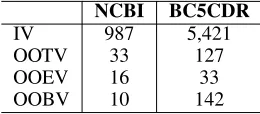
To better understand the behavior of our model, we per-form error analysis on Out-of-Vocabulary words (OOV). Specifically, we partition each data set into four subsets – in-vocabulary words (IV), out-of-training-vocabulary words (OOTV), out-of-embedding-vocabulary words (OOEV) and out-of-both-vocabulary words (OOBV). A word is consid-ered IV if it appears in both the training and embedding vocabulary, while OOBV if neither. OOTV words are the ones do not appear in training set but in embedding vocab-ulary, while OOEV are the ones do not appear in embed-ding vocabulary but in training set. An entity is considered as OOBV if there exists at lease one word not in training set and at least one word not in embedding vocabulary, and the other three subsets can be done in similar manner. Table 6 presents the statistics of the partition on each corpus. The embedding we used is pre-trained 50-dimensional embed-dings in (Pyysalo et al. 2013), the same as Section .
Table 7 illustrates the performance of our best model on different subsets of entities. The largest improvements ap-pear on the IV and OOTV subsets of both the two corpora on both tasks. This demonstrates that by feeding into multi-task learning framework with explicit feedback, our model is more powerful on entities that appear in pre-trained em-bedding sets, which shows the superiority of our model to
NCBI BC5CDR
IV 987 5,421
OOTV 33 127
OOEV 16 33
OOBV 10 142
Table 6: Statistics of the partition on each test set. It lists the number of unique entities.
NCBI BC5CDR
MER MEN MER MEN
Bi-LSTM-CNNs-CRF
IV 0.8451 0.8254 0.8738 0.8677 OOTV 0.8046 0.8094 0.8279 0.8354 OOEV 0.7776 0.8064 0.7835 0.7821 OOBV 0.7221 0.7354 0.6937 0.7223 MTL-MEN&MER feedback+Bi-LSTM-CNNs-CRF IV 0.8931 0.9017 0.9042 0.9136 OOTV 0.8667 0.8753 0.8661 0.8832 OOEV 0.8053 0.8132 0.8163 0.82217 OOBV 0.7668 0.7713 0.7345 0.7804
make better use of pre-trained word embeddings and deal with entities which do not appear in training set.
Conclusion
We study the practical valuable task of MER and MEN. They are fundamental tasks in medical literature mining be-cause many developments in this area are related to these two tasks. Previous state-of-the-art studies have demon-strated that the mutual benefits between medical named en-tity recognition and normalization are very useful. To make use of the mutual benefits in a more advanced and intelligent way, we proposed a novel deep neural multi-task learning framework with two explicit feedback strategies to jointly model MER and MEN. Our method can convert hierarchi-cal tasks, i.e., MER and MEN, into parallel multi-task mode while maintaining mutual supports between tasks. Experi-mental results indicate that our model outperforms previous state-of-the-art studies.
Acknowledgments
This work is supported by NSF 1716432 and IIS-1750326.
References
Augenstein, I., and Søgaard, A. 2017. Multi-task learning of keyphrase boundary classification. InProc. of 55th ACL, 341–346. Chiu, J., and Nichols, E. 2016. Named entity recognition with bidirectional lstm-cnns.TACL4:357–370.
Collobert, R., and Weston, J. 2008. A unified architecture for natural language processing: deep neural networks with multitask learning. InProc. of 25th ICML, 160–167.
Collobert, R.; Weston, J.; Bottou, L.; Karlen, M.; Kavukcuoglu, K.; and Kuksa, P. 2011. Natural language processing (almost) from scratch.JMLR12:2493–2537.
Crichton, G.; Pyysalo, S.; Chiu, B.; and Korhonen, A. 2017. A neural network multi-task learning approach to biomedical named entity recognition.BMC Bioinformatics18(1):368.
Curran, J., and Clark, S. 2003. Language independent ner using a maximum entropy tagger. InProc. of NAACL-HLT-2003, 164–167. Doan, S., and Xu, H. 2010. Recognizing medication related entities in hospital discharge summaries using support vector machine. In
Proc. of COLING-2010, 259–266.
Do˘gan, R. I.; Leaman, R.; and Lu, Z. 2014. Ncbi disease corpus: A resource for disease name recognition and concept normalization.
Journal of Biomedical Informatics47(2):1.
Dong, D.; Wu, H.; He, W.; Yu, D.; and Wang, H. 2015. Multi-task learning for multiple language translation. InProc. of 53rd ACL, 1723–1732.
He, K.; Zhang, X.; Ren, S.; and Sun, J. 2015. Delving deep into rectifiers: Surpassing human-level performance on imagenet clas-sification. InProc. of ICCV-2015, 1026–1034. Washington, DC, USA: IEEE Computer Society.
Huang, Z.; Xu, W.; and Yu, K. 2015. Bidirectional LSTM-CRF models for sequence tagging.CoRRabs/1508.01991.
Klein, D.; Smarr, J.; Nguyen, H.; and Manning, C. D. 2003. Named entity recognition with character-level models. InProc. of
NAACL-HLT-2003, 180–183.
Lample, G.; Ballesteros, M.; Subramanian, S.; Kawakami, K.; and Dyer, C. 2016. Neural architectures for named entity recognition.
InProc. of NAACL-HLT-2016, 260–270.
Leaman, R., and Lu, Z. 2016. Taggerone: joint named entity recog-nition and normalization with semi-markov models. Bioinformat-ics32(18):2839.
Leaman, R.; Islamaj Do˘gan, R.; and Lu, Z. 2013. Dnorm: disease name normalization with pairwise learning to rank.Bioinformatics
29(22):2909–2917.
Leaman, R.; Wei, C. H.; and Lu, Z. 2015. tmchem: a high per-formance approach for chemical named entity recognition and nor-malization.Journal of Cheminformatics7(S1):S3.
Li, J.; Sun, Y.; Johnson, R. J.; Sciaky, D.; Wei, C. H.; Leaman, R.; Davis, A. P.; Mattingly, C. J.; Wiegers, T. C.; and Lu, Z. 2016. Biocreative v cdr task corpus: a resource for chemical disease re-lation extraction. Database: The Journal of Biological Databases
and Curation2016:baw068.
Liu, Y.; Li, S.; Zhang, X.; and Sui, Z. 2016. Implicit discourse relation classification via multi-task neural networks. InProc. of
30th AAAI, 2750–2756.
Lou, Y.; Zhang, Y.; Qian, T.; Li, F.; Xiong, S.; and Ji, D. 2017. A transition-based joint model for disease named entity recognition and normalization.Bioinformatics33(15):2363.
Lowe, D. M.; O’Boyle, N. M.; and Sayle, R. A. 2015. Leadmine: Disease identification and concept mapping using wikipedia. Inthe
Fifth BioCreative Challenge Evaluation Workshop.
Luo, G.; Huang, X.; Lin, C. Y.; and Nie, Z. 2015. Joint entity recognition and disambiguation. InProc. of EMNLP-2015, 879– 888.
Luong, M.-T.; Le, Q. V.; Sutskever, I.; Vinyals, O.; and Kaiser, L. 2016. Multi-task sequence to sequence learning. InProc. of
ICLR-2016.
Ma, X., and Hovy, E. H. 2016. End-to-end sequence labeling via bi-directional lstm-cnns-crf. InProc. of 54th ACL, 1064–1074. McCallum, A., and Li, W. 2003. Early results for named entity recognition with conditional random fields, feature induction and web-enhanced lexicons. InProc. of NAACL-HLT-2003, 188–191. Pennington, J.; Socher, R.; and Manning, C. 2014. Glove: Global vectors for word representation. InProc. of EMNLP-2004, 1532– 1543.
Pyysalo, S.; Ginter, F.; Moen, H.; Salakoski, T.; and Ananiadou, S. 2013. Distributional semantics resources for biomedical text processing. InProc. of Languages in Biology and Medicine, 39– 44.
Ruder, S. 2017. An overview of multi-task learning in deep neural networks.CoRRabs/1706.05098.
Sahu, S., and Anand, A. 2016. Recurrent neural network models for disease name recognition using domain invariant features. In
Proc. of 54th ACL, 2216–2225.
Søgaard, A., and Goldberg, Y. 2016. Deep multi-task learning with low level tasks supervised at lower layers. InProc. of 54th ACL, 231–235.
Srivastava, N.; Hinton, G.; Krizhevsky, A.; Sutskever, I.; and Salakhutdinov, R. 2014. Dropout: a simple way to prevent neu-ral networks from overfitting.JMLR15(1):1929–1958.
Strubell, E.; Verga, P.; Belanger, D.; and McCallum, A. 2017. Fast and accurate entity recognition with iterated dilated convolutions.
InProc. of EMNLP-2017, 2670–2680.
Wang, X.; Zhang, Y.; Ren, X.; Zhang, Y.; Zitnik, M.; Shang, J.; Langlotz, C.; and Han, J. 2018. Cross-type biomedical named entity recognition with deep multi-task learning. CoRR