Overview Page Detection
Heinz-Peter Lang MODUL University Vienna [email protected]
Gerhard Wohlgenannt
Vienna University of Economics and Business [email protected]
Albert Weichselbraun University of Applied Sciences Chur
Abstract
Web pages not only containmain content, but also other elements such as navigation panels, advertisements and links to related documents. Furthermore, overview pages (summarization pages and entry points) duplicate and aggregate parts of articles and thereby create redundancies. The noise elements in Web pages as well as overview pages affect the performance of downstream processes such as Web-based Information Retrieval. Context Extraction’s task is identifying and extracting the main content from a Web page.
In this research-in-progress paper we present an approach which not only identifies and extracts the main content, but also detects overview pages and thereby allows skipping them. The content extraction part of the system is an extension of existing Text-to-Tag ratio methods, overview page detection is accomplished with thenet text length heuris-tic. Preliminary results and ad-hoc evaluation indicate a promising system performance. A formal evaluation and comparison to other state-of-the-art approaches is part of future work.
Keywords
content extraction, overview pages, text filtering, natural language processing, contex-tualized information spaces, Web-based information retrieval
1 Introduction
The presented approach is part of the media monitoring and Web intelligence platform webLyzard (Scharl et al., 2006) and reduces noise by (i) extracting relevant content from Web pages, and (ii) detectingoverview pages.
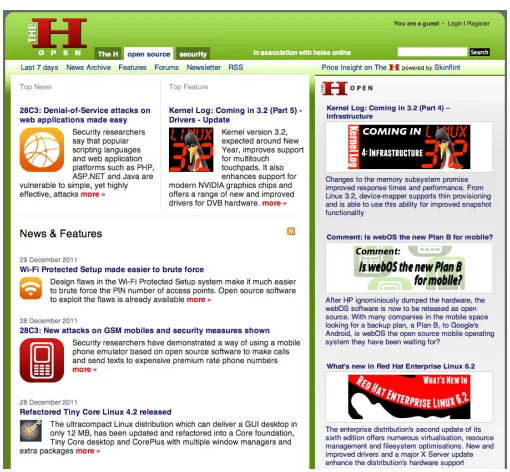
Fig. 1.Example of an overview page (h-online.com/open)
Overview pages (for an example see Figure 1) act as entry points and integrate a number of heterogeneous articles, usually with teasers of article text and “Read more” links to the full articles. All applications that perform tasks such as Web-based information re-trieval, or which generate domain specific corpora or portals based on the Web content, benefit from detecting and skipping such pages as they lead to redundancy and biased results in downstream processes. It is hard to detect and eliminate overview pages ex-post with document similarity metrics as overview pages are a mixture of (parts of) a number of documents.
We propose a pre-processing framework that applies an enhanced Text-to-Tag ratio method which takes the text length within links into account in the content extraction process. The system also facilitates the detection and rejection of overview pages based on net text lengthof most the relevant text blocks. To our knowledge there exist no content extraction systems which address the task of overview page detection.
2 Related Work
The term content extraction was first used by Rahman et al. (2001), some authors also refer toboilerplate detection(Kohlsch¨utter et al., 2010) or Web page segmenta-tion (Kohlsch¨utter & Nejdl, 2008; Yu et al., 2003).
Vision-based approaches (e.g. Yu et al., 2003) rely on partially rendering Web pages to identify visually grouped blocks. Song et al. (2004) apply machine learning to detect important blocks with the help of spatial (e.g. visual location) and content features. Densiometric methods use lower level properties of text, especially the number of to-kens in text fragments. Kohlsch¨utter and Nejdl (2008) utilize text-density derived from vision-based methods to detect text segments. Sun et al. (2011) present a method that uses DOM node text density and preserves the original structure. For languages not based on the Latin alphabet the density of non-ASCII versus ASCII characters helps to identify the main content (Mohammadzadeh et al., 2011). Finn et al. (2001) introduced statistical approaches, they extracted the continuous region with the highest ratio of words vs. HTML tags. Many content extraction methods rely on DOM-level features applied in handcrafted-rules or by trained classifiers (Kohlsch¨utter et al., 2010). Chen et al. (2001) try to understand the function of DOM objects in Web pages and intention of Web site authors.
Weninger et al. (2010)’s method of context extraction via Text-to-Tag ratios (which is based on Weninger and Hsu (2008)) computes tag ratios in a line by line fashion and clusters the resulting histograms into content and noise areas. Before clustering they apply smoothing on the histograms in order not to lose content-lines such as the page title. Kohlsch¨utter et al. (2010) present a low-cost but effective boilerplate detection model based on shallow text features, such asnumber of wordsandlink density. Some authors try to learn the common structure of pages stemming from a Web page collection (template detection), e.g. Yi et al. (2003) remove unrelated content with the help of asite style tree. Such methods remove identical parts from Web pages, therefore the model requires to be built for each Website.
3 Method
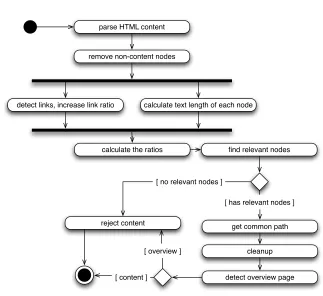
Based on ideas and concepts from related work, we developedTextSweeper: An HTML pre-processing component which extracts the main content of a Web page by applying a modified version of the Text-to-Tag ratio andlink density. Figure 2 presents an activity diagram ofTextSweeper’s architecture. The figure neglects error handling to keep the model simple.
parse HTML content
calculate text length of each node
find relevant nodes
get common path
cleanup remove non-content nodes
detect links, increase link ratio
calculate the ratios
reject content
[ has relevant nodes ] [ no relevant nodes ]
detect overview page [ content ]
[ overview ]
Fig. 2.Activity diagram of theTextSweeperHTML pre-processing component
based on impact of the surrounding layout tags (for instance, headings and bold text are considered more important than other elements) and the text length (the component has a bias towards long text passages because they are a good indicator for an article’s content).
text length=actual text length∗text weight∗parent text weight (1)
In addition to the plain text lengthTextSweeperalso checks if the element contains a link. At this step the system does not only rely on the occurrence of an anchor tag, but also takes attributes such as “onclick” and the actual text into account. The text in overview pages very often only presents a summary of an article and ends with a phrase like “Read more” or “...”. IfTextSweeperfinds one of these indicators, it considers the element as well as its parent as a link element.
ratio=text length−link text length
tag count+node level (2)
While calculating the ratio, theTextSweepersystem also detects the node with the high-est Text-to-Tag ratio which is considered to contain most of the main content. Manual evaluations indicate that this node alone does not always include all the relevant content (main content) of a Web page. Therefore, we adopted a simple smoothing approach (see also Weninger et al. (2010)) to return all nodes for which their ratio is within a range – this range is set by a predefined tolerance ratio. For example, if the tolerance ratio is set to 0.9 and the node with the highest Text-to-Tag ratio has a value of 1,000, then all nodes with a ratio greater than 900 will be considered relevant. For all relevant nodes TextSweeperdetects their common path. This approach reduces the risk of loosing rel-evant content, although it increases the likelihood of including noise elements.
To remove smaller blocks of unrelated content, such as advertisements,TextSweeper performs a cleanup step to delete all nodes which fall below a predefined minimum text length or which mainly contain links. Finally, in order to detect overview pages, TextSweeperexamines thenet text lengthof the returned node and rejects all documents which are below a given minimum threshold.
4 Outlook and Conclusions
In this article we introducedTextSweeper, a framework which extracts the main content from Web pages.TextSweeperuses a modified version of the Text-to-Tag (text length versus the number of tags) ratio relying on the net text length(plain text length mi-nus link text length) of particular DOM elements to remove noise from Web pages. In contrast to related work (see Chapter 2),TextSweeperalso supports the detection and removal of overview pages.
The main contributions of this work are the presentation of (i) a modified and enhanced version of the Text-to-Tag ratio method that is enhanced by considering the link density and (ii) a simple, efficient and unsupervised approach for the detection and elimination of overview pages. It considerably improves the performance of downstream processes such as Web Information Retrieval.
As this is a research in progress paper, an essential part of future work will lie in ex-tensive evaluation of the framework’s performance in terms of precision and recall. Furthermore, we shall test the framework on the CleanEval benchmark and provide a performance comparison to competitive systems.
References
Chen, J., Zhou, B., Shi, J., Zhang, H., & Fengwu, Q. (2001). Function-based object model towards website adaptation. InWww ’01: Proceedings of the 10th interna-tional conference on world wide web(pp. 587–596). New York, NY, USA: ACM Press.
Finn, A., Kushmerick, N., & Smyth, B. (2001). Fact or fiction: Content classification for digital libraries. InDelos workshop: Personalisation and recommender systems in digital libraries.
Gibson, D., Punera, K., & Tomkins, A. (2005). The volume and evolution of web page templates. InSpecial interest tracks and posters of the 14th international conference on world wide web (www2005)(p. 830-839).
Kohlsch¨utter, C., Fankhauser, P., & Nejdl, W. (2010). Boilerplate detection using shal-low text features. In B. D. Davison, T. Suel, N. Craswell, & B. Liu (Eds.),Wsdm (p. 441-450). ACM.
Kohlsch¨utter, C., & Nejdl, W. (2008). A densitometric approach to web page segmen-tation. In J. G. Shanahan et al. (Eds.),Cikm(p. 1173-1182). ACM.
Mohammadzadeh, H., Gottron, T., Schweiggert, F., & Nakhaeizadeh, G. (2011). A fast and accurate approach for main content extraction based on character encoding. InTir’11: Proccedings of the 8th workshop on text-based information retrieval. Rahman, A. F. R., Alam, H., & Hartono, R. (2001). Content extraction from html
documents. InIn 1st int. workshop on web document analysis (wda2001)(pp. 7–10).
Scharl, A., Weichselbraun, A., & Liu, W. (2006, January). An ontology-based ar-chitecture for tracking information across interactive electronic environments. InProceedings of the 39th hawaii international conference on system sciences (hicss-39).Kauai, Hawaii: IEEE Computer Society Press.
Song, R., Liu, H., Wen, J.-R., & Ma, W.-Y. (2004). Learning block importance models for web pages. InWww ’04: Proceedings of the 13th international conference on world wide web(pp. 203–211). New York, NY, USA: ACM Press.
Sun, F., Song, D., & Liao, L. (2011). Dom based content extraction via text density. InProceedings of the 34th international acm sigir conference on research and development in information retrieval(pp. 245–254). New York, NY, USA: ACM. Available fromhttp://doi.acm.org/10.1145/2009916.2009952 Weninger, T., & Hsu, W. H. (2008). Text extraction from the web via text-to-tag ratio.
InDexa workshops(p. 23-28). IEEE Computer Society.
Weninger, T., Hsu, W. H., & Han, J. (2010). Cetr: content extraction via tag ratios. In M. Rappa, P. Jones, J. Freire, & S. Chakrabarti (Eds.),Www(p. 971-980). ACM. Yi, L., Liu, B., & Li, X. (2003). Eliminating noisy information in web pages for
data mining. InKdd ’03: Proceedings of the ninth acm sigkdd international conference on knowledge discovery and data mining(pp. 296–305). New York, NY, USA: ACM Press.