R E S E A R C H
Open Access
A fixed point iterative approach to integer
programming and its distributed
computation
Chuangyin Dang
1*and Yinyu Ye
2*Correspondence:
[email protected] 1Department of Systems
Engineering and Engineering Management, City University of Hong Kong, Kowloon, Hong Kong, China
Full list of author information is available at the end of the article
Abstract
Integer programming is concerned with the determination of an integer or mixed-integer point in a polytope. It is an NP-hard problem and has many applications in economics and management. Although several popular methods have been developed for integer programming in the literature and extensively utilized in practices, it remains a challenging problem and appeals for more endeavors. By constructing an increasing mapping satisfying certain properties, we develop in this paper an alternative method for integer programming, which is called a fixed point iterative method. Given a polytope, the method, within a finite number of iterations, either yields an integer or mixed-integer point in the polytope or proves no such point exists. As a very appealing feature, the method can easily be
implemented in a distributed way. Furthermore, the construction implies that determining the uniqueness of Tarski’s fixed point is an NP-hard problem, and the method can be applied to compute all integer or mixed-integer points in a polytope and directly extended to convex nonlinear integer programming. Preliminary numerical results show that the method seems promising.
MSC: 90C10
Keywords: integer or mixed-integer point; polytope; integer programming; linear programming; self-dual embedding technique; increasing mapping; Tarski’s fixed point theorem; fixed point iterative method
1 Introduction
Integer programming is concerned with the determination of an integer or mixed-integer point in a polytope. As a powerful mechanism, integer programming has been extensively applied in economics [, ] and management []. Integer programming is an NP-complete problem []. To solve such a problem, several methods have been developed in the liter-ature. As an application of linear programming, the cutting plane method was pioneered in []. The method iteratively refines a feasible set or objective function by means of linear inequalities. The branch-and-bound method was formulated in []. The method gradu-ally improves upper and lower bounds of the objective function by solving linear programs and systematically enumerates candidate solutions in branches of a tree with the full set of candidate solutions at the root by checking against the upper and lower bounds. To test whether a given feasible integer point is optimal or not, the neighborhood method was
proposed in [, ]. The method simply checks a minimal set of points in the neighbor-hood of a feasible point to determine whether one of them is in the polytope or yields a better objective function value. The basis-reduction method originates in [, ]. As that in a branch-and-bound method, the method searches for an integer point in a polytope along a set of vectors that forms a reduced basis. The simplicial method was developed in [, ]. The method starts from an arbitrary integer point in the space and follows a simplicial path that either leads to an integer point in a polytope or proves no such point exists when the polytope is in a specific form. Further developments of some of these methods and new methods can be found in the recent literature such as [, –], and the references therein. These methods play an extremely important role in the develop-ment of integer programming, however, it remains a challenging problem and appeals for more endeavors. Thus, developing alternative integer programming methods is always an active research area.
Integer programming can be cast as a fixed point problem of an increasing mapping. More precisely, letbe a binary relation on a nonempty setS. The pair (S,) is a par-tially ordered set ifis reflexive, transitive, and antisymmetric onS. A lattice is a partially ordered set (S,), in which any two elementsxandyhave a least upper bound (supre-mum),supS(x,y) =inf{z∈S|xzandyz}, and a greatest lower bound (infimum),
infS(x,y) =sup{z∈S|zxandzy}, in the set. A lattice (S,) is complete if every nonempty subset ofShas a supremum and an infimum inS. Letf be a mapping from Sinto itself.f is an increasing mapping iff(x)f(y) for anyxandyofSwithxy. When (S,) is a complete lattice andf is an increasing mapping, Tarski’s fixed point theorem [] asserts thatf has a fixed point inS. A significant feature of Tarski’s fixed point theorem is thatScan be a finite set and there is no restriction on its topological structures. This feature has a profound implication for integer programming as evidenced in this paper. The computational complexity of Tarski’s fixed point theorem on (S,≤) has been studied in [], and it is polynomial-time computable if the dimension is fixed. As an application of Tarski’s fixed point theorem to integer programming, an increasing-mapping approach was briefly described in []. However, the approach is very primitive and can only update one coordinate at each iteration.
LetN={, , . . . ,n}andN={, , , . . . ,n}. ForxandyofRn,x≤lyif eitherx=yor bothxi=yi,i= , , . . . ,k– , andxk<ykfor somek∈N, andx≤yifxi≤yifor alli∈N, where≤lis the lexicographic order onRnand≤is the componentwise order onRn. Let Sbe any given finite set ofRn. Then (S,≤
l) is a complete lattice. We now convert integer programming into the computation of fixed points of an increasing mapping from a finite lattice into itself, which leads to the fixed point iterative method proposed in this paper and is the driving force behind our research endeavors.
ConsiderP={x∈R|Ax≤b}with
A= ⎛ ⎜ ⎝
– – –
⎞ ⎟ ⎠
andb= (–, , ). This polytope is illustrated in Figure .
Figure 1 An illustration of the idea.
for any x∈D(P) withx∈/ P andx=xl and thath(x∗) =x∗ if and only if eitherx∗ ∈P orx∗=xl. Such a mapping is illustrated in Figure . This simple example stimulates the idea in this paper though the situation is far more complicated when the dimension is higher.
In this paper, with this constructing we develop a fixed point iterative method for in-teger programming. A self-dual technique is applied for a solution to a bounding linear program in the development. Given any polytope, within a finite number of iterations, the method either yields an integer or mixed-integer point in the polytope or proves no such point exists. Theoretically, one can make the method be a polynomial-time algo-rithm when the dimension is fixed. But a more appealing feature of the method is that it can easily be implemented in a distributed way. Furthermore, the construction implies that determining the uniqueness of Tarski’s fixed point is an NP-hard problem, and the method can be applied to compute all integer or mixed-integer points in a polytope and directly extended to convex nonlinear integer programming. Preliminary numerical re-sults show that the method is promising, and may offer a comparable solution to integer programming though a comprehensive comparison with the existing methods is beyond the scope of this paper.
The rest of the paper is organized as follows. A fixed point iterative method is first de-veloped for integer programming in Section . Then a distributed implementation of the method and the computation of all integer points in a polytope are discussed in Section . Preliminary numerical results are presented in Section .
2 A fixed point iterative method
Let
P=x∈Rn|Ax+Gw≤bfor somew∈Rp ,
whereA∈Rm×nis anm×ninteger matrix withn≥,G∈Rm×panm×pmatrix, andb a vector ofRm. We assume throughout this paper thatPis bounded and full dimensional. For a real numberα, let αdenote the greatest integer less than or equal toα. Forx= (x,x, . . . ,xn)∈Rn, let x= ( x
Letxmax = (xmax
,xmax , . . . ,xmaxn ) withxmaxj =maxx∈Pxj, j= , , . . . ,n, andxmin= (xmin , xmin , . . . ,xmin
n )withxminj =minx∈Pxj,j= , , . . . ,n. Thenxmin≤x≤xmaxfor allx∈P. Let D(P) =x∈Zn|xl≤x≤xu ,
wherexu= xmaxandxl= xmin. Thus,D(P) contains all integer points inP. We assume without loss of generality thatxl<xmin (letxl
i=xmini – ifxli=xmini for somei∈N) and that
xu –xl≤xu–xl≤ · · · ≤xun–xln,
which can be obtained by interchanging the columns ofAif necessary. Forz∈Rnandk∈N, let
P(z,k) ={x∈P|xi=zi, ≤i≤kandxi≤zi,k+ ≤i≤n}.
Given an integer point y∈D(P) withy >xl, we present in the following a fixed point iterative method to determine whether there is an integer pointx∗∈Pwithx∗≤ly.
Initialization: Lety=y,k=n– , andq= . Step: Ifyq∈Poryq=xl,Stop; else, go toStep.
Step: Ifyqi ≤xlifor somei∈NorP(yq,k) =∅, go toStep; else, go toStep. Step: Solve the linear program
max
n
j=k+ xjj
subject toxj∈Pyq,k, j=k+ ,k+ , . . . ,n,
to obtain the optimal value ofxjj, denoted byxjj(yq),j=k+ ,k+ , . . . ,n, and go to Step.
Step: Ifyqj >xjj(yq)for somej≥k+ , letyq+= (yq+ ,y
q+ , . . . ,y
q+ n )with
yq+i =
yqi if≤i≤k, xii(yq) ifk+ ≤i≤n,
i= , , . . . ,n, andq=q+ , and go toStep; else, letk=k+ and go toStep.
Step: Ifk= , letyq+=xlandq=q+ ; else, letyq+= (yq+ ,y
q+ , . . . ,y
q+ n )with
yq+i = ⎧ ⎪ ⎨ ⎪ ⎩
yqi if≤i≤k– , yqi – ifi=k, xui ifk+ ≤i≤n,
i= , , . . . ,n,q=q+ , andk=k– . Go toStep.
Figure 2 An illustration of the method.
Example ConsiderP={x∈R|Ax≤b}with
A= ⎛ ⎜ ⎜ ⎜ ⎝
– – – –
⎞ ⎟ ⎟ ⎟ ⎠
andb= (, , , , ). We havexu= (, , )andxl= (–, –, –). Lety=xu,y=y, andk= – = .
Iteration: SinceP(y, ) =∅, we obtain fromStep
y=y,y– ,xu= (, –, )
andk=k– = – = .
Iteration: Solving
maxx+x
subject toxj∈Py, , j= , ,
we obtainx(y) = –andx(y) = –. Sincey= > – =x(y), we obtain fromStep
y=y,xy,xy= (, –, –),
which is an integer point inP.
An illustration ofy,y, andycan be found in Figure .
Example ConsiderP={x∈R|Ax≤b}with
A= ⎛ ⎜ ⎜ ⎜ ⎝
– – – – – –
⎞ ⎟ ⎟ ⎟ ⎠
Figure 3 An illustration of the method.
Lety=xu,y=y, andk=n– = .
Iteration: SinceP(y, ) =∅, we obtain fromStep
y=y,y– ,xu= (, –, )
andk=k– = – = .
Iteration: SinceP(y, ) =∅, we obtain fromStep
y=y– ,xu,xu= (, , )
andk=k– = – = .
Iteration: SinceP(y, ) =∅, we obtain fromStep
y=xl= (, –, –),
which shows that there is no integer point inP.
An illustration ofy,y,y, andycan be found in Figure .
Forq= , , . . . , letkqdenote the value ofkat which the method determinesyq. Clearly, xl–e≤yq≤xuwithe= (, , . . . , )∈Rn.
Lemma For q= , , . . . ,
yq+≤yq or yq+≤lyq
with yq=yq+.
Proof This lemma is proved in two cases. Case:Suppose that P(yq,k
q) =∅. Then the method will performStep. Ifkq= , we obtain fromStep thatyq+=xl, and consequently,yq+≤yqwithyq=yq+. Assume that kq> . Then we obtain fromStep thatyq+= (yq+ ,y
q+ , . . . ,y
q+ n )with
yq+i = ⎧ ⎪ ⎨ ⎪ ⎩
i= , , . . . ,n. Thus,yq+kq <yqkq. Therefore,yq+≤
lyqwithyq=yq+.
Case:Suppose that P(yq,kq)=∅. Then the method will repeatedly performStepsand right before it goes toStep. Sinceyq∈/P, askincreases one by one, it will reach a value kq+ such thatyqj >x
j
j(yq) for somej≥kq++ . When this occurs, we obtain fromStep thatyq+= (yq+
,y q+ , . . . ,y
q+ n )with
yq+i =
yqi if ≤i≤kq+, xi
i(yq) ifkq++ ≤i≤n,
i= , , . . . ,n. Moreover, one can see fromStep that
xjjyq≤yqj, j=kq++ ,kq++ , . . . ,n.
Therefore,yq+≤yqwithyq=yq+. The proof is completed.
Theorem Given an integer point y∈D(P)with y>xl,the method,within a finite num-ber of iterations,either yields an integer point x∗∈P with x∗≤ly or proves no such point exists.
Proof Letybe any given integer point inD(P) withy>xl. Suppose thaty∈/Pand there is some integer pointz∈Pwithz≤
ly. We assume without loss of generality thatzis the largest integer point ofPsatisfying thatz≤
ly. Applying mathematical induction, we show in the following thatz≤lyq,q= , , . . . .
. Consider the case ofq= . From the method, we know thatk=n– .
(a)Suppose that P(y,k) =∅. Then the method will performStep, and we obtain from Step thaty= (y
,y, . . . ,yn)with
yi= ⎧ ⎪ ⎨ ⎪ ⎩
yi if ≤i≤n– , y
i – ifi=n– , xu
i ifi=n,
i= , , . . . ,n, andk=n– . Ifyi >zi for somei≤n– , thenz≤lywithzj<yjfor some j≤k. Assume thatyi =zi for alli≤n– . Then, fromP(y,k) =∅andz≤ly, we derive thatzn– <yn–since otherwiseP(y,k)=∅. Therefore,z≤y.
(b)Suppose that P(y,k)=∅. Then the method will performStepsand. Sincey∈/P, y
n>xnn(y). Thus, we obtain fromStepy= (y,y, . . . ,yn)with
yi=
yi if ≤i≤n– , xn
n(y) ifi=n,
i= , , . . . ,n, andk=n– . Ifyi >zi for somei≤n– , thenz≤lywithzj <yj for some j≤k. Assume thatyi =zi for alli≤n– . Then we derive fromz≤lythatz∈P(y,k). Thus,z
n≤ xnn(y). Therefore,z≤y.
.Induction hypothesis: For any given ≤h≤q, we assume thatyh∈/Pand thatz≤yh orz≤lyhwithzj<yhj for somej≤kh.
Case:Suppose that P(yq,kq) =∅. Then the method will performStep. Assume that kq= . From the method, we know thatStep must be performed at least once beforeyq is generated. Letyqbe the point obtained by the method in the last performance ofStep
beforeyqis generated. Thus,k
q=kq= ,kq–= , andP(yq–,kq–) =∅. FromStep, we
know thatyq= (yq
,y q
, . . . ,y q
n)with
yq
i =
yq–
i – ifi= , xui if ≤i≤n,
i= , , . . . ,n. This together withP(yq–,k
q–) =∅and the induction hypothesis forh= q– leads to thatz≤yq. Ifq=q, thenz≤yq=yq. Suppose thatq>q. Thenq=q+ and the method will performStepsand to generateyqright afteryqis generated. Since kq=kq, the method will perform onceStepsand to generatey
q. Withk
q= , we obtain fromStep thatyq= (yq,y
q , . . . ,y
q n)with
yqi =xiiyq, i= , , . . . ,n.
Thus, it follows fromz∈P(yq,k
q) thatz
≤yq. Therefore,z∈P(yq,kq). It contradicts withP(yq,kq) =∅. So, we must havekq> .
FromStep, we obtainyq+= (yq+ ,y q+ , . . . ,y
q+ n )with
yq+i = ⎧ ⎪ ⎨ ⎪ ⎩
yqi if ≤i≤kq– , yqi – ifi=kq, xui ifkq+ ≤i≤n,
i= , , . . . ,n, andkq+=kq– . Ifzi <y q
i for somei≤kq– , thenz≤lyq+withzj <y q+ j for somej≤kq+. Suppose thatyqi =zi,i= , , . . . ,kq– . Hence,zkq <y
q
kq from the induction hypothesis since otherwiseP(yq,k
q)=∅. Therefore,z≤yq+. Case :Suppose that P(yq,k
q)=∅. Then the method will repeatedly performSteps and right before it goes toStep. Sinceyq∈/P, askincreases one by one, it will reach a valuekq+≥kq such thatyqj >x
j
j(yq) for somej≥kq++ . When this occurs, we obtain fromStep thatyq+= (yq+
,y q+ , . . . ,y
q+ n )with
yq+i =
yqi if ≤i≤kq+, xi
i(yq) ifkq++ ≤i≤n,
i= , , . . . ,n. Ifz i <y
q
i for somei≤kq, thenz≤lyq+with zj <y q+
j for somej≤kq+. Suppose thatyqi =z
i for alli≤kq. Thus,z≤yqfrom the induction hypothesis forh=q.
• Considerkq+=kq. Sincez∈P(yq,kq),zi≤ xii(yq)for allkq++ ≤i≤n. Therefore, z≤yq+.
• Considerkq+>kq. Ifzi <y q
i for somekq<i≤kq+, then it follows fromStepsand
thatz≤
lyq+withzj <y q+
j for somej≤kq+. Suppose thatyqi =zifor all kq<i≤kq+. Sincez≤yq,z∈P(yq,kq+)and consequently,zi ≤ xii(yq)for all kq++ ≤i≤n. Therefore,z≤yq+.
The above results together with mathematical induction show that
From Lemma , we know thatyq+≤yqoryq+≤
lyq withyq+=yq. Therefore, within a finite number of iterations, the method meetszsince there are only a finite number of integer points in the set
z∈Zn|z≤lz≤lyandxl–e≤z≤xu .
This completes the proof.
As a corollary of Theorem , we come to the following conclusion.
Corollary Starting from y=xu,the method,within a finite number of iterations,either yields an integer point in P or proves no such point exists.
3 Distributed computation and computing all integer points in a polytope
For any given positive integer ν, letxi, i= , , . . . ,ν, be a sequence of different integer points inD(P) withxl≤x≤
lx≤l· · · ≤lxν=xu. Then the method can easily be imple-mented in a distributed way by starting fromxi,i= , , . . . ,ν, simultaneously.
The method can also be applied to compute all integer points inP, which is as follows.
Step: Use the method starting fromxuto compute an integer point inP. If no integer
point has been found,Stop. Otherwise, letsbe the solution found by the method
andg= , and go toStep.
Step: Lety= (y,y, . . . ,yn)with
yi =
sgi ifi<n, sgi– ifi=n,
i= , , . . . ,n, and go toStep.
Step: Ify∈P, letsg+=yandg=g+ , and go toStep. Otherwise, go toStep. Step: Use the method starting fromy to compute an integer point inP. If no integer
point has been found,Stop. Otherwise, letsg+be the solution found by the method
andg=g+ , and go toStep.
4 Numerical results
Table 1 The market split problem
Prob. p q The method The best CPLEX strategy NumLPs Feasibility NumLPs Feasibility
1 5 40 9,640 Feasible 87,136 Feasible
2 5 40 32,015 Feasible 718,883 Feasible
3 5 40 22,221 Feasible 484,796 Feasible
4 5 40 12,670 Feasible 139,967 Feasible
5 5 40 49,709 Feasible 454,552 Feasible
6 5 40 54,525 Infeasible 677,463 Infeasible
7 5 40 105,670 Infeasible 1,644,945 Infeasible
8 5 40 90,204 Infeasible 1,593,382 Infeasible
9 5 40 93,751 Infeasible 1,061,334 Infeasible
10 5 40 67,565 Infeasible 1,039,454 Infeasible
11 5 40 90,218 Infeasible 1,134,168 Infeasible
12 5 40 36,204 Feasible 857,912 Feasible
13 5 40 106,082 Infeasible 2,189,829 Infeasible
14 5 40 33,699 Infeasible 649,045 Infeasible
15 5 40 64,368 Infeasible 808,468 Infeasible
16 5 40 38,577 Feasible 370,900 Feasible
17 5 40 26,167 Feasible 162,529 Feasible
18 5 40 75,633 Feasible 96,595 Feasible
19 5 40 86,061 Infeasible 964,038 Infeasible
20 5 40 36,737 Infeasible 801,745 Infeasible
21 5 40 67,556 Infeasible 881,563 Infeasible
22 5 40 16,170 Feasible 1,136,200 Feasible
23 5 40 33,848 Feasible 225,732 Feasible
24 5 40 78,172 Infeasible 784,658 Infeasible
25 5 40 75,375 Infeasible 1,412,998 Infeasible
a full-dimensional polytope given byP={x∈Rn|Ax≤b}, we apply the basis-reduction algorithm of [] in the same way as that in [] and in the appendix withN= , and N= ,.
Example (The market split problem) The market split problem given in [] is to deter-mine whether the system,Cx=d, has a - integer solution, whereC= (cij) is ap×q(e.g., q= (p– )) nonnegative integer matrix andd= (d,d, . . . ,dp)is an integer vector given bydi=
n
j=cij/,i= , , . . . ,p. In our numerical experiments,cij∈[, ],i= , , . . . ,p, j= , , . . . ,q, are generated randomly.
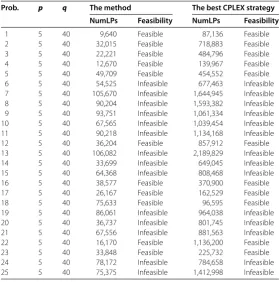
For the problem withp= andq= , we have solved instances using the method and the best CPLEX strategy. Numerical results for instances of the problem are given in Table .
To demonstrate the capability of distributed computation of the method, we have im-plemented the method in a distributed way to solve the market split problem withp= andq= . We divide the problem space into parts and run subproblems simultane-ously on the workstation. In the presentation of numerical results, MAX NumLPs stands for either the largest number of linear programs consumed by the method for any of the subproblems when an instance is infeasible or the smallest number of linear programs consumed by the method for the subproblem in which a feasible solution is found. Nu-merical results for five instances of the problem are given in Table .
Table 2 The market split problem
Prob. p q NumLPs Feasibility
1 6 50 1.25E+07 Feasible 2 6 50 4.13E+07 Infeasible 3 6 50 3.46E+07 Feasible 4 6 50 4.17E+07 Feasible 5 6 50 3.73E+07 Feasible
Table 3 The 0-1 knapsack feasibility problem
Prob. n The method The best CPLEX strategy NumLPs Feasibility NumLPs Feasibility
1 1,000 1,002 Feasible 3,023 Feasible
2 1,000 1,010 Feasible 1,542 Feasible
3 1,000 1,027 Feasible 1,495 Feasible
4 1,000 1,011 Feasible 1,428 Feasible
5 1,000 1,118 Feasible 883 Feasible
6 1,000 1,035 Feasible 2,023 Feasible
7 1,000 1,000 Infeasible 1,280 Infeasible
8 1,000 1,002 Feasible 1,360 Feasible
9 1,000 1,002 Feasible 998 Feasible
10 1,000 1,013 Feasible 1,087 Feasible
11 1,000 1,321 Feasible 1,577 Feasible
12 1,000 1,003 Feasible 1,117 Feasible
13 1,000 1,024 Feasible 1,638 Feasible
14 1,000 1,005 Feasible 1,122 Feasible
15 1,000 1,019 Feasible 1,097 Feasible
16 1,000 1,007 Feasible 1,365 Feasible
17 1,000 999 Infeasible 1,315 Infeasible
18 1,000 1,572 Feasible 3,741 Feasible
19 1,000 1,031 Feasible 1,170 Feasible
20 1,000 1,015 Feasible 2,702 Feasible
21 1,000 1,002 Feasible 978 Feasible
22 1,000 1,007 Feasible 1,486 Feasible
23 1,000 1,005 Feasible 1,043 Feasible
24 1,000 1,001 Feasible 3,643 Feasible
25 1,000 1,065 Feasible 2,017 Feasible
26 1,000 1,016 Feasible 2,587 Feasible
27 1,000 1,014 Feasible 879 Feasible
28 1,000 1,012 Feasible 724 Feasible
29 1,000 1,303 Feasible 1,405 Feasible
30 1,000 1,025 Feasible 1,520 Feasible
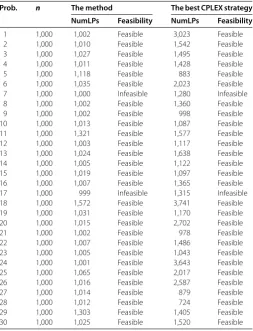
This paper has no intention to make a comprehensive comparison of the proposed method with the existing methods. Nevertheless, one can see from these preliminary nu-merical results that the numbers of linear programs solved by the method for most in-stances of two specific problems are less than those of the best CPLEX strategy: branch and cut. An efficient implementation of the method requires a considerable amount of additional research, which is beyond the scope of this paper and will be carried out in another research project.
Appendix: Basis reduction and preconditioning
bj,j= , , . . . ,l, the orthogonal vectorsb∗j,j= , , . . . ,l, by the following procedure:
b∗=b,
b∗j =bj– j–
k=
μjkb∗k, ≤j≤l,
μjk= bjb∗k
b∗k b∗k, ≤k<j≤l.
For y∈Rn, let y denote the Euclidean norm of y. The following definition comes from [].
Definition A basisb,b, . . . ,blis called reduced if the following two conditions are sat-isfied:
Condition: |μjk| ≤ for≤k<j≤l, and
Condition: b∗j +μj,j–b∗j–≥b∗j–for <j≤l.
Given this definition, Lováz’s basis reduction algorithm in [] can be stated as follows:
Step (Size reduction): If, for any pair ofjandkwith≤k<j≤l, Condition is violated, then replacebjbybj–μjkbk, whereμjk=μjk–.
Step (Interchange): If Condition is violated for somejwith <j≤l, then interchange
bj–andbj.
Step (Repeat): Repeat the above two steps till there is no violation of either of Conditions and .
LetH={y∈Rm
+ |Cy=d}, whereC= (cij) is ann×minteger matrix anddis an inte-ger point ofRn. Without loss of generality we assume thatgcd(ci,ci, . . . ,cim) = for all ≤i≤m. This assumption can be met by directly dividing the GCD (greatest common divisor) to each row ofC, where the GCD can be found by an extended GCD algorithm. To convert this problem into an equivalent problem of determining whether there is an integer point in a polytope given byP={x∈Rn|Ax≤b}, we use the same procedure as in []. Let
B= ⎛ ⎜ ⎝
Im
N NC –Nd
⎞ ⎟ ⎠,
whereIm is anm×midentity matrix and N andN are two sufficiently large positive integers (e.g.,N= , andN= ,). Applying Lováz’s basis reduction algorithm to B, we obtain
ˆ B=
⎛ ⎜ ⎝
A b G
N NIn
⎞ ⎟ ⎠,
Given any polytopeP={x∈Rn|Ax≤b}, one can preconditionAby applying Lováz’s basis reduction algorithm. If there are continuous variables, one can apply Gram-Schmidt orthogonalization to the corresponding matrix.
Given positive integerspi,i= , , . . . ,m, the extended GCD with the basis reduction [] can be employed to find their common greatest divisor, which is as follows.
Initialization: Letm= ,n= ,U= (uij)m×m=Im,di= ,i= , , . . . ,m+ ,T= (tij)m×m= m, andk= .
Step: Leti=k– and performReduce(k,i). Let
r=n
dk–dk++tk,k–
–mdk.
Ifpk–= orpk–= ,pk= , andr< , then performSwap(k)and letk=k– if k> . Otherwise, fori=k– ,k– , . . . , , performReduce(k,i). Letk=k+ and go toStep.
Step: Ifk>m,Stop. Otherwise, go toStep.
Finalization: Ifpm< , letpm= –pmandujm= –ujm,j= , , . . . ,m. LetGCD =pmand, for j= , , . . . ,m, let
h=uj,
uj=ujm,
ujm=h.
Reduce(k,i)
Ifpi= , let
r=
pk/pi–
.
Otherwise, let
r=
tki/di+– if |tki|>di+, otherwise.
Ifr= , let
pk=pk–rpi,
ujk=ujk–ruji, j= , , . . . ,m,
tki=tki–rdi+,
tkj=tkj–rtij, j= , , . . . ,i– .
Swap(k)
h=pk,
pk=pk–,
Forj= , , . . . ,m,
h=ujk,
ujk=uj,k–,
uj,k–=h.
Forj= , , . . . ,k– ,
h=tkj,
tkj=tk–,j,
tk–,j=h.
Forj=k+ ,k+ , . . . ,m,
h=tj,k–tk,k–+tjkdk–,
h=tj,k–dk+–tjktk,k–,
tj,k–=h/dk,
tjk=h/dk,
dk=
dk–dk++tk,k–
/dk.
Competing interests
The authors declare that they have no competing interests.
Authors’ contributions
Both authors contributed equally to the writing of this paper. Both authors read and approved the final manuscript.
Author details
1Department of Systems Engineering and Engineering Management, City University of Hong Kong, Kowloon, Hong
Kong, China.2Department of Management Science and Engineering, Stanford University, Stanford, CA 94305-4026, USA.
Acknowledgements
The authors are very grateful to the editor and reviewers for their valuable comments and suggestions and would like to thank Dr. Zhengtian Wu for numerical implementation of the method. This work was partially supported by GRF: CityU 101113 of Hong Kong SAR Government.
Received: 24 June 2015 Accepted: 24 September 2015
References
1. Scarf, HE: Production sets with indivisibilities - Part I: generalities. Econometrica49, 1-32 (1981)
2. Scarf, HE: Neighborhood systems for production sets with indivisibilities. Econometrica54, 507-532 (1986) 3. Jünger, M, Liebling, TM, Naddef, D, Nemhauser, GL, Pulleyblank, WR, Reinelt, G, Rinaldi, G, Wolsey, LA: 50 Years of
Integer Programming. Springer, Berlin (2010)
4. Garey, MR, Johnson, DS: Computers and Intractability: A Guide to the Theory of NP-Completeness. Freeman, San Francisco (1979)
5. Gomory, RE: Outline of an algorithm for integer solution to linear programs. Bull. Am. Math. Soc.64, 275-278 (1958) 6. Land, AH, Doig, AG: An automatic method for solving discrete programming problems. Econometrica28, 497-520
(1960)
7. Lenstra, HW Jr.: Integer programming with a fixed number of variables. Math. Oper. Res.8, 538-548 (1983) 8. Lovász, L, Scarf, HE: The generalized basis reduction algorithm. Math. Oper. Res.17, 751-764 (1992) 9. Dang, C: An arbitrary starting homotopy-like simplicial algorithm for computing an integer point in a class of
10. Dang, C, van Maaren, H: A simplicial approach to the determination of an integer point in a simplex. Math. Oper. Res.
23, 403-415 (1998)
11. Aardal, K, Hurkens, C, Lenstra, AK: Solving a system of linear Diophantine equations with lower and upper bounds on the variables. Math. Oper. Res.25, 427-442 (2000)
12. Barvinok, AI: A polynomial time algorithm for counting integral points in polyhedra when the dimension is fixed. Math. Oper. Res.19, 769-779 (1994)
13. Bertsimas, D, Weismantel, R: Optimization over Integers. Dynamic Ideas, Belmont (2005)
14. Burer, S, Vandenbussche, D: A finite branch-and-bound algorithm for nonconvex quadratic programming via semidefinite relaxations. Math. Program., Ser. A113, 259-282 (2008)
15. Cornuéjols, G, Dawande, M: A class of hard small 0-1 programs. In: Integer Programming and Combinatorial Optimization. Lecture Notes in Computer Science, vol. 1412, pp. 284-293. Springer, Berlin (1998)
16. De Loera, JA, Hemmecke, R, Köppe, M, Weismantel, R: Integer polynomial optimization in fixed dimension. Math. Oper. Res.31, 147-153 (2006)
17. Nemhauser, GL, Wolsey, LA: Integer and Combinatorial Optimization. Wiley, New York (1998) 18. Schrijver, A: Theory of Linear and Integer Programming. Wiley, New York (1998)
19. Tarski, A: A lattice-theoretical fixpoint theorem and its applications. Pac. J. Math.5, 285-308 (1955) 20. Dang, C, Qi, Q, Ye, Y: Computational models and complexities of Tarski’s fixed points. Technical report (2011).
http://www.stanford.edu/~yyye/unitarski1.pdf
21. Dang, C: An increasing-mapping approach to integer programming based on lexicographic ordering and linear programming. In: Du, DZ, Zhang, XS (eds.) The Ninth International Symposium on Operations Research and Its Applications. Lecture Notes in Operations Research, vol. 12, pp. 55-60. World Publishing Corporation, Beijing (2010) 22. Ye, Y: Interior Point Algorithms: Theory and Analysis. Wiley, New York (1997)
23. Ye, Y, Todd, MJ, Mizuno, S: AnO(√nL)-iteration homogeneous and self-dual linear programming algorithm. Math. Oper. Res.19, 53-67 (1994)
24. Lenstra, AK, Lenstra, HW Jr., Lovász, L: Factoring polynomials with rational coefficients. Math. Ann.261, 515-534 (1982) 25. Havas, G, Majewski, BS, Matthews, KR: Extended GCD and Hermite normal form algorithms via lattice basis reduction.