The Thirty-Third AAAI Conference on Artificial Intelligence (AAAI-19)
Computing the Yolk in Spatial Voting Games without Computing Median Lines
Joachim Gudmundsson, Sampson Wong
University of SydneySydney, Australia
[email protected], [email protected]
Abstract
The yolk is an important concept in spatial voting games: the yolk center generalises the equilibrium and the yolk radius bounds the uncovered set. We present near-linear time algo-rithms for computing the yolk in the plane. To the best of our knowledge our algorithm is the first that does not precompute median lines, and hence is able to break the best known upper bound ofO(n4/3)on the number of limiting median lines. We avoid this requirement by carefully applying Megiddo’s parametric search technique, which is a powerful framework that could lead to faster algorithms for other spatial voting problems.
1
Introduction
Voting theory is concerned with preference aggregation and group decision making. A classic framework for aggregating voter’s preferences is the Downsian (1957), or spatial model of voting.
In this model, voters are positioned on a ‘left-right’ con-tinuum along multiple ideological dimensions, such as eco-nomic, social or religious. These dimensions together form the policy space. Each voter is required to choose a single candidate from a set of candidates, and a common voter preference function is a metric/distance function within the policy space. An intuitive reason behind using metric pref-erences is that voters tend to prefer candidates ideologically similar to themselves.
The spatial model of voting with metric preferences have been studied extensively, both theoretically (McKelvey 1976; 1986; Enelow and Hinich 1984; Miller, Grofman, and Feld 1989; Tovey 1993) and empirically (Poole and Rosen-thal 1984; 1991; 2001; Ordeshook 1993; Schofield, Miller, and Martin 2003; Schofield 2004; 2007). Recently, lower bounds were provided on the distortion of voting rules in the spatial model, and interestingly, metrics other than the Euclidean metric were considered (Anshelevich, Bhardwaj, and Postl 2015; Skowron and Elkind 2017; Goel, Krish-naswamy, and Munagala 2017).
We focus our attention on two-candidate spatial voting games, where the winner is the candidate preferred by a simple majority of voters. In a one dimension policy space,
Copyright c2019, Association for the Advancement of Artificial Intelligence (www.aaai.org). All rights reserved.
Black’s Median Voter Theorem (1948) states that a vot-ing equilibrium (alt. Condorcet winner, plurality point, pure Nash equilibrium) is guaranteed to exist and coincides with the median voter.
Naturally, social choice theorists searched for the equi-librium in the two dimensional policy space, but these at-tempts were shown to be fruitless (Plott 1967). The ini-tial reaction was one of cynicism (McKelvey 1976), but in response a multitude of generalisations were developed, with the yolk being one such concept (McKelvey 1986; Miller, Grofman, and Feld 1989). The yolk in the Eu-clideanL2metric is defined as the minimum radius disk that
intersects all median lines of the voters.
L2
Figure 1: TheL2yolk intersects all median lines of voters.
The yolk is an important concept in spatial voting games due to its simplicity and its relationship to other concepts. The yolk radius provides approximate bounds on the uncov-ered set (Feld et al. 1987; Miller 1980; Miller, Grofman, and Feld 1989), limits on agenda control (Feld, Grofman, and Miller 1989), Shapley-Owen power scores (Feld and Grofman 1990), the Finagle point (Wuffle et al. 1989) and the ε-core (Tovey 2011). As such, studies on the size of the yolk (Feld, Grofman, and Miller 1988; Koehler 1990; Tovey 2010a) translate to these other concepts as well.
raises the following problem: Are there efficient algorithms for computing the yolk? Fast algorithms would, for instance, facilitate empirical studies on large data sets. Tovey (1992) provides the first polynomial time algorithm, which in two dimensions, computes the yolk inO(n4)time. De Berg et
al. (2016) provides an improvedO(n4/3log1+ε
n)time al-gorithm for the same.
The shortcoming of existing algorithms is that they re-quire the computation of all limiting median lines, which are median lines that pass through at least two voters (Stone and Tovey 1992). However, there are Ω(ne
√
logn)(T´oth 2000)
limiting median lines in the worst case. Moreover, the best known upper bound ofO(n4/3)seems difficult to improve
on (Dey 1997). It is an open problem as to whether there is a faster algorithm that computes the yolk without precomput-ing all limitprecomput-ing median lines .
Problem Statement
Given a setV ofnpoints in the plane, a median line ofV
is any line that divides the plane into two closed halfplanes, each with at mostn/2points. The yolk is a minimum radius disk in theLpmetric that intersects all median lines ofV.
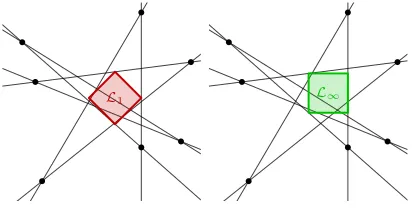
L1 L∞
Figure 2: Example of yolks in theL1andL∞metrics.
We compute yolks in the L1 (Taxicab), the L2
(Eu-clidean), and theL∞(Uniform) metrics. As shown in Fig-ure 2, the yolk inL1is the smallest45◦-rotated square and
inL∞ the smallest axis-parallel square, that intersects all median lines ofV.
Our Contributions and Results
Our contributions are, first, an algorithm that computes the yolk in theL1andL∞metrics inO(nlog7n)time, and sec-ond, an algorithm that computes a(1 +ε)-approximation of the yolk in theL2metric inO(nlog7n·log4 1ε)time.
We achieve the improved upper bounds by carefully applying Megiddo’s (1983) parametric search technique, which is a powerful yet complex technique and that could be useful for other spatial voting problems.
The parametric search technique is a framework for con-verting decision algorithms into optimisation algorithms. For the yolk problem, a decision algorithm would decide whether a given disk intersects all median lines. If this deci-sion algorithm satisifies the three properties as specified by the framework, then Megiddo’s result states that there is an efficient algorithm to compute the yolk.
For the purposes of designing a decision algorithm with the desired properties, we instead consider the more general problem of finding the smallest regular,k-sided polygon that intersects all median lines ofV. The regulark-sided poly-gonPk(r, x, y)is shown in Figure 3 and is defined as:
Definition 1. Given an integerk ≥ 3, construct the regu-lark-sided polygonPk(r, x, y)by:
• Constructing a circle with radiusrand centered at(x, y). • Placing a vertex at the top-most point on the circle, i.e.
at(x, y+r).
• Placing the remainingk−1vertices around the circle so that thekvertices are evenly spaced.
(x, y) (x, y+r)
Pk(r, x, y)
Figure 3: The regular,k-sided polygonPk(r, x, y).
In Section 2, we present the decision algorithm, which given a regular, k-sided polygon Pk(r, x, y), decides
whether the polygon intersects all median lines ofV. Next, in Section 3, we apply Megiddo’s technique to the decision algorithm and prove the convexity and parallelisability prop-erties. This leaves one final property, the existence of criti-cal hyperplanes, left to check. We prove this final property in Sections 4-6, thus completing the parametric search. Finally, in Section 7, we show that our general problem for the regu-lar,k-sided polygonPk(r, x, y)implies the claimed running
times by settingk= 4forL1andL∞, andk= 1εforL2.
2
Decision Algorithm
The aim of this section is to design an algorithm that solves the following decision problem:
Definition 2. Given an integerk≥3and a setV ofnpoints in the plane, the decision problemDk,V(r, x, y)is to decide
whether the polygonPk(r, x, y)intersects all median lines
ofV.
We show that there is a comparison-based decision algo-rithm that solves Dk,V(r, x, y)in O(nlogn·logk) time,
provided the following two comparison-based subroutines.
Subroutine 1. A comparison-based subroutine that, given a pointpand a regulark-sided polygonPk(r, x, y), decides
ifpis outsidePk(r, x, y)inO(logk)time.
computes the relative clockwise order of the four tangent lines drawn from{p, q}toPk(r, x, y)inO(logk)time.
Although the running time of these two subroutines are not too difficult to prove, we shall see in Section 3 that these subroutines must satisfy a stronger requirement for the para-metric search technique to apply. We will formally define the stronger requirement in the next section. To avoid repetition, we simultaneously address the subroutine and the stronger requirement in Sections 5 and 6. But for now, we assume the subroutines exist and present the decision algorithm: Theorem 1. Given an integerk≥3and a setV ofnpoints in the plane, there is a comparison-based algorithm that solve the decision problemDk,V(r, x, y)inO(nlogn·logk)
time, provided that Subroutine 1 and Subroutine 2 exist.
Proof. The proof comes in three parts. First, we transform the decision problemDk,V(r, x, y)into an equivalent form
that does not have median lines in its statement. Then, we present a sweep line algorithm for the transformed version. Finally, we perform an analysis of the running time.
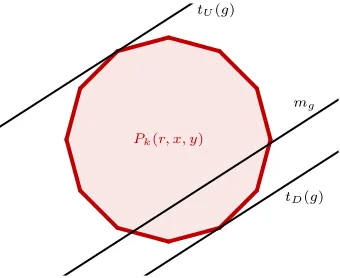
Consider for now a single median linemg that has
gra-dientg. Construct two parallel linestU(g)andtD(g)that
also have gradient g, but are tangent to Pk(r, x, y) from
above and below respectively. If the median linemg
inter-sectsPk(r, x, y), as shown in Figure 4, thenmgmust be in
betweentU(g)andtD(g).
Pk(r, x, y)
mg tU(g)
tD(g)
Figure 4: The relative positions of mg, tU(g) and tD(g)
ifmgintersects thek-sided regular polygonPk(r, x, y).
We will decide whether all median lines of gradientgare betweentU(g)andtD(g), as this would immediately decide
whether all median lines of gradientgintersectsPk(r, x, y).
We will solve this restricted decision problem by counting the number of points inV abovetU(g)and the number of
points inV belowtD(g).
Let t+U(g) be the number of points in V that are above tU(g), and similarly t−D(g)for the points in V
be-low tD(g). Suppose that t+U(g) < n/2 and t
−
D(g) <
n/2. Then there cannot be a median line of gradient g
above tU(g) or below tD(g), since one side of the
me-dian line, in particular the side that contains the polygon, will have more than n/2 points. Hence, if t+U(g) < n/2
andt−D(g)< n/2, then all median lines of gradientgmust be betweentU(g)andtD(g).
Conversely, suppose that all median lines of gradient g
are between tU(g) andtD(g). Then if t+U(g) ≥ n/2, we
can move tU(g) continuously upwards until it becomes a
median line, which is a contradiction. So in this case, we knowt+U(g)< n/2andt−D(g)< n/2.
In summary, we have transformed the decision problem into one that does not have median lines in its statement: All median lines intersectPk(r, x, y)if for all gradientsg, the
pair of inequalitiest+U(g)< n/2andt−D(g)< n/2hold. We present a sweep line algorithm that computes whether the pair of inequalities hold for all gradientsg. Lettbe an ar-bitrary line tangent to the polygonPk(r, x, y), and definet+
to be the open halfplane that hastas its boundary and does not include the polygonPk(r, x, y). Then all median lines
intersectPk(r, x, y)if and only if for all positions oft, the
open halfplanet+contains less thann/2points.
Pk(r, x, y)
t t+
Figure 5: The rotating sweeplinetand the open halfplanet+.
The tangent linetis a clockwise rotating sweep line and the invariant maintained by the sweep line algorithm is the number of points ofV inside the regiont+. Take any
tan-gent linet0to be the starting line, and calculate the number
of points int+0. From here, define an event to be when the linetpasses through a point. There are two events for each point outside Pk(r, x, y); there is one event for when the
point enters the regiont+, and one for when it exits. There
are no events for points ofV that lie insidePk(r, x, y). The
unsorted set of event points can be computed by applying Subroutine 1 to each of point inV.
We sort the set of event points in a clockwise fashion. If we consider only two voters, their associated events can be sorted using Subroutine 2. We can extend this to sort the as-sociated events of all voters with any standard comparison-based sorting algorithm, for example Merge sort.
Once the sorted set of events is computed, we process the events in order. At each new event we maintain our invari-ant, the number of points inside the region t+. This value
increases by one at “entry” events and decreases by one at “exit” events. Finally, we return whether our invariant re-mained less thann/2at all events.
The running time analysis for the algorithm is as follows. Computing the points outside Pk(r, x, y) takes O(logk)
takes O(nlogk)time. Computing the sorted order of the event points takesO(logk)time per comparison by Subrou-tine 2, which adds up toO(nlogn·logk)time. Processing the sorted event points takesO(n)time. Adding these gives the stated bound.
3
Parametric Search
Parametric search is a powerful yet complex technique for solving optimisation problems. The two steps involved in this technique are, first, to design a decision algorithm, and second, to convert the decision algorithm into an optimisa-tion algorithm.
For example, our parameter space is(r, x, y) ∈ R3, our
decision algorithm is stated in Theorem 1, and our optimisa-tion objective is to minimiser∈R+.
Preliminaries
Megiddo’s (1983) states the requirements for converting the decision algorithm into an optimisation algorithm. First, let us introduce some notation. LetRd be a parameter space,
letλ∈Rdbe a parameter and letD(λ)be a decision
prob-lem that either evaluates to true or false. Then the first re-quirement is for the decision problemD(λ).
Property 1. The set of parameters{λ ∈ Rd : D(λ)}that
satisfies the decision problem is convex.
Convexity guarantees that the optimisation algorithm finds the global optimum.
The second property of the technique relates to the de-cision algorithm. LetA(λ)be a comparison-based decision algorithm that computesD(λ). LetC(λ)be any compari-son in the comparicompari-son-based decision algorithmA(λ). The comparisonC(λ)is said to have an associated critical hy-perplane in Rd if the result of the comparison is linearly
separable with respect to λ ∈ Rd. Formally, suppose that
the comparisonC(λ)evaluates to either>,=or <. Then we say that the(d−1)-dimensional hyperplaneH ⊂ Rd
is the associated critical hyperplane ofC(λ)ifCevaluates to>,=or<if and only ifλis above, on, or belowH re-spectively. The comparisons of the decision algorithm must satisfy the following property.
Property 2. Every comparisonC(λ) in the comparison-based decision algorithm A(λ) either (i) does not depend onλ, or (ii) has an associated critical hyperplane inRd.
This requirement allows us to compute a large set of criti-cal hyperplanes that determines the result ofA(λ). More-over, the optimum must lie on one of these critical hy-perplanes, since the result ofA(λ)locally changes sign at the optimum. The new search space now has dimension
d−1instead of dimensiond, and we can recursively apply this procedure to reduce the dimension further. For details see (Agarwal and Sharir 1998).
The final property speeds up the parametric search.
Property 3. The decision algorithm has an efficient parallel algorithm.
If the decision algorithmA(λ)runs inTstime and runs
on P processors in Tp parallel steps, then the
paramet-ric search over λ ∈ Rd runs inO(TpP +Ts(TplogP)d)
time (Agarwal and Sharir 1998).
Applying the technique
To apply the parametric search technique, we show that our decision problemDk,V(r, x, y)satisfies Properties 1-3.
Lemma 1. Given an integerk≥3and a setV ofnpoints in the plane, the set of parameters{(r, x, y) :Dk,V(r, x, y)}
that satisfies the decision problem is convex.
Proof. Suppose we are given a convex combinationλ3 =
αλ1+ (1−α)λ2of the two parametersλ1, λ2∈R3. Then
the polygon Pk(λ3)is a convex combination of the
poly-gonsPk(λ1)andPk(λ2). It is easy to check that if a linem
intersects both Pk(λ1) andPk(λ2), then the line m must
also intersect the convex combinationPk(λ3).
Now assume that bothDk,V(λ1)andDk,V(λ2)are true.
Then for any median line m bothPk(λ1) andPk(λ2)
in-tersect m. By the observation above, the convex combi-nation Pk(λ3) must also intersects m. Repeating this fact
for all median lines implies thatPk(λ3)intersects all
me-dian lines of V. So Dk,V(λ3)is true wheneverDk,V(λ1)
and Dk,V(λ2) are true. Therefore, the set of
parame-ters{(r, x, y)⊆R3:Dk,V(r, x, y)}is convex.
Lemma 2. Every comparison in the decision algorithm in Theorem 1 either (i) does not depend on(r, x, y), or (ii) has an associated critical hyperplane inR3.
Proof. Theorem 1 consists of three steps, computing the points outside the polygon, computing the event order, and processing the events. For the first two steps, the compar-isons do depend on(r, x, y)and have associated critical hy-perplanes. We defer the proof of this claim to Sections 5 and 6 respectively. For the third step, the comparisons do not depend on(r, x, y)but rather the event order, so there is no requirement that comparisons have critical hyperplanes.
Lemma 3. The decision algorithm in Theorem 1 has an ef-ficient parallel algorithm that runs onO(n)processors and takesO(logn·logk)parallel steps per processor.
Proof. GivenO(n)processors, we decide which points are outside the polygon in parallel by assiging a processor to each point. By Subroutine 1, this takes O(logk) parallel steps per processor. We compute the event order in paral-lel using Preparata’s sorting scheme (Preparata 1978). Each processor requiresO(logn)calls to Subroutine 2, so it to-tal, each processor requiresO(logn·logk)parallel steps. Finally, processing the events generates no critical hyper-planes, so this step does not require parallelisation.
Now we combine Properties 1-3 with Megiddo’s result to obtain an optimisation algorithm for the smallest, regular,
k-sided polygonPk(r, x, y)that intersects all median lines.
Theorem 2. Given a setV ofnpoints in the plane, there is anO(nlog7n·log4k)time algorithm to compute the min-imumrsuch thatDk,V(r, x, y)is true for some regular,k
Proof. Megiddo’s multidimensional parametric search im-plies that there is an efficient optimisation algorithm. It only remains to show the running time of the technique.
The parallel algorithm runs on P = O(n) processors inTp = O(logn·logk)parallel steps, whereas the
deci-sion algorithm runs inTs = O(nlogn·logk) time. The
dimension dof the parameter space is three. The running time of multidimensional parametric search is O(TpP +
Ts(TplogP)d) (Agarwal and Sharir 1998). Substituting our
values into the above formula yields the required bound.
4
Computing Critical Hyperplanes
The only requirement left to check is Property 2 for the com-parisons in the comparison-based subroutines, that is, Sub-routine 1 and SubSub-routine 2. Before launching into the anal-ysis of the two subroutines, we first prove a tool. We will use the tool repeatedly in the next two sections to simplify checking Property 2.Lemma 4. Let gradient g ∈ R, point p ∈ R2 and vec-tor v ∈ R2 be given, and let (r, x, y) ∈
R3 be a vari-able parameter. LetLg,v(r, x, y) be the line of gradientg
through the point(x, y) +r·v. Thenpis above, on, or be-lowLg,v(r, x, y)if and only if the point (r, x, y)is above,
on, or below its associated critical hyperplaneHp,g,v.
p
Lg,v(r, x, y)
⇐⇒
(r, x, y)
Hp,g,v
Figure 6: Pointpis aboveLg,v(r, x, y)if and only if
param-eter(r, x, y)is aboveHp,g,v.
Proof. Let point p = (px, py) and vector v = (vx, vy).
Now, (px, py) is above the line through (qx, qy) of
gradi-ent g if (px −qx)−g ·(py −qy) > 0. Substituting the
point(qx, qy) = (x, y) +r·(v1, v2), we get the inequality
(p2−y−rv2)−g·(p2−x−rv2)>0.
This inequality can be rearranged into the formax+by+ cr+d >0, where
a=g, b=−1, c= (gv1−v2), d=p2−gp1.
In this form, we can see that the inequality is satisfied if and only if(r, x, y)lies above the hyperplaneHp,g,v := (ax+
by+cr+d= 0), wherea, b, c, dare given above. Hence, the two conditions,pabove a line and(r, x, y)above a hy-perplane, can be decided with the same inequality, which completes the proof.
Now we are ready to address the subroutines.
5
Subroutine 1
Subroutine 1 decides whether a given point p is out-side the k-sided, regular polygon Pk(r, x, y). We present
anO(logk)time comparison-based algorithm and show that Property 2 holds.
Lemma 5. Subroutine 1 has anO(logk)time comparison-based algorithm, and comparisons in the algorithm that de-pend on the parameter(r, x, y)each have an associated crit-ical hyperplane.
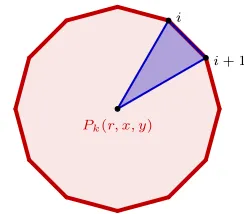
Proof. We partition the polygonPk(r, x, y)intoktriangles,
and decide which partition the pointpis in, if it indeed is in any of these partitions. For 1 ≤ i ≤ k, the ith
par-tition of Pk(r, x, y) is the triangle joining the ith vertex,
the(i+ 1)thvertex and the center ofP
k(r, x, y). Figure 7
shows theithpartition ofPk(r, x, y).
Pk(r, x, y)
i
i+ 1
Figure 7: Theithpartition ofP
k(r, x, y).
Assume for now that the point pis indeed in the poly-gonPk(r, x, y)and hence in one of thekpartitions. We
de-cide whetherpis in theithpartition for somei ≤j, or for
somei > j, and perform a binary search for the indexi. This can be done by deciding if the pointpis above, on, or be-low the line joining the center ofPk(r, x, y)and itsjth
ver-tex. The comparison depends on(r, x, y), so we must com-pute its associated critical hyperplane using Lemma 4. Let
Pk(1,0,0)be thek-sided polygon of radius 1 and centered
at the origin. Then setgto be the gradient of the line joining the center to theithvertex ofP
k(1,0,0), and vectorv = 0
in Lemma 4 to obtain the associated critical hyperplane. We have searched for the partition thatpis in if it is indeed inPk(r, x, y). Hence, it only remains to decide whetherpis
indeed in that partition. This requires a constant number of comparisons, each of which depend on (r, x, y). We have already computed associated critical hyperplanes for two of the sides. The last side joins two adjacent vertices of the polygonPk(r, x, y). Setgto be the gradient of theithside of
polygonPk(1,0,0), and the vectorvto be theithvertex of
Pk(1,0,0), to obtain the final associated critical hyperplane.
The running time is dominated by the binary search for theithpartition, which takesO(logk)time.
6
Subroutine 2
Lemma 6. Subroutine 2 has anO(logk)-time comparison-based algorithm, and comparisons in the algorithm that de-pend on the parameter(r, x, y)each have an associated crit-ical hyperplane.
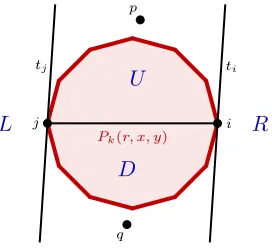
Proof. Draw two linesti, tjtangent toPk(r, x, y)and
par-allel topq, and let the points of tangency be vertexiand ver-texj. If there are multiple points of tangency then choose any such point. Then without loss of generality, setijto be horizontal, and assume further thatphas a largery coordi-nate than q. Then theti, tj andij partition the plane into
the four regions, as shown in Figure 8. RegionLis left of both tangents,Ris right of both tangents,U is between the tangents and aboveij, and D is between the tangents and belowij.
Pk(r, x, y)
U
D
L
R
ti tj
i j
p
q
Figure 8: The lines ti, tj, ij partition the plane into
re-gionsL, R, U, D.
Then the relative clockwise order of the four lines drawn from p and q are determined by which of the four re-gionsL,R,UorDthe pointspandqare located. See Fig-ure 9.
Pk(r, x, y)
p
q qx
pe px
qe
Pk(r, x, y)
p
q pe
px qe
qx
Pk(r, x, y)
p q
px pe qe qx
Pk(r, x, y)
p
q pe px
qx qe
Figure 9: The relative orders shown for when (i) p, q ∈
L,(ii)p, q∈R,((iii)p, q∈U and(iv)p∈U, q∈D.
Five cases follows. Let pe and px points of tangency
from p such that the pointspe, p, px are in clockwise
or-der. If p, q are in the same region, then the containing
re-gionL,R,U, andD correspond to the relative clockwise ordersqepeqxpx,peqepxqx,peqeqxpx, andqepepxqx
respec-tively. Ifp, qare in different regions, then they must be inU
andD respectively, and the relative order ispepxqeqx. The
proof for case analysis for the five cases is omitted, but the diagrams in Figure 9 may be useful for the reader.
The running time of the algorithm is as follows. Given the gradient ofpq, there is anO(logk)time algorithm to binary search the gradients of the sides ofPk(r, x, y)to compute
the vertices i andj. Then the remainder of the algorithm takes constant time: rotating the diagram so thatij is hor-izontal, deciding whetherpor qhas a largery coordinate, and computing the regionL, R, U, Dthat pointsp, qare in.
The proof of existence of critical hyperplanes is as fol-lows. Since the gradients ofpqand sides ofPkdo not depend
on(r, x, y), computingiandjgenerates no critical hyper-planes. Similarly, rotating the diagram so thatijis horizon-tal and then deciding which ofporqhave largery coordi-nates also generates no critical hyperplanes. It only remains to decide which of the four regionsL, R, U, Dthe pointp, and respectivelyq, is in. Setgto the gradient ofpqand vec-torvto be theithvertex ofP
k(1,0,0)in Lemma 4 to decide
ifpis to the left of the tangent throughi. Do so similarly forj to decide ifpis to the right of the tangent throughj. Finally, setgto the gradient ofijand vectorvto be either theithorjthvertex ofP
k(1,0,0)to decide ifpis above the
chordij.
Checking that Property 2 holds for the comparison-based subroutines, Subroutine 1 and Subroutine 2, completes the proof to Theorem 2. In the final section we will prove that Theorem 2 implies that we have an efficient algorithm for computing the yolk in theL1andL∞meetrics, and an effi-cient approximation algorithm for theL2metric.
7
Computing the Yolk in
L
1,
L
2, and
L
∞ It remains to show that our general problem forPk(r, x, y)implies the results as claimed in the introduction.
Theorem 3. Given a setV ofnpoints in the plane, there is anO(nlog7n)time algorithm to compute the yolk ofV in theL1andL∞metrics.
Proof. Settingk = 4in Theorem 2 gives an algorithm to compute the smallest P4(r, x, y)that intersects all median
lines ofV inO(nlog7n)time. This rotated square coincides with yolk in theL1metric, refer to Figure 2 and Definition 1.
Computing the yolk in theL∞metric requires one extra step. Rotate the points ofV by45◦clockwise, compute the smallest P4(r, x, y), and then rotate the squareP4(r, x, y)
back45◦anticlockwise to obtain the yolk in theL∞metric.
Theorem 4. Given a set V ofn points in the plane and anε > 0, there is an O(nlog7n·log4 1ε)time algorithm to compute a (1 +ε)-approximation of the yolk in the L2
metric.
median lines ofV in the desired running time. It suffices to show that for this parameter set(r, x, y), the disk centered at(x, y)with radiusris a(1+ε)-approximation for the yolk in theL2metric.
First, note that Pk(r, x, y) intersects all median lines,
andB(r, x, y)enclosesPk(r, x, y), so the disk must also
in-tersect all median lines ofV. Hence, it suffices to show that the radiusrofB(r, x, y)satisfiesr≤(1 +ε)·r2, wherer2
is the radius of the true yolk in theL2metric.
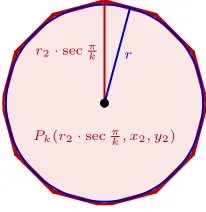
Let the yolk in theL2 metric be the diskB(r2, x2, y2).
Consider the regular,k-sided polygonPk(r2·secπk, x2, y2),
so that by construction, all sides of this polygon are tangent toB(r2, x2, y2).
Pk(r2·secπk, x2, y2)
r2·secπk r
Figure 10: The polygonPk(r2·secπk, x2, y2)is externally
tangent to the diskB(r2, x2, y2).
Now sinceB(r2, x2, y2)is theL2 yolk, it intersects all
median lines and so does its enclosing polygon Pk(r2 ·
secπk, x2, y2). By the minimality ofPk(r, x, y), we getr≤
secπ
k ·r2. But forθ∈[0, π
3], we havesecθ≤ 1 1−θ. So,
secπ k ≤
1 1−π
k
≤1 +ε,
which implies thatr≤(1 +ε)·r2, as required.
8
Concluding Remarks
Cole’s (1987) extension to parametric search states that the running time of the parametric search may be reduced if cer-tain comparisons are delayed. This is a direction for further research that could potentially improve the running time of our algorithms.
An open problem is whether one can compute the yolk in higher dimensions without precomputing all median hy-perplanes. Avoiding the computation of median hyperplanes yields even greater benefits as less is known about bounds on the number of median hyperplanes in higher dimensions. Similarly, our approximation algorithm for theL2yolk in
the plane is optimal up to polylogarithmic factors, however, it is an open problem as to whether there is a near-linear time exact algorithm. Our attempts to apply Megiddo’s paramet-ric search technique to theL2 yolk have been unsuccessful
so far.
Finally, there are other solution concepts in computa-tional spatial voting that currently lack efficient algorithms. The shortcomings of existing algorithms are: for the Shap-ley Owen power score there is only an approximate algo-rithm (Godfrey 2005), for the Finagle point only regular
polygons have been considered (Wuffle et al. 1989) and for the ε-core only a membership algorithm exists (Tovey 2010b). Since these problems have a close connection to either median lines or minimal radius, we suspect that Megiddo’s parametric search technique could also be use-ful for these problems.
References
Agarwal, P. K., and Sharir, M. 1998. Efficient algo-rithms for geometric optimization.ACM Computing Surveys
30(4):412–458.
Anshelevich, E.; Bhardwaj, O.; and Postl, J. 2015. Ap-proximating optimal social choice under metric preferences. InTwenty-Ninth AAAI Conference on Artificial Intelligence, AAAI 2015, 777–783.
Berg, M. D.; Gudmundsson, J.; and Mehr, M. 2016. Faster algorithms for computing plurality points. In32nd Interna-tional Symposium on ComputaInterna-tional Geometry, SoCG 2016, 32:1–32:15.
Black, D. 1948. On the rationale of group decision-making.
Journal of Political Economy56(1):23–34.
Cole, R. 1987. Slowing down sorting networks to obtain faster sorting algorithms. Journal of the ACM 34(1):200– 208.
Dey, T. K. 1997. Improved bounds on planark-sets andk -levels. In38th Annual Symposium on Foundations of Com-puter Science, FOCS 1997, 156–161.
Downs, A. 1957. An economic theory of political action in a democracy. Journal of Political Economy65(2):135–150.
Enelow, J. M., and Hinich, M. J. 1984.The spatial theory of voting: An introduction. CUP Archive.
Feld, S. L., and Grofman, B. 1990. A theorem connecting Shapley-Owen power scores and the radius of the yolk in two dimensions.Social Choice and Welfare7(1):71–74.
Feld, S. L.; Grofman, B.; Hartly, R.; Kilgour, M.; Miller, N.; et al. 1987. The uncovered set in spatial voting games.
Theory and Decision23(2):129–155.
Feld, S. L.; Grofman, B.; and Miller, N. 1988. Centripetal forces in spatial voting: on the size of the yolk. Public Choice59(1):37–50.
Feld, S. L.; Grofman, B.; and Miller, N. R. 1989. Limits on agenda control in spatial voting games. Mathematical and Computer Modelling12(4-5):405–416.
Godfrey, J. 2005. Computation of the Shapley-Owen power index in two dimensions. In4th Annual workshop, Univer-sity of Warwick, 20–22.
Goel, A.; Krishnaswamy, A. K.; and Munagala, K. 2017. Metric distortion of social choice rules: Lower bounds and fairness properties. InProceedings of the 2017 ACM Con-ference on Economics and Computation, EC 2017, 287–304.
McKelvey, R. D. 1976. Intransitivities in multidimensional voting models and some implications for agenda control.
Journal of Economic Theory12(3):472 – 482.
McKelvey, R. D. 1986. Covering, dominance, and institution-free properties of social choice. American Jour-nal of Political Science283–314.
Megiddo, N. 1983. Applying parallel computation algo-rithms in the design of serial algoalgo-rithms.Journal of the ACM
30(4):852–865.
Miller, N. R.; Grofman, B.; and Feld, S. L. 1989. The geometry of majority rule. Journal of Theoretical Politics
1(4):379–406.
Miller, N. R. 1980. A new solution set for tournaments and majority voting: Further graph-theoretical approaches to the theory of voting.American Journal of Political Science68– 96.
Ordeshook, P. C. 1993. The spatial analysis of elections and committees: Four decades of research. Technical report, California Institute of Technology, Division of the Humani-ties and Social Sciences.
Plott, C. R. 1967. A notion of equilibrium and its possibility under majority rule. The American Economic Review787– 806.
Poole, K. T., and Rosenthal, H. 1984. The polarization of American politics.The Journal of Politics46(4):1061–1079. Poole, K. T., and Rosenthal, H. 1991. Patterns of congres-sional voting. American Journal of Political Science 228– 278.
Poole, K. T., and Rosenthal, H. 2001. D-nominate after 10 years: A comparative update to congress: A political-economic history of roll-call voting. Legislative Studies Quarterly5–29.
Preparata, F. P. 1978. New parallel-sorting schemes. IEEE Transactions on Computers(7):669–673.
Schofield, N.; Miller, G.; and Martin, A. 2003. Critical elections and political realignments in the USA: 1860–2000.
Political Studies51(2):217–240.
Schofield, N. 2004. Equilibrium in the spatial ‘valence’ model of politics.Journal of Theoretical Politics16(4):447– 481.
Schofield, N. 2007.The spatial model of politics. Routledge. Skowron, P. K., and Elkind, E. 2017. Social choice un-der metric preferences: Scoring rules and STV. In Thirty-First AAAI Conference on Artificial Intelligence, AAAI 2017, 706–712.
Stone, R. E., and Tovey, C. A. 1992. Limiting median lines do not suffice to determine the yolk.Social Choice and Wel-fare9(1):33–35.
T´oth, G. 2000. Point sets with manyk-sets. In16th Annual Symposium on Computational Geometry, SoCG 2000, 37– 42.
Tovey, C. A. 1992. A polynomial-time algorithm for com-puting the yolk in fixed dimension.Mathematical Program-ming57(1):259–277.
Tovey, C. A. 1993. Some foundations for empirical study in the Euclidean spatial model of social choice. In Politi-cal economy: institutions, competition, and representation: Proceedings of the Seventh International Symposium in Eco-nomic Theory and Econometrics, 175. Cambridge Univ Pr. Tovey, C. A. 2010a. The almost surely shrinking yolk.
Mathematical Social Sciences59(1):74–87.
Tovey, C. A. 2010b. A finite exact algorithm for epsilon-core membership in two dimensions. Mathematical Social Sciences60(3):178–180.
Tovey, C. A. 2011. The Finagle point and the epsilon-core: a comment on Br¨auninger’s proof. Journal of Theoretical Politics23(1):135–139.