The Thirty-Third AAAI Conference on Artificial Intelligence (AAAI-19)
Evolving Solutions to Community-Structured Satisfiability Formulas
Frank Neumann
Optimisation and Logistics School of Computer ScienceThe University of Adelaide Adelaide, Australia
Andrew M. Sutton
Department of Computer ScienceUniversity of Minnesota Duluth Duluth, MN, USA
Abstract
We study the ability of a simple mutation-only evolution-ary algorithm to solve propositional satisfiability formulas with inherent community structure. We show that the com-munity structure translates to good fitness-distance correla-tion properties, which implies that the objective funccorrela-tion pro-vides a strong signal in the search space for evolutionary algorithms to locate a satisfying assignment efficiently. We prove that when the formula clusters into communities of size
s∈ω(logn)∩O(nε/(2ε+2))
for some constant0< ε <1, and there is a nonuniform distribution over communities, a simple evolutionary algorithm called the (1+1) EA finds a sat-isfying assignment in polynomial time on a1−o(1)fraction of formulas with at least constant constraint density. This is a significant improvement over recent results on uniform ran-dom formulas, on which the same algorithm has only been proven to be efficient on uniform formulas of at least loga-rithmic density.
Introduction
Evolutionary algorithms are a broad class of incomplete randomized search heuristics that are sometimes applied to tackling difficult optimization problems that arise in prac-tice. We study the performance of a simple evolutionary al-gorithm tasked with finding a satisfying assignment to struc-tured (non-uniform) propositional formulas expressed as the conjunction of m Boolean disjunctive clauses of size ex-actly k over n variables. A series of recent papers (Sut-ton and Neumann 2014; Doerr, Neumann, and Sut(Sut-ton 2017; Buzdalov and Doerr 2017) have derived rigorous running time bounds on a variety of evolutionary algorithms ap-plied to solving propositional formulas generated uniformly at random.
One criticism of the uniform random model is that it in-adequately characterizes propositional formulas that arise from practical applications. Industrial SAT instances are far more complex, and contain complicated structural charac-teristics. Among these are modularity (Gir´aldez-Cru and Levy 2016), heterogeneity (Ans´otegui, Bonet, and Levy 2009), self-similarity (Ans´otegui et al. 2014), and local-ity(Gir´aldez-Cru and Levy 2017). Several non-uniform
for-Copyright c2019, Association for the Advancement of Artificial Intelligence (www.aaai.org). All rights reserved.
mula distributions have been proposed to model the above characteristics better.
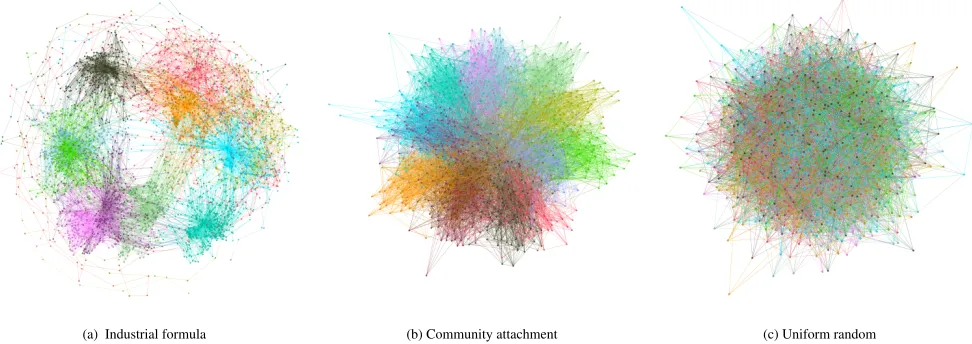
In this paper, we are interested in extending the analysis to structured formulas that exhibit features that are statisti-cally closer to industrial satisfiability problems. We conduct an analysis of the (1+1) EA over a generalization of the com-munity attachmentmodel of Gir´aldez-Cru and Levy (2016) for modular SAT formulas. Figure 1 illustrates the constraint graph structure for an industrial formula (from bounded model checking), a formula generated by the community at-tachment model, and a formula generated uniformly at ran-dom.
We show that the (1+1) EA can solve in polynomial time a1−o(1)fraction of satisfiable formulas drawn from the community attachment model with constraint density (aver-age degree) that is at least a sufficiently large constant, pro-vided that the density within communities is nonuniform. This bound covers a larger region of the constraint den-sity spectrum than previous results on evolutionary algo-rithms on the uniform random model. In particular, analo-gous results were proved for the (1+1) EA on the uniform random model, but only for formulas of density at least Ω(logn)(Doerr, Neumann, and Sutton 2017). For polylog-arithmic densities, a more complicated evolutionary algo-rithm called the (1+(λ,λ)) GA yields a√lognspeed up on formulas with densityω(log2n), and even further improve-ments on asymptotically larger densities when the popula-tion size is adapted (Buzdalov and Doerr 2017).
Randomized search heuristics such as WalkSAT (Selman, Kautz, and Cohen 1994), Sch¨oning’s algorithm (Sch¨oning 1999) and evolutionary algorithms are incomplete in the sense that they can only locate a satisfying assignment if it exists, and not decide an unsatisfiable formula. A perfor-mance guarantee on satisfiable formulas for such algorithms allows for the construction of a Monte Carlo decision algo-rithm with one-sided error (Sutton and Neumann 2014). It therefore suffices to derive time bounds only on satisfiable formulas.
(a) Industrial formula (b) Community attachment (c) Uniform random
Figure 1: Constraint graphs for different formulas partitioned into community components by the Gephi tool (Bastian, Hey-mann, and Jacomy 2009). The industrial formula is a bounded model checking instance. The synthetic formulas both have
n= 1162,m= 3738andk= 3. The community attachment formula hass= 83andp= 0.696.
that are difficult to control in analysis. To address this, pre-vious work analyzing the running time of evolutionary algo-rithms on the random propositional satisfiability model (Sut-ton and Neumann 2014; Doerr, Neumann, and Sut(Sut-ton 2017; Buzdalov and Doerr 2017) investigate the fitness-distance correlation on therandom plantedmodel, in which formulas are forced to be satisfiable by hiding some satisfying assign-ment within the formula. For reasonably dense formulas, this corresponds to the uniform random filtered model, i.e., the uniform model conditioned on satisfiability (Doerr, Neu-mann, and Sutton 2017). We point out that random planted formulas are easy to solve for classical algorithms (Krivele-vich and Vilenchik 2006), but our goal is to advance the the-oretical analysis of incomplete search heuristics on random satisfiability models.
To derive performance guarantees on satisfiable community-structured formulas, we investigate a planted modular satisfiability model. In this model, we choose uniformly at random an assignmentx? from the set of all
assignments. For eachk-set of Boolean variables, we only allow clauses from the 2k − 1 unique clauses on those
variables that are satisfied by x? (rather than the original 2k). Similar to the uniform model, for reasonably dense
formulas the planted modular SAT model converges to the filtered modular SAT model. The proof of this claim is a straightforward adaptation of the analogous proof for the uniform model (Doerr, Neumann, and Sutton 2017, Theorem 4), and we omit it for space.
Formally, we consider propositionalk-CNF formulas F
overnBoolean variables:
F =
m
^
i=1
(`i,1∨`i,2∨ · · · ∨`i,k)
where`i,jis one of thenvariables or its negation. The set of nvariables corresponds to the set[n] :={1,2, . . . , n}, and we will refer to these sets interchangeably. Lets:=s(n)be
a divisor ofn. The community attachment model (Gir´aldez-Cru and Levy 2016) is defined as the set of all propositional
k-CNF formulasF(n, m, k, s, p)that are constructed as fol-lows. Partition[n]intot =n/sdisjoint subsetsΓ1, . . . ,Γt
where
Γ`={s(`−1) + 1, s(`−1) + 2, . . . , s`}.
We call ak-CNF clauselocalized if it contains onlyk lit-erals that involve variables from the same community. We call a clauseseparatedif it does not contain any pairs of lit-erals that involve variables from the same community. Each clause is generated by drawing a localized clause with prob-ability puniformly at random, and a separated clause uni-formly at random with probability 1 −p. Note that, ex-cept when k = 2, the model does not contain uniform random k-SAT as a special case. When k = 2, setting
p = (s−1)/(n−1)recovers the uniform random2-SAT model. Empirically, the model correlates better to industrial formulas in the sense that solvers that specialize on indus-trial instances perform better on highly modular instances than on formulas that are closer to uniform (Gir´aldez-Cru and Levy 2016).
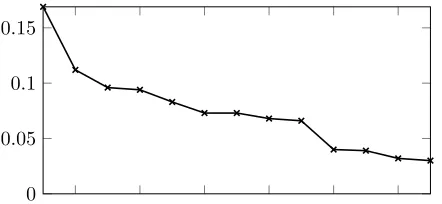
In real world data, the density of communities is not uni-form. For example, the density of each community for the industrial bounded model checking formula shown on the left of Figure 1 is charted in Figure 2. To address this phe-nomenon, we generalize the community attachment model of Gir´aldez-Cru and Levy (2016). In particular we define a distribution0≤π` ≤1for`∈[t]such thatPt`=1π`= 1.
A localized clause is chosen from community`with proba-bilityπ`. The original community attachment model is
re-covered with the uniform distribution π` = 1/t for all `∈[t].
LetF be a propositional formula onnvertices expressed as the conjunction ofmdisjunctive clauses. Theconstraint graph of F is an undirected graph G = (V, E)whose n
0 0.05 0.1 0.15
Figure 2: Relative density of communities in industrial bounded model checking instance in Figure 1a. For a com-munity of size s, the community density is the fraction of
s 2
pairs that are connected by an edge.
and only if uandv appear as literals together in a clause ofF. The constraint graph of a formula is an important tool to understanding the structure of the formula, and how that structure might be exploited by SAT solvers.
The modularityof G(Newman and Girvan 2004) mea-sures the strength of division into communities. Given a par-titionΓof V into communitiesΓ1,Γ2, . . ., the modularity
ofGwith respect toΓis the fraction of edges within a com-munity minus the expected fraction if the edges were ran-domly distributed. Given a community Γ` ∈ Γ, denote as E(Γ`) ⊆ E the set of edges within the community. The
modularity ofGwith respect toΓis
Q(G,Γ) = X
Γ`∈Γ
|E(Γ`)|
|E| −
P
v∈Γ`deg(v) 2|E|
2!
.
The modularity of G is Q(G) = maxΓQ(G,Γ). For a
community-structured SAT formulaF ∈ F(n, m, k, s, p), the expected modularity of the underlying constraint graph ofF is bounded byE(Q(G))≥p−s/n(Gir´aldez-Cru and Levy 2016, Theorem 2).
The (1+1) EA is a basic randomized search heuristic that functions as a kind of degenerate case for more complicated evolutionary techniques. It maintains a population size of one, and produces a single offspring via a mutation opera-tion in each generaopera-tion. Selecopera-tion is performed by compar-ing the offsprcompar-ing to its parent. The parent is replaced only if the offspring is at least as fit as the parent. The mutation op-eration changes the current individual in a minimal way. In the case of length-nbinary strings, the state of each variable is negated with probability1/n. In this way, the (1+1) EA, illustrated in Algorithm 1 operates similarly to a simple local search hill-climber (such as GSAT), with the distinction that in each step, larger jumps in the search space are possible. The probability that mutation produces a jump of Hamming distancedfalls off as a degree-dpolynomial inn. The dis-tinction between the (1+1) EA and a simple hill-climber is small, but important. Current running time bounds for local search-like heuristics on logarithmically dense formulas of the uniform model depend on the ability of the algorithm to change more than one variable at a time (Doerr, Neumann, and Sutton 2017).
Algorithm 1:(1+1) EA
1 Choosexuniformly at random from{0,1}n;
2 whilestopping criterion not metdo 3 y←x;
4 foreachi∈ {1, . . . , n}do
5 With probability1/n,yi←(1−yi);
6 iff(y)≥f(x)thenx←y;
Search space of planted modular formulas
As is usual with evolving assignments to propositional sat-isfiability formulas, we consider each full assignment tonBoolean variables as strings over a binary alphabet. This al-lows us to identify each assignment with a fitness function
f:{0,1}n → {0,1, . . . , m}such thatf(x)counts the
num-ber of clauses satisfied by the assignment corresponding to the binary stringx.
Similar to previous analyses on propositional satisfiabil-ity (Sutton and Neumann 2014; Doerr, Neumann, and Sut-ton 2017; Buzdalov and Doerr 2017), we will rigorously characterize thefitness-distance correlationin typical fitness landscapes induced by f together with the Hamming met-ric on{0,1}n. Fitness-distance correlation was introduced
decades ago as a measure of difficulty for evolutionary al-gorithms (Jones and Forrest 1995), and describes the relat-edness of fitness values to the distance to an optimal solu-tion. In the context of planted formulas, we prove that the fitness of a point is strongly correlated to the distance from the planted solution (although a search algorithm may dis-cover a different satisfying assignment before reaching the planted solution).
In the community attachment model, it will be useful to partition the fitness function by contribution from differ-ent communities. We take f`(x) to be the count of
local-ized clauses from community`that are satisfied byx, and
fsep(x)to be the count of separated clauses satisfied byx.
Thus
f(x) =fsep(x) + t
X
`=1
f`(x). (1)
Furthermore, whenI ⊆[t], we takefI(x)to mean the
con-tributionP
`∈If`(x)tof from the localized clauses in the
communities indexed byI.
In the following section, we introduce a number of defini-tions and preliminary lemmas that support the main result.
Preliminaries
We define the following distance notation, keeping in mind thatx? corresponds to a fixed but arbitrary planted
assign-ment.
Definition 1. Forx, y ∈ {0,1}n, we denote the Hamming
distance ofxandyasd(x, y). For a communityΓ` ⊆[n],
we denote
d(x, y; Γ`) =|{i∈Γ`:xi6=yi}|
we often simply use d(x) and d(x; Γ`)to denote d(x, x?)
andd(x, x?; Γ
`), respectively.
We require the following definition that characterizes bi-nary strings that are in some sense not too far from the planted solution when restricted to any community.
Definition 2. For a formula inFx?(n, m, k, s, p), we say a pointx∈ {0,1}nis-balanced with respect to the formula
ifd(x; Γ`)≤s(1/2 +)for every`∈ {1,2, . . . , n/s}.
As expected, so long ass is not too small, most strings in{0,1}nare-balanced. Moreover, we will also implicitly
use the straightforward fact that the -balance property is closed under steps toward the planted solution.
Lemma 1. For every fixed0< <1/2, ifFis a formula in
Fx?(n, m, k, s, p)with eachs=ω(logn), then a uniformly chosen string from{0,1}n is-balanced with respect toF
with probability1−e−Ω(s).
Proof. Let x ∈ {0,1}n be chosen uniformly at random.
Thus for anyi∈[n],Pr(xi =x?i) = 1/2. For an arbitrary
partitionΓ`, the probability thatd(x; Γ`)>(1 + 2)s2 is at
mostexp(−2s2/3). Applying a union bound over allt < n
communities,xviolates-balance in at least one community with probability at mostexp(−2s2/3+lnt) =e−Ω(s).
We also define the following expression to count the clauses in a particular clause set that have a different sat-isfiability state between two assignments.
Definition 3. Let C be a set of clauses. For any x, y ∈ {0,1}n, denote as∆
xy(C)the number of clauses inCthat
are unsatisfied byxbut satisfied byy.
Finally, we will make use of the following simple propo-sition to count types of clauses in a formula.
Proposition 1. Letd≤k≤sbe integers. Then
d
X
r=1 r
d
r
s−d
k−r
= dk s
s
k
Proof. Sincer dr=d dr−−11, we can rewrite the sum on the LHS as
d d
X
r=1
d
−1 r−1
s
−d k−r
=d d−1
X
r=0
d
−1 r
s
−d k−(r+ 1)
=d
s−1
k−1
,
where we have applied the Chu-Vandermonde iden-tity (Gould 1956).
Fitness signal from localized clauses
For a particular communityΓ`, denote asC`the set of all
legalk-CNF clauses formed fromΓ` that are satisfied by x?. For all`∈ {1,2, . . . , t},|C
`|= (2k−1) ks
since there are2kways to negate variables chosen from anyk-set ofΓ
`,
but exactly one of them is unsatisfied byx?.
We count the potential contribution to the increase in fit-ness of any legal clause inC`for all the points that are closer
to the planted solution.
Lemma 2. Consider a community Γ` and letx∈ {0,1}n
be arbitrary. Let C` denote the set of localized clauses for
Γ`that are satisfied by a planted assignmentx?. Then
X
y:d(x)−d(y)=1
∆xy(C`) =
d(x; Γ`)k s
s
k
.
Proof. LetI ⊆ Γ` be the index set corresponding to the
positions in x that differ from x? in community Γ `. A
clause inC`is unsatisfied byxbut satisfied by someywith d(x)−d(y) = 1if (1) all its literals are false underx, and (2) it contains a literal l such that the variable associated withlappears inI. If it containsr≤ |I|literals with asso-ciated variables indexed by elements ofI, then that clause contributes exactlyrtimes to the sum of∆xy(C`)over the
Hamming neighbors ofxthat are closer tox?.
Such ak-clause can be constructed by choosing ther vari-ables fromIand the remainingk−rvariables fromΓ`\ I.
The negation of thekvariables in the clause is the unique negation pattern on thekchosen variables so that the clause is not satisfied byx. There are |I|r sk−|I|−rways to choose ak-set that corresponds to a clause that contributesrto the sum, and the total contribution of all such clauses to the sum is given by Proposition 1. Since|I|=d(x; Γ`), the RHS of
the claim follows from the proposition.
To ensure that we have not over- or under-counted, note that each of these clauses contain r > 0 literals, each of which must be true under someywithd(y) =d(x)−1. For any one of these literals, there is a uniquei ∈ |I|that cor-responds to the variable that must be flipped to move from
xtoy. Sinced(x; Γ`)−d(y; Γ`) = 1,yi =x?i, and so that
literal is also true underx?. It must therefore be the case that each of the clauses we have counted above are also satisfied byx?, and are hence all valid clauses inC`.
We also need to count the potential contribution to the de-crease in fitness of any legal clause inC`for all the points
that are one step closer to the planted solution. This is cap-tured by the following lemma.
Lemma 3. Consider a community Γ` and letx∈ {0,1}n
be arbitrary. LetC`denote the localized clauses forΓ`that
are satisfied by a planted assignmentx?. Then
X
y:d(x)−d(y)=1
∆yx(C`) =d(x; Γ`)
s−1 k−1
− s−d(x;Γ`)
k−1
.
Proof. For eachk-set of variables fromΓ`, there is only one
way to negate the variables to produce a unique clause (up to commutativity) that is not satisfied by an assignmenty. There ared(x; Γ`)bitstringsy withd(x)−d(y) = 1that
differ fromxin exactly one positioni∈Γ`, and for each of
these, ks−−11ways to choose the remainingk−1variables to appear in a clause. However, s−d(x;Γ`)
k−1
of these clauses are not allowed because allkcorresponding positions differ fromx?, and hence such a clause would not be satisfied by
x?, and is therefore not a legal clause ofC
`. Subtracting the
Lemma 4. Let F be a planted modular formula from
Fx?(n, m, k, s, p)withk, = Θ(1), and letI ⊆ [t]. With probability
1−exp −Ω mp
s
X
`∈I
π`d(x; Γ`)
!!
,
the following bound holds at every-balanced pointx.
X
y:d(x)−d(y)=1
fI(y)−fI(x) = Θ
mp s
X
`∈I
π`d(x,Γ`)
!
.
Proof. Fixxto be an arbitrary-balanced point. LetN =
{y : d(x)−d(y) = 1}. Note thatx?,xandN are fixed
for the remainder of the proof. We define two sequences of
mrandom variables over the probability space of randomly constructed formulasF fromFx?(n, m, k, s, p). Letαi
de-note thei-th clause of F and let {Y1, Y2, . . . , Ym} be the
sequence
Yi=
0 ifαiis separated or true underx,
|{y∈N :αiis true undery}| otherwise.
Ifαiis localized,Yicounts the total number of times thatαi
switches from false to true in the set of Hamming neighbors ofxthat are strictly closer to the planted solution. Similarly, we define the sequence{Z1, Z2, . . . , Zm}as
Zi=
0 ifαiis separated or false underx,
|{y∈N:αiis false undery}| otherwise.
Since a clause can be false under only one configuration of itskvariables,Zi ∈ {0,1}. Whenαiis localized,Zi
indi-cates the presence of an element ofNfor whichαiswitches
from true to false. As each of them clauses is chosen in-dependently, both{Yi : i ∈ [m]} and{Zi : i ∈ [m]} are
sequences of independent random variables. For any`∈ I, we choose clauseαifromC`with probabilitypπ`.
Further-more, the probability thatαiis chosen from the set of clauses
that change from false to true when moving from anyxto
yis exactly∆xy(C`)/|C`|, and we calculate the expectation
as follows.
E(Yi) =p
X
`∈I
π`
|C`|
X
y:d(x;Γ`)−d(y;Γ`)=1
∆xy(C`)
= p
(2k−1) s k
X
`∈I
π`d(x; Γ`)k s
s
k
, by Lemma 2
= pk
(2k−1)s
X
`∈I
π`d(x; Γ`).
Similarly,
E(Zi) =p X
`∈I
π`
|C`|
X
y:d(x;Γ`)−d(y;Γ`)=1
∆yx(C`)
= p
(2k−1)s k
P
`∈Iπ`d(x; Γ`) s−1
k−1
− s−d(x;Γ`)
k−1
,
which holds by Lemma 3. Furthermore, sincexis supposed to be -balanced,d(x; Γ`)≤s(1/2 +), and thus
E(Zi)≤ p
(2k−1)ks
P
`∈Iπ`d(x; Γ`)
s−1
k−1
− s(1k/−2−1)
=p P
`∈Iπ`d(x;Γ`) (2k−1)
k s−
k(1/2−)k−1
s +O
1
s2
=pk P
`∈Iπ`d(x;Γ`)
(2k−1)s (1−(1/2−)
k−1+O(1/s)).
Note that the total fitness change in localized clauses in-dexed byImoving fromxto ally∈N is equivalent to the difference in the sums of the random variables that count lo-calized clauses that switch state betweenxand ally ∈ N. In other words,
X
y:d(x)−d(y)=1
fI(y)−fI(x) = m
X
i=1
(Yi−Zi).
As0 ≤ Yi ≤kand0 ≤Zi ≤1, settingY =P m i=1Yi/k
andZ = Pm
i=1Zi, for any arbitrary constant0 < δ < 1
the probability Y ∈ [(1−δ)E(Y /k),(1 +δ)E(Y)] and
Z ∈ [0,(1 +δ)E(Z)]is bounded as claimed by applying a multiplicative Chernoff bound, completing the proof.
Efficiently solving constant-density formulas
The result of Lemma 4 estimates the probability that a small local mutation can detect a move in the direction of the planted solution. In the original community attachment model,π` = 1/t, that is, a localized clause is chosenuni-formly over all communities. We consider a slight general-ization in which communities are no longer required to be uniform in density. This generalization is arguably more re-alistic, as it more closely matches the variability in commu-nity density observed in real-world data (see Figure 2). For any small constant0< ε <1, we partition the communities so that a nonempty set I ⊆ [t] of communities aredense in the sense thatπ` = Ω(1/t1−ε)for each` ∈ I and the
remaining aresparseso thatπ`=O(1/t1+ε)for`∈[t]\ I.
Theorem 1. Let 0 < ε < 1 be any small constant. Let s∈ω(logn)∩O(nε/(2ε+2)), setp= 1−O(1/n1+ε)and k= Θ(1). Let∅(I ⊆[t]with
π`=
Ω t11−ε
for`∈ I, O t1+1ε
for`∈[t]\ I.
For constraint densities m/n ≥ cwherecis a sufficiently large constant, all but a vanishing fraction of planted mod-ular formulasF inFx?(n, m, k, s, p)are solved in polyno-mial expected time by the (1+1) EA.
Proof. We first argue that all but a fast-vanishing fraction of formulas inFx?(n, m, k, s, p)have a good drift condition on fI. Letx∈ {0,1}nbe an arbitrary-balanced string. Define
N ={y:d(x)−d(y) = 1∧xi 6=yi =⇒ ∃`∈ I, i∈Γ`}
to be the set of P
`∈Id(x; Γ`) neighbors that are closer
to x? in some dense community indexed by I. Applying
Lemma 4, the bound
X
y∈N
fI(y)−fI(x) = Θ
m st1−ε
X
`∈I
d(x,Γ`)
holds with probability
1−exp −Ω m
st1−ε
X
`∈I
d(x; Γ`)
!!
.
SincefIis independent of any bit not inS`∈IΓ`,
apply-ing a union bound over all-bounded length-|I|tsubstrings indexed byS
`∈IΓ`lying at distancedfrom the substring of x?indexed byS
`∈IΓ`, we find this strong drift condition
holds with probability at least
1−
n
X
d=1
|I|t
d
exp−Ω(dnε2)≥1−exp−Ω(nε2).
Here we have used the fact thatm/(st1−ε) = Ω(nε2).
We now show that the fitness contribution from other clauses is small. The expected number of separated clauses in the entire formula is bounded ascn(1−p) = O(1/nε) which exceeds a constant only with probability o(1) by Markov’s inequality. Therefore, with probability1−o(1), at every-balanced point,
X
y∈N
f(y)−f(x)≥X
y∈N
fI(y)−fI(x)−O(1)
= Ω nε2X `∈I
d(x,Γ`)
!
.
Letd=P
`∈Id(x; Γ`). Recall thatNis the set of all
Ham-ming neighbors ofxthat are closer tox?by some variable in a dense community (those indexed byI). A simple proof by induction on distance in dense communities from the planted solution (see Lemma 6 of (Doerr, Neumann, and Sutton 2017)) yields thatfI(x) +fsep(x) = O(d)sincem/n =
Θ(1). As any Hamming neighbor ofxis generated by stan-dard mutation with probability 1−1
n
n−1 1
n ≥e
−1/n, we
can bound the drift offI+fsepat every-balanced pointx
by
1 en
X
y∈N
max{0, f(y)−f(x)}= Ω dn
ε2
n
!
= Ω
f
I(x) +fsep(x) n1−ε2
.
(2)
As long as the the (1+1) EA never generates a point that is not-balanced with respect to the dense communities, there is sufficient drift toward the planted solution in the
length-|I|tsubstring induced by the dense communities. The initial point is drawn uniformly at random, so Lemma 1 guarantees an-balanced string with probability at least1−e−Ω(nε). Finally, as long the current point xof the (1+1) EA is -balanced, the probability of reaching a non--balanced point within any polynomial number of iterations is superpolyno-mially close to zero by using Lemma 4 together with the negative drift theorem (Oliveto and Witt 2011; 2012) at ev-ery dense community. Applying the multiplicative drift the-orem (Doerr, Johannsen, and Winzen 2012), the dense com-munities are solved in expected timeO(n1−ε2logn).
It remains to bound the time until the remaining variables are solved. Fix ` ∈ [t]\ I to be the index to an arbitrary sparse community, and let {Xi : 1 ≤ i ≤ m} be the
in-dicator random variable for localized clauses fromΓ`. The
expected number of localized clauses in the community is E (Pm
i=1Xi) =cnπ`=O nε/12
, since for sparse commu-nities we haveπ` = O(t−(1+))and we have assumed the
community-size bound ofs=O(nε/(2ε+2)).
Finally, we apply a standard Chernoff bound to the sum of indicator random variables to ensure that the sum only exceeds a constantb >1with probabilityO(1/nbε). Thus
each of the O(t)sparse communities contribute at most b
localized clauses tof withO(1/nε)probability. Since we
have assumed there are only a constant number of separated clauses in total, the total number of clauses associated with bits in Γ` is a constant, and each of the remaining
com-munity substrings can be optimized inO(tnO(1)) = nO(1)
time, concluding the proof.
Experiment Results
In order to characterize the leading constants and demon-strate the tightness of the bound, we perform a number of nu-merical experiments to measure the run time of the (1+1) EA on the community attachment model. Since our proofs only require the constraint density to be a sufficiently large but unspecified constant, we generate run length distribution (RLD) curves of the (1+1) EA as a function of constraint density to observe its behavior. In Figure 3, we fixn= 1000,
s= 100andp= 3/4and varymto plot the empirical RLD curves.
On the standard uniform planted model there is a crit-ical constant density near which the performance of the (1+1) EA degrades significantly (Doerr, Neumann, and Sut-ton 2017). There is likely to be a similar effect in the com-munity attachment model, and we conjecture that the perfor-mance degradation as density decreases is an expression of this effect. According to the RLD curves of Figure 3, the density of m/n = 5e is sufficiently large to escape this deterioration. We therefore choose this constant to be large enough of a density for our run time experiments.
For eachs ={100,110,120, . . . ,1000}, we generate 10 modular formulas using the community attachment model withn = s3/2andm/n= 5e. On each formula, we
mea-sure the run time of the (1+1) EA for 10 trials. To estab-lish a segmentation into dense and sparse communities, we identify bt(1−ε)ccommunities as dense and choose local-ized clauses uniformly from dense communities with prob-ability1−t−ε. The remaining communities are chosen uni-formly with probabilityt−ε. Thus a localized clause from
a particular dense community is generated with probability (1−t−ε)/bt(1−ε)c = Ω(1/t(1−ε)) and from a particular
sparse community with probability t−ε/(t− bt(1−ε)c) = O(1/t1+ε) as required by the proof of Theorem 1. We
conjecture, however, that the asymptotic behavior of the (1+1) EA does not depend strongly on this condition. Nor do we believe that the requirement for vanishing separated clauses is necessary.
104.5 105 105.5 10−2
10−1
100
generations
proportion
solv
ed
m/n= 2e m/n= 3e m/n= 4e m/n= 5e
Figure 3: Empirical run length distributions on community attachment model, controlling for density. The curves are created by 100 runs of the (1+1) EA at each constraint den-sity valuem/n ∈ {2e,3e,4e,5e}. Each formula contains
n= 1000variables, community sizes= 100, and localized clause probabilityp= 3/4.
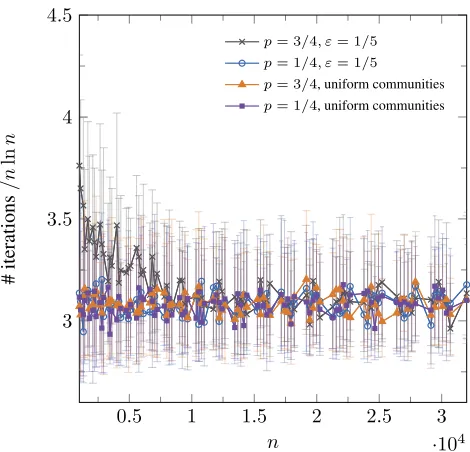
measured in the experiments forp ∈ {3/4,1/4} andε = 1/5. We also compare the run time of the (1+1) EA solving formulas generated with the community attachment model over uniform communities.
Empirically, the median run time converges to roughly 3.1·nlnn, thus our time bound for solving the dense com-munities appears to be closer to the truth, even when the count of separated clauses is non-vanishing. We also find support for our conjecture that the uniformity of communi-ties does not change the asymptotic behavior dramatically, and overall, the running time seems to be largely invariant to localized clause probability.
Conclusions
The uniform random SAT model has been studied intensely for decades. Recently, several works have introduced non-uniform models that produce formulas exhibiting structural features that correspond better to real-world industrial in-stances. In this paper we push the field of run time analysis of randomized search heuristics toward these non-uniform models by conducting a rigorous analysis of the running time of the (1+1) EA on the recently proposed community attachment random SAT model, which has tunable modu-larity. We prove that, as long as the the community size is polynomially smaller than the number of variables, the EA can be efficient down to constant constraint densities. This can be contrasted to the uniform random model, on which the best known results require a density of Ω(logn). Our analysis leverages the fact that in the community-structured
0.5 1 1.5 2 2.5 3
·104
3 3.5 4 4.5
n
#
iterations
/n
ln
n
p= 3/4, ε= 1/5
p= 1/4, ε= 1/5
p= 3/4, uniform communities
p= 1/4, uniform communities
Figure 4: Median run time of the (1+1) EA divided bynlnn
as a function of non formulas sampled from the commu-nity attachment model,p∈ {3/4,1/4}, andm= 5en. Both non-uniform communities (ε= 1/5) and uniform communi-ties are plotted. The error bars denote the interquartile range. The statistics are taken from 10 runs each on10random for-mulas generated for each value ofn = s3/2 varying
com-munity sizesfrom100to1000.
formulas the fitness signal uncovered by mutations concen-trates around the frequency of dense localized clauses, rather than at the overall constraint density. Nevertheless, we con-jecture that the asymptotic behavior of the EA is similar on constant-density uniform formulas.
References
Ans´otegui, C.; Bonet, M. L.; Gir´aldez-Cru, J.; and Levy, J. 2014. The Fractal Dimension of SAT Formulas. In Pro-ceedings of the Seventh International Joint Conference on Automated Reasoning (IJCAR), 107–121. Springer. Ans´otegui, C.; Bonet, M. L.; and Levy, J. 2009. On the struc-ture of industrial SAT instances. InProceedings of the Fif-teenth Conference on Constraint Programming (CP), 127– 141.
Bastian, M.; Heymann, S.; and Jacomy, M. 2009. Gephi: An open source software for exploring and manipulating networks. InProceedings of the Third International AAAI Conference on Weblogs and Social Media (ICWSM). Buzdalov, M., and Doerr, B. 2017. Runtime analysis of the (1 + (λ,λ)) genetic algorithm on random satisfiable 3-CNF formulas. InProceedings of the Genetic and Evolutionary Computation Conference (GECCO), 1343–1350. ACM. Doerr, B.; Johannsen, D.; and Winzen, C. 2012. Multiplica-tive drift analysis. Algorithmica64:673–697.
complexity analysis of evolutionary algorithms on random satisfiablek-CNF formulas.Algorithmica78(2):561–586. Gir´aldez-Cru, J., and Levy, J. 2016. Generating SAT in-stances with community structure. Artificial Intelligence 238:119 – 134.
Gir´aldez-Cru, J., and Levy, J. 2017. Locality in random SAT instances. InProceedings of the Twenty-Sixth Inter-national Joint Conference on Artificial Intelligence (IJCAI), 638–644.
Gould, H. W. 1956. Some generalizations of Vander-monde’s convolution. The American Mathematical Monthly 63(2):84–91.
Jones, T., and Forrest, S. 1995. Fitness distance correlation as a measure of problem difficulty for genetic algorithms. InProceedings of the Sixth International Conference on Ge-netic Algorithms (ICGA), 184–192. Morgan Kaufmann. Kautz, H. A.; Ruan, Y.; Achlioptas, D.; Gomes, C. P.; Sel-man, B.; and Stickel, M. E. 2001. Balance and filtering in structured satisfiable problems (preliminary report). Elec-tronic Notes in Discrete Mathematics9:2–18.
Krivelevich, M., and Vilenchik, D. 2006. Solving random satisfiable 3CNF formulas in expected polynomial time. In Proceedings of the Seventeenth Annual ACM-SIAM Sympo-sium on Discrete Algorithms (SODA), 454–463. ACM Press. Newman, M. E. J., and Girvan, M. 2004. Finding and evaluating community structure in networks. Phys. Rev. E 69:026113.
Oliveto, P. S., and Witt, C. 2011. Simplified drift analy-sis for proving lower bounds in evolutionary computation. Algorithmica59(3):369–386.
Oliveto, P. S., and Witt, C. 2012. Erratum: Simplified drift analysis for proving lower bounds in evolutionary computa-tion.arXiv:1211.7184 [cs.NE].
Sch¨oning, U. 1999. A probabilistic algorithm for k-SAT and constraint satisfaction problems. InProceedings of the Forti-eth Annual Symposium on Foundations of Computer Science (FOCS), 410–414. IEEE Computer Society.
Selman, B.; Kautz, H. A.; and Cohen, B. 1994. Noise strategies for improving local search. In Proceedings of the Twelfth National Conference on Artificial Intelligence (AAAI), 337–343.