RESEARCH
Effect of voltage and electrode
material on electroflocculation of
Scenedesmus
acuminatus
Franziska Bleeke
1,2*, Gunnar Quante
2, Dominik Winckelmann
2and Gerd Klöck
2Abstract
Background: Microalgae are a promising new source for biomass production. One of the major challenges in regards to cost effectiveness is the biomass harvest. High energy input is required for the separation of the small algal cells from a large volume of surrounding media. Electroflocculation is reported as a promising harvesting technique to improve cost effectiveness within the downstream process. In the present study, six electrode materials were tested for electroflocculation of Scenedesmus acuminatus. Besides the commonly used aluminum and iron electrodes, magnesium, copper, zinc and brass electrodes were tested for biomass harvest and compared. The influence of four different voltages (10, 20, 30 and 40 V) was investigated and evaluated.
Results: Electroflocculation was applicable with all tested electrode materials. The highest flocculation efficiency was achieved using magnesium electrodes followed by Al, Zn, Cu, Fe and brass. Using magnesium, 90% of the suspension was clarified at 40, 30, 20, and 10 V after 9.2, 12.5, 18.5, and 43 min, respectively. All electrode materials showed the fastest flocculation at 40 V and the lowest at 10 V. The pH increased from 7.5 to values between 9.3 and 11.9 dur-ing the flocculation processes. Reuse of the supernatant showed no adverse effect on algal growth. The highest cell counts after 12 days of incubation were achieved with iron at 1.86 × 10⁷ cells ml−1 and the lowest with copper at 1.23 × 10⁷ cells ml−1.
Conclusion: Besides the commonly used iron and/or aluminum electrodes, other materials like magnesium, copper, zinc and brass can be successfully used for microalgal biomass harvest. For special biomass applications like food or feed additives, metals like magnesium have other advantages besides their high flocculation efficiency such as their low toxicity at high concentrations. Higher voltages increased the maximum flocculation efficiency but also increased the required energy input.
Keywords: Electroflocculation, Microalgae, Biomass harvest, Scenedesmus acuminatus, Flocculation
© 2015 Bleeke et al. This article is distributed under the terms of the Creative Commons Attribution 4.0 International License (http://creativecommons.org/licenses/by/4.0/), which permits unrestricted use, distribution, and reproduction in any medium, provided you give appropriate credit to the original author(s) and the source, provide a link to the Creative Commons license, and indicate if changes were made.
Background
Microalgae are eukaryotic, photosynthetic microorgan-isms that convert sunlight into chemical energy. The produced biomass can be used as food, feedstock or as potential substrate for biofuel production (Chisti 2007; Mata et al. 2010). They show a broad application in bio-technology since they grow fast at low nutritional and environmental requirements (Chisti 2007; Mallick 2002; Mata et al. 2010; Wang et al. 2008). Although they are
easy to cultivate, the bottleneck which often makes microalgal cultivation uneconomical is the downstream processing which contributes to 20–30% of the biomass production costs (Grima et al. 2003; Mata et al. 2010; Uduman et al. 2010). Separation of the cells (2–10 µm) from the surrounding growth media requires high energy inputs (Grima et al. 2003). Large volumes must be pro-cessed, since the concentration of cells is very low at around 0.5–2.5 g l−1. Common separation processes
combine filtration or flotation with a final centrifuga-tion step (Grima et al. 2003; Uduman et al. 2011), often exceeding the energy content of the harvested biomass
Open Access
*Correspondence: [email protected]
1 Jacobs University Bremen, Bremen, Germany
(Wijffels and Barbosa 2010). Increasing the efficiency at low energy demands within the harvesting process is a major challenge. By flocculation, the cells coagulate and larger particles are produced with a higher settling velocity.
Several studies are available on the use of chemical flocculation using metal salts or polyelectrolytes (Gerde et al. 2014; Granados et al. 2012; Papazi et al. 2010; Ten-ney et al. 1969), pH induced flocculation (Vandamme et al. 2012; Wu et al. 2012; Zheng et al. 2012), and flocculation using bacteria or filamentous fungi for bio-mass harvest (Zhou et al. 2013). In electroflocculation, the flocculant is produced by releasing metal ions from a sacrificial electrode (Vandamme et al. 2011). Numerous studies have been published on the use of electrofloccula-tion for algal biomass harvest (Lee et al. 2013; Uduman et al. 2011; Vandamme et al. 2011); however, these exper-iments used primarily aluminum electrodes (Kim et al.
2012; Lee et al. 2013; Vandamme et al. 2011; Xu et al.
2010) and/or iron electrodes (Uduman et al. 2011; Van-damme et al. 2011). Very little information can be found on the use of other electrode materials like Mg, Zn, Cu or brass for electroflocculation of microalgae.
The microalgae Scenedesmus is one of the most com-mon genera found in freshwater ecosystems. These polymorphic chlorophytes show a broad application in wastewater treatment (Chinnasamy et al. 2010; Hodaifa et al. 2008; Martinez et al. 2000), biodiesel production (Mandal and Mallick 2009; Tang et al. 2011) and in the production of high value pigments like lutein (Sanchez et al. 2008). Flocculation of Scenedesmus by metal salts, bioflocculants, and cationic polymers has been tested in prior experiments, but little research has been done on electroflocculation of Scenedesmus (Mallick 2002; Udu-man et al. 2010; Vandamme et al. 2011, 2012; Wang et al.
2008).
In the present study, six electrode materials were tested at four different voltages. It was verified whether metals other than aluminum and iron are suitable for the elec-troflocculation process (H1) and if the flocculation effi-ciency increases at higher voltages applied (H2).
Methods
Culture media and microalgae cultivation
All experiments were carried out using the freshwater chlorophyte Scenedesmus acuminatus from the culture collection of the University of Applied Sciences Bremen. The cells were grown in 2 l of liquid Wuxal medium (WM) (Winckelmann et al. 2015). Aeration was provided by compressed air, which was introduced into the culture by aeration hoses. Light was emitted by fluorescent lamps (OSRAM L 30W, warm white) placed in front and behind the algae cultures for 24 h per day.
Electroflocculation
The flocculation experiments were carried out at room temperature in 100 ml beakers filled with 90 ml of algae suspension. The initial cell concentration of the algae was 1 × 10⁷ cells ml−1. The electrode plates were cut
from commercial grade metal sheets. Before use, they were mechanically polished using abrasive paper and placed parallel and vertically into the algae suspension. The distance between the cathode and anode was 2.5 cm and the depth of immersion was 4 cm resulting in a sub-merged area of 51.2 cm2 (40 mm × 32 mm × 4 electrode
sides) for both electrodes. All experiments were carried out with the same area immersed in water and the same electrode distance. During the flocculation process, the culture was gently stirred at 100 rpm using a magnetic stirrer.
The electrodes were connected to a DC power supply (Hewlett Packard, Model 6205b, USA) and the voltage was adjusted to 10, 20, 30 or 40 V.
To determine the flocculation efficiency (FE), 1 ml sam-ples were taken before the flocculation and every 2.5 min during the process. Samples were taken from 3 cm below the surface. Optical densities for each sample were meas-ured at a wavelength of 750 nm in a Genesys 20 (Thermo scientific, Walthman, USA) photometer and pH values were recorded.
FE was calculated as follows:
ODt0 is the initial optical density before starting the
flocculation and ODt1 is the optical density of the sample
at a certain point of time during the process.
After the flocculation, the biomass and supernatant were separated and kept at −20°C for recycling
experi-ments. Before and after each flocculation, the electrodes were dried at 60°C for 2 h.
Iron, magnesium, aluminum, zinc, copper and brass electrodes were tested and compared. Each material served as both the anode and cathode at the same time. For comparison, a continuous function of the flocculation efficiency depending on the flocculation time, an interpo-lation, was used based on the following assumption:
The flocculation process can be described by a sigmoid function with an upper limit of 100%, leading to the fol-lowing function:
The coefficients a and b were determined for each volt-age and electrode material, respectively, using a numeri-cal curve fitting tool. By determining the coefficients a and b, it was possible to solve the efficiency function for
Flocculation efficiency=
ODt0−ODt1 ODt0
×100
Efficiency(t)=
100 1+ab−t
the time when the curve reached values of 90%. Those values were used in order to compare the various floccu-lation experiments.
The influence of each electrode material was tested and the best material regarding FE at 90% was determined.
The mass loss as a function of time was assumed to be linear. This assumption allowed calculating the amount of mass lost during the time until a flocculation efficiency of 90% was reached. This mass was multiplied by the exchange prices of the corresponding electrode materials in order to estimate the costs of each flocculation process (London metal exchange 2015).
Media reuse after flocculation
A batch-recycling experiment was conducted over 12 days in 100 ml Erlenmeyer flasks, filled with 50 ml of algae cells incubated in flocculation supernatant. Cell growth was monitored every other day by optical density and cell count measurements. Cell number was determined using the a Thoma counting chamber (Paul Marienfeld GmbH & Co. KG, Lauda-Königshofen, Ger-many) and adjusted to 2 × 10⁶ cells ml−1 by the addition
of concentrated cells to the cell-free supernatant. For positive control, the cells were diluted in fresh Wuxal Media. All experiments were carried out in triplicate.
Results and discussion
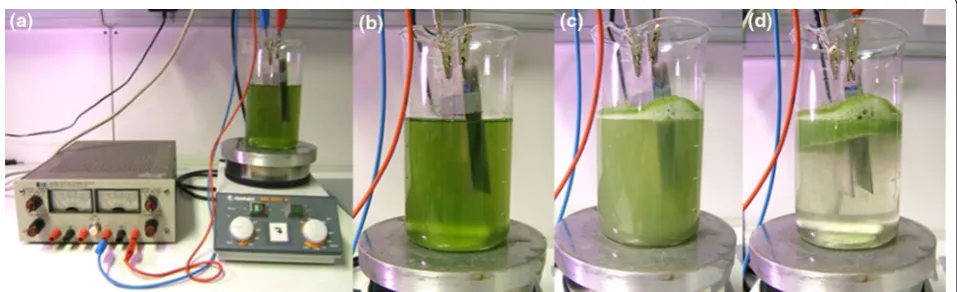
Iron, magnesium, aluminum, zinc, copper and brass electrodes were tested and their corresponding FEs compared. Figure 1 shows an example setup of the floc-culation experiment. The electrodes were connected to a DC power supply (Hewlett Packard, Model 6205b, USA) and the voltage was adjusted to 10, 20, 30 or 40 V depending on the recent experiment (a, b). During the flocculation process, the suspension became milky white and gas visibly formed at the electrodes resulting in foam
formation on the top of the liquid surface (c, d). The floc-culation was successful when the liquid phase was clear and algal cells were located in the foam on top (d).
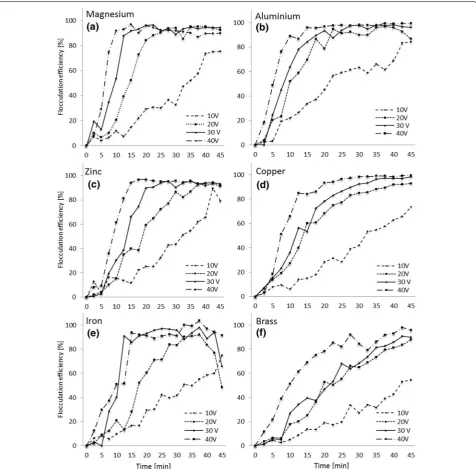
In Fig. 2, the performance (FE) of the different elec-trode materials at different voltages over time is shown. All graphs show the fastest flocculation at 40 V and the slowest at 10 V; the higher the applied voltage, the faster the maxi-mal flocculation efficiency. Similar results were published by other authors (Alfafara et al. 2002; Poelman et al. 1997; Vandamme et al. 2011; Xu et al. 2010; Zhang et al. 2015).
The highest FE was observed when using Mg electrodes (Fig. 2a). Ninety percent of the suspension was clarified at 40 V after 9.2 min (Table 1). When the voltage was decreased to 30 V, the graph leveled slightly, and the recovery time increased. At 30 V, a FE of 90% is reached after 12.5 min, at 20 V after 18.5 min and at 10 V only after 43 min (Table 1).
During the EF process, metal ions are continuously released from the anode by electrolytic oxidation. In H2O
these ions immediately react and form metal hydroxides. These metal hydroxides represent the flocculant which reacts with the algae cells. For the magnesium electrodes, the following reaction occurs:
At higher applied voltages, more ions are produced, and consequently more flocculant is available in the algal solution (Mollah et al. 2001, 2004). The positively charged metal hydroxides react with the negatively charged cell surface of the microalgae. The potential of the algal cell
Mg →Mg2+ +2e−
2H2O
→ 4H+
+O2+4e− (Anode)
M(aq)n+ +ne−
→M(s) 2H2O+2e
→−H2+2OH− (Cathode)
Fig. 2 Effect of electrode material and applied voltage on the recovery rate during the electroflocculation process. Flocculation experiments were conducted using different electrode materials: magnesium (a), aluminum (b), zinc (c), copper (d), iron (e) and brass (f). The graphs were arranged according to the calculated electrode efficiency from high (a) to low (f). The voltage was adjusted to 10, 20, 30 or 40 V and the flocculation effi-ciency was measured every 90 s.
Table 1 Calculated incubation time until a 90% flocculation efficiency is reached
The incubation time is given for each electrode material at 10, 20, 30 and 40 V.
Magnesium Aluminum Zinc Copper Iron Brass
10 V 43.2 42.1 53.6 61.0 53.7 71.1
20 V 18.5 20.6 30.6 31.3 27.9 43.9
30 V 12.5 11.4 21.7 20.3 16.0 40.7
is increased, and the surface charge is neutralized (Hen-derson et al. 2008). The suspension becomes destabilized, and flocs are formed. At 10 V a short lag phase could be detected in all experiments, which is assumed to be due to insufficient flocculent availability at the start the floc-culation process. After 5–10 min, the values start to rise. The shortened lag phase present at higher voltages is due to the faster ion release from the electrodes. Magnesium is bivalent and therefore forms extra stable hydrogen bonds, resulting in an effective floc formation.
The contamination of the harvested biomass and the remaining media with metal particulates might interfere with further processing steps or the use of the biomass as food or feed additive. Here the use of magnesium shows another advantage. Accepted magnesium lim-its are higher when compared to aluminum, iron, cop-per, or brass. In the German Drinking Water Ordinance, for example the limits for magnesium and also for zinc were removed since a negative impact for human health was considered as very low, whereas concentrations of 0.2 mg l−1 for aluminum and iron and 2 mg l−1 for copper
are not to be exceeded (Ordinance 2001).
Extensive research has been conducted regarding the use of aluminum electrodes (Chen et al. 2009; Kim et al.
2012; Lee et al. 2013; Vandamme et al. 2011; Xu et al.
2010) and iron electrodes (Uduman et al. 2011; Van-damme et al. 2011). Aluminum was found to have the sec-ond highest FE (Fig. 2b). Ninety percent FE was reached after 9, 11.4, 20.6 and 42 min at 40, 30, 20 and 10 V (Table 1). In literature the use of aluminum electrodes is compared to the use of iron electrodes in coagulation processes with (Vandamme et al. 2011) or without algae (Zongo et al. 2009) involved. The results of this present study agree with the data reported that the use of alu-minum is more efficient than the use of iron electrodes (Fig. 2e). The lower efficiency of the iron electrode com-pared to aluminum might be explained by the lower cur-rent efficiency of the iron electrode (Zongo et al. 2009).
The lowest recovery efficiency was found using brass electrodes (Fig. 2f). After 15 min at 40 V only approxi-mately 70% of the biomass was recovered. Ninety percent was reached after 30 min which is believed to have been caused by the high pH value during the process (Table 2).
Figure 3a shows that after 11.5 min, a pH of 11.8 was observed. It is suspected that algal recovery efficiency decreases at pH values of 12 because of algal lysis (Con-treras et al. 1981; Xu et al. 2010).
Electroflocculation technologies are currently in use at wastewater treatment facilities (Mollah et al. 2001). In industrial wastewater cleaning, the initial pH is one of the most important factors influencing the EF pro-cess (Mouedhen et al. 2008). In Fig. 3, the pH evolution during the EF with different electrode materials at 40 V is shown. Figure 3a shows the data for Al, Mg and Zn while Fig. 3b shows the values monitored with Fe, Cu and brass. In all of the experiments, the pH increased during the flocculation process.
A fast pH increase up to 10–12 was monitored in all samples except for Al (Fig. 3; Table 2). The highest pH value was reached during the flocculation using brass electrodes. The lowest pH was recorded in the samples using Al electrodes. Since the pH is a measure for the hydrogen and hydroxide concentration, it is expected that the produced metal hydroxides were immediately bound and thereby not contributing to pH increase. During the flocculation process, the algae recovery rate increased in the beginning but started to decrease after 20 min of floc-culation (Fig. 2e). Similar effects were observed by other authors. Xu et al. (2010) described a decrease in recovery time and efficiency from pH 7 to 11 and an increase of recovery time at pH 12 which is expected to be because of algal lysis (Contreras et al. 1981; Xu et al. 2010). The fluctuations in the Al and Fe graphs might be due to insufficient mixing during sample taking.
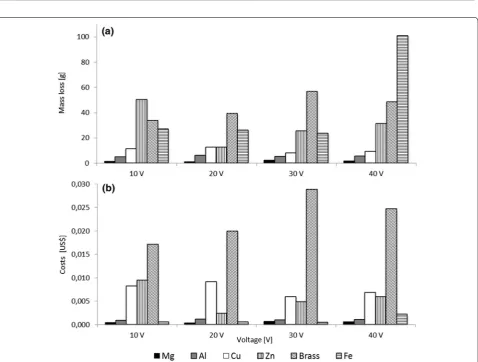
Figure 4 shows the mass loss and the calculated mate-rial costs until a flocculation efficiency of 90% is reached. All tested electrodes lost weight between 1.1 g for mag-nesium and 101 g for iron. The highest mass loss was recorded for Fe with 101 g at 40 V and for brass at 20 and 30 V. Although the mass loss of the iron electrodes is high, the costs for the flocculation with iron are compara-bly low. Since brass is the most expensive electrode mate-rial showing the lowest FE, it cannot be recommended for algal harvest using electro flocculation. The most eco-nomical efficient flocculation was achieved with Mg, Al and Fe.
Table 2 pH values recorded after 30 min of electroflocculation
The table lists the pH values gained with aluminum, brass, magnesium, zinc, copper, and iron electrodes at 10, 20, 30 and 40 V starting with the lowest values (left) to the highest (right).
Aluminum Brass Magnesium Zinc Copper Iron
10 V 9.3 10.7 11.4 11.5 11.5 11.6
20 V 10.3 11.5 11.5 11.3 11.6 11.7
30 V 9.7 11.9 11.4 11.6 11.7 11.6
For industrial applications, reuse of the growth media after cell separation is an important factor regarding cost effectiveness. A recycling experiment was conducted to investigate if the high pH value and/or remaining metal residues negatively affect cell growth if the media is led
back into the culture vessel after cell harvest. The growth of the Scenedesmus cells was monitored in a batch exper-iment over twelve days of cultivation.
Cell growth was monitored in all of the experi-ments (Fig. 5). The best result was achieved with Iron
Fig. 3 Effect of electroflocculation on the pH value using aluminum, iron and brass (a) and zinc, copper and magnesium (b) for electrode material. Measurements were recorded during a flocculation at 40 V.
supernatant and a final cell concentration of 1.86 × 10⁷
cells ml−1 (Fig. 5b). The control experiments with fresh
media resulted in final cell concentration of 1.62 × 10⁷
cells ml−1.The lowest cell concentration was reached
with the copper supernatant with 1.23 × 10⁷ cells ml−1.
Although copper is an essential micronutrient for plants, higher concentrations are known to inhibit photosyn-thetic reactions (Kupper et al. 2009). The reuse of all supernatants showed similar growthbehavior within the 12 days of cultivation.
Several experiments have been published on the use of electroflocculation for algal biomass harvest (Lee et al. 2013; Uduman et al. 2011; Vandamme et al. 2011) mainly using aluminum electrodes (Kim et al. 2012; Lee et al. 2013; Vandamme et al. 2011; Xu et al. 2010) and/ or iron electrodes (Uduman et al. 2011; Vandamme et al.
2011). Magnesium, copper, zinc or brass electrodes have so far not been used for this purpose. This study revealed that besides iron and aluminum, magnesium shows high potential for algal harvest by electroflocculation. Besides a high FE and cost effectiveness, magnesium is non-toxic and can be utilized in a broad range of application.
Conclusion
Besides the commonly used iron and or aluminum elec-trodes other materials like magnesium, copper, zinc and brass can be successfully used for microalgal biomass harvest by electroflocculation. The most cost effective flocculation was achieved with Mg, Al and Fe as electrode material. For special biomass applications like food or feed additives metals like Magnesium have other advan-tages besides their high flocculation efficiency such as their relative harmlessness even at higher concentration.
A higher voltage increased the maximum flocculation efficiency but also increased the energy input needed. Recycling of the supernatant was shown to be possible but should be repeated in a long term experiment com-prising several harvesting steps.
Authors’ contributions
FB contributed to experimental design, data acquisition, result analysis and manuscript preparation. GQ contributed to result analysis and manuscript preparation. DW contributed to experimental design and data acquisition. GK contributed to experimental design, result analysis and manuscript prepara-tion. All authors read and approved the final manuscript.
Author details
1 Jacobs University Bremen, Bremen, Germany. 2 Institute of Environmental
Biology and Biotechnology, University of Applied Sciences Bremen, Bremen, Germany.
Acknowledgements
We would like to thank Michael Lee and Joseph Sincavage for critical reading of our manuscript. This research was financially supported by the project ModuLES funded by the German aerospace association (DLR) (Grant number: 50WB1265).
Compliance with ethical guidelines
Competing interests
The authors declare that they have no competing interests.
Received: 27 April 2015 Accepted: 28 July 2015
References
Alfafara CG, Nakano K, Nomura N, Igarashi T, Matsumura M (2002) Operating and scale-up factors for the electrolytic removal of algae from eutrophied lakewater. J Chem Technol Biotechnol 77:871–876
Chen W, Zhang CW, Song LR, Sommerfeld M, Hu Q (2009) A high throughput Nile red method for quantitative measurement of neutral lipids in micro-algae. J Microbiol Methods 77:41–47
Fig. 5 Media reuse after flocculation. For 12 days Scenedesmus cells were incubated in magnesium, aluminum and zinc (a) as well as iron, copper and brass (b) flocculation supernatant enriched with nutrients. The graphs show the cell growth measured in cells ml−1 monitored every other day.
Chinnasamy S, Bhatnagar A, Hunt RW, Das KC (2010) Microalgae cultivation in a wastewater dominated by carpet mill effluents for biofuel applications. Bioresour Technol 101:3097–3105
Chisti Y (2007) Biodiesel from microalgae. Biotechnol Adv 25:294–306 Contreras S, Pieber M, Delrio A, Soto MA, Toha J, Veloz A (1981) A highly
effi-cient electrolytic method for microorganism flocculation from aqueous cultures. Biotechnol Bioeng 23:1165–1168
Gerde JA, Yao LX, Lio JY, Wen ZY, Wang T (2014) Microalgae flocculation: impact of flocculant type, algae species and cell concentration. Algal Res Biomass Biofuels Bioprod 3:30–35
Granados MR, Acien FG, Gomez C, Fernandez-Sevilla JM, Grima EM (2012) Evaluation of flocculants for the recovery of freshwater microalgae. Bioresour Technol 118:102–110
Grima EM, Belarbi EH, Fernandez FGA, Medina AR, Chisti Y (2003) Recovery of microalgal biomass and metabolites: process options and economics. Biotechnol Adv 20:491–515
Henderson RK, Parsons SA, Jefferson B (2008) Successful removal of algae through the control of zeta potential. Sep Sci Technol 43:1653–1666 Hodaifa G, Martinez ME, Sanchez S (2008) Use of industrial wastewater from
olive-oil extraction for biomass production of Scenedesmus obliquus. Bioresour Technol 99:1111–1117
Kim J, Ryu BG, Kim BK, Han JI, Yang JW (2012) Continuous microalgae recovery using electrolysis with polarity exchange. Bioresour Technol 111:268–275 Kupper H, Gotz B, Mijovilovich A, Kupper FC, Meyer-Klaucke W (2009)
Com-plexation and toxicity of copper in higher plants. I. characterization of copper accumulation, speciation, and toxicity in Crassula helmsii as a new copper accumulator. Plant Physiol 151:702–714
Lee AK, Lewis DM, Ashman PJ (2013) Harvesting of marine microalgae by electroflocculation: the energetics, plant design, and economics. Appl Energy 108:45–53
London metal exchange (2015). http://www.lme.com/. Accessed 22 Jun 2015 Mallick N (2002) Biotechnological potential of immobilized algae for
wastewa-ter N, P and metal removal: a review. Biometals 15:377–390 Mandal S, Mallick N (2009) Microalga Scenedesmus obliquus as a potential
source for biodiesel production. Appl Microbiol Biotechnol 84:281–291 Martinez ME, Sanchez S, Jimenez JM, El Yousfi F, Munoz L (2000) Nitrogen and
phosphorus removal from urban wastewater by the microalga Scenedes-mus obliquus. Bioresour Technol 73:263–272
Mata TM, Martins AA, Caetano NS (2010) Microalgae for biodiesel production and other applications: a review. Renew Sustain Energy Rev 14:217–232 Mollah MYA, Schennach R, Parga JR, Cocke DL (2001) Electrocoagulation
(EC)—science and applications. J Hazard Mater 84:29–41
Mollah MYA, Morkovsky P, Gomes JAG, Kesmez M, Parga J, Cocke DL (2004) Fundamentals, present and future perspectives of electrocoagulation. J Hazard Mater 114:199–210
Mouedhen G, Feki M, Wery MDP, Ayedi HF (2008) Behavior of aluminum elec-trodes in electrocoagulation process. J Hazard Mater 150:124–135 Ordinance GDW (2001) (Trinkwasserverordnung-TrinkwV 2001) Verordnung
über die Qualität von Wasser für den menschlichen Gebrauch. Trinkwas-serverordnung vom 21. Mai 2001 (BGBl. I S. 959), die zuletzt am 7. August 2013 (BGBl. I S. 3154, 3201) geändert worden ist
Papazi A, Makridis P, Divanach P (2010) Harvesting Chlorella minutissima using cell coagulants. J Appl Phycol 22:349–355
Poelman E, DePauw N, Jeurissen B (1997) Potential of electrolytic flocculation for recovery of micro-algae. Resour Conserv Recycl 19:1–10
Sanchez JF, Fernandez JM, Acien FG, Rueda A, Perez-Parra J, Molina E (2008) Influence of culture conditions on the productivity and lutein content of the new strain Scenedesmus almeriensis. Process Biochem 43:398–405 Tang D, Han W, Li P, Miao X, Zhong J (2011) CO2 biofixation and fatty acid
com-position of Scenedesmus obliquus and Chlorella pyrenoidosa in response to different CO2 levels. Bioresour Technol 102:3071–3076
Tenney MW, Echelber WF, Schuessl RG, Pavoni JL (1969) Algal flocculation with synthetic organic polyelectrolytes. Appl Microbiol 18:965
Uduman N, Qi Y, Danquah MK, Forde GM, Hoadley A (2010) Dewatering of microalgal cultures: a major bottleneck to algae-based fuels. J Renew Sustain Energy 2:15
Uduman N, Bourniquel V, Danquah MK, Hoadley AFA (2011) A parametric study of electrocoagulation as a recovery process of marine microalgae for biodiesel production. Chem Eng J 174:249–257
Vandamme D, Pontes SCV, Goiris K, Foubert I, Pinoy LJJ, Muylaert K (2011) Evaluation of electro-coagulation–flocculation for harvesting marine and freshwater microalgae. Biotechnol Bioeng 108:2320–2329
Vandamme D, Foubert I, Fraeye I, Meesschaert B, Muylaert K (2012) Floccula-tion of Chlorella vulgaris induced by high pH: role of magnesium and calcium and practical implications. Bioresour Technol 105:114–119 Wang B, Li YQ, Wu N, Lan CQ (2008) CO(2) bio-mitigation using microalgae.
Appl Microbiol Biotechnol 79:707–718
Wijffels RH, Barbosa MJ (2010) An outlook on microalgal biofuels. Science 329:796–799
Winckelmann D, Bleeke F, Bergmann P, Klöck G (2015) Growth of Cyano-bacterium aponinum influenced by increasing salt concentrations and temperature. 3. Biotech 5:253-26
Wu ZC, Zhu Y, Huang WY, Zhang CW, Li T, Zhang YM, Li AF (2012) Evaluation of flocculation induced by pH increase for harvesting microalgae and reuse of flocculated medium. Bioresour Technol 110:496–502
Xu L, Wang F, Li HZ, Hu ZM, Guo C, Liu CZ (2010) Development of an efficient electroflocculation technology integrated with dispersed-air flotation for harvesting microalgae. J Chem Technol Biotechnol 85:1504–1507 Zhang DW, Yu YL, Li C, Chai CY, Liu LL, Liu J, Feng YJ (2015) Factors affecting
microalgae harvesting efficiencies using electrocoagulation-flotation for lipid extraction. Rsc Adv 5:5795–5800
Zheng HL, Gao Z, Yin JL, Tang XH, Ji XJ, Huang H (2012) Harvesting of microal-gae by flocculation with poly (gamma-glutamic acid). Bioresour Technol 112:212–220
Zhou WG, Min M, Hu B, Ma XC, Liu YH, Wang Q et al (2013) Filamentous fungi assisted bio-flocculation: a novel alternative technique for harvest-ing heterotrophic and autotrophic microalgal cells. Sep Purif Technol 107:158–165