RESEARCH
Development and evaluation of a
functional bioreactor for CO fermentation
into ethanol
Poritosh Roy
*, Animesh Dutta
*and Sheng Chang
Abstract
Background: In a conventional syngas fermentation process, gas was released into the fermentation broth through a single orifice or multiple orifices, except the hollow fiber membrane reactor. Consequently, a simplified bioreactor has been developed employing an innovative gas supply and effluent extraction systems.
Results: A continuous stirred tank bioreactor (CSTBR) has been developed by incorporating an innovative gas supply and effluent extraction system to ferment syngas into ethanol. The working volume of the bioreactor was controlled to 2 L. The CO gas was fermented in the developed bioreactor by using a microorganism (Clostridium ljungdahlii) with different gas (5–15 mL/min), media, and effluent flow rates (0.25–0.75 mL/min) and stirrer speed (300–500 rpm). Gas was diffused into the fermenting broth through an aqueous aeration tube commonly used in the small household aquarium, placed at the bottom layer throughout the periphery. The effluent was extracted from the top layer of the broth by using a membrane separator. Ethanol and acetic acid concentrations were varied from 0.17–1.17 and 8.50–23.68 g/L-effluent, respectively.
Conclusions: It seems that the performance of CSTBR can be enhanced with an innovative gas supply system, which may reduce the gas bubble size and result in higher lateral velocity at the releasing point, especially, throughout the periphery instead of the center of the reactor through a single or multiple orifice.
Keywords: Bioreactor, Continuous stirred tank, Microorganism, CO, Fermentation, Ethanol
© 2016 Roy et al. This article is distributed under the terms of the Creative Commons Attribution 4.0 International License (http:// creativecommons.org/licenses/by/4.0/), which permits unrestricted use, distribution, and reproduction in any medium, provided you give appropriate credit to the original author(s) and the source, provide a link to the Creative Commons license, and indicate if changes were made.
Background
Liquid biofuels are identified to be the alternatives to fossil gasoline. Production and utilization of lignocel-lulosic ethanol (hereafter referred to ethanol) have been emphasized because it does not compete with food crops. Ethanol has been produced from lignocellulosic biomass (hereafter referred to biomass) by both bio-chemical and thermobio-chemical conversion technologies. Although each process has its advantages and disadvan-tages in ethanol production from biomass, biochemical dominates over the thermochemical process (Subramani and Gangwal 2008). The biochemical conversion pro-cess requires higher pretreatment and enzyme costs, has low fermentability of the mixed sugar stream (C5), and
generates inhibitory soluble compounds (Munasinghe and Khanal 2010). In addition, non-carbohydrate mate-rials in biomass cannot be converted into ethanol in the biochemical conversion process (Henstra et al. 2007) and require special care for downstream waste management. Conversely, several authors noted that thermochemical (gasification) conversion process converts all the compo-nents of biomass into syngas with nearly equal efficiency and effectiveness (Pereira et al. 2012; Weber et al. 2010), eliminates complex pretreatment and costly enzyme requirement (Munasinghe and Khanal 2010), and eases the downstream waste management processes. Moreo-ver, industrial off-gas/natural gas/syngas extracted from biomass can be a cheaper feedstock for producing etha-nol through syngas fermentation (Jiang et al. 2015).
Ethanol can be produced from syngas through a cata-lytic or bio-synthesis thermochemical conversion. The
Open Access
catalytic process requires expensive catalyst (metal-based or modified methanol catalysts), higher operat-ing temperature, and pressure (Subramani and Gangwal 2008), which therefore increases the capital and operat-ing costs (Datta et al. 2011). In contrast, some of the bio-logical catalysts are able to convert syngas into ethanol more effectively, even at atmospheric pressure (Munas-inghe and Khanal 2010; Henstra et al. 2007; Elshahed 2010; Heiskanen et al. 2007), while reducing the energy requirements, as well as the capital and operating costs (Daniell et al. 2012). Higher selectivity of biological cata-lysts reduces undesired byproducts and improves etha-nol yield and downstream processes (Griffin and Schultz 2012; Abubackar et al. 2011). However, lower gas–liquid mass transfer and production of inhibitory compounds during fermentation were noted to be the main con-straints to syngas fermentation into ethanol (Munasinghe and Khanal 2010; Huhnke 2013; Lee P 2010).
The mass transfer between substrate and microbes is dependent on the level of syngas mixing with the fermen-tation media which provide greater interfacial area (gas– liquid) and retention time in the fermentation media. Higher agitation speed tends to produce finer bubbles, which result in decreased rising velocity in fermentation media, improved microbe accessibility to syngas, and improved mass transfer rates (Munasinghe and Khanal 2010). Syngas fermentation has been extensively studied with various types of bioreactors (Huhnke 2013; Shen et al. 2014; Richter et al. 2013; Mohammadi et al. 2012). The continuous culture was noted to be advantageous, when compared to a batch culture in a fermentation system (Richter et al. 2013). The mass transfer reported to be improved with an increase in the agitation speed (impeller speed) or gas flow rate; however, the process was not economical because of higher energy consump-tion and stress to microorganisms (Ungerman and Hein-del 2007; Bredwell and Worden 1998). The higher the gas flow rate, the greater the syngas loss into the exhaust line (Bredwell et al. 1999). The stress, either mechanical, from inhibitory compounds, or other experimental param-eters (especially, the cell density) affects the productivity (Mohammadi et al. 2011; Alsaker et al. 2010). Till to date in a conventional syngas fermentation process gas was released into the fermentation broth through a single ori-fice or multiple oriori-fices (Mohammadi et al. 2012; Cotter et al. 2009; Younesi et al. 2006) in both the batch and con-tinuous process, except for a few examples, especially, the hollow fiber membrane reactor (Shen et al. 2014; Richter et al. 2013). Consequently, this study attempts to develop a simplified continuous stirred tank bioreactor (CSTBR) employing an innovative gas supply and effluent extrac-tion systems to enhance gas–liquid mass transfer, reduce inhibitory stress, and improve ethanol productivity.
Methods
Reactor development
A laboratory scale bioreactor (3 L) has been designed and developed to expedite the conversion process considering the following parameters: innovative, flexible, easy moni-toring, durability, safety, easy assemble and disassemble, easy cleaning, and inexpensive. The low-cost gas diffuser was placed in the bottom layer and on the periphery of the fermentation broth, and an in situ cell retention filter was placed on the upper layer of the broth, which were the innovative ideas in this reactor development. A vent was also incorporated for flexibility of operation, i.e., the reactor can be operated in either anaerobic or aero-bic condition. The material safety data sheet was strictly followed in the low-cost materials selection process to ensure the safety and durability. The reactor vessel was with a digital pressure gage, and a meter with a pH and temperature probe for the purpose of easy monitoring. The reactor lid (contains an O-ring which seals the gap between the vessel and the lid) was also made from a transparent PVC sheet. All the components were incor-porated into the reactor through the lid which can eas-ily be assembled and disassembled, which facilitates easy cleaning.
The working volume of the reactor was 2 L. The inno-vative gas diffusion method system may improve gas retention time, thus a higher gas–liquid mass transfer and ethanol concentration. The reactor was equipped with a micropump (GF-F155001, Gilson Inc., USA), gas flow meter (PMR1-0106018, Cole Parmer, QC, Canada), temperature and pH meter (PHE-1411, Omega Envi-ronmental, Inc., Laval, QC, Canada), and pressure gage (PHH-222, Omega Environmental, Inc., Laval, QC, Canada) to monitor and control the working tempera-ture, pH, and pressure, respectively. The tubing for the micropump was selected based on the desired flow rates (F117938). The temperature and pH meter were braced with a temperature (TP-07) and pH probe. The reactor also consists of a membrane support to place the mem-brane evenly in the upper layer of the fermentation broth. The reactor was manufactured and assembled at the Uni-versity of Guelph, Ontario, Canada.
Reactor tank, and media and effluent jar
Gas supply system
Syngas fermentation into ethanol was noted to be dependent on the mass transfer between gas and liq-uid (Huhnke 2013; Lee 2010). The mass transfer can be improved by increasing the residence time of gas in the aqueous media (Lee 2010). The bubbling technology helps in improving the gas retention time in the aqueous media. Although the size of bubbles affects the retention time, an aeration tube (that is commonly used in small household aquariums) has been selected to create a cir-cular gas supply system (diameter is 4 cm smaller than the reactor’s inside diameter) and placed at the center of the bioreactor with the help of a holder keeping a clear-ance of about 1 cm from the bottom (Additional file 1: SI-1-2). The purpose of the holder is so that gas can be diffused at the peripheral area of the fermentation broth, which can easily be replaced with other bubbling systems.
Effluent extraction system (membrane separator)
The membrane separation technology has been adopted to facilitate the continuous extraction of effluent from the fermentation broth excluding the microorganism; thus, the microorganism can be reused. An effluent extraction
system has been developed and evenly placed in the top layer of the fermentation broth (Additional file 1: SI-1-3). The required length of the membrane fiber (PVDF, GE: 0.02 μm) has been determined based on the flux of the selected membrane (10 L/m2/h) and the required effluent
extraction rate. A membrane support has also been used to hold the membrane fiber at the same level (Additional file 1: SI-1-4) in the upper layer of the fermentation broth.
Experimental setup
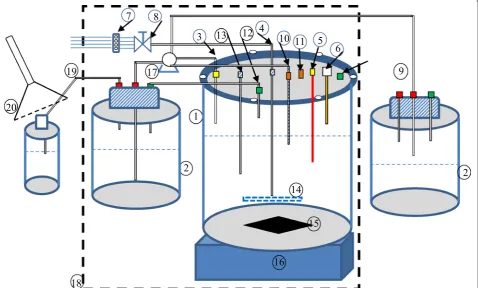
The complete experimental setup was placed in an incu-bator (Heratherm IGS60, Thermo Electron LED GmbH, Germany) at 37 °C (Fig. 1). A bypass tube was used to connect the reactor and the media-jar. Another tube from the media-jar was connected to the exhaust tube to release the excess gas if any. The media and effluent (eth-anol mixture) were supplied and extracted from the reac-tor with a micropump, respectively.
Microorganism and media
American-Type Culture Collection (ATCC#55380;
Clostridium ljungdahlii) has been purchased from Cedar-lane, Burlington, Ontario, Canada and used in this study.
9
20
1
18
16 4 8
7
10
2 17
14
2
15 5
6 11
3 13 12
19
The recommended broth media have been prepared in the laboratory based on the preparation manual supplied by Cedarlane. The components of the broth media and the production procedure are reported in the support-ing information (Additional file 1: SI-1-5). Freeze-dried (0.4 mL) microorganism was aseptically transferred into the broth media in test tubes, cultured and propagated anaerobically in the broth media at 37 °C in an incubator, and then used in the syngas fermentation process.
CO fermentation
The fermenting media (the components have been reported in Additional file 1: SI-1-5) and propagated microorganism were poured into the reactor with a working volume of 2 L and placed in an incubator for fermentation (Additional file 1: SI-1-6). An anaerobic chamber has been used to pour the microorganism and media into the reactor (Additional file 1: S-1-7), which was equipped with a vacuum pump and N2 supply. The
fermentation experiment was conducted at anaerobic condition and at the atmospheric pressure. The pH and stirrer speed in the fermentation broth were controlled to 4.0–5.0 (by adding 1 N NaOH if required, i.e., it was added manually only if pH dropped to less than four) and 300–500 rpm, respectively (Richter et al. 2013; Moham-madi et al. 2012; Younesi et al. 2006). The syngas, media, and effluent flow rates were controlled to 5–15 mL/min, 0.25–0.75 mL/min, and 0.25–0.75 mL/min, respectively. The reactor was operated continuously, after the initial 2 days of batch condition. The quality and composition of syngas from biomass was noted to be dependent on the type of feedstock and gasification parameters. All of the components of feedstock can be converted into syn-gas (usually, H2, CO, CO2, and CH4) with a trace amount
of other gases and a few residues (tar and ash) (He and Zhang 2011). Although a wide range of syngas compo-sition has been used in the syngas fermentation process (Shen et al. 2014; Richter et al. 2013; Kundiyana et al. 2011), only the CO was fermented in this study (Chang et al. 1998) to prove the concept of the developed reac-tor. Fermentation media contains dextrose, acetate, etc., which might also be a trace carbon source in the fermen-tation process.
Analytical method
The GC–MS system (Agilent Technologies, USA) con-sists of a gas chromatograph (7890A) and a mass spec-trometer (59756MS) that have been used to analyze the liquid effluent and quantify the presence of ethanol and acetic acid. The GC–MS system was equipped with a Bruker BR-SWAX column (30 m × 0.25 mm I.D. with a 0.25-μm phase thickness). The oven was programed to maintain the initial temperature at 44 °C for 3.5 min
and allowed to increase at a rate of 5 °C/min to 200 °C. Immediately after this phase, 70 °C/min heating rate was maintained until it reached to 250 °C. The carrier gas (He) flow rate was 1 mL/min. The sample was injected manually in a splitless mode at 280 °C. Liquid samples (0.5 mL) were transferred into sealed vials (15 mL) and incubated for 5 min at 75 °C. The incubated sample was then equilibrated with a 75 μm carboxen–polydimethyl-siloxane (CAR–PDMS) fiber immersed in the headspace for 20 min. The volatile compounds were then thermally desorbed in the injector port by manually injecting and exposing the fiber for 8 min. The mass spectrometer was scanned from m/z 10–150 at an interval of 1 s. The ionization was created by an electronic impact at 200 °C, while the transfer line was kept at 250 °C. The data were obtained in a positive ion mode. The compounds were also extracted manually with a SPME holder (Supelco, USA), a hotplate, and a metal support with clamps.
Results and discussion pH profile during CO fermentation
Several studies revealed that CO can be converted into many value-added products (ethanol, acetic acid, propa-noic acids, propanol, nonapropa-noic acid, benzaldehyde etc.) in the presence of microorganisms (Younesi et al. 2006; Roy 2014). In the initial stages of this experiment, pH was decreased rapidly and then stabilized to about 4.5. The production of organic acids might result to this rapid change. The rapid change in pH was observed in the first 2 days, while the experiment ran on the batch pro-cess, and decreased from 5.8 to about 5.0. The pH varied from 5.0 to 4.5 in the continuous process. This variation was caused by the media, effluent and gas flow rates, and ethanol productivity. During the initial stage, acetic acid might also be the dominant product, which causes the rapid fall of pH in the fermentation broth (Fig. 2).
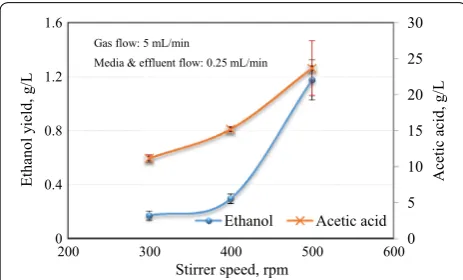
Effect of stirrer speed on products production
with C. ljungdahlii when the pH dropped to 4.0–4.5 (Klasson et al. 1993), because the microorganism pro-duces less acid, which prevents a further pH drop (Datar et al. 2004) and induced the higher ethanol concentra-tion. Bakker et al. (1994) noted that an increase in agi-tation intensity leads to an increase in gas–liquid mass transfer. At a certain gas flow, an increase in impel-ler speed leads to depression of the gas radially. In this stage, the gas bubbles reached the vessel wall, but did not recirculate. The gas bubbles recirculate throughout the tank, if the impeller speed is increased further, known as complete dispersion, beyond that, flow patterns does not change; however, mass transfer rate increases. Stirrer speed helps raising the rotational movements of ferment-ing broth in the reactor; thus, the gas bubble released in the broth gets greater lateral speed (curvilinear motion because of the resultant speed induced by buoyancy and lateral speed), which allowed the gas bubble to travel a
longer path before being diffused into the headspace of the reactor. Bubble movement toward the center of the vortex was caused by the convective flow and the pres-sure gradient. The tangential velocity of the vortex was noted to be proportional to the agitation speed. The higher the stirrer speed, the stronger the vortex (Sudiyo and Andersson 2007). Agitation also helps to break the bubble and enhance gas retention time and increase the gas–liquid interfacial area for mass transfer (van Kas-teren JMN et al. 2005; Bakker et al. 1994). The gas con-version rate was noted to be increased with an increase in agitation speed (Younesi et al. 2006). The mass transfer also reported to be dependent on the reactor configura-tion (Huhnke 2013). It seems the combination of reactor configuration and higher stirrer speed not only helped to break the bubble, but also induced greater lateral speed for the bubble, consequently, increasing the gas–liquid interfacial area which might have improved the gas–liq-uid mass transfer. The combination of higher initial lat-eral speed of the gas bubble, longer retention time, and greater interfacial area led to the improvement of prod-uct concentration.
Effect of gas, media, and effluent flow rates on products production
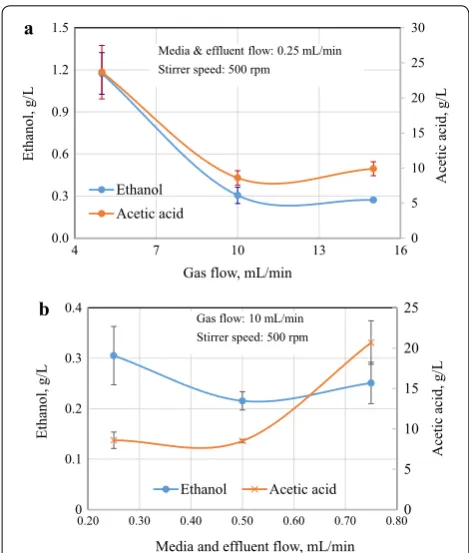
The product concentration was dependent on the gas, media, and effluent flow rates. Ethanol and ace-tic acid concentrations varied from 0.27–1.17 and 8.59–23.68 g/L, respectively, depending on the gas flow rates (Fig. 4a). The product concentration was found to decrease with an increase in gas flow rate, which seems to be supported by another researcher (Shen et al. 2014). The authors reported that after a certain gas flow rate, ethanol production decreased with a further increase in gas flow rate; thus, for the optimum production, gas flow rate might need to be selected based on the working vol-ume of the reactor. High gas flow rate adversely affects the gas conversion (Bredwell et al. 1999). Devarapalli et al. (Huhnke 2013) have also reported that gas–liquid mass transfer characteristic was affected by gas, media, and effluent flow rates. The culture may have also become inhibited by the increased supply of CO. The combina-tion of increased flow rate and stirrer speed might have induced stress to the microorganisms (Ungerman and Heindel 2007; Bredwell and Worden 1998; Alsaker et al. 2010) and resulted in lower product concentration.
Product concentration was also decreased with the increase of media and effluent flow rates, which might be because of the higher dilution rate. Ethanol and acetic acid concentrations varied from 0.21–0.31 and 8.50–20.69 g/L, respectively (Fig. 4b). Shen et al. (2014) reported that in the case of CSTBR, dilution rate had an effect on the syngas fermentation process. Lower dilution 3.0
3.5 4.0 4.5 5.0 5.5 6.0
0 25 50 75 100 125 150 175 200 225
pH
Time, h
Batch Continuous
1 2 3 4 4 6 7
Fig. 2 Variation of pH during the experiment. 1*^; 2*^; 3*^; 4**. Gas: 10 mL/min, media and effluent: 0.25 mL/min; 5***. Gas: 15 mL/ min, media and effluent: 0.25 mL/min; 6***. Gas: 10 mL/min, media and effluent: 0.5 mL/min; 7***. Gas: 10 mL/min, media and effluent: 0.75 mL/min; *300 rpm; **400 rpm; ***500 rpm; ^ Gas: 5 mL/min, media and effluent: 0.25 mL/min
0 5 10 15 20 25 30
0 0.4 0.8 1.2 1.6
200 300 400 500 600
Ethanol
yi
eld,
g/
L
Stirrer speed, rpm
Ethanol Acetic acid
Gas flow: 5 mL/min
Media & effluent flow: 0.25 mL/min
Acetic acid, g/
L
rate improved productivity (Richter et al. 2013; Moham-madi et al. 2012). The greater media flow increases the dilution rate, thus the ethanol concentration was decreased. However, the acetic acid concentration observed to be improved, might be because of greater gas flow rate which restricts ethanol productivity after cer-tain flow rate (Shen et al. 2014) as well as media (content a bit of acetate) flow rate. Therefore, the highest ethanol concentration was observed at a flow rate of 0.25 mL/min in this study. It seems the productivity of acetic acid can be controlled by restricting the gas, media, and effluent flow rates (Fig. 4).
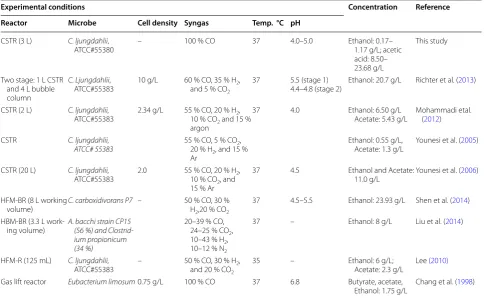
The combination of ethanol and acetic acid produc-tivity varied from 10.83–24.06 g/L when only CO was fermented in this study. The ethanol concentration was reported to be 0.55 g/L (Younesi et al. 2005), where syn-thesis gas had been used. The combined (ethanol and ace-tic acid) production from synthesis gas (CO, H2, CO2, Ar)
fermentation in a CSTBR was also reported to be 11 g/L (Younesi et al. 2006). The ethanol concentration was 20.7 g/L in the case of a two stage CSTBR equipped with a hollow fiber membrane module (Richter et al. 2013). In contrast, the maximum productions of ethanol and ace-tate were 6.50 g/L and 5.43 g/L, respectively (Ungerman and Heindel 2007), but the combined yield was 11.93 g/L. A wide range of ethanol concentration (0.02–0.65 g/L)
has also been reported in the case of batch processes (Abubackar et al. 2011; Kundiyana et al. 2011; Younesi et al. 2005, 2006; Najafpour and Younesi 2006). The for-mation of ethanol inhibits the activity of C. ljungdahlii
(Younesi et al. 2005); thus, continuous removal of ethanol from the fermentation broth improves ethanol produc-tion. The ethanol production in a bubble column reactor was 0.56 g/L (Rajagopalan et al. 2002). Conversely, higher ethanol concentration (23 g/L) was reported in the case of hollow fiber membrane reactor (Shen et al. 2014). Table 1 represents a brief summary of the biosyngas fer-mentation processes and ethanol concentration reported in the literature.
Ethanol concentration was noted to be dependent on the mass transfer efficiency (Munasinghe and Khanal 2010; Huhnke 2013; Lee et al. 2012), and the character-istics of the biofilm (Shen et al. 2014). The mass transfer was also dependent on the reactor configuration, agita-tion speed, syngas, and media flow rates (Huhnke 2013; van Kasteren JMN et al. 2005). Hollow fiber membrane reported to be effective in increasing the gas–liquid mass transfer, thus the ethanol production (Shen et al. 2014; Richter et al. 2013; Lee et al. 2012). Gas–liquid mass transfer was noted to be dependent on the retention time of gas in the fermentation broth and the size of the bub-ble. The ethanol production was observed to be depend-ent on the bioreactor design, especially gas–liquid mass transfer. The position of the syngas supply systems in the reactor may also have an influence on gas retention time (Additional file 1: SI-1-8), thus the gas–liquid mass trans-fer. Gas supply throughout the periphery in a CSTBR improves the gas retention (Additional file 1: SI-1-8) time compared to the gas supply at the center because of higher speed of the gas bubbles at the periphery (Addi-tional file 2: SI-2). The broth circling near the outer rim moves faster and experiences greater forces (since the force is proportional to velocity) compared to the mid-dle or the center. Therefore, the gas bubble released at the outer surface gets greater initial horizontal velocity and travels longer distances before ending to the surface layer of the broth, thus increased the retention time. In addi-tion, the bubbles tend to move toward the center (lat-eral movement) due to the vortex resulted by the stirrer (Sudiyo and Andersson 2007), and help improving gas– liquid mixing, thus gas–liquid mass transfer. The effluent extraction method helps in situ cell retention and extrac-tion of products and water mixture, which might have stipulated in the higher ethanol concentration compared to some of the other studies.
Conclusions
This study revealed that the developed bioreactor can be used for syngas fermentation into ethanol. The ethanol
0 5 10 15 20 25 30
0.0 0.3 0.6 0.9 1.2 1.5
4 7 10 13 16
Acetic
acid, g/
L
Ethanol, g/
L
Gas flow, mL/min Ethanol
Acetic acid
Media & effluent flow: 0.25 mL/min Stirrer speed: 500 rpm
0 5 10 15 20 25
0 0.1 0.2 0.3 0.4
0.20 0.30 0.40 0.50 0.60 0.70 0.80
Acetic acid, g/
L
Ethanol, g/
L
Media and effluent flow, mL/min Ethanol Acetic acid
Gas flow: 10 mL/min Stirrer speed: 500 rpm
b a
yield was observed to be varied from 0.17–1.17 g/L-effluent, while only CO was fermented. The yield was found to be dependent on the experimental parameters. It seems that an innovative gas supply system may reduce the gas bubble size and provide higher lateral velocity at the releasing point, especially, throughout the periphery instead of the center of the reactor through a single or multiple orifice.
Authors’ contributions
PR has conducted the experiments and analysis for this work. He was guided by Dr. AD and Dr. SC. All authors read and approved the final manuscript.
Acknowledgements
The authors are grateful to the NSERC Discovery (Grant No. 400495), for the financial support of this study. Authors are also thankful to Mr. Jamie Minaret for his assistance in the proofreading of the manuscript.
Competing interests
The authors declare that they have no competing interests. Additional files
Additional file 1. Accessories of the developed bioreactor.
Additional file 2. Bubble movement.
Received: 19 October 2015 Accepted: 20 January 2016
References
Abubackar HN, Veiga MC, Kennes C (2011) Biological conversion of carbon monoxide: rich syngas or waste gases to bioethanol. Biofuels Bioprod Bioref 5:93–114
Alsaker KV, Paredes C, Papoutsakis ET (2010) Metabolite stress and tolerance in the production of biofuels and chemicals: gene-expression-based sys-tems analysis of butanol, butyrate, and acetate stresses in the anaerobe Clostridium acetobutylicum. Biotechnol Bioeng 105:1131–1147 Bakker A, Smith J, Myers KJ (1994) How to disperse gases in liquids. Chem Eng
101:98–104
Bredwell MD, Srivastava P, Worden RM (1999) Reactor design issues for synthesis-gas fermentations. Biotechnol Prog 15:834–844
Bredwell MD, Worden RM (1998) Mass-transfer properties of microbubbles. 1. Experimental studies. Biotechnol Prog 14:31–38
Chang IS, Kim DH, Kim BH, Shin PK, Sung HC, Lovitt RW (1998) CO fermenta-tion of Eubacterium limosum KIST612. J Microbiol Biotechnol 8:134–140 Cotter JL, Chinn MS, Grunden AM (2009) Influence of process parameters on
growth of Clostridium ljungdahlii and Clostridium autoethanogenum on synthesis gas. Enzy Microb Technol 44:281–288
Daniell J, Köpke M, Simpson SD (2012) Commercial biomass syngas fermenta-tion. Energies 5:5372–5417
Datar RP, Shenkman RM, Cateni BG, Huhnke RL, Lewis RS (2004) Fermenta-tion of biomass-generated producer gas to ethanol. Biotechnol Bioeng 86:587–594
Datta R, Maher MA, Jones C, Brinker RW (2011) Ethanol—the primary renew-able liquid fuel. J Chem Technol Biotechnol 86:473–480
Table 1 Syngas fermentation parameters and ethanol yields
CSTR Continuous stirred tank reactor; HFM-BR Hollow fiber membrane biofilm reactor
Experimental conditions Concentration Reference
Reactor Microbe Cell density Syngas Temp. °C pH
CSTR (3 L) C. ljungdahlii,
ATCC#55380 – 100 % CO 37 4.0–5.0 Ethanol: 0.17–1.17 g/L; acetic acid: 8.50– 23.68 g/L
This study
Two stage: 1 L CSTR and 4 L bubble column
C. Ljungdahlii,
ATCC#55383 10 g/L 60 % CO, 35 % Hand 5 % CO2 2,
37 5.5 (stage 1)
4.4–4.8 (stage 2) Ethanol: 20.7 g/L Richter et al. (2013)
CSTR (2 L) C. ljungdahlii,
ATCC#55383 2.34 g/L 55 % CO, 20 % H10 % CO2 and 15 % 2, argon
37 4.0 Ethanol: 6.50 g/L
Acetate: 5.43 g/L Mohammadi etal. (2012)
CSTR C. ljungdahlii,
ATCC# 55383 55 % CO, 5 % CO20 % H2, and 15 % 2,
Ar
Ethanol: 0.55 g/L,
Acetate: 1.3 g/L Younesi et al. (2005)
CSTR (20 L) C. ljungdahlii,
ATCC#55383 2.0 55 % CO, 20 % H10 % CO2, and 2, 15 % Ar
37 4.5 Ethanol and Acetate:
11.0 g/L Younesi et al. (2006)
HFM-BR (8 L working
volume) C. carboxidivorans P7 – 50 % CO, 30 % H2,20 % CO2
37 4.5–5.5 Ethanol: 23.93 g/L Shen et al. (2014)
HBM-BR (3.3 L
work-ing volume) A. bacchi strain CP15 (56 %) and Clostrid-ium propionicum (34 %)
20–39 % CO, 24–25 % CO2, 10–43 % H2, 10–12 % N2
37 – Ethanol: 8 g/L Liu et al. (2014)
HFM-R (125 mL) C. ljungdahlii,
ATCC#55383 – 50 % CO, 30 % Hand 20 % CO22,
35 – Ethanol: 6 g/L;
Acetate: 2.3 g/L Lee (2010) Gas lift reactor Eubacterium limosum0.75 g/L 100 % CO 37 6.8 Butyrate, acetate,
Devarapalli M, Atiyeh HK, Phillips JR, Orgill JJ, Lewis RS, Huhnke, RL (2013) Comparison of syngas fermentation reactors for biological alcohol production. http://sungrant.tennessee.edu/NR/rdonlyres/DDF120E1-C312-4065-B095-6EC87BD11DA8/3731/Atiyeh_Hasan.pdf (accessed on 30 May 2014)
Elshahed MS (2010) Microbiological aspects of biofuel production: current status and future directions. J Ad Res 1:103–111
Griffin DW, Schultz MA (2012) Fuel and chemical products from biomass syngas: a comparison of gas fermentation to thermochemical conversion routes. Environ Prog Sustain Energy 31:219–224
He J, Zhang W (2011) Techno-economic evaluation of thermo-chemical biomass-to-ethanol. App Energy 88:1224–1232
Heiskanen H, Virkajarvi I, Viikari L (2007) The effects of syngas composition on the growth and product formation of Butyribacterium methylotrophi-cum. Enzy Microb Technol 41:362–367
Henstra AM, Sipma J, Rinzema A, Stams AJ (2007) Microbiology of syn-thesis gas fermentation for biofuel production. Curr Opin Biotechnol 18:200–206
Jiang Y, Liu J, Jiang W, Yang Y, Yang S (2015) Current status and prospects of industrial bio-production of n-butanol in China. Biotechnol Adv 33:1493–1501
Klasson KT, Ackerson MD, Clausen EC, Gaddy JL (1993) Biological conversion of coal and coal-derived synthesis gas. Fuel 72:1673–1678
Kundiyana DK, Wilkins MR, Maddipati P, Huhnke RL (2011) Effect of tempera-ture, pH and buffer presence on ethanol production from synthesis gas by Clostridium ragsdalei. Bioresour Technol 102:5794–5799
Lee PH, Ni SQ, Chang SY, Sung S, Kim SH (2012) Enhancement of carbon mon-oxide mass transfer using an innovative external hollow fiber membrane (HFM) diffuser for syngas fermentation: experimental studies and model development. Chem Eng J 184:268–277
Lee PH (2010) Syngas fermentation to ethanol using innovative hollow fiber membrane. Graduate Theses and Dissertations, Paper 12377, Iowa State University, USA
Liu K, Atiyeh HK, Stevenson BS, Tanner RS, Wilkins MR, Huhnke RL (2014) Con-tinuous syngas fermentation for the production of ethanol, n-propanol and n-butanol. Bioresour Technol 151:69–77
Mohammadi M, Najafpour GD, Younesi H, Lahijani P, Uzir MH, Mohamed AR (2011) Bioconversion of synthesis gas to second generation biofuels: a review. Renew Sustain Energy Rev 15:4255–4273
Mohammadi M, Younesi H, Najafpour G, Mohamed AR (2012) Sustainable ethanol fermentation from synthesis gas by Clostridium ljungdahlii in a continuous stirred tank bioreactor. J Chem Technol Biotechnol 87:837–843
Munasinghe PC, Khanal SK (2010) Biomass-derived syngas fermentation into biofuels: opportunities and challenges. Bioresour Technol 101:5013–5022
Najafpour G, Younesi H (2006) Ethanol and acetate synthesis from waste gas using batch culture of Clostridium ljungdahlii. Enzy Microb Technol 38:223–228
Pereira EG, da Silva JN, de Oliveira JL, Machado CS (2012) Sustainable energy: a review of gasification technologies. Renew Sustain Energy Rev 16:4753–4762
Rajagopalan S, Datar RP, Lewis RS (2002) Formation of ethanol from carbon monoxide via a new microbial catalyst. Biomass Bioen 23:487–493 Ramachandriya KD, Wilkins MR, De Lorme MM, Zhu X, Kundiyana DK, Atiyeh
HK, Huhnke RL (2011) Reduction of acetone to isopropanol using pro-ducer gas fermenting microbes. Biotechnol Bioeng 108:2330–2338 Richter H, Martin ME, Angenent LT (2013) A two-stage continuous
fermenta-tion system for conversion of syngas into ethanol. Energies 6:3987–4000 Roy P (2014) Life Cycle Assessment of Ethanol produced from Lignocellulosic Biomass: Techno-economic and Environmental Evaluation (Doctoral dis-sertation). University of Guelph, Ontario
Shen Y, Brown R, Wen Z (2014) Syngas fermentation of Clostridium carboxi-divoran P7 in a hollow fiber membrane biofilm reactor: evaluating the mass transfer coefficient and ethanol production performance. Biochem Engg J 85:21–29
Subramani V, Gangwal SK (2008) A review of recent literature to search for an efficient catalytic process for the conversion of syngas to ethanol. Energy Fuels 22:814–839
Sudiyo R, Andersson B (2007) Bubble trapping and coalescence at the baffles in stirred tank reactors. AIChE J 53:2232–2239
Ukpong MN, Atiyeh HK, De Lorme MM, Liu K, Zhu X, Tanner RS, Wilkins MR, Stevenson BS (2012) Physiological response of Clostridium carboxidivorans
during conversion of synthesis gas to solvents in a gas-fed bioreactor. Biotechnol Bioeng 109:2720–2728
Ungerman AJ, Heindel TJ (2007) Carbon monoxide mass transfer for syngas fermentation in a stirred tank reactor with dual impeller configurations. Biotechnol Prog 23:613–620
Weber C, Farwick A, Benisch F, Brat D, Dietz H, Subtil T, Boles E (2010) Trends and challenges in the microbial production of lignocellulosic bioalcohol fuels. App Microbiol Biotechnol 87:1303–1315
Younesi H, Najafpour G, Mohamed AR (2005) Ethanol and acetate production from synthesis gas via fermentation processes using anaerobic bacte-rium, Clostridium ljungdahlii. Biochem Eng J 27:110–119
Younesi H, Najafpour G, Mohamed AR (2006) Liquid fuel production from synthesis gas via fermentation process in a continuous tank bioreactor (CSTBR) using Clostridium ljungdahlii. Iranian J Biotechnol 4:45–53 van Kasteren JMN, Dizdarevic D, van der Waall WR, Guo J, Verberne R (2005)