women
Mehrangiz Shoaa Kazemi1
Abstract
Infidelity is the most frequently cited cause of divorce and is described by couple therapists as among the most difficult problems to treat.im of this study was effect of cognitive-behavioral therapy for betrayed women in Tehran city Method was pre experimental. Sampling was purposeful in which 15 wives (20-35 years old) were selected). They had experienced betrayals that were participating in cognitive- behavioral therapy. Cognitive-behavioral therapy sessions at three stages sessions after preliminary interview they were assessed by the spouse betrayal examination questionnaire and general health questionnaire-28 in pre-training. Then they had every week 1 session of 90 minutes. After the end of session again assessed by post-test. Mean and standard deviation of mental health showed significantly difference after sessions at post-test stage. There was significant effect in cognitive -behavioral therapy of sessions for improving mental health of betrayed women. We recommend behavioral technique in similar situations for betrayed women.
Keywords: Cognitive Therapy, Mental Health, Woman
Journal of Research & Health Social Development & Health Promotion
Research Center Vol. 7, No. 3, May & Jun 2017
Pages: 796 - 802 DOI: 10.18869/acadpub.jrh.7.3.796
Original Article
1. Correspondence to: Department of Family & Women’s Studies, Faculty of Social Sciences, Alzahra University, Tehran, Iran
Email: [email protected]
Received: 20 Jan 2015 Accepted: 28 Mar 2015
How to cite this article: Shoaa Kazemi M. Effect of cognitive-behavior therapy for betrayed women. J Research & Health2017; 7(3): 796 - 802.
Introduction
Although monogamy and sexual exclusivity are the expressed as cultural norms for the great majority of married couples but occurrence of adultery and infidelity is widespread [1]. In a major survey of married individuals in USA, 25% of married men and 15% of married women reported an affair in their lives [2]. One of the most common findings in infidelity research is that males commit more infidelity [3]. Schmitt [4] conducted large-scale of cross-cultural survey on 16,288 people throughout the world and found that men have more desire
sexual partners than women. We had done this research in psychology & counseling center in Tehran city.
and the marital stress as following discovery of infidelity is strong predictor of marital dissolution [7]. Extramarital affairs have also been associated with other social problems such as battering and spousal homicide or suicide attempts that all of them are used to humiliate and punish the cheating spouse [8,9].
The discovery of infidelity represents significant life stressor for both partners and is potential risk factor for host of health and psychosocial problems [10]. Brown estimates that 70% of couples who request marriage counseling have an affair which precipitated crisis in their relationship [8].
Fung et al [11] conducted cross-sectional survey among 193 male cross-border truck drivers of Hong Kong in 2004. No statistical significance was found between family relationship and many work parameters. However, extramarital relationships were related to poor marital relationships.
According to Linley and Joseph there is relationship between forgiveness and satisfaction with life and uppermost influence on forgiveness and psychic health help the quality of interpersonal relationships which improve and enhance of marital life [12] . According to some systemic thinkers, extramarital affairs are joint venture between spouses. In study to revitalize emotionally depleted marriage, partners choose to triangulate third party and thus generate crisis in the marriage from systemic point of view, cheating spouses represent the fear of engulfment while cheated partners represent the fear of abandonment, both fears being associated with the process of individuation. As systems theory's point of view, both partners are responsible for creating this scenario in which there are no victims [13]. Snyder et al describe three-stage model for helping couples to move past an affair, include a) Dealing with the initial impact, b) Exploring contributing factors and finding meaning, and c) Reaching informed decision about how to move on—whether together or apart [14] . Preliminary empirical findings support the
efficacy of this affair-specific intervention. According to spring [15], reconstruction of marital relationship entails ending relation with the third party, dealing with the relationship problems, reviving sexual relationship and finally forgiving guilty spouse.
Gordon also investigated effects of forgiveness as intervention on improvement of marital relationships of six spouses who have gone through betrayal [16]. Results revealed that spouses significantly showed less emotions and distress and also high levels of forgiveness with regard to their husbands’ disloyalty.
Aslo in study in Tehran, found out that 48% of wives had observed evidences indicating their husbands’ extramarital affair and that 27% of husbands had experienced intercourse with person of opposite gender, other than their wife [6] .
Zandipour et al found out that there is significant relationship between the levels of forgiveness and women’s mental health [17]. Yet, only 3 women could reach the final stage of forgiveness.
benevolence and benefaction principles [20]. Although it is reasonable to think of affairs as simply another crisis of living, the betrayal of trust that was invested in the partner destroys many of the couple’s shared assumptions, beliefs, and expectations about the relationship making the task of recovery, even with professional help, an uncertain one. Counselors who to work with this client can expect certain inevitable occurrences or incidents which are commonly associated with the process of helping individuals and couples recover from the negative impact of an affair. So, this study aimed to investigate the effect of cognitive therapy on improving mental health of betrayed women in Tehran.
Method
Method of this research was quasi-experimental (pre-test, post-test) in one group. Research society was total women who were harmed by marital betrayals and were referred to counseling centers of Tehran city in 2014. Sampling was purposeful in which 15 wives (20-35 years old) were selected who had experienced betrayal and were participating in group psychotherapy sessions after preliminary interview. Inclusion criteria were as follow: 1) married 2) volunteer to participate in the whole sections of treatments, and 3) experience of being betrayed.
The study tools consisted of two questionnairs: 1) Spouse betrayal examination questionnaire (with 35 questions) was used to assess symptoms of betrayal. This questionnaire was based on the Vaughan’s questionnaire [21] was translated by Kazemi in 2011 and then was evaluated by some reputable family counseling instructors [18]. Then, its content and face validity was assured and the results indicated the reliability of 0.85. 2) General Health Questionnaire-28 (GHQ-28) of Goldberg (with 28 questions) [22]. This questionnaire is an instrument of self-reporting method that includes 4 subscales (physical symptoms, anxiety, social function disorder, and depression symptoms). Its reliability was 0.89. The range of scores was from 0-84 in
which higher scores reflect worse health state. In Iran, Aghajani [23] have obtained the reliability of this questionnaire as 0.84 by Cronbach’s alpha.
Treatment sessions plan consisted of three stages. Stages 1 and 2 of treatment sessions refer to Stefano and Oala [24] and the stage 3 refers to Harley and Harley [25] treatment: Stage 1: Anticipating traumatic reactions The therapist should give particular attention to more distressing symptoms and to reactions of rage, guilt and humiliation, obsessive ruminations and hyper vigilance. In helping of betrayed spouse, resolving the trauma is associated with the betrayal of the marriage is necessary ingredient in moving the women beyond crisis to place of acceptance, understanding, and forgiveness. Stage 2: Rebuilding the relationship with forgiveness
Forgiveness has more recently emerged as important topic in counseling and psychotherapy. Forgiveness is instrumental in reducing levels of anger, anxiety, and depression while simultaneously promoting esteem and other positive responses.
Constructions of new meanings
There is initially considerable resistance to grant forgiveness because this shows that the offender has been “let off the hook.” Clarifying the potential misconception and faulty notion that forgiveness is equivalent to reconciliation may help women’s readiness to forgive.
honesty principle indicates disclosing feelings whether positive or negative; informing spouse of own daily activities and happenings; being honest about future and how to rebuild spouse’s confidence); and preventing from recurrence through teaching clientele how to establish and enhance empathy, humility, mutual understanding and sound relationship. The procedures followed were in accordance with the standards of the ethics committee of the institution. Descriptive data indices as well as the T dependent test were used for data analysis. The level of significance chosen for all analyses was 0.001.
Results
Educational level of the study's participants and age-related variables of the studied
sample are presented in descriptive data. Frequency & percentage of educational level: High school dropout (2). High school graduated (9). Bachelor of Science degree (4). Percentage, respectively (13.3%, 60%, 26.7%,). Descriptive data of age-related variables: Age: Mean (29.25), sd (4.15). Age at marriage (20.80, 2.48). Marriage duration (10.25, 4.34). Spouse's age(38.06, 6.08). The spouses’ age at marriage (26.33, 4.41).
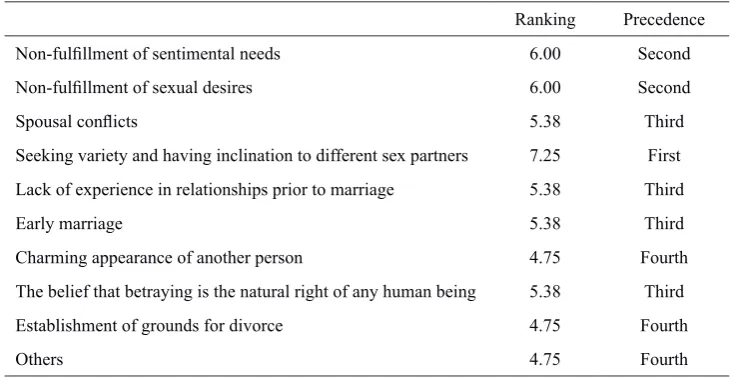
Table 1 presents results of women’s attitude to the most important reason of spousal betrayal. According to Table 1, the most important reason of spousal betrayal is seeking variety and having inclination to different sex partners.
Table 2, presents descriptive data of variables
Table 1 Test results of women’s attitude to the most important reason of spousal betrayal
Precedence Ranking
Second 6.00
Non-fulfillment of sentimental needs
Second 6.00
Non-fulfillment of sexual desires
Third 5.38
Spousal conflicts
First 7.25
Seeking variety and having inclination to different sex partners
Third 5.38
Lack of experience in relationships prior to marriage
Third 5.38
Early marriage
Fourth 4.75
Charming appearance of another person
Third 5.38
The belief that betraying is the natural right of any human being
Fourth 4.75
Establishment of grounds for divorce
Fourth 4.75
Others
of mental health and its related subscales at two stages of pre-test and post-test examination. Mean total of mental health at per-test was 25.53 which decreased to 17.86 at post-test. All components of mental health were found to have been improved at post-test. Table 2 indicates dependent T for difference in means of group (pre-test vs. post-test). According to Table 2, there was significant difference in total of mental health of betrayed women at pre-test stage vs. post-test stage. Findings showed the significant effect of group psychotherapy sessions on improving mental health of the betrayed women. Table 2, presents descriptive data of variables of mental health and its related subscales at two stages of pre-test
and post-test examination. Mean total of mental health at per-test was 25.53 which decreased to 17.86 at post-test. All components of mental health were found to have been improved at post-test. Table 2 indicates dependent T for difference in means of group (pre-test vs. post-test). According to Table 2, there was significant difference in total of mental health of betrayed women at pre-test stage vs. post-test stage. Findings showed the significant effect of group psychotherapy sessions on improving mental health of the betrayed women.
Discussion
Table 2 Mean and standard deviation (SD) total score & t-test of mental health as well as its subscales at pre-test and post-pre-test states
Indexes Variables
Pre-test Post-test
Mean SD Mean SD T-test
Physical health 5.92 4.27 4.13 3.71
6.11
Anxiety 7.25 3.97 5.22 3.25
Social function 6.97 3.97 4.56 2.96 df 14
Depression 5.39 4.79 3.95 2.83
p<0.001 Mental health
(total score) 25.53 17 17.86 12.75
p<0.001
of couples after infidelity disclosure was also admitted in the study of Atkins et al who performed a meta-analysis on results of couple therapy on couples involved in marital infidelity. In this study, outcomes of interventions on 145 couples with and 385 couples with non-marital infidelity problems were compared. The results indicated although in early stages of couple therapy, couples with marital infidelity problems had higher levels of disturbances and depression symptoms, their recovery continued as interventions went up, and at the end of therapy, they were not recognizable from those with non-marital infidelity problems. It was also found that cognitive therapy could enhance verbal communication skills in infidelity-affected mothers. Most of the couples with marital-relationship experiences react to this happening with strong feeling of anger, high degrees of depression symptoms, and insecurity feeling [26]. The results showed that there was significant difference in mental health of the betrayed women at post-test. The findings released the significant effect of group psychotherapy sessions on improving mental health of the betrayed women. All components of mental health have been recovered at the post-test stage. Given review of literature and findings of the current study, it is clear that marital infelicity traces its negative effects both on the couples and their children, and may threaten their physical and psychological health even in long term. Therefore, it is strongly suggested to use media as well as curriculums of schools and universities to encourage people to keep their commitments to marital life, and to inform them about negative impacts of extra-marital relationships on family members, and health
and security of the whole society members. In addition, given that children growing up in infidelity-affected families may experience various problems in adulthood including lack of tendency to form a marital life, taking revenge on spouses, and committing disloyalty, which may have root in childhood experiences, it seems wiser to investigate aspects, causes and consequences of marital infidelity in Iran in a carful way and by observing values and norms, because its seems clear that ignoring these issues do never lead to their solvation, but conversely, terminates in inexpiable sufferings on families and the society [26].
These findings are in accordance with some previous research studies [10-16]. Women can use the safety of therapy as place where they can begin to make sense of what happened to their relationship. A retelling of events of the affair helps the women understand their respective roles in affair and promotes constructions of new meanings. Therapist use the process of forgiveness as conduit out of the hurt, disappointment, and pain to reconstruction of marital life in which quality of interpersonal relationships improve [12-17].
week and lasted for 90 minutes at psychology and counseling center in Tehran. There was no financial support to carry out this study. Finally, this study was not research project.
The main limitation was the unavailable to husbands of betrayed women and to perform the couple the couple therapy.Recommendations: To perform of the common sessions for couple to release from truma to follow up, to the durability of treatmen.
Conclusion
In brief, by psychotherapy sessions, women acquire skills necessary to constructively face the harm inflicted, leave the passive role and eventually learn how to deal with the future situations more effectively. The women’s partners were absent in this study; therefore couple therapy is suggested whereby children’s behavior can be studied too. In this study, every section was held once week and lasted for 90 minutes at psychology and counseling center in Tehran. There was no financial support to carry out this study. Finally, this study was not research project.
The main limitation was the unavailable to husbands of betrayed women and to perform the couple the couple therapy .Recommendations: To perform of the common sessions for couple to release from trauma to follow up, to the durability of treatment.
Acknowledgements
The author would like to acknowledge the respectable women’s participated in the project.
Contribution
Study design: MSH
Data collection and analyses: MSH Manuscript: MSH
Conflict of Interest
"The author declares that they have no competing interests."
Funding
The author (s) received no financial support for the research, authorship and/or publication of this article.
References
1- Treas J, Giesen D. Sexual infidelity among married and cohabitating Americans. J Marriage Fam2000 62(1): 48–60.
2- Langer G, Arnet C, Sussman D. Primetime live poll: American sex survey 2004. Available atURL:http:// www.abcnews.go.com/ primetime/ PollVault/ story id=15692 & page=1. July 19,2004
3- Blow AJ, Hartnett K. Infidility in committed relationships I: a methodological review. J Marital Fam Ther2005; 31(2): 183-216.
4- Schmitt DP, Alcalay L, Allik J, et al. Universal sex differences in the desire for sexual variety: Tests from 52 nations, 6 continents, and 13 islands. J Pers Soc Psychol2003; 85(1): 85–104.
5- Cano A, O’Leary KD. Infidelity and separations precipitate major depressive episodes and symptoms of nonspecific depression and anxiety. J Consult Clin Psychol2000; 68(5): 774–81.
6- Kaveh S. Couple, disloyalty and infidility. Tehran: Sokhan; 2008.
7- Sweeney MM, Horowitz AV. Infidelity, initiation, and the emotional climate of divorce: Are there implications for mental health? J Health Soc Behav2001; 42(3): 295–309.
8- Brown EM. Patterns of infidelity and their treatment (2nd ed). New York: Routledge; 2001.
9- Shakelford TK, Buss DM, Weekes Shakelford VA. Wife killings committed in the context of a lovers triangle. Basic Appl Soc Psych2003; 25(2), 137–43. 10- Snyder DK. Treatment of clients coping with infidelity: an introduction. J Clin Psychol2005; 61(11): 1367-70.
11- Fung SC, Wong CW, Tam MS. Familial and extramarital relations among truck drivers crossing the Hong Kong China border. J Sex Marital Ther2009; 35(3): 239- 44.
12- Linley PA, Joseph S. Positive psychology in practice. New York: Wiley; 2004.
13- Oppenheimer M. Recovering from an extramarital relationship from a non-systemic approach. Am J Psychother2007; 61(2): 181-90.
14- Snyder DK, Baucom DH, Gordon KC. An integrative approach to treating infidelity. The Family Journal2008; 16(4): 300-7.
15- Spring JA. After the affair: Healing the pain and rebuilding the trust when a partner has been unfaithful. NewYork: Harper Collins; 1996.
16- Gordon KC, Baucom DH, Snyder DK. An integrative intervention for promoting recovery from extramarital affairs. J Marital Fam Ther2004; 30(2): 213-31.
and Developments2008; 7(28): 53-66.
18- Momeni M, Shoaa Kazemi M. The impact of psychotherapy on quality of life improvement of couples harmed by marital betrayals. The first student national congress on social determinants of health. Tehran, 2010. 19- Dehghan N. Investigation of relations of social skills and mental health with the educational progress of first grade high school students of Yazd. [dissertation]. Tehran: Al-Zahra University of Tehran 2006.
20- Shafiabadi A, Naseri Gh. Notions of consultation and psychotherapy. Tehran: Tehran University; 2007. 21- Vaughan P. The monogamy myth: a personal handbook for recovering from Affairs. 3rd edition. New York: Newmarket; 2008.
22- Goldberg LR. The structure of phenotypic personality traits. Am Psycholo1993; 48(1): 26-34 23- Aghajani M. The effect of life skills on Mental Health and locus of control in teens [dissertation]. Tehran: Al-Zahra University of Tehran2002.
24- Stefano JD, Oala M. Extramarital affairs: basic considerations and essential tasks in clinical work. The Family Journal2008; 16(1): 13-9.
25- Hosseini SH, Aramnia E. Surviving from marital betrayals by Willard F. Harley, Jennifer Chalmers Harley. Tehran: Nasl noandish; 2006.
26- Atkins DC, Jacobson NS, Baucom DH. Understanding infidelity: correlates in a national random sample. Family Psychology2010; 15(2): 735-49