ARTICLE OPEN ACCESS
ALS in Danish Registries
Heritability and links to psychiatric and cardiovascular disorders
Betina B. Trabjerg, MSc, Fleur C. Garton, PhD, Wouter van Rheenen, MD, PhD, Fang Fang, MD, PhD, Robert D. Henderson, MBBS, PhD, Preben Bo Mortensen, DrMedSc, Esben Agerbo, DrMedSc, and Naomi R. Wray, PhD
Neurol Genet2020;6:e398. doi:10.1212/NXG.0000000000000398
Correspondence Dr. Wray
Abstract
ObjectiveTo investigate the genetic contribution to amyotrophic lateral sclerosis (ALS) and the phenotypic and genetic associations between ALS and psychiatric and cardiovascular disorders (CVD) we used the national registry data from Denmark linked tofirst-degree relatives to estimate herita-bility and cross-trait parameters.
Methods
ALS cases and 100 sex and birth-matched controls per case from the Danish Civil Registration System were linked to their records in the Danish National Patient Registry. Cases and controls were compared for (1) risk of ALS infirst-degree relatives, used to estimate heritability, (2) comorbidity with psychiatric disorders and CVD, and (3) risk of psychiatric disorders and CVD infirst-degree relatives.
Results
5,808 ALS cases and 580,800 controls were identified. Fifteen percent of cases and controls could be linked to both parents and full siblings, whereas 70% could be linked to children. (1) We estimated the heritability of ALS to be 0.43 (95% CI, 0.34–0.53). (2) We found increased rates of diagnosis of mental disorders (risk ratio = 1.18; 95% CI, 1.09–1.29) and CVD in those later diagnosed with ALS. (3) Infirst-degree relatives of those with ALS, we found increased rate of schizophrenia (1.17; 95% CI, 0.96–1.42), but no evidence for increased risk CVD.
Conclusions
Heritability of ALS is lower than commonly reported. There is likely a genetic relationship between ALS and schizophrenia, and a nongenetic relationship between ALS and CVD.
From the National Centre for Register-Based Research NCRR (B.B.T., P.B.M., E.A.), Aarhus University; Centre for Integrated Register-Based Research CIRRAU (B.B.T., P.B.M., E.A.), Aarhus University; The Lundbeck Foundation Initiative for Integrative Psychiatric Research (B.B.T., P.B.M., E.A.), iPSYCH, Denmark; Institute for Molecular Bioscience (F.C.G., N.R.W.), University of Queensland, Brisbane, Australia; Department of Neurology, Brain Center Rudolf Magnus, University Medical Center Utrecht, The Netherlands; Department of Medical Epidemiology and Biostatistics (F.F.), Karolinska Institutet, Stockholm, Sweden; Centre for Clinical Research (R.D.H.), The University of Queensland, Brisbane; Queensland Brain Institute (R.D.H., N.R.W.), University of Queensland, Brisbane; Department of Neurology (R.D.H.), Royal Brisbane and Women’s Hospital, Australia.
Go to Neurology.org/NG for full disclosures. Funding information is provided at the end of the article.
The Article Processing charge was funded by the authors.
The analyses based on the summary statistics derived from the Danish Registry data and quantitative genetic modeling was conducted by Fleur Garton and Naomi Wray.
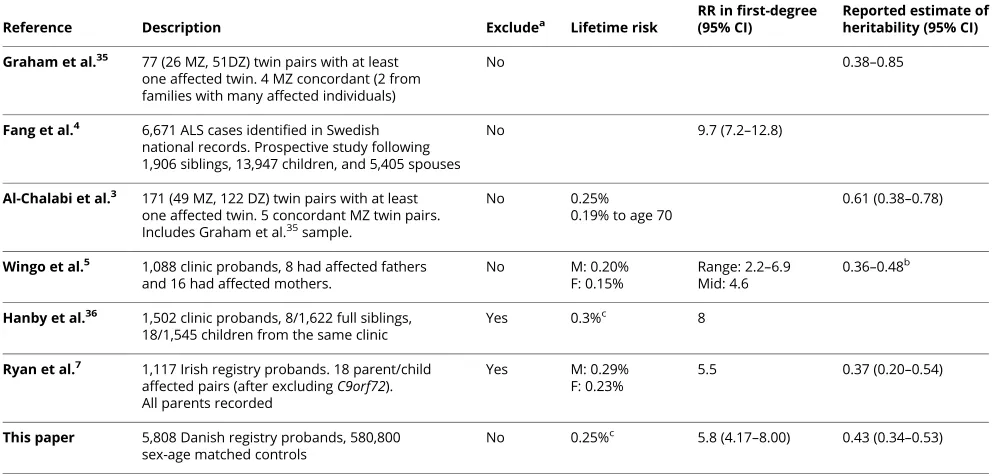
Multiple genes1(e.g.,SOD1and C9orf72) can harbor causal mutations of amyotrophic lateral sclerosis (ALS) found in 5%–10% of those diagnosed,2mostly those with many affected family members. Genetic factors likely contribute to ALS when these mutations are absent. Heritability of liability quantifies the relative genetic contribution to the disease, assuming a polygenic architecture. Estimates of heritability3–7(table 1) are difficult to obtain for late-onset disorders because the es-sential information required is the increased risk of disease in relatives of those affected. This is particularly difficult for a disorder such as ALS where lifetime risk is;0.25%.8,9
More recently, genome-wide association study (GWAS) data have enabled estimation of the proportion of variation in liability associated with genome-wide single nucleotide polymorphisms (SNP-based heritability10). For ALS, SNP-based heritability has been estimated to be 8.2% (95% CI, 7.2–9.2),11which provides a lower bound for heritability (because the estimate only captures variation associated with the GWAS common SNPs) and dem-onstrates evidence in support of a polygenic architecture. SNP-based heritability methods have bivariate extensions12,13that allow estimation of genetic correlations using GWAS summary statistics from independently collected disease cohorts. Application of these methods to ALS gave a significant estimate for a genetic corre-lation of ALS with schizophrenia (0.14, 95% CI, 0.07–0.21).14By contrast, the estimated genetic correlation with cardiovascular disease (CVD) was not different from zero,15despite increased rates of CVD in those with ALS.16Here, we apply genetic epi-demiology approaches to population records of ALS from Denmark with the objective to provide independent evidence for genetic associations between ALS and other disorders.
Methods
Study populationThe Danish Civil Registration System (CRS) was established in 1968, registering all people alive and living in Denmark17with a unique personal identifier (CRS number). All other national registries can be linked using the CRS number. Our study population included all persons alive in Denmark from January 1, 1968, or born between 1969 and January 1, 2017. The study was approved by the Danish Health Data Authority, the Danish Data Protection Agency, and Statistics Denmark and did not require ethical approval because its use serves a scientific cause and no reference is made to a single person.
ALS cases
ALS cases were identified using the Danish National Patient Registry18(established January 1, 1977, accessing records until
January 1, 2017). The patient registry records any individual with a hospital admission and covers information on all Danish somatic inpatient hospital contacts; outpatient contacts were included from January 1, 1994. We considered both main and auxiliary diagnoses for inpatient and outpatient contacts. In-clusion was based on persons who were living in Denmark at the time, were older than 16 years at the time of theirfirst diagnosis, and had International Classifications of Disease (ICD) 8:348.0 or icd-10:G12.2 codes included in their records. These definitions have been used in previous studies of ALS using the Danish registry,19–22and a very good agreement in diagnosis has been reported with death certificate data.19 A published validation study used these ICD codes for cases identified from the registry data and confirmed the ALS di-agnosis in 160 of 173 ALS cases (92.5%) and found no dif-ference in the predictive validity between ICD-8 and ICD-10 codes.22
Controls
For each case that was identified, 100 controls were extracted and matched for sex and date of birth (alive and living in Denmark at the time case diagnosis wasfirst recorded). Par-ticularly, for older cases, it was not possible tofind 100 con-trols matched for an exact date of birth. Where necessary, the window was increased by ±1 day until the quota of controls was reached. The controls were sampled without re-placement, and the cases could not be selected as controls.
Identification of family members
After the selection of ALS cases and controls, parents, siblings, or children were identified when possible. For people regis-tered as children, a link to the CRS number of their legal parents is created. Since the registry was established in 1968, only those born after;1950 (aged 18 years or younger at the time when the registry was established) are expected to have parental CRS records. Full siblings could only be identified for those who had both parents linked to their records. Similarly, in identifying children of cases, only children born after 1950 and before 2017 would be identified. We note that the CRS system identifies legal parents; although these are expected to mostly reflect biological relationships, this will not always be true. We count parents, siblings, and children asfirst-degree relatives.
Psychiatric and CVD diagnoses
Information on individuals diagnosed with schizophrenia and other mental disorders was obtained from the Danish Psychi-atric Central Research Register.23 From 1969, this Registry contained data on all admissions to Danish psychiatric inpatient facilities (secondary care treatment). From 1995, information on all contacts to outpatient psychiatric departments and visits
Glossary
to psychiatric emergency care units was included. For all cases and controls and their identified first-degree relatives, endorsements of records for psychiatric diagnoses were obtained24(table e-1, links.lww.com/NXG/A224). The same hospital registry that was used to identify ALS cases, the Danish National Patient Registry, was also used to identify all persons with any diagnosis of heart disease. We defined heart disease under both a broad definition of CVD and a narrower defi ni-tion of myocardial infarcni-tion (MI)20(table e-1). The psychi-atric or CVD diagnoses in both cases and their matched controls were restricted to those recorded before thefirst re-cord of ALS for the case. We estimated risk of psychiatric disorders and CVD in ALS cases and controls and calculated risk ratios (RRs).
Quantitative genetic modeling
We estimated the increased risk of ALS in relatives of the cases compared with the controls for different types of relatives.
When families have 3 or more affectedfirst-degree relatives, it is very likely that they have a mendelian type of ALS, given a life-time risk for ALS of;0.25%. However, co-occurrence of ALS in a pair of relatives could be explained by shared genetic factors under a more polygenic model of disease (or even by shared environment). Many other diseases have mendelian and poly-genic types (such as breast cancer, Parkinson disease, and Alz-heimer disease). Under a polygenic genetic architecture, even when the total genetic contribution to disease etiology is high, most people affected present without a family history.25Here, we assume that the observed increased risk infirst-degree relatives is
attributed to a polygenic contribution (the same assumptions as made in the studies listed in table 1) and estimate the heritability of ALS under the liability threshold model,26–28 assuming a lifetime risk of 0.25%. Recognizing that families harboring the known causal mutations cannot be identified from the registry data, we conducted sensitivity analyses and re-estimated herita-bility removing 20% of counts of ALS concordant relative pairs. Last, we estimated the risk of psychiatric disorders or CVD in relatives of ALS cases and controls. We used bivariate liability threshold methods to link risk in relatives to genetic correlation,27,28assuming estimates of heritability for these traits made from Danish national registry data.28
Data availability
Access to individual-level Denmark data is governed by Danish authorities. These include the Danish Data Protection Agency, the Danish Health Data Authority, and Statistics Denmark. Each scientific project must be approved before initiation, and approval is granted to a specific Danish research institution. International researchers may gain data access through col-laboration with a Danish research institution.
Results
Cases and controls
We identified 5,808 ALS cases (3,227 men and 2,581 women), of which 62% had an ICD-10:G122 diagnosis, 27% ICD-8: 34809, and 10% ICD-10:G122G. These statistics are in good agreement with the studies which previously accessed the ALS
Table 1 A summary of the studies estimating risk in relatives and/or estimating heritability
Reference Description Excludea Lifetime risk
RR in first-degree (95% CI)
Reported estimate of heritability (95% CI)
Graham et al.35 77 (26 MZ, 51DZ) twin pairs with at least
one affected twin. 4 MZ concordant (2 from families with many affected individuals)
No 0.38–0.85
Fang et al.4 6,671 ALS cases identified in Swedish
national records. Prospective study following 1,906 siblings, 13,947 children, and 5,405 spouses
No 9.7 (7.2–12.8)
Al-Chalabi et al.3 171 (49 MZ, 122 DZ) twin pairs with at least
one affected twin. 5 concordant MZ twin pairs. Includes Graham et al.35sample.
No 0.25% 0.19% to age 70
0.61 (0.38–0.78)
Wingo et al.5 1,088 clinic probands, 8 had affected fathers
and 16 had affected mothers.
No M: 0.20% F: 0.15%
Range: 2.2–6.9 Mid: 4.6
0.36–0.48b
Hanby et al.36 1,502 clinic probands, 8/1,622 full siblings,
18/1,545 children from the same clinic
Yes 0.3%c 8
Ryan et al.7 1,117 Irish registry probands. 18 parent/child
affected pairs (after excludingC9orf72). All parents recorded
Yes M: 0.29% F: 0.23%
5.5 0.37 (0.20–0.54)
This paper 5,808 Danish registry probands, 580,800 sex-age matched controls
No 0.25%c 5.8 (4.17–8.00) 0.43 (0.34–0.53)
Abbreviations: MZ = monozygotic twins; DZ = dizygotic twins; RR = relative risk.
aHere, we note if cases carrying known mutations or from families with many affected individuals were excluded, recognizing that any exclusion is likely to be
incomplete.
records from Danish registers.19–22For more than 94% of cases, all their matched controls were born within 2 days (table e-2, links.lww.com/NXG/A224). The birth years of the cases ranged from 1886 to 2000, but given that ALS is typically a disease of late-onset, 94% of cases were born before 1960 (table e-3). We found that annual incidence was higher in later years (figure e-1), consistent with the previously reported increase in age-adjusted incidence of 1.6% annually after 1982.21Because some people with ALS have no need for an inpatient hospitalization, the addition of outpatient records in 1994 may partially account for incidence increase. The median age at diagnosis for the ALS cohort (minimum age of diagnosis of 16 years) was 67.1 years (interquartile range 58.4–74.2 years) (figure e-2).
Relatives
As a reflection of the timing of the registry establishment, the percentage of those with a link to a mother increased rapidly from 9.7% for those born in 1950 to 98.6% and 99.8% for those born in 1960 and 1970, respectively, retaining that level for all subsequent birth years. Similar findings were obtained regarding a link to a father. Given the age distri-bution for ALS diagnosis, only 16% of cases/controls could
be linked to their mother, 15% could be linked to their father, and 15% could be linked to both parents, with no difference between the cases and controls (χ2test,p= 0.12) (table e-4, links.lww.com/NXG/A224). Only those linked to their parents could have their siblings identified (table e-5). By contrast, children could be identified for 70% of people (table e-6). Overall, 74% of people had at least onefirst-degree relative identified in the registry data (table e-7). In these data, no ALS case or control had more than one affected sibling and the number of individuals with more than one affected child was less than 4 (concern about potential reidentification means that the exact number is nonreportable). The rate of ALS was 0.15% in mothers of controls and 0.20% in fathers of controls (among only the 15% controls with their parents identified) (table 2). Because ALS is a late-onset disorder, the parents of controls matched to the cases must be close to a full lifetime in age; hence, these rates provide a lower bound on lifetime risk.
Estimate of heritability
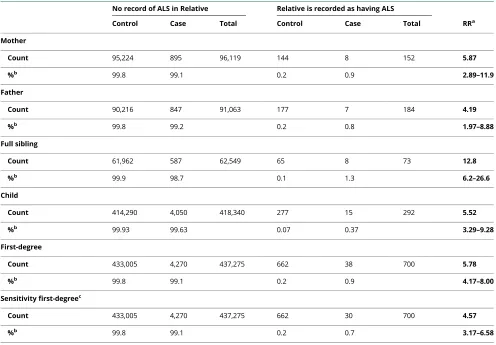
The RR of ALS infirst-degree relatives of ALS cases compared with those of the controls ranged from 4.2 in fathers to 12.8 in
Table 2Counts of ALS in each relative type of ALS cases and controls and RRs for ALS cases compared with ALS controls
No record of ALS in Relative Relative is recorded as having ALS
RRa
Control Case Total Control Case Total
Mother
Count 95,224 895 96,119 144 8 152 5.87
%b 99.8 99.1 0.2 0.9 2.89–11.9
Father
Count 90,216 847 91,063 177 7 184 4.19
%b 99.8 99.2 0.2 0.8 1.97–8.88
Full sibling
Count 61,962 587 62,549 65 8 73 12.8
%b 99.9 98.7 0.1 1.3 6.2–26.6
Child
Count 414,290 4,050 418,340 277 15 292 5.52
%b 99.93 99.63 0.07 0.37 3.29–9.28 First-degree
Count 433,005 4,270 437,275 662 38 700 5.78
%b 99.8 99.1 0.2 0.9 4.17–8.00
Sensitivity first-degreec
Count 433,005 4,270 437,275 662 30 700 4.57
%b 99.8 99.1 0.2 0.7 3.17–6.58
Abbreviations: ALS = amyotrophic lateral sclerosis; RR = risk ratio. Bold type face is used for RR that are significantly different from 1
aCalculated function RR from R library fmsb. bPercent of either case or control count.
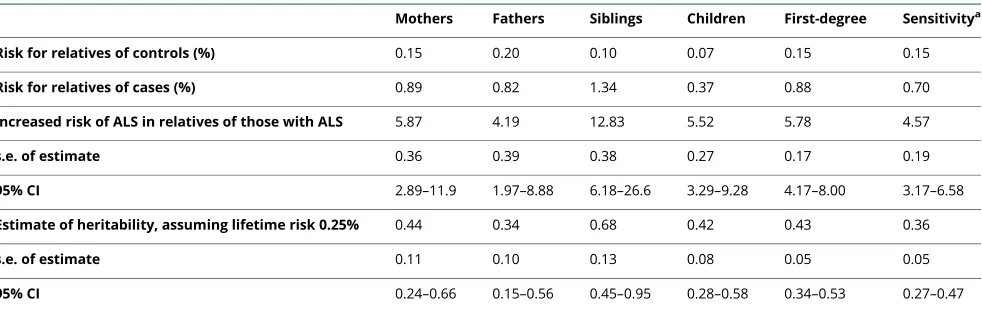
siblings (table 3). Despite this range, the 95% CI was over-lapping. Across all first-degree relatives, there is a 5.78-fold (95% CI, 4.17–8.00) increase in the risk of ALS in relatives of the cases compared with in relatives of the controls. This generates an estimate of heritability of 0.43 (95% CI, 0.34–0.53), given a lifetime risk8,9 of 0.25% (table 3). Sensi-tivity analyses assumed lifetime risks of ALS in Denmark of 0.2% or 0.3%, which gave heritability estimates of 0.41 (95% CI, 0.32–0.50) and 0.45 (95% CI, 0.35–0.55), respectively, (tables e-8 and e-9, links.lww.com/NXG/A224). The methodology to estimate heritability assumes that the disease is polygenic, and hence, the estimate provided here is an upper limit of herita-bility on the liaherita-bility scale because some of the first-degree relatives concordant for ALS may reflect families harboring mendelian mutations; as such, it is not possible to identify these families from the registry data. In a sensitivity analysis, with an exclusion of 20% of concordant pairs, the estimate of the rel-ative risk reduced to 4.57 (95% CI, 3.17–6.58) and that of heritability reduced to 0.36 (95% CI, 0.27–0.47) (table 3). We note that no family included more than 2 affected individuals, and we were unable tofind reports of rates of ALS mendelian mutations in Denmark. Given the intercountry variability, it is possible that the rates of ALS dominant mutations are not high. For example, in an international study,29 the most common form of mendelian ALS, associated with the hexanucleotide repeat in the geneC9orf72, was less frequent in the Netherlands and Sweden (albeit the latter from a small sample) than in other countries; Denmark did not contribute to the study.
Cross-trait analyses within individual and for relatives
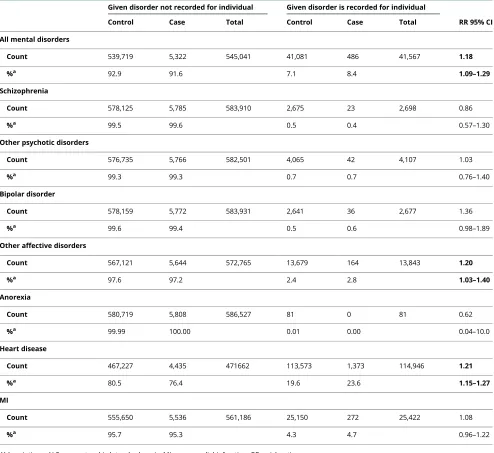
We estimated the risk of psychiatric disorders and CVD before ALS diagnosis date in those with ALS and their matched controls (table 4). We found an increased risk of CVD (RR) of (1.21; 95% CI, 1.15–1.27,p= 6 × 10⁻¹⁵) in those with ALS compared with those without (as previously reported16), but the increased risk was not significant for MI (RR = 1.08; 95% CI, 0.96–1.22,p=
0.19). We also found an increased risk of all psychiatric disorders (RR = 1.18; 95% CI, 1.09–1.29,p= 1.3 × 10⁻⁴) likely reflecting an increased risk in affective disorders excluding bipolar disorder (RR = 1.20; 95% CI, 1.03–1.40,p = 0.019). These affective disorders affect 2.4% of the controls (i.e., reflecting mostly hos-pitalized unipolar disorder), noting that the Danish Psychiatric Central Research Register does not include depression treated in primary care. There is no increased risk of severe psychiatric disorders such as schizophrenia, bipolar disorder, and anorexia.
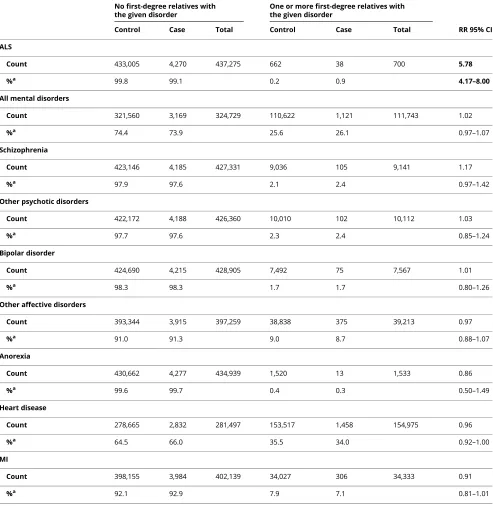
We estimated the risk of psychiatric and CVD disorders infi rst-degree relatives of those with and without ALS. When con-sidering allfirst-degree relatives together, none of the risks to relatives were significant (table 5). The highest increased risk was 1.17 (95% CI, 0.97–1.42;p= 0.10) for schizophrenia (table 5). Despite being nonsignificant, the increased risk was in the direction expected from the genetic correlation estimates from GWAS summary data.14 Using lifetime risk and heritability estimates280.0112 and 0.67, respectively for schizophrenia, and of 0.0025 and 0.43, respectively for ALS, and assuming a ge-netic correlation of 0.14,14we estimate the expected RR to be 1.32, which is within the 95% CI of our estimate. When con-sidering differentfirst-degree relatives, we found an increased risk of schizophrenia in mothers of ALS cases (RR = 2.21; 95% CI, 1.05–4.65, p = 0.033) and increased risk of all mental disorders in fathers of ALS case (RR = 1.29; 95% CI, 1.08–1.53,
p= 0.0053) (table e-8, links.lww.com/NXG/A224).
Discussion
Recorded in over 48 years of Danish national patient and outpatient registries were 5,808 ALS cases, who were matched with 580,800 controls. The increased risk of ALS in fi rst-degree relatives of those with ALS compared withfirst-degree relatives of controls was 5.78 (95% CI, 4.17–8.00). The resulting estimate of heritability was 0.43 (95% CI, 0.34–0.53). This has a lower mean and smaller bounds than the published
Table 3 Estimates of heritability of ALS based on relative risk of ALS for different type of relatives
Mothers Fathers Siblings Children First-degree Sensitivitya
Risk for relatives of controls (%) 0.15 0.20 0.10 0.07 0.15 0.15
Risk for relatives of cases (%) 0.89 0.82 1.34 0.37 0.88 0.70
Increased risk of ALS in relatives of those with ALS 5.87 4.19 12.83 5.52 5.78 4.57
s.e. of estimate 0.36 0.39 0.38 0.27 0.17 0.19
95% CI 2.89–11.9 1.97–8.88 6.18–26.6 3.29–9.28 4.17–8.00 3.17–6.58
Estimate of heritability, assuming lifetime risk 0.25% 0.44 0.34 0.68 0.42 0.43 0.36
s.e. of estimate 0.11 0.10 0.13 0.08 0.05 0.05
95% CI 0.24–0.66 0.15–0.56 0.45–0.95 0.28–0.58 0.34–0.53 0.27–0.47
Abbreviations: ALS = amyotrophic lateral sclerosis; RR = risk ratio; s.e. = standard error.
Heritability following liability threshold methodology,26–28assuming lifetime risk of K = 0.0025. 95% CI are calculated using the 95% CI of the RR, as the only estimated value in the equation.
twin-based estimate3(0.61%, 95% CI, 0.38–0.78%) but is in good agreement with later estimates (table 1).
The published estimate of the genetic correlation derived from ALS and schizophrenia GWAS data is 0.14 (95% CI, 0.07–0.21).14Although psychosis has been reported in relatives of those with ALS in kindred segregating the C9orf72 hex-anucleotide repeat expansion,2increased rates of ALS in those with schizophrenia have not been reported, which would be expected if there was a shared genetic architecture between the disorders. Here, we found no evidence for increased rates of schizophrenia in those with ALS (RR 0.86, 95% CI, 0.57–1.30). However, the life expectancy is significantly reduced for those
with schizophrenia: reported from survival analysis using the Danish registry data to be 18.7 years and 16.3 years shorter for men and women, respectively.30The observed increased rate of schizophrenia infirst-degree relatives of those with ALS was also not significant (1.17; 95% CI, 0.96–1.42;p= 0.10), but the RR expected from a genetic correlation of 0.14 is 1.32, which is within the confidence limits of our estimate. Hence, our results provide some support that the genetic relationship between ALS and schizophrenia is genetic. A Swedish national registry study, which identified 3,648 ALS cases and 364,800 matched controls found higher rates of psychiatric disorders in chil-dren of those with ALS.31 The overlap between ALS and schizophrenia is unlikely to be attributed toC9orf72mutations
Table 4Disease/disorder counts in 5,808 ALS cases and 580,800 matched controls before ALS diagnosis in the case and RRs for ALS cases compared with ALS controls
Given disorder not recorded for individual Given disorder is recorded for individual
RR 95% CI
Control Case Total Control Case Total
All mental disorders
Count 539,719 5,322 545,041 41,081 486 41,567 1.18
%a 92.9 91.6 7.1 8.4 1.09–1.29
Schizophrenia
Count 578,125 5,785 583,910 2,675 23 2,698 0.86
%a 99.5 99.6 0.5 0.4 0.57–1.30
Other psychotic disorders
Count 576,735 5,766 582,501 4,065 42 4,107 1.03
%a 99.3 99.3 0.7 0.7 0.76–1.40
Bipolar disorder
Count 578,159 5,772 583,931 2,641 36 2,677 1.36
%a 99.6 99.4 0.5 0.6 0.98–1.89
Other affective disorders
Count 567,121 5,644 572,765 13,679 164 13,843 1.20
%a 97.6 97.2 2.4 2.8 1.03–1.40
Anorexia
Count 580,719 5,808 586,527 81 0 81 0.62
%a 99.99 100.00 0.01 0.00 0.04–10.0 Heart disease
Count 467,227 4,435 471662 113,573 1,373 114,946 1.21
%a 80.5 76.4 19.6 23.6 1.15–1.27
MI
Count 555,650 5,536 561,186 25,150 272 25,422 1.08
%a 95.7 95.3 4.3 4.7 0.96–1.22
Abbreviations: ALS = amyotrophic lateral sclerosis; MI = myocardial infarction; RR = risk ratio.
Note 0.5 was added to the case count for anorexia to enable estimation of the RR. Bold type face is used for RR significantly different from 1.
because the hexanucleotide repeat is reported to have a fre-quency less than 0.1% in those with schizophrenia.32
We found increased rates of recorded cardiovascular disease (CVD) before diagnosis of ALS (RR = 1.21; 95% CI, 1.15–1.27), as previously reported.16 This association, how-ever, was not detected in the narrow definition of heart disease; MI. By contrast, we found no increase in the rate of CVD
among relatives of those with ALS, despite high rates infi rst-degree relatives of both the cases and controls (;35%). This may suggest broad lifestyle factors, rather than a genetic re-lationship, and explain the observed increased rates of CVD in those with ALS,16which would be consistent with the genetic correlation estimates from GWAS data between ALS and CVD that were not different from zero.15Alternatively, the high rate of CVD recorded before ALS diagnosis may reflect the
Table 5Disease/disorder counts in first-degree relatives of ALS cases and controls, and RRs for ALS cases compared to ALS controls
No first-degree relatives with the given disorder
One or more first-degree relatives with the given disorder
RR 95% CI
Control Case Total Control Case Total
ALS
Count 433,005 4,270 437,275 662 38 700 5.78
%a 99.8 99.1 0.2 0.9 4.17–8.00
All mental disorders
Count 321,560 3,169 324,729 110,622 1,121 111,743 1.02
%a 74.4 73.9 25.6 26.1 0.97–1.07
Schizophrenia
Count 423,146 4,185 427,331 9,036 105 9,141 1.17
%a 97.9 97.6 2.1 2.4 0.97–1.42
Other psychotic disorders
Count 422,172 4,188 426,360 10,010 102 10,112 1.03
%a 97.7 97.6 2.3 2.4 0.85–1.24
Bipolar disorder
Count 424,690 4,215 428,905 7,492 75 7,567 1.01
%a 98.3 98.3 1.7 1.7 0.80–1.26
Other affective disorders
Count 393,344 3,915 397,259 38,838 375 39,213 0.97
%a 91.0 91.3 9.0 8.7 0.88–1.07
Anorexia
Count 430,662 4,277 434,939 1,520 13 1,533 0.86
%a 99.6 99.7 0.4 0.3 0.50–1.49
Heart disease
Count 278,665 2,832 281,497 153,517 1,458 154,975 0.96
%a 64.5 66.0 35.5 34.0 0.92–1.00
MI
Count 398,155 3,984 402,139 34,027 306 34,333 0.91
%a 92.1 92.9 7.9 7.1 0.81–1.01
Abbreviations: ALS = amyotrophic lateral sclerosis; MI = myocardial infarction; RR = risk ratio.
Bold type face is used for RR significantly different from 1. Note: Only persons with recorded first-degree relatives are included. First-degree relatives accounting parents, full siblings, and children.
increased medical surveillance in those in the early stages of disease.
The key strength of the Danish registry data is its completeness so that ascertainment biases are minimized compared with other designs. Nonetheless, there are limitations. First, because ALS is a late-onset disorder and given the timing of the es-tablishment of the registry system, we could only trace parents for those born after;1950. From the parents, we were able to trace the siblings, but only siblings born after 1950. To counter this, our design of 100 controls per case provides robustness to our estimates and any potential biases apply to both cases and controls. Second, although;70% of ALS cases had records of
first-degree relatives in the registry system, the majority of such relatives were children, who were mostly below the expected age of ALS onset (median age diagnosis in these data of 67.1 years). The information for estimation of heritability was therefore mostly generated from;15% of the ALS cases that could be linked to both parents and hence also to siblings, which is still a sizeable data set (table 1). Third, in these registry data, we were unable to identify individuals and their family members carrying ALS causal mutations and inclusion of these individuals could inflate the estimate of heritability, which methodologically assumes a polygenic architecture. We did not attempt to access frontotemporal dementia diagnoses (relevant because it co-occurs in families carrying the C9orf72 hex-anucleotide repeat33) because these diagnoses have not been validated in registry data.34To address these limitations, we conducted sensitivity analyses in which we excluded from the analyses a proportion of concordant relative pairs, the pro-portion chosen as a likely upper limit that could be attributed to
first-degree relative pairs with causal mutations. The resulting relative risk (RR = 4.57; 95% CI, 3.17–6.58) and heritability (RR = 0.36; 95% CI, 0.27–0.47) provide lower bounds of these estimates. Last, higher relative risks associated with maternal transmission have recently been reported in a prospective ALS study in Ireland,7although results were not significant when families carrying theC9orf72hexanucleotide repeat expansion were excluded. Here, we have not considered sex-specific risks because the number of concordant affected pairs is too few to generate meaningful results.
Our heritability estimate of 0.43 withstands sensitivity analyses and supports a genetic contribution to the disease. If anything, our estimate might be upwardly biased, yet the estimate is lower than the twin estimate of heritability of ALS that has been most often cited. The weight of evidence is now such that a lower estimate must be seen as more plausible (table 1), we suggest
;0.40. Wefind evidence for previous risk of psychiatric dis-orders and CVD in individuals with ALS, plus tentative evi-dence that this relationship has a genetic contribution for schizophrenia and other psychiatric disorders but not for CVD.
Acknowledgment
N.R.W. and F.C.G. acknowledge funding from the Australian National Health and Medical Research Council (1078901, 1113400, 1087889). B.B.T., P.B.M., and E.A. acknowledge
financial support from The Stanley Medical Research Institute and The Lundbeck Foundation Initiative for Integrative Psychiatric Research, iPSYCH (grant no. R102-A9118 and R155-2014-1724).
Study funding
The Australian National Health and Medical Research Council (1078901, 1113400, 1087889) to N.R.W. and F.G. The Stanley Medical Research Institute and The Lundbeck Foundation Initiative for Integrative Psychiatric Research, iPSYCH (grant no. R102-A9118 and R155-2014-1724) to B.B.T., P.B.M., and E.A.
Disclosure
B.B. Trabjerg, F.C. Garton, W. van Rheenen, F. Fang, R.D. Henderson, P.B. Mortensen, E. Agerbo, and N.R. Wray report no disclosures. Go to Neurology.org/NG for full disclosures.
Publication history
Received byNeurology: GeneticsSeptember 10, 2019. Accepted infinal form January 13, 2020.
References
1. Taylor JP, Brown RH Jr, Cleveland DW. Decoding ALS: from genes to mechanism. Nature 2016;539:197–206.
AppendixAuthors
Name Location Role Contribution
Betina B. Trabjerg, MSc Aarhus University, Denmark
Author Analysis of the Danish registry data
Fleur C. Garton, PhD
The University of Queensland, Brisbane, Australia
Author Analysis applied to the summary statistics derived from the Danish registry data. Manuscript first draft. Wouter van Rheenen, MD, PhD University medical Center Utrecht, The Netherlands
Author Study design and ALS interpretation Fang Fang, MD, PhD Karolinska Institutet, Stockholm, Sweden
Author Study design and interpretation
Robert D. Henderson, MBBS, PhD
The University of Queensland, Brisbane, Australia
Author Study design and ALS interpretation Preben Bo Mortensen, DrMedSc Aarhus University, Denmark
Author Supervision of the analysis of Danish registry data; study design
Esben Agerbo, DrMedSc Aarhus University, Denmark
Author Supervision of the analysis of Danish registry data; study design
Naomi R. Wray, PhD
The University of Queensland, Brisbane, Australia
2. Byrne S, Walsh C, Lynch C, et al. Rate of familial amyotrophic lateral sclerosis: a systematic review and meta-analysis. J Neurol Neurosurg Psychiatry 2011;82: 623–627.
3. Al-Chalabi A, Fang F, Hanby MF, et al. An estimate of amyotrophic lateral sclerosis heritability using twin data. J Neurol Neurosurg Psychiatry 2010;81:1324–1326. 4. Fang F, Kamel F, Lichtenstein P, et al. Familial aggregation of amyotrophic lateral
sclerosis. Ann Neurol 2009;66:94–99.
5. Wingo TS, Cutler DJ, Yarab N, Kelly CM, Glass JD. The heritability of amyotrophic lateral sclerosis in a clinically ascertained United States research registry. PLoS One 2011;6:e27985.
6. Hanby MF, Scott KM, Scotton W, et al. The risk to relatives of patients with sporadic amyotrophic lateral sclerosis. Brain 2011;134:3454–3457.
7. Ryan M, Heverin M, McLaughlin RL, Hardiman O. Lifetime risk and heritability of amyotrophic lateral sclerosis. JAMA Neurol 2019;76:1367–1374.
8. Alonso A, Logroscino G, Jick SS, Hernan MA. Incidence and lifetime risk of motor neuron disease in the United Kingdom: a population-based study. Eur J Neurol 2009;16:745–751. 9. Kiernan MC, Vucic S, Cheah BC, et al. Amyotrophic lateral sclerosis. Lancet 2011;
377:942–955.
10. Yang J, Zeng J, Goddard ME, Wray NR, Visscher PM. Concepts, estimation and interpretation of SNP-based heritability. Nat Genet 2017;49:1304.
11. van Rheenen W, Shatunov A, Dekker AM, et al. Genome-wide association analyses identify new risk variants and the genetic architecture of amyotrophic lateral sclerosis. Nat Genet 2016;48:1043–1048.
12. Lee SH, Yang J, Goddard ME, Visscher PM, Wray NR. Estimation of pleiotropy between complex diseases using single-nucleotide polymorphism-derived genomic relationships and restricted maximum likelihood. Bioinformatics 2012;28:2540–2542. 13. Bulik-Sullivan B, Finucane HK, Anttila V, et al. An atlas of genetic correlations across
human diseases and traits. Nat Genet 2015;47:1236–1241.
14. McLaughlin RL, Schijven D, van Rheenen W, et al. Genetic correlation between amyotrophic lateral sclerosis and schizophrenia. Nat Commun 2017;8:14774. 15. Bandres-Ciga S, Noyce AJ, Hemani G, et al. Shared polygenic risk and causal
infer-ences in amyotrophic lateral sclerosis. Ann Neurol 2019;85:470–481.
16. Kioumourtzoglou MA, Seals RM, Gredal O, Mittleman MA, Hansen J, Weisskopf MG. Cardiovascular disease and diagnosis of amyotrophic lateral sclerosis: a pop-ulation based study. Amyotroph Lateral Scler Frontotemporal Degeneration 2016;17: 548–554.
17. Pedersen CB. The Danish Civil Registration system. Scand J Public Health 2011;39: 22–25.
18. Lynge E, Sandegaard JL, Rebolj M. The Danish national patient register. Scand J Public Health 2011;39:30–33.
19. Kioumourtzoglou MA, Seals RM, Himmerslev L, Gredal O, Hansen J, Weisskopf MG. Comparison of diagnoses of amyotrophic lateral sclerosis by use of death certificates and hospital discharge data in the Danish population. Amyotroph Lateral Scler Frontotemporal Degener 2015;16:224–229.
20. Laursen TM, Munk-Olsen T, Agerbo E, Gasse C, Mortensen PB. Somatic hospital contacts, invasive cardiac procedures, and mortality from heart disease in patients with severe mental disorder. Arch Gen Psychiatry 2009;66:713–720.
21. Seals RM, Hansen J, Gredal O, Weisskopf MG. Age-period-cohort analysis of trends in amyotrophic lateral sclerosis in Denmark, 1970–2009. Am J Epidemiol 2013;178: 1265–1271.
22. Seals RM, Kioumourtzoglou MA, Hansen J, Gredal O, Weisskopf MG. Amyotrophic lateral sclerosis and the Military: a population-based study in the Danish Registries. Epidemiology 2016;27:188–193.
23. Mors O, Perto GP, Mortensen PB. The Danish psychiatric Central research register. Scand J Public Health 2011;39:54–57.
24. Pedersen CB, Mors O, Bertelsen A, et al. A Comprehensive nationwide study of the incidence rate and lifetime risk for treated mental disorders. JAMA Psychiatry 2014; 71:573–581.
25. Yang J, Visscher PM, Wray NR. Sporadic cases are the norm for complex disease. Eur J Hum Genet 2010;18:1039–1043.
26. Reich T, Morris CA, James JW. Use of multiple thresholds in determining mode of transmission of semi-continuous traits. Ann Hum Genet 1972;36:163–184. 27. Falconer DS. Inheritance of liability to certain diseases estimated from incidence
among relatives. Ann Hum Genet 1965;29:51-76.
28. Wray NR, Gottesman II. Using summary data from the Danish national registers to estimate heritabilities for schizophrenia, bipolar disorder, and major depressive dis-order. Front Genet 2012;3:118.
29. Majounie E, Renton AE, Mok K, et al. Frequency of the C9orf72 hexanucleotide repeat expansion in patients with amyotrophic lateral sclerosis and frontotemporal dementia: a cross-sectional study. Lancet Neurol 2012;11:323–330.
30. Laursen TM. Life expectancy among persons with schizophrenia or bipolar affective disorder. Schizophr Res 2011;131:101–104.
31. Longinetti E, Mariosa D, Larsson H, et al. Neurodegenerative and psychiatric diseases among families with amyotrophic lateral sclerosis. Neurology 2017;89: 578–585.
32. Ducharme S, Bajestan S, Dickerson BC, Voon V. Psychiatric Presentations of C9orf72 mutation: what are the diagnostic implications for Clinicians? J Neuropsychiatry Clin Neurosci 2017;29:195–205.
33. Rohrer JD, Isaacs AM, Mizielinska S, et al. C9orf72 expansions in fronto-temporal dementia and amyotrophic lateral sclerosis. Lancet Neurol 2015;14: 291–301.
34. Phung TK, Andersen BB, Hogh P, Kessing LV, Mortensen PB, Waldemar G. Validity of dementia diagnoses in the Danish hospital registers. Dement Geriatr Cogn Disord 2007;24:220–228.
35. Graham AJ, Macdonald AM, Hawkes CH. British motor neuron disease twin study. J Neurol Neurosurg Psychiatry 1997;62:562–569.
DOI 10.1212/NXG.0000000000000398
2020;6;
Neurol Genet
Betina B. Trabjerg, Fleur C. Garton, Wouter van Rheenen, et al.
disorders
ALS in Danish Registries: Heritability and links to psychiatric and cardiovascular
This information is current as of February 20, 2020
Services
Updated Information &
http://ng.neurology.org/content/6/2/e398.full.html
including high resolution figures, can be found at:
References
http://ng.neurology.org/content/6/2/e398.full.html##ref-list-1
This article cites 36 articles, 3 of which you can access for free at:
Subspecialty Collections
http://ng.neurology.org//cgi/collection/amyotrophic_lateral_sclerosis_ Amyotrophic lateral sclerosis
http://ng.neurology.org//cgi/collection/all_psychiatric_disorders All Psychiatric disorders
http://ng.neurology.org//cgi/collection/all_genetics All Genetics
http://ng.neurology.org//cgi/collection/all_epidemiology All epidemiology
following collection(s):
This article, along with others on similar topics, appears in the
Permissions & Licensing
http://ng.neurology.org/misc/about.xhtml#permissions
its entirety can be found online at:
Information about reproducing this article in parts (figures,tables) or in
Reprints
http://ng.neurology.org/misc/addir.xhtml#reprintsus
Information about ordering reprints can be found online:
reserved. Online ISSN: 2376-7839.
Published by Wolters Kluwer Health, Inc. on behalf of the American Academy of Neurology.. All rights an open-access, online-only, continuous publication journal. Copyright Copyright © 2020 The Author(s).