VOLUME NO. 4 (2014), ISSUE NO. 03 (MARCH) ISSN 2231-5756
A Monthly Double-Blind Peer Reviewed (Refereed/Juried) Open Access International e-Journal - Included in the International Serial Directories
Indexed & Listed at:
Ulrich's Periodicals Directory ©, ProQuest, U.S.A., EBSCO Publishing, U.S.A., Cabell’s Directories of Publishing Opportunities, U.S.A., Open J-Gage, India [link of the same is duly available at Inflibnet of University Grants Commission (U.G.C.)],
VOLUME NO. 4 (2014), ISSUE NO. 03 (MARCH) ISSN 2231-5756
CONTENTS
Sr.
No.
TITLE & NAME OF THE AUTHOR (S)
Page
No.
1
.
PERFORMANCE OF KHADI AND VILLAGE INDUSTRIES COMMISSION (KVIC) IN INDIA
SK.GHOUSE, K. RAJAIAH & P.R SIVASANKAR
1
2
.
COST MANAGEMENT PRACTICES IN INDIA: AN ANALYTICAL STUDY
DR. SAMBHAVNA GUPTA, DR. R. K. SHARMA & DR. M.S.S. RAJU
6
3
.
IMPLICATIONS OF INFLATION ON INVESTMENT DECISIONS: AN EMPIRICAL STUDY
DR. SANJIV MITTAL, RITESH GUPTA & DR. SUNIL GUPTA
10
4
.
STUDY OF THE EDUCATIONAL LEVEL AND IT’S INFLUENCE ON MALL SHOPPING
BEHAVIOUR
DR. ANIL CHANDHOK & DR. BHAVET
14
5
.
THE NETWORK CONFIGURATION OF AN OBJECT RELATIONAL DATABASE
MANAGEMENT SYSTEM: A REVIEW
DEEPSHIKHA
17
6
.
ISLAMIC BANKING: AWARENESS AND PERCEPTIONS (A STUDY WITH SPECIAL
REFERENCE TO SOUTH INDIA, INDIA)
DR. A. MOHAMED SALI & DR. K. SALEEM KHAN
19
7
.
A STUDY ON COMPETENCY MAPPING OF THE EXECUTIVES AND ITS IMPLICATION ON
THEIR PERFORMANCE WITH SPECIAL REFERENCE TO MNC, CHENNAI, INDIA
DR. VIMALA VENUGOPAL & RIZALDY RAPSING
24
8
.
QUALITY MANAGEMENT PRACTICES IN HIGHER EDUCATION
SHEETAL DUBEY
28
9
.
A STUDY ON IMPACT OF PROMOTIONAL STRATEGIES ON BRAND AWARENESS IN
DAIRY INDUSTRY
P SUJATHA
30
10
.
AMERICAN AND CHINESE CULTURES: A COMPARATIVE STUDY
ROBIN INDERPAL SINGH
33
11
.
PERCEPTION OF THE POLICYHOLDERS TOWARDS SERVICE QUALITY OF THE LIFE
INSURANCE CORPORATION OF INDIA IN BANGALORE DIVISION
DR. SHOBHA. C
37
12
.
INTERPERSONAL COMMUNICATION SKILLS OF INDUSTRIAL ENGINEERS: A CASE
STUDY
CHIRAG PATHANIA & NUPUR KUMAR
43
13
.
AN INVESTIGATION INTO DEFICIENCIES IN STRATEGIES OF MANAGING EMPLOYEE
DIVERSITY IN THE HOSPITALITY INDUSTRY IN KENYA: A SURVEY OF SELECTED HOTELS
IN MOMBASA COUNTY
VICTORIA TUMAINI & KARIM OMIDO
49
14
.
TPAS: A CURE FOR THE INDIAN HEALTH INSURANCE SECTOR
MANJUSHREE S
57
15
.
2011 CONTINENTAL ECONOMIC COMPARISON: AN EMPIRICAL INVESTIGATION
ABDURRAUF IDOWU BABALOLA
62
VOLUME NO. 4 (2014), ISSUE NO. 03 (MARCH) ISSN 2231-5756
INTERNATIONAL JOURNAL OF RESEARCH IN COMMERCE, IT & MANAGEMENT
CHIEF PATRON
PROF. K. K. AGGARWAL
Chairman, Malaviya National Institute of Technology, Jaipur
(An institute of National Importance & fully funded by Ministry of Human Resource Development, Government of India)
Chancellor, K. R. Mangalam University, Gurgaon
Chancellor, Lingaya’s University, Faridabad
Founder Vice-Chancellor (1998-2008), Guru Gobind Singh Indraprastha University, Delhi
Ex. Pro Vice-Chancellor, Guru Jambheshwar University, Hisar
FOUNDER PATRON
LATE SH. RAM BHAJAN AGGARWAL
Former State Minister for Home & Tourism, Government of Haryana
Former Vice-President, Dadri Education Society, Charkhi Dadri
Former President, Chinar Syntex Ltd. (Textile Mills), Bhiwani
CO-ORDINATOR
AMITA
Faculty, Government M. S., Mohali
ADVISORS
DR. PRIYA RANJAN TRIVEDI
Chancellor, The Global Open University, Nagaland
PROF. M. S. SENAM RAJU
Director A. C. D., School of Management Studies, I.G.N.O.U., New Delhi
PROF. M. N. SHARMA
Chairman, M.B.A., Haryana College of Technology & Management, Kaithal
PROF. S. L. MAHANDRU
Principal (Retd.), Maharaja Agrasen College, Jagadhri
EDITOR
PROF. R. K. SHARMA
Professor, Bharti Vidyapeeth University Institute of Management & Research, New Delhi
CO-EDITOR
DR. BHAVET
Faculty, Shree Ram Institute of Business & Management, Urjani
EDITORIAL ADVISORY BOARD
DR. RAJESH MODI
Faculty, Yanbu Industrial College, Kingdom of Saudi Arabia
PROF. SANJIV MITTAL
University School of Management Studies, Guru Gobind Singh I. P. University, Delhi
PROF. ANIL K. SAINI
VOLUME NO. 4 (2014), ISSUE NO. 03 (MARCH) ISSN 2231-5756
DR. SAMBHAVNA
Faculty, I.I.T.M., Delhi
DR. MOHENDER KUMAR GUPTA
Associate Professor, P. J. L. N. Government College, Faridabad
DR. SHIVAKUMAR DEENE
Asst. Professor, Dept. of Commerce, School of Business Studies, Central University of Karnataka, Gulbarga
ASSOCIATE EDITORS
PROF. NAWAB ALI KHAN
Department of Commerce, Aligarh Muslim University, Aligarh, U.P.
PROF. ABHAY BANSAL
Head, Department of Information Technology, Amity School of Engineering & Technology, Amity
University, Noida
PROF. A. SURYANARAYANA
Department of Business Management, Osmania University, Hyderabad
DR. SAMBHAV GARG
Faculty, Shree Ram Institute of Business & Management, Urjani
PROF. V. SELVAM
SSL, VIT University, Vellore
DR. PARDEEP AHLAWAT
Associate Professor, Institute of Management Studies & Research, Maharshi Dayanand University, Rohtak
DR. S. TABASSUM SULTANA
Associate Professor, Department of Business Management, Matrusri Institute of P.G. Studies, Hyderabad
SURJEET SINGH
Asst. Professor, Department of Computer Science, G. M. N. (P.G.) College, Ambala Cantt.
TECHNICAL ADVISOR
AMITA
Faculty, Government M. S., Mohali
FINANCIAL ADVISORS
DICKIN GOYAL
Advocate & Tax Adviser, Panchkula
NEENA
Investment Consultant, Chambaghat, Solan, Himachal Pradesh
LEGAL ADVISORS
JITENDER S. CHAHAL
Advocate, Punjab & Haryana High Court, Chandigarh U.T.
CHANDER BHUSHAN SHARMA
Advocate & Consultant, District Courts, Yamunanagar at Jagadhri
SUPERINTENDENT
VOLUME NO. 4 (2014), ISSUE NO. 03 (MARCH) ISSN 2231-5756
INTERNATIONAL JOURNAL OF RESEARCH IN COMMERCE, IT & MANAGEMENT
CALL FOR MANUSCRIPTS
We invite unpublished novel, original, empirical and high quality research work pertaining to recent developments & practices in the areas of Computer Science & Applications; Commerce; Business; Finance; Marketing; Human Resource Management; General Management; Banking; Economics; Tourism Administration & Management; Education; Law; Library & Information Science; Defence & Strategic Studies; Electronic Science; Corporate Governance; Industrial Relations; and emerging paradigms in allied subjects like Accounting; Accounting Information Systems; Accounting Theory & Practice; Auditing; Behavioral Accounting; Behavioral Economics; Corporate Finance; Cost Accounting; Econometrics; Economic Development; Economic History; Financial Institutions & Markets; Financial Services; Fiscal Policy; Government & Non Profit Accounting; Industrial Organization; International Economics & Trade; International Finance; Macro Economics; Micro Economics; Rural Economics; Co-operation; Demography: Development Planning; Development Studies; Applied Economics; Development Economics; Business Economics; Monetary Policy; Public Policy Economics; Real Estate; Regional Economics; Political Science; Continuing Education; Labour Welfare; Philosophy; Psychology; Sociology; Tax Accounting; Advertising & Promotion Management; Management Information Systems (MIS); Business Law; Public Responsibility & Ethics; Communication; Direct Marketing; E-Commerce; Global Business; Health Care Administration; Labour Relations & Human Resource Management; Marketing Research; Marketing Theory & Applications; Non-Profit Organizations; Office Administration/Management; Operations Research/Statistics; Organizational Behavior & Theory; Organizational Development; Production/Operations; International Relations; Human Rights & Duties; Public Administration; Population Studies; Purchasing/Materials Management; Retailing; Sales/Selling; Services; Small Business Entrepreneurship; Strategic Management Policy; Technology/Innovation; Tourism & Hospitality; Transportation Distribution; Algorithms; Artificial Intelligence; Compilers & Translation; Computer Aided Design (CAD); Computer Aided Manufacturing; Computer Graphics; Computer Organization & Architecture; Database Structures & Systems; Discrete Structures; Internet; Management Information Systems; Modeling & Simulation; Neural Systems/Neural Networks; Numerical Analysis/Scientific Computing; Object Oriented Programming; Operating Systems; Programming Languages; Robotics; Symbolic & Formal Logic; Web Design and emerging paradigms in allied subjects.
Anybody can submit the soft copy of unpublished novel; original; empirical and high quality research work/manuscriptanytime in M.S. Word format
after preparing the same as per our GUIDELINES FOR SUBMISSION; at our email address i.e. [email protected] or online by clicking the link online submission as given on our website (FOR ONLINE SUBMISSION, CLICK HERE).
GUIDELINES FOR SUBMISSION OF MANUSCRIPT
1. COVERING LETTER FOR SUBMISSION:
DATED: _____________ THE EDITOR
IJRCM
Subject: SUBMISSION OF MANUSCRIPT IN THE AREA OF.
(e.g. Finance/Marketing/HRM/General Management/Economics/Psychology/Law/Computer/IT/Engineering/Mathematics/other, please specify)
DEAR SIR/MADAM
Please find my submission of manuscript entitled ‘___________________________________________’ for possible publication in your journals.
I hereby affirm that the contents of this manuscript are original. Furthermore, it has neither been published elsewhere in any language fully or partly, nor is it under review for publication elsewhere.
I affirm that all the author (s) have seen and agreed to the submitted version of the manuscript and their inclusion of name (s) as co-author (s).
Also, if my/our manuscript is accepted, I/We agree to comply with the formalities as given on the website of the journal & you are free to publish our contribution in any of your journals.
NAME OF CORRESPONDING AUTHOR: Designation:
Affiliation with full address, contact numbers & Pin Code: Residential address with Pin Code:
Mobile Number (s): Landline Number (s): E-mail Address: Alternate E-mail Address:
NOTES:
a) The whole manuscript is required to be in ONE MS WORD FILE only (pdf. version is liable to be rejected without any consideration), which will start from
the covering letter, inside the manuscript.
b) The sender is required to mentionthe following in the SUBJECT COLUMN of the mail:
New Manuscript for Review in the area of (Finance/Marketing/HRM/General Management/Economics/Psychology/Law/Computer/IT/ Engineering/Mathematics/other, please specify)
c) There is no need to give any text in the body of mail, except the cases where the author wishes to give any specific message w.r.t. to the manuscript. d) The total size of the file containing the manuscript is required to be below 500 KB.
e) Abstract alone will not be considered for review, and the author is required to submit the complete manuscript in the first instance.
f) The journal gives acknowledgement w.r.t. the receipt of every email and in case of non-receipt of acknowledgment from the journal, w.r.t. the submission
of manuscript, within two days of submission, the corresponding author is required to demand for the same by sending separate mail to the journal.
2. MANUSCRIPT TITLE: The title of the paper should be in a 12 point Calibri Font. It should be bold typed, centered and fully capitalised.
3. AUTHOR NAME (S) & AFFILIATIONS: The author (s) full name, designation, affiliation (s), address, mobile/landline numbers, and email/alternate email address should be in italic & 11-point Calibri Font. It must be centered underneath the title.
VOLUME NO. 4 (2014), ISSUE NO. 03 (MARCH) ISSN 2231-5756
5. KEYWORDS: Abstract must be followed by a list of keywords, subject to the maximum of five. These should be arranged in alphabetic order separated by commas and full stops at the end.
6. MANUSCRIPT: Manuscript must be in BRITISH ENGLISH prepared on a standard A4 size PORTRAIT SETTING PAPER. It must be prepared on a single space and single column with 1” margin set for top, bottom, left and right. It should be typed in 8 point Calibri Font with page numbers at the bottom and centre of every page. It should be free from grammatical, spelling and punctuation errors and must be thoroughly edited.
7. HEADINGS: All the headings should be in a 10 point Calibri Font. These must be bold-faced, aligned left and fully capitalised. Leave a blank line before each heading.
8. SUB-HEADINGS: All the sub-headings should be in a 8 point Calibri Font. These must be bold-faced, aligned left and fully capitalised.
9. MAIN TEXT: The main text should follow the following sequence:
INTRODUCTION
REVIEW OF LITERATURE
NEED/IMPORTANCE OF THE STUDY
STATEMENT OF THE PROBLEM
OBJECTIVES
HYPOTHESES
RESEARCH METHODOLOGY
RESULTS & DISCUSSION
FINDINGS
RECOMMENDATIONS/SUGGESTIONS
CONCLUSIONS
SCOPE FOR FURTHER RESEARCH
ACKNOWLEDGMENTS
REFERENCES
APPENDIX/ANNEXURE
It should be in a 8 point Calibri Font, single spaced and justified. The manuscript should preferably not exceed 5000 WORDS.
10. FIGURES &TABLES: These should be simple, crystal clear, centered, separately numbered & self explained, and titles must be above the table/figure. Sources of data should be mentioned below the table/figure. It should be ensured that the tables/figures are referred to from the main text.
11. EQUATIONS:These should be consecutively numbered in parentheses, horizontally centered with equation number placed at the right.
12. REFERENCES: The list of all references should be alphabetically arranged. The author (s) should mention only the actually utilised references in the preparation of manuscript and they are supposed to follow Harvard Style of Referencing. The author (s) are supposed to follow the references as per the following:
•
All works cited in the text (including sources for tables and figures) should be listed alphabetically.•
Use (ed.) for one editor, and (ed.s) for multiple editors.•
When listing two or more works by one author, use --- (20xx), such as after Kohl (1997), use --- (2001), etc, in chronologically ascending order.•
Indicate (opening and closing) page numbers for articles in journals and for chapters in books.•
The title of books and journals should be in italics. Double quotation marks are used for titles of journal articles, book chapters, dissertations, reports, workingpapers, unpublished material, etc.
•
For titles in a language other than English, provide an English translation in parentheses.•
The location of endnotes within the text should be indicated by superscript numbers.PLEASE USE THE FOLLOWING FOR STYLE AND PUNCTUATION IN REFERENCES: BOOKS
•
Bowersox, Donald J., Closs, David J., (1996), "Logistical Management." Tata McGraw, Hill, New Delhi.•
Hunker, H.L. and A.J. Wright (1963), "Factors of Industrial Location in Ohio" Ohio State University, Nigeria. CONTRIBUTIONS TO BOOKS•
Sharma T., Kwatra, G. (2008) Effectiveness of Social Advertising: A Study of Selected Campaigns, Corporate Social Responsibility, Edited by David Crowther &Nicholas Capaldi, Ashgate Research Companion to Corporate Social Responsibility, Chapter 15, pp 287-303. JOURNAL AND OTHER ARTICLES
•
Schemenner, R.W., Huber, J.C. and Cook, R.L. (1987), "Geographic Differences and the Location of New Manufacturing Facilities," Journal of Urban Economics,Vol. 21, No. 1, pp. 83-104. CONFERENCE PAPERS
•
Garg, Sambhav (2011): "Business Ethics" Paper presented at the Annual International Conference for the All India Management Association, New Delhi, India,19–22 June.
UNPUBLISHED DISSERTATIONS AND THESES
•
Kumar S. (2011): "Customer Value: A Comparative Study of Rural and Urban Customers," Thesis, Kurukshetra University, Kurukshetra.ONLINE RESOURCES
•
Always indicate the date that the source was accessed, as online resources are frequently updated or removed.WEBSITES
VOLUME NO. 4 (2014), ISSUE NO. 03 (MARCH) ISSN 2231-5756
INTERNATIONAL JOURNAL OF RESEARCH IN COMMERCE, IT & MANAGEMENT
PERFORMANCE OF KHADI AND VILLAGE INDUSTRIES COMMISSION (KVIC) IN INDIA
SK.GHOUSE
RESEARCH SCHOLAR
DEPARTMENT OF COMMERCE
VIKRAMA SIMHAPURI UNIVERSITY P.G. CENTRE
KAVALI
K. RAJAIAH
RESEARCH SCHOLAR
DEPARTMENT OF COMMERCE
VIKRAMA SIMHAPURI UNIVERSITY P.G. CENTRE
KAVALI
P.R SIVASANKAR
PROFESSOR & HEAD
RESEARCH SCHOLAR
DEPARTMENT OF COMMERCE
VIKRAMA SIMHAPURI UNIVERSITY P.G. CENTRE
KAVALI
ABSTRACT
Khadi and Village Industries Commission (KVIC) established under the Khadi and Village Industries Commission Act, 1956 (61 of 1956), is a statutory organization under the aegis of the M/o MSME, engaged in promoting and developing Khadi and village industries (KVI) for providing employment opportunities in the rural areas, thereby strengthening the rural economy. KVIC has been identified as one of the major organizations in the decentralized sector for generating sustainable non-farm employment opportunities in rural areas at a low per capita investment. It undertakes activities like skill improvement, transfer of technology, research & development, marketing etc., and helps in generating employment/self-employment opportunities in rural areas. In this paper it discussed with the Plan outlays to KVIC, Performance of KVI Sector in India, Small Major Schemes being implemented by KVIC includes, (i) Prime Minister’s Employment Generation Programme (PMEGP), (ii) Work shed Scheme for Khadi Artisans, (iii) Khadi Reform and Development Programme (KRDP) (iv) Interest Subsidy Eligibility Certificate (ISEC) Scheme, (v) Market Development Assistance (MDA), (vi) Product Development, Design Intervention and Packaging (PRODIP), (vii)Rural Industries Service Centres (RISC) and Performance of the Central Sliver Plants (CSPs)
KEYWORDS
KVIC, MSME, village industries, Khadi industries.
INTRODUCTION
hadi and Village Industries Commission (KVIC) established under the Khadi and Village Industries Commission Act, 1956 (61 of 1956), is a statutory organization under the aegis of the MSME, engaged in promoting and developing Khadi and Village Industries (KVI) for providing employment opportunities in the rural areas, thereby strengthening the rural economy. KVIC has been identified as one of the major organizations in the decentralized sector for generating sustainable non-farm employment opportunities in rural areas at a low per capita investment. It undertakes activities like skill improvement, transfer of technology, research & development, marketing etc., and helps in generating employment/self-employment opportunities in rural areas.
OBJECTIVES
The main objectives of KVIC include
the social objective of providing employment in rural areas, the economic objective of producing saleable articles, and
the wider objective of creating self-reliance amongst people and building up a strong rural community spirit.
FUNCTIONS
The functions of KVIC as prescribed under the KVIC Act, 1956 (61 of 1956) and Rules made there under are as follows. • To plan and organize training to persons employed or desirous of seeking employment in KVI.
• To build up reserves of raw materials either directly o through specified agencies and supply them or arrange supply of raw materials to persons engaged or likely to be engaged in production of handspun yarn or KVI at such rates as the Commission may decide.
• To encourage and assist in the creation of common service facilities for the processing of raw materials or semi-finished goods and otherwise facilitate production and marketing of Khadi or products of village industries.
• To promote the sale and marketing of Khadi or products of village industries or handicrafts and for this purpose forge links with established marketing agencies wherever necessary and feasible.
• To encourage and promote research in the technology used in KVI, including the use of non-conventional energy and electric power with a view to increasing productivity, eliminating drudgery and otherwise enhancing their competitive capacity and to arrange for dissemination of salient results obtained from such research.
• To undertake directly or through other studies agencies, on the problems of KVI.
• To provide financial assistance either directly or through specified agencies to institutions or persons engaged in the development and operation of KVI and guide them through supply of designs, prototypes and other technical information, for the purpose of producing goods and services for which there is effective demand in the opinion of the Commission.
VOLUME NO. 4 (2014), ISSUE NO. 03 (MARCH) ISSN 2231-5756 • To undertake directly or through specified agencies, experiments or pilot projects which in the opinion of the Commission, are necessary for the
development of KVI
• To establish and maintain separate organizations for the purpose of carrying out any or all of the above matters.
• To promote and encourage cooperative efforts among the manufacturers of Khadi or persons engaged in village industries.
• To ensure genuineness and to set up standards of quality and ensure that products of KVI do conform to the said standards, including issue of certificates or letters of recognition to the concerned persons, and
• To carry out any other activity incidental to the above.
ORGANIZATIONAL SET-UP
KVIC is functioning under the administrative control of the MSME, Government of India. The Commission functions with its Head Office at Mumbai and six Zonal Offices located at New Delhi, Bhopal, Bengaluru, Kolkata, Mumbai and Guwahati and 36 State/Divisional Offices spread all over the country to facilitate speedy implementation of KVI programme. At the Central Office level, different Directorates have been constituted for coordinating the functions like training, marketing, funding, economic research, implementing of Prime Minister’s Employment Generation Programme (PMEGP), etc.
KVIC undertakes training activities through its 41 departmental and non departmental training centres. Marketing is taken up through its 09 departmentally-run Khadi Gramodyog Bhavans located in urban areas and 7,050 institutional/retail sales outlets located at different parts of the country. KVIC also makes available quality raw material to Khadi institutions through its six Central Sliver Plants (CSPs).
KVI programmes are implemented through 33 State/Union Territories (UTs), Khadi and Village Industries Boards (KVIBs), 5,000 registered institutions, 30,129 cooperative societies and banks /financial institutions. The Khadi programme is implemented through institutions registered either with KVIC or State/UT KVIBs. In case of village industries, KVIC is implementing with effect from 2008-09 the Prime Minister’s Employment Generation Programme (PMEGP) which is a highly attractive scheme for prospective entrepreneurs with higher subsidy levels than the erstwhile Rural Employment Generation Programme (REGP) and Prime Minister’s Rozgar Yojana (PMRY). KVIC also implements cluster development activities in traditional industries of KVI under Scheme of Fund for Regeneration of Traditional Industries (SFURTI) as a Nodal Agency.
CLASSIFICATION OF INDUSTRIES
While the Khadi Programme comprises hand spun and hand woven cotton, woollen, muslin and silk varieties, the Village Industries (VI) Programmes have been classified into seven broad groups. These are.
• Mineral Based Industry, • Forest Based Industry,
• Agro Based & Food Processing Industry, • Polymer & Chemical Based Industry, • Rural Engineering & Bio-Technology Industry, • Hand Made Paper & Fibre Industry, and • Service and Textiles Industry.
Industries connected with meat (slaughter) i.e., processing, canning and/ or serving items made the reform, production/manufacturing or sale of intoxicant items like beedi/pan/cigar/cigarette, etc., any hotel or Dhaba or sales outlet serving liquor, preparation/ producing tobacco as raw materials, tapping of toddy for sale and manufacturing of polythenecarry bags of thickness less than 20 microns
PLAN OUTLAYS TO KVIC
The Union Government through the MSME provides funds to KVIC for undertaking its various activities under Plan and Non-Plan heads. These funds are provided primarily by the way of grants and loans and KVIC in turn reallocates them to its implementing agencies, namely the State KVIBs, institutions registered under the Societies Registration Act, 1860 cooperative societies registered under the Cooperative Acts of the State Governments, implementing banks, District Industries Centres, etc. The Commission’s administrative expenditure including pension payments is met out of Non-plan Government budgetary support. The details of funds provided from budgetary sources (both under Plan and Non-Plan head) during 2006-07 to 2012-13 are given in the following Table-1 The table-1 reveals that the Budgetary allocation to KVIC in India under Plan and Non-Plan is Rs. 677.75 crore (Rs. 592.93 and 84.82 crore) and Funds released Rs. 673.73 core (Rs. 589.82 and Rs. 83.91) in 2006-07, allocated funds Rs. 735.22 crore (Rs. 650.40 and Rs. 84.82 crore) and Funds released Rs. 705.79 crore (Rs. 622.99 and Rs. 82.80) in 2007-08, Rs. 1212.58 crore (Rs. 1104.95 and Rs. 107.63 crore) and Funds released Rs. 1212.56 crore (Rs. 1104.94 and Rs. 107.62 crore) in 2008-09, allocated funds Rs. 1111.61 crore (Rs. 919.20 and Rs. 192.41 crore) and Funds released Rs. 1028.38 crore (Rs. 836.00 and Rs. 192.38 crore) in 2009-10, allocated funds Rs. 1716.60 crore (Rs. 1543.96 and Rs. 172.64 crore) and Funds released Rs. 1624.10 crore (Rs. 1452.46 and Rs. 171.64) in 2010-11 and allocated funds Rs. 1679.44 crore (Rs. 1494.22 and Rs. 185.22 crore) and Funds released Rs. 1443.18 crore (Rs. 1258.46 and Rs. 184.72 crore) in 2011-12 it is accounted an overall linear growth rate of 33.74 per cent per annum.
TABLE 1: BUDGETARY ALLOCATION TO KVIC IN INDIA (Rs. In Crore) Year Allocation (RE) Funds Released
Plan Non-Plan Plan* Non-Plan
2006-07 592.93 84.82 589.82 83.91 2007-08 650.40 84.82 622.99 82.80 2008-09 1104.95 107.63 1104.94 107.62 2009-10 919.20 192.41 836.00 192.38 2010-11 1543.96 172.64 1452.46 171.64 2011-12 1494.22 185.22 1258.46 184.72 2012-13# (BE) 1607.11 195.58 1008.05@ 117.00@
LGR 33.74 28.64 12.63 14.13 Source: Annual Reports 2012-13
* including SFURTI
Notes
1. @as on 31 December 2012
2. Growth rate calculated for 6 years only (excluding 2012-13)
The performance of KVI sector in respect of production, sales and employment during 2006-07 to 2012-13 is shown in Table 2
VOLUME NO. 4 (2014), ISSUE NO. 03 (MARCH) ISSN 2231-5756
INTERNATIONAL JOURNAL OF RESEARCH IN COMMERCE, IT & MANAGEMENT
The total cumulative employment in the KVI sector is estimated to have also increased to 121.73 lakh persons (10.69 lakh in Khadi and 111.04 lakh in V.I.) by 31, December, 2012 as against 119.10 lakh persons (10.45 lakh in Khadi and 108.65 lakh in V.I.) of corresponding period of previous year.
TABLE 2: YEAR- WISE PERFORMANCE OF KVI SECTOR IN INDIA Year Production
(Rs. in crore)
Sales (Rs. in crore)
Cumulative employment (lakh in persons) Khadi V.I Khadi V.I Khadi V.I
2006-07 491.52 13527.19 663.19 18888.21 8.84 80.08 2007-08 543.39 16134.32 724.39 20819.09 9.16 90.11 2008-09 585.25 16753.62 799.60 21948.59 9.50 94.41 2009-10 628.98 17508.00 867.01 23254.53 9.81 98.72 2010-11 673.01 19198.85 917.26 24875.73 10.15 103.65 2011-12 716.98 21135.06 967.87 25829.26 10.45 108.65 2012-13* 569.30 17448.31 790.78 20320.73 10.69 111.04
LGR 9.07 10.14 9.35 7.29 3.66 6.69 Source: Annual Reports 2012-13
Notes
1. *up to 31 December 2012
2. Growth rate calculated 6 years only (excluding 2012-13)
SMALL MAJOR SCHEMES BEING IMPLEMENTED BY KVIC
1. PRIME MINISTER’S EMPLOYMENT GENERATION PROGRAMME (PMEGP)The Ministry was implementing two credit linked employment generation schemes namely, Prime Minister’s Rozgar Yojana (PMRY) and Rural Employment Generation Programme (REGP) since October, 1993 and April, 1995 respectively. By the end of March, 2008, the Ministry was able to generate an estimated 46.62 lakh and 49.45 lakh additional employment opportunities under PMRY and REGP respectively. Keeping in view the varying parameters and entitlements, targeting almost the schemes same set of beneficiaries in rural areas, better recovery rates under REGP as compared to PMRY and the existence of employment generation schemes being implemented by a number of States with more attractive benefits/ assistance/ interventions like Bangla Swanirbhar Karma Sansthan Prakalpa (West Bengal); Shri Vajpayee Bankable Yojana (Gujarat); Chief Minister’s Rozgar Yojana (Uttar Pradesh), etc., it was decided to discontinue PMRY and REGP from 2008-09 and introduce a new credit linked subsidy scheme titled Prime Minister’s Employment Generation Programme (PMEGP) through merger of the erstwhile schemes of PMRY and REGP. PMEGP has been a significant initiative with a higher level of subsidy than that available under PMRY and REGP. This Scheme is being implemented through KVIC as the national level nodal agency.
2. WORK SHED SCHEME FOR KHADI ARTISANS
In order to facilitate and empower Khadi spinners and weavers to chart out a sustainable path for growth, income generation and better work environment and to enable them to carry out their spinning and weaving work effectively ‘Work shed Scheme for Khadi Artisans’ was introduced in 2008-09. Under this Scheme, financial assistance for construction of work sheds is provided to Khadi artisans belonging to BPL category through the Khadi institutions with which the Khadi artisans are associated. The revised quantum of assistance is as under:
Component Area per unit Amount of Assistance Area per unit Amount of Assistance
Individual Work shed 20 Square meters
(approximately)
Rs. 45,000/- or 75% of the cost of the work shed, whichever is less.
Group Work sheds (for a group of minimum 5 and maximum 15 Khadi artisans)
15 Square meters per beneficiary (approximately)
Rs. 30,000/- per beneficiary of the group or 75% of the total cost of the project, whichever is less.
Under this Scheme, more than 38,000 Work sheds are targeted to be constructed at a total cost of Rs. 127 crore (approx.), involving financial assistance of Rs. 95 crore as grant to KVIC from the Government’s budgetary sources. Assistance to 4444 artisans has been provided during 2011-12. Against the target of providing assistance to 4444 artisans during 2012-13, assistance to 3557 artisans could be provided up to 31 December, 2012. Keeping in view the past experience, it is expected that the target would be achieved by the end of the year. Scheme for Enhancing Productivity & Competitiveness of Khadi Industry and Artisans: The Scheme aims at making Khadi industry more competitive with more market-driven production and sustained employment for Khadi artisans and related service providers through replacement of obsolete and old machinery and equipment and repair /renovation of existing/operational machinery/ equipment. The Ministry has introduced the ‘Scheme for Enhancing Productivity and Competitiveness of Khadi Industries and Artisans’ through KVIC with effect from July 2008. The Scheme would provide financial assistance to 200 of the ‘A+ and ‘A’ category Khadi institutions of which 50 institutions would be those which are managed by beneficiaries belonging to Scheduled Castes (SCs)/ Scheduled Tribes (STs), at a total cost of Rs. 84.00 crore involving financial assistance of Rs. 71.14 crore as grant to KVIC from the Government’s budgetary sources between 2008-09 to 12. A total of 59 Khadi institutions were selected for assistance during 2011-12. The target for assisting 43 Khadi institutions in 2012-13 has been fixed. Strengthening Infrastructure of existing weak Khadi institutions and assistance for marketing infrastructure in order to facilitate the need-based support towards the Khadi sector for nursing the sick/problematic institutions elevated from “D” to “C” category as well as those whose production, sales and employment have been declining while they have potential to attain normalcy and to support creation of marketing infrastructure in other identified outlets, the scheme of Strengthening of infrastructure of existing weak Khadi institutions and assistance for marketing Infrastructure has been formulated. Under this scheme, financial assistance has been provided to 58 existing weak Khadi institutions for strengthening of their infrastructure and for renovation of selected 30 Khadi sales outlets which includes. The maximum amount of assistance for strengthening of weak Khadi institutions under this scheme is Rs. 9.90 lakh (capital expenditure Rs. 3.50 lakh, working capital Rs. 6.15 lakh and Rs. 0.25 lakh towards conducting detailed study report). For renovation of sales outlets, the ceiling of financial assistance is Rs. 25 lakh for Departmental Sales outlets of KVIC, Rs. 21.25 lakh for Departmental Sales outlets of State KVIBs, Rs. 18.75 lakh for institutional outlets located in metro cities and Rs. 15 lakh for institutional outlets located in non-metro cities. It is expected that after implementation of this scheme, there will be a higher level of production, sales and employment along with the increased level of earnings in Khadi sector. The target for assisting 45 institutions in 2012- 13 has been fixed.
3. KHADI REFORM AND DEVELOPMENT PROGRAMME (KRDP)
Department of Economic Affairs, Ministry of Finance has tied up financial aid from Asian Development Bank (ADB) amounting to US$150 million over a period of three years for implementing a comprehensive Khadi Reform Programme worked out in consultation with ADB and KVIC. Under this Reform Package, it is proposed to revitalize the Khadi sector with enhanced sustainability of Khadi, increased incomes and employment to artisans, increased artisans’ welfare and to enable KVIC to stand on its own with gradually decreasing dependence on Government Grants. Initially, the programme will be implemented in 300 Khadi institutions keeping in mind the needs of regional balance, geographical spread and inclusion of backward areas.
4. INTEREST SUBSIDY ELIGIBILITY CERTIFICATE (ISEC) SCHEME
VOLUME NO. 4 (2014), ISSUE NO. 03 (MARCH) ISSN 2231-5756 and funds for this purpose are provided under the Khadi grant head to KVIC. The Institutions registered with the KVIC/State Khadi and Village Industries Boards (KVIBs) can avail of financing under the ISEC Scheme. Initially, the entire KVI sector was covered under the Scheme. However, with the introduction of REGP for village industries (VI) in 1995 and PMEGP in 2008, the Scheme now supports only the Khadi and the Polyvastra sector. The extent of credit flow to the institutions under the Scheme during 2006-07 to 2012-13 is depicted in the Table 3.
TABLE 3: YEAR WISE CREDIT FLOW UNDER ISEC SCHEME
Year Credit Flow to Khadi and Polyvastra Institutions Subsidy Provided by KVIC
2006-07 233.62 10.62
2007-08 226.12 17.61
2008-09 244.85 27.54
2009-10 279.02 25.00
2010-11 275.52 29.09
2011-12 305.03 35.56
2012-13* 305.03 10.46
LGR 6.59 42.13
Source: Annual Reports 2012-13
Notes
1. *up to 31 December 2012
2. Growth rate calculated 6 years only (excluding 2012-13)
5. MARKET DEVELOPMENT ASSISTANCE (MDA)
For promoting sale of Khadi and polyvastra, Government of India through the KVIC used to provide subsidy in the form of rebate on sale which used to be passed to the consumers. But it was observed that artisans, who are the backbone of Khadi activities, were not extended any benefit from this and Khadi outlets also were not able to attract buyers due to inadequate quality design, unattractive look of the outlets and inadequate marketing support, etc. To rectify these deficiencies, the Government after extensive consultation with Khadi institutions and other stakeholders and also with the approval of Cabinet Committee on Economic Affairs(CCEA) has introduced a flexible, growth stimulating and artisan centric ‘Market Development Assistance (MDA) Scheme for Khadi and Polyvastra’ in place of the Rebate Scheme with effect from 01.04.2010 for implementation during two terminal years of XI Plan, i.e., 2010-11 and 2011-12 with estimated cost of Rs. 345.05 crore (Rs. 159.65 crore for 2010-11 & Rs. 185.40 crore for 2011-12). The main feature of this Scheme is that financial assistance (i.e., MDA) will be provided @ 20% of value of production of Khadi and polyvastra (cotton Khadi, silk khadi, wollen Khadi and Polyvastra) achieved by the producing institution. It is mandatory on the part of the Khadi Institution to pass on 25% of MDA to artisans/weavers as bonus/incentive, in addition to wages in their Post Office/Bank Account. The remaining 75% can be utilized by the producing and selling institutions for various marketing and production related activities as per norms. The MDA would be claimed by the situations quarterly on the basis of their production in the preceding quarter. An amount of Rs. 119.53 crore has been disbursed by KVIC towards MDA (Khadi) in 2011-12. Rs. 26.39 crore has been disbursed by KVIC towards MDA (Khadi) in 2012-13 (up to 31 December 2012).
6. PRODUCT DEVELOPMENT, DESIGN INTERVENTION AND PACKAGING (PRODIP)
The Product Development, Design Intervention and Packaging (PRODIP) Scheme was launched in November 2002 as a small intervention with a view to selectively improving the quality of Khadi products and also to diversify into new products. It also seeks to improve the marketability of Khadi by enlisting the support of professional designers approved by the National Institute of Design (NID). Under this Scheme, financial assistance is provided to the institutions or entrepreneurs affiliated to the KVIC or State KVIBs up to Rs. 2 lakh per project per year or 75 per cent of the project cost whichever is less. In the case of individual entrepreneurs, the quantum of assistance is up to Rs. 1 lakh or 75 per cent of the project cost, whichever is less. The internal studies conducted by KVIC have indicated that production and sales have increased approximately by 13 per cent and 21 per cent, respectively, in the case of the projects taken up under PRODIP.
The Progress of KVI under PRODIP is assisted the 162 projects in 2006-07, 208 in 2007-08, 256 in 2008-09, 169 in 2009-10, 175 in 2010-11 and 122 in 2011-12 it is accounted a negative growth rate of 6.81 percent per annum.
7. RURAL INDUSTRIES SERVICE CENTRES (RISC)
KVIC has also taken up another small intervention called “Rural Industries Service Centers (RISC)” Scheme from 2004-05 onwards for providing infrastructural support and services to the selected units with a view to upgrading their production capacity; skill upgradation and market promotion. RISC, inter alia, provides testing facilities by establishing laboratories for ensuring quality of products, improved achinery/equipment to be utilized as common facilities by nearby units /artisans for enhancing production capacity or value addition of the product, attractive and appropriate packaging facilities and machinery to the local units/artisans for better marketing of their products, training facilities for upgrading artisans’ skills in order to increase their earnings and new designs and diversified products in consultation with experts /agencies for value addition of rural manufacturing units. This Scheme is being implemented through KVIC/KVIBs; National level/ State level Khadi and VI Federations; Khadi and VI Institutions affiliated to KVIC and KVIBs and NGOs which have already worked for the implementation of the programmes relating to rural industries. Under this scheme, financial assistance for establishing smaller projects costing up to Rs. 5 lakh each is provided to KVI units, while in bigger projects such assistance is up to Rs. 25 lakh. Each project cost up to Rs. 5 lakh is expected to provide benefit to at least 25 individuals.
The Progress of KVI under Rural Industries Service Centres (RISC) is assisted the 72 projects in 2006-07, 76 in 2007-08, 54 in 2008-09, 169 in 2009-10, 175 in 2010-11 and 122 in 2011-12 and it is accounted a growth rate of 26.26 per cent per annum.
In order to streamline the payment of MDA, release of interest subsidy, supply of raw materials, etc., Khadi institutions are categorized as A+, A, B, C and D on the basis of their performance in production, sales, marketing, etc. As on March 31, 2012, the details of 2299 categorized Khadi institutions are given in the Table 4.
TABLE 4: CATEGORIZATION OF KHADI INSTITUTIONS
S. No Type A+ A B C D Total
1 Affiliated to KVIC 107 288 322 469 260 1448 2 Affiliated to State Boards 31 177 224 340 81 853
Grand Total 138 465 546 809 341 2299
Source: Annual Reports 2012-13
GOVERNMENT SUPPLIES
KVIC has been supplying its products under the ‘Rate Contract’ of Director General of Supplies and Disposal (DGS&D) to various Government Departments/Agencies. Based upon DGS&D Rate Contract, the items like Dasuti Khadi, Dungari cloth, dusters, long cloth, bunting cloth and sheeting cloth, etc., are being supplied to Government Agencies and bed rolls, curtains, pillow covers, “Kulhars” (Earthern cup), etc., are being made available to the Indian Railways. The Performance of KVI in terms of supply with a value of the government accounted of Rs. 29.10 crore in 2006-07, Rs. 33.99 in 2007-08, Rs. 31.82 in 2008-09, Rs. 21.36 in 2009-10, Rs. 30.28 in 2010-11 and Rs. 29.94 in 2011-12 it is accounted a negative growth rate of 1.71 per cent per annum.
REGISTRATION OF NEW KHADI INSTITUTIONS
KVIC has directly enlisted/registered institutions with a view to enhance production.
VOLUME NO. 4 (2014), ISSUE NO. 03 (MARCH) ISSN 2231-5756
INTERNATIONAL JOURNAL OF RESEARCH IN COMMERCE, IT & MANAGEMENT
KHADI ARTISANS WELFARE TRUST FUND (KAWTF)
KAWTF is conceptually meant to be run on the lines of a Provident Fund. Membership of KAWTF is mandatory for all Khadi and Polyvastra producing institutions affiliated to KVIC and State KVIBs. All the Institutions categorized as A+, A, B and C are eligible to join the Trust Fund. This Fund has been functioning in 21 States and the concerned State Government manages it. A total of 1797 Khadi institutions have become its members as on March 31, 2012, accounting for remittance to the tune of Rs. 23.06 crore and refund of Rs. 11.09 crore.
NATIONAL FLAG PRODUCTION CENTRE
Khadi is the pride and joy of our nation and this can be easily understood from the fact that the Bureau of Indian Standards (BIS) gave it the first place by way of national flag specifications. As per BIS, Khadi is the only fabric that is to be used for production of India's National Flag. Accordingly, one National Flag Production Unit has been started in consultation with the South Indian Textile Research Association (SITRA) at Karnataka Khadi Gramodyog Samyukta Sangh, an NGO of KVIC at Bengeri, Hubli (Karnataka) at an estimated cost of Rs. 51.10 lakh. The National Flag Production Unit was awarded BIS certification on February 17, 2006. The Unit has also installed the dyeing, processing and finishing equipment envisaged in the second phase of the programme of National Flag Production Centre. The Unit has the capacity to produce around 5000 National Flags of different sizes per day.
KHADI ‘READY-TO-USE MISSION
KVIC has initiated a “Ready-to-Use” Mission during 2005-06 for Khadi products. Under this project, a major Khadi institution works as a lead institution where facilities for production of garments including covering, designing, finishing, packaging, etc., are installed. Other institutions working in nearby areas are associated in a concentric manner with the activities of the lead institution. As a result, all of them are able to upgrade their product quality by sharing their experiences and common facilities installed by the lead institution. The National Institute of Fashion Technology (NIFT), Kolkata and Chennai have been engaged as Service Providers for conceptualization and development of project, identification of location, installation of machinery, training, commissioning of project and post installation support. Two projects one each at Murshidabad (West Bengal) and Padiyur (Tamil Nadu) have been established under this Mission. The NIFT, Kolkata and Chennai have been enlisted by KVIC to also provide hand-holding support in the areas of design inputs and training.
CENTRAL SLIVER PLANTS
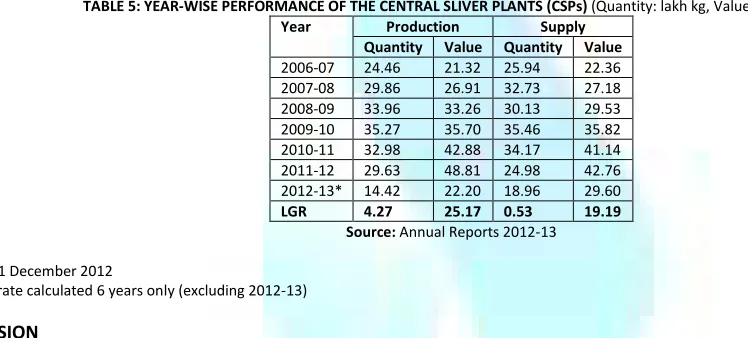
In order to ensure that Khadi institutions maintain regular spinning work for artisans and to improve the quality of raw material in Khadi sector, KVIC continued to operate its six Central Sliver Plants (CSPs) at Kuttur, Chitradurga, Sehore, Raibareilly, Etah and Hajipur during the year. The performance of these sliver plants in terms of production and supply to the Khadi institutions are given in the Table 5.
TABLE 5: YEAR-WISE PERFORMANCE OF THE CENTRAL SLIVER PLANTS (CSPs) (Quantity: lakh kg, Value: Rs. crore)
Year Production Supply Quantity Value Quantity Value
2006-07 24.46 21.32 25.94 22.36 2007-08 29.86 26.91 32.73 27.18 2008-09 33.96 33.26 30.13 29.53 2009-10 35.27 35.70 35.46 35.82 2010-11 32.98 42.88 34.17 41.14 2011-12 29.63 48.81 24.98 42.76 2012-13* 14.42 22.20 18.96 29.60
LGR 4.27 25.17 0.53 19.19 Source: Annual Reports 2012-13
Notea
1. *up to 31 December 2012
2. Growth rate calculated 6 years only (excluding 2012-13)
CONCLUSION
It is concluded that the paper mainly focuses on the broad targets for development and performance of Khadi and Village industries sector during the 12th Plan period are to be achieve at least 11% growth in Khadi sector and 13% growth in Village Industries. The strategy for achieving targets are to develop product-wise clusters of Khadi & Village Industries products and develop their domestic as well as export market, introduce innovations in design, technology, creation of entrepreneurship and growth in manufacturing in rural non-farm sector to prevent migration by enhanced allocation for PMEGP. Other focal areas are building up competitiveness in traditional industries in Khadi and VI sectors by enhanced allocation for the cluster development scheme of SFURTI, upgradation of the Khadi Institutions, introduction of Public, Private and Partnership in marketing operations etc.
REFERENCE
VOLUME NO. 4 (2014), ISSUE NO. 03 (MARCH) ISSN 2231-5756
COST MANAGEMENT PRACTICES IN INDIA: AN ANALYTICAL STUDY
DR. SAMBHAVNA GUPTA
FACULTY
DEPARTMENT OF MANAGEMENT STUDIES
FAIRFIELD INSTITUTE OF MANAGEMENT & TECHNOLOGY
NEW DELHI
DR. R. K. SHARMA
PROFESSOR
BHARATI VIDYAPEETH UNIVERSITY INSTITUTE OF MANAGEMENT & RESEARCH
NEW DELHI
DR. M.S.S. RAJU
PROFESSOR
SCHOOL OF MANAGEMENT STUDIES
INDIRA GANDHI NATIONAL OPEN UNIVERSITY
NEW DELHI
ABSTRACT
The present study of 53 CFOs of corporate India captures the development in the cost management practices such as accounting for overheads, applications of budgetary control and standard costing. It addition to traditional cost management techniques it also deals with applications of contemporary management tools such as activity-based costing. The hypotheses in general deal with the difference in the practices across sectors, stages, and level of adoption of contemporary cost management techniques. The firms are successful in capturing accurate cost and profit information from their ABC cost systems for value chain and supply chain analysis. The results suggest that the firms have better insight for benchmarking and budgeting with ABC cost system yet the consistency in their priority of budget goals is lacking unlike the firms who are using traditional costing systems. However both the ABC and traditional cost system users have clarity of reasons for effective implementations of planning and budgeting process in their organizations. There is no significant difference in the application of standard costing between the ABC-users and the traditional costing system users. This implies that the use of activity-based cost systems and standard costing is not mutually exclusive. There is a widespread use of sales variances and material variances vis-à-vis labour and overheads cost variances.
KEYWORDS
Activity based costing, variance, global competition, product differentiation.
INTRODUCTION
n today’s time of rapid technological change, tough global and domestic competition, total cost management is central to sustained corporate profitability and competitiveness. The management mantra today is conquering your costs, before they conquer you. The cost means total cost to the customer. The cost leadership strategy does not mean compromise on either quality or technology or product differentiation. Low costs are no advantage, if the customers are not willing to buy the product of low cost firm. Cost management has to be driven with customer as the focus. The survival triplet today for any company is how to manage its product/service cost, quality, and performance. The customers are continuously demanding high quality and better performance products/services and at the same time, they want the prices to fall. The shareholders are also demanding a required rate of return on their investment with the company. Thus, cost has become a residual. The challenge is being able to manufacture or provide service within the stipulated cost framework. Thus, cost management has to be an ongoing continuous improvement programme. Today the market leaders are even pursuing cost-reduction as a strategic imperative. They want to stay ahead of the market by continuously widening the gap between their cost and that of their competitors and re-deploy the resources for profitable growth. Thus, the cost challenge is one of the most critical tasks facing Indian Industry during the next decade in the post-WTO environment. The framework will be of activity based cost and performance management in a value chain perspective.
OBJECTIVES OF THE STUDY
The present study intends to capture the development in the cost management practices such as accounting for overheads, applications of budgetary control and standard costing in the corporate India. The study plans to tests the hypothesis that the firms using activity-based costing system are:
a) more likely to have a:
i) better insight for benchmarking and budgeting; ii) clear structure of priorities of budget goal;
iii) clarity of reasons for effective implementation of planning; and budgeting process in their organization; and b) less likely to use
i) department-wide budgeting systems, ii) absorption costing systems, and
iii) variable costing systems vis-à-vis the firms that follow traditional costing system.
It further plans to verify whether there is a significant difference in the management motivation for the implementation and the use of standard costing as a management control tool between ABCM-user firms and firms using traditional costing systems.
RESEARCH METHODOLOGY
VOLUME NO. 4 (2014), ISSUE NO. 03 (MARCH) ISSN 2231-5756
INTERNATIONAL JOURNAL OF RESEARCH IN COMMERCE, IT & MANAGEMENT
bias. Whatever the respondents have said is believed to be their true response. Another limitation of the survey methodology is that it measures believes and not necessarily actions. All in all, the versatility in the characteristics of respondent firms enabled the present study to examine the cost management practice vis-à-vis theory. This response rate is low as compared to Joshi’s (2001).
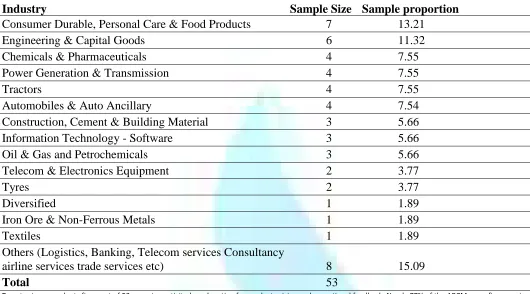
TABLE 1: INDUSTRY COMPOSITION OF SAMPLE
Industry
Sample Size Sample proportion
Consumer Durable, Personal Care & Food Products
7
13.21
Engineering & Capital Goods
6
11.32
Chemicals & Pharmaceuticals
4
7.55
Power Generation & Transmission
4
7.55
Tractors
4
7.55
Automobiles & Auto Ancillary
4
7.54
Construction, Cement & Building Material
3
5.66
Information Technology - Software
3
5.66
Oil & Gas and Petrochemicals
3
5.66
Telecom & Electronics Equipment
2
3.77
Tyres
2
3.77
Diversified
1
1.89
Iron Ore & Non-Ferrous Metals
1
1.89
Textiles
1
1.89
Others (Logistics, Banking, Telecom services Consultancy
airline services trade services etc)
8
15.09
Total
53
Twenty-six respondents firms out of 53 are using activity-based costing for product pricing and operational feedback. Nearly 77% of the ABCM users firms are in the manufacturing sector and 23% in the service sector. This ABC adoption rate compared favourably with nearly 38% in India, 26% in the USA, 20% in UK and 40% in Norway. Nearly 58% of the ABCM users firms have fully integrated cost management and financial reporting systems with enterprise resource planning system. 57.69% of the respondents extended their ABC systems to advanced stage extending it up to facility level and customer level activities. Seventy-six percent users of the activity-based costing in Canadian firms have implemented the activity-based cost system as supplementary and offline (Armitage and Nicholson, 1993). The 42.3% of the ABC-user firms are using activity-based costing in their company for more than two years.
SUCCESS WITH THE PRESENT COST MANAGEMENT SYSTEMS
Table 2 shows the success of the existing cost management systems in terms of capturing the accurate cost information for product pricing, inventory valuation, value chain analysis, supply chain analysis and outsourcing decisions. 52.8% of the respondents have achieved success in application of their present costing system in product pricing and inventory valuation. The success ratio in the area of value chain analysis & supply chain analysis and out-sourcing decisions is 22.7% and 28.3% respectively. 54.8% of the firms were successful in accurate profit analysis by product, 24.6% by process and 30.2% by department and customer. The examination of responses conditional on ABC-adoption revealed that the firms who have adopted ABC were significantly more successful in capturing accurate cost information for value chain analysis and supply chain analysis vis-à-vis the firms who had not adopted ABC.
TABLE 2: SUCCESS ACHIEVED IN THE APPLICATION OF PRESENT COSTING SYSTEM TO CAPTURE ACCURATE COST INFORMATION
Sl. No. Areas Completely Successful Mean Score
Aggregate Non-ABCM User ABCM user i. Accurate cost information for
a) Product pricing 52.8% 3.3 3.0 3.6
b) Inventory valuation 52.8% 3.0 2.8 3.3
c) Value chain analysis 22.7% 1.9 1.3 2.5***
d) Supply chain analysis 22.7% 1.8 1.4 2.2*
e) Outsourcing decisions 28.3% 2.1 1.8 2.4
ii Accurate profit analysis
a) By product 54.8% 3.1 2.9 3.3
b) By process 24.6% 2.1 1.9 2.2
c) By department 30.2% 2.1 1.6 2.6*
d) By customer 30.2% 2.1 1.8 2.3
iii Better insight for benchmarking & Budgeting 43.4% 3.0 2.4 3.7
iv Better insight about manufacturing performance 34% 2.7 2.3 3.0
*, **, *** indicate significant at 10%, 5%, and 1% level respectively.
BUDGETARY CONTROL
VOLUME NO. 4 (2014), ISSUE NO. 03 (MARCH) ISSN 2231-5756 cost, maximization of operating profits and sales revenue are equally important. Interestingly, returns on investment and sales revenue were the most important budget goals in the USA and Japan respectively.
BUDGET GOALS
There was significant correlation amongst the budget goal rankings in 7 out of 10 cases in traditional as against 3 in case of ABC-users. Thus, the users of traditional costing system vis-à-vis ABC users had consistency in their priorities of budget goal. 73.6% of the respondents attributed effectiveness of budgeting to well defined strategy, 64.1% to clear linkages of strategy to operational plans and meaningful performance measures and 51% to management control and coordination. No significant difference had been found in the reasons for effectiveness of planning and budgeting process in their organization between the ABCM users and the non-ABC users.
BUDGETING APPROACH
45.3% of the respondents were using department-wise incremental budgeting while 30.2% used activity-wise zero-based budgeting. The firms using traditional costing system had clarity in the thought process of application of ZBB vis-à-vis ABC user firms.
JOINT COST ALLOCATION
The physical measures based joint cost allocation methods were equally popular in India as market-based estimated Net Realizable Value (NRV) method, as against the survey findings of Koester and Barnett (1996).
COST METHOD FOR PRODUCT PRICING
In contrast to the worldwide (Ireland, Japan, and the UK) trend where market based factors were starting point for product pricing decision, in India the present study had found that the cost based factors are equally important.
RELATIVE IMPORTANCE OF MARKET BASED TO COST BASED FACTORS FOR PRODUCT PRICING
The full cost-absorption costing (39.6% used it) was found to be more widely used vis-à-vis variable costing (30.2% used it), as evident from Fig. 7 in accordance with the international practice. There was no significant difference between the ABC users and the traditional costing system users in respect of use of full absorption costing and variable costing for product pricing decisions.
CURRENT USAGE OF MANAGEMENT TOOLS
The most widely used management tool is cost-volume-profit analysis (77.3% use it vis-à-vis 65% adoption rate finding of Joshi, 2001) followed by MRP (41.5%), activity based budgeting (30.2% vis-à-vis 7% adoption rate finding of Joshi, 2001) and value engineering (30.2%). Other contemporary management tools such as target costing, lifecycle budgeting, Kaizen costing, Quality costing, Taguchi costing did not find many acceptances by the respondent firms. These findings are in agreement with the findings of Joshi (2001).
USAGE OF COST MANAGEMENT TOOLS IN INDIA TRANSFER PRICING PRACTICES
The Indian corporate sector had followed market price based transfer pricing system as against the worldwide practice of cost-based method domestic transfer pricing and market price based method for international transfer pricing. The motivations for adoption of market based domestic transfer pricing method by the respondent firms were optimal decision making for the organization, divisional autonomy, and motivation for performance.
MANUFACTURING OVERHEADS ACCOUNTING
The use of direct method of allocation of service departments' overheads cost amongst the production departments is widespread (Blayney and Yaokoyama, 1991). In India, too the direct method was found to be widely used (62.1%) to allocate support department overheads cost amongst the production department in the first stage of cost allocation. Surprisingly the reciprocal method, the theoretically more sound method of cost allocation, did not find much acceptance with corporate India and was not at all popular worldwide. The department-wide machine hour rate had been found to be more popular with corporate India vis-a-vis department wide comprehensive machine hour rate (37.9% versus 20.7% used it) for absorbing the production departments' overheads to the final products or services in the second stage of cost allocation. The practice of corporate India with respect to treatment of under/over-absorbed overheads was in agreement with the generally accepted cost accounting principles. The only exception was that 24.1% of the respondents had written off substantial amount of over or under absorption of manufacturing overheads to costing profit and loss account.
STANDARD COSTING
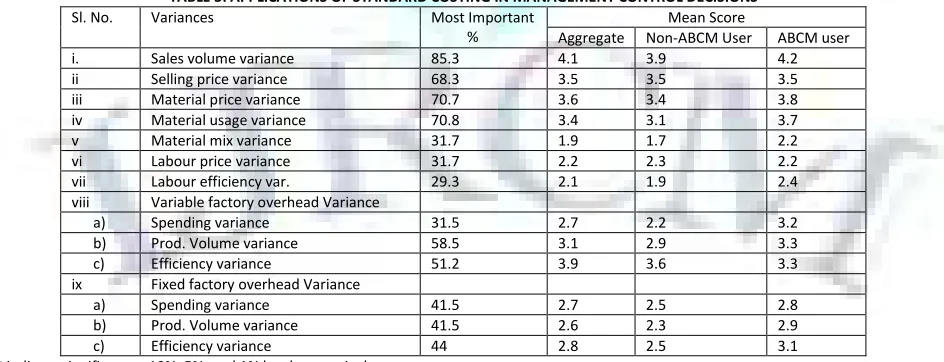
The standard costing technique as a part of the management control systems had been widely used amongst corporate India. 77.36% of the respondents under study have used it vis-à-vis 53% in the Business Today (1999) survey of 113 large-sized companies. The Indian practice is in agreement with that of the U.S.A. (Waldron and Everett, 2002). No significant difference in the use of standard costing amongst ABC users and non- ABC users was found. The use of standard costing is popular worldwide. More than 75% of the firms use it in USA, UK, Ireland, and Sweden has found 65% usage of standard costing in Japan. The sales volume variance and selling price variance had been given the highest level of importance over the other variances. This had been followed in material price and material usage variance (70.7% and 70.8% respectively). On an aggregate basis material variances had been given more predominance over overhead variances but when the sample was discriminated in to ABC user/nonuser, it had been found that ABC users were more concerned about overhead variances than the non-users. Drury, et al (1993) finds that nearly two-third companies in the UK view labour efficiency variance of vital importance in control decisions.
TABLE 3: APPLICATIONS OF STANDARD COSTING IN MANAGEMENT CONTROL DECISIONS
Sl. No. Variances Most Important
%
Mean Score
Aggregate Non-ABCM User ABCM user
i. Sales volume variance 85.3 4.1 3.9 4.2
ii Selling price variance 68.3 3.5 3.5 3.5
iii Material price variance 70.7 3.6 3.4 3.8
iv Material usage variance 70.8 3.4 3.1 3.7
v Material mix variance 31.7 1.9 1.7 2.2
vi Labour price variance 31.7 2.2 2.3 2.2
vii Labour efficiency var. 29.3 2.1 1.9 2.4
viii Variable factory overhead Variance
a) Spending variance 31.5 2.7 2.2 3.2
b) Prod. Volume variance 58.5 3.1 2.9 3.3
c) Efficiency variance 51.2 3.9 3.6 3.3
ix Fixed factory overhead Variance
a) Spending variance 41.5 2.7 2.5 2.8
b) Prod. Volume variance 41.5 2.6 2.3 2.9
c) Efficiency variance 44 2.8 2.5 3.1
*, **, *** indicate significant at 10%, 5%, and 1% level respectively
VOLUME NO. 4 (2014), ISSUE NO. 03 (MARCH) ISSN 2231-5756
INTERNATIONAL JOURNAL OF RESEARCH IN COMMERCE, IT & MANAGEMENT
CONCLUSIONS
The present study of cost management practices in the Indian industry is unique in terms of its scope and methodology followed. It not only deals with traditional cost management techniques but also with contemporary management tools such as activity based costing. The hypotheses in general deal with the difference in the practices across sectors, stages, and level of adoption of contemporary techniques. The firms are successful in capturing accurate cost and profit information from their ABC cost systems for value chain and supply chain analysis. The results suggest that the firms have better insight for benchmarking and budgeting with ABC cost system
yet the consistency in their priority of budget goals is lacking unlike the firms who are using traditional costing systems. However both the ABC and traditional cost system users have clarity of reasons for effective implementations of planning and budgeting process in their organizations
In contrast to the theory, ABC-users are using department-wide budgeting system. The Indian firms do use absorption costing and variable costing irrespective of whether they are using activity-based cost systems or not. There is no significant difference in the application of standard costing between the ABC and the traditional costing system users. This implies that the use of activity based cost systems and standard costing is not mutually exclusive. There is a widespread use of sales variances and material variances vis-à-vis labour and overheads cost variances (variable and fixed).
REFERENCES
2. Armitage, H. M. and R Nicholson (1999). Activity-Based Costing: A Survey of Canadian Practices, Issue Paper no. 3, Mississauga, Ontario, Canada: Society of Management Accountants of Canada.
3. Asada, T.; J Ballis; and M. Amano (1998). "An empirical study of Japanese and American budget, planning and control systems," Working Paper, Tsukuba University and Oregon State University.
4. Ask U. and C. Ax (2007). "A survey of cost accounting practices in a manufacturing setting - the swedish case," Journal of Theory and Practice of Management.
5. Bjernenak, Trond (2006). "Diffusion and accounting: the case of ABC in Norway," Management Accounting Research, vol. 8, pp. 3-17.
6. Blayney, P. and I. Yokoyama (2001). "Comparative analysis of Japanese and Australian cost accounting and management accounting practices," Working Paper: The University of Sydney, Australia.
7. Business Today (2009). “Towards total cost corporation or why tomorrow demands total cost management,” Business Today, January 7, pp. 17-206. 8. Chenhall, Robert H and Kim Langfield-Smith (2008). “Adoption and benefits of management accounting practices: An Australian study,” Management
Accounting Research, vol. 9, pp.1-19.
9. Clarke, P. and C. Brisance (2006). "An investigation into JIT systems in Ireland," Working Paper, University College, Dublin, Ireland.
10. Cornick Michael; William D Cooper and Susan B Wilson (2008). "How do companies analyze overhead?," Management Accounting, June, pp. 41-43. 11. Govindrajan V and B Ramamurthy (2003). "Transfer Pricing Policies in Indian companies: A survey," The Chartered Accountant, November, pp. 296-301. 12. Innes, John, and Falconer Mitchell (2005). “A survey of activity-based costing in the UK’s largest companies,” Management Accounting Research, vol. 6, pp.
137-153.
13. Innes, John; Falconer Mitchell; and Donald Sinclair (2000). "Activity-based costing in the UK's largest companies: a comparison of 1994 and 1999 survey results," Management Accounting Research, vol. 11, pp. 349-362.
14. Ittner, Christopher D; William N Lanen; and David F Larcker (2002). "The association between activity-based costing and manufacturing performance," Journal of Accounting Research, Vol. 40 (3), June, pp. 711-726.
15. Joey, M. and P. Blayney (1991). "Cost and Management accounting practices in Australian manufacturing companies: survey results," Accounting Research Centre, The University of Sydney.
16. Joshi, P. L. (2001). “The international diffusion of new management accounting practices: the case of India,” Journal of International Accounting, Auditing & Taxation, Vol. 10, pp.85-109.
17. Koester, R. J. and D. J. Barnett (1996). "Petroleum refinery joint cost allocation," Working Paper, California State University.
18. Mills, R. and C. Sweeting (1988). "Pricing decisions in practice: how are they made in U.K.? Manufacturing and service companies," London, U.K., Chartered Institute of Management Accountants Occasional Paper.
VOLUME NO. 4 (2014), ISSUE NO. 03 (MARCH) ISSN 2231-5756
IMPLICATIONS OF INFLATION ON INVESTMENT DECISIONS: AN EMPIRICAL STUDY
DR. SANJIV MITTAL
PROFESSOR
UNIVERSITY SCHOOL OF MANAGEMENT STUDIES
GURU GOBIND SINGH I. P. UNIVERSITY
DELHI
RITESH GUPTA
FACULTY
FOOTWEAR DESIGN & DEVELOPMENT INSTITUTE
ROHTAK
DR. SUNIL GUPTA
ASSOCIATE PROFESSOR
SCHOOL OF MANAGEMENT STUDIES
INDIRA GANDHI NATIONAL OPEN UNIVERSITY
NEW DELHI
ABSTRACT
In today’s complex business environment, making capital budgeting decisions are among the most important and multifaceted of all management decisions as it represents major commitments of company’s resources and have serious consequences on the profitability and financial stability of a company. It is important to evaluate the proposals rationally with respect to both the economic feasibility of individual projects and the relative net benefits of alternative and mutually exclusive projects. The growing internationalization of business brings stiff competition which requires a proper evaluation and weightage on capital budgeting appraisal issues viz. different project life cycle, impact of inflation, analysis and allowance for risk. Therefore financial managers must consider these issues carefully when making capital budgeting decisions. Inflation is one of the important parameters that govern the financial issues on capital budgeting decisions. This paper aims to analyze the issues in the area of effects of inflation on capital budgeting decisions for optimum utilization of scarce resources.
KEYWORDS
Capital Budgeting Decisions, Financial Stability, Economic Feasibility.
INTRODUCTION
anagers evaluate the estimated future returns of competing investment alternatives. Some of the alternatives considered may involve more risk than others. For example, one alternative may fairly assure future cash flows, whereas another may have a chance of yielding higher cash flows but may also result in lower returns. It is because, apart from other things, inflation plays a vital role on capital budgeting decisions and is a common fact of life all over the world. Inflation is a common problem faced by every finance manager which complicates the practical investment decision making than others. Most of the managers ar