1
Constantly Connected: What are the Biggest Challenges to Communication?
Connor Biddulph, Human and Health Sciences
Accepted date: 17th December 2018
Published date: 13th March 2019
Abstract
Social media (SM) are websites and applications which allow individuals to engage in social networking (Stevenson, 2010). This allows for friends and family to stay connected (Gemmill & Peterson, 2006), thus changing the dynamics of
communication between people. However, little has been documented on the effect SM use has had on face-to-face communication.
Six semi-structured interviews were conducted with university students to explore how the use of SM has changed face-to-face communication. Additionally, whether the Fear of Missing Out (FoMO) impacted on social interaction, and how university students’ understanding of this phenomenon was also explored.
2
research into the effect of FoMO on face-to-face communication and how SM use influences face-to-face communication skills would be beneficial.
Keywords
Constantly connected, face-to-face communication, fear of missing out (FoMO), permanently online (PO), permanently connected (PC), self-determination theory (SDT), social constructionism, social etiquette, social media, undergraduate students
Acknowledgements
3 Introduction
Social media (SM) are websites and mobile applications that allow users to engage in social networking; this can be through creating and sharing content as well as through communication (Stevenson, 2010). Forrester (2012) found that, in Europe, 79% of adults with internet access used SM. Now That SM use has been adapted for different devices, it is suggested that students value the connectedness with others that SM use brings (McMahon & Pospisil, 2005). SM plays an important role in staying in contact with friends and family (Gemmill & Peterson, 2006).
People are shown to use SM in public and in the company of other people (Wang, Ki & Kim, 2017), meaning that SM is merging into the daily lives of many, especially students. Despite this, there is a lack of research on how this communication
technology impacts upon face-to-face communication. The use of SM in face-to-face communication is known to exist, although most of the research data is quantitative (Abel, Buff & Burr, 2016; Vorderer, Krömer & Schneider, 2016). Thus, our
understanding of the meaning behind the act of using SM in face-to-face
communication is still limited (Ritchie et al., 2014). The fear of missing out also has a documented presence in SM use with students (Hetz, Dawson & Cullen, 2015).
Aims and objectives
The objective of this research was to explore how the use of SM and being
constantly connected to SM affects university students’ face-to-face communication. Specifically, the three aims were to:
4
2. Investigate whether Fear of Missing Out (FoMO) impacts on communication between students;
3. Investigate how students understand SM use and their own connectedness. Literature review
This critical literature review of current research examines the effects of SM and multitasking as well as how SM use is understood. It provides the context for this study with regards to examining the effect SM use has on university students. The concept of FoMO and how this affects university students’ face-to-face
communications is also discussed.
Effects of social media and multitasking
Media multitasking is not a concept that includes SM exclusively. It is described as ‘the simultaneous pursuit of two or more relatively independent tasks, with at least one of the tasks involving media’ (Xu, Wang & David, 2016. p. 242).
Pea et al. (2012) conducted an online survey of 3,461 North American girls aged 8– 12 to examine the relationship between social well-being and media use. These findings show that media multitasking led to negative socio-emotional outcomes; feelings of not being normal and having less social success. Media multitasking was also seen as a replacement for face-to-face communication, in that face-to-face communication was less likely to occur if someone was in the process of media multitasking. Whilst the study produced these findings, the use of an online survey brought a problem. Firstly, the attrition rates of an online survey were difficult to measure as the researcher did not have full control over who received the survey, or at least who embarked on it (McInroy, 2016). This could have been helped by
5 volunteer sample.
Similar findings were found in a study conducted by Xu, Wang and David (2016). The study examined media multitasking and the impact on university student's well-being via an online survey. The survey, mainly consisting of Likert Scale questions, was completed by 375 students in Beijing, China. The findings indicated that media multitasking had a negative effect on cognitive well-being, such as lower grade point average (GPA) and lower lecture performance. Furthermore, media multitasking during face-to-face social interactions lowered the degree of social success which negatively impacted on well-being. However, when chatting through text, email or SM, media multitasking did not affect well-being. Importantly, neither study examined SM use as a single entity. Instead they focused on media as a whole and, therefore, the extent to which SM influences these negative points is unknown.
Additionally, Vorderer et al. (2016) gathered a total of 178 German university students completed an online survey designed to explore the concept of being Permanently Online (PO) and Permanently Connected (PC) following the
technological advancement of mobile phones. Vorderer et al. (2016, p. 695) defined PO as ‘using online content (simultaneously to other activities)’ and PC as ‘engaging in online social interaction (simultaneously to other activities)’. SM was categorised within PC behaviours for this study.
6
emerged showed that students displayed behaviours of PC/PO frequently, although PC behaviours were shown to be more relevant to participants than PO behaviours. Furthermore, students were using smart phones to check SM often, especially at night and in social situations; such as when meeting with others or in university lectures. When discussing lost internet connection, participants expressed strong responses such as feeling ‘empty’, ‘old-fashioned’ or ‘like an organ is missing’ (Vorderer et al., 2016, p. 699).
How we understand social media use
Brooks (2015) examined the distracting nature of SM, as well as the negative effects that may become evident when measuring individual's technostress and happiness levels. Technostress is defined as a negative impact on oneself brought about by technology, this could relate to attitudes, thoughts, behaviours and physiological impacts (Weil & Rosen, 1997). Brooks (2015) study used a 15-minute lecture video which participants had to focus on and then answer questions later. Pre and post-task surveys were used to measure participants’ SM use during the activity in a sample of 209 American undergraduates. Brooks (2015) found that SM use during the study highlighted poor performance, whereas those who did not use SM
performed better across the board. Additionally, those who used SM more often had higher levels of technostress. Brooks (2015) also found that SM itself negatively affects happiness, which when considering that individuals are likely to use it often, even in social situations, is puzzling. Although a correlation is found, the question of why SM is used when it produces negative feelings is unanswered.
7
to explore the effect of SM use on students’ behaviour. It also examined whether self-confidence was linked to SM participation. A 51-item Likert scale questionnaire was given to 362 high school students in Cyprus to measure this. Participants ranked statements according to how true to them the statement was. Finding that nice Facebook comments increased a student’s confidence, although the reasoning for this finding is not specified. Traits of narcissism were found in the study through students sharing and liking their own SM content.
SM can also influence academic performance among university students. Lau (2017) surveyed 348 undergraduate students at a Hong Kong university to examine whether there were any distinctions between SM use for academic and non-academic
purposes. Lau (2017) found that SM use for academic purposes, such as asking for help and study groups, did not significantly predict academic performance. However, where non-academic use of SM was concerned, such as gaming and conversation, it negatively impacted on academic performance.
The Fear of Missing Out
8
provided a link between FoMO and social media engagement in that the higher an individual’s FoMO score, the higher their social media engagement is. The third study found that high levels of FoMO can indicate a heightened use of SM in other scenarios, this included checking SM during university lectures, as well as checking and writing text messages whilst driving. The third study also found an overall higher use of SM when performing and after performing activities during the day, if the participant showed high levels of FoMO.
Similar findings about FoMO and SM use are recorded in studies by Abel et al. (2016) and Alt (2017). Abel et al.’s (2016) study was designed to measure
inadequacy, irritability, anxiety and self-esteem in a survey made to measure FoMO in a sample of 202 college students. The research aims were to try and develop a measure of FoMO, whilst seeking to understand the differences in FoMO and socio-demographic characteristics. The results, which are useful regarding this research, confirmed that people with a higher level of FoMO were more likely to check SM in different situations, for example when the individual is in the company of others / with friends.
9
to language barriers and to seek assistance from friends, non-minority students experienced FoMO and therefore used SM in lectures. Thus, the presence of FoMO in SM use is documented by Abel et al. (2016) and Alt (2017). However, why a participant feels FoMO, especially when in the company of other people, cannot be determined. The reason someone would want to check SM when they are already in company is not expanded upon either. Consequently, there is a need for further qualitative exploration of SM use and face-to-face communication, hence the focus of the current study.
Methodology
This research project draws on aspects of social constructionism, as the aims highlight the need to explore the topic through an individual’s perspective. This theory focuses on the processes in which individuals jointly construct their
understandings of the world (Leeds-Hurwitz, 2009). Social constructionism is said to have evolved through a combination of different writers from locations such as North America and Britain, rather than from a single point in history (Burr, 2015). Gergen (1985) states that there are no objective observations of the world. No knowledge is taken for granted, and any knowledge which appears to be taken for granted should be examined critically. Further, the knowledge we gain from the world is historically and culturally specific and is constructed between people. As this project adopted a social constructionist position, a qualitative approach was used.
10
knowledge relating to the social world (Ritchie, Lewis, Nicholls and Ormston, 2014). Quantitative data on the other hand is often structured and therefore not suited for exploratory research. Additionally, qualitative research states that social processes and knowledge are outcomes of interactions between individuals rather than
something separate from people. This means qualitative research acknowledges that reality is shaped by subjective and cultural perspectives, as well as social interaction (Yardley, 2000).
Data collection
Sampling
Participants were recruited into the study using a mixture of sampling techniques: convenience sampling and snowball sampling. Overall, six university students were recruited and interviewed, three female and three male, and the participants’ age range was 19–24.
Semi-structured interviewing
Semi-structured interviews were used for data collection as they allow the researcher to pick up on any new themes and use prompts to explore them. This involved using open-ended questions about the research topic to give the interviewee an
opportunity to discuss the topic in depth.
11
that the data would be audio-recorded and then analysed later. At the end of the interview participants were briefed on their right to withdraw from the study. Data analysis
Thematic analysis (TA) is a method which allows for identifying, analysing and interpreting different patterns of meaning within qualitative data (Clarke & Braun, 2017). TA was used for this study as it allowed similarities and differences to be highlighted across the dataset.
Research ethics
Ethical approval to conduct this study was given by the Department of Behavioural and Social Sciences Ethics Committee, University of Huddersfield. This study also adhered to the British Psychological Society's Code of Ethics and Conduct (2009). Participants were given a participant information sheet which gave them an overview of the project and the interview process. They were also given sources of support if they needed it and information detailing their right to withdraw their data should they wish to do so. Participants were also informed about data anonymity, confidentiality and were given the contact details of the researcher and their supervisor.
12 Reflexivity
According to Berger (2015) there are three types of reflexivity. These are: the situation where a researcher has similar experiences to study participants, the instance where a researcher switches positions from being an outsider to being an insider, and the case where a researcher is not familiar with a research topic.
For this research, the first type of reflexivity was most applicable as the researcher is a university student, a user of SM, and had previous experience of people using SM in face-to-face communication. This had its advantages and disadvantages (Padgett, 2008). Being positioned as an insider allowed existing knowledge of the topic to be present. The downside, however, was that it could have influenced participants’ answers. Participants were, for example, more likely to leave out definitions of concepts that one would expect an insider to have knowledge of. To limit this effect, efforts were made throughout the research to encourage participants to explain phenomena which were already known to the researcher. Another potential issue that being an insider creates is that the researcher may impose their own beliefs and values on the research (Drake, 2010). To guard against this, the use of reminders and reflection in the form of a research diary were used. This allowed the researcher to be constantly aware of the possibility that their own values could impact on the research and helped limit this.
Findings and discussion
13 connected.
Impact on personal relationships
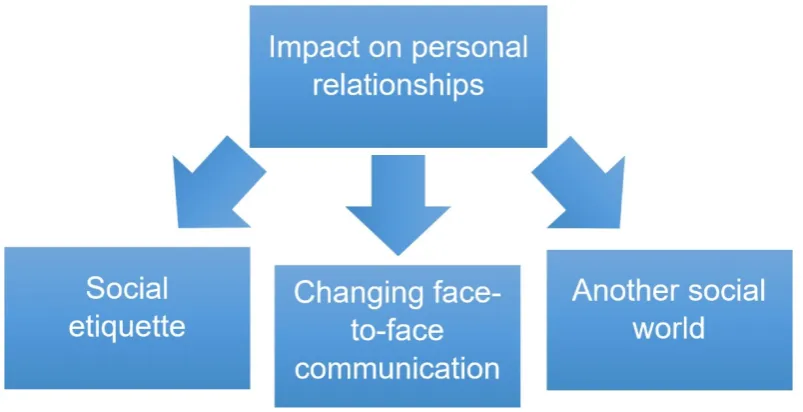
Participants were asked about their SM use when they were with other people. They were asked whether they used it in the company of other individuals, how they felt when someone used SM in front of them, and how they felt regarding other's SM use in general. This theme highlighted how participants detailed the presence of SM in their personal relationships, as well as how it affected their relationships with other individuals (See Figure 1).
Figure 1: Impact on personal relationships, theme one.
Social etiquette
14
All participants commented on when they felt it was acceptable or unacceptable to use SM when in the company of others. Three of the participants felt that using SM in the company of other people was rude. Feelings of isolation were also mentioned: ‘No-one is actually communicating and talking with you’ (P1).
Three participants stated that they felt left out when someone began to SM when talking to them, with one participant mentioning that they ‘can’t see what’s going on’ (P6).
Not only did the participants highlight what they felt when someone was using SM in their company, but four participants also discussed acceptability. Each of them suggested that if the situation is a casual meet up then it is okay but when the situation is part of a plan to be with that person, then it is unacceptable. The
inclusion of other people when using SM impacts on acceptability: ‘When you’re in the company of another person, I feel like that’s rude…unless you’re showing me something’ (P2).
It would appear from the findings presented here that SM does have an impact on face-to-face communications and it is not always positive. This also alludes to a social etiquette regarding SM use.
Changing face-to-face communication
This sub-theme highlights how SM can be used in face-to-face interaction, as well as how it could affect someone's communication skills. Four participants commented on the fact that they use SM together in conversations. Some stated that SM content is used as a topic of conversation, such as sharing images: ‘Every time someone’s posted a funny image, I show him it’ (P1).
15
my really close friends then I will probably show them’ (P2).
Participants felt that sometimes face-to-face communication is cut out all together in favour of SM. Three participants stated that they notice SM use can be detrimental to the quality of communication with others, one stating that they know of people who ‘can’t talk in a real-world setting because they’re so used to being able to, like, think out their messages’ (P5).
This could have implications in terms of SM use and whether too much substitution of face-to-face communication can affect someone's communication skills.
Conversely, most participants spoke about how they use SM as a tool for interacting with others; they share what they see on SM with the person they are with and talk about it. These findings support those of Vorderer et al. (2016) who found that participants were willing to use SM in the company of others and it varied according to how close the relationship between the individuals is. This could imply that SM can be used as a communication aide that enhances the interaction. This reveals the intricacies of how SM can be used when two people, or a group of people are
talking. It contradicts the research conducted by Xu et al. (2016) who stated that those who used social media in face-to-face interaction felt less social success.
Another social world
The act of using SM as a form of communication opens up a new social world to the individual. Communication through SM mentioned by participants ranged from checking up on others and seeking others’ attention, to communicating with people far away.
16
what they post on SM. Some said it makes them feel more connected to family, by having the ability to check up on them: ‘I wasn’t probably that linked to my relatives and to my friends as much as now where I can see all their news on Facebook’ (P3). The advantage of being able to communicate with people far away was mentioned favourably by four participants, one mentioning that ‘It does make you feel part of a bigger social network in a way? Because then people that, like, have gone miles away you’ll be able to talk to them’ (P5).
This is not the only way in which checking up on others is enacted. Three participants mention checking up on someone if they know they are doing something, with one participant claiming that people will share information online that they would not want others to know: ‘Most people tend to update mostly everyday…especially if people don’t want to share information, they seem to put it online anyways’ (P1).
Using SM to gain attention and living a parallel life was also mentioned, one participant indicating that an individual will ‘project a different image than the one they’ve already got and they’re trying to act like… a different person who’s got a better personality or like a better lifestyle than other people’ (P4).
Finally, the idea that nice comments on SM gives the individual a boost in mood was highlighted: ‘You get lots of likes, lots of comments, so it’s a bit nice int’it?’ (P2).
17
(Buffardi & Campbell, 2008). The link between SM use and narcissism has been examined before. A meta-analysis of 57 studies revealed that social networking behaviours of self-promotion and a large number of friends indicated narcissism (Gnambs & Appel, 2018). The self-promotion identified in this meta-analysis links to the findings of this current research which showed that participants recognised this behaviour is occurring.
Impact on daily life
The impact of SM use on daily life was the final theme to emerge from the data. This revealed how SM use is intertwined with daily life. The sub-themes are: part of everyday life and always connected (See Figure 2).
Figure 2: Impact on daily life, theme two.
Part of everyday life
18
SM is also used in daily routines. Often it can be used at bedtime to help the process of falling asleep.: ‘Yes, I do, I use it before I go to bed to be honest’ (P3).
The use of SM during lectures is also evident: ‘during boring lectures, is a common one’ (P5).
These findings show that participants use SM for entertainment purposes and to fill ‘dead’ time. Individuals using SM for entertainment purposes is not a new finding. Lau’s (2017) study found that some undergraduate students used SM to play games. Additionally, the use of SM in lectures has been documented: Vorderer et al. (2016) and Alt’s (2017) studies reported that students used SM in lectures.
Always connected
Participants recognised that they felt always connected to SM. They could reach out or be reached through SM most of the day, under normal circumstances. One way that participants felt they were always connected was through notifications.
Notifications were the main reason SM was checked, and participants would check SM as soon as they heard a notification: ‘If I’ve just got a notification I will go and check it straight away’ (P2).
The context of a situation, however, may influence whether the notifications are checked: ‘Most of the time I just ignore people who tend to ring me during lectures’ (P4).
19
saying that it feels as though SM has a hold over them: ‘I think it has some sort of gravity that brings you into it even if you don’t want to’ (P3).
Similarly, the hold can feel so strong that, when commenting on how it would be if they were denied access to social media, one participant noted that: ‘I don’t think it’d bother me. I’d be like oh thank god I can do something without my phone for once’ (P2).
However, it was also suggested that not having access to SM can be isolating and there is a need to reconnect: ‘I’ve tried deleting it a couple of times but…I felt very isolated’ (P1).
These findings show how participants noticed they were always connected to SM and how they felt when it was not accessible. Multiple studies have looked at mobile phone notifications including the study by Pielot, Church & de Oliveira (2014). They found that notifications were typically viewed within minutes of being received which appears to support the statements made by participants.
Similarly, the mention of feeling isolated without SM relates to the concept FoMO (Przybylski et al., 2013). FoMO itself is shown by a desire to stay connected with what others are doing. This clearly presents itself in the data, with missing out being mentioned as a concern.
FoMO has a theoretical link to Self-Determination Theory (SDT) in that the
20
individuals not meeting their needs of relatedness. Therefore, the act of checking up on others through SM is an act of meeting the basic need of relatedness. As stated, evidence of this is present in this study through the sub-theme ‘always connected’. Overall, this highlights how SM has allowed individuals to satisfy their psychological need for relatedness through remaining connected with others. It also helps explain the feelings of isolation shared by participants when they are disconnected from this medium.
Conclusion
The aim of this research was to explore how the use of SM and being constantly connected affects face-to-face communication amongst university students. There was a lack of qualitative research on this topic area hence the focus of this study. The current study found a social etiquette for SM use in face-to-face communication. Students understood their SM use in face-to-face communication as a set of
unwritten rules which must be followed. Breaking these, as discussed, resulted in the person being viewed as rude. Additionally, SM was found to influence face-to-face interactions in multiple ways. It either enhanced social interaction through being used as a tool for conversation, or traded face-to-face interaction in favour of being on SM. Use of SM in this way was noted to have an effect on face-to-face communication skills.
Limitations
21 Recommendations
Further research might include investigation on how use of SM can affect face-to-face communication skills. Traits of narcissism were also linked with posting on SM, which appeared to support the research reviewed in this study. FoMO was found to be present in SM use and was linked to SDT. Although FoMO was found to impact on communication, when it came to face-to-face communication the study did not find any evidence of this. Therefore, future research could focus on this aspect to determine whether FoMO affects students’ face-to-face communication.
Finally, another direction for future research could be to examine the general
population rather than university students exclusively. As this study was focused on undergraduate students, generalisations cannot be made to the wider society.
References
Abel, J, P., Buff, C, L., & Burr, S, A. (2016). Social Media and the Fear of Missing Out: Scale Development and Assessment. Journal of Business & Economics
Research (JBER), 14(1). 33–44. doi:10.19030/jber.v14i1.9554
Alt, D. (2015). College students’ academic motivation, media engagement and fear of missing out. Computers in Human Behavior, 49, 111–19. doi:
10.1016/j.chb.2015.02.057
Alt, D. (2017). Students’ social media engagement and fear of missing out (FoMO) in a diverse classroom. Journal of Computing in Higher Education, 29(2), 388–410. doi:10.1007/s12528-017-9149-x
Berger, R. (2015). Now I see it, now I don’t: Researcher’s position and reflexivity in qualitative research. Qualitative Research, 15(2), 219–34.
22
Brooks, S. (2015). Does personal social media usage affect efficiency and well-being? Computers in Human Behavior, 46, 26–37. doi.10.1016/j.chb.2014.12.053
Bryman, A. (2016). Social Research Methods (5th ed.). London: Oxford University Press.
Buffardi, L. E., & Campbell, W. K. (2008). Narcissism and social networking web sites. Personality and Social Psychology Bulletin, 34(10), 1303–14.
doi.10.1177/0146167208320061
Burr, V. (2015). Social constructionism (3rd ed.). London: Routledge. Clarke, V., & Braun, V. (2017). Thematic analysis. The Journal of Positive
Psychology, 12(3), 297–98. doi.10.1080/17439760.2016.1262613
Deci, E. L., & Ryan, R. M. (2008). Self-determination theory: A macrotheory of human motivation, development, and health. Canadian Psychology/Psychologie
Canadienne, 49(3), 182–85. doi.10.1037/a0012801
Drake, P. (2010). Grasping at methodological understanding: A cautionary tale from insider research. International Journal of Research & Method in Education, 33(1), 85–99. doi.10.1080/17437271003597592
Forrester. (2012). Global Social Technographics Update 2011: US And EU Mature, Emerging Markets Show Lots Of Activity. Retrieved from
23
Gemmill, E. L., & Peterson, M. (2006). Technology use among college students: Implications for student affairs professionals. NASPA Journal, 43(2), 482–502. doi:
10.2202/1949-6605.1640
Gergen, K. J. (1985). The social constructionist movement in modern psychology.
American Psychologist, 40(3), 266–75.doi.10.1037/0003-066X.40.3.266
Gnambs, T., & Appel, M. (2018). Narcissism and social networking behavior: A Meta‐Analysis. Journal of Personality, 86(2), 200–12. doi.10.1111/jopy.12305
Hetz, P. R., Dawson, C. L., & Cullen, T. A. (2015). Social media use and the fear of missing out (FoMO) while studying abroad. Journal of Research on Technology in
Education, 47(4), 259–72. doi.10.1080/15391523.2015.1080585
Kaya, T., & Bicen, H. (2016). The effects of social media on students’ behaviors; facebook as a case study. Computers in Human Behavior, 59, 374–79.
doi.10.1016/j.chb.2016.02.036
Lau, W. W. F. (2017). Effects of social media usage and social media multitasking on the academic performance of university students. Computers in Human Behavior,
68, 286–91. doi.10.1016/j.chb.2016.11.043
Leeds-Hurwitz, W. (2009). Social Construction of Reality. In S . W. Littlejohn & K . A. Foss (Eds.) Encyclopedia of Communication Theory (pp. 891-–94). Thousand Oaks, CA: SAGE.
Mauthner, M. (2002). Ethics in qualitative research. London: SAGE.
24
McMahon, M., & Pospisil, R. (2005). Laptops for a digital lifestyle: Millennial students and wireless mobile technologies. In Proceedings of the 22nd ASCILITE conference, 4–7 December 2005 (pp. 421–31). Retrieved from
http://citeseerx.ist.psu.edu/viewdoc/download?doi=10.1.1.504.9796&rep=rep1&type =pdf
Opdenakker, R. (2006). Advantages and Disadvantages of Four Interview
Techniques in Qualitative Research. Forum Qualitative Sozialforschung / Forum:
Qualitative Social Research, 7(4).doi. 10.17169/fqs-7.4.175
Oxford Dictionaries. (2018). etiquette. Retrieved from https://en.oxforddictionaries.com/definition/etiquette
Padgett, D. (2008). Qualitative methods in social work research (2nd ed.). London; Los Angeles, Calif: Sage Publications.
Pea, R., Nass, C., Meheula, L., Rance, M., Kumar, A., Bamford, H., Zhou, M. (2012). Media use, face-to-face communication, media multitasking, and social well-being among 8- to 12-year-old girls. Developmental Psychology, 48(2), 327–36.
doi.10.1037/a0027030
Pielot, M., Church, K., & de Oliveira, R. (2014). An in-situ study of mobile phone notifications. Paper presented at the 16th international conference on human-computer interaction with mobile devices & services. 233-242. doi:
10.1145/2628363.2628364 Przybylski, A. K., Murayama, K., DeHaan, C. R., & Gladwell, V. (2013). Motivational, emotional, and behavioral correlates of fear of missing out. Computers in Human Behavior, 29(4), 1841. doi:
25
Ritchie, J., Lewis, J., Nicholls, C.M. & Ormston, R. (2014). Qualitative research practice: A guide for social science students and researchers (2nd ed.). London: SAG
Stevenson, A. (2010). Social media. In Oxford Dictionary of English (3rd ed.). Oxford [England]; New York: Oxford University Press.
The British Psychological Society. (2009). Code of Ethics and Conduct. Retrieved from https://www.bps.org.uk/sites/bps.org.uk/files/Policy/Policy - Files/Code of Ethics and Conduct (2009).pd.
Vorderer, P., Krömer, N., & Schneider, F. M. (2016). Permanently online –
permanently connected: Explorations into university students’ use of social media and mobile smart devices. Computers in Human Behavior, 63, 694–703. doi:
10.1016/j.chb.2016.05.085
Wang, Y., Ki, E., & Kim, Y. (2017). Exploring the perceptual and behavioral
outcomes of public engagement on mobile phones and social media. International
Journal of Strategic Communication, 11(2), 133–47.
doi: 10.1080/1553118X.2017.1280497
Weil, M.M., Rosen, L.D. (1997) TechnoStress: Coping with Technology @Work
@Home @Play. Wiley: New York
Xu, S., Wang, Z. & David, P. (2016). Media multitasking and well-being of university students. Computers in Human Behavior, 55, 242–50.
doi: 10.1016/j.chb.2015.08.040