105
Journal of Studies in Learning and Teaching English Vol. 1, No. 2, (2012),105-136
Web-Based Writing Lessons in EFL Contexts:
Instruction on Coherent Writing
Seyyedeh Susan Marandi Associate Professor Department of Foregin Languages
Alzahra University Tehran,Iran
Abstract
In Iranian language learning contexts, writing in English is an important challenge for learners, since it is usually treated as a secondary skill and is led to the periphery of language classes, due to its time-consuming nature. Computer technology and namely the free online environments available in the World Wide Web (WWW) offer possibilities for moving beyond such confinements. Asynchronous discussion forums and web-based materials, for instance, can facilitate e-writing in addition to being motivational and engaging. Such environments can compensate for the time limitations which restrict language classes, and also offer equal learning opportunities to all learners. The present experimental research investigates how implementing technology i.e., web-based writing lessons can enhance the degree of coherence in participants’ English essays. The data consists of the results of the pre- and post-treatment TOEFL-like writing exams, which were scored according to the degree of coherence they demonstrated. The participants included forty female Iranian students studying English as a foreign language in a private institute in Tehran. They were randomly divided into comparison and experimental groups. The experimental group used an educational website entitled “Writing Snapshot: Received: September 2011 ; Accepted: January 2012
*Corresponding author
Fatemeh Nami* Ph.D. candidate in TEFL Department of Foregin Languages
Alzahra University Tehran, Iran
comparison group received a conventional book-based treatment.
The results revealed that the essays of the participants in the experimental group working with web-based lessons demonstrated a statistically significantly higher frequency and diversity of indicators of coherence. It would seem, therefore, that introducing new technologies into language classes can open new horizons for EFL writing practice.
Keywords: Web-based writing lessons, coherence, essay writing, Iranian EFL learners
1. Introduction
Over the past four decades, “research on L2 writing has grown exponentially” (Matsuda et al., 2003, p. 151). Writing as a productive skill for communicating ideas contributes to the communication skills and critical thinking (Etter & Merhout, 2007). Accordingly, attaining writing skill can be assumed to be “a pressing matter” (Nelson, 2006, p. 72). However, different reasons such as its time-consuming nature, classroom time limitations, and/or the difficulties teachers might encounter in teaching writing (Raimes, 2002) have usually led it to the margin of language classes or out-of-class assignments, which might not provide the learners with sufficient writing skills (Etter & Merhout, 2007). This situation becomes specifically significant for Foreign Language (FL) learners, whose restricted knowledge of the foreign language forms might prohibit them from organizing their opinions on a topic in a coherent piece of writing (Richards & Renandya, 2002). In fact, it has been claimed that one of the most challenging issues in learners’ writings is that they very often lack coherence (Reinhardt, 1980).
106
Web-Based Writing Lessons in EFL Contexts: ...
107
S. S. Marandi and F. Nami
(Godwin-Jones, 2000, p. 12). Computers can be applied for teaching and practicing writing in a variety of ways ranging from the mere use of word processors to the applications of web-based lessons and a/synchronous writing environments such as wikis. These provide the opportunity for leading the students to “generate more writing and better quality writing” (Patterson, 2006, p. 65) since “there are a number of…differences in the learning opportunities and benefits that the Web can provide” (Sengupta, 2001 p. 106). As an instance, in addition to providing equal space for asynchronous writing (Rajasingham, 2007), such environments might make learners more interested in its practice by being motivational and engaging. Parallel to these, a flexible degree of availability beyond that of classroom context allows learners and teachers to allocate unlimited time to the practice of writing (Etter & Merhout, 2007). That is, pupils have the opportunity of developing their writing skills outside the classroom via collaborating with other pupils and even native speakers a/synchronously (Kreeft Peyton, 1999; Rajasingham, 2007). This might be attributed to the fact that “computer-mediated communication…enhances understanding of writing as a social and collaborative act as it promotes awareness of the act of communication and helps develop a sense of audience in writing” (Kasper 1999, p. 2).
material to the focus of their instruction e.g., writing with coherence in this experiment. Consequently, we designed a website for EFL learners with a special attention being dedicated to the introduction of the concept of coherence and the possible requirements for demonstrating it in writing. In addition, in order to compare the possible effect of the mode of instruction on learners’ abilities to write coherently we also made comparison with the conventional book-based treatment. In what follows we will explain the overall structure and design of the web-based lessons applied in this research.
1.1 Web-based writing
108
Web-Based Writing Lessons in EFL Contexts: ...
109
S. S. Marandi and F. Nami
the hyperlinks. The bulk of online content and sample writings linked to the lesson-pages provided the students with a pool of web-based resources which could be applied for solving the problems posed during classroom discussions or the learning process through collaborative and critical group work. The teacher was to act as a consultant and facilitator for enhancing the “collaboration and cooperation among students” (Weller, 2007, p. 21). In addition to hyperlinks, the lessons also contained a number of questions regarding different aspects of essay writing such as basic paragraph structure and punctuation patterns which required the participants to search the links for coming up with possible responses. Besides presenting a problem-based design, the web-problem-based lessons developed for the current study also paid special attention to peer learning since the students were required to comment on each others’ work and share their understanding.
1.2 Coherence in writing
relevance as the three required linguistic devices for achieving coherence. Following Reinhardt’s (1980) framework and definition, Ehrlich (1990) clarifies these devices like the following
These conditions of coherence are also emphasized by other scholars (Bailey & Powell, 1988; Givon, 1995; Greetham, 2001; Gee, 2006). For instance, Brown and Yule (1983) highlight the role of connectedness in achieving coherence. Bailey and Powell (1988) and Greetham (2001) have focused on the relevance of the sentences and the paragraphs to one main idea (i.e., the overall topic of the essay), which according to White (1997) is especially crucial for essays: “if you are writing a persuasive essay, offering… persuasive arguments to your readers, make sure that all the sentences that relate to one particular argument go together” (p. 174). In addition, the sentences and clauses in the writing need to be consistent with one another (Reinhart, 1980). Such consistency can be signaled via relative clause markers like that, who, and which (Bailey & Powell, 1988).
In this study connectedness was analyzed on the basis of the frequency of the transition words (e.g., on one hand, finally, and the like), which can connect the sentences and paragraphs semantically (Bailey & Powell, 1988; Stolley, 2006). For investigating consistency, the frequency of relative clause markers (i.e., where, which, that, who/m, when, and in
110
Web-Based Writing Lessons in EFL Contexts: ...
111
S. S. Marandi and F. Nami
and thus signal the writing as a coherent piece (Johnstone, 2008). Finally, the relevance of the essays to the overall topic was investigated in the first 13 sentences of each essay, since the essays did not contain the same number of sentences.
2. Research Question
The question addressed in the present experiment was as follows:
• Does the use of web-based writing lessons have any influence on the coherence of EFL learners’ essays, compared to a conventional book-based writing classroom?
Borrowing the definition of coherence from Reinhart (1980), three sub-questions were also posed for the analysis of this question:
• Does the use of web-based writing lessons have any influence on connectedness in EFL learners’ essays, compared to a conventional book-based writing classroom?
• Does the use of web-based writing lessons have any influence on consistency in EFL learners’ essays, compared to a conventional book-based writing classroom?
• Does the use of web-based writing lessons have any influence on relevance in EFL learners’ essays, compared to a conventional book-based writing classroom?
3. Methodology
3.1 Participants
north-east of Tehran participated in this experiment. The basis for establishing the homogeneity of their writing skills was a sample TOEFL writing proficiency exam administered to the volunteers who enrolled in the writing class, which was not a part of the institute’s regular educational schedule. From among the 47 students who took the exam, 40 were selected and divided randomly into two groups of 20 on the basis of the exam results. This included all of the pupils with scores between one standard deviation (sd = 1.0013, rounded to 1.00) below and above the mean of 2.447 (rounded to 2.5), or a range score between 1.5 and 3.5 out of 6. The participants were randomly divided into comparison and experimental groups and assigned to two different treatment conditions. The first group received the book-based treatment and the other group was assigned to the web-assisted treatment. The rationale for including such a broad standard deviation range in our study was the fact that we were looking for the writings with poor or disorganized structure which indicate limited or lack of coherence according to the scoring scale of essays we applied for the scoring process (Sharpe, 2005). The essays which score below 4 according to this scale are either
• disorganized or inadequately organized since • partially address the topic or do not address it at all • do not contain detail and examples
• present numerous grammatical and vocabulary errors which obscure the meaning or make it incommunicable
All of these are indicators of problems with regard to coherence.
3.2 Instrument
112
Web-Based Writing Lessons in EFL Contexts: ...
113
S. S. Marandi and F. Nami
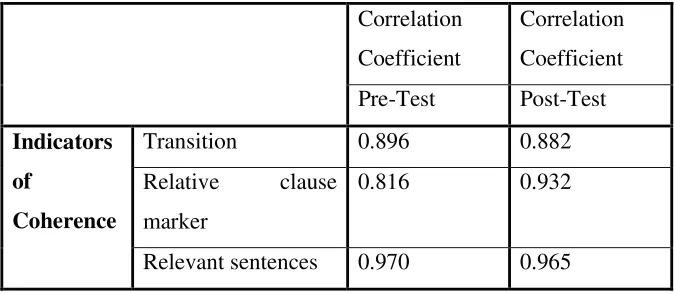
post-treatment writing exams were analyzed with regard to the frequency of each of the indicators of coherence (i.e., transition words, relative pronouns, and relevant sentences). The topics of the essays were taken from Sharpe (2005). The teacher read the essays written in both classes and identified different transition words (indicators of connectedness), relative clause markers (indicators of consistency), and the relevant sentences and counted their frequency. In order to estimate the intra-rater consistency of the ratings, the essays were rated twice with the second rating took place one month after the first. The intra-rater correlation coefficient was calculated (Table 1). The reliability estimate range of 0.819 to 0.970 for the pre-test and 0.882 to 0.965 for the post-test demonstrated a high correlation (Hatch & Farhady, 1982; Bachman, 1990) between the two sets of ratings.
Table 1. Correlation coefficients for the intra-rater consistency in the pre-and post-test
3.3 Materials
3.3.1 The experimental group:
A website entitled Writing Snapshot: Web-Based Writing Lessons for EFL Learners available on the Internet at http://writingsnapshot.tripod.com/ 112
Web-Based Writing Lessons in EFL Contexts: ...
113
S. S. Marandi and F. Nami
post-treatment writing exams were analyzed with regard to the frequency of each of the indicators of coherence (i.e., transition words, relative pronouns, and relevant sentences). The topics of the essays were taken from Sharpe (2005). The teacher read the essays written in both classes and identified different transition words (indicators of connectedness), relative clause markers (indicators of consistency), and the relevant sentences and counted their frequency. In order to estimate the intra-rater consistency of the ratings, the essays were rated twice with the second rating took place one month after the first. The intra-rater correlation coefficient was calculated (Table 1). The reliability estimate range of 0.819 to 0.970 for the pre-test and 0.882 to 0.965 for the post-test demonstrated a high correlation (Hatch & Farhady, 1982; Bachman, 1990) between the two sets of ratings.
Table 1. Correlation coefficients for the intra-rater consistency in the pre-and post-test
3.3 Materials
3.3.1 The experimental group:
A website entitled Writing Snapshot: Web-Based Writing Lessons for EFL Learners available on the Internet at http://writingsnapshot.tripod.com/ 112
Web-Based Writing Lessons in EFL Contexts: ...
113
S. S. Marandi and F. Nami 3.2. Instrument
To address the research question and sub-research questions, the pre- and post-treatment writing exams were analyzed with regard to the frequency of each of the indicators of coherence (i.e., transition words, relative pronouns, and relevant sentences). The topics of the essays were taken from Sharpe (2005). The teacher read the essays written in both classes and identified different transition words (indicators of connectedness), relative clause markers (indicators of consistency), and the relevant sentences and counted their frequency. In order to estimate the intra-rater consistency of the ratings, the essays were rated twice with the second rating took place one month after the first. The intra-rater correlation coefficient was calculated (Table 1). The reliability estimate range of 0.819 to 0.970 for the pre-test and 0.882 to 0.965 for the post-test demonstrated a high correlation (Hatch & Farhady, 1982; Bachman, 1990) between the two sets of ratings.
Table 1. Correlation coefficients for the intra-rater consistency in the pre-and post-test
3.3. Materials
3.3.1. The experimental group:
was designed and developed by the teacher for the experimental group’s use. It consisted of different webpages; e.g. home, introduction, lessons, and teacher’s page. The content and design of the main parts in each lesson were as follow:
• Pre-voyage task: The first section in each lesson introduced the basic
• Wizzy-wuzzy text voyage: This section focused on coherence;
• Your writing task: The last section of the lessons provided the topic about which the participants were asked to write an essay and hand it in the following session.
concepts in essay writing including: a) the pre-requisites for starting writing, b) single- and multi-paragraph structures, c) transitions, and d) punctuation devices. After a brief introduction to the lesson’s discussion point, one or more questions were posed for the pupils to discuss. Next, the learners were to click on the links and compare their answers with the information on the webpages.
114
Web-Based Writing Lessons in EFL Contexts: ...
115
S. S. Marandi and F. Nami
In order to deal with the possible problem of local area disconnection, which could impede access to the Internet and the website and thus the class work of the experimental group, a particular backup software from Fire Fox (version 2009) was downloaded and used. This software enabled the researcher to download the whole website together with its hyperlinks in a way that all the links were active when there was no connection to the Internet.
The participants also had the chance to exchange their ideas, pose questions, and receive feedback from their peers and the teacher through asynchronous on a wiki environment which was designed for this purpose. This way, they had the opportunity to keep their contact with peers and the teacher beyond the confines of actual language classroom. For this purpose, the teacher provided them with the shared ID and password required for entering the wiki and they were informed that they can discuss anything related to writing in classroom wiki.
3.3.2 The comparison group:
The participants in the book-based class worked with The Practical Writer with Readings by Bailey and Powell (1988). The rationale behind incorporating this book as the basic material of the comparison group can be classified as following:
1. Having a fluid language for the Intermediate and Upper-Intermediate students participating in the study;
2. Containing two separate units that dealt exclusively with the concept of coherence with explanations more or less the same as those of the web-based lessons;
3. Including detailed discussion of punctuation in section three of the book, which was also emphasized in the online class material;
oppor-5. Allocating two parts in section two to a detailed discussion of basic paragraph structure and five paragraph essays similar to that of the pre-voyage task in the web-based class.
Considering these factors, the book demonstrated a format very close to that of the web-based lessons.
3.4 Procedure
The current study took place throughout 17 sessions from September 6th to November 5th (Shahrivar 16th to Aban 15th) in the book-based class and from September 7th to November 2nd, 2009 (Shahrivar 17th to Aban 12th) in the CALL-based class. The participants in the comparison group were taught through an essay writing book, mentioned-above. In both groups, each pupil was expected to hand in 14 essays (8 single- and 6 multi-paragraph essays) by the end of the course. Each of these essays was read and commented on twice: once by one of their peers and after that by the teacher. The participants were informed that their comments could address different aspects of their peers’ essays such as their overall structure, or the concept of coherence. The procedure for both groups in each session was set up as the following:
• Reviewing the points introduced and discussed in the previous sessions;
• Introducing concepts about basic paragraph structure;
116
Web-Based Writing Lessons in EFL Contexts: ...
117
S. S. Marandi and F. Nami
• Distributing students’ essays among their peers in order to receive comments on them.
parallel to each other, the teacher had the opportunity to introduce/discuss any new point that arose in either of the classes for the other group as well, in order to ensure that the participants in both groups were provided with the same information.
3.5 Research design
The approach applied in this study roughly matches the tradition of quantitative true experimental research with a pretest posttest control group design (Hatch & Farhady, 1982), to the extent that it demonstrated three main characteristics: 1) a comparison group, 2) the random selection of the participants, and 3) the application of a pre-test (administered for homogenizing purposes) and a post-test writing exam administered at the end of the course. The purpose was to analyze the effect of web-based lessons as the independent variable on the coherence of the participants’ essays as the dependent variable.
4. Results
4.1 Presentation and analysis of data
118
Web-Based Writing Lessons in EFL Contexts: ...
119
S. S. Marandi and F. Nami
words both had expected frequencies less than five. Hence, the two cells we combined resulting in a cell which offered the frequency of essays with 5 to 6 transitions. All of the results were carried out at the level of significance of p<0.05, two-tailed.
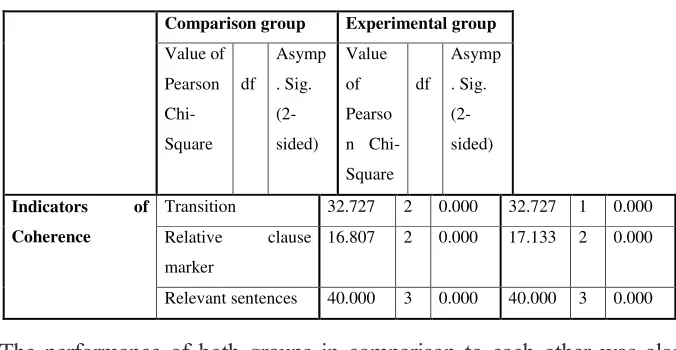
The frequency of each of the indicators of coherence in the pre- and post-treatment writing exams for each group was counted, and Chi-Square analyses were performed in order to analyze the effectiveness of treatments (Table 2). It was revealed that significant differences existed between the frequencies of the indicators used in the pre-test with those applied in the post-test of both groups. In other words, the treatments in both groups could be regarded as effective in increasing the frequency of each of the cohesive devices and indicators of coherence in students’ essays.
Table 2. Chi-square test results for indicators of coherence in each group’s pre- and post-test results
The performance of both groups in comparison to each other was also investigated the results of which will be discussed below in separate sections for the three indicators of coherence.
118
Web-Based Writing Lessons in EFL Contexts: ...
119
S. S. Marandi and F. Nami
words both had expected frequencies less than five. Hence, the two cells we combined resulting in a cell which offered the frequency of essays with 5 to 6 transitions. All of the results were carried out at the level of significance of p<0.05, two-tailed.
The frequency of each of the indicators of coherence in the pre- and post-treatment writing exams for each group was counted, and Chi-Square analyses were performed in order to analyze the effectiveness of treatments (Table 2). It was revealed that significant differences existed between the frequencies of the indicators used in the pre-test with those applied in the post-test of both groups. In other words, the treatments in both groups could be regarded as effective in increasing the frequency of each of the cohesive devices and indicators of coherence in students’ essays.
Table 2. Chi-square test results for indicators of coherence in each group’s pre- and post-test results
The performance of both groups in comparison to each other was also investigated the results of which will be discussed below in separate sections for the three indicators of coherence.
118
Web-Based Writing Lessons in EFL Contexts: ...
119
S. S. Marandi and F. Nami
words both had expected frequencies less than five. Hence, the two cells we combined resulting in a cell which offered the frequency of essays with 5 to 6 transitions. All of the results were carried out at the level of significance of p<0.05, two-tailed.
The frequency of each of the indicators of coherence in the pre- and post-treatment writing exams for each group was counted, and Chi-Square analyses were performed in order to analyze the effectiveness of treatments (Table 2). It was revealed that significant differences existed between the frequencies of the indicators used in the pre-test with those applied in the post-test of both groups. In other words, the treatments in both groups could be regarded as effective in increasing the frequency of each of the cohesive devices and indicators of coherence in students’ essays.
Table 2. Chi-square test results for indicators of coherence in each group’s pre- and post-test results
The performance of both groups in comparison to each other was also investigated the results of which will be discussed below in separate sections for the three indicators of coherence.
Web-Based Writing Lessons in EFL Contexts: ... S. S. Marandi and F. Nami
4.2 Connectedness
As mentioned earlier “the clauses of a text should be formally connected, in that each adjacent pair is… linked by a semantic connector” (Canford & Moxey, 1995, p. 162). These semantic connectors compromise one of the three qualities required for achieving coherence in Reinhardt’s (1980) model. For investigating sentence connectedness the frequency of transition words was analyzed (Bailey & Powell, 1988; Stolley, 2006). These words signal
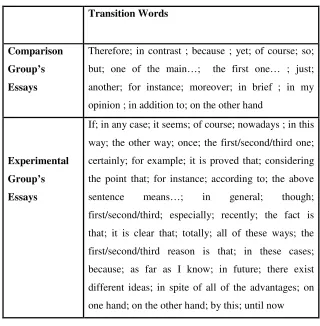
Table 5.The transition words found in experimental and comparison groups’ post-tests
Web-Based Writing Lessons in EFL Contexts: ... S. S. Marandi and F. Nami
4.2 Connectedness
As mentioned earlier “the clauses of a text should be formally connected, in that each adjacent pair is… linked by a semantic connector” (Canford & Moxey, 1995, p. 162). These semantic connectors compromise one of the three qualities required for achieving coherence in Reinhardt’s (1980) model. For investigating sentence connectedness the frequency of transition words was analyzed (Bailey & Powell, 1988; Stolley, 2006). These words signal
Table 5.The transition words found in experimental and comparison groups’ post-tests
Web-Based Writing Lessons in EFL Contexts: ... S. S. Marandi and F. Nami
4.2. Connectedness
As mentioned earlier “the clauses of a text should be formally connected, in that each adjacent pair is… linked by a semantic connector” (Canford & Moxey, 1995, p. 162). These semantic connectors compromise one of the three qualities required for achieving coherence in Reinhardt’s (1980) model. For investigating sentence connectedness the frequency of transition words was analyzed (Bailey & Powell, 1988; Stolley, 2006). These words signal
Table 5.The transition words found in experimental and comparison groups’ post-tests �������
����������� ���
����������
����������� ������� �� ������ ������� �� ������
��������� �������
��������
������� �� ������ ������� �� ������
�������������������� ������� �� ������ ������� �� ������
������������������������������������������������������������������������������������������������
���������������������������������������������������������������������������������������������
�������������������
������������������������������������������������������������������������������������������������
����� ���� ������� ��� �� ��������� ����������� ��������� �� ������� ������ ��� ������ � ������ ���������
����������� ����������� ���� ��� ���� ������ ���������� ��������� ���� ���������� ���������� ���
�����������������������������������������������������������������������������������������������
�������������������������������������������������������������������������������
�����������������������������������������������������������������������������������������������
����������������
�����������
��������
�������
����������� ��� ��������� �� �������� �� ����� ��� �������� ����
����� ���� ��� ���� ������� � ���� ������ ����� �� ������
��������� ���� ���������� ���������� ��� ������ �� ��� ���
����������������������������������������������
�������������
��������
�������
���������������������������������������������������������
����� ���� ������ ����� ������ ���� ������������������� �����
����������� ���� ��������� ��� ��� ������� ������ ������������
���� ������ ������ ���� ���������� ���������� ���� ���� ������
��������� �������� ��� ��������� ��������
�������������������� ������������ ���������� ���� ����� ���
������ ��� ��� ������ ������ ��������� ���� ��� ������ ������ ����
������������������� ������� ��� ������ ��� ������ �������
��������� ��� ���� ��� �� ������ ��� �������� ������ ������
���������� ������� ��� ������ ��� ���� ��� ���� ������������ ���
120
Web-Based Writing Lessons in EFL Contexts: ...
121
S. S. Marandi and F. Nami
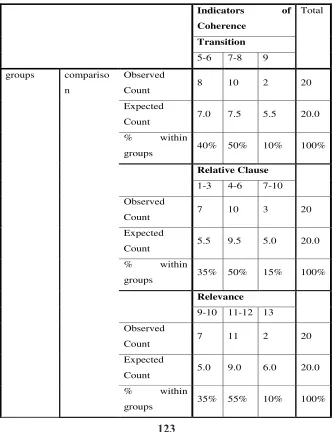
not only inter-sentential but also inter-paragraph connectedness, both of which are addressed in Reinhart’s (1980) model. The analysis of the transitions used in the essays (Table 3) revealed that 45% of the experimental group’s essays contained 9 transition words, which was significant according to the Chi-Square results at the p<0.05 ( =6.407, df =2, Table 4); i.e., there existed a significant difference between the groups regarding the frequency of transition words. A further analysis of the transition words used in students’ essays revealed that besides being significantly higher in number, the transition words used by the participants in the web-assisted class appeared to be more diverse (Table 5).
Accordingly, it can be claimed that the application of the web-based writing lessons had influenced the connectedness of the sentences and paragraphs by enhancing the number and diversity of the transition words used in the essays. As a result, the first sub-null hypothesis investigating the possible influence of web-based writing lessons on connectedness of sentences in students’ essays in comparison to a conventional book-based class was not confirmed.
4.3 Consistency
In addition to connectedness, the sentences in a written piece must appear in a consistent sequence ordered coherently one after another (Ehrlich, 1990). This second quality of coherence, which Reinhardt (1980) calls consistency, can be achieved through the use of relative clause markers (Johnstone, 2008). The frequency of relative clause markers was accordingly accounted in both groups’ post-test essays. The Chi-Square test results and the obtained percentages (Tables 3 & 4) indicated that there was no significant difference between the two groups with regard to the use of relative clauses in the essays since at p>0.05 and df of 2 the obtained 120
Web-Based Writing Lessons in EFL Contexts: ...
121
S. S. Marandi and F. Nami
4.2 Connectedness
As mentioned earlier “the clauses of a text should be formally connected, in that each adjacent pair is… linked by a semantic connector” (Canford & Moxey, 1995, p. 162). These semantic connectors compromise one of the three qualities required for achieving coherence in Reinhardt’s (1980) model. For investigating sentence connectedness the frequency of transition words was analyzed (Bailey & Powell, 1988; Stolley, 2006). These words signal
Table 5.The transition words found in experimental and comparison groups’ post-tests
120
Web-Based Writing Lessons in EFL Contexts: ...
121
S. S. Marandi and F. Nami
4.2. Connectedness
As mentioned earlier “the clauses of a text should be formally connected, in that each adjacent pair is… linked by a semantic connector” (Canford & Moxey, 1995, p. 162). These semantic connectors compromise one of the three qualities required for achieving coherence in Reinhardt’s (1980) model. For investigating sentence connectedness the frequency of transition words was analyzed (Bailey & Powell, 1988; Stolley, 2006). These words signal
Table 5.The transition words found in experimental and comparison groups’ post-tests
122 123 Chi-Square was 2.471. This implied that the second sub-null hypothesis
was not rejected.
Using relative clause markers present the ability to produce complex clauses and the obtained results revealed that the application of the web-based lessons did not enhanced the ability of the CALL-web-based group in comparison to their counterparts.
4.4 Relevant sentences
To investigate how many sentences were relevant to the essay topics, all of the writings needed to be of the same length. Such a thing usually does not happen, but on counting sentences in each essay it was seen that all of them contained at least 13 sentences. Accordingly, the relevance of the first thirteen sentences in each essay was investigated. Throughout the analysis it became apparent that the number of relevant sentences in both groups demonstrated a considerable increase in a way that we did not find any essay with more than four irrelevant sentences in the final exam. We classified the essays into three main groups regarding the number of relevant sentences: 9-10, 11-12, and 13. We also combined the two nearby cells in order to avoid cells with expected frequency counts less than five. On the basis of the results (Table 3), in the majority of comparison group essays (55%) 11 to 12 sentences out of the first 13 ones were relevant to the overall topic. Regarding the experimental group however the last cell, which stood for the essays with 13 relevant sentences, allocated the majority (50%) or half of the population in that group to itself; a quality which was seen in only 10% of our book-based i.e., only in two essays. Chi-Square results (Table 9) indicated that such a pattern was significant at p<0.05 ( =7.822, df =2). Before drawing any conclusions a further analysis was conducted. Since the experimental group essays were to a bit longer than
122 123
their counterparts, the relevance of those sentences which were not counted in the analysis was also investigated. It was seen that none of them
Table 3.Observed and expected frequencies of the three indicators of coherence in both groups’ post-tests
122
Web-Based Writing Lessons in EFL Contexts: ...
123
S. S. Marandi and F. Nami
their counterparts, the relevance of those sentences which were not counted in the analysis was also investigated. It was seen that none of them
Table 3. Observed and expected frequencies of the three indicators of coherence in both groups’ post-tests
122
Web-Based Writing Lessons in EFL Contexts: ...
123
S. S. Marandi and F. Nami
their counterparts, the relevance of those sentences which were not counted in the analysis was also investigated. It was seen that none of them
Table 3. Observed and expected frequencies of the three indicators of coherence in both groups’ post-tests
122
Web-Based Writing Lessons in EFL Contexts: ...
123
S. S. Marandi and F. Nami
their counterparts, the relevance of those sentences which were not counted in the analysis was also investigated. It was seen that none of them
Table 3.Observed and expected frequencies of the three indicators of coherence in both groups’ post-tests
122
Web-Based Writing Lessons in EFL Contexts: ...
123
S. S. Marandi and F. Nami
their counterparts, the relevance of those sentences which were not counted in the analysis was also investigated. It was seen that none of them
Table 3. Observed and expected frequencies of the three indicators of coherence in both groups’ post-tests
����������� ���
����������
�����
�����������
���� ���� ��
������� ���������
��
���������
������ �� ��� �� ���
���������
������ ���� ���� ���� �����
�� �������
������� ���� ���� ���� ����
����������������
���� ���� �����
���������
������ �� ��� �� ���
���������
������ ���� ���� ���� �����
�� �������
������� ���� ���� ���� ����
����������
����� ����� ���
���������
������ �� ��� �� ���
���������
������ ���� ���� ���� �����
�� �������
124
Web-Based Writing Lessons in EFL Contexts: ...
125
S. S. Marandi and F. Nami
124
Web-Based Writing Lessons in EFL Contexts: ...
125
S. S. Marandi and F. Nami
Table 4. Chi-Square test results for the indicators of coherence in post-test
*(a) 0 cells (.0%) have expected count less than 5. The minimum expected count for transition is 5.50, for relative clause and relevance is 5.00.
were irrelevant. The reason behind this was also investigated. It was found that these sentences fell in the concluding paragraph and usually in the clincher, where the writer signals that the writing has come to an end, and accordingly, restates the main points mentioned in the introductory paragraph about the overall topic again. As a result, the sentences in this part were not likely to be irrelevant. Therefore, the last sub-null hypothesis of the second research question was also not confirmed since the web-based lessons had influenced the coherence of essays by increasing the frequency of relevant sentences in comparison to the book-based treatment, which according to Reinhart (1980) indicates a higher degree of coherence.
5. Discussion of the Findings
The results of the data analysis revealed that the number of relevant sentences
was significantly higher in experimental group essays in comparison to 124
Web-Based Writing Lessons in EFL Contexts: ...
125
S. S. Marandi and F. Nami
Table 4. Chi-Square test results for the indicators of coherence in post-test
*(a) 0 cells (.0%) have expected count less than 5. The minimum expected count for transition is 5.50, for relative clause and relevance is 5.00.
were irrelevant. The reason behind this was also investigated. It was found that these sentences fell in the concluding paragraph and usually in the clincher, where the writer signals that the writing has come to an end, and accordingly, restates the main points mentioned in the introductory paragraph about the overall topic again. As a result, the sentences in this part were not likely to be irrelevant. Therefore, the last sub-null hypothesis of the second research question was also not confirmed since the web-based lessons had influenced the coherence of essays by increasing the frequency of relevant sentences in comparison to the book-based treatment, which according to Reinhart (1980) indicates a higher degree of coherence.
5. Discussion of the Findings
The results of the data analysis revealed that the number of relevant sentences
was significantly higher in experimental group essays in comparison to
����������������������������������������������������������������������������� ������ ��� ������� ����� ��� ������� ������������������ ������������ ��������� �� ����� ���������������� ��������� �� ����� ����������� ��������� �� ����� ���������������� ������������ ������ �� ����� ���������������� ������ �� ����� ����������� ������ �� ����� ����������������� ����������� ������������ ������ �� ����� ���������������� ������ �� ����� ����������� ������ �� ����� ����������������� �� �������������������������������������������������������������������������������������������������������������������� ������������������������������ ������������������������������������������������������������������������������������������������� ����� ��� ���� ����������� ���������� ���� �������� ��� ���� ���������� ������ ���� ������� �������� ����� ���� �������� ���� ����� ��� ��� ����� ���� ������������� ��������� ���� ����� ������� ���������� ��� ���� ��������������������������������������������������������������������������������������������������� ����������������������������������������������������������������������������������������������������� ��������������������������������������������������������������������������������������������� ������������������������������������������������������������������������������������������������ ��������������������������������������������������������������������� ��������������������������������������������������������������������������� �������������������������������������������������������������������������������������������������� ����������������������� ������������������������������������ �������������� ������������������������ ������������ ��� ���� ������������ ��� ���������� ��� ���� ������� ����������� ������ ��������� ������ ���������������������������������������������������������������������������������������������� ���� ���� �������������� ������� ������ ����� ��������� ��� ����������� ��� ����������������� ���� ������ 124
Web-Based Writing Lessons in EFL Contexts: ...
125
S. S. Marandi and F. Nami
124
Web-Based Writing Lessons in EFL Contexts: ...
125
S. S. Marandi and F. Nami ���������� ���� ���� �� ���������� �� ��������� ������ �� �� �� ��� ��������� ������ ���� ���� ���� ����� �� ������� ������� ���� ���� ���� ���� � � � � � ��������������� ���� ���� ����� ��������� ������ �� �� �� ��� ��������� ������ ���� ���� ���� ����� �� ������� ������� ���� ���� ����� ���� ���������� ����� ����� ��� ��������� ������ �� �� ��� ��� ��������� ������ ���� ���� ���� ����� �� ������� ������� ���� ���� ���� ���� 124 125 124 125 ���������� ���� ���� �� ���������� �� ��������� ������ �� �� �� ��� ��������� ������ ���� ���� ���� ����� �� ������� ������� ���� ���� ���� ���� � � � � � ��������������� ���� ���� ����� ��������� ������ �� �� �� ��� ��������� ������ ���� ���� ���� ����� �� ������� ������� ���� ���� ����� ���� ���������� ����� ����� ��� ��������� ������ �� �� ��� ��� ��������� ������ ���� ���� ���� ����� �� ������� ������� ���� ���� ���� ���� 124
Web-Based Writing Lessons in EFL Contexts: ...
125
S. S. Marandi and F. Nami
124
Web-Based Writing Lessons in EFL Contexts: ...
125
S. S. Marandi and F. Nami ���������� ���� ���� �� ���������� �� ��������� ������ �� �� �� ��� ��������� ������ ���� ���� ���� ����� �� ������� ������� ���� ���� ���� ���� � � � � � ��������������� ���� ���� ����� ��������� ������ �� �� �� ��� ��������� ������ ���� ���� ���� ����� �� ������� ������� ���� ���� ����� ���� ���������� ����� ����� ��� ��������� ������ �� �� ��� ��� ��������� ������ ���� ���� ���� ����� �� ������� ������� ���� ���� ���� ���� 124
Web-Based Writing Lessons in EFL Contexts: ...
125
S. S. Marandi and F. Nami
124
Web-Based Writing Lessons in EFL Contexts: ...
125
S. S. Marandi and F. Nami
124
Web-Based Writing Lessons in EFL Contexts: ...
125
S. S. Marandi and F. Nami
Table 4.Chi-Square test results for the indicators of coherence in post-test
*(a) 0 cells (.0%) have expected count less than 5. The minimum expected count for transition is 5.50, for relative clause and relevance is 5.00.
were irrelevant. The reason behind this was also investigated. It was found that these sentences fell in the concluding paragraph and usually in the clincher, where the writer signals that the writing has come to an end, and accordingly, restates the main points mentioned in the introductory paragraph about the overall topic again. As a result, the sentences in this part were not likely to be irrelevant. Therefore, the last sub-null hypothesis of the second research question was also not confirmed since the web-based lessons had influenced the coherence of essays by increasing the frequency of relevant sentences in comparison to the book-based treatment, which according to Reinhart (1980) indicates a higher degree of coherence.
5. Discussion of the Findings
The results of the data analysis revealed that the number of relevant sentences was significantly higher in experimental group essays in comparison to 124
Web-Based Writing Lessons in EFL Contexts: ...
125
S. S. Marandi and F. Nami
Table 4. Chi-Square test results for the indicators of coherence in post-test
*(a) 0 cells (.0%) have expected count less than 5. The minimum expected count for transition is 5.50, for relative clause and relevance is 5.00.
were irrelevant. The reason behind this was also investigated. It was found that these sentences fell in the concluding paragraph and usually in the clincher, where the writer signals that the writing has come to an end, and accordingly, restates the main points mentioned in the introductory paragraph about the overall topic again. As a result, the sentences in this part were not likely to be irrelevant. Therefore, the last sub-null hypothesis of the second research question was also not confirmed since the web-based lessons had influenced the coherence of essays by increasing the frequency of relevant sentences in comparison to the book-based treatment, which according to Reinhart (1980) indicates a higher degree of coherence.
5. Discussion of the Findings
The results of the data analysis revealed that the number of relevant sentences
was significantly higher in experimental group essays in comparison to 124
Web-Based Writing Lessons in EFL Contexts: ...
125
S. S. Marandi and F. Nami
Table 4. Chi-Square test results for the indicators of coherence in post-test
*(a) 0 cells (.0%) have expected count less than 5. The minimum expected count for transition is 5.50, for relative clause and relevance is 5.00.
were irrelevant. The reason behind this was also investigated. It was found that these sentences fell in the concluding paragraph and usually in the clincher, where the writer signals that the writing has come to an end, and accordingly, restates the main points mentioned in the introductory paragraph about the overall topic again. As a result, the sentences in this part were not likely to be irrelevant. Therefore, the last sub-null hypothesis of the second research question was also not confirmed since the web-based lessons had influenced the coherence of essays by increasing the frequency of relevant sentences in comparison to the book-based treatment, which according to Reinhart (1980) indicates a higher degree of coherence.
5. Discussion of the Findings
The results of the data analysis revealed that the number of relevant sentences
was significantly higher in experimental group essays in comparison to
their counterparts. This in effect directly contributes to the enhancement of coherence in the essays (Reinhart, 1980; Ehrlich, 1990; Sanford & Moxey, 1995). A similar pattern of higher frequency and diversity was also found in the use of transition words, which were analyzed as indicators of inter-sentential and inter-paragraphs connectedness (Bailey & Powell, 1988; Stolley, 2006). In addition to diversity and frequency, the experimental group essays contained more sentences and were closer to the 300 word essay which they were asked to write for their post-test exam.
Such diversity in wording and applying different indicators of coherence has the potential of preventing the written piece from sounding repetitive and accordingly signals the art of the writer in writing (Bailey & Powell, 1988; Greetham, 2001). The more coherent a piece of writing, the easier it would be understood by the audience and/or the reader. In other words, coherent writings demonstrate a sense for their audience and our participants in the CALL-based class displayed such awareness in their writings by writing more relevant sentences about the topic and their diverse and frequent use of connective words.
126
Web-Based Writing Lessons in EFL Contexts: ...
127
S. S. Marandi and F. Nami
essay writing requirements (such as paragraph structure and relevance of the sentences) and their possible problems as they have had the chance to pose them whenever they came across with them during writing, even at home. At the same time, in addition to sustaining student-student and student-teacher connection beyond the classroom (LaTorre, 1999), such out-of-class discussion have proved to be influential for learners’ writing as the primary means of communication in such contexts is in written mode. So they are provided with additional opportunity to use their writing ability to communicate (Kreeft Peyton, 1999; Rajasingham, 2007) rather than merely learning about writing. Such a kind of writing-based online exchange “enhances understanding of writing as a social and collaborative act… and helps develop a sense of audience in writing” (Kasper 1999, p. 2). Besides, the very fact that the participants found their discussions publicized in the wiki might have led them to habitually pay more attention to their writings and improve their writing. This finding is in line with that of Fayyazi (2007) who found similar effects on the writing proficiency of the students who wrote in a weblog. She reported that writing in an online environment can enhance writing proficiency, including the cohesion and coherence of the participants in the CALL-assisted class. Nelson (2006) has reported similar pattern in the writings of the students who practiced Multimedia Writing (MW).
have been prominent. The effect of web-based materials on their writings can be approached from a number of different angels. First of all and in comparison to the conventional book-based class, the participants had the opportunity to surf through and read different hypertexts and webpages linked to the main lesson’s page. The act of reading hypertext according to Kasper (1999)
fosters a nonlinear pattern of exploration and discovery and promotes the cognitive flexibility necessary for the integration and consolidation of knowledge gleaned from a variety of sources… the Internet and its resources also facilitate participation in collaborative projects that actively engage… learners in real interpretation, criticism, and analysis of complex problems and thereby encourage their creative construction of knowledge. (p. 2)
128
Web-Based Writing Lessons in EFL Contexts: ...
129
S. S. Marandi and F. Nami
in the program. Her justification was that discussing with the peers on the wiki had been helpful for her and enhanced her confidence talking. By the end of the course, Mania whose shyness and fear of restricted knowledge always left her silent in the first week of the course had the highest number of wiki posts and also opened up in classroom discussions. Her essays also demonstrated considerable change both regarding the grammatical accuracy and sentence structure. This might be attributed to the encouraging nature of web-based materials and interactions for the students in comparison to those of the book-based writing course.
130
Web-Based Writing Lessons in EFL Contexts: ...
131
S. S. Marandi and F. Nami
It is worth mentioning that this study was confined only to the analysis of the writing skill realized in the form of students’ essays and was carried out on Iranian female EFL learners studying English in a private language institute in Tehran who voluntarily took part in the course. Accordingly, the same study in a co-ed or only male or in a compulsory writing course might yield different results. Thus, the results are limited to this educational context and population and any generalization on the basis of the findings of this research should be taken with care with regard to the students of other genders and nationalities as well as other course types. In addition, the concept of coherence in writing was analyzed on the basis of the frequency of transition words, relative clause markers, and relevant sentences. However, as a number of scholars (Halliday & Hasan, 1976; Brown & Yule, 1983; Beaugrande, 1985; Georgakpoulou & Goutsos, 2004) believe considering a discourse (written or spoken) as coherent is interwoven with the reader or hearer’s own assumptions of the words used in the text together with the context in which they are used and something beyond the discussion of the formal textual markers.
boot up, others with more modern mother boards did the same spending less amount of time. The problem is intensified in the case of local institutes and classes that usually do not have the opportunity of providing electricity back-up devices in such cases. Along the same lines, the problem doubles in the case of inadequate Internet speed, where a considerable amount of class time is wasted waiting for the intended web-pages to be loaded. Another significant problem has to do with the electricity. In other words, any class which relies exclusively on online material for each session is always threatened whenever there is a power cut, a problem we also encountered with for about twenty minutes during one of the classroom sessions in the web-assisted class.
6. Conclusion
The present study examined the differences between essays of the students who attended a computer-aided writing class (experimental group) and those in a traditional book-based one concerning possible changes in their coherence. Regarding the obtained results it is possible to claim that the participants who received CALL-assisted treatment in this study demonstrated more diverse and frequent application of transition words (indicator of connectedness). Besides, the number of the relevant sentences in post-test essays was significantly higher in comparison to those of the book-based class. The results of the current research enhanced our understanding about the probable influence of applying web-based writing lessons on the coherence of the pupils’ essays in comparison to a book-based treatment.
132
Web-Based Writing Lessons in EFL Contexts: ...
133
S. S. Marandi and F. Nami
ability. These potentials might be fruitful for material developers, syllabus designers, and writing instructors. Material developers, especially in the field of writing, might take advantage of online spaces for developing web-based materials for different writing courses, which besides being more engaging and motivating can directly address the objectives of their particular writing course. Syllabus designers and writing instructors might find it useful to include wiki spaces and web-assisted lessons in their programs in order to engage the participants more and to provide a more motivating and interactive environment in which the students have the opportunity for both learning about the writing and practicing it on the web. In addition, they might find it helpful to expose their students to the use of web-assisted writing lessons and benefit from the diversity of information resources available.
The authors:
Seyyedeh Susan Marandi is an associate professor of TEFL at Al-Zahra University where she teaches B. A, M. A and Ph.D courses. She has published many articles and presented at many national and international conferences.
Her main areas of interest are language assessment and CALL.
Refrences
Anderson, A. H. (1995). Negotiating coherence in dialogue. In M. A. Gernsbacher, & T. Givon (Eds.), Coherence in spontaneous text. Amsterdam: John Benjamins Publishing Company.
Bailey, E. P. & Powell, P. A. (1988). The practical writer with readings (2nd ed.). NY: Holt Rinehart Winston
Broncano, B. & Ribeiro, M. (1999). The shape of the future: Computers and multimedia resources in the teaching of Portuguese as a foreign language and culture. ReCALL 11, 13-24.
Brown, G. & Yule, G. (1983). Discourse analysis. Cambridge: CUP. Chastain, K. (1988). Developing second language skills theory and practice (3rd ed.). New York: Harcourt Brace Jovanovich Publishers.
Clyde, W. & Delohery, A. (2004). Using technology in teaching. New Haven: Yale University Press.
Coates, J. (1995). The Negotiation of coherence in face-to-face interaction: Some examples form extreme bounds. In M. A. Gernsbacher, & T. Givon (Eds.), Coherence in spontaneous text. Amsterdam: John Benjamins Publishing Company.
Ehrlich, S. (1990). Point of view a linguistic analysis of literary style. London: Routledge Taylor & Francis Group.
Etter, S. J. & Merhout, J. W. (2007). Writing-across the IT/MIS curriculum. In L. Tomei (Ed.), Integrating information and communication technologies into the classroom. Hershey: Information Science Publishing.
Fayyazi, M. (2007). The effect of using ‘weblogs’ in writing classes on Iranian EFL university students’ writing proficiency. Unpublished M.A. Thesis, Al-Bean, J. C. (2000). Engaging Ideas: The professor’s guide to integrating writing, critical thinking, and active learning in the classroom. San Francisco: Jossey-Bass Publishers
.
134
Web-Based Writing Lessons in EFL Contexts: ...
135
S. S. Marandi and F. Nami
Georgakpoulou, A. & Goutsos, D. (2004). Discourse analysis an introdu-ction (2nd ed.). Edinburgh: Edinburgh University Press.
Givon, T. (1995). Coherence in text vs. coherence in mind. In M. A. Gernsbacher, & T. Givon (Eds.), Coherence in spontaneous text. Amsterdam: John Benjamins Publishing Company.
Godwin-Jones, B. (2000). Emerging technologies literacies and technology tools/trends. Language Learning & Technology 4, 11-18.
Greetham, B. (2001). How to write better essays. NY: Palgrave Study Guides. Halliday, M. & Hasan, R. (1976). Cohesion in English. London: Longman. Hanson-Smith, E. (2001). Computer-assisted language learning. In R. Carter, & D. Nunan (Eds.), The Cambridge guide to teaching English to speakers of other languages. Cambridge: CUP.
Hatch, E. & Farhady, H. (1982). Research design and statistics for applied linguistics. Rowley, Mass.: Newbury House.
Hinton, P. R., Brownlow, C., McMurray, I., & Cozens, B. (2004). SPSS explained. London: Routledge Taylor & Francis.
Inan, F. A. & Lowther, D. L. (2007). A Comparative analysis of computer-supported learning models and guidelines. In F. M. M. Neto, & F. U. Brasilerio (Eds.). Advances in computer-supported learning. Hershey: Information Science Publishing.
Johnstone, B. (2008). Discourse analysis (2nd ed.). Oxford: Blackwell Publishing.
Kreeft Peyton, J. (1999). Theory and research: Interaction via computers. In J. Egbert, & E. Hanson-Smith (Eds.). CALL environments research, practice and critical issues. Virginia: TESOL.
La Torre, M. (1999). A web-based resource to improve translation skills.
ReCALL 11, 41-49.
Nelson, M. E. (2006). Mode, meaning, and synaesthesia in multimedia L2 Writing. Language Learning & Technology 10, 56-76.
Patterson, N. (2006). Computers and writing: The research says YES! Voices from the Middle 13, 64-8.
Raimes, A. (2002). Ten steps in planning a writing course and training teachers of writing. In J. C. Richards, & W. A. Renandya (Eds.). Methodology in language teaching an anthology of current practice. Cambridge: CUP. Rajasingham, L. (2007). Perspectives on 21st century e-learning in higher education. In L. Tomei (Ed.). Integrating information and communication technologies into the classroom. Hershey: Information Science Publishing. Reinhart, T. (1980). Conditions of coherence. Poetics Today 1, 61-180. Richards, C. (2005). The Design of effective ICT- supported learning activities: Exemplary models, changing requirements, and new possibilities. Language Learning & Technology 9, 60-79.
Reppen, R. (2002). A genre-based approach to content writing instruction. In J. C. Richards, & W. A. Renandya (Eds.). Methodology in language teaching an anthology of current practice. Cambridge: CUP.
Richards, J. C. & Renandya, W. A. (2002). Methodology in language teaching an anthology of current practice. Cambridge: CUP.
Sanford, A. J. & Moxey, L. M. (1995). Aspects of coherence in written language: A Psychological perspective. In M. A. Gernsbacher, & T.Givon (Eds.). Coherence in spontaneous text. Amsterdam: John Benjamins Publishing Company.
Sengupta, S. (2001). Exchanging ideas with peers in network-based classrooms: An aid or a pain? Language learning & Technology 5, 103-134.