*Corresponding author:Muchdie
Universitas Muhammadiyah Prof. DR. HAMKA, Jakarta ISSN:0976-3031
Research Article
HAPPINESSAND ISLAMICITY
Muchdie
Universitas Muhammadiyah Prof. DR. HAMKA, Jakarta
ARTICLE INFO ABSTRACT
This paper analysis relation andimpacts of Islamicity on happiness, with human development and global competitiveness as moderating variables.Cross-nations data on Islamicity, human development, global competitiveness and happiness were collected from 123 countries and employed in a path analysis model. The result showed that there were positive and very strong correlations between Islamicity and happiness (r14= 0.81), between global competitiveness and
happiness (r34= 0.76), and between human development and happiness (r24= 0.82). Path coefficients
indicated that direct impact of Islamicity on happiness was positive and significant (P41= 0.36),
direct impact of global competitiveness on happiness was positive and significant (P43= 0.06), direct
impact of human development on happiness was positive and significant (P42= 0.46). Indirectly, the
impact of Islamicity on happiness, through global competitiveness was positive, but statistically not significant (P43-P31= 0.04), the impact of Islamicity on happiness through global competitiveness
and human development was positive, but statistically not significant (P43-P32-P21= 0.01) and the
impact of Islamicity on happiness through human development was positive and significant (P42
-P21=0.39). Implication of this finding was that applying Islamic teaching and implementing the
practice of human development would be very important to make people happy and to maintain happiness.
INTRODUCTION
In April 2012, the first World Happiness Report was published in support of the High Level Meeting at the United Nations on happiness and well-being, chaired by the Prime Minister of Bhutan. The report outlined the state of world happiness, causes of happiness and misery, and policy implications highlighted by case studies. In September 2013 the second World Happiness Report offered the first annual follow-up and reports are now issued every year (Helliwell, J, et al, 2016). On March 2016 on UN Happiness Day, United Nations Development Programme updated the World Happiness Report 2016 which is a landmark survey of the state of global happiness (United Nations Development Programme, 2016).
Happiness is a mental or emotional state of well-being defined by positive or pleasant emotions ranging from contentment to intense joy (Hornby, A.S, 1985). The Merriam Webster online dictionary defines happiness as a state of well-being or contentment, a pleasurable or satisfying experience. Happy mental states may also reflect judgments by a person about their overall well-being (Anand, P., 2016). Happiness is a fuzzy concept and can mean many different things to many people. Related concepts are well-being, quality of life and flourishing. At least one author defines happiness as contentment (Graham, M. C., 2014). Some commentators focus on the difference
between the hedonistic tradition of seeking pleasant and avoiding unpleasant experiences, and the eudaimonic tradition of living life in a full and deeply satisfying way (Deci, E.L. & Ryan, R. M., 2006). Algoe, S. & Haidt, J., (2009) stated that happiness may be the label for a family of related emotional states, such as joy, amusement, satisfaction, gratification, euphoria, and triumph.
It has been argued that happiness measures could be used not as a replacement for more traditional measures, but as a supplement (Weiner, E. J., 2007). Several scales have been used to measure happiness, such as: the SHS (Subjective Happiness Scale) is a four-item scale, measuring global subjective happiness (Lyubomirsky, S. & Lepper, H. S., 1999).The PANAS(Positive and Negative Affect Schedule) is used to detect the relation between personality traits and positive or negative affects at this moment, today, the past few days, the past week, the past few weeks, the past year, and generally (on average). The SWLS (Satisfaction with Life Scale) is a global cognitive assessment of life satisfaction developed byDiener, E., et al., (1985).
There have also been some studies that happiness related religion (among others:Baetz, M & Toews, J, 2009; Ellison, C. G. & George, L.K., 1994). There are a number of mechanisms through which religion may make a person happier, including
Available Online at http://www.recentscientific.com
International Journal of
Recent Scientific
Research
International Journal of Recent Scientific Research
Vol. 8, Issue, 2, pp. 15465-15474, February, 2017
Copyright © Muchdie, 2017, this is an open-access article distributed under the terms of the Creative Commons Attribution
License, which permits unrestricted use, distribution and reproduction in any medium, provided the original work is properly cited.
Article History:
Received 05thNovember, 2016 Received in revised form 08th
December, 2016
Accepted 10thJanuary, 2017 Published online 28stFebruary, 2017
Key Words:
social contact and support that result from religious pursuits, the mental activity that comes with optimism and volunteering, learned coping strategies that enhance one's ability to deal with stress, and psychological factors such as reason for being. It may also be that religious people engage in behaviors related to good health, such as less substance abuse, since the use of psychotropic substances is sometimes considered abuse (Baetz& Toews, 2009; Ellison & George, 1994; Strawbridge, W. J., et al, 2001; Burris, C.T., 1999).The Handbook of
Religion and Health describes a survey that examined
happiness in Americans who have given up religion, in which it was found that there was little relationship between religious disaffiliation and unhappiness (Koenig, H. G. et al., 2001). A survey also cited in this handbook, indicates that people with no religious affiliation appear to be at greater risk for depressive symptoms than those affiliated with a religion. A review of studies by 147 independent investigators found, "the correlation between religiousness and depressive symptoms was -0.096, indicating that greater religiousness is mildly associated with fewer symptoms (Smith, T. B., et al, 2003).
Some religion teaching on the happiness, such as from Buddhist view that happiness forms a central theme of Buddhist teachings (O’Brien, B., 2016). Happiness in Judaism is considered an important element in the service of God (Yanklowitz, S, 2012). The primary meaning of happiness in various European languages involves good fortune, chance or happening. In Catholicism, the ultimate end of human existence consists in felicity blessed happiness (Thomas, A., 2010).
Islam is the religion that is a complete way of life. Nothing is too small or too big to be covered by the teachings of Islam. Rejoice and be happy, remain positive and be at peace. This is what Islam teaching about happiness (Al Qarni, 2003). Every
single one of God’s commandments aims to bring happiness to
the individual. This applies in all aspects of life, worship, economics, and society (Stacey, A, 2011). Rehman, S.S., & Askari, H., (2010a; 2010b) develop an index to measure the
“Islamicity” of 208 countries adherence to Islamic principles
using four sub-indices related to economics, legal and governance, human and political rights, and international relations. Further,Askari, H, et al,(2016) continue to measure Islamicity index and published Islamicity ranking for 2015.
Muchdie(2016a) examined the relation between Islamicity and human development and global competitiveness. So far, no study has been conducted to test the correlation between happiness and Islamicity; vice versa.
Two moderating variables between Islamicity and happiness are human development and global competitiveness. Human
development isan approach in international
development, developed by the economist Mahbub Ul-Haq
(2003). He is anchored in the Nobel laureate Amartya Sen's work on human capabilities (Nussbaum, 2011). The inequality adjusted Human Development Index is used as a way of measuring actual progress in human development by the United Nations Development Programme (1997). It is an alternative approach to a single focus on economic growth, and focused more on social justice, as a way of understanding progress. The concept of human developments was first laid out by Zaki Bade, a 1998 Nobel Laureate, and expanded upon by Nussbaum (2000; 2011), and Alkire (1998). Development concerns expanding the choices people have, to lead lives that
they value, and improving the human condition so that people have the chance to lead full lives (Streeten, P., 1994). Thus, human development is about much more than economic
growth, which is only a means of enlarging people’s choices.
Fundamental to enlarging these choices is building human capabilities, the range of things that people can do or be in life. Capabilities are the substantive freedoms a person enjoys to lead the kind of life they have reason to value (World Health Organization, 2016). Human development disperses the concentration of the distribution of goods and services that underprivileged people need and center its ideas on human decisions (Srinivasan, T.N., 1994). By investing in people, we enable growth and empower people to pursue many different life paths, thus developing human capabilities. The most basic capabilities for human development are: to lead long and healthy lives, to be knowledgeable, to have access to the resources and social services needed for a decent standard of living, and to be able to participate in the life of the community. Without these, many choices are simply not available, and many opportunities in life remain inaccessible.
The United Nations Development Programme (1997) has been defined human development as the process of enlarging people's choices, allowing them to lead a long and healthy life, to be educated, to enjoy a decent standard of living, as well as political freedom, other guaranteed human rights and various ingredients of self-respect. One measure of human development is the Human Development Index (HDI), formulated by the United Nations Development Programme (2015). The index encompasses statistics such as life expectancy at birth, an education index (calculated using mean years of schooling and expected years of schooling), and gross national income per capita. Though this index does not capture every aspect that contributes to human capability, it is a standardized way of quantifying human capability across nations and communities. Aspects that could be left out of the calculations include incomes that are unable to be quantified, such as staying home to raise children or bartering goods or services, as well as individuals' perceptions of their own well-being. The HDI is a summary measure of average achievement in key dimensions of human development: a long and healthy life, being knowledgeable and have a decent standard of living. The HDI is the geometric mean of normalized indices for each of the three dimensions (United Nations Development Programme, 2015).
According to Porter (2009), the fundamental goal of economic policy is to enhance competitiveness, which is reflected in the productivity with which a nation or region utilizes its people, capital, and natural endowments to produce valuable goods and services. However, competitiveness has been defined diversely. Scholars and institutions have been very prolific in proposing
their own definition of competitiveness. According to Institute
for Management Development (2003), competitiveness was a
field of economic knowledge, which analyses the facts and
International Journal of Recent Scientific Research Vol. 8, Issue, 2, pp. 15465-15474, February, 2017
15467 |
P a g e
shareholder and customer values, financial strength which
determines the ability to act and react within the competitive environment and the potential of people and technology in implementing the necessary strategic changes. National
competitiveness refers to a country’s ability to create, produce,
distribute and/or service products in international trade while earning rising returns on its resources (Scott, B. R. & Lodge, G. C., 1985). Competitiveness includes both efficiency and
effectiveness. It is this choice of industrial goals which is crucial. Competitiveness includes both the ends and the means towards those ends (Buckley, P. J. et al, 1998). In recent years, the concept of competitiveness has emerged as a new paradigm in economic development. Competitiveness captures the awareness of both the limitations and challenges posed by global competition, at a time when effective government action is constrained by budgetary constraints and the private sector faces significant barriers to competing in domestic and international markets.
Competitiveness is important for any economy that must rely on international trade to balance import of energy and raw materials. The European Union (EU) has enshrined industrial research and technological development (R&D) in her Treaty in order to become more competitive. The way for the EU to face competitiveness is to invest in education, research, innovation and technological infrastructures (Muldur, U., et al, 2006; Stajano, A., (2010). The International Economic Development Council (IEDC) in Washington, D.C. published the "Innovation Agenda: A Policy Statement on American Competitiveness". International comparisons of national competitiveness are conducted by the World Economic Forum, in its Global Competitiveness Report, and the Institute for
Management Development (2003), in its World
Competitiveness Yearbook 2003.
The Global Competitiveness Report 2014-2015 is a yearly report published by the World Economic Forum. Since 2004, the Global Competitiveness Report ranks countries based on the Global Competitiveness Index 2014-2015, developed by
Martin, X., S. and Artadi, E.V., (2004). The Global Competitiveness Index integrates the macroeconomic and the micro aspects of competitiveness into a single index. Study on
economic growth, human development and global
competitiveness has been reported byMuchdie(2016b).
The objective of this paper is to analyze the relation dan the impacts, both direct and indirect, of Islamicity and economic development on happiness, using path analysis model.
METHODS OF ANALYSIS
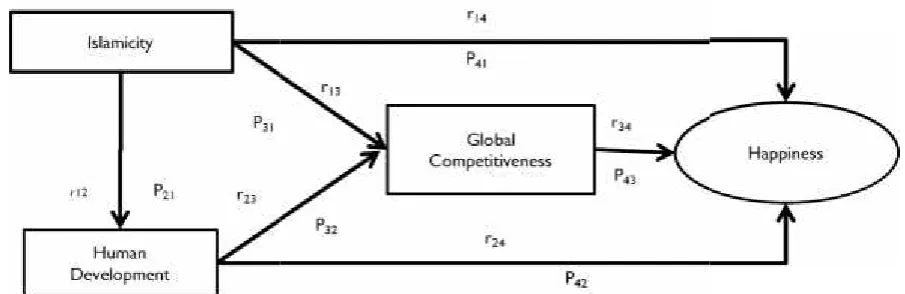
In analyzing direct and indirect impacts of Islamicity on happiness, this study employed path analysis model thatwas developed by Sewall Wright (1921; 1934). It has since been applied to a vast array of complex modeling areas, including biology, psychology, sociology, and econometrics (Dodge, Y., 2003). Basically, the path model can be used to analysis two types of impacts: direct and direct impacts. The total impacts of exogenous variables are the multiplication (Alwin, D.F., & Hauser, R.M., 1975). In this study, the path model is depicted in Figure 1: where human development and global competitiveness were the exogenous variables.
Path coefficients were calculated by solving these path equations; given that the coefficients of correlation have been calculated. P41 was direct impact of Islamicity on happiness; P31was direct impact of Islamicity on global competitiveness; P21was direct impact of Islamicity on human development; P32 was direct impact of human development on global competitiveness, and P42 was direct impact of human development on happiness. Indirect impact of Islamicity on happiness, through global competitiveness was in Path-7 (P43 -P31); Path-8 (P43- P32- P21) was indirect impact of Islamicity on happiness, through global competitiveness and human development; Path-9 (P42-P21) was indirect impact of Islamicity on happiness, through human development.
Happiness was measured by happiness index, Islamicity was measured by the Islamicity index, human development was
measured by the human development index and
competitiveness was measured by global competitiveness index. Data on the happiness index from 156 countries was downloaded from United Nations Development Programme (2016) World Happiness Report, Chapter 2: The Distribution of World Happiness written by John F. Helliwell, Haifang Huang
and Shun Huang. Data are available at
http://worldhappiness.report/wp-content/uploads/
sites/2/2016/03/HR-V1Ch2_web.pdf. Data on Islamicity from 153 countries (115 countries from Islamic countries) downloaded from Islamicity Index.org that available on line at http://islamicity-index.org/wp/islamicity-indices.
Figure 1:Path Model to Analysis the Impact of Islamicity on Happiness
International Journal of Recent Scientific Research Vol. 8, Issue, 2, pp. 15465-15474, February, 2017
15467 |
P a g e
shareholder and customer values, financial strength which
determines the ability to act and react within the competitive environment and the potential of people and technology in implementing the necessary strategic changes. National
competitiveness refers to a country’s ability to create, produce,
distribute and/or service products in international trade while earning rising returns on its resources (Scott, B. R. & Lodge, G. C., 1985). Competitiveness includes both efficiency and
effectiveness. It is this choice of industrial goals which is crucial. Competitiveness includes both the ends and the means towards those ends (Buckley, P. J. et al, 1998). In recent years, the concept of competitiveness has emerged as a new paradigm in economic development. Competitiveness captures the awareness of both the limitations and challenges posed by global competition, at a time when effective government action is constrained by budgetary constraints and the private sector faces significant barriers to competing in domestic and international markets.
Competitiveness is important for any economy that must rely on international trade to balance import of energy and raw materials. The European Union (EU) has enshrined industrial research and technological development (R&D) in her Treaty in order to become more competitive. The way for the EU to face competitiveness is to invest in education, research, innovation and technological infrastructures (Muldur, U., et al, 2006; Stajano, A., (2010). The International Economic Development Council (IEDC) in Washington, D.C. published the "Innovation Agenda: A Policy Statement on American Competitiveness". International comparisons of national competitiveness are conducted by the World Economic Forum, in its Global Competitiveness Report, and the Institute for
Management Development (2003), in its World
Competitiveness Yearbook 2003.
The Global Competitiveness Report 2014-2015 is a yearly report published by the World Economic Forum. Since 2004, the Global Competitiveness Report ranks countries based on the Global Competitiveness Index 2014-2015, developed by
Martin, X., S. and Artadi, E.V., (2004). The Global Competitiveness Index integrates the macroeconomic and the micro aspects of competitiveness into a single index. Study on
economic growth, human development and global
competitiveness has been reported byMuchdie(2016b).
The objective of this paper is to analyze the relation dan the impacts, both direct and indirect, of Islamicity and economic development on happiness, using path analysis model.
METHODS OF ANALYSIS
In analyzing direct and indirect impacts of Islamicity on happiness, this study employed path analysis model thatwas developed by Sewall Wright (1921; 1934). It has since been applied to a vast array of complex modeling areas, including biology, psychology, sociology, and econometrics (Dodge, Y., 2003). Basically, the path model can be used to analysis two types of impacts: direct and direct impacts. The total impacts of exogenous variables are the multiplication (Alwin, D.F., & Hauser, R.M., 1975). In this study, the path model is depicted in Figure 1: where human development and global competitiveness were the exogenous variables.
Path coefficients were calculated by solving these path equations; given that the coefficients of correlation have been calculated. P41 was direct impact of Islamicity on happiness; P31was direct impact of Islamicity on global competitiveness; P21was direct impact of Islamicity on human development; P32 was direct impact of human development on global competitiveness, and P42 was direct impact of human development on happiness. Indirect impact of Islamicity on happiness, through global competitiveness was in Path-7 (P43 -P31); Path-8 (P43- P32- P21) was indirect impact of Islamicity on happiness, through global competitiveness and human development; Path-9 (P42-P21) was indirect impact of Islamicity on happiness, through human development.
Happiness was measured by happiness index, Islamicity was measured by the Islamicity index, human development was
measured by the human development index and
competitiveness was measured by global competitiveness index. Data on the happiness index from 156 countries was downloaded from United Nations Development Programme (2016) World Happiness Report, Chapter 2: The Distribution of World Happiness written by John F. Helliwell, Haifang Huang
and Shun Huang. Data are available at
http://worldhappiness.report/wp-content/uploads/
sites/2/2016/03/HR-V1Ch2_web.pdf. Data on Islamicity from 153 countries (115 countries from Islamic countries) downloaded from Islamicity Index.org that available on line at http://islamicity-index.org/wp/islamicity-indices.
Figure 1:Path Model to Analysis the Impact of Islamicity on Happiness
International Journal of Recent Scientific Research Vol. 8, Issue, 2, pp. 15465-15474, February, 2017
15467 |
P a g e
shareholder and customer values, financial strength which
determines the ability to act and react within the competitive environment and the potential of people and technology in implementing the necessary strategic changes. National
competitiveness refers to a country’s ability to create, produce,
distribute and/or service products in international trade while earning rising returns on its resources (Scott, B. R. & Lodge, G. C., 1985). Competitiveness includes both efficiency and
effectiveness. It is this choice of industrial goals which is crucial. Competitiveness includes both the ends and the means towards those ends (Buckley, P. J. et al, 1998). In recent years, the concept of competitiveness has emerged as a new paradigm in economic development. Competitiveness captures the awareness of both the limitations and challenges posed by global competition, at a time when effective government action is constrained by budgetary constraints and the private sector faces significant barriers to competing in domestic and international markets.
Competitiveness is important for any economy that must rely on international trade to balance import of energy and raw materials. The European Union (EU) has enshrined industrial research and technological development (R&D) in her Treaty in order to become more competitive. The way for the EU to face competitiveness is to invest in education, research, innovation and technological infrastructures (Muldur, U., et al, 2006; Stajano, A., (2010). The International Economic Development Council (IEDC) in Washington, D.C. published the "Innovation Agenda: A Policy Statement on American Competitiveness". International comparisons of national competitiveness are conducted by the World Economic Forum, in its Global Competitiveness Report, and the Institute for
Management Development (2003), in its World
Competitiveness Yearbook 2003.
The Global Competitiveness Report 2014-2015 is a yearly report published by the World Economic Forum. Since 2004, the Global Competitiveness Report ranks countries based on the Global Competitiveness Index 2014-2015, developed by
Martin, X., S. and Artadi, E.V., (2004). The Global Competitiveness Index integrates the macroeconomic and the micro aspects of competitiveness into a single index. Study on
economic growth, human development and global
competitiveness has been reported byMuchdie(2016b).
The objective of this paper is to analyze the relation dan the impacts, both direct and indirect, of Islamicity and economic development on happiness, using path analysis model.
METHODS OF ANALYSIS
In analyzing direct and indirect impacts of Islamicity on happiness, this study employed path analysis model thatwas developed by Sewall Wright (1921; 1934). It has since been applied to a vast array of complex modeling areas, including biology, psychology, sociology, and econometrics (Dodge, Y., 2003). Basically, the path model can be used to analysis two types of impacts: direct and direct impacts. The total impacts of exogenous variables are the multiplication (Alwin, D.F., & Hauser, R.M., 1975). In this study, the path model is depicted in Figure 1: where human development and global competitiveness were the exogenous variables.
Path coefficients were calculated by solving these path equations; given that the coefficients of correlation have been calculated. P41 was direct impact of Islamicity on happiness; P31was direct impact of Islamicity on global competitiveness; P21was direct impact of Islamicity on human development; P32 was direct impact of human development on global competitiveness, and P42 was direct impact of human development on happiness. Indirect impact of Islamicity on happiness, through global competitiveness was in Path-7 (P43 -P31); Path-8 (P43- P32- P21) was indirect impact of Islamicity on happiness, through global competitiveness and human development; Path-9 (P42-P21) was indirect impact of Islamicity on happiness, through human development.
Happiness was measured by happiness index, Islamicity was measured by the Islamicity index, human development was
measured by the human development index and
competitiveness was measured by global competitiveness index. Data on the happiness index from 156 countries was downloaded from United Nations Development Programme (2016) World Happiness Report, Chapter 2: The Distribution of World Happiness written by John F. Helliwell, Haifang Huang
and Shun Huang. Data are available at
http://worldhappiness.report/wp-content/uploads/
sites/2/2016/03/HR-V1Ch2_web.pdf. Data on Islamicity from 153 countries (115 countries from Islamic countries) downloaded from Islamicity Index.org that available on line at http://islamicity-index.org/wp/islamicity-indices.
Data on human development index from 155 countries download from United Nations Development Programme (2016b) Human Development Report 2015: Work for Human
Development Web Version and was accessed at
http://hdr.undp.org/en/data. Data on global competitiveness index from 138 countries were downloaded from http://reports.weforum.org/global-competitiveness-index/. Problems of missing data have been solved by deleting countries with incomplete data. Finally, data on happiness, global competitiveness, human development, and economic growth used in this study were from 123 countries.
RESULT AND DISCUSSION
Figure 2: depicts the Islamicity index, human development index, global competitiveness index and happiness index from 123 countries being studied. The lowest Islamic index happened in Chad (1.82) and the highest Islamicity was the Netherland (8.91). Average Islamicity index in term of statistic mean was 5.40 (Saudi Arabia), median 5.16 (Turkey, Argentina) and mode 8.44 (Australia, Canada).
The highest human development index was in Australia (94.00) and the lowest human development index was in Chad (39.00).
Ten countries with highest index of human development were: Norway, Australia, Switzerland, Netherlands, Denmark, Germany, Ireland, United States, Sweden, and New Zealand. Ten countries with lowest human development index were: Haiti, Senegal, Malawi, Ethiopia, Liberia, Mali, Sierra Leone, Guinea, Burundi, and Chad. Average index of human development in terms of statistical mean was 72.99 (Jamaica, Colombia, Tunisia, Dominican Republic, and Belize), median was 76.00 (Mexico, Georgia, Turkey, Jordan, Macedonia, Azerbaijan, and Ukraine), and mode was 73.00 (The Netherland, Sweden, New Zealand, and Australia).
The highest global competitiveness index was 5.76 (Switzerland) and the lowest global competitiveness index was 2.84 (Guinea). Ten countries with highest index of global competitiveness were: Switzerland, Singapore, United States, Germany, Netherlands, Japan, Finland, Sweden, United Kingdom, and Norway. Ten countries with lowest index of global competitiveness were: Liberia, Madagascar, Venezuela RB, Haiti, Malawi, Burundi, Sierra Leone, Mauritania, Chad, and Guinea. The average index of global competitiveness in term of statistical mean was 4.27 (Georgia, Jordan, Hungary, Macedonia, Colombia, Rwanda, Mexico), median was 4.22
Table1:Path Equations
Source: http://faculty.cas.usf.edu/mbrannick/regression/Pathan.html
Figure 2: Islamicity, Human Development, Global Competitiveness and Happiness
Data on human development index from 155 countries download from United Nations Development Programme (2016b) Human Development Report 2015: Work for Human
Development Web Version and was accessed at
http://hdr.undp.org/en/data. Data on global competitiveness index from 138 countries were downloaded from http://reports.weforum.org/global-competitiveness-index/. Problems of missing data have been solved by deleting countries with incomplete data. Finally, data on happiness, global competitiveness, human development, and economic growth used in this study were from 123 countries.
RESULT AND DISCUSSION
Figure 2: depicts the Islamicity index, human development index, global competitiveness index and happiness index from 123 countries being studied. The lowest Islamic index happened in Chad (1.82) and the highest Islamicity was the Netherland (8.91). Average Islamicity index in term of statistic mean was 5.40 (Saudi Arabia), median 5.16 (Turkey, Argentina) and mode 8.44 (Australia, Canada).
The highest human development index was in Australia (94.00) and the lowest human development index was in Chad (39.00).
Ten countries with highest index of human development were: Norway, Australia, Switzerland, Netherlands, Denmark, Germany, Ireland, United States, Sweden, and New Zealand. Ten countries with lowest human development index were: Haiti, Senegal, Malawi, Ethiopia, Liberia, Mali, Sierra Leone, Guinea, Burundi, and Chad. Average index of human development in terms of statistical mean was 72.99 (Jamaica, Colombia, Tunisia, Dominican Republic, and Belize), median was 76.00 (Mexico, Georgia, Turkey, Jordan, Macedonia, Azerbaijan, and Ukraine), and mode was 73.00 (The Netherland, Sweden, New Zealand, and Australia).
The highest global competitiveness index was 5.76 (Switzerland) and the lowest global competitiveness index was 2.84 (Guinea). Ten countries with highest index of global competitiveness were: Switzerland, Singapore, United States, Germany, Netherlands, Japan, Finland, Sweden, United Kingdom, and Norway. Ten countries with lowest index of global competitiveness were: Liberia, Madagascar, Venezuela RB, Haiti, Malawi, Burundi, Sierra Leone, Mauritania, Chad, and Guinea. The average index of global competitiveness in term of statistical mean was 4.27 (Georgia, Jordan, Hungary, Macedonia, Colombia, Rwanda, Mexico), median was 4.22
Table1:Path Equations
Source: http://faculty.cas.usf.edu/mbrannick/regression/Pathan.html
Figure 2: Islamicity, Human Development, Global Competitiveness and Happiness
Data on human development index from 155 countries download from United Nations Development Programme (2016b) Human Development Report 2015: Work for Human
Development Web Version and was accessed at
http://hdr.undp.org/en/data. Data on global competitiveness index from 138 countries were downloaded from http://reports.weforum.org/global-competitiveness-index/. Problems of missing data have been solved by deleting countries with incomplete data. Finally, data on happiness, global competitiveness, human development, and economic growth used in this study were from 123 countries.
RESULT AND DISCUSSION
Figure 2: depicts the Islamicity index, human development index, global competitiveness index and happiness index from 123 countries being studied. The lowest Islamic index happened in Chad (1.82) and the highest Islamicity was the Netherland (8.91). Average Islamicity index in term of statistic mean was 5.40 (Saudi Arabia), median 5.16 (Turkey, Argentina) and mode 8.44 (Australia, Canada).
The highest human development index was in Australia (94.00) and the lowest human development index was in Chad (39.00).
Ten countries with highest index of human development were: Norway, Australia, Switzerland, Netherlands, Denmark, Germany, Ireland, United States, Sweden, and New Zealand. Ten countries with lowest human development index were: Haiti, Senegal, Malawi, Ethiopia, Liberia, Mali, Sierra Leone, Guinea, Burundi, and Chad. Average index of human development in terms of statistical mean was 72.99 (Jamaica, Colombia, Tunisia, Dominican Republic, and Belize), median was 76.00 (Mexico, Georgia, Turkey, Jordan, Macedonia, Azerbaijan, and Ukraine), and mode was 73.00 (The Netherland, Sweden, New Zealand, and Australia).
The highest global competitiveness index was 5.76 (Switzerland) and the lowest global competitiveness index was 2.84 (Guinea). Ten countries with highest index of global competitiveness were: Switzerland, Singapore, United States, Germany, Netherlands, Japan, Finland, Sweden, United Kingdom, and Norway. Ten countries with lowest index of global competitiveness were: Liberia, Madagascar, Venezuela RB, Haiti, Malawi, Burundi, Sierra Leone, Mauritania, Chad, and Guinea. The average index of global competitiveness in term of statistical mean was 4.27 (Georgia, Jordan, Hungary, Macedonia, Colombia, Rwanda, Mexico), median was 4.22
Table1:Path Equations
Source: http://faculty.cas.usf.edu/mbrannick/regression/Pathan.html
International Journal of Recent Scientific Research Vol. 8, Issue, 2, pp. 15465-15474, February, 2017
15469 |
P a g e
(Slovak Republic, Georgia, Cyprus, Peru, Jordan) and mode was 4.39 (Turkey, Panama, Philippines, South Africa, Malta).
The lowest index of happiness was in Burundi (29.05) and the highest index of happiness was in Denmark. Ten countries with highest index of happiness were: Denmark, Switzerland, Iceland, Norway, Finland, Canada, Netherlands, New Zealand, Australia and Sweden. Ten countries with lowest index of happiness were: Cambodia, Chad, Uganda, Madagascar, Tanzania, Liberia, Guinea, Rwanda, Benin, and Burundi. Average index of happiness in terms of statistical mean was 55.4 (Paraguay), median was 55.23 (Cyprus, Latvia, Croatia, Romania, Jamaica, and Paraguay), and mode was 58.35 (Poland, Ethiopia, Lithuania, Korea Republic, Peru, Moldova, and Bolivia).
Figure 3 (left panel): presents the countries at various levels Islamicity index related to happiness index. Both were ranked into three levels: low, medium and high. According to the levels of the Islamicity index, 41 countries classified as the low Islamicity index countries, 41 countries classified as the medium Islamicity index countries, and 41 countries classified as the high Islamicity index countries.
The same number of countries was also classified as low, medium and high happiness index countries.
From 41 countries with the low Islamicity index, there were 30 countries that also had low happiness index. Another 10 countries had medium happiness index, and only one country had high happiness index, namely Azerbaijan. From 41 countries with medium Islamicity index, 11 countries had low happiness index, 22 countries were classified as happiness index countries, and another 8 countries were classified as high happiness index countries. From 41 countries with high Islamicity index, no countries had low happiness index. Meanwhile, 9 countries were classified as medium happiness index, and another 32 countries were classified as high happiness index countries.
Figure 4 (right panel): presents Scatter Diagram between Islamicity index and global competitiveness index that shows a positive trend. It means that Islamicity had positive correlation on global competitiveness. Countries with high global competitiveness index were also the countries with high Islamicity index.
Coefficients Standard Error t Stat P-value Global
Competitiveness 25.63 0.91 28.22 0.00
Islamicity 3.16 0.16 19.89 0.00
Figure 4: Islamicity and Global Competitiveness
Coefficients Standard Error t Stat P-value
Human Development 35.52 2.10 16.90 0.00
Islamicity 6.94 0.37 18.83 0.00
Figure 5: Islamicity and Human Development
International Journal of Recent Scientific Research Vol. 8, Issue, 2, pp. 15465-15474, February, 2017
15469 |
P a g e
(Slovak Republic, Georgia, Cyprus, Peru, Jordan) and mode was 4.39 (Turkey, Panama, Philippines, South Africa, Malta).
The lowest index of happiness was in Burundi (29.05) and the highest index of happiness was in Denmark. Ten countries with highest index of happiness were: Denmark, Switzerland, Iceland, Norway, Finland, Canada, Netherlands, New Zealand, Australia and Sweden. Ten countries with lowest index of happiness were: Cambodia, Chad, Uganda, Madagascar, Tanzania, Liberia, Guinea, Rwanda, Benin, and Burundi. Average index of happiness in terms of statistical mean was 55.4 (Paraguay), median was 55.23 (Cyprus, Latvia, Croatia, Romania, Jamaica, and Paraguay), and mode was 58.35 (Poland, Ethiopia, Lithuania, Korea Republic, Peru, Moldova, and Bolivia).
Figure 3 (left panel): presents the countries at various levels Islamicity index related to happiness index. Both were ranked into three levels: low, medium and high. According to the levels of the Islamicity index, 41 countries classified as the low Islamicity index countries, 41 countries classified as the medium Islamicity index countries, and 41 countries classified as the high Islamicity index countries.
The same number of countries was also classified as low, medium and high happiness index countries.
From 41 countries with the low Islamicity index, there were 30 countries that also had low happiness index. Another 10 countries had medium happiness index, and only one country had high happiness index, namely Azerbaijan. From 41 countries with medium Islamicity index, 11 countries had low happiness index, 22 countries were classified as happiness index countries, and another 8 countries were classified as high happiness index countries. From 41 countries with high Islamicity index, no countries had low happiness index. Meanwhile, 9 countries were classified as medium happiness index, and another 32 countries were classified as high happiness index countries.
Figure 4 (right panel): presents Scatter Diagram between Islamicity index and global competitiveness index that shows a positive trend. It means that Islamicity had positive correlation on global competitiveness. Countries with high global competitiveness index were also the countries with high Islamicity index.
Coefficients Standard Error t Stat P-value Global
Competitiveness 25.63 0.91 28.22 0.00
Islamicity 3.16 0.16 19.89 0.00
Figure 4: Islamicity and Global Competitiveness
Coefficients Standard Error t Stat P-value
Human Development 35.52 2.10 16.90 0.00
Islamicity 6.94 0.37 18.83 0.00
Figure 5: Islamicity and Human Development
International Journal of Recent Scientific Research Vol. 8, Issue, 2, pp. 15465-15474, February, 2017
15469 |
P a g e
(Slovak Republic, Georgia, Cyprus, Peru, Jordan) and mode was 4.39 (Turkey, Panama, Philippines, South Africa, Malta).
The lowest index of happiness was in Burundi (29.05) and the highest index of happiness was in Denmark. Ten countries with highest index of happiness were: Denmark, Switzerland, Iceland, Norway, Finland, Canada, Netherlands, New Zealand, Australia and Sweden. Ten countries with lowest index of happiness were: Cambodia, Chad, Uganda, Madagascar, Tanzania, Liberia, Guinea, Rwanda, Benin, and Burundi. Average index of happiness in terms of statistical mean was 55.4 (Paraguay), median was 55.23 (Cyprus, Latvia, Croatia, Romania, Jamaica, and Paraguay), and mode was 58.35 (Poland, Ethiopia, Lithuania, Korea Republic, Peru, Moldova, and Bolivia).
Figure 3 (left panel): presents the countries at various levels Islamicity index related to happiness index. Both were ranked into three levels: low, medium and high. According to the levels of the Islamicity index, 41 countries classified as the low Islamicity index countries, 41 countries classified as the medium Islamicity index countries, and 41 countries classified as the high Islamicity index countries.
The same number of countries was also classified as low, medium and high happiness index countries.
From 41 countries with the low Islamicity index, there were 30 countries that also had low happiness index. Another 10 countries had medium happiness index, and only one country had high happiness index, namely Azerbaijan. From 41 countries with medium Islamicity index, 11 countries had low happiness index, 22 countries were classified as happiness index countries, and another 8 countries were classified as high happiness index countries. From 41 countries with high Islamicity index, no countries had low happiness index. Meanwhile, 9 countries were classified as medium happiness index, and another 32 countries were classified as high happiness index countries.
Figure 4 (right panel): presents Scatter Diagram between Islamicity index and global competitiveness index that shows a positive trend. It means that Islamicity had positive correlation on global competitiveness. Countries with high global competitiveness index were also the countries with high Islamicity index.
Coefficients Standard Error t Stat P-value Global
Competitiveness 25.63 0.91 28.22 0.00
Islamicity 3.16 0.16 19.89 0.00
Figure 4: Islamicity and Global Competitiveness
Coefficients Standard Error t Stat P-value
Human Development 35.52 2.10 16.90 0.00
Islamicity 6.94 0.37 18.83 0.00
The opposite apply; countries with low global competitiveness index were also the countries with low Islamicity index. The higher the Islamicity indexes of a country, the higher the index of global competitiveness in that country. Regression coefficient resulted from regression analysis was a positive, 3.16. This regression coefficient was statistically significant as t-calculated (19.89) was higher than t-table (1.98) n=123, at 95% significant level, and P-value (0.00) was less than 0.05.
Figure 5 (left panel): presents the countries at various levels Islamicity index related to the human development index. Both were ranked into three levels: low, medium and high. According to the levels of the Islamicity index, 41 countries classified as the low Islamicity index countries, 41 countries classified as the medium Islamicity index countries, and 41 countries classified as the high Islamicity index countries. The same number of countries was also classified as low, medium and high human development index countries.
From 41 countries with the low Islamicity index, there were 32 countries that also had low human development index, 9 countries had medium human development index, and no one country had high human development index.
From 41 countries with the medium Islamicity index, there were 9 countries that had low human development index, 29 countries had medium human development index, and only 3 countries had high human development index, namely: Greece, Saudi Arabia, and Argentina. From 41 countries with the high Islamicity index, there was no country that had low human development index. Meanwhile, there were only 3 countries that had medium human development index, and another 38 countries had high development index.
Figure 5 (right panel): presents Scatter Diagram between Islamicity index and human development index that shows a positive trend. It means that Islamicity had positive correlation on the human development. The countries with low Islamicity index were the counties with low human development index. The countries with high Islamicity index were the counties with high human development index. The higher the Islamicity indexes of a country, the higher the index of human development in that country. Regression coefficient resulted from regression analysis was a positive, 6.94.
Coefficients Standard Error t Stat P-value
Happiness 10.13 2.97 3.41 0.00
Human Development 0.62 0.04 15.58 0.00
Figure 6:Human Development and Happiness
Coefficients Standard Error t Stat P-value
Global Competitiveness 15.67 1.71 9.15 0.00
Human Development 0.37 0.02 16.11 0.00
Figure 7:Human Development and Global Competitiveness
The opposite apply; countries with low global competitiveness index were also the countries with low Islamicity index. The higher the Islamicity indexes of a country, the higher the index of global competitiveness in that country. Regression coefficient resulted from regression analysis was a positive, 3.16. This regression coefficient was statistically significant as t-calculated (19.89) was higher than t-table (1.98) n=123, at 95% significant level, and P-value (0.00) was less than 0.05.
Figure 5 (left panel): presents the countries at various levels Islamicity index related to the human development index. Both were ranked into three levels: low, medium and high. According to the levels of the Islamicity index, 41 countries classified as the low Islamicity index countries, 41 countries classified as the medium Islamicity index countries, and 41 countries classified as the high Islamicity index countries. The same number of countries was also classified as low, medium and high human development index countries.
From 41 countries with the low Islamicity index, there were 32 countries that also had low human development index, 9 countries had medium human development index, and no one country had high human development index.
From 41 countries with the medium Islamicity index, there were 9 countries that had low human development index, 29 countries had medium human development index, and only 3 countries had high human development index, namely: Greece, Saudi Arabia, and Argentina. From 41 countries with the high Islamicity index, there was no country that had low human development index. Meanwhile, there were only 3 countries that had medium human development index, and another 38 countries had high development index.
Figure 5 (right panel): presents Scatter Diagram between Islamicity index and human development index that shows a positive trend. It means that Islamicity had positive correlation on the human development. The countries with low Islamicity index were the counties with low human development index. The countries with high Islamicity index were the counties with high human development index. The higher the Islamicity indexes of a country, the higher the index of human development in that country. Regression coefficient resulted from regression analysis was a positive, 6.94.
Coefficients Standard Error t Stat P-value
Happiness 10.13 2.97 3.41 0.00
Human Development 0.62 0.04 15.58 0.00
Figure 6:Human Development and Happiness
Coefficients Standard Error t Stat P-value
Global Competitiveness 15.67 1.71 9.15 0.00
Human Development 0.37 0.02 16.11 0.00
Figure 7:Human Development and Global Competitiveness
0 10 20 30 40 50 60 70
0 20 40
G
lo
b
al
C
o
m
p
et
it
iv
en
ess
Human Development
The opposite apply; countries with low global competitiveness index were also the countries with low Islamicity index. The higher the Islamicity indexes of a country, the higher the index of global competitiveness in that country. Regression coefficient resulted from regression analysis was a positive, 3.16. This regression coefficient was statistically significant as t-calculated (19.89) was higher than t-table (1.98) n=123, at 95% significant level, and P-value (0.00) was less than 0.05.
Figure 5 (left panel): presents the countries at various levels Islamicity index related to the human development index. Both were ranked into three levels: low, medium and high. According to the levels of the Islamicity index, 41 countries classified as the low Islamicity index countries, 41 countries classified as the medium Islamicity index countries, and 41 countries classified as the high Islamicity index countries. The same number of countries was also classified as low, medium and high human development index countries.
From 41 countries with the low Islamicity index, there were 32 countries that also had low human development index, 9 countries had medium human development index, and no one country had high human development index.
From 41 countries with the medium Islamicity index, there were 9 countries that had low human development index, 29 countries had medium human development index, and only 3 countries had high human development index, namely: Greece, Saudi Arabia, and Argentina. From 41 countries with the high Islamicity index, there was no country that had low human development index. Meanwhile, there were only 3 countries that had medium human development index, and another 38 countries had high development index.
Figure 5 (right panel): presents Scatter Diagram between Islamicity index and human development index that shows a positive trend. It means that Islamicity had positive correlation on the human development. The countries with low Islamicity index were the counties with low human development index. The countries with high Islamicity index were the counties with high human development index. The higher the Islamicity indexes of a country, the higher the index of human development in that country. Regression coefficient resulted from regression analysis was a positive, 6.94.
Coefficients Standard Error t Stat P-value
Happiness 10.13 2.97 3.41 0.00
Human Development 0.62 0.04 15.58 0.00
Figure 6:Human Development and Happiness
Coefficients Standard Error t Stat P-value
Global Competitiveness 15.67 1.71 9.15 0.00
Human Development 0.37 0.02 16.11 0.00
Figure 7:Human Development and Global Competitiveness
60 80 100
International Journal of Recent Scientific Research Vol. 8, Issue, 2, pp. 15465-15474, February, 2017
15471 |
P a g e
This regression coefficient was statistically significant as t-calculated (18.83) was higher than t-table (1.98) n=123, at 95% significant level, and P-value (0.00) was less than 0.05.
Figure 6 (left panel): presents the countries at various levels human development index related to the happiness index. Both were ranked into three levels: low, medium and high. According to the levels of the human development index, 41 countries classified as the low human development index countries, 41 countries classified as the medium human development index countries, and 41 countries classified as the high human development index countries. The same number of countries was also classified as low, medium and high happiness index countries.
From 41 countries with the low human development index, there were 31 countries that also had low happiness index, 9 countries had medium happiness index, and only one country had high happiness index. From 41 countries with the medium human development index, there were 9 countries that had low happiness index, 20 countries had medium happiness index, and another 12 countries had high happiness index. From 41 countries with the high human development index, there was only one country, Greece, which had low happiness index. Meanwhile, there were 12 countries that had medium happiness index, and another 28 countries had high happiness index.
Figure 6 (right panel): presents Scatter Diagram between human development index and happiness index that shows a positive trend. It means that human development had positive correlation on happiness. The countries with low human development index were the countries with low happiness index. The countries with high human development index were the countries with high happiness index. The higher the human development indexes of a country, the higher the index of happiness in that country. Regression coefficient resulted from regression analysis was a positive, 0.62. This regression coefficient was statistically significant as t-calculated (15.58) was higher than t-table (1.98) n=123, at 95% significant level, and P-value (0.00) was less than 0.05.
Figure 7 (left panel): presents the countries at various levels human development index related to the global competitiveness index.
Both were ranked into three levels: low, medium and high. According to the levels of human development index, 41 countries classified as the low human development index countries, 41 countries classified as the medium human development index countries, and 41 countries classified as the high development index countries. The same number of countries was also classified as low, medium and high global competitiveness index countries.
From 41 countries with the low human development index, there were 30 countries that also had low global competitiveness index, 10 countries had medium global competitiveness index, and only one country had high global competitiveness index, namely Indonesia. From 41 countries with the medium human development index, there were 10 countries that had low global competitiveness index, 24 countries had medium global competitiveness index, and another 7 countries had high global competitiveness index. From 41 countries with the high human development index, there was only one country, Argentina, which had low global competitiveness index. Meanwhile, there were 7 countries that had medium global competitiveness index, and another 33 countries had high global competitiveness index.
Figure 7 (right panel): presents Scatter Diagram between human development index and global competitiveness index that shows a positive trend. It means that human development had positive correlation on global competitiveness. The countries with low human development index were the countries with low global competitiveness index. The countries with high human development index were the countries with high global competitiveness index. The higher the human development indexes of a country, the higher the index of global competitiveness in that country. Regression coefficient resulted from regression analysis was a positive, 0.37. This regression coefficient was statistically significant as t-calculated (16.11) was higher than t-table (1.98) n=123, at 95% significant level, and P-value (0.00) was less than 0.05.
Figure 8 (left panel): presents the countries at various levels global competitiveness index related to happiness index. Both were ranked into three levels: low, medium and high.
Coefficients Standard Error t Stat P-value
Happiness 0.12 4.30 0.03 0.98
Global Competitiveness 1.29 0.10 13.00 0.00
Figure 8:Global Competitiveness and Happiness
International Journal of Recent Scientific Research Vol. 8, Issue, 2, pp. 15465-15474, February, 2017
15471 |
P a g e
This regression coefficient was statistically significant as t-calculated (18.83) was higher than t-table (1.98) n=123, at 95% significant level, and P-value (0.00) was less than 0.05.
Figure 6 (left panel): presents the countries at various levels human development index related to the happiness index. Both were ranked into three levels: low, medium and high. According to the levels of the human development index, 41 countries classified as the low human development index countries, 41 countries classified as the medium human development index countries, and 41 countries classified as the high human development index countries. The same number of countries was also classified as low, medium and high happiness index countries.
From 41 countries with the low human development index, there were 31 countries that also had low happiness index, 9 countries had medium happiness index, and only one country had high happiness index. From 41 countries with the medium human development index, there were 9 countries that had low happiness index, 20 countries had medium happiness index, and another 12 countries had high happiness index. From 41 countries with the high human development index, there was only one country, Greece, which had low happiness index. Meanwhile, there were 12 countries that had medium happiness index, and another 28 countries had high happiness index.
Figure 6 (right panel): presents Scatter Diagram between human development index and happiness index that shows a positive trend. It means that human development had positive correlation on happiness. The countries with low human development index were the countries with low happiness index. The countries with high human development index were the countries with high happiness index. The higher the human development indexes of a country, the higher the index of happiness in that country. Regression coefficient resulted from regression analysis was a positive, 0.62. This regression coefficient was statistically significant as t-calculated (15.58) was higher than t-table (1.98) n=123, at 95% significant level, and P-value (0.00) was less than 0.05.
Figure 7 (left panel): presents the countries at various levels human development index related to the global competitiveness index.
Both were ranked into three levels: low, medium and high. According to the levels of human development index, 41 countries classified as the low human development index countries, 41 countries classified as the medium human development index countries, and 41 countries classified as the high development index countries. The same number of countries was also classified as low, medium and high global competitiveness index countries.
From 41 countries with the low human development index, there were 30 countries that also had low global competitiveness index, 10 countries had medium global competitiveness index, and only one country had high global competitiveness index, namely Indonesia. From 41 countries with the medium human development index, there were 10 countries that had low global competitiveness index, 24 countries had medium global competitiveness index, and another 7 countries had high global competitiveness index. From 41 countries with the high human development index, there was only one country, Argentina, which had low global competitiveness index. Meanwhile, there were 7 countries that had medium global competitiveness index, and another 33 countries had high global competitiveness index.
Figure 7 (right panel): presents Scatter Diagram between human development index and global competitiveness index that shows a positive trend. It means that human development had positive correlation on global competitiveness. The countries with low human development index were the countries with low global competitiveness index. The countries with high human development index were the countries with high global competitiveness index. The higher the human development indexes of a country, the higher the index of global competitiveness in that country. Regression coefficient resulted from regression analysis was a positive, 0.37. This regression coefficient was statistically significant as t-calculated (16.11) was higher than t-table (1.98) n=123, at 95% significant level, and P-value (0.00) was less than 0.05.
Figure 8 (left panel): presents the countries at various levels global competitiveness index related to happiness index. Both were ranked into three levels: low, medium and high.
Coefficients Standard Error t Stat P-value
Happiness 0.12 4.30 0.03 0.98
Global Competitiveness 1.29 0.10 13.00 0.00
Figure 8:Global Competitiveness and Happiness
International Journal of Recent Scientific Research Vol. 8, Issue, 2, pp. 15465-15474, February, 2017
15471 |
P a g e
This regression coefficient was statistically significant as t-calculated (18.83) was higher than t-table (1.98) n=123, at 95% significant level, and P-value (0.00) was less than 0.05.
Figure 6 (left panel): presents the countries at various levels human development index related to the happiness index. Both were ranked into three levels: low, medium and high. According to the levels of the human development index, 41 countries classified as the low human development index countries, 41 countries classified as the medium human development index countries, and 41 countries classified as the high human development index countries. The same number of countries was also classified as low, medium and high happiness index countries.
From 41 countries with the low human development index, there were 31 countries that also had low happiness index, 9 countries had medium happiness index, and only one country had high happiness index. From 41 countries with the medium human development index, there were 9 countries that had low happiness index, 20 countries had medium happiness index, and another 12 countries had high happiness index. From 41 countries with the high human development index, there was only one country, Greece, which had low happiness index. Meanwhile, there were 12 countries that had medium happiness index, and another 28 countries had high happiness index.
Figure 6 (right panel): presents Scatter Diagram between human development index and happiness index that shows a positive trend. It means that human development had positive correlation on happiness. The countries with low human development index were the countries with low happiness index. The countries with high human development index were the countries with high happiness index. The higher the human development indexes of a country, the higher the index of happiness in that country. Regression coefficient resulted from regression analysis was a positive, 0.62. This regression coefficient was statistically significant as t-calculated (15.58) was higher than t-table (1.98) n=123, at 95% significant level, and P-value (0.00) was less than 0.05.
Figure 7 (left panel): presents the countries at various levels human development index related to the global competitiveness index.
Both were ranked into three levels: low, medium and high. According to the levels of human development index, 41 countries classified as the low human development index countries, 41 countries classified as the medium human development index countries, and 41 countries classified as the high development index countries. The same number of countries was also classified as low, medium and high global competitiveness index countries.
From 41 countries with the low human development index, there were 30 countries that also had low global competitiveness index, 10 countries had medium global competitiveness index, and only one country had high global competitiveness index, namely Indonesia. From 41 countries with the medium human development index, there were 10 countries that had low global competitiveness index, 24 countries had medium global competitiveness index, and another 7 countries had high global competitiveness index. From 41 countries with the high human development index, there was only one country, Argentina, which had low global competitiveness index. Meanwhile, there were 7 countries that had medium global competitiveness index, and another 33 countries had high global competitiveness index.
Figure 7 (right panel): presents Scatter Diagram between human development index and global competitiveness index that shows a positive trend. It means that human development had positive correlation on global competitiveness. The countries with low human development index were the countries with low global competitiveness index. The countries with high human development index were the countries with high global competitiveness index. The higher the human development indexes of a country, the higher the index of global competitiveness in that country. Regression coefficient resulted from regression analysis was a positive, 0.37. This regression coefficient was statistically significant as t-calculated (16.11) was higher than t-table (1.98) n=123, at 95% significant level, and P-value (0.00) was less than 0.05.
Figure 8 (left panel): presents the countries at various levels global competitiveness index related to happiness index. Both were ranked into three levels: low, medium and high.
Coefficients Standard Error t Stat P-value
Happiness 0.12 4.30 0.03 0.98
Global Competitiveness 1.29 0.10 13.00 0.00