A Monthly Double-Blind Peer Reviewed (Refereed/Juried) Open Access International e-Journal - Included in the International Serial Directories
Indexed & Listed at:
Ulrich's Periodicals Directory ©, ProQuest, U.S.A., EBSCO Publishing, U.S.A., Cabell’s Directories of Publishing Opportunities, U.S.A., Open J-Gage, India [link of the same is duly available at Inflibnet of University Grants Commission (U.G.C.)],
VOLUME NO. 3 (2013), ISSUE NO. 12 (DECEMBER) ISSN 2231-5756
INTERNATIONAL JOURNAL OF RESEARCH IN COMMERCE, IT & MANAGEMENT
A Monthly Double-Blind Peer Reviewed (Refereed/Juried) Open Access International e-Journal - Included in the International Serial Directories
ii
CONTENTS
Sr.
No.
TITLE & NAME OF THE AUTHOR (S)
Page No.
1. ROLE OF IT IN COMMERCE EDUCATION IN INDIA: A KEY TO ACHIEVE INCLUSIVE GROWTH AND SUSTAINABILITY
DR. SONAL SHARMA & DR. M. K. SINGH
1
2. AGRIBUSINESS POTENTIAL IMPACT OF HORTICULTURE CROPS: AN AGRICULTURAL ECONOMIC ANALYSIS OF CASHEW NUT IN TAMIL
NADU
DR. R.LOGANATHAN & DR. M.CHANDRASEKARAN
8
3. REAL IMPACT OF IMPACT FACTOR RESEARCH JOURNALS ON RESEARCH PAPERS
SHUBHANGI JAIN & DR. PRATEEK SHARMA
13
4. GREEN CONSUMERISM: AWARENESS OF ENVIRONMENTAL ISSUES AMONG CONSUMERS IN TAMILNADU
DR. K. SALEEM KHAN, DR. A. MOHAMED SALI & K.SHARIFA NIZARA
21
5. REFINED HR SCENARIO IN INDIAN IT INDUSTRY
U. JEYASUTHARSAN & DR. N. RAJASEKAR
27
6. AN ANALYSIS OF FACTORS AFFECTING POST-HARVESTING FOOD LOSS IN PERISHABLE CHAIN
N. ARUNFRED & DR. D. KINSLIN
32
7. ANALYSIS OF LIQUIDITY AND PROFITABILITY IN TEXTILE INDUSTRY IN INDIA
DR. T. MADHU SUDANA & DR. B. PHANISWARA RAJU
35
8. TECHNOLOGICAL DEVELOPMENTS IN INDIAN BANKING SECTOR
N. SURESH BABU & DR. G.V.CHALAM
43
9. FOREIGN DIRECT INVESTMENT IN MULTIBRAND RETAILING IN INDIA: FROM STAKEHOLDERS PERSPECTIVES
DR. P. SANTHI
48
10. COMPARATIVE STUDY OF IMAGE ENHANCEMENT TECHNIQUES
SANJEEV KUMAR & NAVNEET GOLCHHA
53
11. IMPLEMENTATION OF SHORTEST PATH ALGORITHM FOR RECTILINEAR STEINER TREE PROBLEM
SAKSHI RAJPUT
57
12. A STUDY ON FAST MOVING CONSUMER GOODS MARKETING WITH SPECIAL REFERENCE TO SAKTHI MASALA PRODUCTS
R. BUVANESWARI, B.BHARATHI & MAHALAKSHMI VENKATESH
61
13. A STUDY ON CONSUMER BEHAVIOUR TOWARDS RETAIL STORES WITH REFERENCE TO BIG BAZAAR IN COIMBATORE CITY
B.DEVIPRIYA & DR. M. NANDHINI
64
14. ROLE OF MARKET ORIENTATION IN PERFORMANCE OF SMALL-SCALE INDUSTRIES: A STUDY OF UNISOPENT PVT. LTD.
NISHU MARWAH
67
15. STRATEGIC THINKING: A KEY FOR COMPETITIVENESS IN SMALL BUSINESS OPERATING IN NIGERIA
ONYEAGHALA OBIOMA, H. & UKPATA, SUNDAY IJUO
70
16. IS SMALL SCALE IRRIGATION A SOLUTION FOR ALLEVIATING RURAL POVERTY IN TIGRAY? (CASE STUDY IN HINTALLO WAJIRAT)
TEFERA KEBEDE LEYU
77
17. ENVIRONMENTAL CORRELATES OF SCIENCE, TECHNICAL, VOCATIONAL AND BUSINESS EDUCATION FOR ECONOMIC TRANSFORMATION
IN NIGERIA
UKPATA, SUNDAY IJUO & DR. ONYEUKWU, PAULINE EBERE
85
18. EMPLOYEES PERCEPTION TOWARDS HRD CLIMATE IN THE BANKING SECTOR: A CASE STUDY OF JAMMU AND KASHMIR BANK
RAFIA GULZAR
90
19. POVERTY REDUCTION: A PREDICATE OF HUMAN CAPACITY DEVELOPMENT IN NIGERIA
ONYEAGHALA, OBIOMA, H., KAPPE, MAMMAN, P. & DIBAL, HYELADI STANLEY
95
20. A STUDY ON LEADERSHIP STYLES OF SELECTED ENGINEERING UNITS LOCATED IN GIDC, VITTHAL UDYOGNAGAR, GUJARAT
SAMIR P RATHOD & MEHUL J MISTRY
101
21. ADOPTION OF THE TECHNOLOGY ACCEPTANCE MODEL TO DETERMINE THE FACTORS THAT DRIVE TO SHOP ONLINE
ANKUR SANGWAN
107
22. TO ASSESS THE EFFECT OF INTELLECTUAL CAPITAL ON ORGANIZATIONAL PERFORMANCE IN THE MANUFACTURING SECTOR
JOHN WEKESA WANJALA
113
23. THE ANALYSIS AND DERIVATION OF A NEW FRAMEWORK TO INVEST IN GOLD
ANKUR SANGWAN
119
24. THE FINANCIAL STATEMENT ANALYSIS OF TAMIL NADU NEWSPRINT AND PAPERS LIMITED, KARUR
OMBEGA OGUTA KEPHAR
127
25. NATURAL RESOURCE AND CIVIL WARS: A CRITICAL ANALYSIS
SIDDHARTH RATHORE
136
26. EMERGENCE OF HEDGE FUNDS: IMPLICATIONS ON THE INDIAN CAPITAL MARKET
ANINDITA CHAKRAVORTY
140
27. TRAINING AND DEVELOPMENT PROGRAMMES IN TAMILNADU STATE TRANSPORT CORPORATION LIMITED, KUMBAKONAM
D. PAUL DHINAKARAN
146
28. INDIGENIZATION OF MILITARY HARDWARE: A NECESSITY FOR INDIA?
SIDDHARTH RATHORE
150
29. A STUDY ON THE STATUS OF FACULTY DEVELOPMENT ACTIVITIES IN ENGINEERING INSTITUTIONS
S. MURALI
153
30. WIRELESS MONITORING AND RECORDING OF ENVIRONMENTAL PARAMETERS BASED ON XBEE AND PIC
ARAVIND.S
158
CHIEF PATRON
PROF. K. K. AGGARWAL
Chairman, Malaviya National Institute of Technology, Jaipur
(An institute of National Importance & fully funded by Ministry of Human Resource Development, Government of India)
Chancellor, K. R. Mangalam University, Gurgaon
Chancellor, Lingaya’s University, Faridabad
Founder Vice-Chancellor (1998-2008), Guru Gobind Singh Indraprastha University, Delhi
Ex. Pro Vice-Chancellor, Guru Jambheshwar University, Hisar
FOUNDER PATRON
LATE SH. RAM BHAJAN AGGARWAL
Former State Minister for Home & Tourism, Government of Haryana
Former Vice-President, Dadri Education Society, Charkhi Dadri
Former President, Chinar Syntex Ltd. (Textile Mills), Bhiwani
CO-ORDINATOR
AMITA
Faculty, Government M. S., Mohali
ADVISORS
DR. PRIYA RANJAN TRIVEDI
Chancellor, The Global Open University, Nagaland
PROF. M. S. SENAM RAJU
Director A. C. D., School of Management Studies, I.G.N.O.U., New Delhi
PROF. M. N. SHARMA
Chairman, M.B.A., Haryana College of Technology & Management, Kaithal
PROF. S. L. MAHANDRU
Principal (Retd.), Maharaja Agrasen College, Jagadhri
EDITOR
PROF. R. K. SHARMA
Professor, Bharti Vidyapeeth University Institute of Management & Research, New Delhi
CO-EDITOR
DR. BHAVET
Faculty, Shree Ram Institute of Business & Management, Urjani
EDITORIAL ADVISORY BOARD
DR. RAJESH MODI
Faculty, Yanbu Industrial College, Kingdom of Saudi Arabia
PROF. SANJIV MITTAL
University School of Management Studies, Guru Gobind Singh I. P. University, Delhi
PROF. ANIL K. SAINI
VOLUME NO. 3 (2013), ISSUE NO. 12 (DECEMBER) ISSN 2231-5756
INTERNATIONAL JOURNAL OF RESEARCH IN COMMERCE, IT & MANAGEMENT
A Monthly Double-Blind Peer Reviewed (Refereed/Juried) Open Access International e-Journal - Included in the International Serial Directories
iv
DR. SAMBHAVNA
Faculty, I.I.T.M., Delhi
DR. MOHENDER KUMAR GUPTA
Associate Professor, P. J. L. N. Government College, Faridabad
DR. SHIVAKUMAR DEENE
Asst. Professor, Dept. of Commerce, School of Business Studies, Central University of Karnataka, Gulbarga
ASSOCIATE EDITORS
PROF. NAWAB ALI KHAN
Department of Commerce, Aligarh Muslim University, Aligarh, U.P.
PROF. ABHAY BANSAL
Head, Department of Information Technology, Amity School of Engineering & Technology, Amity
University, Noida
PROF. A. SURYANARAYANA
Department of Business Management, Osmania University, Hyderabad
DR. SAMBHAV GARG
Faculty, Shree Ram Institute of Business & Management, Urjani
PROF. V. SELVAM
SSL, VIT University, Vellore
DR. PARDEEP AHLAWAT
Associate Professor, Institute of Management Studies & Research, Maharshi Dayanand University, Rohtak
DR. S. TABASSUM SULTANA
Associate Professor, Department of Business Management, Matrusri Institute of P.G. Studies, Hyderabad
SURJEET SINGH
Asst. Professor, Department of Computer Science, G. M. N. (P.G.) College, Ambala Cantt.
TECHNICAL ADVISOR
AMITA
Faculty, Government M. S., Mohali
FINANCIAL ADVISORS
DICKIN GOYAL
Advocate & Tax Adviser, Panchkula
NEENA
Investment Consultant, Chambaghat, Solan, Himachal Pradesh
LEGAL ADVISORS
JITENDER S. CHAHAL
Advocate, Punjab & Haryana High Court, Chandigarh U.T.
CHANDER BHUSHAN SHARMA
Advocate & Consultant, District Courts, Yamunanagar at Jagadhri
SUPERINTENDENT
CALL FOR MANUSCRIPTS
We invite unpublished novel, original, empirical and high quality research work pertaining to recent developments & practices in the areas of Computer Science & Applications; Commerce; Business; Finance; Marketing; Human Resource Management; General Management; Banking; Economics; Tourism Administration & Management; Education; Law; Library & Information Science; Defence & Strategic Studies; Electronic Science; Corporate Governance; Industrial Relations; and emerging paradigms in allied subjects like Accounting; Accounting Information Systems; Accounting Theory & Practice; Auditing; Behavioral Accounting; Behavioral Economics; Corporate Finance; Cost Accounting; Econometrics; Economic Development; Economic History; Financial Institutions & Markets; Financial Services; Fiscal Policy; Government & Non Profit Accounting; Industrial Organization; International Economics & Trade; International Finance; Macro Economics; Micro Economics; Rural Economics; Co-operation; Demography: Development Planning; Development Studies; Applied Economics; Development Economics; Business Economics; Monetary Policy; Public Policy Economics; Real Estate; Regional Economics; Political Science; Continuing Education; Labour Welfare; Philosophy; Psychology; Sociology; Tax Accounting; Advertising & Promotion Management; Management Information Systems (MIS); Business Law; Public Responsibility & Ethics; Communication; Direct Marketing; E-Commerce; Global Business; Health Care Administration; Labour Relations & Human Resource Management; Marketing Research; Marketing Theory & Applications; Non-Profit Organizations; Office Administration/Management; Operations Research/Statistics; Organizational Behavior & Theory; Organizational Development; Production/Operations; International Relations; Human Rights & Duties; Public Administration; Population Studies; Purchasing/Materials Management; Retailing; Sales/Selling; Services; Small Business Entrepreneurship; Strategic Management Policy; Technology/Innovation; Tourism & Hospitality; Transportation Distribution; Algorithms; Artificial Intelligence; Compilers & Translation; Computer Aided Design (CAD); Computer Aided Manufacturing; Computer Graphics; Computer Organization & Architecture; Database Structures & Systems; Discrete Structures; Internet; Management Information Systems; Modeling & Simulation; Neural Systems/Neural Networks; Numerical Analysis/Scientific Computing; Object Oriented Programming; Operating Systems; Programming Languages; Robotics; Symbolic & Formal Logic; Web Design and emerging paradigms in allied subjects.
Anybody can submit the soft copy of unpublished novel; original; empirical and high quality research work/manuscriptanytime in M.S. Word format
after preparing the same as per our GUIDELINES FOR SUBMISSION; at our email address i.e. [email protected] or online by clicking the link online
submission as given on our website (FOR ONLINE SUBMISSION, CLICK HERE).
GUIDELINES FOR SUBMISSION OF MANUSCRIPT
1. COVERING LETTER FOR SUBMISSION:
DATED: _____________
THE EDITOR
IJRCM
Subject: SUBMISSION OF MANUSCRIPT IN THE AREA OF.
(e.g. Finance/Marketing/HRM/General Management/Economics/Psychology/Law/Computer/IT/Engineering/Mathematics/other, please specify) DEAR SIR/MADAM
Please find my submission of manuscript entitled ‘___________________________________________’ for possible publication in your journals.
I hereby affirm that the contents of this manuscript are original. Furthermore, it has neither been published elsewhere in any language fully or partly, nor is it under review for publication elsewhere.
I affirm that all the author (s) have seen and agreed to the submitted version of the manuscript and their inclusion of name (s) as co-author (s).
Also, if my/our manuscript is accepted, I/We agree to comply with the formalities as given on the website of the journal & you are free to publish our contribution in any of your journals.
NAME OF CORRESPONDING AUTHOR: Designation:
Affiliation with full address, contact numbers & Pin Code: Residential address with Pin Code:
Mobile Number (s): Landline Number (s): E-mail Address: Alternate E-mail Address:
NOTES:
a) The whole manuscript is required to be in ONE MS WORD FILE only (pdf. version is liable to be rejected without any consideration), which will start from
the covering letter, inside the manuscript.
b) The sender is required to mentionthe following in the SUBJECT COLUMN of the mail:
New Manuscript for Review in the area of (Finance/Marketing/HRM/General Management/Economics/Psychology/Law/Computer/IT/ Engineering/Mathematics/other, please specify)
c) There is no need to give any text in the body of mail, except the cases where the author wishes to give any specific message w.r.t. to the manuscript. d) The total size of the file containing the manuscript is required to be below 500 KB.
e) Abstract alone will not be considered for review, and the author is required to submit the complete manuscript in the first instance.
f) The journal gives acknowledgement w.r.t. the receipt of every email and in case of non-receipt of acknowledgment from the journal, w.r.t. the submission
of manuscript, within two days of submission, the corresponding author is required to demand for the same by sending separate mail to the journal.
2. MANUSCRIPT TITLE: The title of the paper should be in a 12 point Calibri Font. It should be bold typed, centered and fully capitalised.
3. AUTHOR NAME (S) & AFFILIATIONS: The author (s) full name, designation, affiliation (s), address, mobile/landline numbers, and email/alternate email address should be in italic & 11-point Calibri Font. It must be centered underneath the title.
VOLUME NO. 3 (2013), ISSUE NO. 12 (DECEMBER) ISSN 2231-5756
INTERNATIONAL JOURNAL OF RESEARCH IN COMMERCE, IT & MANAGEMENT
A Monthly Double-Blind Peer Reviewed (Refereed/Juried) Open Access International e-Journal - Included in the International Serial Directories
vi
5. KEYWORDS: Abstract must be followed by a list of keywords, subject to the maximum of five. These should be arranged in alphabetic order separated bycommas and full stops at the end.
6. MANUSCRIPT: Manuscript must be in BRITISH ENGLISH prepared on a standard A4 size PORTRAIT SETTING PAPER. It must be prepared on a single space and single column with 1” margin set for top, bottom, left and right. It should be typed in 8 point Calibri Font with page numbers at the bottom and centre of every page. It should be free from grammatical, spelling and punctuation errors and must be thoroughly edited.
7. HEADINGS: All the headings should be in a 10 point Calibri Font. These must be bold-faced, aligned left and fully capitalised. Leave a blank line before each heading.
8. SUB-HEADINGS: All the sub-headings should be in a 8 point Calibri Font. These must be bold-faced, aligned left and fully capitalised. 9. MAIN TEXT: The main text should follow the following sequence:
INTRODUCTION REVIEW OF LITERATURE
NEED/IMPORTANCE OF THE STUDY STATEMENT OF THE PROBLEM OBJECTIVES
HYPOTHESES
RESEARCH METHODOLOGY RESULTS & DISCUSSION FINDINGS
RECOMMENDATIONS/SUGGESTIONS CONCLUSIONS
SCOPE FOR FURTHER RESEARCH ACKNOWLEDGMENTS REFERENCES APPENDIX/ANNEXURE
It should be in a 8 point Calibri Font, single spaced and justified. The manuscript should preferably not exceed 5000 WORDS.
10. FIGURES &TABLES: These should be simple, crystal clear, centered, separately numbered & self explained, and titles must be above the table/figure. Sources of data should be mentioned below the table/figure. It should be ensured that the tables/figures are referred to from the main text.
11. EQUATIONS:These should be consecutively numbered in parentheses, horizontally centered with equation number placed at the right.
12. REFERENCES: The list of all references should be alphabetically arranged. The author (s) should mention only the actually utilised references in the preparation of manuscript and they are supposed to follow Harvard Style of Referencing. The author (s) are supposed to follow the references as per the following:
•
All works cited in the text (including sources for tables and figures) should be listed alphabetically.•
Use (ed.) for one editor, and (ed.s) for multiple editors.•
When listing two or more works by one author, use --- (20xx), such as after Kohl (1997), use --- (2001), etc, in chronologically ascending order.•
Indicate (opening and closing) page numbers for articles in journals and for chapters in books.•
The title of books and journals should be in italics. Double quotation marks are used for titles of journal articles, book chapters, dissertations, reports, workingpapers, unpublished material, etc.
•
For titles in a language other than English, provide an English translation in parentheses.•
The location of endnotes within the text should be indicated by superscript numbers.PLEASE USE THE FOLLOWING FOR STYLE AND PUNCTUATION IN REFERENCES: BOOKS
•
Bowersox, Donald J., Closs, David J., (1996), "Logistical Management." Tata McGraw, Hill, New Delhi.•
Hunker, H.L. and A.J. Wright (1963), "Factors of Industrial Location in Ohio" Ohio State University, Nigeria.CONTRIBUTIONS TO BOOKS
•
Sharma T., Kwatra, G. (2008) Effectiveness of Social Advertising: A Study of Selected Campaigns, Corporate Social Responsibility, Edited by David Crowther &Nicholas Capaldi, Ashgate Research Companion to Corporate Social Responsibility, Chapter 15, pp 287-303.
JOURNAL AND OTHER ARTICLES
•
Schemenner, R.W., Huber, J.C. and Cook, R.L. (1987), "Geographic Differences and the Location of New Manufacturing Facilities," Journal of Urban Economics,Vol. 21, No. 1, pp. 83-104.
CONFERENCE PAPERS
•
Garg, Sambhav (2011): "Business Ethics" Paper presented at the Annual International Conference for the All India Management Association, New Delhi, India,19–22 June.
UNPUBLISHED DISSERTATIONS AND THESES
•
Kumar S. (2011): "Customer Value: A Comparative Study of Rural and Urban Customers," Thesis, Kurukshetra University, Kurukshetra.ONLINE RESOURCES
•
Always indicate the date that the source was accessed, as online resources are frequently updated or removed.WEBSITES
ROLE OF IT IN COMMERCE EDUCATION IN INDIA: A KEY TO ACHIEVE INCLUSIVE GROWTH AND
SUSTAINABILITY
DR. SONAL SHARMA
ASST. PROFESSOR
DEPARTMENT OF COMMERCE
P.G.D.A.V. COLLEGE
UNIVERSITY OF DELHI
NEW DELHI
DR. M. K. SINGH
DIRECTOR
UNIVERSITY DEPARTMENT OF MANAGEMENT
VINOBA BHAVE UNIVERSITY
HAZARIBAG
ABSTRACT
The higher education in India is passing through a challenging phase in terms of expansion, quality, and access. To meet these challenges, the University Grants Commission (UGC) called for a major thrust for expansion of higher education and promotion of greater regional and social equity in the 11th FYP. The education whether it is of commerce education, science education and art education, it is significant for the inclusive growth and Sustainability. But in real terms we can’t categorize education only on these criteria’s. It is a wide term in itself and includes so many disciplines and the limit is endless. The dimension of education not only limited to school, college, university and higher level educational institutions but it can be anywhere and everywhere. IT comes as a digital revolution in the field of higher education. In today scenario, IT plays a very important role in bridging the gap between the users of education and providers of education, which plays a very important role in achieving the broad objective of 11th five year plans and the 12th five year plans. In today’s technology-driven world, lack of IT knowledge limits employment opportunities. IT inclusion in commerce education is the key to accomplish the very vision of 11th five year plan. It makes inclusive
growth and sustainability possible. It has a positive impact on our education system. The education acts as driver and enabler for the sustainable development. IT plays a very important aspect in meeting the challenges of education “reaching the unreached” thus makes it essential.
KEYWORDS
Education, Information Technology, Inclusive Growth, Sustainability, 11th Five Year Plans.
INTRODUCTION
ducation is the only tool which enables qualitative change in the society. An Educated population well equipped with knowledge and skills supports economic growth and also for the growth to be inclusive. An educated youth can better exploit the employment opportunities which results in an economic growth. In order to build a robust higher education system for sustain rapid economic growth, there is an urgency to use IT enabled tools. To ensure quality in higher education system, the IT should be harnessed. In terms of commerce education which is very useful to understand the functioning of current world of business. In other words commerce education is business education. For inclusive growth and sustainability, commerce education plays a very important role. The quality of commerce education determines the state of India Higher education system. IT inclusion in commerce education is the need of the time. In an ever changing business environment commerce education plays a very important role to understand the dynamics of the modern world through or by the use of IT in Commerce Education. IT in Commerce Education is the emerging dimension before Indian Higher Education System. Information technology and mobile technology have forced Indian higher education sector for a change in an educational curriculum and the system for an efficient use of IT tools for teaching and learning. In order to fulfill the growing demand of knowledge economy IT integration into Commerce education is essential. For the sustainable development and inclusive growth only education can make it possible.
OBJECTIVES OF STUDY
• To study the Role and Current Status of Commerce Education in India.
• To study the Role of IT in Commerce Education from the perspective of Inclusive Growth and Sustainability.
• To provide the methods of IT Integration into Commerce Education.
• To find out the Challenges behind use of IT and the Strategic Steps for its proper implementation.
• To highlight the IT initiatives in 12th Five Year Plans.
• To provide Recommendations and Suggestions for the policy makers and heads of the institutions.
ROLE OF COMMERCE EDUCATION
Commerce Education is also refers to Business Education. Commerce education is that area of education which develops the required knowledge, skills and attitudes for the handling of Trade, Commerce and Industry. Chesseman defined Commerce Education as – Commerce Education is that form of instruction which both directly and indirectly prepare the business man for his calling. As a branch of knowledge, Commerce education imparts knowledge of different functional areas of business which is requisite for trade, commerce and industry.
The role and relevance of commerce education has become more important due to significant changes in the needs and demands of the business society. Commerce education is also essential to meet the growing skilled manpower needs of an industry. The Commerce education plays an essential role in today's dynamic business environment. The rapid trend of globalization and technological changes have made difficult for organizations to survive in the competitive world. As a result the importance of Commerce education has been increased many folds. It is the commerce education which creates a tomorrow's leaders, managers, and professionals. By regular research and innovation in teaching and research techniques in commerce education, it will lead to the development of society as well as nation.
VOLUME NO. 3 (2013), ISSUE NO. 12 (DECEMBER) ISSN 2231-5756
INTERNATIONAL JOURNAL OF RESEARCH IN COMMERCE, IT & MANAGEMENT
A Monthly Double-Blind Peer Reviewed (Refereed/Juried) Open Access International e-Journal - Included in the International Serial Directories
2
CURRENT STATE OF COMMERCE EDUCATION IN INDIA
IN TERMS OF STUDENT ENROLMENT – FACULTY WISE
TABLE NO. 1.1: FACULTY-WISE STUDENTS ENROLMENT IN HIGHER EDUCATION 2010-11 *
Agriculture 93166 Veterinary Science 27423 Medicine 652533 Engineering/Technology 2862439 Education 569961
Commerce/Management 2904752
Law 327146 Science 3127042 Arts 6177730 Others 232691 Note: * Provisional
Source: Higher Education in India at a Glance, February, 2012, University Grants Commission, New Delhi, India.
CHART NO. 1.1
WHAT IS ICT EDUCATION?
ICT is an acronym that stands for Information Communications Technology as defined, for the purposes, as a “diverse set of technological tools and resources used to communicate, and to create, disseminate, store, and manage information.” These technologies include computers, the Internet, broad casting technologies (radio and television), and telephony.ICT Education is the education that concerned with the use of Information and Communication Technology.
ROLE OF IT IN COMMERCE EDUCATION IN INDIA
Commerce is one of the most popular courses in Higher education in India. Commerce education opens so many career options for young graduates in India. With a growing emphasis on information technology is forcing Indian higher education system to include IT in a course curriculum. Integration of information and communication technology (ICT) into teaching and learning is essential for interaction between learners and educators in commerce education. Commerce educators facilitate learning in accounting, economics and business studies subjects. ICT can be used to advance cognitive skills such as comprehension, reasoning, problem-solving and creative thinking (Department of Education, 2003). ICT is expected to improve educational outcomes and enhance and improve the quality and effectiveness of teaching and learning (Jaffer, Ng’ambi & Czerniewicz, 2007). It makes Knowledge and information widely available, Improve research quality and Ensure effective governance both at the institutional and systemic level.
The main objective behind ICT inclusion in commerce education is to move from traditional Teacher directed approach to Student centric approach of teaching and learning. ICT in Education is the base of development of knowledge society upon which the superstructure of modern society depends. It is also adds value to the processes of learning, and in the organization and management of Higher Education Institutions. It also acts as a driving force behind innovative projects and Research & Development. ICT determines the success of modern corporations. A well trained staff adequately equipped with ICT tools can better exploit market opportunities. It also enables handling of dynamic situations if arises in internal as well as external environment of business by taking decisions based on critical thinking. ICT is one of the key skills needed to access and enrich learning of all kinds. In Today world of business, it is very vital for an individual to be an ICT Literate in order to take the advantage of business conditions.
WHAT IS INCLUSIVE GROWTH?
• “Inclusion” should be seen as a process of including the excluded as agents whose participation is essential.
• Growth is inclusive when it creates economic opportunities along with ensuring equal access to them.
EDUCATION FOR SUSTAINABILITY
Sustainability refers to meeting the requirements of present without compromising the potential for the future. Education is an essential tool to achieve sustainability. For sustainable development, sustainable education system is required. ICT integration into Higher education system makes it attainable. An ICT tool has a potential to accomplish the very vision of eleventh five year plan and twelfth five year plan of higher education. The result of that, there is a shift of quantitative focus on education to qualitative aspects of education. Due to Inadequate access to higher levels of learning is resulting in a knowledge divide that includes the ‘literacy’ gap. The ‘literacy’ gap is also prevalent in between genders, where girls generally have a lower literacy rate. ICT enables to fill the e-literacy gap. In a today technology driven world, Where ICT knowledge is very important to take the advantage of employment opportunities.
93166
27423 652533
2862439
569961
2904752
327146
3127042
6177730
232691
Agriculture
Veterinary Science
Medicine
Engineering/Technology
Education
Commerce/Management
Law
Science
Arts
IT-ENABLED SUSTAINABLE DEVELOPMENT FOR INCLUSIVE GROWTH
There is an urgency to recognize the significance of sustainable development. By the following ways sustainability can be achieved:
• By make efficient use of energy and resources.
• It should be integrated as a part of educational programme.
• Long term approach is required in order to attain sustainability.
• There is a need to use sustainable IT tools.
• Awareness about sustainable use of IT is necessary tool to address the issue of sustainability.
• It also allows researchers to better study the local and global impacts of climate change.
• For sustainability, Teachers, students, staff should be equipped with knowledge and competencies.
• Environmental Issues and Applied Environment Education should be integral part of our Higher Education System.
• By or with the cooperation and interaction among all stakeholders on the issue sustainability.
• IT should be applied in such a way that it leads to by awareness changing the mindsets of an individual and thus influencing their lives.
• It also facilitates empowerment of people by enabling them contribute towards a sustainable future.
ICT INTEGRATION IN COMMERCE EDUCATION
ICT Integration in commerce education can be possible in the following manner:
• ICT as a subject
• ICT as a tool to support subjects
• ICT as an administrative tool
• ICT as a medium of knowledge exchange
BENEFITS OF IT IN COMMERCE EDUCATION
IT has proved to be one of the most effective modes of dissemination of knowledge in the formal, non-formal, and informal sectors of education.
• IT in Commerce Education is a part of Innovation and Transformation Process in Higher Education in India and around the world.
• IT can be used as a potent tool for Teaching, Learning and Research.
• IT integration into Commerce Education also deals with the fundamental challenges of Access, Equity and Quality.
• Through E-Learning-.E-Learning supplements the conventional delivery of instructions in the class-room and helps in quality improvement of content using
ICT tools i.e. Computers, Multimedia and the Web. E-Learning facilitates the learning and delivery process for both the teachers and students.
CHALLENGES OF IT INCLUSION IN HIGHER EDUCATION
There is a significant challenge those policymakers and planners, educators, education administrators, and other stakeholders need to consider for IT Inclusion in terms of educational policy and planning, infrastructure, language and content, capacity building, and financing.
FIG NO. 1: CHALLENGES OF IT IN HIGHER EDUCATION
• EDUCATIONAL POLICY
o To re-view teaching practice,
o The curriculum, o The role of teachers,
o and the ways in which IT can be incorporated into course curriculum to maximize educational outcomes.
• INFRASTRUCTURE
o IT comes up as a challenge in an existing educational infrastructure for improvement by new and emerging technologies. o High cost of purchasing, installing, operating, maintaining and replacing ICTs.
o Non-availability of Continuous Electricity.
o Network Connectivity is also one of the major challenges behind use of ICT.
o There is a need of technical infrastructure as well as educational infrastructure.
Challenges
of IT in
Higher
Education
Access
Equity
VOLUME NO. 3 (2013), ISSUE NO. 12 (DECEMBER) ISSN 2231-5756
INTERNATIONAL JOURNAL OF RESEARCH IN COMMERCE, IT & MANAGEMENT
A Monthly Double-Blind Peer Reviewed (Refereed/Juried) Open Access International e-Journal - Included in the International Serial Directories
4
• LANGUAGE AND CONTENT
IT in higher education are being used for developing course material; delivering content and sharing content; communication between learners, teachers and the outside world; creation and delivery of presentations and lectures; academic research.
• CAPACITY BUILDING
Capacity building challenge involves or covers up a number of aspects in relation to training and development of teachers for or to support content development. It highlights the important issue that, without adequate capacity building, even well-designed policies and the most sophisticated technologies would not be able to achieve the desired results.
• FINANCING
This challenge involves financing the cost of IT. This includes capital investment in large IT projects. In order to achieve the advantage of economies of scale, there should be an effective formulation of strategy for proper management of funds.
By Considering all these factors lead to effective use of IT in Higher education furthering addresses the fundamental challenges of Access, Equity, Quality and Resource Allocation.
STRATEGIC STEPS FOR ICT ENABLED COMMERCE EDUCATION
• Analysis of current status of educational system
• ICT integration must be in accordance with institutional practices
• Need to identify the drivers and barriers to ICT related to curriculum and pedagogy, infrastructure, capacity-building, language and content, and financing.
• Defined Clear-cut objectives
• Setting of time bound targets
• Mobilization of required resources
• The identification of stakeholders and the harmonizing of efforts across different interest groups.
THE INITIATIVES IN THE AREA OF QUALITY AND EXCELLENCE IN HIGHER EDUCATION
ICT INTEGRATION
Existing Scheme (11th Five Year Plan) New Scheme (12th Five Year Plan)
ICT infrastructure & tools for Universities Digital Repository in University & College Libraries
Automation of University Libraries Internet Connectivity and NKN Portals to Universities and Colleges Electronics submission of Thesis (INFLIBNET) e-content Development
Digitization of Doctoral Theses
Source: Inclusive and Qualitative Expansion of Higher Education 12th Five-Year Plan 2012-17, UGC, New Delhi
TABLE NO. 1.2: AREA WISE BUDGETARY PROVISIONS
S.No. Sector/Schemes Proposed Allocation ( in Crores)
1. Enhancing Aggregate Access 1,44,350 2. Equity 16,260 3. Quality and Excellence 11,140 4. Research Projects 5,350 5. Relevance and Value Based Education 1,240
6. ICT Integration 4,450
7. Governance & efficiency improvement 1,950
Total Projected Requirements 1,84,740
Source: Inclusive and Qualitative Expansion of Higher Education 12th Five-Year Plan 2012-17, UGC, New Delhi
IT INITIATIVES BY DEPARTMENT OF INFORMATION TECHNOLOGY, GOVERNMENT OF INDIA ARE AS FOLLOWS:
NATIONAL KNOWLEDGE NETWORK
The Government's decision to set up National Knowledge Network was announced in the Budget Speech, 2008-09. An initial amount of Rs. 100 crore for FY 2008-09 was allocated to the Department for establishing the National Knowledge Network. Government has approved the project on Establishment of National Knowledge Network in March, 2010 with an outlay of Rs. 5990 Cr. over a period of 10 years. National Informatics Centre (NIC) is the implementing agency.
OBJECTIVE
The objective of the National Knowledge Network (NKN) is to interconnect all institutions of higher learning and research with a high speed data communication network to facilitate knowledge sharing and collaborative research.
CURRENT STATUS
As on 31st October, 2012, around 885 institutions (This includes 266 links to Institutions under NMEICT, MHRD which have been migrated to NKN) of higher learning and advanced research have been connected to the network and 61 virtual classrooms have been set up.
E-LEARNING
E-Learning is one of the thrust areas identified by the Department for imparting education using Educational Tools and Communication Media. The main thrust of the E-Learning programme is to effectively integrate E-Learning methodology and approach with the conventional classroom system to maximize the benefits flowing from the traditional education system, increase its reach to more and more learners and spread E-Learning from teaching of IT related subjects to other subjects in the curricula.
A number of academic Institutions and R&D Labs have been financially supported by DIT to carry out R&D projects in the field of e-Learning.
IT FOR MASSES
“IT for Masses” is a Plan Scheme of DeitY. It was introduced in the Tenth Five Year Plan, continued in the Eleventh Five Year Plan, retained in the Twelfth Five Year Plan. The Working Group on Information Technology Sector for Twelfth Five Year Plan (2012-17) has considered and recommended continuance of the scheme in 12th Plan under ‘e-Inclusion’ as thrust area.
OBJECTIVE
The objective of this scheme is to Initiate / promote activities in ICT for focus groups and areas for inclusive growth of IT sector (Outcome Budget 2012-13 of DeitY).
STRATEGY
Some of the components of e-Inclusion are:
• Using ICT for Capacity Building
• Creation of e-Inclusion centres for development and deployment of IT products and solutions for differently-abled persons
• Conducting studies and advocacy of e-Inclusion initiatives
• Content creation in Indian languages
• Develop appropriate systems and software for applications in areas like health, education, training and governance, which will facilitate inclusive development
TOWARDS ACHIEVING THESE OBJECTIVES PROJECT PROPOSALS ARE INITIATED IN THE FOLLOWING AREAS:
Training, Infrastructure Development, Capacity BuildingTARGET GROUPS
SC, ST, Gender, Minorities, Differently-abled, Senior citizens.
TARGET AREAS
North East Region, Blocks & Districts having more than 40% SC / ST population and Backward Districts.
TWELFTH PLAN ALLOCATION & EXPENDITURE
Year GBS Approved (B.E.)
(Rupees in Crore)
GBS Approved (R.E.) (Rupees in Crore)
Actual Expenditure (Rupees in Crore)
2012-13 16.94 7.06 7.02
Source : Report of the Working Group on IT Sector for Twelfth Five Year Plan (2012-17) Note: From 2013-14 onwards, IT for Masses Programme will be merged with Manpower Development Scheme of the Department.
TABLE NO. 1.3: DEPARTMENT OF ELECTRONICS AND INFORMATION TECHNOLOGY – ANNUAL PLAN 2013-14 (RS. CRORE)
S.No. Schemes Budgetary Support
I. e-Government
1. Electronic Governance 700*
2. National Informatics Centre (NIC) 830.00
II. e-Learning
3. National Knowledge Network 360.00
4. Manpower Development (Incl. Skill Dev. in IT & IT for Masses) 150.00
5. NIELIT (erstwhile DOEACC) 10.75
6. Education & Research Network (ERNET) 0.01
7. Technology Development for Indian Languages (TDIL) 35.00
8. Facilitation of Setting-up of Integrated Townships 0.10
III. e-Security
9. Cyber Security (including CERT-In, IT Act) 54.37
10. Controller of Certifying Authorities (CCA) 6.00
IV. e-Industry (Electronics Hardware)
11. Promotion of Electronics/IT Hardware Manufacturing 100.00
12. Standardisation Testing and Quality Certification (STQC) 120.00
V. e-Industry ( IT-ITeS)
13. Software Technology Parks of India (STPI) & EHTP 52.50
VI. e-Innovation/R&D
14. Centre for Development of Advanced Computing (C-DAC) 205.00
15. Technology Development Council Projects (incl. ITRA) 85.00
16. Micro-elctronics and Nano-Technology Development Programme 100.00
17. Society for Applied Microwave Electronics Engineering and Research (SAMEER) 50.00
18. Convergence, Communication & Strategic Electronics 30.00
19. Media Lab Asia 26.27
20. Component & Material Development Programme 30.00
21. R&D in Medical Electronics & Heath Informatics (erstwhile Electronics in Health & Telemedicine) 10.00
Others
22. Secretariat - Economic Services 45.00
Grand Total 3000.00
Source: Electronics and Information Technology, Annual Report 2012-13, Department of Electronics and Information Technology, Ministry of Communication and Information Technology, Govt. of India.
* includes EAP component of `100.00 crore
IT INITIATIVE BY MINISTRY OF HUMAN RESOURCE DEVELOPMENT, GOVERNMENT OF INDIA
SPOKEN TUTORIAL PROJECT
The Spoken Tutorial project is the initiative of the "Talk to a Teacher" project of the National Mission on Education through Information and Communication Technology, launched by MHRD, Govt of India to promote IT literacy through Open Source Software. The Spoken Tutorial project is being developed by IIT
Bombay for MHRD, Govt. of India.
OBJECTIVE
The objective is to take software education to the masses and to Bridgethe Digital Divide. The use of spoken tutorials to popularize software development and its use will be coordinated through the website spoken-tutorial.org. The aim is to conduct free of cost software training workshops using spoken tutorials and give certificates to those who pass an online test.
TARGET GROUP
The target group is the community at large, including school children, college students, working professionals, retired professionals, housewives, teachers, trainers, research scholars, software users and developers.
CONCLUDING REMARKS
VOLUME NO. 3 (2013), ISSUE NO. 12 (DECEMBER) ISSN 2231-5756
INTERNATIONAL JOURNAL OF RESEARCH IN COMMERCE, IT & MANAGEMENT
A Monthly Double-Blind Peer Reviewed (Refereed/Juried) Open Access International e-Journal - Included in the International Serial Directories
6
life, there is a need for IT-enabled Commerce education in order to meet the challenges behind higher education of quality, equity, access and excellence. It makes higher education more affordable and accessible by reducing cost per student. It also increases enrolments, enhancing students' mobility and enhancing flexibility of programs. It also creates competition among higher educational institutions to improve quality by application of IT tools and techniques. IT integration into commerce education is the driving force behind growth to be inclusive and capable of being sustained in the long run. IT based commerce education is the emerging dimensions before higher education in India in terms of issues related to finance, infrastructure, connectivity, development of course curriculum, course materials, preparation of lectures and presentation, communication, cooperation, administration, research and innovation. For professional development in higher education, IT in commerce education is essential in current changing business environment. To meet the demands of quality education for all, IT in education is vital.
RECOMMENDATIONS
1. For successful implementation of ICT in Commerce education, there is a need to empower teachers about its importance and features rather than acquiring necessary equipments- hardware and software.
2. Successful ICT integration depends on many factors such as policies and actions of Higher education ministry,
3. High rate of youth unemployment is a key challenge among various developing countries to cope with this, there is an urgent need to develop our youth with adequate education and skills required to face employment challenges.
4. In a knowledge society, demand for knowledgeable and skilled workforce is of high concern not at the national level but at the global level 5. Skills development is another important area in which ICT could be used effectively.
6. International cooperation is also required for knowledge sharing and capacity building. 7. Effective governance should be ensured both at the institutional and systemic level. 8. There is a need to re-build human resources in order to attain required level of competence. 9. To achieve excellence in teaching and research, ICT should be employed.
10. Environmental policies have to be designed to ensure that ICT applications make a beneficial contribution to environmental outcomes, and, at the same time, suppress rebound effects.'
11. For expansion and quality improvement, there is a requirement to build strong higher education system with an ample scope for growth and development. 12. To achieve sustainable ICT in Higher education, Smart Application of ICT tools to avoid Carbon Emissions.
13. IT can be served as an important tool by reaching to large number of learners and facilitate new ways of learning and understanding that will be required to meet the challenges of sustainability.
14. The very essential step to achieve sustainability is to first educate the masses about the sustainability, problems such as Natural Resource Depletion, Increasing Pollution, Poverty and so on, the opportunities and scope for innovation and research and also empowering them to act in a responsible way towards a sustainable future.
15. There is also a need to assess the learning outcomes based on ICT enabled learning and to determine whether it will be fruitful to educate the masses to live sustainably.
16. ICT pedagogical methods should be designed in such a way to contribute towards sustainable education.
17. Merely by educating people is not sufficient to attain inclusive growth and sustainability, A New Vision on Higher Education is required to achieve sustainable development with a proper and effective policy for its implementation.
REFERENCES
BOOKS
1. Bach Shirley , Haynes Philip , Smith Jennifer Lewis (2006), “ Online Learning and Teaching in Higher Education”, McGraw-Hill International, 209 pages. 2. Bhanot Rakesh , Fallows Stephen (2004), “Educational Development through Information and Communications Technology”, Routledge, 235 pages. 3. Brandon P. and Lombardi P. (2010), “Evaluating Sustainable Development in the Built Environment”, Blackwell-Wiley, 280 pages.
4. Dutz Mark Andrew (2007), “Unleashing India's Innovation: Toward Sustainable and Inclusive Growth”, World Bank Publications, 205 pages. 5. Mahapatra B. C. (2005), “Information Technology and Education”, Sarup and Sons, 201 pages.
6. Marshall Stewart , Kinuthia Wanjira , Taylor Wallace (ed.) (2009), “Bridging the Knowledge Divide: Educational Technology for Development” , information age publishing, USA, 433 pages.
7. Powar K. B. , Tiwari Murli D. , Dikshit H. P. , Association of Indian Universities (2002), “ICT enabled education”, Association of Indian Universities, 191 pages. 8. Siddiqui M. H. (2004), “Technology in Higher Education”, APH Publishing, New Delhi, 365 pages.
9. Venkatasubramanian Krishnaswamy (ed.) (2004), “Issues in Higher Education”, ICFAI University Press, Hyderabad, India, 320 pages.
JOURNALS
10. Aristovnik, A. (2012), "The Impact of ICT on Educational Performance and Its Efficiency in Selected EU and OECD Countries: A Non-Parametric Analysis", TOJET: The Turkish Online Journal of Educational Technology, July, 11(3), pp. 144–152.
11. Gulavani Ulka Toro and Joshi Millind (2012), “ICT in Higher Education: Review of Literature from the Period 2004-2011”, International Journal of Innovation, Management and Technology, Vol. 3, No. 1, Feb., pp. 20-23.
12. International Institute for Communication and Development (IICD) (2008). Using ICT in the Education Sector, pp. 4. 13. Kozma, R., and Johnson, J. "The Technology Revolution Comes to the Classroom."Change, Jan.–Feb. 1992, pp. 10–23.
14. Morrison, J. L. (1998), “The Role of Technology in Education Today and Tomorrow: An Interview with Kenneth Green”, On the Horizon, 6(5), pp. 2–4. 15. Nwosu Rev. Dr. Obiora, Ogbomo Esoswo Francisca (Summer 2011)., “ICT in Education: A Catalyst for Effective Use of Information”, PNLA Quarterly- The
Official Publication of the Pacific North West Library Association, Vol. 75, No. 4, pp.1-13.
16. Sukri Saud Muhammad, Shu'aibu Babawuro, Yahaya Noraffandy and Yasin M. Al-Muzammil (2011), “Effective Integration of Information and Communication Technologies (ICTs) in Technical and Vocational Education and Training (TVET) Toward Knowledge Management in the Changing World of Work” African Journal of Business Management, Vol. 5(16), 18 August, pp. 6668-6673
17. Tilak Jandhyala B. G. (2007), “Inclusive Growth and Education: On the Approach to the Eleventh Plan”, Economic and Political Weekly, Vol. 42, No. 38, Sep. (22-28), pp.3872-3877.
18. Watson, D. M. (2001). “Pedagogy before Technology: Re-thinking the Relationship between ICT and Teaching”, Education and Information Technologies, Vol. 6, No. 4, Dec., pp. 251-266.
REPORTS
19. NIC (2011), “Annual Report 2010-11”, National Informatics Centre, Department of Electronics and Information Technology, Ministry of Communication and Information Technology, New Delhi, India.
20. UNESCO (2002), Education for Sustainability from Rio to Johannesburg: Lessons Learnt from a Decade of Commitment, Paris.
WORKING PAPERS
CONFERENCE PROCEEDING
23. Subhasitha Manjari (Ed.) (2010), “Managing Education for Business and Commerce in a Globalised World: Strategies for Excellence”, International Conference Proceedings, PSGR Krishnammal College for Women and GRG School of Management Studies, Peelamedu, Coimbatore, Allied Publishers Private Limited, New Delhi.
WEBSITES
24. www.deity.gov.in/ 25. www.finmin.nic.in/ 26. www.indiabudget.nic.in/ 27. www.mhrd.gov.in/ 28. www.nic.in/ 29. www.nkn.in/
30. www.planningcommission.nic.in/ 31. www.ugc.ac.in/
VOLUME NO. 3 (2013), ISSUE NO. 12 (DECEMBER) ISSN 2231-5756
INTERNATIONAL JOURNAL OF RESEARCH IN COMMERCE, IT & MANAGEMENT
A Monthly Double-Blind Peer Reviewed (Refereed/Juried) Open Access International e-Journal - Included in the International Serial Directories
8
AGRIBUSINESS POTENTIAL IMPACT OF HORTICULTURE CROPS: AN AGRICULTURAL ECONOMIC ANALYSIS
OF CASHEW NUT IN TAMIL NADU
DR. R.LOGANATHAN
RESEARCH ASSOCIATE
DIRECTORATE OF PLANNING & MONITORING
TAMILNADU AGRICULTURAL UNIVERSITY
COIMBATORE
DR. M.CHANDRASEKARAN
DIRECTOR
PLANNING & MONITORING
TAMILNADU AGRICULTURAL UNIVERSITY
COIMBATORE
ABSTRACT
Cashew, a perennial dry fruit crop grown in laterite, red and coastal sandy soils of the tropical and subtropical tracts, is a native of South America. In order to study the marketing aspects of cashew, the study covered five village traders, five processors, five commission agents, one Regulated market one Cooperative Marketing Society (Sathva) who were engaged in marketing of cashew in the study area. All these market functionaries were interviewed to gather the required information. The following tools of analysis were used to analyse the samples. They viz., Price Spread Analysis, Sum-of-Average Gross Margin Method, Farmer’s Share in Cashew Processor’s Rupee, Export Competitiveness of major cashew export was assessed the methods like the Nominal Protection Coefficient (NPC) of Cashew, etc. Majority of the cashew farmers sold their produce through village traders. Irrigated cashew growers preferred to sell through village traders (76 per cent) than through commission agents (3 per cent), in contrary to the dry cashew growers. The net prices realized by the sample farmers accounted for 84.65, 93.66, 86.82 and 97.74 per cent of price paid by the processor in the respective channel. The price spread in channels I, II and III were Rs. 605.45, Rs.180.00, Rs.505.25 respectively. Farmers’ share in processor rupee was higher in channel IV (Rs. 97.74) and low in channel I (Rs. 84.65). The marketing channel IV through which the cashew grower directly sold his produce to the processor was considered to be more efficient when compared with all other marketing channels. The NPC of cashew kernel exports during 2008-09 would reveal that NPC value under exportable hypothesis was 0.96.
KEYWORDS
Cashew nut, Price Spread, Marketing Channel,Export Competitiveness, Nominal Protection Coefficient (NPC).
INTRODUCTION
ashew, a perennial dry fruit crop grown in laterite, red and coastal sandy soils of the tropical and subtropical tracts, is a native of South America. However, cashew is also grown in the most fertile-forest soils rich in organic matter found in the slopes of Eastern Ghats. Today, India has become the top producer, processor and exporter of cashew in the world with an area of 8.93 lakh hectares and it produces 6.95 lakh tonnes of raw nuts.
GLOBAL CASHEW TRADE
Cashew ranks third in world production of edible nuts that are traded globally. World-wide trade in cashew exceeded US$2 billion and the demand for edible cashew nut and it’s by products continues to be increasing. Of the total world supply, 1.1 lakh tonnes are traded in the international markets of which India (51 per cent) and Brazil (31 per cent) were the major cashew exporters.
EXPORT OF CASHEW BY INDIA
Export of cashew kernels was 1.14 lakh tonnes valued at Rs.2, 988.40 crores and the export of Cashew Nut Shell Liquid (CNSL) was 9,099 tonnes valued at Rs.2606 lakh in the year 2008-09 (www.dacnet.nic.in/cashewcocoa/stat1). The major buyers of Indian cashew kernels in 2008-09 were United States of America (U.S.A.) (37 per cent), Netherlands (12 per cent), United Arab Emirates (U.A.E.) (11 per cent), and so on as detailed in Table 1.3 (Shalini Yadav, 2010).
CASHEW ECONOMY OF TAMIL NADU
Cashew is traditionally cultivated in Tamil Nadu for the past two centuries. Cashew occupied an area of 99,168 hectares with a production of 51,667 tonnes and yield of 521 kg/ha in Tamil Nadu in the year of 2008-09 (Season and Crop Report, 2008-09).
Among the different cashew growing districts in Tamil Nadu, Ariyalur (31.4 per cent), Cuddalore (30.2 per cent) and Pudukkottai (8.5 per cent) were the major cashew growing districts accounting for about 70 per cent of the total area. Cuddalore district ranked first in terms of cashew production with 24,302 tonnes (47.0 per cent) and had the highest cashew productivity of 810 kg / ha among cashew growing districts in the state. Though Ariyalur district ranked first in area under cashew, it produced only 19 per cent of total cashew production in Tamil Nadu and its productivity was lesser (315 Kgs / ha) than the state’s average productivity of 521 Kgs / ha. Pudukkottai district occupied fourthplace with 5.6 per cent of total production with the productivity of 343 kg / ha (Season and Crop Report, 2008-09).
HYPOTHESES
The following hypotheses have been formulated for the present study:
There exist different channels of cashew marketing, resulting in high variations in marketing efficiencies, and India has export competitiveness in the world cashew market.
OBJECTIVES
The specific objectives of the study are:
1. to assess the differences in marketing practices, channels and efficiency of cashew marketing in Tamil Nadu;
2. to analyze the export competitiveness of Indian cashew and to analyze the direction and performance of cashew trade in India; and 3. to suggest suitable policy measures to reorient the export strategies of cashew nut trade
METHODOLOGY
MARKETING BUSINESS MODELS / TOOLS FOR TAMIL NADU, INDIA SELECTION OF THE SAMPLE MARKET INTERMEDIARIES
In order to study the marketing aspects of cashew, the study covered five village traders, five processors, five commission agents, one Regulated market one Cooperative Marketing Society (Sathva) who were engaged in marketing of cashew in the study area. All these market functionaries were interviewed to gather the required information.
1. PRICE SPREAD ANALYSIS
1. Farmer →village Trader → Wholesaler → Processor → Trader 2. Farmer → Co-operative Marketing Society→ Processor 3. Farmer → Commission Agent → Wholesaler → Processor 4. Farmer → Processor
Profits of the above said marketing channels and various market functionaries involved in moving the produce from the initial point of production till it reaches the processor were also recorded.
2. SUM-OF-AVERAGE GROSS MARGIN METHOD
The average gross margins of all the intermediaries were added to obtain the total marketing margin and the shares of marketing margin of different marketing functionaries in the consumer’s rupee were also recorded (Acharya, (2004)).
N
MM = Σ [{ Si – Pi}]
i=1 Qi Where,
MM = Total Marketing Margin per unit of the product transacted in the market Si = Sale value of a product for ith intermediary
Pi = Purchase value paid by the ith intermediary
Qi = Quantity of the product handled by the ith intermediary
i = 1, 2, 3 … N (Number of intermediaries involved in the market chain)
3. FARMER’S SHARE IN CASHEW PROCESSOR’S RUPEE
Further, the share of price received by the farmer in the cashew processor’s rupee was calculated with the help of the following formula: Fs = (Fp / Pp) × 100
Where,
FS = Farmer’s share in processor’s rupee (percentage) Fp = Price received by the farmer
Pp= Price paid by the cashew processor
4. EXPORT COMPETITIVENESS
The export competitiveness of major cashew exports in the present study has been assessed by using the following method.
4.1 NOMINAL PROTECTION COEFFICIENT (NPC) OF CASHEW
Symbolically, NPC = Pd / Pr Where,
NPC = Nominal Protection Coefficient Pd = Domestic price of the cashew
Pr = World reference price of the cashew, i.e., what the farmer would have received in case of free trade.
The wholesale price was taken as the price prevailing of Panruti market because as it was a better representation of the price of export quality cashew as compared to the wholesale price of cashew in Tamil Nadu. For the world reference price, the price of New York market was taken because New York was one of the major markets for cashew and also because of the non-availability of data of any other export market. Estimation of world reference price entails adding freight charges, insurance charge, trading margins, transportation cost etc. from New York market (USA) to Chennai port. The resulting international price was compared with domestic price.
RESULTS & DISCUSSION
1. MARKETING CHANNEL
In the study area, the cashew growers disposed off their produce through four different marketing channels (Table 1).
TABLE 1:MARKETING CHANNEL FOLLOWED BY SAMPLE CASHEW FARMERS
Channel No. Marketing Channel No. of Farmers Adopted Qty.Sold Kg/Farm
I. Farmer → Village trader → Wholesaler → Processor 124 (68.89)
1302 (63.57) II. Farmer → Coopera]ve marke]ng Society→ Processor 38
(21.11)
325 (15.87) III. Farmer → Commission Agent →Wholesaler →Processor 12
(6.67)
241 (11.77) IV. Farmer → Processor 6
(3.33)
180 (8.79)
Total 180
(100.00)
2048 (100.00)
(Figures in parentheses indicate percentage to total).
CHANNEL I
A majority of farmers (68.89 per cent) adopted the channel I. They preferred village trader to market their produce, as the village traders made spot payment for their purchase and this was the main reason for the farmers to select this channel.
CHANNEL II
About 21.11 per cent of sample respondents marketed raw nuts through this channel. By marketing through cooperative marketing society they got remunerative price for their produce. In the study area, Andimadam Primary Cooperative Marketing Society also played a major role in marketing of raw nuts received from the farmers.
CHANNEL III
Only 6.67 per cent of the sample respondents marketed through this channel. Sometimes, commission agents purchased the raw cashew nut from the cashew growers, even when the crop was at its fruit - bearing stage itself, i.e., they acted like pre-harvest contractors.
CHANNEL IV
A small proportion (3.33 per cent) of farmers marketed their produce directly to the processing factories.
2. SELECTION OF MIDDLEMEN
VOLUME NO. 3 (2013), ISSUE NO. 12 (DECEMBER) ISSN 2231-5756
INTERNATIONAL JOURNAL OF RESEARCH IN COMMERCE, IT & MANAGEMENT
A Monthly Double-Blind Peer Reviewed (Refereed/Juried) Open Access International e-Journal - Included in the International Serial Directories
10
TABLE 2: SELLING BEHAVIOUR OF SAMPLE CASHEW GROWERS (Kgs/farm.)
S.No. Sample Districts Village Trader Cooperative Marketing Society Commission Agent Processing Units Total 1. Cuddalore 1232
( 57.02 ) 475 (21.99 ) 298 (13.83) 155 (7.16) 2160 (100.00) 2. Ariyalur 1042
(56.61) 259 (14.08) 343 (18.62) 197 (10.69) 1841 (100.00) 3. Pudukkottai 615
( 63.08) 105 (10.77) 159 (16.31) 96 (9.84) 975 (100.00) Total Dry 1024
(57.70) 306 (17.24) 283 (15.97) 161 (9.09) 1774 (100.00) 4. Pudukkottai
Irrigated- 2832 (76.03) 432 (11.60) 96 (2.58) 365 (9.79) 3725 (100.00)
Overall 1302 (63.58) 325 (15.84) 241 (11.78) 180 (8.80) 2048 (100.00)
(Figures in parentheses indicate percentage to total).
As could be seen from the above table 2, 63 per cent of the total quantity of cashew was sold through village traders and they were followed by Co-operative Marketing Society (16 per cent), commission agent (12 per cent) and processing units (9 per cent). Majority of the cashew farmers sold their produce through village traders. Of the total quantity of cashew sold by the sample farmers, 57.02 per cent in Cuddalore district, 56.61 per cent in Ariyalur district, 63.08 per cent of dry land farms in Pudukkottai district and 76.03 per cent in irrigated farms of Pudukkottai district were sold through village traders. Co-operative marketing society accounted for 22 per cent of the total quantity sold in Cuddalore and ranked second among the marketing agencies in marketing of cashew from the farmers, as a major co-operative marketing society (SATTVA) was located in Cuddalore district. Irrigated cashew growers preferred to sell through village traders (76 per cent) than through commission agents (3 per cent), in contrary to the dry cashew growers.
3.COMPARISON OF PRICE SPREAD UNDER DIFFERENT CHANNELS IN CASHEW MARKETING
The marketing efficiency and price spread for cashew are presented in Table 3. In general, the producers’ share in the processors’ rupee has been considered as an important measure of marketing efficiency. However, from the farmers’ point of view, the absolute net price realized was more relevant rather than his percentage share in processors' rupee, though a higher share would be desirable. The net prices realized by the sample farmers through the channels I, II, III and IV were worked out to Rs.3650, Rs.3681, Rs.3651 and Rs.3763 respectively. They accounted for 84.65, 93.66, 86.82 and 97.74 per cent of price paid by the processor in the respective channel. The price spread in channels I, II and III were Rs. 605.45, Rs.180.00, Rs.505.25 respectively. Farmers’ share in processor rupee was higher in channel IV (Rs. 97.74) and low in channel I (Rs. 84.65).The channels II and III accounted a share of Rs.93.66 and Rs.86.82 respectively. Therefore, the marketing channel IV through which the cashew grower directly sold his produce to the processor was considered to be more efficient when compared with all other marketing channel
TABLE 3: PRICE SPREAD OF CASHEW NUT UNDER DIFFERENT MARKETING CHANNELS (Rs. per bag of 80Kgs)
S. No. Particulars Channel I Channel II Channel III Channel IV 1. Gross price received by the farmer 3600.00
(85.60) 3750.00 (95.41) 3700.00 (87.99) 3850.00 (100.00) i) Marketing cost 40.00
(0.95) 69.00 (1.75) 49.00 (1.17) 87.00 (2.26) ii) Net price realized 3560.00
(84.65) 3681.00 (93.66) 3651.00 (86.82) 3763.00 (97.74) 2. Village Trader
i) Price paid 3600.00 (85.60)
- - -
ii) Marketing cost 50.40 (1.19)
- - -
iii) Marketing margin 162.00 (3.85)
- - -
iv) Price received 3812.40 (90.65)
- - -
3. Commission Agent
i) Price paid - - 3700.00 (87.99)
-
ii) Marketing cost - - 22.00 (0.52)
-
iii) Marketing margin (commission) - - 75.00 (1.78)
-
iv) Price received - - 3797.00 (90.29)
-
4. Co-operative Marketing Society
i) Price paid - 3750.00 (95.41)
- -
ii) Marketing cost - 80.00 (2.03)
- -
iii) Marketing margin - 100.00 (2.54)
- -
iv) Price received - 3930.00 - - 5. Wholesaler
i) Price paid 3812.40 (90.65)
- 3797.00 (90.29)
-
ii) Marketing cost 331.05 (7.87)
- 327.76 (7.79)
-
iii) Marketing margin 62.00 (1.47)
- 80.49 (1.91)
-
iv) Price received 4205.45 - 4205.25 - 6. Processor
i) Price paid 4205.45 (100.00) 3930.00 (100.00) 4205.25 (100.00) 3850.00 (100.00) ii) Price spread 605.45 180.00 505.25 0.00 iii) Farmer's share in processors rupee 84.65 93.66 86.82 97.74
4. EXPORT COMPETITIVENESS OF INDIAN CASHEW KERNEL
In the era of globalization, foreign trade policies have gained greater importance in boosting over agricultural exports. This has resulted in cut throat competition among different nations in the trade scenario of various commodities, and in this connection a country’s exports will be decided by efficiency promotion and its price competitiveness. Under the WTO regime, the bilateral agreements between the countries as per which the trade of different items have taken place, is of not much importance. Hence, examining the export competitiveness of the commodities of interest for a country is utmost importance. India has higher access to global market especially for horticultural commodities. The exports of cashew kernels in India was 1.14 lakh tonnes valued at Rs.2, 988.40 crores and the export of Cashew Nut Shell Liquid (CNSL) was 9,099 tonnes valued at Rs.26.06 lakh in the year 2008-09 (www.dacnet.nic.in/cashewcocoa/stat1).The import of raw nuts was to the extent of 7.52 lakh tonnes valued at Rs.3037.35 crores in the year 2009-10 as against 6.05 lakh tonnes valued at Rs.2632.41 crores in the year 2008-09 (www.indiastat.com). Cashew assumed importance in view of the fact that it earned a sizeable amount of foreign exchange (Rs. 22,889 million during 2007-08). Cashew is primarily an export-oriented commodity in India. The share of kernels exported in the total processed kernels in the country was 40.84 per cent in 2007-08. During 2007-08, the export of cashew kernels and CNSL was of the value of Rs. 2,288. 90 crores and Rs.11.97 crores respectively. The value of imported raw nuts was Rs.1746.80 crores and the net foreign exchange earnings were Rs. 554.07crores. Thus, import of raw nuts caused a drain to the economy (Shalini Yadav, 2010). In this context, the competitiveness of Indian cashew export was analyzed using Nominal Protection Coefficients (NPC). The nominal protection coefficients of cashew kernel were estimated for the year 2008-09 under exportable and importable hypothesis and the results of the analysis are presented in Table 4 and 5.
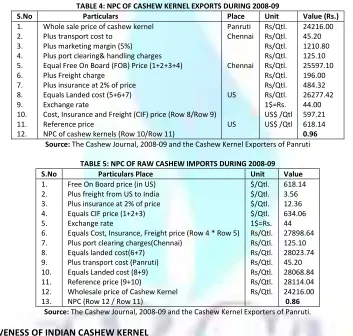
The Nominal Protection Coefficient (NPC) of export of cashew kernel for the year 2008-09 was found to be lower than unity (0.96) under exportable hypothesis (Table 4). This would imply that cashew kernel was a good exportable product. The nominal protection coefficient (NPC) of cashew kernel for the year 2008-09 under importable hypothesis is presented in Table 5 and this would indicate that the NPCs was found to be less than unity (0.86) which would indicate a good import substitute of raw cashew nut. The foregoing results revealed that cashew kernel was competitive in the international market and has a vast potential for export of the domestic industry.
TABLE 4: NPC OF CASHEW KERNEL EXPORTS DURING 2008-09
S.No Particulars Place Unit Value (Rs.)
1. 2. 3. 4. 5. 6. 7. 8. 9. 10. 11. 12.
Whole sale price of cashew kernel Plus transport cost to
Plus marketing margin (5%) Plus port clearing& handling charges Equal Free On Board (FOB) Price (1+2+3+4) Plus Freight charge
Plus insurance at 2% of price Equals Landed cost (5+6+7) Exchange rate
Cost, Insurance and Freight (CIF) price (Row 8/Row 9) Reference price
NPC of cashew kernels (Row 10/Row 11)
Panruti Chennai Chennai US US Rs/Qtl. Rs/Qtl. Rs/Qtl. Rs/Qtl. Rs/Qtl. Rs/Qtl. Rs/Qtl. Rs/Qtl. 1$=Rs. US$ /Qtl


![TABLE 6: SWOC ANALYSIS FOR FDI IN MULTIBRAND RETAILING - CHALLENGES[C]](https://thumb-us.123doks.com/thumbv2/123dok_us/207124.2015046/58.595.28.568.49.258/table-swoc-analysis-fdi-multibrand-retailing-challenges-c.webp)