
International Journal of Engineering
J o u r n a l H o m e p a g e : w w w . i j e . i rThe Effect of Anisotropy on Free Vibration of Rectangular Composite Plates with Patch
Mass
R. Alibakhshi *
Department of Mechanical Engineering, Babol University of Technology, P. O. Box 484, Babol, Iran
A R T I C L E I N F O
Article history: Received 15 June 2011
Received in revised form 15 Febuary 2012 Accepted 17 May 2012
Keywords: Free Vibration Patch Mass
Laminated Composite Plate Anisotropy
Refined Plate Theory
A B S T R A C T
In this paper, the effect of anisotropy on the free vibration of laminated rectangular plate supporting a localized patch mass is investigated. The two variable refined plate theory is applied to define the third order displacement field of a composite rectangular plate. The plate is considered to have simply supported boundaries. The equations of motion for rectangular plate are obtained by calculus of variation. Parametric study of non-dimensional natural frequencies is carried out and the influences of geometrical parameters such as aspect ratio of the plate, size and location of the patch mass on these frequencies are also studied. First, the results obtained are compared with those reported using several plate theories. In the next step, the effect of anisotropy on free vibration of plates for different types of lamination are studied. The numerical results are found to be in a very good agreement with well known published papers for the case of vibration analysis of loaded and unloaded plates.
doi:10.5829/idosi.ije.2012.25.03b.09
1. INTRODUCTION1
Composite materials are simply a combination of two or more different materials that may provide superior and unique mechanical and physical properties. These materials have high strength to weight ratio compared with other materials. Practically, these materials are exposed to various loading conditions such as distributed patch mass, transverse and in-plane loadings and etc. hence it is necessary to investigate their response to these loading conditions. Srinivas and Rao [1] studied the bending, vibration and buckling behavior of simply supported thick orthotropic rectangular laminated plates and obtained normal and shear stresses under the effect of uniformly distributed transverse load. Withney and Pagano [2] investigated free vibration response of a composite plate using first order shear deformation theory (FSDT) and employed the Yang-Norris-Stavski (YNS) theory to study the cylinrical bending of anti-symmetric cross-ply and angle-ply plate strips with sinusoidal loading. Bert and Chen [3] presented a closed form solution for the free vibration of simply supported anti-symmetric rectangular plates based on the YNS theory. Shankara
*Corresponding Author Email: [email protected](R. Alibakhshi)
vibration response of anti-symmetric laminated rectangular plates with distributed patch mass. Seung-Eock et al. [13] employed the two variable refined plate theory (RPT2) for plates which are under the action of the transverse and in-plane forces and obtained the stiffness and mass matrices using Hamilton principle. They compared the non-dimensional deflection obtained by various theories namely the classical laminate plate theory, the first order shear deformation theory, the higher order shear deformation theory and the refined plate theory. They showed that the RPT2 gives more accurate results of deflection and buckling load than the HSDT in comparison with the three-dimensional elasticity solution. Seung-Eock et al. [14] also carried out buckling analysis of isotropic and orthotropic plates using the two variable refined plate theory. A closed form solution of a simply supported rectangular plate subjected to in-plane loading was obtained using Navier's method. In this paper, the non-dimensional first natural frequency of vibration with simply supported boundary conditions and under the effect of a patch mass in arbitrary dimensions and positions is obtained. The effect of various parameters such as position of the patch mass and the aspect ratio of the plate on free vibration are also studied.
2. BASIC FORMULATION
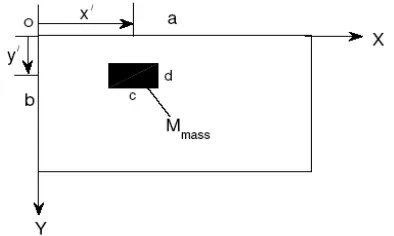
A rectangular plate with length, width and thickness equal to a, b and h respectively is considered. The plate supports a distributed patch mass, Mmass, with
dimensions equal to c and d in the x and y-direction,
respectively which is located in arbitrary position ( , )x y¢ ¢ in Figure 1. The mass is considered to be placed on the upper surface of the plate. The global Cartesian coordinate system is chosen with the origin at the corner and on the middle plane of the plate, z=0. Therefore, the domain of plate is defined as 0£x£a, 0£y£b and
2
2 z h
h £ £
- .
In order to proceed with the formulation of the problem using the two variable refined plate theory (RPT2), it is assumed that the displacements (u,v,w)
of the plate are small in comparison with the thickness of the plate, hence the strains involved are considered to be infinitesimal. On the other hand, the transverse normal stress in the z-direction,sz, is very small in comparison with the in-plane stresses,sx and sy. As a consequence of the above definition, the stress–strain relations can be reduced from a 6´6 matrix to a 5´5 matrix which can reduce the complexity of the problem. The total displacement of the plate in the z-direction (W) is assumed to be consisting of three components, wa
(extension), wb (bending) and ws (shear) which are functions of
x
,y
and the time [13].) , , ( ) , , ( ) , , ( ) , , ,
(x yzt w x yt w x yt w x yt
W = a + b + s (1)
The displacements in the x and y-directions are also defined as [13]:
) , , ( ) , , ( ) , , ( ) , , ,
(x y z t u x y t u x y t u x y t
U = + b + s
) , , ( ) , , ( ) , , ( ) , , ,
(x y z t v x yt v x yt v x y t
V = + b + s
(2)
The bending components of displacements i.e. ub
and vb are considered to be similar to their corresponding components of displacements, u and v (component of extension) as defined in the classical plate theory (CPT). It means that:
(
w x)
z
ub =- ¶ b ¶ , vb=-z
(
¶wb ¶y)
(3) Considering the fact that the shear stresses tzx andzy
t are zero at upper and lower faces of the plate,
2
h
z=+ and z=-h 2, respectively, the shear displacement us and vs can be written as [13]:
x w h z z
u s
s 
¶ ÷ ÷ ø ö ç
ç è æ
÷ ø ö ç è æ -=
2
3 5 4
1 ,
y w h z z
v s
s
¶ ¶ ÷ ÷ ø ö ç
ç è æ
÷ ø ö ç è æ -=
2
3 5 4
1
(4) Each layer is assumed to have orthotropic material property, hence the stress-strain relations in the direction of the principle axes of orthotropy are found to be as:
ï ï ï ï
þ ïï ï ï
ý ü
ï ï ï ï
î ïï ï ï
í ì
ú ú ú ú ú ú ú ú
û ù
ê ê ê ê ê ê ê ê
ë é
=
ï ï ï ï
þ ïï ï ï
ý ü
ï ï ï ï
î ïï ï ï
í ì
xz yz xy z y x
xz yz xy z y x
Q Q Q Q Q Q
Q Q Q
Q Q Q
g g g e e e
t t t s s s
66 55 44 33 23 13
23 22 12
13 12 11
0 0 0 0 0
0 0
0 0 0
0 0 0
0 0
0 0 0
0 0 0
0 0 0
(5)
where Qij are the components of the reduced
stiffness matrix and are expressed in terms of material properties of each layer.
. ,
, 0
, ,
1 , 1
12 66 13
55 23 44 33 23 13
22 12 12 21 12
2 22 21 12
1 11
G Q and G Q G Q Q Q Q
Q Q E Q E Q
= =
= = = =
=
-=
-= u
u u u
u (6)
Equation (5) represents the stress-strain relations in an especially orthotropic material, where the principle axes of orthotropy are parallel to the geometric axes of the plate (x, y), i.e. the direction of application of the load.
Figure 1. A rectangular plate with a localized patch mass ( ) ( ) ( ) ( ) ( ) ï ï ï î ïï ï í ì ï ï ï þ ïï ï ý ü xz k yz k xy k y k x k t t t s s = ) ( 55 45 45 44 66 26 16 26 22 12 16 12 11 0 0 0 0 0 0 0 0 0 0 0 0 k Q Q Q Q Q Q Q Q Q Q Q Q Q ú ú ú ú ú ú û ù ê ê ê ê ê ê ë
é ( )
( ) ( ) ( ) ( ) ï ï ï î ïï ï í ì ï ï ï þ ïï ï ý ü xz k yz k xy k y k x k g g g e e (7)
where k indicates the layer number and Qij are the
material constants of the kth lamina in the laminate coordinate system.
In order to obtain the equations of motion by the Hamilton principle, the strain energy and the kinetic energy of the plate are first defined. The definition of the strain energy is as follows:
ò
= V ij ij plate dVU s e
2 1
(8) The strain energy of the plate can be written as [13]:
a xz a xz a yz a yz s xz s xz s yz s yz s y s y s xy s xy s x s x b y b y b xy b xy b x b x A y y xy xy x x plate Q Q Q Q M M M M M M N N N U pltae g g g g k k k k k k e g e + + + + + + + + + + + +
=
ò
0 0 02 1
(9)
where
{ }
N ,{ }
M and { }Q are the stress resultants of the total N layers of the plate and defined in Appendix.The total kinetic energy is the summation of the kinetic energy of the plate and the kinetic energy of the uniformly distributed patch mass with dimensions c and d acting on the top surface of the plate.
plate mass T T
T= + (10)
The kinetic energy of plate is defined as:
ò
÷÷øö ç ç è æ ÷ ø ö ç è æ ¶ ¶ + ÷ ø ö ç è æ ¶ ¶ + ÷ ø ö ç è æ ¶ ¶ = V plate dxdydz t W t V t U T 2 2 2 2 1 r (11)
Substituting Equations (1) to (4) into Equation (11), and considering the limits of integration in the plate, the kinetic energy of plate can be written as:
. 84 2 1 2 1 2 1 0 0 2 2 2 0 0 2 2 2 0 0 2 2 2 0 dxdy y w x w I dxdy y w x w I dxdy w w w v u I T b a s s b a b b b a s b a plate
ò ò
ò ò
òò
ú ú ú û ù ê ê ê ë é ÷÷ ÷ ø ö çç ç è æ ¶ ¶ + ÷÷ ÷ ø ö çç ç è æ ¶ ¶ + ú ú ú û ù ê ê ê ë é ÷÷ ÷ ø ö çç ç è æ ¶ ¶ + ÷÷ ÷ ø ö çç ç è æ ¶ ¶ + ú ú û ù ê ê ë é ÷ ø ö ç èæ + +
+ + = & & & & & & & & & (12)
where I0,I2are the inertia terms as below:
( )
(
)
2 2 0 2 2 , 1, h hI I r z d z
-=
ò
(13)The kinetic energy of the distributed patch mass (Mmass) which is located on the top surface of the plate
(
z=h2)
can be written as:dydx w w w y w h y w h v x w h x w h u h T c x c x d y d y s b a s b s b m m mass
ò ò
+ ¢ -¢ + ¢ -¢ ÷ ÷ ÷ ÷ ÷ ÷ ÷ ÷ ÷ ÷ ÷ ÷ ÷ ø ö ç ç ç ç ç ç ç ç ç ç ç ç ç è æ úû ù êë
é + +
+ ú ú ú û ù ê ê ê ë é ÷÷ ÷ ø ö çç ç è æ ¶ ¶ -÷÷ ÷ ø ö çç ç è æ ¶ ¶ -+ ú ú ú û ù ê ê ê ë é ÷÷ ÷ ø ö çç ç è æ ¶ ¶ -÷÷ ÷ ø ö çç ç è æ ¶ ¶ -= 2 2 2 2 2 2 2 12 2 12 2 2 1 & & & & & & & & & r (14)
where rm and hm are the density of the patch mass and its thickness in the z-direction, respectively. It is observed that the ranges of integration for Equations (12) and (14) are different. Hamilton principle is employed to obtain the coefficients of mass and stiffness matrices.
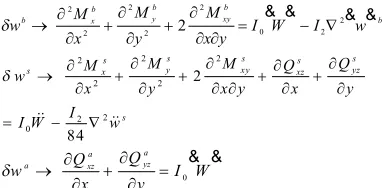
Substituting the displacements field in the relevant strain energy and kinetic energy terms, integrating the results and obtaining their first variation, the equations of motion are found. Substituting Equations (9), (12) and (14) into Equation (15) that called Hamilton principle and carrying out integration by parts, the equations of motion are derived as:
(
)
ò
+ - =2 1 0 t t dt T U V d (15)
where d presents a variation with respect to x and y. Here V denotes the work done due to applied loads. Since primary aim is in the free vibration analysis, the energy due to applied forces is zero. Substitution of displacements into Equation (15) and integrating the equation by parts, the equations of motion are obtained as: u I y N x N
u x xy & &
0 = ¶ ¶ + ¶ ¶ ® d v I x N y N
v y xy & &
b b xy b y b x
b I W I w
y x M y M x M
w & & 2& & 2 0 2 2 2 2 2
2 = - Ñ
¶ ¶ ¶ + ¶ ¶ + ¶ ¶ ® d 2 2 2 2 2 2 2 0 2 84
s s s
s s
y xy yz
s x xz
s
M M Q
M Q
w
x y x y x y
I
I W w
d ® ¶ +¶ + ¶ +¶ +
¶ ¶ ¶ ¶ ¶ 
= &&- Ñ &&
W I y Q x Q w a yz a xz
a & &
0 = ¶ ¶ + ¶ ¶ ® d
Finally, by collecting the coefficients of parts, the governing equation of plate vibration is obtained as below:
[ ] [ ]
(
S - M w2)
{ } { }
l = 0 (17)where [S], [M], w and l are the stiffness [13], mass matrices, natural frequency and the vector of unknown coefficients, respectively.
For convenience, the non-dimensional natural frequency of plate is defined as [11]:
2
2 a
h E
r
w =w (18)
3. PROBLEM DEFINITION
Now, a set of boundary conditions are considered and it is called the SS-2 boundary condition that is applied for an anti-symmetric angle-ply laminate and is defined by . K.Seung-Eock et al. [13].
In order to satisfy the boundary conditions, the following displacement fields are assumed:
å å
¥ = ¥ = ï ï ï þ ïï ï ý ü ï ï ï î ïï ï í ì = ï ï ï þ ïï ï ý ü ï ï ï î ïï ï í ì 1 1 sin sin sin sin sin sin cos sin sin cos m n n m amn n m smn n m bmn n m mn n m mn a s b y x W y x W y x W y x V y x U w w w v u b a b a b a b a b a (20)where a=mp a,b = np b and Umn, Vmn, Wbmn,
smn
W , Wamn are coefficients.
4. RESULTS AND DISCUSSION
Three sets of dimensionless material properties are considered: MAT1: 25 . 0 , 5 . 0 , 6 . 0 ,
40 12 2 23 2 13 2 12
2
1 E = G E = G E =G E = n =
E MAT2: 3 . 0 , 6 . 0 , 4 . 0
, 23 2 12 2 13 2 12
2
1 E =openG E = G E =G E = n =
E MAT3: 25 . 0 , 5 . 0 , 2 . 0
, 23 2 12 2 13 2 12
2
1 E =openG E = G E =G E = n =
E
At first, the effect of the distributed patch mass is not considered and vibration response of a plate without the patch mass is studied. The results are then compared with the results obtained using the second order shear deformation theory for angle-ply and cross-ply square laminated plates as reported by Khdeir and Reddy [7]. The results obtained with a h as a parameter for four layers anti-symmetric angle-ply, MAT1 with
2 13 0.6E
G = , [45/-45]2 and two layer cross-ply
(
0/90)
,MAT3 are presented in Table 1. Comparison of the results indicates that the results obtained using the present method are lower than those of the second order shear deformation theory. This difference reduces as the ratio a h increases. Table 2 shows the effect of aspect ratios on the natural frequencies of a four-layer composite plate. The accuracy of the RPT2 is presented with comparing of well known published results. In order to evaluate the accuracy of the RPT2, the % error is calculated as:
÷÷ ø ö çç è æ -´
=100 2 1
% theory other by value ing Correspond RPT the by obtained value error (21)
The % error in values of the non-dimensional first natural frequencies for a/h=10 and a/h=50 is shown in Figure 2. It is observed from Figure 2 that the % error of the RPT2 with the YNS and HSDT has the same results (when a»2b and a/h=10). The ranges of the % error with corresponding values of the FEM, YNS, HSDT and TSDT are inside the intervals [0.1664 3.4017], [0.6591 2.7373], [0.0268 1.8973] and [0.0002 1.6531],
respectively. It is interesting to know that the % error increases with increasing the a/h ratio for the FEM and also decreases for YNS, HSDT and TSDT.
Now, a distributed patch mass, Mmass, at the centre
of the plate (x¢=a 2,y¢=b 2) with the following properties is considered:
. 125 . 3 125 . 3 5 . 0 4 . 0 , 5 . 0 0 I h h hab cd h b d a c M M m m m m plate mass = = ® = ® = = = r r r r
With above definition of patch mass properties, the kinetic energy of mass is obtained as below:
dxdy y w x w I dxdy y w x w I dxdy w w w v u I T a a b b s s a a b b b b a a b b s b a mass
ò ò
ò ò
ò ò
ú ú ú û ù ê ê ê ë é ÷÷ ÷ ø ö çç ç è æ ¶ ¶ + ÷÷ ÷ ø ö çç ç è æ ¶ ¶ + ú ú ú û ù ê ê ê ë é ÷÷ ÷ ø ö çç ç è æ ¶ ¶ + ÷÷ ÷ ø ö çç ç è æ ¶ ¶ + ÷ ÷ ø ö ç ç è æ ÷ ø ö ç èæ + +
+ + = 7 . 0 3 . 0 7 . 0 3 . 0 2 2 2 7 . 0 3 . 0 7 . 0 3 . 0 2 2 2 7 . 0 3 . 0 7 . 0 3 . 0 2 2 2 0 2604 . 0 2 1 3750 . 9 2 1 1250 . 3 2 1 & & & & & & & & & (22)
Using Equation (14), the arrays of mass matrix are:
0 11 1.2136I
M = , M22 =1.2136I0,
0
34 2.5436I
0 35 2.5436I
M = , M45 =2.5436I0,
0 55 2.5436I
M =
2 2
33 0 2
2 2
44 0 2
2.5436 1.65 (( ) ( ) )
1
2.5436 ( 0.167)(( ) ( ) )
84
p p
= + +
p p
= + + +
M I I a b
M I I a b
The effect of the distributed patch mass on vibration response of isotropic plate is studied.
Then, the results are compared with the results obtained using the three order shear deformation theory for angle-ply laminates as reported by Alibegloo [11]. The results obtained with
( )
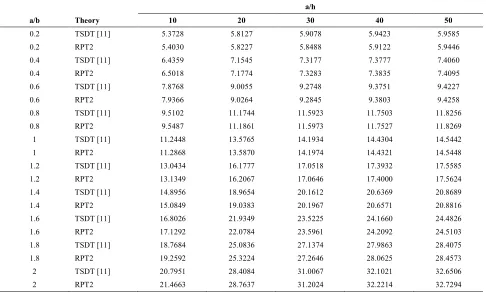
a h as a parameter are presented in Table 3. In Figure 3, the results obtained by the present study (RPT2) are compared with the results obtained by (TSDT) method [11]. It is considered the same position of patch mass for anisotropic plate. In Table 4, the effect of anisotropy on free vibration of rectangular different laminated plates with patch mass at the centre of the plate for MAT2 is presented (E1 E2aspect ratio is also variable). As shown by Table 4, the results of FNF for anisotropic plate
[
a/a/-a/a]
are greater than the results for anisotropic plate[
a/a/a/-a]
and also isotropic plate[
a/-a/a/-a]
with patch mass. In the next step, the distributed patch mass in three different positions of the plate is considered and the results of FNF for anisotropic different laminated plates are compared together in Table 5. These three positions of the distributed patch mass are assumed as:2 , 4 1
1 a y b
x¢= ¢= , 2) x¢2=a2,y¢2=b4, 3) x3¢=a6,y3¢=b5
and properties of the distributed patch mass are considered as Mmass Mplate=0.3,c a=d b=0.2.
The arrays of mass matrix for these three positions are defined in Appendix. Table 5 shows the effect of a h
and ab ratios on free vibration of four-layer anisotropic plates with patch mass. Increasing of the foregoing ratios leads to increase of the non-dimensional first natural frequencies. On the other hand, the effects of these ratios on anisotropic laminated plate
[
a/a/-a/a]
are greater than anisotropic laminated plate[
a/a/a/-a]
. Due to symmetry imposed by the boundary conditions of the plate, it is observed that patch mass in position 1 and position 2 would have similar natural frequencies of vibration.5. CONCLUSION
In this study, the two variable refined plate theory for vibration study of laminated composite isotropic and anisotropic plates with patch mass was developed. Firstly, the governing equation of rectangular plate vibration with a patch mass was obtained by this theory. On the other hand, the effect of various parameters such as size and location of distributed patch mass, different aspect ratios and different types of anisotropy on the natural frequency of plate vibration was studied. To illustrate the accuracy of RPT2, the results obtained by this theory were compared with the results obtained by the well known theories. The main conclusions are as follows:
1) The RPT2 is variationally consistent and number of unknown functions involved in this theory is only two.
2) As seen in section 4, the RPT2 has more consistency with TSDT compared to FEM, YNS and HSDT.
3) The % error of the RPT2 in frequency value approaches to zero in respect of FEM from abf1 to a»2b at a h=10.
4) The % error of the RPT2 in frequency value approaches to zero in respect of HSDT and TSDT at a b=1 and a h=10.
5) Increasing the ratio of a/h can cause to increase the % error of RPT2 with FEM and decrease the % error for YNS, HSDT and TSDT.
6) Considering the large values of a/h ratio, the RPT2 has more consistency with YNS, HSDT and TSDT than FEM for rectangular composite plates. 7) Amount of patch mass and its location leads to
change fundamental frequencies.
8) The lowest natural frequency of plate with symmetric boundary conditions occurs with the patch mass at the centre of the plate. The natural frequency increases with the patch mass moving towards the corner of the plate.
9) The influences of aspect ratios on free vibration of anisotropic plates
[
a/a/-a/a]
are greater than anisotropic plates[
a/a/a/-a]
and also isotropic plates[
a/-a/a/-a]
TABLE 1. The non-dimensional first natural frequency
a/h
Theory/Laminate 5 10 20 50 100
SSDT / Angle ply[7] 12.928 18.665 21.954 23.252 23.458
RPT2 / Angle ply 12.534 18.320 21.803 23.223 23.451
SSDT / Cross ply[7] 7.609 8.997 9.504 9.665 -
TABLE 2. Thenon-dimensional first natural frequency, MAT1, [45/-45]2
a/b
a/h Sources 0.2 0.6 0.8 1 1.2 1.6 2
10 Reddy [5] 8.7240 12.9650 15.7120 18.6090 21.5670 27.7360 34.2470 Bert [3] 8.6640 12.8200 15.5400 18.4600 21.5100 27.9500 34.8700 Shankara [4] 8.5557 12.5588 15.1802 17.9735 20.8797 26.9916 33.5534 Alibeigloo [11] 8.5587 12.5646 15.1873 17.9829 20.8947 27.0306 33.6340 Present 8.6060 12.6424 15.2101 17.9784 20.9214 27.2818 34.1900
20 Reddy [5] 9.4750 14.8960 18.5570 22.5840 26.8570 36.2490 46.7890 Bert [3] 9.3000 14.4500 17.9700 21.8700 26.1200 35.5600 46.2600 Shankara [4] 9.3011 14.3856 17.8458 21.6808 25.8363 35.0421 45.4096 Alibeigloo [11] 9.2661 14.3594 17.8217 21.6588 25.8174 35.0365 45.4305 Present 9.2825 14.3887 17.8302 21.6552 25.8278 35.1772 45.8175
30 Reddy [5] 9.6670 15.3850 19.3040 23.6760 28.3810 38.9400 51.1320 Bert [3] 9.4360 14.8400 18.5600 22.7400 27.3500 37.8200 49.9800 Shankara [4] 9.4880 14.8427 18.5390 22.6911 27.2555 37.5907 49.5474 Alibeigloo [11] 9.4196 14.7896 18.4866 22.6371 27.1995 37.5341 49.4992 Present 9.4274 14.8038 18.4908 22.6352 27.2047 37.6112 49.7263
40 Reddy [5] 9.7590 15.8530 19.6040 24.1180 29.0030 40.0710 53.0120 Bert [3] 9.4850 14.9800 18.7800 23.0800 27.8300 38.7200 51.5200 Shankara [4] 9.5724 15.0248 18.8134 23.0940 27.8286 38.6523 51.3324 Alibeigloo [11] 9.4754 14.9500 18.7384 23.0137 27.7409 38.5499 51.2217 Present 9.4799 14.9583 18.7408 23.0125 27.7439 38.5969 51.3642
50 Reddy [5] 9.8160 15.6890 19.7590 24.3430 29.3210 40.6530 53.9890 Bert [3] 9.5070 15.0400 18.8900 23.2400 28.0600 39.1700 52.2900 Shankara [4] 9.6216 15.1177 18.9510 23.2956 28.1168 39.1932 52.2539 Alibeigloo [11] 9.5016 15.0261 18.8586 23.1948 28.0031 39.0503 52.0860 Present 9.5045 15.0315 18.8602 23.1940 28.0051 39.0815 52.1822
0 0.5 1 1.5 2
0 0.5 1 1.5 2 2.5 3 3.5
a/b
%
E
rr
or
0 0.5 1 1.5 2
0 1 2 3 4 5
a/b
%
E
rr
or
TABLE 3. The non-dimensional first natural frequency, MAT1,[45/-45]2
a/h
a/b Theory 10 20 30 40 50
0.2 TSDT [11] 5.3728 5.8127 5.9078 5.9423 5.9585
0.2 RPT2 5.4030 5.8227 5.8488 5.9122 5.9446
0.4 TSDT [11] 6.4359 7.1545 7.3177 7.3777 7.4060
0.4 RPT2 6.5018 7.1774 7.3283 7.3835 7.4095
0.6 TSDT [11] 7.8768 9.0055 9.2748 9.3751 9.4227
0.6 RPT2 7.9366 9.0264 9.2845 9.3803 9.4258
0.8 TSDT [11] 9.5102 11.1744 11.5923 11.7503 11.8256
0.8 RPT2 9.5487 11.1861 11.5973 11.7527 11.8269
1 TSDT [11] 11.2448 13.5765 14.1934 14.4304 14.5442
1 RPT2 11.2868 13.5870 14.1974 14.4321 14.5448
1.2 TSDT [11] 13.0434 16.1777 17.0518 17.3932 17.5585
1.2 RPT2 13.1349 16.2067 17.0646 17.4000 17.5624
1.4 TSDT [11] 14.8956 18.9654 20.1612 20.6369 20.8689
1.4 RPT2 15.0849 19.0383 20.1967 20.6571 20.8816
1.6 TSDT [11] 16.8026 21.9349 23.5225 24.1660 24.4826
1.6 RPT2 17.1292 22.0784 23.5961 24.2092 24.5103
1.8 TSDT [11] 18.7684 25.0836 27.1374 27.9863 28.4075
1.8 RPT2 19.2592 25.3224 27.2646 28.0625 28.4573
2 TSDT [11] 20.7951 28.4084 31.0067 32.1021 32.6506
2 RPT2 21.4663 28.7637 31.2024 32.2214 32.7294
TABLE 4. The non-dimensional first natural frequency, MAT2,a=45, ah=10, ba=5
2
1 E
E
Lamination 3 10 20 30 40 50
[a/a/a/-a] [a/a/-a/a]
[
a/-a/a/-a]
Anisotropic Anisotropic Isotropic
2.3777 2.4509 2.4170
3.1280 3.4579 3.3041
3.8942 4.4488 4.1924
4.4884 5.1890 4.8643
4.9798 5.7836 5.4082
5.4003 6.2802 5.8650
0 5 10 15 20 25 30 35 40 45 50 0
5 10 15 20 25
a/h
N
on-d
im
en
sio
na
l f
ir
st
na
tura
l f
re
qu
en
cy
a/b=0.2 a/b=0.6 a/b=1 a/b=1.4 Results based on RPT2 (Present) Results based on TSDT
TABLE 5. The non-dimensional first natural frequency, MAT1, [45/-45]2
a/h
a/b Lamination 10 20 30 40 50
Position 1
0.2
[
a a a -a]
/ /
/ 5.1686 5.4812 5.5464 5.5699 5.5808
[
a/a/-a/a]
5.9248 6.3796 6.4770 6.5123 6.52880.8
[
]
a a a
a/ / /- 9.6697 10.9556 11.2588 11.3713 11.4247
[
a/a/-a/a]
10.5704 12.2834 12.7075 12.8672 12.94321.4
[
]
a a a
a/ / /- 15.6051 18.8574 19.7285 20.0647 20.2264
[
a/a/-a/a]
16.7904 20.9722 22.1700 22.6425 22.87222
[
a a a -a]
/ /
/ 22.4899 28.7611 30.6523 31.4126 31.7851
[
a/a/-a/a]
23.9509 31.7737 34.3236 35.3791 35.9031 Position 20.2
[
a/a/a/-a]
5.1873 5.4874 5.5493 5.5715 5.5819[
a/a/-a/a]
5.9419 6.3857 6.4799 6.5139 6.52990.8
[
a/a/a/-a]
9.6783 10.9595 11.2608 11.3725 11.4254[
a/a/-a/a]
10.5776 12.2872 12.7095 12.8684 12.94401.4
[
]
a a a
a/ / /- 15.5793 18.8416 19.7198 20.0593 20.2229
[
a/a/-a/a]
16.7713 20.9576 22.1614 22.6372 22.86862
[
]
a a a
a/ / /- 22.4069 28.6941 30.6119 31.3870 31.7678
[
a/a/-a/a]
23.8950 31.7157 34.2856 35.3542 35.8860 Position 30.2
[
a a a -a]
/ /
/ 6.1358 6.5294 6.6089 6.6372 6.6504
[
a/a/-a/a]
7.0136 7.5981 7.7175 7.7602 7.78010.8
[
a a a -a]
/ /
/ 11.3638 13.0331 13.4101 13.5479 13.6128
[
a/a/-a/a]
12.2959 14.5948 15.1317 15.3289 15.42181.4
[
]
a a a
a/ / /- 18.0563 22.3655 23.4754 23.8945 24.0943
[
a/a/-a/a]
19.0972 24.7965 26.3612 26.9582 27.24352
[
a a a -a]
/ /
/ 25.5836 33.9495 36.4142 37.3800 37.8470
[
a/a/-a/a]
26.6909 37.3022 40.7176 42.0805 42.74286. REFERENCES
1. Srinivas, S. and Rao, AK., “Bending, vibration and buckling of simply supported thick orthotropic rectangular plates and laminates”, International Journal of Solids and Structures, Vol. 6, (1970), 1463-1481.
2. Withney, JM. and Pagano, NJ., “Shear deformation in heterogeneous anisotropic plates”, ASME Journal of Applied
Mechanics; Vol. 37,(1970),1031-1036.
3. Bert, CW. and Chen, TLC., “Effect of shear deformation on vibration of antisymmetric angle-ply laminated rectangular plates”, International Journal of Solids and Structures, Vol. 14, (1978), 465-473.
4. Shankara, CA. and Iyengar, NG., “A C element for the free 0
vibration analysis of laminated composite plates”, Journal of
Sound and Vibration, Vol. 191, (1996), 721-738.
6. Reddy, JN., “A simple higher order theory for laminated composite plates”. ASME Journal of Applied Mechanics, Vol. 51, (1984), 745-52.
7. Khdeir, AA. and Reddy, JN., “Free vibrations of laminated composite plates using second-order shear deformation theory”,
Journal of Computers and Structures Vol. 71, (1999), 617-626.
8. Wong, WO., “The effect of distributed mass loading on plate vibration behaviour”, Journal of Sound and Vibration, Vol. 252, (2002), 577-583.
9. Shimpi, RP. and patel, HG., “A two variable refined plate theory for orthotropic plate analysis”, International Journal of
Solids and Structures, Vol. 43, (2006), 6783-6799.
10. Shimpi, R.P. and patel, H.G., “Free vibrations of plate using two variable refined plate theory”. Journal of Sound and Vibration, Vol. 296, (2006), 979-999.
11. Alibeigloo, A., Shakeri, M. and Kari, MR., “Free vibration of anti-symmetric laminated rectangular plates with distributed patch mass using third-order shear deformation theory”.
Journal of Ocean Engineering, Vol. 35, (2008), 183-190.
12. Alibeigloo, A. and Kari, MR., “Forced vibration analysis of anti-symmetric laminated rectangular plates with distributed patch mass using third order shear deformation theory”.
Journal of Thin-Walled Structures, Vol. 47, (2009), 653-660.
13. Seung-Eock, K., Huu-Tai, T. and Lee, J., “A two variable refined plate theory for laminated composite plates”, Journal of
Composite Structures, Vol. 89, (2009), 197-205.
14. Seung-Eock, K., Huu-Tai, T and, Lee, J., “Buckling analysis of plates using the two variable refined plate theory”, Journal of
Thin Walled Structures, Vol. 47, (2009), 455-462.
APPENDIX
( ) ( )
( )
( )
( ) ( )
( )
( )
. b e . a . I b a I I . M b e . a . I b a I I . M I . M M M M M , I . M matrix Mass of arrays The ÷÷ ÷ ÷ ø ö çç ç ç è æ ´ -+ ´ + ÷ ø ö ç è æ + + = ÷÷ ÷ ÷ ø ö çç ç ç è æ ´ -+ ´ + ÷ ø ö ç è æ + + = = = = = = = ® 2 2 2 2 2 2 0 44 2 2 2 2 2 2 0 33 0 55 45 35 34 22 0 11 4 4511 6 0194 0 6 84 5820 1 4 4511 6 0194 0 90 5820 1 5820 1 0194 1 p p p p p p p p 1 Position( ) ( )
( )
( )
( ) ( )
( )
( )
. b e . a . I b a I I . M b e . a . I b a I I . M I . M M M M , I . M , I . M ÷÷ ÷ ÷ ø ö çç ç ç è æ ´ -+ ´ + ÷ ø ö ç è æ + + = ÷÷ ÷ ÷ ø ö çç ç ç è æ ´ -+ ´ + ÷ ø ö ç è æ + + = = = = = = = ® 2 2 2 2 2 2 0 44 2 2 2 2 2 2 0 33 0 55 45 35 34 0 22 0 11 4 4511 6 0194 0 6 84 5820 1 4 4511 6 0194 0 90 5820 1 5820 1 0194 1 5820 1 p p p p p p p p 2 Position( ) ( )
( )
( )
( ) ( )
( )
( )
. b . a . I . b a I I . M b . a . I b a I I . M , I . M , I . M M M , I . M , I . M ÷÷ ÷ ÷ ø ö çç ç ç è æ ´ + ´ + ÷ ø ö ç è æ + + = ÷÷ ÷ ÷ ø ö çç ç ç è æ ´ + ´ + ÷ ø ö ç è æ + + = = = = = = = ® 2 2 2 2 2 2 0 44 2 2 2 2 2 2 0 33 0 45 0 55 35 34 0 22 0 11 0069 0 0104 0 5 2 84 5820 1 0069 0 0104 0 90 1140 1 5820 1 1140 1 3120 1 2070 1 p p p p p p p p 3 Position(
)
(
)
(
)
(
)
( )(
)
(
)
(
)
( )(
)
( )(
)
( )(
)
(
)
(
)
(
w x)
,(
w y)
,(
w x y)
The Effect of Anisotropy on Free Vibration of Rectangular Composite Plates with Patch
Mass
Department of Mechanical Engineering, Babol University of Technology, P. O. Box 484, Babol, Iran
A R T I C L E I N F O
Article history: Received 15 June 2011
Received in revised form 15 Febuary 2012 Accepted 17 May 2012
Keywords: Free Vibration Patch Mass
Laminated Composite Plate Anisotropy
Refined Plate Theory
هﺪﯿﮑﭼ
،ﻪﻟﺎﻘﻣﻦﯾارد
ﯽﻣﯽﺳرﺮﺑﻪﺘﺳﻮﯿﭘمﺮﺟﻊﯾزﻮﺗﻞﻣﺎﺣﯽﻠﯿﻄﺘﺴﻣتﺎﺤﻔﺻدازآتﺎﺷﺎﻌﺗرايورﺮﺑيدﺮﮕﻧﺎﺴﻤﻫﺎﻧﺮﯿﺛﺄﺗ
دﻮـﺷ
.
زا
ﯽﻣهدﺎﻔﺘﺳاﯽﻠﯿﻄﺘﺴﻣﯽﺘﯾزﻮﭙﻣﺎﮐتﺎﺤﻔﺻﻪﺳﻪﺒﺗﺮﻣﯽﯾﺎﺠﺑﺎﺟناﺪﯿﻣﻒﯾﺮﻌﺗياﺮﺑﻪﺤﻔﺻهﺪﺷحﻼﺻاﺮﯿﻐﺘﻣوديرﻮﺌﺗ
ددﺮﮔ
.
ﺣتﻻدﺎﻌﻣ
ﯽﻣﺖﺳﺪﺑنﻮﯿﺳﺎﯾراوﻪﺒﺳﺎﺤﻣﻂﺳﻮﺗﻪﺤﻔﺻﺖﮐﺮ
ﺪﯾآ
.
ﺲﻧﺎﮐﺮﻓﮏﯾﺮﺘﻣارﺎﭘﻪﻌﻟﺎﻄﻣ
ﺰـﯿﻧوﺪـﻌﺑنوﺪﺑﯽﻌﯿﺒﻃيﺎﻫ
ﺲﻧﺎﮐﺮﻓﻦﯾايورﺮﺑﻪﺘﺳﻮﯿﭘمﺮﺟنﺎﮑﻣوهزاﺪﻧا،ﻪﺤﻔﺻﺮﻫﺎﻇﺖﺒﺴﻧﻞﯿﺒﻗزاﯽﺳﺪﻨﻫيﺎﻫﺮﺘﻣارﺎﭘﺮﯾﺎﺳتاﺮﯿﺛﺄﺗ
ﯽـﺳرﺮﺑﺎـﻫ
ﯽﻣ دﻮﺷ
.
ﭼﻂﺳﻮﺗهﺪﺷشراﺰﮔﺞﯾﺎﺘﻧﺎﺑهﺪﻣآﺖﺳﺪﺑﺞﯾﺎﺘﻧاﺪﺘﺑارد
يرﻮﺌﺗﻦﯾﺪﻨ
ﺮـﺛاﺪﻌﺑﻪﻠﺣﺮﻣردوهﺪﺷﻪﺴﯾﺎﻘﻣتﺎﺤﻔﺻ
ﻪﯾﻻعﻮﻧﻦﯾﺪﻨﭼياﺮﺑﻪﺤﻔﺻدازآتﺎﺷﺎﻌﺗرايوريدﺮﮕﻧﺎﺴﻤﻫﺎﻧ
ﯽﻣراﺮﻗﻞﯿﻠﺤﺗدرﻮﻣتوﺎﻔﺘﻣﯽﻨﯿﭼ
دﺮﯿﮔ
.
نﺎﺸﻧﻪﻠﺻﺎﺣﺞﯾﺎﺘﻧ
ﺗراﻞﯿﻠﺤﺗﻪﻨﯿﻣزردهﺪﺷﺮﺸﺘﻣﺞﯾﺎﺘﻧﺎﺑﻪﺘﻓررﺎﮑﺑيرﻮﺌﺗيﻻﺎﺑﺖﻗدهﺪﻨﻫد
هﺪﺸﻧيراﺬﮔرﺎﺑوهﺪﺷيراﺬﮔرﺎﺑتﺎﺤﻔﺻتﺎﺷﺎﻌ
ﯽﻣ ﺪﺷﺎﺑ .

![Figure 2. The % error of the RPT2 in non-dimensional first natural frequencies with corresponding value by FEM [5] (corresponding value by YNS [3] (blue), red), corresponding value by HSDT [4] (green) and corresponding value by TSDT [11] (black) (Left, a/h=10 and Right, a/h=50)](https://thumb-us.123doks.com/thumbv2/123dok_us/237708.2018443/6.595.53.525.122.540/figure-dimensional-natural-frequencies-corresponding-corresponding-corresponding-corresponding.webp)
![TABLE 5. The non-dimensional first natural frequency, MAT1, [45/−45]](https://thumb-us.123doks.com/thumbv2/123dok_us/237708.2018443/8.595.55.537.110.597/table-non-dimensional-natural-frequency-mat.webp)