A Monthly Double-Blind Peer Reviewed (Refereed/Juried) Open Access International e-Journal - Included in the International Serial Directories Indexed & Listed at:
VOLUME NO.5(2015),ISSUE NO.04(APRIL) ISSN 2231-5756
INTERNATIONAL JOURNAL OF RESEARCH IN COMMERCE, IT & MANAGEMENT
CONTENTS
Sr.
No.
TITLE & NAME OF THE AUTHOR (S)
Page
No.
1.
ROBUST FACE IDENTIFICATION USING MOVIE
SUGANYA.C, SIVASANKARI.A & SANGEETHA LAKSHMI.G
1
2.
IMPACT OF ECONOMIC AND NON ECONOMIC VARIABLES ON CORPORATE GOVERNANCE COMPLIANCE
AND DISCLOSURE PRACTICES OF LISTED AND UNLISTED DEFENCE PUBLIC SECTOR ENTERPRISES IN INDIA
DR. U. PADMAVATHI
4
3.
IMPACT OF YOGA ON SCHOOL STUDENTS PERFORMANCE: A STUDY
DR. C. ANURADHA, DR. J. ANURADHA & DR. S. GOPALSAMY
12
4.
A STUDY ON MUTUAL FUND INVESTMENT PERSPECTIVES IN INDIA
S. CHAKRAVARTHI, DR. M SARADADEVI & N.SAIBABU
16
5.
ADVANCED ESSENTIALS BASED ON AGRICULTURE USING SOLAR TRACTOR WITH WIRELESS SENSOR
NETWORKS
K.DEEPASHREE, G.SANGEETHALAKSHMI & A.SIVASANKARI
19
6.
AN INVESTIGATION INTO THE DETERMINANTS OF SERVICE QUALITY IN COMMERCIAL BANKS
M. RAMESH, DR. G. VAMSHI & C. SIVARAMI REDDY
24
7.
THE IMPACT OF ATM SERVICES IN CANARA BANK IN MYSORE CITY
GEETHA S & DR. C S RAMANARAYANAN
28
8.
A CASE STUDY ON CORPORATE SOCIAL RESPONSIBILITY OF JINDAL STEEL WORK'S LTD, BELLARI
(KARNATAKA)
VENKATESHA K & DR. RAMESH.OLEKAR
32
9.
A STUDY OF LIQUIDITY AND PROFITABILITY ANALYSIS OF AN INDUSTRIAL UNIT IN ODISHA
JAYASHREE JETHY, SUPRAVA SAHU & MALAY K MOHANTY
37
10.
TRAINING AND MANAGEMENT DEVELOPMENT FOR PROMOTABILITY IN GHANAIAN ORGANIZATIONS
IDDIRISU ANDANI MU-AZU
41
11.
CROWD FUNDING AS INVESTMENT TOOL: DISCOVERING SOMETHING ADDITIONAL
REKHA SHARMA & NEHA THAKUR
44
12.
CHILD SEXUAL ABUSE AND EXPLOITATION: ROLE OF JUDICIARY
DR. MANPREET KAUR
48
13.
GREEN MARKETING AND MNCs: GO GREEN PROCESS IN INDIA
SEEMA BANGAR
50
14.
A STUDY STRESS MANAGEMENT AMONG TRAFFIC CONSTABLES WITH SPECIAL REFERENCE TO MYSURU
CITY
DR. A.C.PRAMILA
54
15.
MARKETING STRATEGIES OF PHARMACEUTICAL COMPANIES IN INDIA: A COMPARATIVE STUDY OF LUPIN
AND RANBAXY
RUCHI MANTRI, ANKIT LADDHA & PRACHI RATHI
56
16.
GREEN MARKETING: EVOLUTION, REASONS, ADVANTAGES AND CHALLENGES
MANJU KAMBOJ & RENU BALA
58
17.
IMPORTANCE OF RECORDS MANAGEMENT IN AN ORGANIZATION
DR. JUSTINA I. EZENWAFOR
63
18.
FACTORS RELATED TO JOB SATISFACTION OF ACADEMIC STAFF IN SRI LANKA INSTITUTE OF ADVANCED
TECHNOLOGICAL EDUCATION (SLIATE)
S.ANTONY
67
19.
WORKING CAPITAL ANALYSIS WITH SPECIAL REFERENCE TO SESHASAYEE PAPER AND BOARDS LIMITED,
ERODE
M.ANAND SHANKAR RAJA & SHENBAGAM KANNAPPAN
72
20.
IMPACT OF ENVIRONMENTAL AWARENESS ON YOUNG FEMALE CONSUMER ATTITUDES IN SELECTION
AND PURCHASE OF ECO-FRIENDLY APPARELS IN SELECTED CITIES OF UTTATAKHAND
JUBILEE GOYAL
77
CHIEF PATRON
PROF. K. K. AGGARWAL
Chairman, Malaviya National Institute of Technology, Jaipur
(An institute of National Importance & fully funded by Ministry of Human Resource Development, Government of India)
Chancellor, K. R. Mangalam University, Gurgaon
Chancellor, Lingaya’s University, Faridabad
Founder Vice-Chancellor (1998-2008), Guru Gobind Singh Indraprastha University, Delhi
Ex. Pro Vice-Chancellor, Guru Jambheshwar University, Hisar
FOUNDER PATRON
LATE SH. RAM BHAJAN AGGARWAL
Former State Minister for Home & Tourism, Government of Haryana
Former Vice-President, Dadri Education Society, Charkhi Dadri
Former President, Chinar Syntex Ltd. (Textile Mills), Bhiwani
CO-ORDINATOR
AMITA
Faculty, Government M. S., Mohali
ADVISORS
PROF. M. S. SENAM RAJU
Director A. C. D., School of Management Studies, I.G.N.O.U., New Delhi
PROF. M. N. SHARMA
Chairman, M.B.A., Haryana College of Technology & Management, Kaithal
PROF. S. L. MAHANDRU
Principal (Retd.), Maharaja Agrasen College, Jagadhri
EDITOR
PROF. R. K. SHARMA
Professor, Bharti Vidyapeeth University Institute of Management & Research, New Delhi
CO-EDITOR
DR. BHAVET
Faculty, Shree Ram Institute of Business & Management, Urjani
EDITORIAL ADVISORY BOARD
DR. RAJESH MODI
Faculty, Yanbu Industrial College, Kingdom of Saudi Arabia
PROF. SANJIV MITTAL
University School of Management Studies, Guru Gobind Singh I. P. University, Delhi
PROF. ANIL K. SAINI
Chairperson (CRC), Guru Gobind Singh I. P. University, Delhi
DR. SAMBHAVNA
VOLUME NO.5(2015),ISSUE NO.04(APRIL) ISSN 2231-5756
INTERNATIONAL JOURNAL OF RESEARCH IN COMMERCE, IT & MANAGEMENT
DR. MOHENDER KUMAR GUPTA
Associate Professor, P. J. L. N. Government College, Faridabad
DR. SHIVAKUMAR DEENE
Asst. Professor, Dept. of Commerce, School of Business Studies, Central University of Karnataka, Gulbarga
ASSOCIATE EDITORS
PROF. NAWAB ALI KHAN
Department of Commerce, Aligarh Muslim University, Aligarh, U.P.
PROF. ABHAY BANSAL
Head, Department of Information Technology, Amity School of Engineering & Technology, Amity
University, Noida
PROF. A. SURYANARAYANA
Department of Business Management, Osmania University, Hyderabad
DR. SAMBHAV GARG
Faculty, Shree Ram Institute of Business & Management, Urjani
PROF. V. SELVAM
SSL, VIT University, Vellore
DR. PARDEEP AHLAWAT
Associate Professor, Institute of Management Studies & Research, Maharshi Dayanand University, Rohtak
DR. S. TABASSUM SULTANA
Associate Professor, Department of Business Management, Matrusri Institute of P.G. Studies, Hyderabad
SURJEET SINGH
Asst. Professor, Department of Computer Science, G. M. N. (P.G.) College, Ambala Cantt.
TECHNICAL ADVISOR
AMITA
Faculty, Government M. S., Mohali
FINANCIAL ADVISORS
DICKIN GOYAL
Advocate & Tax Adviser, Panchkula
NEENA
Investment Consultant, Chambaghat, Solan, Himachal Pradesh
LEGAL ADVISORS
JITENDER S. CHAHAL
Advocate, Punjab & Haryana High Court, Chandigarh U.T.
CHANDER BHUSHAN SHARMA
Advocate & Consultant, District Courts, Yamunanagar at Jagadhri
SUPERINTENDENT
CALL FOR MANUSCRIPTS
We invite unpublished novel, original, empirical and high quality research work pertaining to recent developments & practices in the areas of Computer Science & Applications; Commerce; Business; Finance; Marketing; Human Resource Management; General Management; Banking; Economics; Tourism Administration & Management; Education; Law; Library & Information Science; Defence & Strategic Studies; Electronic Science; Corporate Governance; Industrial Relations; and emerging paradigms in allied subjects like Accounting; Accounting Information Systems; Accounting Theory & Practice; Auditing; Behavioral Accounting; Behavioral Economics; Corporate Finance; Cost Accounting; Econometrics; Economic Development; Economic History; Financial Institutions & Markets; Financial Services; Fiscal Policy; Government & Non Profit Accounting; Industrial Organization; International Economics & Trade; International Finance; Macro Economics; Micro Economics; Rural Economics; Co-operation; Demography: Development Planning; Development Studies; Applied Economics; Development Economics; Business Economics; Monetary Policy; Public Policy Economics; Real Estate; Regional Economics; Political Science; Continuing Education; Labour Welfare; Philosophy; Psychology; Sociology; Tax Accounting; Advertising & Promotion Management; Management Information Systems (MIS); Business Law; Public Responsibility & Ethics; Communication; Direct Marketing; E-Commerce; Global Business; Health Care Administration; Labour Relations & Human Resource Management; Marketing Research; Marketing Theory & Applications; Non-Profit Organizations; Office Administration/Management; Operations Research/Statistics; Organizational Behavior & Theory; Organizational Development; Production/Operations; International Relations; Human Rights & Duties; Public Administration; Population Studies; Purchasing/Materials Management; Retailing; Sales/Selling; Services; Small Business Entrepreneurship; Strategic Management Policy; Technology/Innovation; Tourism & Hospitality; Transportation Distribution; Algorithms; Artificial Intelligence; Compilers & Translation; Computer Aided Design (CAD); Computer Aided Manufacturing; Computer Graphics; Computer Organization & Architecture; Database Structures & Systems; Discrete Structures; Internet; Management Information Systems; Modeling & Simulation; Neural Systems/Neural Networks; Numerical Analysis/Scientific Computing; Object Oriented Programming; Operating Systems; Programming Languages; Robotics; Symbolic & Formal Logic; Web Design and emerging paradigms in allied subjects.
Anybody can submit the soft copy of unpublished novel; original; empirical and high quality research work/manuscriptanytime in M.S. Word format
after preparing the same as per our GUIDELINES FOR SUBMISSION; at our email address i.e. [email protected] or online by clicking the link online submission as given on our website (FOR ONLINE SUBMISSION, CLICK HERE).
GUIDELINES FOR SUBMISSION OF MANUSCRIPT
1. COVERING LETTER FOR SUBMISSION:
DATED: _____________
THE EDITOR
IJRCM
Subject: SUBMISSION OF MANUSCRIPT IN THE AREA OF .
(e.g. Finance/Marketing/HRM/General Management/Economics/Psychology/Law/Computer/IT/Education/Engineering/Mathematics/other, please specify)
DEAR SIR/MADAM
Please find my submission of manuscript entitled ‘___________________________________________’ for possible publication in your journals.
I hereby affirm that the contents of this manuscript are original. Furthermore, it has neither been published elsewhere in any language fully or partly, nor is it under review for publication elsewhere.
I affirm that all the authors have seen and agreed to the submitted version of the manuscript and their inclusion of names as co-authors.
Also, if my/our manuscript is accepted, I/We agree to comply with the formalities as given on the website of the journal & you are free to publish our contribution in any of your journals.
NAME OF CORRESPONDING AUTHOR :
Designation : Institution/College/University with full address & Pin Code : Residential address with Pin Code : Mobile Number (s) with country ISD code : WhatsApp or Viber is active on your above noted Mobile Number (Yes/No) : Landline Number (s) with country ISD code : E-mail Address : Alternate E-mail Address : Nationality :
NOTES:
a) The whole manuscript is required to be in ONE MS WORD FILE only (pdf. version is liable to be rejected without any consideration), which will start from the covering letter, inside the manuscript.
b) The sender is required to mention the following in the SUBJECT COLUMN of the mail:
New Manuscript for Review in the area of (Finance/Marketing/HRM/General Management/Economics/Psychology/Law/Computer/IT/
Engineering/Mathematics/other, please specify)
c) There is no need to give any text in the body of mail, except the cases where the author wishes to give any specific message w.r.t. to the manuscript. d) The total size of the file containing the manuscript is required to be below 500 KB.
e) Abstract alone will not be considered for review, and the author is required to submit the complete manuscript in the first instance.
f) The journal gives acknowledgement w.r.t. the receipt of every email and in case of non-receipt of acknowledgment from the journal, w.r.t. the submission of manuscript, within two days of submission, the corresponding author is required to demand for the same by sending separate mail to the journal.
g) The author (s) name or details should not appear anywhere on the body of the manuscript, except the covering letter and cover page of the manuscript, in the manner as mentioned in the guidelines.
2. MANUSCRIPT TITLE: The title of the paper should be in a 12 point Calibri Font. It should be bold typed, centered and fully capitalised.
3. AUTHOR NAME (S) & AFFILIATIONS: The author (s) full name, designation, affiliation (s), address, mobile/landline numbers, and email/alternate email address should be in italic & 11-point Calibri Font. It must be centered underneath the title.
VOLUME NO.5(2015),ISSUE NO.04(APRIL) ISSN 2231-5756
INTERNATIONAL JOURNAL OF RESEARCH IN COMMERCE, IT & MANAGEMENT
5. ABSTRACT: Abstract should be in fully italicized text, not exceeding 250 words. The abstract must be informative and explain the background, aims, methods, results & conclusion in a single para. Abbreviations must be mentioned in full.
6. JEL CODE: Provide the appropriate Journal of Economic Literature Classification System code (s). JEL codes are available at www.aeaweb.org/econlit/jelCodes.php
7. KEYWORDS: JEL Code must be followed by a list of keywords, subject to the maximum of five. These should be arranged in alphabetic order separated by commas and full
stops at the end.
8. MANUSCRIPT: Manuscript must be in BRITISH ENGLISH prepared on a standard A4 size PORTRAIT SETTING PAPER. It must be prepared on a single space and single column with 1” margin set for top, bottom, left and right. It should be typed in 8 point Calibri Font with page numbers at the bottom and centre of every page. It should be free from grammatical, spelling and punctuation errors and must be thoroughly edited.
9. HEADINGS: All the headings should be in a 10 point Calibri Font. These must be bold-faced, aligned left and fully capitalised. Leave a blank line before each heading. 10. SUB-HEADINGS: All the sub-headings should be in a 8 point Calibri Font. These must be bold-faced, aligned left and fully capitalised.
11. MAIN TEXT: The main text should follow the following sequence:
INTRODUCTION REVIEW OF LITERATURE NEED/IMPORTANCE OF THE STUDY STATEMENT OF THE PROBLEM OBJECTIVES
HYPOTHESES
RESEARCH METHODOLOGY RESULTS & DISCUSSION FINDINGS
RECOMMENDATIONS/SUGGESTIONS CONCLUSIONS
LIMITATIONS
SCOPE FOR FURTHER RESEARCH REFERENCES
APPENDIX/ANNEXURE
It should be in a 8 point Calibri Font, single spaced and justified. The manuscript should preferably not exceed 5000 WORDS.
12. FIGURES & TABLES: These should be simple, crystal clear, centered, separately numbered & self explained, and titles must be above the table/figure. Sources of data should be mentioned below the table/figure. It should be ensured that the tables/figures are referred to from the main text.
13. EQUATIONS/FORMULAE: These should be consecutively numbered in parentheses, horizontally centered with equation/formulae number placed at the right. The equation editor provided with standard versions of Microsoft Word should be utilized. If any other equation editor is utilized, author must confirm that these equations may be viewed and edited in versions of Microsoft Office that do not have the editor.
14. ACRONYMS: These should not be used in the abstract. The use of acronyms is elsewhere is acceptable. Acronyms should be defined on first use in each section: Reserve
Bank of India (RBI). Acronyms should be redefined on first use in subsequent sections.
15. REFERENCES: The list of all references should be alphabetically arranged. The author (s) should mention only the actually utilised references in the preparation of manuscript and they are supposed to follow Harvard Style of Referencing. Also check to make sure that everything that you are including in the reference section is cited in the paper. The author (s) are supposed to follow the references as per the following:
•
All works cited in the text (including sources for tables and figures) should be listed alphabetically.•
Use (ed.) for one editor, and (ed.s) for multiple editors.•
When listing two or more works by one author, use --- (20xx), such as after Kohl (1997), use --- (2001), etc, in chronologically ascending order.•
Indicate (opening and closing) page numbers for articles in journals and for chapters in books.•
The title of books and journals should be in italics. Double quotation marks are used for titles of journal articles, book chapters, dissertations, reports, working papers, unpublished material, etc.•
For titles in a language other than English, provide an English translation in parentheses.•
Headers, footers, endnotes and footnotes may not be used in the document, but in short succinct notes making a specific point, may be placed in number orders following the references.PLEASE USE THE FOLLOWING FOR STYLE AND PUNCTUATION IN REFERENCES: BOOKS
•
Bowersox, Donald J., Closs, David J., (1996), "Logistical Management." Tata McGraw, Hill, New Delhi.•
Hunker, H.L. and A.J. Wright (1963), "Factors of Industrial Location in Ohio" Ohio State University, Nigeria.CONTRIBUTIONS TO BOOKS
•
Sharma T., Kwatra, G. (2008) Effectiveness of Social Advertising: A Study of Selected Campaigns, Corporate Social Responsibility, Edited by David Crowther & Nicholas Capaldi, Ashgate Research Companion to Corporate Social Responsibility, Chapter 15, pp 287-303.JOURNAL AND OTHER ARTICLES
•
Schemenner, R.W., Huber, J.C. and Cook, R.L. (1987), "Geographic Differences and the Location of New Manufacturing Facilities," Journal of Urban Economics, Vol. 21, No. 1, pp. 83-104.CONFERENCE PAPERS
•
Garg, Sambhav (2011): "Business Ethics" Paper presented at the Annual International Conference for the All India Management Association, New Delhi, India, 19–23UNPUBLISHED DISSERTATIONS
•
Kumar S. (2011): "Customer Value: A Comparative Study of Rural and Urban Customers," Thesis, Kurukshetra University, Kurukshetra.ONLINE RESOURCES
•
Always indicate the date that the source was accessed, as online resources are frequently updated or removed.WEBSITES
IMPACT OF YOGA ON SCHOOL STUDENTS PERFORMANCE: A STUDY
DR. C. ANURADHA
ASST. PROFESSOR
SRI VENKATESWARA COLLEGE OF COMPUTER APPLICATIONS & MANAGEMENT
COIMBATORE
DR. J. ANURADHA
ASST. PROFESSOR
VLB COLLEGE OF ARTS & SCIENCE
KOVAIPUDUR
DR. S. GOPALSAMY
PROFESSOR
SRI VENKATESWARA COLLEGE OF COMPUTER APPLICATIONS & MANAGEMENT
COIMBATORE
ABSTRACT
The present study is aimed at the surge of yoga practice and its role in human health. In order to determine the impact of yoga in the performance of students who are practicing it regularly, the Structural Equation Modeling has been used. A sample of 60 higher secondary school students who were practicing regular yoga were selected by using the simple random sampling technique. The result portrays that there is a positive impact of yoga practices in the performance of school students in Erode district of TamilNadu (State), India. Life is wonderful gift of nature. If life is to be happy, successful, harmonious, good physical health is indispensable.
KEYWORDS
Human System, Healthy Living, Students Performance, Yoga.
INTRODUCTION
oga is a science of life to develop sixth sense to its fullness and to enable man to enjoy peaceful and blissful life.
Vethathiri maharishi
All people wish to lead a happy life. No one can deny it. While enjoying life people came across some issues. They will feel disharmony, ill health, pains and miseries of various kinds. In order to promote human health rishi’s identified Yoga. Through the yoga practices, it will secure physical and mental health of human. The main role of yoga practice is to inculcate individual peace which spreads eventualy to family and blossoms into world peace. Yoga offers many benefits to modern day students at almost every level. The combination of yoga, the breath and movement can help to assuage stress towards the modern academic pressure. The major benefit from yoga is that it reduces the stress. Practicing yoga will reduce students’ stress levels, translating into better academic performance. Yoga offers time for the body and mind to relax from the rigors of learning. This may help students to become better at applying themselves while studying and learning in a classroom.
Medical students who practiced yoga for just one month reported better sleep and improved concentration during their studies as published in a 2013 issue of the “Indian Journal of Community Medicine.” Yoga, especially breathing techniques, can also increase concentration and academic performance in academically struggling students, concluded a 2012 study published by the International Society for Scientific Interdisciplinary Yoga Research.
The major princes of yoga includes as:
To purify soul, mind and body of human society.
To do services for development of knowledge, social understanding, good habits of life. To promote education growth of children.
To promote trustiness of people.
To promote universal brotherhood for universal peacefulness.
The Key Benefits of Yoga includes Physical and mental benefits. Through the continuous practice of yoga it develops immunity against diseases and helps in curing diseases. Yoga improves memory and concentration, helps to prevent and cure diseases, provides calmness, relaxs ensures peace and fulfillment in individual and society, reducing stress, improving understanding and relationships.
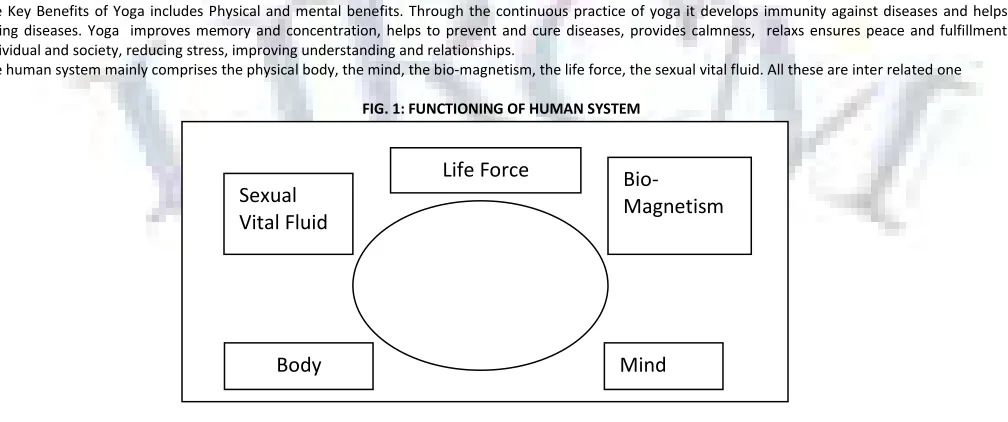
The human system mainly comprises the physical body, the mind, the bio-magnetism, the life force, the sexual vital fluid. All these are inter related one
FIG. 1: FUNCTIONING OF HUMAN SYSTEM
Y
Life Force
Bio-
Magnetism
Mind
Body
VOLUME NO.5(2015),ISSUE NO.04(APRIL) ISSN 2231-5756
INTERNATIONAL JOURNAL OF RESEARCH IN COMMERCE, IT & MANAGEMENT
The life force: Life force is the form of smallest energy particle which runs throughout the body. In the process these particles produce bio-magnetic waves. Life force particles circulates throughout the physical body and energizes all the cells and tissues.The bio-magnetism: It’s generated within the physical body. Life force particles liberate formative dust particles which are called bio-magnetism. It is the phenomenon of magnetic fields produced by living organisms. These Bio-magnetism is responsible for all physical and mental activites of human body.
The mind: The extension of bio-magnetism through senses and through brain as thought wave is called mind. Life force particles are spent during the body and mind functions.
The physical body: Billions of life energy particles keep whirling all over the body. Each life energy particle, millions and millions of formative dust particles, functions energizing the life energy particle.
The sexual vital fluid: The birth and death of human being depend on the sexual vital fluid. It holds the life. Death occurs after enormous wastage of the fluid. Body structure is based on the quality and quantity of fluid.
YOGA FOR SCHOOL STUDENTS
The school students in their teen age. Have changes in physiological, psychological and socia as they were from a being child adult. In this time proper guidance is needed to understand the values of life. In school, Social intuition is formulated to serve skills training and cultural transmission, but yoga plays as a major source for enhancing mental ability to absorb things and also has physical benefits.
MATERIALS & METHODS
DESIGN AND PARTICIPANTS
The present study is an attempt to determine the impact of yoga on school students. The population of students in this study who are regularly is practicing yoga in World Community Service Centre, Gobichetipalayam. Erode (District), Tamilnadu (State), India. Students were contacted at their respective Yoga Centers. They were asked to respond to the questionnaire.
THE STUDY QUESTIONNAIRE
The questionnaire was made up of both open ended and close ended questions that were self explanatory. The impact of yoga on the regular activities of each student were observed. The information related to concentration, improvement in studies, involvement in sports, co-curricular activities and self-confidence were collected. The dependent variable was an item on ‘performance’. Each item was rated on a 5-point scale ranging from 1 (poor) to 5 (very good).
SAMPLING
A sample of 60 higher secondary school students who were practicing regular yoga were selected using simple random sampling technique.
STATISTICAL ANALYSIS
In order to determine the influence of yoga towards the performance of students who are practicing regular yoga, the Structural Equation Modeling has been used. Structural equation model(SEM) is used to test and eradicate the contributory relationship using a mixture of statistical and qualitative data with assumptions. Considered as the best approach by many researchers, the SEM unlike other statistical methods does not have limitation on the number of variables. There is no difficulty in hypothesis testing in SEM because it takes the confirmatory approach rather than the exploratory approach. Many sub-criteria are considered under each criterion. The response is arrived for all the sub-criteria from the people involved in the decision making process. The significance of the criteria as well as the sub-criteria was tested. This is the reason why the relative weightage arrived from SEM is considered more valid than any other approach. This model also takes measurement error into account when analyzing the data statistically. SEM is capable of estimating or assessing measurement error. It can incorporate both observed and latent variables. SEM models require less reliance on basic statistical methods.
ETHICS
The World Community Service Centre, Gobichettipalayam, Erode - (district), Tamilnadu (State), India permitted this study. All participants gave oral consent.
RESULTS
RESEARCH MODEL AND HYPOTHESIS FORMULATION
The research hypothesis has been defined on the basis of the problems identified in the present research pertaining to influence of yoga towards performance of selected school students who are practicing yoga regularly in the study area.
HYPOTHESIS OF THE STUDY
There is no positive relationship between selected five measured variables and the latent variable (Yoga students’ performance).
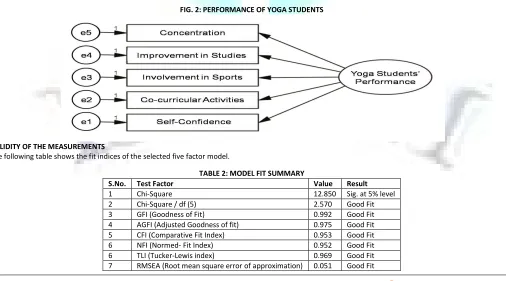
FIG. 2: PERFORMANCE OF YOGA STUDENTS
VALIDITY OF THE MEASUREMENTS
The following table shows the fit indices of the selected five factor model.
TABLE 2: MODEL FIT SUMMARY
S.No. Test Factor Value Result
A model is said to be fulfilling the criteria of goodness of fit, if it satisfies certain values. In this case, the calculated value of the chi-square analysis is 12.850 on 5 degrees of freedom, which gives a p-value of 0.000 and this model is a good fit for the analysis. The value of ‘chi-square/df’ should be less than or equal to 5. Based on these values, estimated value for the model is 2.570 which satisfy the required condition. Similarly, the required value of root mean square error of approximation (RMSEA) should be less than 0.07. Against this value, the estimated model value is 0.051 which highly validates the result. Similarly, rest all model fit indices (GFI, AGFI, CFI, NFI and TLI) for the 5-factor model indicates that the model fits well in representing the dataset of 5 performance activity factors. Regression weights between items and factors variables are shown in the following path diagram. The real strength of SEM is to estimate more complicated path models, with intervening variables between the independent and dependent variables, and the latent factor as well.
FIG. 3: RELATIONSHIP BETWEEN ACTIVITIES THAT INFLUENCE THE PERFORMANCE RESULTED HYPOTHESIS MODEL
Impact of Yoga: The impacts of five factors towards the yoga students’ performance were examined with the help of regression weights and presented in the following table.
TABLE NO. 3: REGRESSION WEIGHTS
Measured Variable Latent Variable Estimate S.E. C.R. Result
Concentration ← Yoga Students’ performance 1.000 0.907 13.169 1% Improvement in Studies ← Yoga Students’ performance 0.690 0.505 14.176 1% Involvement in Sports ← Yoga Students’ performance 0.393 0.327 16.045 1% Co-curricular activities ← Yoga Students’ performance 0.769 0.356 6.576 1% Self confidence ← Yoga Students’ performance 0.106 0.297 17.219 1%
TESTING OF HYPOTHESES
The following table represents the results of the testing of the hypotheses.
TESTING OF HYPOTHESES
TABLE 4
Hypotheses Hypothetical Relationship Result
H1 : There is a positive impact of concentration on students’ performance Positive Confirmed H2 : There is a positive impact of improvement in studies on students’ performance Positive Confirmed H3 : There is a positive impact of involvement in sports on students’ performance Positive Confirmed H4 : There is a positive impact of co-curricular activities on students’ performance Positive Confirmed H5 : There is a positive impact of self-confidence on students’ performance Positive Confirmed
From the path diagram, measured variables with latent variable of influencing factors is having positive relationship and also significant at 1 percent. The analysis of the model suggests that all the measured variables concentration, improvement in studies, involvement in sports, co-curricular activities and self-confidence are significantly associated on students’ performance.
DISCUSSION
The result shows that continuous practice of yoga free mind to wards learning. So concentration of the students improve. Better concentration automatically enables students to improve their studies. The continuous practice of yoga gives good immunity power. So there is no chance for diseases occurring. Yoga education improves the student mental and physical performances. It paves the way to reduce stress and improve concentration among students. So yoga education should be compulsory from the primary education to the students.
CONCLUSION
Life is wonderful gift of nature. Those, who are healthy can lead meaningful life. If life is to be happy, successful a harmonious good physical health is indispensable. It would be witnessed that this experimental group of students had improved and performed better in their day-to-day activities physically and mentally. The results show that if students practice yoga regularly they can get sound health and can shine in their academic activities which leads them to get success in their life.
ETHICAL CONSIDERATIONS
Ethical issues (Including plagiarism, Informed Con-sent, misconduct, data fabrication and/or falsification, double publication and/or submission, redundancy, etc) have been completely observed by the authors.
ACKNOWLEDGEMENTS
This study was supported by the World Community Service Centre, Gobichettipalayam, Erode (District), Tamilnadu (State), India. The authors wish to thank the yoga teachers and students from Gobichettipalayam for their contribution to the study. The authors would specifically like to thank Ms. Amutha, Mr. Raja for their assistance and hard work. The authors declare that there is no conflict of interests.
REFERENCES
VOLUME NO.5(2015),ISSUE NO.04(APRIL) ISSN 2231-5756
INTERNATIONAL JOURNAL OF RESEARCH IN COMMERCE, IT & MANAGEMENT
3. Brain Trust (2004). Value Education for Health: Happiness and Harmony. Aliyar Vethathiri Publication Erode: Tamilnadu: India. 4. Edgar Cayce, John Van Auke (2007). Toward a Deeper Meditation: Rejuvenating the Body Illuminating the Mind. ARE Press:108p. 5. GabrielJulie (2013). Holistic Beauty from the Inside Out. Seven Stories Press: 8p.
6. Gore MM, Gharote ML, Raya Purkar MV (2008). Effect of 10 minutes Kapalabhati on some physiological functions: Yoga Mimamsa. 18(2):87-94.
7. Javanbakht M, Kenari RH, Ghasemi M (2009). Effects of yoga on depression and anxiety of women: Complementary Therapies in Clinical Practice. 15(2): 102104.
8. Jyotirupananda Dada (2009). Meditation: Searching for the Real You. John Hunt Publishing: 63p.
9. Pandiamani BK (2004). Principles of Yoga therapy: Social skillsand living value based education. Annamalai University Publication. 10. Ray S Dutta (2013). Yogic Exercises. Jaypee Brothers Publication. New Delhi.
11. Roger OMD (2013). The Healer Within: Deep Relaxation and Meditation Practices. Chapter 7. 12. Swamy Rama (2007). Meditation and Its Practice. Himalayan Institute Press: 20p.
13. Vethathiri Maharishi (2007). Rejuvenating Life Force and Mind: Special Meditations Nine-Center Meditation. Vethathiri Publications: 83p.
14. Vethathiri Maharishi institute for spiritual and intuitional education (2013). Temple of consciousness: Arutperumjothi Nagar: Aliyar- 642 101, Pollchi, Tamilnadu, India.
REQUEST FOR FEEDBACK
Dear Readers
At the very outset, International Journal of Research in Commerce, IT & Management (IJRCM)
acknowledges & appreciates your efforts in showing interest in our present issue under your kind perusal.
I would like to request you tosupply your critical comments and suggestions about the material published
in this issue as well as on the journal as a whole, on our [email protected] for further
improvements in the interest of research.
If youhave any queries please feel free to contact us on our E-mail
.
I am sure that your feedback and deliberations would make future issues better – a result of our joint
effort.
Looking forward an appropriate consideration.
With sincere regards
Thanking you profoundly
Academically yours
Sd/-
Co-ordinator
DISCLAIMER
VOLUME NO.5(2015),ISSUE NO.04(APRIL) ISSN 2231-5756