University of Bolton
UBIR: University of Bolton Institutional Repository
Educational Cybernetics: Conference Papers Institute for Educational Cybernetics
2004
Limitations of some eLearning standards for
supporting learning.
Rocio Garcia-Robles
Universitat Pompeu Fabra
Josep Blat
Universitat Pompeu Fabra
Sergio Sayago
Universitat Pompeu Fabra
David Griffiths
University of Bolton, [email protected]
Francis Casado
Universitat Pompeu Fabra
See next page for additional authors
This Conference Paper is brought to you for free and open access by the Institute for Educational Cybernetics at UBIR: University of Bolton Institutional Repository. It has been accepted for inclusion in Educational Cybernetics: Conference Papers by an authorized administrator of UBIR: University of Bolton Institutional Repository. For more information, please [email protected].
Digital Commons Citation
Garcia-Robles, Rocio; Blat, Josep; Sayago, Sergio; Griffiths, David; Casado, Francis; and Martinez, Juanjo. "Limitations of some eLearning standards for supporting learning.." (2004).Educational Cybernetics: Conference Papers.Paper 6.
Authors
Rocio Garcia-Robles, Josep Blat, Sergio Sayago, David Griffiths, Francis Casado, and Juanjo Martinez
Limitations of some eLearning standards for supporting learning
Rocio Garcia-Robles, Josep Blat, Sergio Sayago, Dai Griffiths, Francis Casado,
Juanjo Martinez
Department of Technology, Interactive Technology Group, Pompeu Fabra University
Key words
:
eLearning, education, IMS QTI, reusability, learning objet
Abstract
:
The IMS-QTI, and other related specifications have been developed to support the creation of reusable and pedagogically neutral learning scenarios and content, as stated by the IMS Global Learning Consortium. In this paper we discuss how current specifications both constrain the design of assessment scenarios, and limit content reusability. Key issues regarding reusability such as granularity, localization and self-contained-ness are analyzed from the point of view of current eLearning specifications. We also suggest some solutions to overcome these limitations. The paper is based on our experience developing and testing an IMS QTI Lite compliant assessment authoring tool, QAed. It supports teacher centering, which is quite neglected when designing such tools. In the paper we also discuss how to make compatible standards support and user centering in eLearning applications and provide some recommendations for the design of the user interfaces.
1
Introduction
We concluded that the UI must support teachers’ usual workflow of Q&A preparation and reflect the essential structure of the standard, e.g. by grouping the elements according to their functionality; but the terminology must not be specialized. Meta-tagging and packaging conceptualization should be invisible to the final user, in order to be effective for both, content creators and authors. Moreover, reusability is promoted by supporting several services such as repository, different granularity levels, and domain classification.
On the other hand, the IMS QTILite specification only supports multiple-choice questions and limits the rendering form to the “true response” choice from a set of answers. From the pedagogical point of view, this is very limited, as assessment can be performed in a wide variety of educational scenarios. But even the larger QTI ASI specification has limitations for providing appropriate support to common assessment scenarios such as Question Item Banks (QIB), which are basic for supporting reusability in the teacher’s workflow. Question Item Banks are collection of items which can be used to construct assessments through the selection of questions based on various predefined criteria according to the appropriate assessment scenarios envisaged. [1]. While QIB are supported by the specification, important features allowing their sensible use, such as for instance, the overlap exclusion requirement, is not supported. Overlap exclusion means, in simple terms, to make some questions force removal of other questions. This is acknowledged by the IMS QTI ASI, and is intended to be supported in version 2.0 of the specification. Another QIB common requirement is the overlap inclusion. Nevertheless, we claim that the approach intended to provide support for overlap inclusion is not going to allow for true reusability because the specification suggests the use of the so called “section” entity for encapsulating the dependency. We discuss how this approach hinders reusability, by addressing the level of granularity incorrectly, by not allowing the feature to be included in question items. This approach makes it also backward incompatible with the IMS QTI Lite compliant banks, because this specification only supports the question item object, neither sections nor assessments. We suggest and discuss an alternative approach, based on XLink, , which is a W3C specification. So, the main weakness of the packaging approach underlying current versions of IMS QTI specifications is that it cannot support question items dependency, neither inclusion nor exclusion. It can partially support question items inclusion by packaging dependent question into static sections, but constraining the granularity, and thus content reusability. The proposed linking approach supports items dependency by linking items establishing a relationship between them, and therefore avoiding encapsulating them into closed sections.
In the next section we discuss the QAed related issues, in the following, our XLinking approach to support the description of items dependencies. But, according to experts on the field, not only granularity and localization are key issues for promoting reusability, but also self-contained-ness. We discuss how describing contextual information could help on the diss-aggregation process as a first step for reusing content. A solution based on MPEG-7 specification is suggested. We conclude summarizing the results and indicating some other perspectives.
2
The support of QAed for both teachers’ workflow and
standards based reusability
QAed1 is a simple eLearning open-source and multiplatform application developed in JAVA for editing Q&A items binding the IMS QTI Lite specification , i.e. it is a tool to develop Q&A. The IMS-QTI Lite compliancy implies a strong orientation towards reusability and interoperability. But another feature is strong teacher support: we think tools should support the usual workflow of Q&A preparation, and the user should not need to know anything about the standard for his/her work.
Supporting the principles of conceptual design as defined by [2], the GUI features a multiple-window paradigm in such a way that each multiple-window encapsulates information related to only one part of the standard. It also allows users to decide when, and how interact with what information. It supports varying user roles (question editor, assessment editor and tool user), and the standard specification structure. In practical terms, some times users might prefer to edit the questions first, and others might approach first the edition of the assessment.
On the other hand, the standard specification defines the assessments as a container of questions and responses and therefore, from the UI perspective, they can be handled as separate entities. The same flexible teacher workflow approach has been adopted for main services such as saving (in PDF, XML, HTML and ZIP formats2 ), searching (by date, author and category), pre-visualization (in a HTML customizable style), export and import (to/from XML files binding the IMS QTI Lite specification).
QAed has been designed according to an authoring oriented approach, trying to keep the specification complexity invisible to the user. By contrast, most of the already created learning authoring tools complying with IMS QTI specifications have GUIs which resemble very closely specification related concepts such as content packaging process and meta-tagging. This approach may be closer to the educational publishing industry way of doing, but it is far away from normal teaching practices.
For that purpose, the application was designed taking usage-centered and usability approaches. Trying to converge the usage with the standardization on eLearning, positive results were obtained with both experienced and inexperienced users, who were both able to use the application successfully. Three factors were identified in this success, and are suggested as UI recommendations. Firstly, the interface reflects the essential structure of the standard grouping the elements according to their functionality; standardization requires that the specification elements and their corresponding relationships must be reflected in the GUI design. Secondly, the terminology used is not specialized; usage requires to translate the terminology and to enlarge the information available in the specification data model. Thirdly, the GUI reflects information supporting teachers’ usual workflow of Q&A preparation, supporting and promoting to reuse, recombine, share and visualize content.
Further usability enhancements could come from a customizable user interface, because it may be useful to show or hide certain type of information according to the user profile.; and for support for collaborative work.
1
The tool was developed in the framework of the EU funded project SCOPE www.tecn.upf.es/scope, www.tecn.upf.es/gti/leteos/
2
In the standardization framework, interoperability and reusability are the main promises for promoting the extended use of this kind of specifications. QAed promotes two of the three key issues identified by [3]: granularity and accessibility.
Main services promoting both are the repository, the domain classification and the possibility of supporting different granularity levels. The repository is managed by using a folders tree to organize the structure of the assessment, question and responses. Tree elements are folders, subfolders and Q&A. That folder structure is the main local browsing facility, offering a logical hierarchy on which actions can be undertaken. Moreover, keywords can be used to classify Q & A into domain categories. Finally, an assessment scenario can be created by editing questions and then grouping and/or associating them, or vice versa, and so different granularity levels are supported. A shopping basket facility is also available as persistent storage (the user must update/delete explicitly the items in the basket) of Q&A items supporting the user on pre-selecting and reusing content.
The third key issue promoting reusability is self-contained-ness, intended for resources to be reusable in multiple situations. According to some authors “For maximum reuse, resources should be context free: they should not contain information specific to a particular subject discipline” [4]. However, many other authors recognize that “this contradicts the way the teachers normally modify and adapt resources to fit specific teaching situations” [5]. Because of this controversy, the current implementation of QAed leaves the teacher distinguish context from resources. However, as we will see in next sections, we suggest the inclusion of contextual information as a semantic complement to descriptive capability of current specifications.
3
A linking approach to overcome current reusability limitations
The IMS QTI Lite specification supports only multiple-choice questions and limits the rendering form to the classical true response from a set of answers (true/false alternative). It is a compact subset of the IMS QTI ASI specifications, which describes the components required to construct the simplest form of an IMS QTI-compliant system. IMS QTI ASI specifications support eight core data object, which are combinations of Assessment, Sections and Question items. IMS QTI Lite supports only two of those core data objects [6], and both of them are based on the question item object, i.e. it doesn’t support the assessment neither the section objects. Conceptually then, the only assessment scenario possible is the QIB.
There are many requirements in QIB scenarios. Among them, the overlap exclusion requirement has been identified by CAA experts. To avoid similar items appearing in the same test and a mix of questions where one question provides the answer for another is clearly needed. [7]. Nevertheless, that “overlap exclusion requirement” is not supported by any IMS specification, and this fact is explicitly recognized in the IMS QTI specifications [8] In addition, the complementary requirement, overlap inclusion, is only partially supported and the need for further study in new releases of IMS QTI specifications is recognized. The requirement involves different cases:
(i)- If item ‘X’ is presented then item ‘Y’ must also be presented. [8]; (ii)- Item ‘Y’ can only be presented if ‘X’ has already been presented [8]; (iii)- Presentation of item ‘Y’ depends on outcome or response of item ‘X’ [8].
Only case (i) is partially addressed by the current specifications. As indicated above, the QTI ASI intended solution suggests the use of the “section” entity for encapsulating the dependency. Nevertheless, this might lead to several problems:
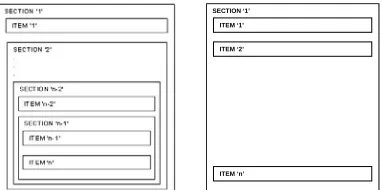
1- Encapsulating the question items dependency by structuring question items into nested sections do not promote reusability, because it compromises the granularity level. For instance, if we want to create an assessment with n question items in which every question item depends on the previous one3 , we will need to create an assessment with one section packaging all the question items, or a package with (n-1) nested sections, as it is shown in Figure 2. In that case the granularity will be fixed to the assessment level.
SECTION ‘1’ ITEM ‘1’
ITEM ‘2’
ITEM ‘n’
Figure 2. Packaging question items dependency.
2- The IMS-QTILite specification is restricted to question items only, not dealing with sections or assessments. This means that QIB is the only assessment scenario supported. But, on the other hand, it would not be possible to address overlap inclusion as suggested, because sections are needed to package items dependency. Considering that question items dependency is a common requirement to many QIB assessment scenarios, there should be another mechanism for supporting question items dependency directly related to the question item objects, avoiding the encapsulation of the dependency in aggregated structures like section and assessment which are not supported by the QTILite specification.
There is another possible solution to describe question items dependency by adding metadata for each question item, and using the “references” element of IEEE-LOM (IMS-Metadata), for describing the dependency. This approach has some disadvantages. One of them is that the information is replicated, and so there could be data integrity problems. Another one is that it does not support different points of view regarding with the dependency between items (i.e. different teachers could disagree about the relationships between two items, and then the learning object must be replicated for supporting discrepancies). It is possible to find some recent approaches in the related literature. Some of them propose to enlarge the IEEE-LOM support of learning object dependencies and other types of relationships [24]. Other approaches suggest the enlargement of the IEEE-LOM specification in order to make the description of this kind of dependencies [12].
We suggest an alternative solution to be implemented in the next release of QAed, in order to support both overlap exclusion and inclusion requirements, namely to move from a packaging to a linking approach. We propose supporting items dependency by linking items , allowing an item which depends on another to explicitly reference it, and thus establishing a relationship between them. In the packaging approach there does not exist a relationship among individual items. Linking versus packaging would solve the constraints explained.
Indeed, the proposed solution is more related to the IMS-CP which is underlying the content aggregation of the other IMS specifications. For compliance purposes, our proposal is to use a linking approach as a layer over the current packaging approach. Moreover of supporting the description of dependencies at an items level, other benefits of the linking solution would be:
3
1- Taking into account diss-aggregation is considered a previous stage to reusing content [9], the linking approach promotes reusability because the final user does not need to think in terms of how to diss-aggregate a whole section. Granularity is kept at the lowest level.
2- It promotes data mining because it is possible to navigate through the linked structure. 3- Supporting adaptive mechanisms based on the notion of points of view. The linking approach facilitates to establish items relationships depending on the teacher/tutor’s point of view. In fact, e.g. one teacher could consider question items q1 and q2 exclude each other, while other teacher could disagree. Not only exclusion but also inclusion could be dependent on the teacher’s perspective. The previous example is related to an assessment scenario, but the same point of view approach could be interesting when addressing the design of broader learning scenarios. Most of current specifications (e.g. IMS-SS, IMS-LD, SCORM,…) are based on the notion of activity sequencing, and all of them are based on the concept of building an static activity tree, which can be only dynamically traversed by allowing the visibility of some activities to be switched on or off [21], [17], [18], [19], and by allowing to go back to an ancestor activity, but without really modifying learning paths. Also random selection and order randomization of brother activities is allowed [20] , but graph navigability
is not supported because the underlying aggregation model is the packaging model. That model is closer to the notion of table of content than to the concept of hypertext. Adopting a linking approach could support graph navigability because the relationships between different items (of the same or even different types) would be explicitly defined. Link inference could also be supported for creating new relationships between different items. So, for example, it would be possible to deduct exclusion dependency between q1 and q3, if there is an exclusion dependency between q1 and q2 and between q2 and q3.
4- Semantic nets could be also built based on the notion of connecting a domain ontology and the linked items. Several attempts are documented in the literature. Some of the most recent approaches use semantic metadata mapped into RDF or OWL for reusing and assembling of learning objects [13], [14], [15], [16]. Others support the generation of a hyper-book in which link inference helps people to discover the environment of their subject and to establish relations between them [22]. But all of those approaches only use the metadata specifications. They are not concerned with the use of the semantic web in relation to pedagogical oriented structural specifications, such as IMS-LD, IMS-SS or SCORM. We suggest to connect domain ontologies (for describing context), pedagogical oriented (supporting structure and process description) specifications and the linking approach (for describing functional and other semantic relationships between reusable items) in order to create learning enriched semantic networks.
4
Describing context for promoting reusability
As stated before, according to experts on the field, in order to promote reusability self-contained-ness should be promoted. But to develop neutral content is against the usual teacher workflow. Anyway, in order to promote reusability in both intra- and inter-contextual scenarios, it could be interesting to be able to describe context using a semantic framework. So it would be easier to find contextual issues in an specific content, as a previous stage to the de-contextualization or re-contextualization of the learning material and/or scenario. For example, if we want to reuse a unit of learning about how to develop typing skills, it would be interesting to localize those activities regarding with the distribution of characters on the keyboard in order to be able to adapt this part of the unit of learning to the alphabetic features of the student’s culture and language.
In order to support context description, several approaches are possible. If we want to describe small pieces of information, e.g. question items, a domain ontology supported by OWL or RDF could be a solution. On the other hand, if we want to describe higher granularity pieces of information (both data and processes), for example a whole unit of
learning, other types of narrative oriented solutions could be better used. Indeed there are other standard specifications for the description of multimedia content, such as the MPEG-7, which support the description of both the structure (video segments, moving regions,…) and the semantic. The MPEG-7 semantic entity tools describe semantic entities such as narrative worlds, objects, events, concepts, states, places and times. Events understood as occasions when something happens. Objects, people and places can populate such occasions and the times at which they occur. Furthermore, these entities can have properties and states through which they pass as what is being described transpires. There are interrelations among these entities. Finally, there is the world in which all of this is going on, the background, the other events and other entities, which provide context for the description. [23]
On the education field, there are standards for describing the structure of content (i.e. IMS-CP) and the pedagogical process (e.g. IMS-SS, IMS-LD, SCORM). But context is only described in terms of domain vocabularies in the metadata specifications (i.e. IMS-Metadata, IEEE-LOM). Only IMS-LD may support the description of context in terms of the underlying narrative syntax (expressed in terms of roles playing activities using resources), but it is not so abstract as the MPEG-7 semantic tool because it is adapted to the description of information in pedagogical terms.
In order to support semantic description of learning scenarios, we propose to use the MPEG-7 semantic tool, promoting also the interoperability with other content description specifications. At a lowest granularity level, we suggest to use domain ontology approaches, as it is intended to be developed in the QAed tool for the description of the domain of question items and assessments. A taxonomy based solution is currently supported by this tool.
5
XLink as a proposed solution for supporting the linking
approach
In practical terms, the linking approach could be supported by using XLink linkbases for gathering together the information of related linked items4. XLink is a W3C specification which allows elements to be inserted into XML documents in order to create and describe links between resources. Linkbases are a type of XLink link by which relational elements are stored separately from the resources they associate. This makes link management easier, it allows linking read-only resources, and it supports describing different views of the items dependency in terms of different linkbases.
XLink has some semantic attributes: role, arcrole and title, which describe the meaning of resources within the context of a link. Arcrole or title can be used for describing the type of dependency (exclusion, inclusion and even the type of inclusion) between linked items. The role attribute of every linked resource, or the directionality of the arc (explicitly described using the from and to attributes of the XLink arc element type) can be used to express the order in the inclusion relationship. More than one title could be used for specifying other semantically relevant information related to the inclusion dependency between the linked elements, as illustrated by the following example.
qi1
qi2
qi3
Exclusion Inclusion
Fig 2. qi1 and qi2 exclude each other, qi2 has a inclusion dependence on qi1
4
<xlink:extended xmlns:xlink=”http:// www.w3.org/1999/xlink/ namespace”>
<xlink:locator href=”uri_qi1” role=”question_item_01”
title=”first question item”/> <xlink:locator href=”uri_qi2” role=”question_item_02”
title=”second question item”/> <xlink:locator href=”uri_qi3” role=”question_item_03”
title=”third question item”/>
<xlink:arc from=”question_item_01” to= “question_item_03” arcrole=exclusion title=”exclusion”>
<xlink:arc from=”question_item_02”
to= “question_item_01” arcrole=inclusion title=”inclusion”>
</xlink:extended>
Different types of inclusion dependency could be specified. For example, in Fig.3 qi2 has an inclusion dependency in relation to qi1, but this could mean at least two things in a QIB scenario: (case 1) qi2 can appear only if qi1 has been also selected, or (case 2) if qi1 appears then qi2 must also appear. Case 2 is solved by the current version of the IMS-QTI specifications by packaging qi1 and qi2 in a section, while case 1 is not supported anyway, i.e. the overlap exclusion scenario is not supported by current version of IMS-QTI.
On the other hand, there are two potential disadvantages related to the linking solution. First one is the need of using unique resource identifier for each item. This is already solved by adopting the URI identifying naming convention recommended by the IMS specifications [11]. QAed automatically generate unique identifiers for items, reducing the cognitive load on the user. Second disadvantage is the need of solving cyclic dependency, if exists, in runtime. XLink specification addresses that issue in the following terms: “An application should maintain a list of extended links retrieved as a result of processing a linkbase, and should not retrieve duplicate resources or links in the case where a cyclic dependency exists” Therefore, both issues could be better considered as already solved constraints than disadvantages.
6
Conclusions and perspectives
We have discussed two issues for eLearning tools, usability and reusability, arising from our experience developing a standards compliant tool for Q&A authoring5, and have described some of the lessons learned which might have wide applicability. We have not discussed some interoperability problems of current specifications, which have appeared when implementing QTILite compliancy, and which seem to be quite applicable to other eLearning specifications. We intend to do this in a future paper.
We have not discussed other improvements we intend to support the use of scientific notation, currently absent. In some fields like Maths, this would mean to use a standard oriented solution like MathML, a product of the W3C Math working group, which is a low-level specification for describing mathematics as a foundation for the inclusion of mathematical expressions in Web pages.
A more significant aspect is related to the need of strengthening the pedagogical component in the assessment field, as indicated in [10] which remarks the weaknesses of IMS QTI specifications in order to describe advanced assessment scenarios. Peer to peer,
5
Further analysis of use of the QAed tool, including a further comparison to other available tools has been undertaken. For paper page limitations it was not able to include that information in the current paper.
assessment or groupwork are not supported. If we consider that assessment should be integrated in the global learning process, then other IMS specifications could be used, such as the recent IMS Learning Design. But when using those types of pedagogically oriented specifications, we think that there is a need for an ontological solution supporting assessment experiences in a broad sense.
Concerning the use of IMS specifications in general terms, the use of the linking approach as well as the use of domain ontologies and semantic narrative tools could be tested for promoting the reusability of learning content and processes.
References
:
[1] Dalziel, J et al: Assessing question banks, Reusing online resources: A sustainable approach to e-learning, 2003, Chapter 14, ISBN: 0749439491
[2] Norman, D.A: The Psychology of everyday things, Basic Book, New York, 1998
[3] Duncan, C: Granularisation, Reusing online resources: A sustainable approach to e-learning, 2003, Chapter 2, ISBN: 0749439491
[4] Naeve, A. : Conceptual Navigation and Multiple Scale Narration in a Knowledge Manifold, Royal Institute of Technology, Numerical Analysis and Computing Science, Kungl Tekniska Hogskolan, Stockholm, 1999
[5] Littlejohn, A.: Issues in Reusing Online Resources, Reusing online resources: A sustainable approach to e-learning, 2003, Chapter 1, ISBN: 0749439491
[6] IMS QTI Lite v1.2, Figure 2.2
[7] Maughan, S. et al: On-line formative Assessment Item banking and learning Support, Proceedings of the CAA Conferences at Loughborough University, 2001
[8] IMS QTI ASI Selection and Ordering v1.2, pp 9-12
[9] Koper, R.: Combining reusable learning resources and services to pedagogical purposeful units of learning, Reusing online resources: A sustainable approach to e-learning, 2003, Chapter 5, ISBN: 0749439491
[10] Sclater, N. et al: “Interoperability with caa: does it work in practice?” , Proceedings of the CAA Conferences at Loughborough University, 2002
[11] IMS QTI Lite, pp 8
[12] Frosch-Wilke, D.: An extended and adaptable information model for learning objects, Proceedings of the IEEE-ICALT 2004, Joensuu, Finland, 2004
[13] Bouzeghoub, A. et al: A RDF description model for manipulating learning objects, Proceedings of the IEEE-ICALT 2004, Joensuu, Finland, 2004
[14] Bennacer, N. et al: Formalizing for querying learning objects using OWL, Proceedings of the IEEE-ICALT 2004, Joensuu, Finland, 2004
[15] Doan, B.L. et al: Using OWL to describe pedagogical resources, Proceedings of the IEEE-ICALT 2004, Joensuu, Finland, 2004
[16] Sicilia, M. et al: On integrating learning object metadata inside the OpenCyc knowledge base, Proceedings of the IEEE-ICALT 2004, Joensuu, Finland, 2004
[17] IMS-SS best practice and implementation guide, pp 11-12, www.imsproject.org [18] IMS-SS information and behaviour model, pp 34-35, www.imsproject.org [19] IMS-SS information and behaviour model, pp 77, www.imsproject.org [20] IMS-SS information and behaviour model, pp 67, www.imsproject.org [21] IMS-LD information model, pp 71, www.imsproject.org
[22] Falquet, G. et al: Adaptive mechanisms in a virtual hyperbook, Proceedings of the IEEE-ICALT 2004, Joensuu, Finland, 2004
[23] Manjunath, B.S.(ed): Introduction to MPEG 7: Multimedia Content Description Language, John
Wiley & Sons, ISBN: 0471486787
[24] Sicilia, S.: On the semantics of aggregation and generalization in learning objects
contracts, Proceedings of the IEEE-ICALT 2004, Joensuu, Finland, 2004
Author(s)
:
Garcia-Robles, Rocío, Blat, J., Sayago, S., Griffiths, D., Casado, F., Martínez, Juanjo Pompeu Fabra University, France Railway Station, Barcelona 08003