*Corresponding author: Pukazhenthi.N ISSN: 0976-3031
Research Article
PERFORMANCE ANALYSIS OF DISCRETE TIME BULK SERVICE QUEUING MODEL NB (L,K)/Geo/1
Pukazhenthi.N and Ramki.S
Department of Statistics, Annamalai University, Annamalai Nagar - 608 002
DOI: http://dx.doi.org/10.24327/ijrsr.2017.0805.0249
ARTICLE INFO ABSTRACT
The present paper is an attempt to explore a discrete – time queueing models which is suitable for the performance evaluation of Asynchronous Transfer Mode (ATM) multiplexers and switches. In these models, the time axis is divided into fixed-length slots and the service of a customer must start and end of slot boundaries. Most analytical studies of discrete-time queues assume constant service times equal to one slot, an infinite buffer capacity and/or uncorrelated arrival process. A discrete time bulk service rule ( , ), the inter arrival time are assumed to be independent and identically distributed random variable follows negative binomial distribution. The time arrival between the consecutive arrivals of customers is described in terms of a discrete probability mass function (p.m.f)
( ); ( ) is the probability of having an interval of an integer number of x time units between the arrival customer number n and customer number n+1. The service time of customers n is given in terms of a discrete p.m.f ( ) follows geometric distribution. The arrival and service are independent and identically distributed (i.i.d). The arrival of customer in First In First Out (FIFO) order. One server transports packets in batches of size minimum L packets and maximum K. The steady state analysis for the considered queuing system is presented and the generating functions of the number of customers in the system are obtained. We also obtained the closed form of expressions for some performance measures of the system.
INTRODUCTION
In the study of discrete-time queue of packets and the distribution of system occupancy just before and after the departure epochs follows the bulk service rule ( , ). A fundamental motive for studying discrete- time queues is that they become more appropriate than their continuous-time counterparts for analysing computer and telecommunication systems. Since these systems are more digital (machine cycle times, bits and packets, etc.) than analogue. In view of this, there have a increasingly important owing to their applications in the study of many computer and communication systems such as asynchronous transfer mode (ATM), multiplexers in Broadband Integrated Service Digital Networks (BISDN’s), Circuit-Switched Time Division Multiple Access (TDMA), Carrier Sense Multiple Access (CSMA) protocols and traffic concentrators in which the time axis is divided into slots. The packets arrive one by one inter-arrival time following negative binomial distribution, with the probability of success of arrival in a slot is ‘p’ and not for arrival is ‘q’. If an arriving packet finds the server busy, it joint the queue in First In and First Out (FIFO) order. The service times of batches are assumed to constitute a set of i.i.d positive random variable with a geometric distribution with probability , and the complementary is .
Chaudhry and Templeton [1] have presented extensive discussions of bulk service systems that operate according to a rule admitting non-accessible batch. Mathias [6] studies a departure time distribution for batches and studies correlation between inter-departure time and batch sizes. Mathias and Alexander [5]provide an discrete-time analysis in the performance evaluation of manufacturing systems. Sivasamy and Elangovan [11]on the other hand, the batch, which entries service queue with accessible and non-accessible batches. Goswami, et al., [3] discrete-time bulk-service queues with accessible and non-accessible batches. Sivasamy and Pukazhenthi [12] have carried out and analyzed the discrete time bulk service queue for the accessible batch with the arrivals time being geometrical distribution and services time being negative binomial distribution. Vijaya Laxmi Pikala, et.al., [13] have studied the discrete-time renewal input bulk service queue with changeover time. Pukazhenthi and Ezhilvanan [10] discussed the discrete time queue length distribution with a bulk service rule. Daniel Wei-ChungMiao1, et al., [2] computational analysis of a markovian queueing system with geometric mean-reverting arrival process. Pukazhenthi and Ezhilvanan [8] the analysis of
International Journal of
Recent Scientific
Research
International Journal of Recent Scientific Research
Vol. 8, Issue, 5, pp. 16939-16944, May, 2017
Copyright © Pukazhenthi.N and Ramki.S, 2017, this is an open-access article distributed under the terms of the Creative Commons Attribution License, which permits unrestricted use, distribution and reproduction in any medium, provided the original work is properly cited.
DOI: 10.24327/IJRSR CODEN: IJRSFP (USA)
Article History:
Received 18th February, 2017 Received in revised form 10th March, 2017
Accepted 06th April, 2017 Published online 28th May, 2017
Key Words:
discrete time queues with single server using correlated times. Pukazhenthi and Ezhilvanan [7] analysis of discrete time queue of packets with G/G/1 queueing model. Pukazhenthi and Ezhilvanan [9]recently used a vacation queueing model with bulk service rule. In this present study, this paper focus on the analysis of discrete time queue packets with bulk service rule (L,K). Customers arrive according to negative binomial arrival process with parameter p, the probability that an arrival occurs in a slot and the service time is assumed to follow geometric distribution with parameter . We consider on ( , ) policy bulk service queue with accessible and non accessible batches under the customer’s choice. In this model the time axis is divided into fixed-length of contiguous intervals, referred to as slots and it is assumed that the inter-arrival and the service times are integral multiples of slot durations. It is always assumed that service time can be started and completed only at slot boundaries and that their durations are integral multiples of slot durations. Customers arrive to the system in according with a negative binomial process and are accommodated in the buffer. The numbers of customers entering the system during the consecutive slots are assumed to be (i.i.d) non negative discrete random variables in a discrete case. A batch of packets of size ( ≤ ≤ ) starts service at the beginning of a slot, and may only end service just before the end of a slot. The probability of a batch being transported by the server at the end of a slot is probability ‘ ’and the probability of the batch not being transported is ‘1− ’. Service time of a batch is independent of the number of packets in a batch and simultaneous occurrence of both arrival and departure in a single slot is ruled out. All the random variables in the analysis are nonnegative and of integer valued. It is also assumed that the service times and the arrival process are mutually independent. The customers are served in batches of variables capacity, the maximum service capacity being a finite integer value. The steady state behaviours of the models are studied and explicit expressions for the steady state probabilities and the expected queue length are obtained.
The rest of the paper is organized as follows: In section 2, presents the description of the model, i.e, arrival distribution and service distribution. Section 3, deals with the steady state distribution of system occupancy at departure epochs, the join distribution of inter-departure time and number of pockets in a batch. In section 4 presents numerical study for various performance measures of the steady state distribution of the batch server at departure instants. A brief conclusion is presented in section 5.
Description of the Model
Let assume that before customers’ arrival follow the negative binomial distribution, and the customer’s service fallow the geometric distribution, with the queue of packets in an infinite capacity, on the bulk server rule of minimum size L and maximum size K. The packets are independent and identically distributed, ( ); (i.i.d) the random variables.
Inter Arrival-time Distribution
Let ( ) be the number of customers those arrive during slot x. In this model it is assumed that the inter-arrival ‘ ′ of customers are independent and negative binomial distribution { ( ; , ) = ( = )} and the arrival time are independent of the number of slots in the batch.
( ; , ) = −1
−1 (1− ) ; { = , + 1, + 2 … . } … (1)
Hence, the mean arrival times and variance of the arrival times are
i.e, ( ) = ⁄ , ( ) = ( + )/ and Var( ) = … (2)
The mean number of customers in the service time distribution
The service time follows geometric distribution and service of packets are independent and identically distributed random variable of s(x) with probabilityp . The service time for the nth batch is of length B whereB are random variables that follows geometric distribution with (p.m.f) b(k), Service times are independent of the number of slots in the batch b(k) = Pr (B = k); {k = 0,1,2, … }
b(k) = p (1−p ) ; k = 0,1,2 …. … (3)
where ‘p ’ probability of service time,
B is the number of slots required to complete a batch service at the k success in a sequence of independent Bernoulli trails with probability p for success and q = 1−p is the probability of failure. The mean,E(B ) and var(B) are
i. e. , E(B) = 1/p , E(B ) = (2−p ) p⁄ and var(B) = q /p … (4)
Utilization Factor
Utilization is the proportion of the system resources which is used by the traffic which arrives at it (Negative binomial arrivals and Geometric server), then it is given by the mean arrival rate over the mean service rate that is
= ( )
Distribution of System Occupancy at Departure Epochs
Let be the number of packets which has 0,1,2,...∞ accumulated in the system (queue + service) just after the server has left with the nth batch The steady state distribution { ( ) = lim →∞ ( ) = lim →∞Pr( = ) : = 0,1,2, …∞} of system
occupancy at departure epochs is derived in this section using the embedded Markov Chain (MC) technique.
Let be random variable denote the number of packets that reaching the system during the service then the distribution
{ ( ): = 0,1,2 … } can be derived as follows:
( ) = − −1
−1
∞
(1− ) (1− ) … (6)
= 0,1,2. . . ∞
Put = − − which gives + = − in the above equation. Further as + + = gives = + ,
when = 0 and =∞ implies =∞. Therefore the above equation can be rewritten as
( ) = −
∞
_
{ (1− ) }{ (1− ) } + + −1
−1
( ) = { (1− ) } + (1− )
∞
+ + −1
−1 (1− )
( ) = { (1− ) } ( + −1)! ( + + −1)!
! ! ( −1)! ( + −1)! (1− )
∞
(1− )
( ) = { (1− ) } ( + )!
! !
( + + −1)!
( + )! ( −1)!(1− )
∞
(1− )
( ) = { (1− ) }( − −1)!
! ( −1)!
+ + −1
−1 (1− )
∞
(1− )
( ) = + −1
−1
(1− )
1−(1− )(1− )
where +
∞
= 1 (1− )
( ) = + −1
−1
(1− )
(1−1 + + − )
( ) = + −1
−1
(1− )
+
Hence
( ) = + −1
−1 (1− ) … (7)
Where
=
+ p −pp
Also,
( ) = (1− )
( ) = (1− )
=
⎩ ⎪ ⎪ ⎨ ⎪ ⎪
⎧ ∑ ( ) ; 0≤ ≤ −1 = 0
( − + ) ; 0≤ ≤ −1 ≥1
∑ ( ) ; ≤ ≤ = 0
( − + ) ; ≤ ≤ ≥1
( + − ) ; ≥( + 1) ≥( − ) 0 ; ℎ
… (8)
The unknown probability (row) vector = ( , , , … ) can now be obtained solving the following system of equations.
= , = , … (9)
Where ′ ′ denotes the row vector of unities. A number of numerical methods could be suggested to solve the system of equations (9). For example an algorithm for solving the system of equations is given by Latouche and Ramaswami [4]. Here an upper bound N and ‘ ’ and ‘ ’ of unit step probability function has been selected so that the values are very small for all ,
and they could be ignored. Thus ∑ = 1 and = 1− ∑ for all 0≤ ≤ andP = is a square matrix of order( + 1).The expected average system length of the model is calculated as
= ( ) … (10)
∞
The expected average queue length of the model is calculated as applying equation
= ( ) + ( − ) ( ) … (11)
∞
The average system length and average queue length can be obtained, for certain parameter value are, presented in the following section.
NUMERICAL RESULTS
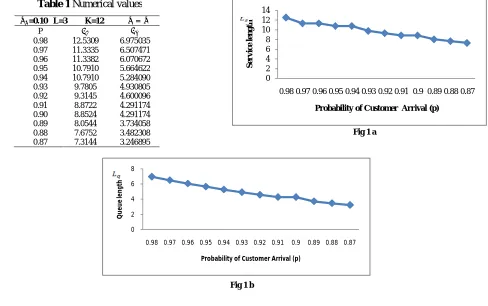
Some numerical results have been obtained and presented in the form of a table which is self-explanatory.
With the various probability value of p, for some fixed values , , , and, , the average system length and average queue length are given in the table-1 and also as a graph.
Table 1 Numerical values
=0.10 L=3 K=12 =
P
0.98 12.5309 6.975035
0.97 11.3335 6.507471
0.96 11.3382 6.070672
0.95 10.7910 5.664622
0.94 10.7910 5.284090
0.93 9.7805 4.930805
0.92 9.3145 4.600096
0.91 8.8722 4.291174
0.90 8.8524 4.291174
0.89 8.0544 3.734058
0.88 7.6752 3.482308
0.87 7.3144 3.246895
Fig 1 a
0 2 4 6 8 10 12 14
0.98 0.97 0.96 0.95 0.94 0.93 0.92 0.91 0.9 0.89 0.88 0.87
S
e
r
v
ic
e
l
e
n
g
th
Probability of Customer Arrival (p)
Fig 1 b
0 2 4 6 8
0.98 0.97 0.96 0.95 0.94 0.93 0.92 0.91 0.9 0.89 0.88 0.87
Q
u
e
u
e
le
n
gt
h
From fig-1(a) and fig-1(b), we can see that the expected system length Ls and expected queue length Lq decreases with the rate of probability of arrival decreases. And the larger interruption probability p is, the expected system length Ls and expected queue length Lq becomes larger which is in agreement with practical case.
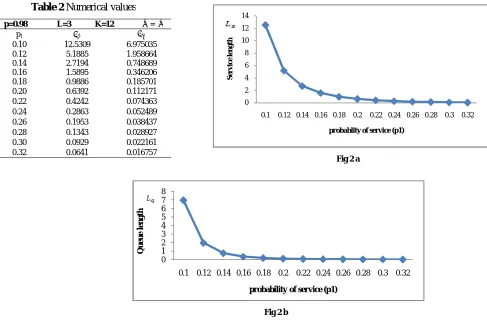
With the various probability value of p , for fixed the valuesL, K, p, and α, the average system length and average queue length are given in the table-2 and also as a graph.
Fig-2(a) and Fig-2(b) provide the expected queue length and expected system length, respectively, with the service rate different probabilityp . It is obvious that Ls and Lq decreases evidently with the rate p increases and the larger probability p is, the smaller Ls become smaller. Therefore under the bulk service policy (L,K) if we want to develop a better service, we can consider (L,K) policy which utilizes the server and decreases the waiting jobs effectively.
CONCLUSION
In this paper, we propose a new NB(L,K)/G/1 queue with bulk service rule (L,K). The system is more complicated and generalizes many discrete time queues about bulk service rule. Using matrix geometric method, we obtain the steady-state distributions and some performance measure. We also perform some numerical examples to study the effect of various parameters on the expected queue length and expected system length. For future research, one can consider for some model when the bulk rule follow those type distributions.
References
1. Chaudhry M.L., Templeton J.G. (1983). "A first course in bulk queues", Wiley, New York.
2. Daniel Wei-Chung Miao, Xenos Chang-Shuo Lin, Wan-Ling Chao (2015),"Computational Analysis of a Markovian Queueing System with Geometric Mean-Reverting Arrival Process". Computer and Operations Research, Vol.65, Issue.C, 2016. pp. 111-124.
3. Goswami. V, Mohanty. J.R., Samanta .S.K, (2006), "Discrete-time bulk- service queues with accessible and non-accessible batches". Applied Mathematics and Computation, Vol.182, pp. 898–906.
4. Latouche, G., and Ramaswami, V. (1999). "Introduction to matrix analytic methods in Stochastic Modeling", American Statistical Association and the Society for industrial and applied Mathematics. Alexandria, Virginia.
5. Mathias A. D and Alexander K. S. (1998), “Using Discrete-time Analysis in the performance evaluation of manufacturing systems”, Research Report Series. (Report No: 215), University of Wiirzburg, Institute of computer Science.
6. Mathias., D. (1998). "Analysis of the Departure process of a batch service queuing system". Research report series. (Report No: 210),University of Wiirzburg, Institute of computer Science.
Table 2 Numerical values
p=0.98 L=3 K=12 =
p1
0.10 12.5309 6.975035
0.12 5.1885 1.958664
0.14 2.7194 0.748689
0.16 1.5895 0.346206
0.18 0.9886 0.185701
0.20 0.6392 0.112171
0.22 0.4242 0.074363
0.24 0.2863 0.052489
0.26 0.1953 0.038437
0.28 0.1343 0.028927
0.30 0.0929 0.022161
0.32 0.0641 0.016757
Fig 2 a
0 2 4 6 8 10 12 14
0.1 0.12 0.14 0.16 0.18 0.2 0.22 0.24 0.26 0.28 0.3 0.32
S
er
v
ic
e
le
n
g
th
probablity of service (p1)
Fig 2 b
0 1 2 3 4 5 6 7 8
0.1 0.12 0.14 0.16 0.18 0.2 0.22 0.24 0.26 0.28 0.3 0.32
Q
u
e
u
e
l
e
n
g
th
7. Pukazhenthi. N and Ezhilvanan. M (2015)." Analysis of discrete time queue of packets with G/G/1 Queueing model",
International Journal of multidisciplinary Research and Development, Vol.2.pp-73-79.
8. Pukazhenthi. N and Ezhilvanan. M (2015), "Analysis of discrete time queues with single server using correlated times",
International Journal of Recent Scientific Research, Vol.6, pp.3584-3589.
9. Pukazhenthi. N and Ezhilvanan. M (2016), "A vacation queueing model with bulk service rule". International Journal of Resent Research in Interdisciplinary Sciences, Vol.3, pp-1-12.
10. Pukazhenthi. N and Ezhilvanan. M, (2014), "Analysis of the discrete time queue length distribution with a bulk Service rule (L,K)". International Journal of Mathematics and Statistics Invention, Vol.2, pp-48-51.
11. Sivasamy, R and Elangovan, R. (2003)."Bulk service queues of M/G/1 type with accessible batches and single vacation".
Bulletin of pure and applied sciences. Vol-22E, (No:1), pp.73-78.
12. Sivasamy, R and Pukazhenthi, N. (2009). "A discrete time bulk service queue with accessible batch: Geo/NB (L, K) /1".
Opsearch. Vol.46 (3), pp.321-334.
13. Vijaya Laxmi Pikala, Goswami, V and Seleshi Demie (2013). "Discrete-time renewal input bulk service queue with changeover time". International Journal of Management Science and Engineering Management .Vol.8:1.pp.47-55.
*******
How to cite this article:Pukazhenthi.N and Ramki.S.2017, Performance Analysis of Discrete Time Bulk Service Queuing Model NB (L,K)/Geo/1.