University of Bolton
UBIR: University of Bolton Institutional Repository
Educational Cybernetics: Conference Papers
(Peer-Reviewed)
Institute for Educational Cybernetics
2008
Dialogic learning and interactive groups: an IMS
LD
Davinia Hernández-Leo
Universitat Pompeu Fabra
Mar Pérez-Sanagustín
Patricia Santos
Sergio Sayago
David Griffiths
University of Bolton, [email protected]
See next page for additional authors
This Conference Paper is brought to you for free and open access by the Institute for Educational Cybernetics at UBIR: University of Bolton Institutional Repository. It has been accepted for inclusion in Educational Cybernetics: Conference Papers (Peer-Reviewed) by an authorized administrator of UBIR: University of Bolton Institutional Repository. For more information, please [email protected].
Digital Commons Citation
Hernández-Leo, Davinia; Pérez-Sanagustín, Mar; Santos, Patricia; Sayago, Sergio; Griffiths, David; and Blat, Josep. "Dialogic learning and interactive groups: an IMS LD." (2008).Educational Cybernetics: Conference Papers (Peer-Reviewed).Paper 3.
1
Dialogic learning and interactive groups: an IMS LD
template integrated in runtime systems
Davinia Hernández-Leo, Mar Pérez-Sanagustín, Patricia Santos, Sergio Sayago, Dai Griffiths, Josep Blat
Contact: Davinia Hernández-Leo
Universitat Pompeu Fabra, Information and Communication Technologies Department Estació de França, Passeig de Circumval.lació 8
08003, Barcelona, Spain Phone: + 34 93 542 1428 Fax: + 34 93 542 2517 Email: [email protected]
Dialogic learning and interactive groups have proved to be a useful methodological approach applied in educational situations for lifelong adult learners. The principles of this approach stress the importance of dialogue and equal participation also when designing the training activities. This paper adopts these principles as the basis for a configurable template that can be integrated in runtime systems. The template is formulated as a meta-UoL which can be interpreted by IMS Learning Design players. This template serves as a guide to flexibly select and edit the activities at runtime (on the fly). The meta-UoL has been used successfully by a practitioner so as to create a real-life example, with positive and encouraging results.
Keywords: IMS LD, lifelong learning, pedagogical model, template, authoring, enactment
1. Introduction
Some of the main problems of lifelong competence development are related to the enormous diversity among lifelong adult learners. This diversity encompasses a large number of factors such as age, gender, culture but also aspects such as needs and interests. The complexity of this context is also emphasized by the fact that lifelong learners have already accumulated experience in informal learning settings, typically associated to real-life situations. This is the rationale behind the research on pedagogical models that is being conducted within the European TENCompetence project. In this project a pedagogical model is considered to be a representation of a pedagogical activity using the IMS Learning Design (IMS LD) specification [1] which can be used for authoring and delivering learning activities [2]. This representation does not need to be a full ready-to-run Unit of Learning (UoL).
In this paper we adopt the methodology used in Agora as a significant basis for approaching TENCompetence pedagogical models. Agora is an association within the La Verneda School for
adult education [3]. Their main objectives are to address social exclusion by providing opportunities for people to train and to update their skills. Through these actions, not only do participants improve their access to the labour market but also their participation in society. Agora’s principles are based on democratic participation. Every participant has the opportunity to contribute in a myriad of decision spaces. In this way, the methodology used in their training activities relies on dialogic learning and interactive groups approaches [4]. Essentially, it is an educational approach that has proven to be very useful, as is being used in a growing number of adult centers, in order to teach adult and older people. The main idea is that people help each other in their process of learning and that group work should promote solidarity, dialogue between equals, express implicit knowledge and the abilities or cultural intelligence of all the participants (learners and instructors). There are no hierarchies within participants and everybody can contribute in the definition of the learning design.
terms of the actual running of a UoL based on these approaches. Not only may unexpected situations occur which would require a UoL to be modified on the fly [5], but it may also be required that the participants should be able to participate in the (on-going) dialogic design of the UoLs. This situation demands a different approach to the current IMS LD implementations in which authoring tools are not integrated in runtime systems and where UoLs need to be planned in advance [6]. This paper proposes adopting the ideas of dialogic learning and interactive groups to develop an IMS LD template (using a terminology according to the framework proposed in [7]) that can be directly integrated in runtime systems. The template is computationally represented in the form of what we call a meta-UoL, which is a fully-fledged UoL offering abstract information derived from other more concrete UoLs. This template incorporates dialogic learning methodological activities so that participants can refine the template into completely defined UoLs according to the needs of their particular learning situation.
Therefore, the aim of this paper is twofold: to define a pedagogical template based on the principles of dialogic learning and the interactive groups, and to formalize the template in an IMS LD interoperable format so that it can be integrated and directly refined (authored) in runtime systems. The rest of the paper is structured as follows. Section 2 deals with the formulation of the pedagogical template. Then, Section 3 illustrates the template integrated in the SLeD system [8] and its particularization with a real-life example. Finally, Section 4 concludes this paper indicating the future work planned to enhance this approach.
2. Template based on dialogic
learning and the interactive groups
The seven principles of dialogic learning lay the foundations for implementing the template: egalitarian dialogue, cultural intelligence, transformation, instrumental dimension, creating meaning, solidarity and equality of differences [3]. After an iterative analysis, the template integrates seven different types of activities, defined for supporting each of these principles, and enables the user to make different types of design decisions, namely: if an activity type appears and when, the activity
description (task), the tool support, input resources (supporting the activity), and the
output artefact (resulting from the activity).
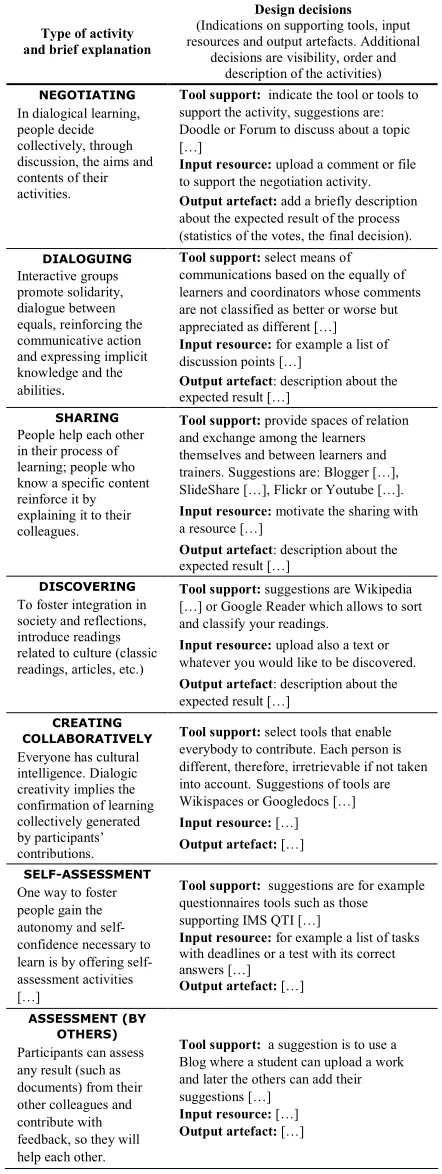
Table 1 Summary of the types of activities and the associated design decisions needed to refine the proposed template into a complete UoL.
Type of activity and brief explanation
Design decisions
(Indications on supporting tools, input resources and output artefacts. Additional
decisions are visibility, order and description of the activities)
NEGOTIATING
In dialogical learning, people decide collectively, through discussion, the aims and contents of their activities.
Tool support: indicate the tool or tools to support the activity, suggestions are: Doodle or Forum to discuss about a topic […]
Input resource: upload a comment or file to support the negotiation activity.
Output artefact: add a briefly description about the expected result of the process (statistics of the votes, the final decision).
DIALOGUING
Interactive groups promote solidarity, dialogue between equals, reinforcing the communicative action and expressing implicit knowledge and the abilities.
Tool support: select means of communications based on the equally of learners and coordinators whose comments are not classified as better or worse but appreciated as different […]
Input resource: for example a list of discussion points […]
Output artefact: description about the expected result […]
SHARING
People help each other in their process of learning; people who know a specific content reinforce it by explaining it to their colleagues.
Tool support: provide spaces of relation and exchange among the learners themselves and between learners and trainers. Suggestions are: Blogger […], SlideShare […], Flickr or Youtube […].
Input resource: motivate the sharing with a resource […]
Output artefact: description about the expected result […]
DISCOVERING
To foster integration in society and reflections, introduce readings related to culture (classic readings, articles, etc.)
Tool support: suggestions are Wikipedia […] or Google Reader which allows to sort and classify your readings.
Input resource: upload also a text or whatever you would like to be discovered.
Output artefact: description about the expected result […]
CREATING COLLABORATIVELY
Everyone has cultural intelligence. Dialogic creativity implies the confirmation of learning collectively generated by participants’ contributions.
Tool support: select tools that enable everybody to contribute. Each person is different, therefore, irretrievable if not taken into account.Suggestions of tools are Wikispaces or Googledocs […]
Input resource: […]
Output artefact: […]
SELF-ASSESSMENT
One way to foster people gain the autonomy and self-confidence necessary to learn is by offering self-assessment activities […]
Tool support: suggestions are for example questionnaires tools such as those supporting IMS QTI […]
Input resource: for example a list of tasks with deadlines or a test with its correct answers […]
Output artefact: […]
ASSESSMENT (BY OTHERS)
Participants can assess any result (such as documents) from their other colleagues and contribute with feedback, so they will help each other.
Tool support: a suggestion is to use a Blog where a student can upload a work and later the others can add their suggestions […]
Input resource: […]
3
For the latest three aspects, the template offers some hints or indications that may be useful to the user when refining the template into a completely defined UoL. These indications and a brief explanation of each activity are shown in Table 1. Both trainer and learners (all considered as playing the same role: participant) can plan the design either a priori or during the learning process.
Technically, the current version of the template1 considers up to four possible different phases formalized as IMS LD acts. Within each phase, the user can select the activity type out of the seven types shown in Table 1. Once selected, the edition of the chosen activity is enabled. Both the selection activity and each of the possible “edition activities” are modelled as
supporting activities. When the user finished the edition by having described the activity and the rest of aspects mentioned in Table 1, the actual learning activity is available and has the characteristics previously configured. Each design decision is codified with local properties
and the effects of showing and hiding the corresponding activities is achieved with
conditions.
3. Integration of the template in
SLeD
The template formalized as a meta-UoL can be interpreted by any IMS LD compliant system. This section illustrates its integration in the SLeD player with an example realized by an Agora’s member in charge of coordinating and conducting training sessions related to lifelong learning of adults in information technologies. Following the guidance provided by the meta-UoL, the Agora’s member created the example in such a way that it represents the activities and the decisions that he usually performs in some of his training sessions.
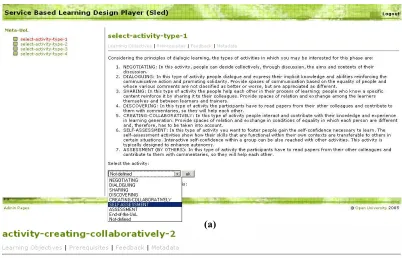
The first activity he put forward to the participants is to write a document and save it in a folder. The main objective is to let participants realize that they can become autonomous users in performing this type of tasks. With this purpose, he chose the self-assessment activity and configures it according to his needs (Figure 1a). In the second activity he wanted to increase the level of difficulty and edited a task that consists of creating
1 Available online at
http://www.tecn.upf.es/~daviniah/metaUoL.zip
collaboratively a document about the towns where they were born (Figure 1b). Finally, he defined a negotiation activity in which the participants decide what they want to do in the next session. To support this activity, he decided to recommend the use of the Doodle Web 2.0 [8] tool as suggested by the UoL (Figure 1c). Since, he did not need a forth activity in the UoL, he set the design of the UoL as finished (Figure 1d).
After the trial (use of the template integrated in SleD), the feedback provided by the Agora’s member was overall positive. Some of his comments were “If I had had this tool when I started participating in Agora, it would have helped me more,” “I was used to traditional academic formation and in Agora I saw that the teacher is not a teacher!” or “It would have been also useful for me to see the lesson plans by other Agora trainers.”
He also stressed the need for flexibility in this type of contexts, “There are many situations in which I need to improvise. Tools might not work properly; students do not have a keen interest in the topic or have specific needs, so I sometimes need to reschedule groups and activities to adapt to the circumstances.” Moreover, he provided feedback regarding the vocabulary employed in the template and suggested changing some words to enhance their comprehensibility. For example, input resources and output artefacts may be more clearly understood if formulated as “supporting resources” and “resulting products.”
4. Conclusion and future work
In this paper we propose a new approach to IMS LD authoring that can be integrated in runtime systems. This approach is based on a template formulated as an IMS LD compliant meta-UoL, which can be interpreted (and thus integrated) by IMS LD players. This template serves users as a guide to flexibly select and configure the activities on the fly. The meta-UoL relies on the principles of dialogic learning and interactive groups and has been used successfully by an Agora’s member to create a real-life example. Dialogic learning is an educational approach based on participative and egalitarian dialogue which has proven to be very useful to teach adult people.
the modification of the activity order and their configuration once they have been configured, and adding group-based functionalities. We also plan to enrich the template by integrating more detailed support for the assessment activities. The suggestions regarding (Web 2.0) tool support need further research which can benefit from the experience of the actual use of the
template by the target audience when planning the tools for their training sessions. We are also currently working on an approach for saving the users’ design decisions with sharing and reusing purposes.
Figure 1. (a) Selection of the self-assessment activity. (b) Final configuration of the creating-collaboratively activity. (c) Edition of the negotiation-activity. (d) UoL finishes with the third activity.
(a)
(b)
5
Acknowledgment
This work has been partially funded by European Commission in the TENCompetence project (IST-2004-02787). The work done in the OpenDock project represents the initial motivation of this research.
5. References
[1] Koper, R., Olivier, B. (2004). Representing the
Learning Design of Units of Learning. Educational
Technology & Society,7(3), 97-111.
[2] Griffiths, D. et al. (2007) D6.1 – Report with summary of WP6 outputs of month 1-18, TENCompetence project deliverable, retrieved February 2008 from http://hdl.handle.net/1820/1148
[3] La Verneda School for Adult Education, Website,
retrieved February 2008 from
http://www.edaverneda.org/Ingles/
[3] Flecha, R. (2005). Sharing Words. (3 ed.). Lanham,
M.D: Rowman & Littlefield.
[4] Dillenbourg, P., Tchounikine, P. (2007) Flexibility in macro-scripts for computer-supported collaborative
learning, Journal of Computer Assisted Learning, 23,
1-13.
[5] Griffiths, D., Blat, J., García, R., Vogten, H., Kwong, K.L. (2005). Learning Design tools. In R. Koper & C. Tattersall (Eds.), Learning Design, a handbook on modelling and delivering networked education and training (pp. 109-135). Heidelberg: Springer-Verlag.
[6] Hernández-Leo, D., Harrer, A., Dodero, J.M., Asensio-Pérez, J.I., Burgos, D. (2007) A Framework for the Conceptualization of Approaches to
“Create-by-Reuse” of Learning Design Solutions. Journal of
Universal Computer Science, 13(7), 991-1001.
[7] McAndrew, P., Nadolski, R., Little, A. (2005) Developing an approach for Learning Design players, Jounal of Interactive Media in Education, Special Issue on Advances in Learning Design, retrieved
February 2008 from
http://www-jime.open.ac.uk/2005/14/