*Corresponding author:Parashram ISSN: 0976-3031
Research Article
EFFECTIVENESS OF PLANNED TEACHING PROGRAMME ON KNOWLEDGE REGARDING
THE PREVENTION OF CHILD LABOUR AMONG THE PARENTS OF SCHOOL AGE CHILDREN
Parashram
Shri Ram Murti Smarak College of Nursing, Bareilly, U.P
DOI: http://dx.doi.org/10.24327/ijrsr.2019.1008.3897
ARTICLE INFO ABSTRACT
Introduction: "World revolves around the children. Children's future revolves around education. Stop Child Labor"
Children are the future custodians of all the present philosophies including sovereignty, rule of law, justice, liberty, fraternity and international peace and security. The human rights jurisprudence categorically recognized the rights of the child. The Declaration of Geneva in 1924 gave a clarion
call that “Mankind owes to the child the best it has to give”. The Universal Declaration of Human
rights rightly obliges family, as a fundamental unit of society, to focus on children so as to afford them necessary pre-conditions to growth. Article 24 of the UN (United Nations) declaration Provides: “Every Child shall have the right to such measures of protection as are required by his status as a minor, on the part of his family, society and the State”.
Material and Methods:A quasi experimental -one group pre-test post-test design to evaluate the effectiveness of PTP on prevention of child labour among the parents of school age children. The study was conducted on 100 parents having children between the ages of 6-14 years. Data was collected from October 2018 to December 2018.A structured questionnaire was used to evaluate the effectiveness of PTP on prevention of child labour among the parents of school age children
Result:The data revealed that, there is significant difference in mean of pre-test score 31.18% and mean of post-test score 68.82% of knowledge regarding prevention of child labour measures. Major findings of study revealed that Plan Teaching Program (PTP) is effective in enhancement of parents knowledge.
Conclusion: After the detailed analysis of this study it shows that effective use of PTP help in providing pertinent information and knowledge to parents, regarding prevention of child labour measures.
INTRODUCTION
“Every child deserves a reason to laugh. Child labourers live and work in such poor conditions that their lips would probably crack if they smiled.”
-Zoe Grueskin, Hoover Elementary School of Iowa city, Iowa
Child labour is a vexed subject in India. People often think about it with their hearts rather than with their heads. On October 10th 2006, Government introduced a new amendment in Child Labour (Prohibition and Regulation) Act, 1986. According to the amendment, a ban was imposed on employment of children (less than the age of fourteen) in dhabas, restaurants and hotels and as servants or domestic help as well. Any violation of this ban would lead to imprisonment up to two years and/or fine of Rs.10,000 to Rs.20,000. However, just after two months, in December 2006, over 1,670
cases of such violation have been detected by many State Governments. It’s been more than a year now and the tragedy is that child laborers' are still found all over India.1
While Child labour is the product of poverty and unemployment, it further contributes to underdevelopment and unemployment. It contributes to unemployment, because the existence of child labour, results in the increase of adult unemployment; and to under development, because a child laborer by the time he becomes as adult, is fully burnt out. The encouragement of child laborers to work and contribute towards the family income, prompts parents to have more children. Thus child labour defeats the goal of family planning. Child labour also hinders the prospect of implementing the policy of compulsory primary education which is now made important by the implementation of the Right to Education Act, 2009.2
International Journal of
Recent Scientific
Research
International Journal of Recent Scientific Research
Vol. 10, Issue, 08(G), pp. 34442-34447, August, 2019
Copyright © Parashram, 2019, this is an open-access article distributed under the terms of the Creative Commons Attribution License, which permits unrestricted use, distribution and reproduction in any medium, provided the original work is properly cited.
DOI: 10.24327/IJRSR
CODEN: IJRSFP (USA)
Article History:
Received 15th May, 2019
Received in revised form 7th June, 2019
Accepted 13th July, 2019
Published online 28th August, 2019
Key Words:
The development of India as a nation is being hampered by child labour. The Government of India must ensure that the needs of the poor are satisfied. If poverty is addressed, the need for child labour will diminish. Concerted efforts are required from all section of the society to make a dent in the problem. There should be combined efforts of government, international agencies, non-governmental organizations and above all the citizens. Let us hope that child labour issue would be addressed genuinely and eradicated completely from our society in the coming years and near future. Public awareness is a great force to threat the danger of child labour. Some of the parents do not realize the need for a proper physical, emotional and cognitive development of a child. It is important that everyone become aware of the existence of these horrors and feel personally called upon to act.3
In its quadrennial Global Report on child labour (2010) the ILO
estimates globally, child labour continues to decline, albeit to a
lesser extent than before. There are still 215 million children caught in child labour. The number of children in hazardous work, often used as a proxy for measuring the extent of the worst forms of child labour, is declining, particularly among those below 15 years of age. The overall rate of reduction, however, has slowed. There are still 115 million children in hazardous work. Children’s work is declining in the Asia-Pacific region and in Latin America and the Caribbean, but it is increasing in sub-Saharan Africa.8 India's Country Report states that the number of working children was estimated to be 17 million. 90% working children are in rural India. 85% of working children are in the unorganized sectors. About 80% of child labour is engaged in agricultural work. 25% of the victims of commercial sexual exploitation in India are below 18 years of age. According to the 2001 census, in Karnataka there were recorded 0.82 million child laborers', making it the seventh highest state in the country. According to a report by child right organization June 26 2006 there has been an alarming rise in the incidence of child labour in Madhya Pradesh. The report released by the Haq Centre for Child Rights Gwalior M.P. puts the number of child laborers in the state at 1,065,259. Of the 1,700 cases registered under the Child Labour (Prohibition and Regulation) Act 1986, there have been only 35 convictions. Government of M.P. estimates say one fourth of bidi workers in the state are children below 14, which means of the estimated 14 lac bidi workers, 3.5 lac are children However, child rights activists say India currently has around 50 million child laborers. Violators face jail for up to two years and a fine up to Rs 20,000.
A study was conducted in the glass-bangle manufacturing industry in Firozabad district of Uttar Pradesh, 2003 to understand the impact of relevant legislation on child labour, keeping in view demand-side factors, supply-side factors and the state of education in the area. A sample of 1013 households was taken for study, out of which 312 households had migratory status. Study was conducted through observations, questionnaires and focus group discussion. The result showed that the enforcement of child labour legislation at Firozabad faces problems such as inadequate staff to implement labour laws, false certificates with employers showing the age of child workers to be more than 14 years, attitude of the workers who side with the employers as they do not want to risk losing their jobs and want to avoid the hassles of being involved in court
cases. The researcher concluded that efforts have been made to introduce new technological interventions in the existing organizational structure in order to bring about improvement in working conditions. The system should be improved and enforcement of child labour.4
The government alone cannot deal such a great problem and a change in attitude is needed to eliminate/reduce this menace. If children of the poor can be provided education and vocational training and if stipends accompany such training, parents would be under less pressure to send their children to work in hazardous factories. But this require a huge effort and a fresh thinking, which sadly is lacking and the blame for child labour must be shared by the society and the leaders, hence it created an awareness in the researcher mind that there is a need to arouse knowledge among the rural parents regarding the impact of child labour and importance of prevention of child labor.12
So as it is mentioned before the problem is so complicated and has deep roots. It needs all the efforts from the individual, children, parents, groups, institutions, governmental directories and civil society to face it and end child labour. The study will contribute to the awareness of child labour and to inform about increased incidence, causes, hazards and recommend immediate and appropriate responsive actions that can be undertaken by the families, community and civil society organizations for the prevention of child labour.
Child labour remains a serious problem in many parts of the world in the current scenario. So the investigator felt that, solutions should be framed in order to prevent child labour. The most applicable and affordable way to avoid these problems include increase the knowledge level of parents. Hence the investigator has taken the initiative to conduct a study to increase the knowledge level of parents in preventing child labour.
Objectives of study
1. To determine the pre-test and post-test knowledge of parents regarding the prevention of child labour. 2. To evaluate the effectiveness of planned teaching
programme regarding knowledge of prevention of child labour.
3. To find out the association between pre-test knowledge score of parents of school age children regarding the prevention of child labour with the selected socio-demographic variables.
MATERIAL & METHODS
A quasi-experimental study was carried out on 100 parents having children between the ages of 6-14 years to measure the effectiveness of PTP for parents of school age children on prevention of child labour. The sample for the study comprised of 100 parents having children between the ages of 6-14 years. The sample who met sampling criteria and available during the month of Oct. 2018 to Dec. 2018 were selected as the subject for the study. They were selected by non-probability convenient sampling technique.
effectiveness of Plan Teaching Program (PTP) on parents’ knowledge regarding prevention of child labour. The research design used was Quasi-experimental, one group pre-test, post-test design to measure the effectiveness of Plan Teaching Program on parents’ knowledge regarding prevention of child labour. A self-structured assessment questionnaire on knowledge of prevention of child labour was developed which consists of General information on child labour, Effects of child labour and Prevention of child labour. And an (PTP) Plan Teaching Program was prepared to provide pertinent information about the same.
Part I – Baseline Performa It consisted of 9 items that included age in years, gender, occupation, monthly income of family, educational qualification, number of children, type of family, religion and exposure to mass media.
Part II – Structured knowledge questionnaire on prevention of child labour The structured knowledge questionnaire consisted of 32 items that were divided into 3 areas. The maximum score is 32 and minimum is zero.
The content validity of questionnaire was established by experts. The experts were selected on the basis of their expertise, experience and interest in the problem being studied. They were from different specialties i.e. Community Health Nursing, Psychology, Education, Research, Statistics and PSM. They were requested to give their opinions on the appropriateness and relevance of the items in the tool. Necessary modifications were made as per the expert's advice. The reliability of the questionnaire was established by Split Half method and was found to be r-0.87. A final study was carried out on 100 parents having children between the ages of 6-14 years. Data was collected from Oct 2018 to Dec 2018. The sample for the study comprised of the parents, who met the designated criteria were selected through convenient sampling technique. Objectives of study was discussed and obtained consent for participation in study. Existing knowledge of parents about child labor was assessed by administering a structured assessment questionnaire, followed by administration of Plan Teaching Program (PTP) on prevention of child labor. Posttest was taken after 7 days. Based on the objective and the hypothesis the data was analyzed by using various statistical tests i.e. percentage, mean, and standard deviation.
Statistical methods
The significance was calculated by using mean, Standard deviation, unpaired t statistics, paired t statistics for comparison and the Chi-square statistics is used to find the independence of difference. Significance was accepted at 0.01 and 0.05 level of probability.
RESULTS
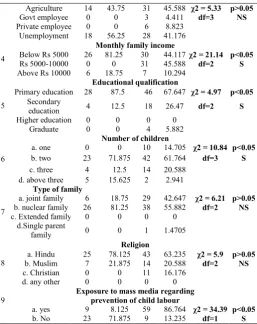
Section I: Description of Socio demographic data of parents Findings of section I show that out of 100 sample distribution in table 1 shows that 9% were in the age group of <25 years, 33% were in the age group of 25-35 years and 58% were in the age group of >35 years. Majority (52%) of the parents were males and the remaining (48%) were females. 45% were in agriculture, 3% were govt. employees, 6% were private employees and 46% unemployment. 56% were having below Rs5000 monthly family income, 31% were having monthly
family income between Rs5000-10000, and 13% were having monthly income above Rs10000. 74% were having primary school education, 22% were having secondary level education, 0% were having higher secondary education and 4% were graduates.10% were having one child, 65% were having two children, 18% were having three children and 7% were having >3 children. 35% were belongs to joint family and 64% were belongs to nuclear family and 0% were belongs to extended family and 1% were belongs to single belongs to single parent family. 68% were Hindus, 21% were Muslims and 11% were Christians.68% having knowledge from mass media and 32% never had any exposure.
Section - II A Assessment of pre-test knowledge of parents regarding prevention of child labour
Sr. Demographic variables Frequency %
1
Age in years
a. Below 25 yrs 9 9
b. 25-35 yrs 33 33
c. Above 35 yrs 58 58
2
Gender
a. male 52 52
b. female 48 48
3
Occupation
a. Agriculture 45 45
b. Govt. employee 3 3
c. Private employee 6 6
d. Unemployment 46 46
4
Monthly family income
a. Below Rs 5000 56 56
b. Rs 5000-10000 31 31
c. Above Rs 10000 13 13
5
Educational status
a. Primary education 74 74
b. secondary education 22 22
c. Higher education 0 0
d. Graduate 4 4
6
Educational status
a. Primary education 74 74
b. secondary education 22 22
c. Higher education 0 0
d. Graduate 4 4
7
Number of children
a. one 10 10
b. two 65 65
c. three 18 18
d. above three 7 7
8
Type of family
a. joint family 35 35
b. nuclear family 64 64
c. Extended family 0 0
d. single parent family 1 1
9
Religion
a. Hindu 68 68
b. Muslim 21 21
c. Christian 11 11
d. any other 0 0
10
Exposure to mass media regarding prevention of child labour
a. yes 68 68
b. No 32 32
Area of Knowledge
No of items
Range Pre-test Knowledge
Min Max Mean
score SD Mean %
General
information 13 1 8 4.86 1.75 37.38
Effects of child
labour 9 0 5 2.2 1.17 24.4
Prevention of
Findings of section IIA show that out of 100 samples pre-test knowledge of parents regarding prevention of child labour in table 2 shows that the mean score is 4.86 with a standard deviation (SD) of 1.75 and the mean percentage is 37.38%. In the pre-test knowledge regarding effects of child labour, the mean score is 2.2 with a SD of 1.17 and the mean percentage is 24.4%. In the pre-test knowledge score regarding prevention of child labour, the mean score is 2.92 with a SD of 1.4 and the mean percentage is 29.2%.
Section - II B Assessment of post-test knowledge of the parents regarding prevention of child labour
Findings of section IIB show that out of 100 samples post-test knowledge of parents regarding prevention of child labour in table 3 shows that in the General information, the mean score is 9.58 with a mean percentage of 73.69 and a standard deviation of 1.78.In Effects of child labour, the mean score is 5.8 with a mean percentage of 64.4 and a standard deviation of 1.51. In Prevention of child labour, the mean score is 7.63 with a mean percentage of 76.3 and a standard deviation of 1.22.
Findings of section III show that out of 100 samples comparison of pretest and posttest knowledge of parents regarding prevention of child labour in table 4 shows that in all aspects the Parents has improved their knowledge after the administration of planned teaching programme. The difference between pre and post-test knowledge score is large and it is significant. Statistical significance was calculated using parent’s paired ‘t’ test.
The mean pre-test score is 9.98 and the mean post test score is 23.01.The mean difference is 13.03. The parents paired‘t’ test value is t=39.48 and is significant.
Section IV Association between the selected demographic variable and the mean pre-test level of knowledge
Sr. Demographic
variables
Knowledge level of respondent Chi- Inference
< Median ≥ Median square
1
Age No. % No. %
Below 25 yrs 2 6.25 7 10.294 χ2 = 1.42 p>0.05
25-35 yrs 13 40.625 20 29.411 df=2 NS
Above 35 yrs 17 53.125 41 60.294
2
Gender
Male 14 43.75 38 55.882 χ2 = 1.28 p>0.05
Female 18 56.25 30 44.117 df=1 NS
3 Occupation
Agriculture 14 43.75 31 45.588 χ2 = 5.33 p>0.05
Govt employee 0 0 3 4.411 df=3 NS
Private employee 0 0 6 8.823
Unemployment 18 56.25 28 41.176
4
Monthly family income
Below Rs 5000 26 81.25 30 44.117 χ2 = 21.14 p<0.05
Rs 5000-10000 0 0 31 45.588 df=2 S
Above Rs 10000 6 18.75 7 10.294
5
Educational qualification
Primary education 28 87.5 46 67.647 χ2 = 4.97 p<0.05
Secondary
education 4 12.5 18 26.47 df=2 S
Higher education 0 0 0 0
Graduate 0 0 4 5.882
6
Number of children
a. one 0 0 10 14.705 χ2 = 10.84 p<0.05
b. two 23 71.875 42 61.764 df=3 S
c. three 4 12.5 14 20.588
d. above three 5 15.625 2 2.941
7
Type of family
a. joint family 6 18.75 29 42.647 χ2 = 6.21 p>0.05
b. nuclear family 26 81.25 38 55.882 df=2 NS
c. Extended family 0 0 0 0
d.Single parent
family 0 0 1 1.4705
8
Religion
a. Hindu 25 78.125 43 63.235 χ2 = 5.9 p>0.05
b. Muslim 7 21.875 14 20.588 df=2 NS
c. Christian 0 0 11 16.176
d. any other 0 0 0 0
9
Exposure to mass media regarding prevention of child labour
a. yes 9 8.125 59 86.764 χ2 = 34.39 p<0.05
b. No 23 71.875 9 13.235 df=1 S
Findings of section IV in table 4 show that out of the 9 socio-demographic variables, only 4 variables (The Educational status, monthly family income, number of children and exposure to mass media) were significantly associated with their mean pre-test knowledge score. These types of association are statistically significant and it was calculated using Pearson chi square test.
DISCUSSION
The present study revealed in analysis of phase I that majority parents (58%) were in the age group of >35 years who were (52%) males and (46%) unemployed who were having monthly income above Rs10000.
It is also found that majority i.e. 74% were having primary school education, and (65%) were having two children.
Majority (68%) were Hindus and (68%) having knowledge from mass media.
Majority of samples scored high in post-test than that of pre-test and mean percentage score of samples regarding knowledge about prevention of child labour was higher in post-test than that of pre-post-test.
There is significant association between Educational status, monthly family income, number of children and exposure to mass media. Whereas other demographic variable like age, gender, occupation, religion and type of family have insignificant association with pre-test knowledge score.
Recent studies conducted to find out the effectiveness of education and awareness program conducted by NGO’s for the child labourers and their parents. The sample comprised of four non-residential camps conducted by NGO’s. The finding of the Area of knowledge No of
items
Range Post-test Knowledge
Min Max Mean
score SD Mean %
General information 13 6 13 9.58 1.78 73.69
Effects of child labour 9 3 9 5.8 1.51 64.4
Prevention of child
labour 10 5 10 7.63 1.22 76.3
Section III Comparison of pre and post-test knowledge scores of parents regarding prevention of child labour
Area of knowledge
Pre-test Post-test Enhancement paired
t-test
Mean SD Mean SD Mean SD
General
information 4.86 1.75 9.58 1.78 4.72 2.03 t=23.6
Effects of child
labour 2.2 1.17 5.8 1.51 3.6 1.37 t=26.27
Prevention of
child labour 2.92 1.40 7.63 1.22 3.733 1.52 t=26.9
Overall
study reveal that the mean post test knowledge score (59.6%) was higher when compared with pre test mean knowledge score (29.37%), 50% of children were mainstreamed into formal school system at an age- appropriate grade level and the parents showed positive attitude towards formal education. There is significant difference between pre test knowledge and post test knowledge score of parents. Children age 5-9 had their mainstreaming rate about 90%. But in older children it was only about 50%. The study concluded that the parental and community awareness is important factor to limit child labour.6 It is reported in a study conducted in slum area of Gwalior city with an objective to find out the knowledge regarding child labour level and to administer and find out the effectiveness of educational programme for them. Sample size was 30 mothers. The results reveal that the mean post-test knowledge score was higher (7.94) with standard deviation of 2.8% when compared with pre test mean knowledge score. Majority of mother had low school level education 1st to 4th class (20 out of 30). There is significant difference between pre-test knowledge and post test knowledge score of parents. The obtained percentage value 3.128 is statistically significance at p<0.05 level. It was found that the educational material was effective in terms of increasing the cognitive behavior and developing a more unfavorable attitude towards child labour.5
A cross-sectional study of 150 child labourers engaged in different occupations in a slum area of Calcutta was conducted to assess their health and nutritional status. Most (88%) of them had some type of morbidity. Female child workers (95.5%) suffered more than the males (84.7%). Most prevalent morbidities among the child labourers were seen as pallor (49.3%) followed by pediculosis (48%), dental caries (28.6%), malnutrition (22.6%), worm infestation (20.6%) and scabies (16.6%). Garage workers were observed to suffer less from any type of morbidity except pallor which may be attributed to lead exposure. Rag-pickers had significantly (p < 0.05) more risk of developing worm infestation, scabies and pediculosis whereas domestic helpers had significantly (p < 0.05) more risk of developing pediculosis. Occupational hazards were also studied but excepting pallor in garage workers and scabies in rag-pickers, nothing could be documented.7
CONCLUSIONS
The present study explore that there is significant effect of PTP on knowledge of parents about prevention of child labour. The correlation finding which was done to find the relationship with selected demographic variables was done by using 'chi-square' test.PTP have significant effect in improving nurses knowledge of parents about prevention of child labour for its implication.
Implecation & Recommendation
The findings of the study have implications related to nursing administration, nursing practice, nursing education and nursing research which provides the way towards the better improvement in knowledge of parents of school age children regarding prevention of child labour and for children as well as educating the public and creating the awareness regarding prevention of child labour.
The special implication of nursing administration in rural area is that they should pay attention to all school
children regarding to see whether they are provided with enough health education about the general things. In-service education and clinical teaching programmes
should be conducted to improve the knowledge of the staff.
In the schools and community the nurse administrator should organize teaching programme to bring awareness regarding prevention of child labour.
Nurse can conduct teaching sessions for the school children during their visits to the hospital, home and school.
Nurses are the resource persons working in the hospital, school and community setting should impart education especially on prevention of child labour.
Self explanatory posters and charts regarding child labour and its effects can be displayed in the class room. More emphasis has to be placed in the curriculum on
preventive and promotive services in schools and community (village) settings.
Student nurses can be motivated to organize school health programmes to enhance the knowledge of students regarding measures for prevention of child labour.
Encourage the student nurse to participate actively in health awareness in various educational programmes. Child labour is most prominent in rural areas,
particularly in the agricultural sector. So it is important to educate the parents in rural area regarding child labour and the measures to prevent them. The findings of the present study is helpful for the nursing professionals and nursing students to conduct further studies to find out the effectiveness of various methods of providing education on improving the knowledge among nurses and other people. It will in turn strengthen nursing research.
Keeping in view the findings of the study, the following recommendations are made:
A similar study can be conducted on large sample to assess the effectiveness of planned teaching programme on the parents of school age children regarding the prevention of child labour.
A comparative study can be conducted to assess the knowledge regarding prevention of child labour among various rural communities.
A descriptive study can be carried out to assess the knowledge of the parents regarding prevention of child labour.
A comparative study can be done between the parents of school age children in urban and rural areas regarding prevention of child labour.
References
1. http://www.legalindia.in/progressive-abolition-of-child-labour.
2. http://www.naukrihub.com/hr-today/child-labour.html. 3.
http://www.publishyourarticles.org/knowledge-hub/essay/child-labor-essay.html 4. http//Elliot.gwu.edu/assets/docs/acad/ids
5. Ghosh Singh, Ruma and Sharma Rajeev. Child labour in the glass bangle industry of Firozabad (2003). Research abstracts on child labour1998- 2009.2010: 39.
6. Ramkumar N. A study to Assess the Effectiveness of Self Instructional Module (SIM) on Causes, Hazards, and Prevention of Child Labour among the Mothers in Selected slum areas at Gwalior City. [Unpublished Masters Thesis submitted to Jiwaji University].
7. Mallik S, Chaudhuri RN, Biswas R, Biswas B. A study on morbidity pattern of child labourers engaged in different occupations in a slum area of Calcutta. J Indian Med Assoc. 2004 Apr; 102(4):198-200, 226.
How to cite this article:
Parashram.2019, Effectiveness of Planned Teaching Programme on Knowledge Regarding The Prevention of Child Labour Among The Parents of School Age Children. Int J Recent Sci Res. 10(08), pp.34442-34447.
DOI: http://dx.doi.org/10.24327/ijrsr.2019.1008.3897