VOLUME NO.5(2015),ISSUE NO.08(AUGUST) ISSN 2231-5756
A Monthly Double-Blind Peer Reviewed (Refereed/Juried) Open Access International e-Journal - Included in the International Serial Directories
Indexed & Listed at:
Ulrich's Periodicals Directory ©, ProQuest, U.S.A., EBSCO Publishing, U.S.A., Cabell’s Directories of Publishing Opportunities, U.S.A., Open J-Gage, India [link of the same is duly available at Inflibnet of University Grants Commission (U.G.C.)],
VOLUME NO.5(2015),ISSUE NO.08(AUGUST) ISSN 2231-5756
INTERNATIONAL JOURNAL OF RESEARCH IN COMMERCE, IT & MANAGEMENT
CONTENTS
Sr.
No.
TITLE & NAME OF THE AUTHOR (S)
Page
No.
1.
TIME LAG ANALYSIS OF SELECTED INDIAN COMPANIES
DR. RAMANJIT KAUR
1
2.
A STUDY ON WOMEN EMPLOYEE ATTRITION IN IT INDUSTRY WITH SPECIAL REFERENCE TO
TECHNOPARK, THIRUVANANTHAPURAM
DR. R. MOHAN KUMAR & A. ASTALIN MELBA
5
3.
CUSTOMERS PERCEPTION TOWARDS ELECTRIC TWO WHEELER VEHICLES IN BANGALORE CITY: A
STUDY ON GO GREEN BATTERY OPERATED VEHICLES
SANTHOSH.M & RAGHAVENDRA.K.A
9
4.
STATUS OF SCHEDULE TRIBES IN TELANGANA REGION
A. LAKSHMI
15
5.
COMPANIES ACT 2013: A NEW INITIATIVE TOWARDS CORPORATE GOVERNANCE
BHARAT N. BASRANI
18
6.
CATALOGUING OF ISSUES BIRTHING LIFE INSURANCE POLICIES LAPSATION: A CASE STUDY OF
HARYANA
DR. SILENDER SINGH HOODA
21
7.
MICROFINANCE AND IT’s PROGRESS IN UTTARAKHAND
GAURAV PANT
24
8.
STRATEGIC ISSUES OF MAKE IN INDIA CAMPAIGN
DR. SONIA, DR. GARIMA DALAL, YOGITA & SUMEET MALIK
29
9.
THE STUDY OF IMPACT SIMULTANEOUS OF CAPITAL STRUCTURE AND COMPETITIVE POSITION IN
PRODUCT MARKET (MARKET SHARE) OF COMPANY LISTED IN TEHRAN STOCK EXCHANGE
YAVAR MOBASHER & MOHAMMAD REZA POURALI
33
10.
SEGMENTATION STUDIES FOR GREEN MARKETING AND THEIR LIMITATIONS
RAJEEV GUPTA
39
11.
TRANSFORMING THE NIGERIAN ECONOMY THROUGH FOREIGN DIRECT INVESTMENT: THE ROLE OF
FINANCIAL DEVELOPMENT
DR. NSEABASI IMOH ETUKAFIA & DR. AKPAN JAMES WILLIAMS
43
12.
A STUDY OF FEMININE SANITARY WELL BEING OF KORKU TRIBE IN SOUTH MADHYA PRADESH
DR. SUNEELI ANAND & PARTH GUPTA
50
13.
A CAPSULIZATION OF REGNANT CONTENTIONS IN HRM
KIRTI S BIDNUR
54
14.
MICRO FINANCE INSTITUTIONS (MFIs): AN ANALYSIS OF THEIR FUNCTIONING IN BELLARY DISTRICT
DURGASHAMILI.SUNKARA & GURUDATT.KAMATH B
58
15.
VALUE ADDITION ON KENYAN TEAS: EFFECTS ON INTERNATIONAL MARKET SUSTAINABILITY AND
COMPETITIVENESS
ESTHER WANJIRU MAINA
65
16.
EMPLOYEE RETENTION: MANAGING THE HUMAN RESOURCE IN EDUCATION SECTOR
JWALA HANDOO & TANIA MENGI
68
17.
PERFORMANCE EVALUATION OF MUTUAL FUNDS OF ICICI AND SBI
CHILLAKURU ESWARAMMA
71
18.
MULTIVARIATE MODEL FOR PREDICTING THE IMPACT OF FIRM SPECIFIC VARIABLES ON FINANCIAL
PERFORMANCE OF AIR INDIA LIMITED
SWARICHA JOHRI
78
19.
A STUDY ON ECONOMICS OF TOURISM WITH SPECIAL REFERENCE TO VELANKANNI- NAGAPATTINAM
DISTRICT
W.ROSE MARY FLORENCE
82
20.
INNOVATION CAPACITY: A PREREQUISITE FOR ‘MAKE IN INDIA’
AAINA DHINGRA
89
VOLUME NO.5(2015),ISSUE NO.08(AUGUST) ISSN 2231-5756
INTERNATIONAL JOURNAL OF RESEARCH IN COMMERCE, IT & MANAGEMENT
CHIEF PATRON
PROF. K. K. AGGARWAL
Chairman, Malaviya National Institute of Technology, Jaipur
(An institute of National Importance & fully funded by Ministry of Human Resource Development, Government of India)
Chancellor, K. R. Mangalam University, Gurgaon
Chancellor, Lingaya’s University, Faridabad
Founder Vice-Chancellor (1998-2008), Guru Gobind Singh Indraprastha University, Delhi
Ex. Pro Vice-Chancellor, Guru Jambheshwar University, Hisar
FOUNDER PATRON
LATE SH. RAM BHAJAN AGGARWAL
Former State Minister for Home & Tourism, Government of Haryana
Former Vice-President, Dadri Education Society, Charkhi Dadri
Former President, Chinar Syntex Ltd. (Textile Mills), Bhiwani
FORMER CO-ORDINATOR
DR. S. GARG
Faculty, Shree Ram Institute of Business & Management, Urjani
ADVISORS
PROF. M. S. SENAM RAJU
Director A. C. D., School of Management Studies, I.G.N.O.U., New Delhi
PROF. M. N. SHARMA
Chairman, M.B.A., Haryana College of Technology & Management, Kaithal
PROF. S. L. MAHANDRU
Principal (Retd.), Maharaja Agrasen College, Jagadhri
EDITOR
PROF. R. K. SHARMA
Professor, Bharti Vidyapeeth University Institute of Management & Research, New Delhi
CO-EDITOR
DR. BHAVET
Faculty, Shree Ram Institute of Engineering & Technology, Urjani
EDITORIAL ADVISORY BOARD
DR. RAJESH MODI
Faculty, Yanbu Industrial College, Kingdom of Saudi Arabia
PROF. SANJIV MITTAL
University School of Management Studies, Guru Gobind Singh I. P. University, Delhi
PROF. ANIL K. SAINI
Chairperson (CRC), Guru Gobind Singh I. P. University, Delhi
DR. SAMBHAVNA
VOLUME NO.5(2015),ISSUE NO.08(AUGUST) ISSN 2231-5756
INTERNATIONAL JOURNAL OF RESEARCH IN COMMERCE, IT & MANAGEMENT
DR. MOHENDER KUMAR GUPTA
Associate Professor, P. J. L. N. Government College, Faridabad
DR. SHIVAKUMAR DEENE
Asst. Professor, Dept. of Commerce, School of Business Studies, Central University of Karnataka, Gulbarga
ASSOCIATE EDITORS
PROF. NAWAB ALI KHAN
Department of Commerce, Aligarh Muslim University, Aligarh, U.P.
PROF. ABHAY BANSAL
Head, Department of Information Technology, Amity School of Engineering & Technology, Amity
University, Noida
PROF. A. SURYANARAYANA
Department of Business Management, Osmania University, Hyderabad
PROF. V. SELVAM
SSL, VIT University, Vellore
DR. PARDEEP AHLAWAT
Associate Professor, Institute of Management Studies & Research, Maharshi Dayanand University, Rohtak
DR. S. TABASSUM SULTANA
Associate Professor, Department of Business Management, Matrusri Institute of P.G. Studies, Hyderabad
SURJEET SINGH
Asst. Professor, Department of Computer Science, G. M. N. (P.G.) College, Ambala Cantt.
FORMER TECHNICAL ADVISOR
AMITA
Faculty, Government M. S., Mohali
FINANCIAL ADVISORS
DICKIN GOYAL
Advocate & Tax Adviser, Panchkula
NEENA
Investment Consultant, Chambaghat, Solan, Himachal Pradesh
LEGAL ADVISORS
JITENDER S. CHAHAL
Advocate, Punjab & Haryana High Court, Chandigarh U.T.
CHANDER BHUSHAN SHARMA
Advocate & Consultant, District Courts, Yamunanagar at Jagadhri
SUPERINTENDENT
VOLUME NO.5(2015),ISSUE NO.08(AUGUST) ISSN 2231-5756
INTERNATIONAL JOURNAL OF RESEARCH IN COMMERCE, IT & MANAGEMENT
CALL FOR MANUSCRIPTS
We invite unpublished novel, original, empirical and high quality research work pertaining to recent developments & practices in the areas of Computer Science & Applications; Commerce; Business; Finance; Marketing; Human Resource Management; General Management; Banking; Economics; Tourism Administration & Management; Education; Law; Library & Information Science; Defence & Strategic Studies; Electronic Science; Corporate Governance; Industrial Relations; and emerging paradigms in allied subjects like Accounting; Accounting Information Systems; Accounting Theory & Practice; Auditing; Behavioral Accounting; Behavioral Economics; Corporate Finance; Cost Accounting; Econometrics; Economic Development; Economic History; Financial Institutions & Markets; Financial Services; Fiscal Policy; Government & Non Profit Accounting; Industrial Organization; International Economics & Trade; International Finance; Macro Economics; Micro Economics; Rural Economics; Co-operation; Demography: Development Planning; Development Studies; Applied Economics; Development Economics; Business Economics; Monetary Policy; Public Policy Economics; Real Estate; Regional Economics; Political Science; Continuing Education; Labour Welfare; Philosophy; Psychology; Sociology; Tax Accounting; Advertising & Promotion Management; Management Information Systems (MIS); Business Law; Public Responsibility & Ethics; Communication; Direct Marketing; E-Commerce; Global Business; Health Care Administration; Labour Relations & Human Resource Management; Marketing Research; Marketing Theory & Applications; Non-Profit Organizations; Office Administration/Management; Operations Research/Statistics; Organizational Behavior & Theory; Organizational Development; Production/Operations; International Relations; Human Rights & Duties; Public Administration; Population Studies; Purchasing/Materials Management; Retailing; Sales/Selling; Services; Small Business Entrepreneurship; Strategic Management Policy; Technology/Innovation; Tourism & Hospitality; Transportation Distribution; Algorithms; Artificial Intelligence; Compilers & Translation; Computer Aided Design (CAD); Computer Aided Manufacturing; Computer Graphics; Computer Organization & Architecture; Database Structures & Systems; Discrete Structures; Internet; Management Information Systems; Modeling & Simulation; Neural Systems/Neural Networks; Numerical Analysis/Scientific Computing; Object Oriented Programming; Operating Systems; Programming Languages; Robotics; Symbolic & Formal Logic; Web Design and emerging paradigms in allied subjects.
Anybody can submit the soft copy of unpublished novel; original; empirical and high quality research work/manuscript anytime in M.S. Word format after preparing the same as per our GUIDELINES FOR SUBMISSION; at our email address i.e. [email protected] or online by clicking the link online submission as given on our website (FOR ONLINE SUBMISSION, CLICK HERE).
GUIDELINES FOR SUBMISSION OF MANUSCRIPT
1. COVERING LETTER FOR SUBMISSION:
DATED: _____________
THE EDITOR
IJRCM
Subject: SUBMISSION OF MANUSCRIPT IN THE AREA OF .
(e.g. Finance/Mkt./HRM/General Mgt./Engineering/Economics/Computer/IT/ Education/Psychology/Law/Math/other, please specify)
DEAR SIR/MADAM
Please find my submission of manuscript entitled ‘___________________________________________’ for possible publication in one of your journals.
I hereby affirm that the contents of this manuscript are original. Furthermore, it has neither been published elsewhere in any language fully or partly, nor is it under review for publication elsewhere.
I affirm that all the co-authors of this manuscript have seen the submitted version of the manuscript and have agreed to their inclusion of names as co-authors.
Also, if my/our manuscript is accepted, I agree to comply with the formalities as given on the website of the journal. The Journal has discretion to publish our contribution in any of its journals.
NAME OF CORRESPONDING AUTHOR :
Designation :
Institution/College/University with full address & Pin Code :
Residential address with Pin Code :
Mobile Number (s) with country ISD code :
Is WhatsApp or Viber active on your above noted Mobile Number (Yes/No) :
Landline Number (s) with country ISD code :
E-mail Address :
Alternate E-mail Address :
VOLUME NO.5(2015),ISSUE NO.08(AUGUST) ISSN 2231-5756
INTERNATIONAL JOURNAL OF RESEARCH IN COMMERCE, IT & MANAGEMENT
NOTES:
a) The whole manuscript has to be in ONE MS WORD FILE only, which will start from the covering letter, inside the manuscript.
pdf. version is liable to be rejected without any consideration.
b) The sender is required to mention the following in the SUBJECT COLUMNof the mail:
New Manuscript for Review in the area of (e.g. Finance/Marketing/HRM/General Mgt./Engineering/Economics/Computer/IT/ Education/Psychology/Law/Math/other, please specify)
c) There is no need to give any text in the body of mail, except the cases where the author wishes to give any specific message
w.r.t. to the manuscript.
d) The total size of the file containing the manuscript is expected to be below 1000 KB.
e) Abstract alone will not be considered for review and the author is required to submit the complete manuscript in the first instance.
f) The journal gives acknowledgement w.r.t. the receipt of every email within twenty four hours and in case of non-receipt of acknowledgment from the journal, w.r.t. the submission of manuscript, within two days of submission, the corresponding author is required to demand for the same by sending a separate mail to the journal.
g) The author (s) name or details should not appear anywhere on the body of the manuscript, except the covering letter and the
cover page of the manuscript, in the manner as mentioned in the guidelines.
2. MANUSCRIPT TITLE: The title of the paper should be bold typed, centeredand fully capitalised.
3. AUTHOR NAME (S) & AFFILIATIONS: Author (s) name, designation, affiliation (s), address, mobile/landline number (s), and
email/alternate email address should be given underneath the title.
4. ACKNOWLEDGMENTS: Acknowledgements can be given to reviewers, guides, funding institutions, etc., if any.
5. ABSTRACT: Abstract should be in fully italicized text, ranging between 150 to 300 words. The abstract must be informative and
explain the background, aims, methods, results & conclusion in a SINGLE PARA. Abbreviations must be mentioned in full.
6. KEYWORDS: Abstract must be followed by a list of keywords, subject to the maximum of five. These should be arranged in alphabetic order separated by commas and full stop at the end. All words of the keywords, including the first one should be in small letters, except special words e.g. name of the Countries, abbreviations.
7. JEL CODE: Provide the appropriate Journal of Economic Literature Classification System code (s). JEL codes are available at www.aeaweb.org/econlit/jelCodes.php, however, mentioning JEL Code is not mandatory.
8. MANUSCRIPT: Manuscript must be in BRITISH ENGLISH prepared on a standard A4 size PORTRAIT SETTING PAPER. It should be free from any errors i.e. grammatical, spelling or punctuation. It must be thoroughly edited at your end.
9. HEADINGS: All the headings must be bold-faced, aligned left and fully capitalised. Leave a blank line before each heading.
10. SUB-HEADINGS: All the sub-headings must be bold-faced, aligned left and fully capitalised.
11. MAIN TEXT:
THE MAIN TEXT SHOULD FOLLOW THE FOLLOWING SEQUENCE:
INTRODUCTION
REVIEW OF LITERATURE
NEED/IMPORTANCE OF THE STUDY
STATEMENT OF THE PROBLEM
OBJECTIVES
HYPOTHESIS (ES)
RESEARCH METHODOLOGY
RESULTS & DISCUSSION
FINDINGS
RECOMMENDATIONS/SUGGESTIONS
CONCLUSIONS
LIMITATIONS
SCOPE FOR FURTHER RESEARCH
REFERENCES
APPENDIX/ANNEXURE
VOLUME NO.5(2015),ISSUE NO.08(AUGUST) ISSN 2231-5756
INTERNATIONAL JOURNAL OF RESEARCH IN COMMERCE, IT & MANAGEMENT
12. FIGURES & TABLES: These should be simple, crystal CLEAR, centered, separately numbered & self explained, and titles must beabove the table/figure. Sources of data should be mentioned below the table/figure. It should be ensured that the tables/figures are referred to from the main text.
13. EQUATIONS/FORMULAE: These should be consecutively numbered in parenthesis, horizontally centered with equation/formulae number placed at the right. The equation editor provided with standard versions of Microsoft Word should be utilised. If any other equation editor is utilised, author must confirm that these equations may be viewed and edited in versions of Microsoft Office that does not have the editor.
14. ACRONYMS: These should not be used in the abstract. The use of acronyms is elsewhere is acceptable. Acronyms should be defined on its first use in each section: Reserve Bank of India (RBI). Acronyms should be redefined on first use in subsequent sections.
15. REFERENCES: The list of all references should be alphabetically arranged. The author (s) should mention only the actually utilised references in the preparation of manuscript and they are supposed to follow Harvard Style of Referencing. Also check to make sure that everything that you are including in the reference section is duly cited in the paper. The author (s) are supposed to follow the references as per the following:
•
All works cited in the text (including sources for tables and figures) should be listed alphabetically.•
Use (ed.) for one editor, and (ed.s) for multiple editors.•
When listing two or more works by one author, use --- (20xx), such as after Kohl (1997), use --- (2001), etc, in chronologicallyascending order.
•
Indicate (opening and closing) page numbers for articles in journals and for chapters in books.•
The title of books and journals should be in italics. Double quotation marks are used for titles of journal articles, book chapters,dissertations, reports, working papers, unpublished material, etc.
•
For titles in a language other than English, provide an English translation in parenthesis.•
Headers, footers, endnotes and footnotes should not be used in the document. However, you can mention short notes to elucidate some specific point, which may be placed in number orders after the references.PLEASE USE THE FOLLOWING FOR STYLE AND PUNCTUATION IN REFERENCES:
BOOKS
•
Bowersox, Donald J., Closs, David J., (1996), "Logistical Management." Tata McGraw, Hill, New Delhi.•
Hunker, H.L. and A.J. Wright (1963), "Factors of Industrial Location in Ohio" Ohio State University, Nigeria.CONTRIBUTIONS TO BOOKS
•
Sharma T., Kwatra, G. (2008) Effectiveness of Social Advertising: A Study of Selected Campaigns, Corporate Social Responsibility,Edited by David Crowther & Nicholas Capaldi, Ashgate Research Companion to Corporate Social Responsibility, Chapter 15, pp 287-303.
JOURNAL AND OTHER ARTICLES
•
Schemenner, R.W., Huber, J.C. and Cook, R.L. (1987), "Geographic Differences and the Location of New Manufacturing Facilities,"Journal of Urban Economics, Vol. 21, No. 1, pp. 83-104.
CONFERENCE PAPERS
•
Garg, Sambhav (2011): "Business Ethics" Paper presented at the Annual International Conference for the All India ManagementAssociation, New Delhi, India, 19–23
UNPUBLISHED DISSERTATIONS
•
Kumar S. (2011): "Customer Value: A Comparative Study of Rural and Urban Customers," Thesis, Kurukshetra University,Kurukshetra.
ONLINE RESOURCES
•
Always indicate the date that the source was accessed, as online resources are frequently updated or removed.WEBSITES
VOLUME NO.5(2015),ISSUE NO.08(AUGUST) ISSN 2231-5756
INTERNATIONAL JOURNAL OF RESEARCH IN COMMERCE, IT & MANAGEMENT
MICROFINANCE AND IT’s PROGRESS IN UTTARAKHAND
GAURAV PANT
ASST. PROFESSOR
AMRAPALI GROUP OF INSTITUTE
HALDWANI
ABSTRACT
Uttarakhand became the 27th state in the country of India on 9th Nov. 2000 which is consist of 13 district and 95 development blocks, as per census 2011 state
represent .83% in the total population of India. Uttarakhand is backward since it’s independence from Uttarpradesh, maximum of the geographical area is in the hilly region. Due to its backwardness microfinance play an important role in the development of the state. The present research is conducted with the objective to know the progress of microfinance in Uttarakhand and also the progress of the sector in the state in comparison with the total progress of the sector in India, Paper also provide the evolution of microfinance in the state and the key players involved in the development of the sector. Paper also analyzes the growth rate of the group formation, membership and savings in Uttarakhand during the study period. The study explores the some glaring issue responsible for underdevelopment of the sector in the state.
KEYWORDS
Micro Finance, Self Help Group, NABARD, FY (Financial Year), SEWA.
1.
INTRODUCTION
evelopment of a any country can not only be defined as the development of infrastructure, innovations and technology however it is actually belongs to the development of each and every person of the country in terms of their quality and independent life. A country will move on the development path if all the citizens are involved in the development process and enjoy good standard of living by having access to basic amenities of life such as food, clothing, housing, health, clean water, education, employment and good natural and social environment. But, if the people of a country are poor they will think about earning their livelihood only and their inclusion in the progress of nation will be miles away.
2.
MICROFINANCE
Microfinance is the provision of small loans to poor people for their varied needs such as consumption, shelter, income generation and self-employment, etc. In some cases, micro finance offers a combination of several services to their clients, in addition to credit. These include linkage with savings and insurance avenues, skill development training and marketing network. Micro finance, thus, assumes significance since they facilitate poverty reduction through promotion of sustainable livelihoods and bring about women empowerment through social and collective action at the grassroots. In addition, microfinance interventions lead to increased social interaction for poor women within their household and in the community, besides, greater mobility that increases their self-worth and self-assertion in the social circle. These unique features led to the worldwide acceptance of programme as an important development tool.
Microfinance refers to the entire range of financial services such as savings, money transfers, insurance, production and investment credit as also housing and includes the need for skill up gradation and entrepreneurial development that would enable them to overcome poverty. Microfinance provides credit support in small doses along with training and other related services to people who are resource-poor but who are able to undertake economic activities.
Microfinance rest on the following principles:
• Self-employment/enterprise formation is a viable means for poverty alleviation.
• Lack of access to capital assets/credit is a constraint for existing and potential microenterprises. • The poor are able to save despite their low-level and sporadic incomes.
3.
MICROFINANCE IN INDIA
In India Micro financing by ‘non-formal’ financial organization had already started. SEWA (Self Employed Women’s Association) owned by women of petty trade groups was established on cooperative principle in 1974 in Ahmedabad. Working Women’s Forum (WWF) started promoting working women’s cooperative societies in Tamil Nadu since 1980. Shreyas in Kerala actively got involved in microfinance operations since 1988 with the objectives of promoting people’s cooperatives.1 Microfinance programmee was formally Initiated in India by National Bank for Agriculture and Rural Development (NABARD) in 1992; The NABARD introduced a pilot project commonly known as SHG linkage project in 1992. With a small beginning in 1992 as a pilot project, the active participation of Government, Banks, development agencies and NGOs (Non Government Organization) has made the SHG movement as the world’s largest microfinance programmee. According to NABARD, a Self Help Group (SHG) consist of an ‘average size’ of 15 people from a homogeneous social or economic class, all of who come together for addressing their common problems2. Members of the SHG meet regularly at predefined place and save small sum of money. Financial records maintain at group level shows the financial transaction of the group. After completion of at least of five to six month they approach to bank and leverage their accumulated savings for higher loans, which they can rotate within the SHG.
Up to March 2014 74.3 Lakh groups linked with the bank, out of the total group under SBLP linked with the bank, 84.14% are belongs with women’s group and 30.44% are belongs with the group formed under Swarnajayanti Gram Swarojgar Youana (SGSY), National Rural Livelihood Mission (NRLM) and other government sponsored programme. Rs. 9897.42 crore is the amount deposited by the group formed and linked to the bank, share of the 84.14% of the women in total saving deposited is 80.96% and the share of other groups formed under govt. sponsored scheme is 25.03% and deposited Rs. 2477.58 crore. Estimated number of families linked to the bank up to 31st March 2014 is near about 97 million. 3
4.
OBJECTIVES OF THE STUDY
The basic objective of the current study is:
1. To evaluate the progress of Self Help Group Bank Linkage Programme (SBLP) programme in Uttarakhand. 2. To evaluate the progress of SBLP in Uttarakahand in comparison with Progress in India.
5.
REVIEW OF LITERATURE
Microfinance through self help group is propagated as the alternative system of credit delivery for the poorest of the poor group. The origin of SHG is from the brainchild of Grameen Bank of Bangladesh, which was founded by Mohammed Yunus. In India this concept is pioneer by the Self-Employed Women’s Association (SEWA) which was started as trade union for women in the unorganized sector in 1972. It started first women’s bank in India by 2000, it’s member has reached to 20,99,250. Majority of the studies observed the positive effect of microfinance through SHG on economic, social, political and psychological empowerment, increase in income and employment opportunities, development of leadership qualities, enhanced participation in community activities and high degree of participation in domestic as well in the society. Manimekalai and Rajeshwari (2001)4 found that SHGs helped the groups to achieve economic and social empowerment. It has development a sense of leadership, organization skill, management of various activities of business, right from acquiring finance,
VOLUME NO.5(2015),ISSUE NO.08(AUGUST) ISSN 2231-5756
INTERNATIONAL JOURNAL OF RESEARCH IN COMMERCE, IT & MANAGEMENT
identifying raw material, market and suitable diversification and modernization. Lalitha and Nagarajan (2004)5, Revealed that Self Help Groups has laid the seeds for economic and social empowerment of Women. Participation in group activities leads to changed self image, enhanced access to information and skills, broadened their knowledge about resource. The first impact study of NABARD on SHG-Bank linkage programme was carried out by Puhazhendhi and Satyasai (2000)6 for NABARD, found in his study that the average borrowings rose from Rs. 4,282 during the pre-SHG period to Rs. 8,341 in the post-SHG period, in the same way they found that the average value of the assets per household(including consumer durables and livestock) was Rs. 6,843 during the pre SHG period, which increased by 72.3 per cent to Rs. 11,793 in the post-SHG period, average saving of the household before the group was Rs. 460, which is increased to Rs. 1,444. Another study on impact of SHG linkage programme in India was carried out by Puhazhendi and Badatya (2002)7, the study assessed the impact on SHG members in three states, i.e Orissa, Jharkhand and Chattisgarh, overall finding of the study suggest that the SHG-Bank linkage programme had made a significant contribution to social and economic improvement of SHG members. A study by Chakrabarti (2004)8 in his study on poverty eradication and reassessment of microfinance scenario in India suggest that the microfinance sector provides an important way to banking sector to operate in the rural areas. Moyle, Dollard and Biswas (2006)9 assessed the economic and personal empowerment of 100 women aged between 16 and 65 years, participating in SHGs from two villages (Delwara and Shishvi) in Rajasthan, found that after joining the SHGs, the members achieved both economic and personal empowerment in terms of collective efficiency, pro-active attitudes, self-esteem and self-efficacy.6.
BENEFITS OF THE STUDY
This paper helps in understating the progress of Microfinance in Uttarakhand, and helpful in evaluating the comparative progress of microfinance in Uttarakhand in comparison with India, this would be helpful in identifying the gap of progress between Uttarakhand and India.
7.
METHODOLOGY OF THE STUDY
The study is basically based on secondary data. Secondary data is collected from NABARD website, journals and books. Data collected from secondary sources have been tabulated then interpreted by using MS office. The period of data considered for study is from the f.y 2010-11 to the f.y 2013-14.
8.
MICROFINANCE IN UTTARAKHAND
Uttrakhand formaly known as Uttaranchal was formed on 9 November 2000 by carved out of the state of Uttarpradesh and became the 27th state in the country of India. The state was created with the inclusion of 13 districts of Undivided Uttarpradesh. It is further divided into 49 sub-divisions and 95 development blocks. As per Census 2011 total population of Uttarakhand is 10,086,292 out of which male population is 5,137,773 and female population is 4,948,519. Population growth rate in the decade 2001-2011 is 18.81% however in the previous decade it was 19.2 per cent, it means the population growth rate in uttarakhand was decreased by .39% in comparison with the previous decade. As per census 2011 proportion of the population of uttarakhand in India population is 0 .83 per cent. Census 2011 shows that literacy rate of Uttarakhand is in upward trend which is 78.2 per cent which was 71.62 per cent in 2001. Only about ten percent of the total geographical area of the state is in the plain region and rest i.e 90% area are of hilly region.
8.1 EVOLUTION OF SHG IN UTTARAKHAND
In the decade of eighty, a few non-governmental organization start working in the field of natural resource management, formal and informal education, health-hygiene etc. SBMA (Shri Bhuvneshwari Mahila Ashram), Uttarakhand Seva Nidhi, Laxmi Ashram, CHIRAG (Central Himalayan Rural Action Group) etc. were among the pioneers in formation of village level institutions especially women’s group to initiate village development program. These organizations made several efforts (trainings, exposure visits, awareness and motivation campaign etc.) for organizing and strengthening Mahila Mangal Dals. The sector received a major boost in the 1990s with the entry of several NGOs in the field of rural development.
The concept of saving and credit groups came into existence in Uttaranchal only when the State government started working in close association with local NGOs, Several International projects such as Doon Watershed development project (1993-2002), Swajal (1996-2000) etc. took initiatives to form users groups/ Self-Help Groups among the poor, mostly women, and started microfinance in the later stages of the project.
The most important of the government programs using the SHG approach is the Swarnajayanti Gram Swarojgar Youana (SGSY) launched in 1999. The SGSY is a holistic program in the sense that it covers all aspects of self-employment such as organization of the poor into self-help groups and then providing them with training, credit, technology, infrastructure and marketing.
The credit of spreading concept of SHG based microfinance and enterprise development goes to Diversified Agriculture Support Project, Uttarakhand that was started in the year 1999 in five districts of Uttarakahnd. DASP, Uttarakhand is the first time in the state initiative a process to interlink technical interventions related to on-farm income generation activities with saving and credit of SHGs. The project has also created an atmosphere to link SHGs with Banks to take up income generation activities on group basis.
8.2 KEY PLAYERS INVOLVE IN PROMOTION OF MICROFINANCE IN UTTARAKHAND
Following are the institution which was involved in the promotion of SHG in Uttarakhand. • Doon Valley Watershed Development Project.
• Swajal Project.
• Shivalik Watershed Development Project. • Swarnjayanti Gram Swarojgar Yojna (SGSY) • Diversified Agriculture Support Project (DASP) • Swa-Shakti Project.
• Uttarakhand Livelihood Development Project for Himalyas (ULIPH) • Jalagam vikas Ekai
• Integrated Livelihood Support Programme(ILSP) • National Rural Livelihood Mision (NRLM) • CHIRAG (Central Himalayan Rural Action Group) • CHEA (Central Himalayan Environment Association)
• Uttarakhand Micro Finance and Livelihood Promotion Co-operative Institution
• PAHAL Community Micro finance Services
VOLUME NO.5(2015),ISSUE NO.08(AUGUST) ISSN 2231-5756
INTERNATIONAL JOURNAL OF RESEARCH IN COMMERCE, IT & MANAGEMENT
44295
48141
40316
37294
0
10000
20000
30000
40000
50000
60000
2011
2012
2013
2014
359897
392863
330109
312858
0
50000
100000
150000
200000
250000
300000
350000
400000
450000
2011
2012
2013
2014
8.3 PROGRESS OF MICROFINANC IN UTTARAKHAND
Commercial Bank, RRB, Cooperative Bank and Private Bank all are contributing in the progress of microfinance in Uttarakhand the contribution of these agencies are given in the table 1.
TABLE 1
Particular F.Y.
2011 2012 2013 2014
Number of SHG 44295 48141 40316 37294
Growth - 8.68 -16.25 -7.49
Number of Member 359897 392863 330109 312858
Growth - 9.15 -15.97 -5.22
Saving Amount (in lakh) 3965.37 5913.27 4763.57 3903.04
Growth - 49.12 -19.44 -18.06
Source: NABARD
Table 1 shows the progress of SBLP in Uttarakhand since 2011 to 2014, table shows that during the f.y 2010-11 44295 group were formed the figure is increase to 48141 with the growth rate of 8.68%, however in the next year the growth rate is negative i.e 16.25 and total group formed during the year was 40316, however again in the next year with the negative growth rate of 7.50 per cent the total group formed and linked to the bank under SBLP programme in the f.y 2013-14 was 37294. As far as number of members is concerned during the f.y 2010-11 3,59,897 members were belongs to the 44295 groups, the figure was increase by 9.16 per cent growth rate and it goes up to 3,92,863 but in the next year i.e f.y 2012-13 the figure comes down by 15.97 per cent and figure of number of member in the group came down from 392863 to 330109, again in the next f.y 2013-14 number of members linked to the group were decreased by 5.23 per cent and the total members belongs to the total group formed during the year was 312858. Savings of the group formed and linked to the bank in Uttarakhand shows that in the f.y 2010-11 saving was Rs. 3965.37 lakh which is increased drastically by 49.12 per cent but immediately in the next f.y 2012-13 it was reduced by 19.44% but again in the next f.y 2013-14 it decreased by 18.06%.
FIG. 1: SHG IN UTTARAKHAND FIG. 2: NUMBER OF MEMBER IN UTTARAKHAND
Source: NABARD Source: NABARD
FIG. 3: TOTAL SAVINGS OF SHG FORMED IN UTTARAKHAND
Source: NABARD
Table 1 and figure 1,2,3 shows that the f.y 2011-12 was the best year as far as number of groups, number of member and total amount saved is concerned during the year 48141 groups were linked to the different bank which is the highest figure among all the figure of all the financial year in the same year the total amount deposited by the member was Rs. 5913.27 lakh which is again higher than all the financial year, in the same way the number of members linked to the bank was highest which is 392863. Now it can be concluded from the above that the total number of group formed up during these four year was approx 1.70 lakh, 13.95 lakh members were belongs to these 1.70 groups and these 13.95 lakh members save Rs. 18545.25 lakh during these four year.
3965.37
5913.27
4763.57
3903.04
0
1000
2000
3000
4000
5000
6000
7000
VOLUME NO.5(2015),ISSUE NO.08(AUGUST) ISSN 2231-5756
INTERNATIONAL JOURNAL OF RESEARCH IN COMMERCE, IT & MANAGEMENT
1.16%
0.57%
0.90%
0.58%
0.39%
0.00%
0.20%
0.40%
0.60%
0.80%
1.00%
1.20%
1.40%
2010
2011
2012
2013
2014
8.4 COMPARATIVE PROGRESS OF SHG-BLP
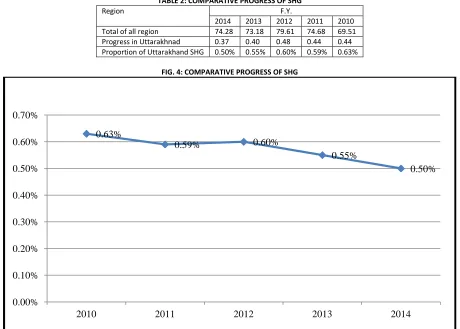
TABLE 2: COMPARATIVE PROGRESS OF SHG
Region F.Y.
2014 2013 2012 2011 2010 Total of all region 74.28 73.18 79.61 74.68 69.51 Progress in Uttarakhnad 0.37 0.40 0.48 0.44 0.44 Proportion of Uttarakhand SHG 0.50% 0.55% 0.60% 0.59% 0.63%
FIG. 4: COMPARATIVE PROGRESS OF SHG
Table 3.44 and figure 3.18 shows that in 2009-10 69.51 lakh groups were formed in India out of these groups .44 lakh were formed and linked in the area of Uttarakhand, the proportion of this figure is .63%. Figure remain the same in the next f.y 2010-11 i.e .44 lakh but the proportion was decreased by .01%. in the f.y 2011-12 number of group formed was increased from previous year .44 lakh to .48 lakh in terms of proportion it was .01% higher than the previous year. In the financial year 2012-13 and 2013-14 the proportion was reduced to .55% and .50% respectively and also the total number of groups of Uttarakhand was also reduced to .40 lakh and .37 lakh.
8.5 COMPARATIVE PROGRESS OF SAVINGS
TABLE 2: PROGRESS OF SAVINGS IN COMPARISON WITH INDIA
Region F.Y.
2014 2013 2012 2011 2010
Total of all region 989741.5 821725.5 655141.4 701630.3 619870.9 Progress in Uttarakhnad 3903.04 4763.57 5913.27 3965.37 7170.41 Proportion of savings of Uttarakhand SHG .39% .58% .90% .57% 1.16%
FIG. 5: COMPARATIVE PROGRESS OF SAVINGS
Contribution of Uttarakhand in the total saving deposited by the total group formed in the f.y 2009-10 in India is 1.16%, in the next f.y the contribution of the Uttarakhand is reduced to .57% and the total contribution in terms of amount is Rs. 3965.37 lakh, however the situation of Uttarakhand is improved in the f.y
0.63%
0.59%
0.60%
0.55%
0.50%
0.00%
0.10%
0.20%
0.30%
0.40%
0.50%
0.60%
0.70%
VOLUME NO.5(2015),ISSUE NO.08(AUGUST) ISSN 2231-5756
INTERNATIONAL JOURNAL OF RESEARCH IN COMMERCE, IT & MANAGEMENT
2011-12 and the contribution of Uttrakhan d is .33% is higher than the previous contribution but again in the next two financial year contribution of the state come down to .58% and .39%. It is concluded from the above that the number of groups as well total amount saved by the group is decreasing, hence on the basis of the information provided above it can be said that the contribution of Uttarakhand in SBLP is decreasing.CONCLUSION
The present paper attempted to study the status of SHGs Bank linkage programme in Uttarakhand and comparative progress of microfinance in Uttarakhand with the progress in India. It is clear that micro financing programme of NABARD through SHG is working effectively. SHG bank linkage model is one of the successfully operated models of Micro Finance in India. Under this model, the SHGs are financed by bank without any collateral, peer group pressure is considered as collateral by the lenders. Self Help Group bank Linkage model also helps to reduce transaction costs proper monitoring of funds by group members, economic empowerment of SHG members by collective decision making. Period of study consider for this paper shows that more than 1.7 lakh SHGs were formed, however the overall contribution of the Uttarakhand in the development of the sector is meagre and contribution in terms of number of SHG, number of members and total amount saved is showing a decreasing trend. One important reason behind this is that the proportion of population of Uttarakhand in India as per Census 2011 is only .83%, one another reason which may be responsible for such lower contribution in the SBLP programme is that the movement of the members toward other programme of NABARD such JLG and Kissan Club. The overall performance of SHG-Bank Linkage Programme of NABARD is remarkable as it is the largest micro-financing programme in the world and it is moving towards the right direction for empowering women. So, NABARD must continue micro financing through SHGs for poverty alleviation in rural.
REFERENCES
1. Chakrabarti, Rajesh (2004), “The India Microfinance Experience-Accomplishments and Challenges’, in Bibek Debroy and Amir Ullah Khan eds. ‘Integrating the Rural Poor into Markets’, Academic Foundation, New Delhi.
2. Das Gupta, R. (2001) : “Working and Impact of Rural Self-Help Groups: Experiences and other Forms of Micro Financing”. Indian journal of Agricultural Economics, Vol. 56(3).
3. “Impact and Sustainability of SHG Bank Linkage Programme”, july 2008, National Council of Applied Economics Research, Pp 1.
4. Lalitha. B., & Nagarajan, B.S (2004). “Empowerment of Rural Women through Self Help Groups: A study in Tamil Nadu”.
5. Manimekalani, M., & Rajeswari G. (2001). “Nature and performance of informal Self Help Groups: A case from Tamil Nadu”, Indian Journal of Agriculture Economics, 56(3), 453-54.
6. Moyle, Dollard and Biswas(2006), “Personal and Economic Empowerment in Rural Indian women: A Self-help Group Approace”, International Journal of Rural Management, 2, Sage Publications.
7. Puhazhendi, V and K C Badatya (2002), “SHG Bank Linkage Programme for Rural Poor-An Impact Assessement” Paper presented at seminar of SBLP at New Delhi, 25-26 November, NABARD, Mumbai.
VOLUME NO.5(2015),ISSUE NO.08(AUGUST) ISSN 2231-5756
INTERNATIONAL JOURNAL OF RESEARCH IN COMMERCE, IT & MANAGEMENT
REQUEST FOR FEEDBACK
Dear Readers
At the very outset, International Journal of Research in Commerce, IT & Management (IJRCM)
acknowledges & appreciates your efforts in showing interest in our present issue under your kind perusal.
I would like to request you tosupply your critical comments and suggestions about the material published
in this issue as well as on the journal as a whole, on our [email protected] for further
improvements in the interest of research.
If youhave any queries please feel free to contact us on our E-mail
.
I am sure that your feedback and deliberations would make future issues better – a result of our joint
effort.
Looking forward an appropriate consideration.
With sincere regards
Thanking you profoundly
Academically yours
Sd/-
Co-ordinator
DISCLAIMER
VOLUME NO.5(2015),ISSUE NO.08(AUGUST) ISSN 2231-5756