A Monthly Double-Blind Peer Reviewed (Refereed/Juried) Open Access International e-Journal - Included in the International Serial Directories
Indexed & Listed at:
VOLUME NO.2(2012),ISSUE NO.12(DECEMBER) ISSN2231-5756
INTERNATIONAL JOURNAL OF RESEARCH IN COMMERCE, IT & MANAGEMENT
CONTENTS
CONTENTS
CONTENTS
CONTENTS
Sr.No.
TITLE & NAME OF THE AUTHOR (S)
Page No.
1. EFFECTIVENESS OF PAY-FOR-PERFORMANCE AND FIXED-PAY PRACTICES: AN ASSESSMENT OF PAY SATISFACTION, COMMITMENT AND TURNOVER INTENTION
PRINCY THOMAS & DR. G. NAGALINGAPPA
1
2. ROLE OF CORPORATE GOVERNANCE ON PERFORMANCE OF PRIVATE COMMERCIAL BANKS IN BANGLADESH: AN ECONOMETRIC ANALYSIS
DR. MD NAZRUL ISLAM, MOHAMMAD MASUD ALAM & MOHAMMAD ASHRAFUL FERDOUS CHOWDHURY
6 3. IDENTIFYING OPPORTUNITIES, CHALLENGES AND INFRASTRUCTURE REQUIREMENTS FOR ESTABLISHING SECONDARY MARKETS IN
ETHIOPIA
KANNAN SIMHAKUTTY ASURI & LETENAH EJIGU
12
4. A NOVEL BANKRUPTCY PREDICTION MODEL BASED ON SUPPORT VECTOR DATA DESCRIPTION METHOD
ALIREZA DEHVARI, FEZEH ZAHEDI FARD & MAHDI SALEHI
17 5. ANALYSIS OF FACTORS INFLUENCING EXPORT VOLUME: THE NIGERIAN EXPERIENCE
KAREEM, R.O, OKI A.S, RAHEEM, K.A & BASHEER, N.O
24 6. A MODEL FOR ORGANIZING, MEASURING, ANALYZING STUDENTS’ KNOWLEDGE AND PERFORMANCE
ROY MATHEW
32 7. DETERMINANTS OF CUSTOMER LOYALTY AND SUBSCRIBER CHURN OF MOBILE PHONE SERVICES IN GHANA
JACOB NUNOO & CHRISTIAN KYEREMEH
38 8. FACTORS AFFECTING CUSTOMERS’ ATTITUDE TOWARDS INFORMATION TECHNOLOGY ADOPTION IN COMMERCIAL BANKS OF ETHIOPIA: A
CASE STUDY OF SELECTED BANKS IN MEKELLE CITY
ZEMENU AYNADIS
42
9. EFFECTIVE USE OF TRAINING FEEDBACK FOR REINFORCEMENT OF LEARNING AND EMPLOYEE DEVELOPMENT
AJAY KR VERMA, SUDHIR WARIER & LRK KRISHNAN
53 10. IMPACT OF DEMOGRAPHIC VARIABLES ON FACTORS OF JOB SATISFACTION OF EMPLOYEES IN PUBLIC SECTOR: AN EMPIRICAL STUDY
DR. RIZWANA ANSARI, DR. T. N. MURTY, NILOUFER QURAISHY & S A SAMEERA
62 11. SUBSCRIBERS’ ATTITUDE TOWARDS DTH SERVICES
M. J. SENTHIL KUMAR & DR. N. R. NAGARAJAN
69 12. ISSUES AND CHALLENGES INDIAN BUSINESS: VISION 2020 WITH THE REFERENCE OF MICRO, SMALL AND MEDIUM ENTERPRISES (MSMEs)
IN INDIA
DR. M. L. GUPTA, DR. SHWETABH MITTAL & PRIYANKA GUPTA
73
13. ENHANCING JOB SATISFACTION OF SOFTWARE PROFESSIONALS: THE RELEVANCE OF EMOTIONAL QUOTIENT
V. ANOOPKUMAR & DR. R. GANESAN
82 14. A SURVEY ON CONSUMER ATTITUDE TO CHOOSE AND USE VARIOUS TELECOM SERVICES
V. BALAKUMAR & DR. C. SWARNALATHA
88 15. COUNTERPRODUCTIVE WORK BEHAVIOUR (CWB) AND LOCUS OF CONTROL (LOC) AMONG MANAGERS
DR. RISHIPAL & PAWAN KUMAR CHAND
94 16. CORPORATE GOVERNANCE FAILURES IN INDIA - A REVIEW
KAISETTY. BALAJI & DR. Y. VENU GOPALA RAO
98 17. SIGNIFICANCE OF INCLUSIVE GROWTH IN INDIAN ECONOMIC DEVELOPMENT – A STUDY
DR. T. C. CHANDRASHEKAR
103 18. A STUDY ON EMPLOYEE JOB PERFORMANCE (A COMPARATIVE STUDY OF SELECT PUBLIC AND PRIVATE ORGANIZATIONS)
S.FAKRUDDIN ALI AHMED & DR. G. MALYADRI
110 19. ORGANISATIONAL AND ENVIRONMENTAL DETERMINANTS OF PERFORMANCE APPRAISAL SYSTEM: A REVIEW AND FRAMEWORK FROM
CONTEXTUAL PERSPECTIVE
SAPNA TANEJA, DR. RAVIKESH SRIVASTAVA & DR. N. RAVICHANDRAN
117
20. E-LEARNING INITIATIVES TO AUGMENT BUSINESS PERFORMANCE: AN EMPIRICAL STUDY OF SELECT AUTO COMPONENT FIRMS
DR. AISHA M. SHERIFF & GEETHA R
127 21. INTERPRETIVE STRUCTURAL MODELING BASED APPROACH FOR ADOPTING CPFR IN INDIAN INDUSTRIES
RAJESH A. KUBDE & DR. SATISH V. BANSOD
136 22. TECHNOLOGY TRENDS AND IMPACT OF ROBOTICS IN THE CORPORATE WORLD AT DIFFERENT LEVELS OF MANAGEMENT
P. POONGUZHALI & DR. A. CHANDRA MOHAN
141 23. PERFORMANCE APPRAISAL ACT AS A MAJOR MOTIVATIONAL SOURCE
NAILA IQBAL
147 24. FOREIGN DIRECT INVESTMENT FLOWS INTO INDIA AND THEIR CAUSAL RELATIONSHIP WITH ECONOMIC GROWTH SINCE LIBERALISATION
S. GRAHALSKSHMI & DR. M. JAYALAKSHMI
150 25. INCLUSIVE GROWTH AND REGIONAL DISPARITIES IN ANDHRA PRADESH
V. VANEENDRA NATHA SASTRY
159 26. STRATEGIES TO COPE UP WORK - PLACE STRESSORS: AN EMPIRICAL STUDY IN EDUCATIONAL INSTITUTIONS
B. LAVANYA
162 27. DETERMINANTS OF JOB SATISFACTION AMONG EMPLOYEES IN INFORMATION TECHNOLOGY INDUSTRY IN DELHI
BRAJESH KUMAR & DR. AWADHESH KUMAR
166 28. MODERN CHALLENGES TO WOMEN ENTREPRENEURSHIP DEVELOPMENT: A STUDY OF DISTRICT RAJOURI IN JAMMU AND KASHMIR STATE
AASIM MIR
169 29. INTERNATIONAL HRM CHALLENGES FOR MNC’s
B. G. VENKATESH PRASAD & N. CHETAN KUMAR
173 30. INSIDER TRADING: GOVERNANCE, ETHICAL AND REGULATORY PERSPECTIVE
NIDHI SAHORE
177
CHIEF PATRON
CHIEF PATRON
CHIEF PATRON
CHIEF PATRON
PROF. K. K. AGGARWAL
Chancellor, Lingaya’s University, Delhi
Founder Vice-Chancellor, Guru Gobind Singh Indraprastha University, Delhi
Ex. Pro Vice-Chancellor, Guru Jambheshwar University, Hisar
FOUNDER
FOUNDER
FOUNDER
FOUNDER PATRON
PATRON
PATRON
PATRON
LATE SH. RAM BHAJAN AGGARWAL
Former State Minister for Home & Tourism, Government of Haryana
Former Vice-President, Dadri Education Society, Charkhi Dadri
Former President, Chinar Syntex Ltd. (Textile Mills), Bhiwani
CO
CO
CO
CO----ORDINATOR
ORDINATOR
ORDINATOR
ORDINATOR
AMITA
Faculty, Government M. S., Mohali
ADVISORS
ADVISORS
ADVISORS
ADVISORS
DR. PRIYA RANJAN TRIVEDI
Chancellor, The Global Open University, Nagaland
PROF. M. S. SENAM RAJU
Director A. C. D., School of Management Studies, I.G.N.O.U., New Delhi
PROF. M. N. SHARMA
Chairman, M.B.A., Haryana College of Technology & Management, Kaithal
PROF. S. L. MAHANDRU
Principal (Retd.), Maharaja Agrasen College, Jagadhri
EDITOR
EDITOR
EDITOR
EDITOR
PROF. R. K. SHARMA
Professor, Bharti Vidyapeeth University Institute of Management & Research, New Delhi
CO
CO
CO
CO----EDITOR
EDITOR
EDITOR
EDITOR
DR. BHAVET
Faculty, M. M. Institute of Management, Maharishi Markandeshwar University, Mullana, Ambala, Haryana
EDITORIAL ADVISORY BOARD
EDITORIAL ADVISORY BOARD
EDITORIAL ADVISORY BOARD
EDITORIAL ADVISORY BOARD
DR. RAJESH MODI
Faculty, Yanbu Industrial College, Kingdom of Saudi Arabia
PROF. SANJIV MITTAL
University School of Management Studies, Guru Gobind Singh I. P. University, Delhi
PROF. ANIL K. SAINI
Chairperson (CRC), Guru Gobind Singh I. P. University, Delhi
DR. SAMBHAVNA
VOLUME NO.2(2012),ISSUE NO.12(DECEMBER) ISSN2231-5756
INTERNATIONAL JOURNAL OF RESEARCH IN COMMERCE, IT & MANAGEMENT
DR. MOHENDER KUMAR GUPTA
Associate Professor, P. J. L. N. Government College, Faridabad
DR. SHIVAKUMAR DEENE
Asst. Professor, Dept. of Commerce, School of Business Studies, Central University of Karnataka, Gulbarga
ASSOCIATE EDITORS
ASSOCIATE EDITORS
ASSOCIATE EDITORS
ASSOCIATE EDITORS
PROF. NAWAB ALI KHAN
Department of Commerce, Aligarh Muslim University, Aligarh, U.P.
PROF. ABHAY BANSAL
Head, Department of Information Technology, Amity School of Engineering & Technology, Amity
University, Noida
PROF. A. SURYANARAYANA
Department of Business Management, Osmania University, Hyderabad
DR. SAMBHAV GARG
Faculty, M. M. Institute of Management, Maharishi Markandeshwar University, Mullana, Ambala, Haryana
PROF. V. SELVAM
SSL, VIT University, Vellore
DR. PARDEEP AHLAWAT
Associate Professor, Institute of Management Studies & Research, Maharshi Dayanand University, Rohtak
DR. S. TABASSUM SULTANA
Associate Professor, Department of Business Management, Matrusri Institute of P.G. Studies, Hyderabad
SURJEET SINGH
Asst. Professor, Department of Computer Science, G. M. N. (P.G.) College, Ambala Cantt.
TECHNICAL ADVISOR
TECHNICAL ADVISOR
TECHNICAL ADVISOR
TECHNICAL ADVISOR
AMITA
Faculty, Government M. S., Mohali
FINANCIAL ADVISORS
FINANCIAL ADVISORS
FINANCIAL ADVISORS
FINANCIAL ADVISORS
DICKIN GOYAL
Advocate & Tax Adviser, Panchkula
NEENA
Investment Consultant, Chambaghat, Solan, Himachal Pradesh
LEGAL ADVISORS
LEGAL ADVISORS
LEGAL ADVISORS
LEGAL ADVISORS
JITENDER S. CHAHAL
Advocate, Punjab & Haryana High Court, Chandigarh U.T.
CHANDER BHUSHAN SHARMA
Advocate & Consultant, District Courts, Yamunanagar at Jagadhri
SUPERINTENDENT
SUPERINTENDENT
SUPERINTENDENT
SUPERINTENDENT
SURENDER KUMAR POONIA
CALL FOR MANUSCRIPTS
CALL FOR MANUSCRIPTS
CALL FOR MANUSCRIPTS
CALL FOR MANUSCRIPTS
Weinvite unpublished novel, original, empirical and high quality research work pertaining to recent developments & practices in the area of Computer, Business, Finance, Marketing, Human Resource Management, General Management, Banking, Insurance, Corporate Governance and emerging paradigms in allied subjects like Accounting Education; Accounting Information Systems; Accounting Theory & Practice; Auditing; Behavioral Accounting; Behavioral Economics; Corporate Finance; Cost Accounting; Econometrics; Economic Development; Economic History; Financial Institutions & Markets; Financial Services; Fiscal Policy; Government & Non Profit Accounting; Industrial Organization; International Economics & Trade; International Finance; Macro Economics; Micro Economics; Monetary Policy; Portfolio & Security Analysis; Public Policy Economics; Real Estate; Regional Economics; Tax Accounting; Advertising & Promotion Management; Business Education; Management Information Systems (MIS); Business Law, Public Responsibility & Ethics; Communication; Direct Marketing; E-Commerce; Global Business; Health Care Administration; Labor Relations & Human Resource Management; Marketing Research; Marketing Theory & Applications; Non-Profit Organizations; Office Administration/Management; Operations Research/Statistics; Organizational Behavior & Theory; Organizational Development; Production/Operations; Public Administration; Purchasing/Materials Management; Retailing; Sales/Selling; Services; Small Business Entrepreneurship; Strategic Management Policy; Technology/Innovation; Tourism, Hospitality & Leisure; Transportation/Physical Distribution; Algorithms; Artificial Intelligence; Compilers & Translation; Computer Aided Design (CAD); Computer Aided Manufacturing; Computer Graphics; Computer Organization & Architecture; Database Structures & Systems; Digital Logic; Discrete Structures; Internet; Management Information Systems; Modeling & Simulation; Multimedia; Neural Systems/Neural Networks; Numerical Analysis/Scientific Computing; Object Oriented Programming; Operating Systems; Programming Languages; Robotics; Symbolic & Formal Logic and Web Design. The above mentioned tracks are only indicative, and not exhaustive.
Anybody can submit the soft copy of his/her manuscript anytime in M.S. Word format after preparing the same as per our submission guidelines duly available on our website under the heading guidelines for submission, at the email address: [email protected].
GUIDELINES FOR SUBM
GUIDELINES FOR SUBM
GUIDELINES FOR SUBM
GUIDELINES FOR SUBMISSION OF MANUSCRIPT
ISSION OF MANUSCRIPT
ISSION OF MANUSCRIPT
ISSION OF MANUSCRIPT
1. COVERING LETTER FOR SUBMISSION:
DATED: _____________ THE EDITOR
IJRCM
Subject: SUBMISSION OF MANUSCRIPT IN THE AREA OF .
(e.g. Finance/Marketing/HRM/General Management/Economics/Psychology/Law/Computer/IT/Engineering/Mathematics/other, please specify)
DEAR SIR/MADAM
Please find my submission of manuscript entitled ‘___________________________________________’ for possible publication in your journals.
I hereby affirm that the contents of this manuscript are original. Furthermore, it has neither been published elsewhere in any language fully or partly, nor is it under review for publication elsewhere.
I affirm that all the author (s) have seen and agreed to the submitted version of the manuscript and their inclusion of name (s) as co-author (s).
Also, if my/our manuscript is accepted, I/We agree to comply with the formalities as given on the website of the journal & you are free to publish our contribution in any of your journals.
NAME OF CORRESPONDING AUTHOR:
Designation:
Affiliation with full address, contact numbers & Pin Code: Residential address with Pin Code:
Mobile Number (s): Landline Number (s): E-mail Address: Alternate E-mail Address:
NOTES:
a) The whole manuscript is required to be in ONE MS WORD FILE only (pdf. version is liable to be rejected without any consideration), which will start from the covering letter, inside the manuscript.
b) The sender is required to mention the following in the SUBJECT COLUMN of the mail:
New Manuscript for Review in the area of (Finance/Marketing/HRM/General Management/Economics/Psychology/Law/Computer/IT/
Engineering/Mathematics/other, please specify)
c) There is no need to give any text in the body of mail, except the cases where the author wishes to give any specific message w.r.t. to the manuscript. d) The total size of the file containing the manuscript is required to be below 500 KB.
e) Abstract alone will not be considered for review, and the author is required to submit the complete manuscript in the first instance.
f) The journal gives acknowledgement w.r.t. the receipt of every email and in case of non-receipt of acknowledgment from the journal, w.r.t. the submission of manuscript, within two days of submission, the corresponding author is required to demand for the same by sending separate mail to the journal.
2. MANUSCRIPT TITLE: The title of the paper should be in a 12 point Calibri Font. It should be bold typed, centered and fully capitalised.
3. AUTHOR NAME (S) & AFFILIATIONS: The author (s) full name, designation, affiliation (s), address, mobile/landline numbers, and email/alternate email address should be in italic & 11-point Calibri Font. It must be centered underneath the title.
4. ABSTRACT: Abstract should be in fully italicized text, not exceeding 250 words. The abstract must be informative and explain the background, aims, methods,
VOLUME NO.2(2012),ISSUE NO.12(DECEMBER) ISSN2231-5756
INTERNATIONAL JOURNAL OF RESEARCH IN COMMERCE, IT & MANAGEMENT
5. KEYWORDS: Abstract must be followed by a list of keywords, subject to the maximum of five. These should be arranged in alphabetic order separated by commas and full stops at the end.
6. MANUSCRIPT: Manuscript must be in BRITISH ENGLISH prepared on a standard A4 size PORTRAIT SETTING PAPER. It must be prepared on a single space and
single column with 1” margin set for top, bottom, left and right. It should be typed in 8 point Calibri Font with page numbers at the bottom and centre of every page. It should be free from grammatical, spelling and punctuation errors and must be thoroughly edited.
7. HEADINGS: All the headings should be in a 10 point Calibri Font. These must be bold-faced, aligned left and fully capitalised. Leave a blank line before each
heading.
8. SUB-HEADINGS: All the sub-headings should be in a 8 point Calibri Font. These must be bold-faced, aligned left and fully capitalised.
9. MAIN TEXT: The main text should follow the following sequence:
INTRODUCTION
REVIEW OF LITERATURE
NEED/IMPORTANCE OF THE STUDY
STATEMENT OF THE PROBLEM
OBJECTIVES
HYPOTHESES
RESEARCH METHODOLOGY
RESULTS & DISCUSSION
FINDINGS
RECOMMENDATIONS/SUGGESTIONS
CONCLUSIONS
SCOPE FOR FURTHER RESEARCH
ACKNOWLEDGMENTS
REFERENCES
APPENDIX/ANNEXURE
It should be in a 8 point Calibri Font, single spaced and justified. The manuscript should preferably not exceed 5000 WORDS.
10. FIGURES & TABLES: These should be simple, crystal clear, centered, separately numbered & self explained, and titles must be above the table/figure. Sources of data should be mentioned below the table/figure. It should be ensured that the tables/figures are referred to from the main text.
11. EQUATIONS: These should be consecutively numbered in parentheses, horizontally centered with equation number placed at the right.
12. REFERENCES: The list of all references should be alphabetically arranged. The author (s) should mention only the actually utilised references in the preparation
of manuscript and they are supposed to follow Harvard Style of Referencing. The author (s) are supposed to follow the references as per the following:
•
All works cited in the text (including sources for tables and figures) should be listed alphabetically.•
Use (ed.) for one editor, and (ed.s) for multiple editors.•
When listing two or more works by one author, use --- (20xx), such as after Kohl (1997), use --- (2001), etc, in chronologically ascending order.•
Indicate (opening and closing) page numbers for articles in journals and for chapters in books.•
The title of books and journals should be in italics. Double quotation marks are used for titles of journal articles, book chapters, dissertations, reports, working papers, unpublished material, etc.•
For titles in a language other than English, provide an English translation in parentheses.•
The location of endnotes within the text should be indicated by superscript numbers.PLEASE USE THE FOLLOWING FOR STYLE AND PUNCTUATION IN REFERENCES: BOOKS
•
Bowersox, Donald J., Closs, David J., (1996), "Logistical Management." Tata McGraw, Hill, New Delhi.•
Hunker, H.L. and A.J. Wright (1963), "Factors of Industrial Location in Ohio" Ohio State University, Nigeria. CONTRIBUTIONS TO BOOKS•
Sharma T., Kwatra, G. (2008) Effectiveness of Social Advertising: A Study of Selected Campaigns, Corporate Social Responsibility, Edited by David Crowther & Nicholas Capaldi, Ashgate Research Companion to Corporate Social Responsibility, Chapter 15, pp 287-303.JOURNAL AND OTHER ARTICLES
•
Schemenner, R.W., Huber, J.C. and Cook, R.L. (1987), "Geographic Differences and the Location of New Manufacturing Facilities," Journal of Urban Economics, Vol. 21, No. 1, pp. 83-104.CONFERENCE PAPERS
•
Garg, Sambhav (2011): "Business Ethics" Paper presented at the Annual International Conference for the All India Management Association, New Delhi, India, 19–22 June.UNPUBLISHED DISSERTATIONS AND THESES
•
Kumar S. (2011): "Customer Value: A Comparative Study of Rural and Urban Customers," Thesis, Kurukshetra University, Kurukshetra. ONLINE RESOURCES•
Always indicate the date that the source was accessed, as online resources are frequently updated or removed. WEBSITESA MODEL FOR ORGANIZING, MEASURING, ANALYZING STUDENTS’ KNOWLEDGE AND PERFORMANCE
ROY MATHEW
LECTURER
I.T. DEPARTMENT
BURAIMI UNIVERSITY COLLEGE
AL BURAIMI
ABSTRACT
Present work tries to offer a new view on the current, vastly discussed and successfully engaged concept of a Data Warehouse. This view presents it in the light of Knowledge Management that includes knowledge sharing and knowledge reuse. i.e., a Data Warehouse can serve as a storage medium for keeping the business memory, or at least involving certain varieties of data. It helps to get new knowledge by presenting well integrated data to analysis tools and then becomes an important part of Executive Information Systems or Decision Support Systems. Sharing and reuse of relevant knowledge during project could prove significant benefits. Data Warehouse by storing, managing and sharing data contributes to the growth of knowledge and may show the way to improve the institution’s quality and success.Data mining can be used for the purpose of discovering new knowledge from large databases.New knowledge may be further managed by the applications of knowledge sharing and reuse. Data mining as a new technology allows the user to access or process large amount of information generated mainly from large databases using its latest database technologies. Thus the present work relates Data Warehousing and Data Mining to Knowledge Discovery and Knowledge Management including knowledge sharing and knowledge reuse. The intention is to apply this problem to the higher education sector and compare their results to diagnose pros and cons.
KEYWORDS
Achievement Measure, Course Objectives, Performance Analysis, Students’ Assignments.
1. INTRODUCTION
he suitability in systems of education requires detailed reports about students’ performance to take appropriate actions. A well developed set of information regarding students’ knowledge and their performances, helps to make a diagnosis with fair accuracy what the student knows and how much a student knows, in order to conclude what a student does not know i.e., a student’s learning gaps. The set of information regarding students’ knowledge and their performances obtained through an assessment process of their several assignments specify, with reasonable precision, whether the courses selected were appropriate for them or not. And if not, the areas for improvement have to be identified for its remedy, in case students decide to go ahead with their study in that field. This work proposes a model for organizing, measuring, analyzing students’ knowledge and performance in systems of education with the help of certain Data Mining tools.
There could be various Assignments to assess students’ knowledge in a particular area of knowledge. The general knowledge area is very vast, but an assignment is designed to measure the knowledge only in a particular area of knowledge. Assignment is a tool designed to observe student’s behavior and produce data that can be used to draw reasonable conclusion about what students know. Assignments serve a vital role in providing information to help students, teachers, parents, administrators, and policy makers to take decisions [7].
Assignments are very powerful educational tools for encouraging effectual study in the field of education. These Assignments provide specific information about students’ strengths and weaknesses with their study. Educators can use information from these Assignments after its evaluation, to adjust their instructions to meet students’ requirements. Students can also use this information to decide which skills and knowledge they need to learn further or to be improved upon or for their higher studies.
Black and William [3] specified that classroom-based formative Assignments can positively affect learning when the Assignments are properly used. According to them and to their research, students study better when they get advice on what they can do to improve on particular qualities of their work along with a feedback about their work. Based on research of Black and William, the Assessment Reform Group [5] holds that successful study occurs when students understand the goals they are aiming at and when they get control on their proper study, and when they have the enough abilities to do self-assessment tasks. The continuous assessments of various Assignments that aim to identify difficulties and to improve the learning, instead of simply classifying the students, can provide data for increasing the personalization of the learning through the flexibility of systems. Status Measures are important in many Assignment situations, but in educational setting it is also important to track and monitor student change over time [7]. Pimentel and Omar [28] developed a model for continuous assessments of the study to detect possible learning gaps, by monitoring student’s Knowledge Acquisition Level in each item of the knowledge area. The model also supports the monitoring and developing the process of acquiring knowledge to allow the student controlling his own study through a process of self-regulation, which consists of self-reinforcement, self-evaluation and self-monitoring [29].
The process of data collection creates great amount of data involves automatic procedures for analysis to acquire new knowledge for further action [29]. This paper suggests another model for organizing, measuring, analyzing students’ knowledge and performance in systems of higher education with the help of certain Data Mining tools. Following descriptions in the next few sections contain a discussion on knowledge organization using specialized group of concepts associated with its objectives and presents some ideas on data mining and its application in higher education sector. It demonstrates the proposed model for organizing, measuring, analyzing students’ knowledge and performance.
2. KNOWLEDGE ORGANIZATION AND ITS MEASUREMENTS
The outermost rectangle in the below given figure corresponds to the whole knowledge area and the ellipses in the figure represent the student current knowledge i.e., what the student knows. The student will possibly have a bad performance if an Assignment is designed mainly from “knowledge absence” portion of the knowledge area. But the student will possibly have a good performance if an Assignment is designed mainly from that part of knowledge area where the student possesses a certain level of knowledge. It is always better to have assignments designed to give emphasis on identifying students’ learning gaps. The instructions can be adjusted based on the outcome of an assignment.
VOLUME NO.2(2012),ISSUE NO.12(DECEMBER) ISSN2231-5756
INTERNATIONAL JOURNAL OF RESEARCH IN COMMERCE, IT & MANAGEMENT
FIGURE 1: MEASURING STUDENT KNOWLEDGE
The knowledge or expertise has to be encoded and represented in such a way it supports reasoning that resembles the human problem-solving process within the teaching domain and in Intelligent Tutoring Systems (ITS) the domain module contains the knowledge of the specific domain to be taught [36] [37]. Robert Gagne [12] has proposed instructional prescriptions designed to facilitate learning in the various categories of learned capabilities that he has identified. According to Gagne, if instruction is organized hierarchically, learning some of the skills can be facilitated, so that prerequisite courses and objectives are learned in proper order. Hierarchical learning maps can also help the students and educators to prioritize or schedule their learning activities based on objectives for a course. Moreover, the hierarchical learning maps can guide assignments that assess different objectives of a course in the direction as shown in the figure below.
The continuous learning assessment process of different assignments in a course allows to have a better understanding of the students’ knowledge in a particular course (current student knowledge), in order to guide the instruction in that area of the course. The phrase “current student knowledge” means that what someone knows is always changing.
The knowledge representation in a knowledge area allows ontology knowledge units with many objectives and its measurements in a hierarchical way, through interconnections between the objectives and its measurements. The word ontology means a specialized type of knowledge that consists of definitions or descriptions of special kinds of things and it is frequently mystified with knowledge base. This corresponds roughly to Gruber’s definition, which is: “a specification of a conceptualization: the objects and relations that exist for an agent” [13] [14].
The following figure shows an architecture of the Knowledge Unit with the hierarchical organization of the objectives and its various related assignments for a course. A course may have many objectives (n number of objectives: O1, O2, O3… On) and it could be measured using several assignments (A1, A2, A3… An).
FIGURE 3: KNOWLEDGE UNIT
According Self J. [31], a detailed student model preferably contains information about previous student knowledge prior to the application of educational system, like the student’s interests, objectives, preferences, progress and all other information related to student. In addition to the Knowledge Unit of the knowledge organization, other important points are the Objective Units and Marks Units, i.e., the units to organize the way students’ performances will be updated.
Brusilovsky [6] considered Student Knowledge Model as a part of the main model which symbolizes a manifestation of the student’s mental state and level of knowledge and abilities in terms of a particular course and its output. The Assessments Unit could be configured with measurements from various assignments of the course. The process of acquiring knowledge from various such Assignments is done by its accumulation and dynamic updation in the Objectives Unit and Marks Unit. After organizing the Knowledge Area, Assignments can be created in order to refer objective items from the Knowledge Unit. The Assignment grading will show the measurement for each objective item in detail, and its accumulation in the Objectives Unit and Marks Units, making it possible to show the students’ main learning gaps, i.e., it identifies in which course objective, the student displays better or worse performance.
3. DATA MINING IN HIGHER EDUCATION SECTOR
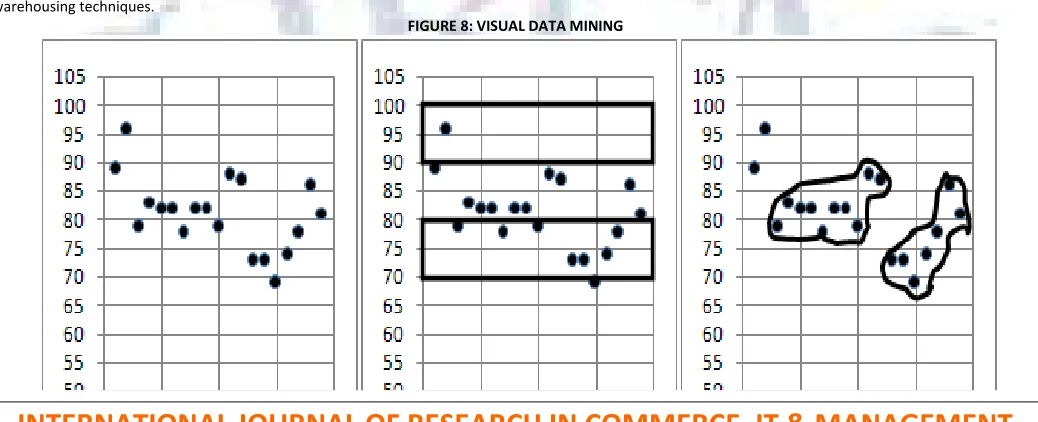
Data mining can be used for the purpose of discovering new knowledge from databases. Data mining as a new technology allows the user to access or process large amount of information extracted mainly from large databases using its latest database technologies. The process of data mining uses its techniques to create automatic tools to investigate and then to generate new information from large databases. The generated new knowledge is then offered with the help of certain rules using different variables and then presented as a model. Data mining is used to predict new data, based on a set of rules or models extracted from databases. Data mining uses its techniques and powerful tools to describe database in a summarized way by capturing its important properties. Due to their multidisciplinary application, a multitude of data mining techniques have been studied, applied and proposed in a variety of different fields and visual data mining can be considered a data mining process enriched by visualization methods [29] [10]. Some works that apply Data Mining techniques in education concentrate on the data gathered during student interaction with communication tools: chat, forum and e-mail [31].
Data mining is applied on students ‘performance-data’ obtained from several of his Assignments (for example, Test 1 [A1], Test 2 [A2], Take-home-assignment [A3] and Final Examination [A4]). The main idea is to prepare the data collected from all of his assignments related with different objectives of a course and relate them by using their hierarchical organization of study, in order to discover new knowledge about students learning by using data mining tools.
Assessments Unit of the Relational Model presents data from the database that contains Assignment data showing students’ performance in various assignments stored in relational database model. Students’ knowledge is measured based on the different objectives of the course using different assignments and the findings are recorded using a relational database.
VOLUME NO.2(2012),ISSUE NO.12(DECEMBER) ISSN2231-5756
INTERNATIONAL JOURNAL OF RESEARCH IN COMMERCE, IT & MANAGEMENT
This data from the relational model is then summarized to get another data for a multidimensional model of Objectives Unit, as shown in the table below. It shows students’ summarized performance in different objectives that were measured previously using various assignments.
FIGURE 5: TABLE OF MULTIDIMENSIONAL OBJECTIVE UNIT
Each objective (O1 for example) can be measured in several Assignments. The Knowledge Acquisition Level indicates the student knowledge level in a specific objective item of the knowledge area and it could be computed using appropriate formula. For example, the knowledge acquisition level for the objective O1 can be calculated from three assignments (A1, A3, and A4) as 10 + 2 + 12 = 24 getting by adding all separate marks obtained in all different assignments testing that particular objective of the course. Another way of calculation is computing the arithmetic average of the percentages of marks obtained in various assignments of the course testing that objective.
In the multidimensional table of the Objectives Unit, the knowledge acquisition level for each objective (O1, O2,…,On) is displayed. This data corresponds to the objective evaluated (each respective line of the table in relational model) and the measures correspond to respective knowledge acquisition level for the objectives. (The objectives are all specified clearly and distributed to the students normally at the beginning of the course’s training along with the syllabus for that course.)
Marks obtained in various assignments during the continuous evaluation process are summarized in Marks Unit as shown in the given table below. This is same as the summation of marks obtained in all the objectives for that course. (For example O1+O2+O3+O4=24+23+21+22=90) The student with ID: 1001 scored 90 marks and the grade ‘A-‘ is awarded to that student according to the assessment criteria for the marks. (Assessment criteria are also specified in the syllabus of the course.)
FIGURE 6: TABLE OF MULTIDIMENSIONAL MARKS UNIT
Apply visual data mining tools along with other data mining techniques like clusterization, segmentation, classification and association on the data for knowledge discovery. Historical data must be kept and utilized for new knowledge discovery for a continuous assessment learning model. The conclusion based on historical data helps the teachers to see what qualities and problems their students face and who their students are. An improvement in education is possible by the implementation of a program of such data and analysis.
A model for organizing, measuring, analyzing students’ knowledge and performance with the help of data mining is discussed next.
4. A MODEL FOR ORGANIZING, MEASURING, ANALYZING STUDENTS’ KNOWLEDGE AND PERFORMANCE
It is very important to find out continuously what the student knows by measuring their performance and knowledge. Keep this information in a database for its investigation, so that the new knowledge can be used for improvement of teaching by instructors as well as for improved understanding and study by students. This work proposes a model for knowledge organization, measurement and analysis based on ontology knowledge area, and with the help of data mining techniques; the model makes discovery of new information from the data collected with the several assignments.
This model is based on knowledge organization representing the learning hierarchies, uses ontology knowledge area with different objectives and its measurements using several assignments. Each problem or question in an Assignment must be associated with an objective of the course and the objective must be clearly indicated for each question specifying very clearly which objective is tested with that question.
FIGURE 7
Based on knowledge organization using Knowledge Unit and the current student knowledge calculated in the Objectives Unit and Marks Unit, the proposal is to apply data mining techniques for new knowledge discovery concerned with students’ knowledge to get new information regarding them. The use of visual tools will help in the new knowledge reading and its interpretation.
Successful knowledge management (including knowledge sharing and reuse) needs to integrate data bases, information systems, and knowledge based systems. These kinds of systems can be connected based on the Data Ware-house of the architecture shown in the figure above. It provides an extensive basis of integrated data. This data can be presented and utilized via proper knowledge management; knowledge sharing and knowledge reuse activities with the help of data discovery or related tools.
Knowledge-based support for decision-making is becoming a key element of a Higher Educational setting. Traditional data warehouses with the combinations of knowledge management environments and its related tools may influence Higher Educational decision-makers. The knowledge oriented model together with a collection of services, can be used to manage and encourage knowledge activities within the Higher education sector, through the data mining and data warehousing techniques.
VOLUME NO.2(2012),ISSUE NO.12(DECEMBER) ISSN2231-5756
INTERNATIONAL JOURNAL OF RESEARCH IN COMMERCE, IT & MANAGEMENT
5. CONCLUSION
The continuous learning assessment process aims to find out the learning gaps to improve the training, can create a huge amount of data. The collected data need to be recorded and analyzed so as to provide new and necessary information concerning the current student knowledge level and measure how much they know about the course and evaluate it to take decisions to improve the situation.
The model for organizing, measuring, analyzing students’ knowledge and performance in systems of education with the help of Data Mining tools generates new information from the collected assessment data automatically. The model is based on knowledge organization using ontology of course objectives that represents the learning hierarchies and it makes possible to establish the knowledge acquisition level in each objective item of the knowledge area. The model helps to organize, measure, analyze students’ knowledge and performance and thus used to improve both students’ as well as teachers’ performances. The model for organizing, measuring, analyzing students’ knowledge and performance must be tested with some data mining techniques on the real data and implement the model after its validation.
6. REFERENCES
[1] Benjamins V. R., Fensel, D., Pérez, A. G., Knowledge Management through Ontologies”, Proc. of the 2nd International Conference on Practical Aspects of Knowledge Management (PAKM98), Switzerland, 1998.
[2] Berners-Lee T. R., Cailliau, A. Loutonen, H. F. Nielsen, and A. Secret, “The World- Wide Web,” Communications of the ACM, vol. 37, pp. 76—82, 1994. [3] Black P. and D. William, Assessment and classroom learning. Assessment in Education: principles, policy & practice, 5(1):7–71, March 1998. Academic
Research Library.
[4] Borges L.M.S., Falbo, R.A., “Managing Software Process Knowledge”, Proc. of the CSITeA’2002, June 2002.
[5] Broadfoot P. R., Daugherty, J. Gardner, C. Gipps,W. Harlen, M. James, and G. Stobart. Assessment for learning: Beyond the black box. Technical report, University of Cambridge, School of Education, 1999. Assessment Reform Group -ARG.
[6] Brusilovsky P. The construction and application of student models in intelligent tutoring systems. Journal of computer and systems sciences international,, 32(1):70–89, 1994.
[7] Council N. R. Knowing what students know: The science and design of educational assessment. National Academy Press, Washington, D.C., 2001.
[8] Cross R., Parker, A., Prusak, L., & Borgatti, S. P. (2001). Knowing What We Know: Supporting Knowledge Creation and Sharing in Social Networks. Organizational Dynamics, 30(2), 100-120.
[9] Davenport T. H., & Prusak, L. (2000). Working Knowledge: How Organizations Manage What They Know. Harvard Business School Press. Boston, Massachusets.
[10] Fayyad U., G. G. Grinstein, and A. Wierse. Information Visualization In Data Mining And Knowledge Discovery. Morgan Kaufmann Publishers Inc, SAN FRANCISCO, CA, USA, 2002.
[11] Firestone J.M., “DKMS Brief No. Nine: Enterprise Integration, Data Federation, and DKMS: A Commentary,” Executive Information Systems, 1999. [12] Gagne R. M., The Conditions of Learning. Holt, Rinehart and Winston, New York, 4th edition, 1985.
[13] Gruber T. R., Toward principles for the design of ontologies used for knowledge sharing. In Formal Ontology in Conceptual Analysis and Knowledge Representation. Kluwer Academic Publishers., Netherlands, 1993.
[14] Guarino N., Some organizing principles for a unified toplevel ontology. In Proceedings of AAAI Spring Symposium on Ontological Engineering, Stanford, CA, 1997. AAAI Press.
[15] Hansen M. T. (2002), Knowledge Networks: Explaining Effective Knowledge Sharing in Multiunit Companies. Organization Science, 13(3), 232-248. [16] Harsh O. K, Three Dimensional Explicit Knowledge Management and Reuse. Presented in International Conference on Knowledge Management in
Organization held in Lecee, Italy, Sept 10-11, 2007.
[17] Harsh O. K. and Sadiq Sohail, M An Experiment on Course Design, Delivery and Effective Interaction in Distance Technical Education. Malaysian Journal of Distance Education. Vol. 5, No. 1 ISSN 1511-6433 June 2003.
[18] Harsh O. K. and Sadiq Sohail, M. "Role of delivery, course design and teacher-student interaction: Experiment on adult distance-education" O. International Review of Research in Open and Distance Learning", Canada Published. Available at: http://www.irrodl.org/content/v3.2/harsh.html
[19] Henninger S. "Tools supporting the creation and evolution of software development knowledge," ase, p. 46, 12th IEEE International Conference on Automated Software Engineering (ASE'97) (formerly: KBSE), 1997.
[20] Huemer, L., von Krogh, G., & Roos, J. (1998). Knowledge and the Concept of Trust. In G. von Krogh, J. Roos, & D. Klein (eds), Knowing In Firms: Understanding, Managing and Measuring Knowledge. London, UK: Sage, 123-145.
[21] Ichijo, K., von Krogh, G., & Nonaka, I. (1998). Knowledge Enablers. In G. von Krogh, J. Roos, & D. Klein (eds), Knowing In Firms: Understanding, Managing and Measuring Knowledge. London, UK: Sage, 173-203.
[22] Johnson J. H. Data-driven school improvement. Technical Report 109, The Education Resources Information Center (ERIC), USA, 1997. ERIC Clearinghouse on Educational Management Eugene.
[23] Kerschberg L. and D. Weishar, “Conceptual Models and Architectures for Advanced Information Systems,” Applied Intelligence, vol. 13, pp. 149-164, 2000. [24] Markkula, M., “Knowledge Management in Software Engineering Projects”, In: Proc. of the 11th International Conference on Software Engineering and
Knowledge Engineering, Kaiserslautern, Germany, June, 1999.
[25] Martensson, M. (2000). A critical review of knowledge management as a management tool. Journal of Knowledge Management, 4(3), 204-212.
[26] Nonaka, I, & Takeuchi, H. (1995). The Knowledge-Creating Company: How Japanese Companies Create the Dynamics for Innovation. Oxford University Press, New York, NY.
[27] O’Leary D.E., Studer, R., “Knowledge Management: An Interdisciplinary Approach”, IEEE Intelligent Systems, January/February, Vol. 16, No. 1, 2001. [28] Pimentel E. and Omar N. Towards a model for organizing and measuring knowledge upgrade in education with data mining, pages 56–60, Published by IEEE
15-17 Aug. 2005.
[29] Pimentel E., Omar N. and V. Franca. Monitoring the knowledge acquisition level in distance learning education. In Methods and Technologies for Learning, pages 173–179, March 2005,Palermo, Italy.
[30] Rud O. P. Data Mining Cookbook: Modeling Data for Marketing, Risk and Customer Relationship Management. Willey Computer Publishing, New York, 2001.
[31] Self J. Formal approaches to student modelling. In Student Modelling: The Key to Individualized Knowledge-Based Instruction, pages 295–352. Springer-Verlag, Berlin, 1994.
[32] Silva D. R. and M. T. P. Vieira. Using data warehouse and data mining resources for ongoing assessment in distance learning. In The Second IEEE International Conference on Advanced Learning Technologies, Kazan, Russia, September 2002.
[33] Small CT, J Tatalias - The Edge: The MITRE Advanced Technology Newsletter, 2000-mitre.org, “Application of Domain Analysis to Knowledge Reuse”, Eighth Annual Workshop on Institutionalizing Software Reuse (WISR), held at the Ohio State University, March 23-26, 1997.
[34] Steyn GM. (2002). Creating Knowledge Through Management Education: A Case Study of Human Resources Management. Education, 123(3), 514-531. [35] Todd R. J. (1999). Knowledge Management: Utilizing the knowledge capital of a learning community. Access, 13(3), 11-14.
[36] VanLehn K., Student modeling. In Foundations of Intelligent Tutoring Systems, pages 55–78. Lawrence Erlbaum Associates, New Jersey, 1988.
[37] Woods P. J. and J. R. Warren. Rapid prototyping of an intelligent tutorial system. In Annual Conference Australian Society for Computers in Learning In Tertiary Education, Melbourne, 1995.
REQUEST FOR FEEDBACK
Dear Readers
At the very outset, International Journal of Research in Commerce, IT and Management (IJRCM)
acknowledges & appreciates your efforts in showing interest in our present issue under your kind perusal.
I would like to request you to supply your critical comments and suggestions about the material published
in this issue as well as on the journal as a whole, on our E-mail i.e.
for further
improvements in the interest of research.
If you have any queries please feel free to contact us on our E-mail
.
I am sure that your feedback and deliberations would make future issues better – a result of our joint
effort.
Looking forward an appropriate consideration.
With sincere regards
Thanking you profoundly
Academically yours
Sd/-
VOLUME NO.2(2012),ISSUE NO.12(DECEMBER) ISSN2231-5756