CHAPTERll
Noncombatant Persons
11.1 INTRODUCTION
A
s discussed in Chapter 5, the law of anned conflict is premised largely on
the distinction to be made between combatants and noncombatants.
1Noncombatants are those individuals who do not fonn a part of the anned forces
and who otherwise refrain from the commission of hostile acts.
2Noncombatants
also include those members of the anned forces who enjoy special protected
status, such as medical personnel and chaplains, or who have been rendered
incapable of combat by wounds, sickness, shipwreck, or capture. This chapter
reviews the categories of noncombatants and outlines the general rules of the law
of anned conflict designed to protect them from direct attack.
311.2 PROTECTED STATUS
The law of anned conflict prohibits making noncombatant persons the object
of intentional attack
4and requires that they be safeguarded against in!ury not
incidental to military operations directed against military objectives. When
1. See paragraph 5.3 and note 11 (p. 296). See also Ipsen, Combatants and Non-Combatants,
in Fleck at 65-104.
2. In this context, "hostile acts" include those actions described in the second subparagraph of paragraph 11.3 (p. 484). (Fornations bound thereby, GP I, art. 51(3), addresses this rule by granting protection to civilians "unless and for such time as they take a direct part in hostilities" without further definition. The United States supports this principle. The Sixth Annual American Red Cross-Washington College ofLaw Conference on International Humanitarian Law: A Workshop on Customary International Law and the 1977 Protocols Additional to the 1949 Geneva
Conventions, 2 Am. UJ. Int'l L. & Policy 426 (1987) (remarks of U.S. Department of State
Deputy Legal Adviser Matheson). (See paragraph 5.4.2, note 34 (p. 303) regarding the U.S.
decision not to seek ratification ofGP I.)
3. Incidental injury to or death of civilians is discussed in paragraph 8.1.2.1 (p. 404). A useful summary of the rules governing capture of noncombatants (as that tenn is used in this chapter) may
be found in de Preux, Synopsis V: Capture, 1986 Int'IRev. Red Cross 89, and of the obligations of
neutrals regarding noncombatants in de Preux, Synopsis VIII: Conventions and Neutral Powers,
1989 id. 125.
4. Medical personnel: GWS, art. 24; GWS-Sea, art. 36; wounded and sick: GWS, art. 12(1); shipwrecked: GWS-Sea, art. 12(1) ("shall be respected and protected in all circumstances");
prisoners of war: GPW, art. 13 (humanely treated; protected); civilians: GP I, arts. 51(2) & 57(5)
("shall not be the object of attack"); Matheson remarks, note 2, at 423; Solf, Protection of Civilians Against the Effects of Hostilities Under Customary International Law and Under Protocol I, 1 Am.
UJ. Int'l L. & Policy 117, 130 (1986).
5. GPW, arts. 19(3) & 23; GP I, arts. 48 & 57(2)(a).
Annotated Supplement to The Commander's Handbook on the Law of Naval Operations
A. R. Thomas & James C. Duncan (Editors)
circumstances permit, advance warning should be given of attacks that might
endanger noncombatants in the vicinity.
6Such warnings are not required,
however,
if
mission accomplishment requires the element of surprise or the
security of the attacking forces would be otherwise compromised? On the other
hand, a party to an armed conflict has an affirmative duty to remove civilians under
its control as well as the wounded, sick,
shi~wrecked,and prisoners of war from
the vicinity of targets of likely enemy attack. Deliberate use of noncombatants to
shield military objectives from enemy attack is prohibited.
9Although the principle
of proportionality underlying the concept of collateral damage and incidental
irUury continues to apply in such cases, the presence of noncombatants within or
adjacent to a legitimate target does not preclude attack of it.
1011.3 THE CIVILIAN POPULATION
The civilian population as such, as well as individual civilians, may
not be the object of attack or of threats or acts of intentional
6. HR, art. 26; Hague IX, art. 6; GP I, art. 57(2)(c); Matheson remarks, note 2, at 427. See also
paragraph 8.5.2 (p. 427).
7. See paragraph 8.5.2 (p. 427).
8. GWS, art. 19 and GC, art. 18 (locate hospitals away from military objectives); GC, art. 28;
GP I, arts. 58(a) & (b).
This duty requires only actions that are feasible under the circumstances. For example, civilians accompanying an armed force, such as journalists and media representatives, civilian governmental employees and contractor employees, obviously cannot be separated from all military targets. Similarly, civilian crewmembers on merchant vessels, trains and civil aircraft cannot be separated from such objects which are often legitimate military objectives. Cities often surround transportation centers. The urban population cannot be separated from docks, warehouses, runways and similar military objectives within these cities.
An occupying power may evacuate an area if civilian protection or military reasons demand. See
Gasser, Protection of the Civilian Population, in Fleck at 544; Green at 255-56. Transferoutside of
occupied territory must be avoided if possible. GC, art. 24, and GP I, art. 78, contain special
restrictions on evacuation of children, especially from occupied territory.
9. GC, art. 28 (enemy aliens in national territory of a belligerent and civilians in occupied
territory); GP I, art. 51(7) (own civilians); GPW, art. 23(1); GP I, art. 12(4) (medical units);
Matheson remarks, note 2 (p. 481), at 426. See also CG, art. 34, which prohibits the taking of
hostages. During the Persian GulfWar, Iraq's taking of U.S. and other hostages, including civilians forcibly deported from Kuwait, and their placement in or around military targets as a "human
shield," in violation ofGC, arts. 28 & 34, constituted grave breaches under GC, art. 147. Tide V
Report at 0-607,08; Moore, Crisis in the Gulf86, 87 (1992).
10. Solf, Protection of Civilians, note 4 (p. 481) at 131, correcdy notes:
[W]hile a civilian may not lose his protection against individualized attack while
working in a munitions plant, he assumes the risk of collateral injury when he is in the vicinity of the munitions plant, although he continues to retain full protection while at home.
Cj.
GPW, art. 23(1); GC, art. 28; GP I, arts. 51(7) & 12(4); notes 14 & 15 and accompanying textterrorization.
11The civilian population consists of all persons not serving in
the anned forces, militia, or paramilitary forces and not otherwise taking a direct
part in the hostilities.
12Women and children are entitled to special respect and
protection.
13Unlike military personnel (other than those in a specially protected
status such as medical personnel and the sick and wounded) who are always
subject to attack whether on duty or in a leave capacity, civilians, as a class, are
not to be the object of attack. However, civilians that are engaged in direct
11. 1923 Draft Hague Rules of Air Warfare, art. 22; GC, art. 33; common article 3; GP I, art.
51(2); GP II, arts. 4(2)(d) & 13(2); Matheson remarks, paragraph 11.1, note 2 (p. 481), at 426;
Green 220-233. The concept of terror has been explained as follows:
Any action which carries warfare to civilians is bound to create terror in some and
perhaps all. However, what the present article prohibits is only conduct which is
intended to terrorize civilians. Otherwise legal acts which cause incidental terror to civilians (for example, the bombing of a munitions factory the work force of which is civilian) are not within the prohibitions of the present article.
Levie, 1 The Code oflnternational Armed Conflict 217-18 (1986). See also CDDH12151 Rev.1;
XV Official Records 261, at para. 51; Levie, 3 Protection of Victims of War 158 (1980); Gasser, Prohibition ofTerroristActs in International Humanitarian Law, 1986 Int'lRev. Red Cross 200.
Starvation as a method ofwarfure is discussed in paragraph 8.1.2, note 15 (p. 404).
12. GP I, art. 50.
Cj
GPW, arts. 4A(4)-(5); GC, arts. 4 & 13. UnderGP I, art. 51(3), civilianstaking a direct part in hostilities lose their protection against dangers arising from military
operations, but not their status as civilians. Bothe, Partsch & Solf301.
War correspondents accredited by the armed forces which they accompany, although civilians, are entitled to prisoner of war status on capture. GPW, art. 4A(4). Otherjournalists do not
have this protected status, although nations must treat them (and accredited war correspondents)
prior to capture as civilians provided the unaccredited journalists take no action adversely affecting their status as civilians. The United States supports the principle in GP I, art. 79, that journalists must be protected as civilians under the same conditions. Matheson remarks, paragraph 11.1, note 2 (p. 481), at 428. (Nations bound by GP I may issue identity cards to journalists on dangerous
professional missions in areas of armed conflict, art. 79 & Annex II.) See also, Green 233. Both
accredited war correspondents and other journalists act at their own risk if they operate too close to military units engaged in or subject to attack. Gasser, The Protection of Journalists Engaged in Dangerous Professional Missions: Law Applicable in Periods of Armed Conflict, 1983 Int'l Rev. Red Cross 3.
13. The special respect and protection to which women and children in the power of a party to the conflict (friend or foe) are entitled is detailed in GWS, art. 12(4); GWS-Sea, art. 12(4); GPW,
arts. 14(2),25(4), 29(2), 88(2,3), 97(4) & 108(2); GC, art. 27(2), 85(4), 124(3) & 97(4) (women);
andGC, arts. 14(1,2), 17,23,24,38(5),50(1-5),51(2),68(4),76(5),89(5) & 132 (children); and for
parties thereto amplified in GP I, arts. 76-78, and GP II, arts. 4-6. The United States supports the principles in GP I, arts. 76, 77, that women and children be the object of special respect and
protection, that women be protected against rape and indecent assault, and that all feasible measures
be taken in order that children under the age of fifteen do not take direct part in hostilities.
Matheson remarks, paragraph 11.1, note 2 (p. 481), at 428. See also de Preux, Synopsis III: Special
Protection of Women and Children, 1985 Int'l Rev. Red Cross 292; Krill, The Protection of
Women in International Humanitarian Law, 1985 id. 337; Singer, The Protection of Children
During Armed Conflict Situations, 1986 id. 133; Plattner, Protection of Children in International
support of the enemy's war-fighting or war-sustaining effort are at risk of
incidental injury from attack on such activities.
14Civilians who take a direct part in hostilities by taking up arms or otherwise
trying to
kill,
injure, or capture
enem~persons or destroy enemy property lose
their immunity and may be attacked.
5Similarly, civilians serving as lookouts,
guards, or intelligence agents for military forces may be attacked.
16Direct
participation may also include civilians serving as guards, intelligence agents, or
lookouts on behalf of millitary forces. Direct participation in hostilities must be
judged on a case-by-case basis. Combatants in the field must make an honest
determination as to whether a particular civilian is or is not subject to deliberate
attack based on the person's behavior, location and attire, and other information
available at the time.
1711.4 THE WOUNDED, SICK, AND SHIPWRECKED
Members of the armed forces incapable of participating in combat due to
injury or illness may not be the object of attack.
18Moreover, parties to the
14. The "direct support" envisaged includes direct support by civilians to those actually participating in battle or directly supporting battle action, and military work done by civilians in the midst of an ongoing engagement. Bothe, Partsch & Solf 302-304. Civilians not in a "direct support" role also assume the risk ofincidental injury as a result of attacks againstlegitimate military
objectives in the immediate vicinity, e.g., "their places of work or transport." Id.
15. GC, art. 5; GP I, arts. 45 & 51(3); FM27-10, para. 81; Matheson remarks, paragraph 11.1, note 2 (p. 481), at 426.
16. GWS, art. 12(1); GP I, art. 41(1). Seegenerally, Bothe &Janssen, Issues in the Protection of
the Wounded and Sick: The Implementation ofInternational Humanitarian Law at the National Level, 1986 Int'l Rev. Red Cross 189; Green 207-11; Rabus, Protection of the Wounded, Sick and Shipwrecked, in Fleck at 293-99.
17. GWS, art. 15(1); GC, art. 16; GP I, art. 33(1); Matheson remarks, paragraph 11.1, note 2
(p. 481), at 424. This requirement also extends to the dead, and includes a requirement to prevent despoiling of the dead. GWS, art. 15(1); GC, art. 16(2); GP I, art. 34(1). The United States also supports the new principles in GP I, arts. 32 & 34, that families have a right to know the fate of their relatives, and that as soon as circumstances permit, arrangement be made to facilitate access to grave sites by relatives, to protect and maintain such sites permanently, and to facilitate the return of the
remains when requested. Matheson id., at 424. Further, the United States supports the principles in
GP I, art. 74, that nations facilitate in every possible way the reunion offamilies dispersed as a result
of armed conflicts and encourage the work of humanitarian organizations engaged in this task, and
the principle in article 73 that persons who were considered as refugees or stateless persons before
the beginning of hostilities nonetheless be protected persons under the GC. Matheson id., at 427.
See Vecsey, Co-operation between the Central Tracing Agency of the International Committee of
the Red Cross and National Red Cross and Red Crescent Society Tracing Services, 1988 Int'l Rev. Red Cross 257.
18. GWS, art. 12(1); GP I, art. 41(1). See generally, Bothe &Janssen, Issues in the Protection of
conflict must, after each engagement and without delay, take all possible measures
to search for and collect the wounded and sick on the field of battle, protect them
fr
om
hann
,an ensure eIr care.
d
th
.
19Wh
en CIrcumstances permIt, an armISoce or
.
.
. .
cease-fire should be arranged to enable the wounded and sick to be located and
removed to safety and medical care.
20Wounded and sick personnel falling into
enemy hands must be treated humanely anclcared for without adverse distinction
along with the enemy's own casualties?l Priority in order of treatment may only
be justified by urgent medical considerations.
22The physical or mental well-being
of enemy wounded and sick personnel may not be unjustifiably endangered, nor
may they be subjected to any medical procedure not called for by their condition
or inconsistent with accepted medical standards.
23Similarly, shipwrecked persons, whether military or civilian, may not be the
object of attack.
24Shipwrecked persons include those in peril at sea or in other
waters as a result of either the sinking, grounding, or other damage to a vessel in
which they are embarked, or of the downing or distress of an aircraft.
25It
is
immaterial
whether the peril was the result of enemy action or nonmilitary causes.
26Following each naval engagement at sea, the belligerents are obligated to take all
19. GWS, art. 15(1); GC, art. 16; GP I, art. 33(1); Matheson remarks, paragraph 11.1, note 2
(p. 481), at 424. This requirement also extends to the dead, and includes a requirement to prevent
despoiling of the dead. GWS, art. 15(1); GC, art. 16(2); GP I, art. 34(1). The United States also
supportS the new principles in GP I, artS. 32 & 34, that families have a rightto know the fate of their
relatives, and that as soon as circumstances permit, arrangement be made to facilitate access to grave sites by relatives, to protect and maintain such sites permanendy, and to facilitate the return of the
remains when requested. Matheson id., at 424. Further, the United States supportS the principles in
GP I, art. 74, that nations facilitate in every possible way the reunion offamilies dispersed as a result
of armed conflicts and encourage the work of humanitarian organizations engaged in this task, and
the principle in article 73 that persons who were considered as refugees or stateless persons before
the beginning of hostilities nonetheless be protected persons under the GC. Matheson id., at 427.
See Vecsey, Co-operation between the Central Tracing Agency of the International Committee of
the Red Cross and National Red Cross and Red Crescent Society Tracing Services, 1988 Int'l Rev. Red Cross 257.
20. GWS, art. 15(2); GWS-Sea, art. 18(2); GC, art. 17; GP I, art. 33(4).
21. GWS, art. 12(1-2); GP I, art. 10(2). This protection also extends to the shipwrecked.
GWS-Sea, art. 12(2).
22. GWS, art. 12(3); GP I, artS. 10(2), 15(3); Matheson remarks, paragraph 11.1, note 2
(p. 481), at 423. This protection applies to the shipwrecked. GWS-Sea, art. 12(3).
23. GWS, art. 12, as amplified by GP I, art. 11(1); Matheson remarks, paragraph 11.1, note 2
(p. 481), at 423. This protection also applies to the shipwrecked. GWS-Sea, art. 12.
24. HR, art. 23(c); GWS-Sea, art. 12(1); GP I, art. 41(1); Trial cifEck, 1 War Crimes Trials 1,1
Reps. U.N. Comm. 1 (1945) (TIle Peleus TriaQ; The llandovery Castle Case, 16 Am.]. Int'l L. 708
(1922); TIleJean Nicolet, F.E.I.M.T. Proc. 15,095-148, Judgment 1072; Mallison 139-43. See also
San Remo Manual, para. 47(j) and paragraph 8.3, note 86 (p. 419).
25. GWS-Sea, art. 12(1); GP I, art. 8(b). The shipwrecked may display the international code
signal of distress indicated by "NC" on their liferaft. This signal means "I am in distress and require immediate assistance." International Convention for the Safety of Life at Sea, Annex B,
Regulation 31 (N over C); Eberlin, Protective Signs 60 (1983).
possible measures, consistent with the security of their forces, to search for and
rescue the shipwrecked.
27Shipwrecked persons do not include combatant personnel engaged in
amphibious, underwater, or airborne attacks who are proceeding ashore, unless
they are clearly in distress and require assistance.
28In the latter case they may
qualify as shipwrecked persons only if they cease
all
active combat activity and
the enemy has an opportunity to recognize their condition of distress.
29Shipwrecked combatants falling into enemy hands become prisoners of war.
3011.5 MEDICAL PERSONNEL AND CHAPLAINS
Medical personnel, including medical and dental officers, technicians and
corpsmen, nurses, and medical service personnel, have special protected status
when engaged exclusively in medical duties and may not be attacked.
3127. Hague X, art. 16; GWS-Sea, art. 18(1); GP I, art. 33(1). An engagement is not finished
until the warships involved are safe from attack. Frequently, it is operationally hazardous or
infeasible for a submarine to comply with this requirement. 2 Pictet 131, citing with approval Tucker
71-73. But if military circumstances permit, it is a war crime to fail to provide for the safety of
survivors, or to take affirmative actions to prevent survival, such as shooting at life rafts. See note 24
(p. 485) and paragraph 6.2.5, subparagraph 5 and note 63 (p. 349). See also Rabus, paragraph 11.4
note 18 (p. 484) at 297. 28. GP I, art. 42(3). 29. GP I, art. 42(2). 30. GWS-Sea, art. 16.
31. GWS, art. 24; GWS-Sea, art. 36. Medical personnel are therein defined as:
1. Medical personnel exclusively engaged in the search for, or the collection, transport or treatment of the wounded or sick, or in the prevention of disease, and staff exclusively engaged in the administration of medical units and establishments;
2. Members of the armed forces specially trained for employment, should the need arise, as hospital orderlies, nurses or auxiliary stretcher-bearers, in the search for or the
collection, transport or treatment of the wounded and sick, if they are carrying out these
duties at the time when they come into contact with the enemy or fall into his hands;
3. Staff of National Red Cross Societies and of other Voluntary Aid Societies, duly recognized and authorized by their Governments, employed as in subparagraph 1 above, provided the staff of such societies are subject to military laws and regulations;
4. Medical and hospital personnel of hospital ships and their crews.
The United States supports the principle in GP I, art. 15, that civilian medical and religious personnel be respected and protected and not be made the objects of attack. Matheson remarks,
paragraph 11.1, note 2 (p.481), at 423. See also Rabus, paragraph 11.4, note 18 (p. 484) at 300-19;
Green 212-19.
See generally, Pictet, The Medical Profession and International Humanitarian Law, 1985 Int'l Rev.
Red Cross 191; Bothe & Janssen, Issues in the Protection of the Wounded and Sick, 1986 id.
191-99; and Mine, The Geneva Conventions and Medical Personnel in the Field, 1987 id. 180.
Possession of small anns for self-protection, for the protection of the wounded
and sick, and for protection from marauders and others violating the law of
armed conflict does not disqualify medical personnel from protected status.
32Medical personnel may not use such arms against enemy forces acting in
conformity with the law of armed conflict.
33Chaplains attached to the armed
forces are entitled to respect and protection.
34Medical personnel and chaplains
should display the distinctive emblem of the red cross or red crescent when
engaged in their respective medical and religious activities.
35Failure to wear the
32. GWS, art. 22(1); GP I, arts. 13(2)(a) & 65(3). Cf GP I, art. 65(3), defining the arms civil
defense personnel may use as "light individual weapons." There was no agreement at the Diplomatic Conference which negotiated GP I as to what that term meant, although a number of military experts agreed with this British proposal: "The term 'light individual weapons' excludes fragmentation grenades and similar devices, as well as weapons which cannot fully be handled or fired by a single individual and those basically intended for non-human targets."
CDDH/406/Rev. 1, paras. 56 & 58; 13 Official Records 372; Bothe, Partsch & Solf 414-15; ICRC, Commentary (GP I), para. 2626, at 776 ("a valuable contribution to the definition"). Rabus, paragraph 11.4, note 18 (p. 484) at 311, states that:
Medical personnel may be equipped with small-arms weapons for the protection of the wounded, sick and shipwrecked in their charge and for their own protection .... Small-arms are pistols, sub-machine guns and rifles.
33. 1 Pictet 203.
34. GWS, art. 24; GWS-Sea, art. 36. To be entided to protection, chaplains, unlike medical
personnel, need not be exclusively or even partially assigned to the wounded and sick. However,
U.S. Navy Regulations, 1990, art. 1063, requires that "while assigned to a combat area during a
period of armed conflict" they be engaged exclusively in religious duties. Chaplains must abstain from all hostile acts. Further, to be accorded immunity they must be attached to the armed forces and not be mere volunteers. The government thus decides who is a chaplain for this purpose. The Geneva Conventions do not otherwise attempt to define who is a chaplain; GWS-Sea, art. 36 uses the term "religious personnel" in lieu of "chaplains" . GP I, art. 8(d), speaks of chaplains by way of example only, in expanding the units to which "religious personnel" may be attached. Chaplains
lose their special status if they commit acts harmful to the enemy outside their humanitarian
functions. Although not forbidden by international law, U.S. Navy chaplains are forbidden to
carry arms by SECNAVINST 1730.7 A, Subj: Religious Ministries in the Navy, encl. 1, para. Ie.
Unlike the protected "staff" of medical units, enlisted religious program specialists have no such
special status since they are not chaplains. See generally, Rabus, Religious Personnel, in Fleck at
369-75.
35. GWS, arts. 39 & 40; GWS-Sea, arts. 41 & 42. Personnel exclusively engaged in medical
duties, along with personnel temporarily assigned to medical duties, may wear an arm band on the left arm bearing a red cross or red crescent. The arm band in actual practice has not been worn with any regularity, and the U.S. Navy Bureau of Medicine and Surgery has no regulation regarding its
wearing. Experience has shown that the "regular" arm band is not recognizable beyond 60 meters.
de Mulinen, Signalling and Identification of Medical Personnel and Material, 1972 Int'l Rev. Red Cross 479,483. Accordingly, GP I, Annex I, arts. 3, 4, provide that the distinctive emblem shall be as large as appropriate under the circumstances, and worn so as to be visible from as many directions and
from as tar away as possible, such as large emblems worn on the chest and back. For nations bound by
GP I, this rule effectively supersedes the narrow requirements set forth above. That rule should be
followed whenever tactically appropriate. See Cauderay, Visibility of the Distinctive Emblem on
Medical Establishments, Units, and Transports, 1990 Int'l Rev. Red Cross 295.
distinctive emblem does not, by itself, justify attacking a medical person or
chaplain, recognized as such.36 Medical personnel and chaplains falling into
enemy hands do not become prisoners ofwar.37 Unless their retention by the
enemy is required to provide for the medical or religious needs of prisoners of
war, medical personnel and chaplains must be repatriated at the earliest
. 38
opportumty.
11.6 PARACHUTISTS
Parachutists descending from disabled aircraft may not be attacked while in
the air unless they engage in combatant acts while descending.39 Upon reaching
the ground,40 such parachutists must be provided an opportunity to surrender.
35.( ... continued)
Personnel exclusively engaged in medical duties should, in time of anned conflict, carty a special identity card (such as the Geneva Conventions Identity Card DD Fonn 1934) bearing the distinctive emblem (red cross or red crescent) to establish their status in the event of capture. GWS,
art. 40 & Annex II; GWS-Sea, art. 42 & Annex. For additional guidance regarding the identity
card, see Naval Military Personnel Manual (MILPERSMAN) 4620100.
Chaplains are entided to wear the ann band. Chaplains in time of armed conflict should carry a special identity card bearing the red cross (such as DD Fonn 1934) or equivalent emblem. This
identification card is identical to that carried by medical personnel. For additional guidance see
MILPERSMAN 4620100.
36. 1 Pietet 307. See paragraph 11.9.6 (p. 499).
37. GPW, art. 33(1); GWS, art. 28(2); GWS-Sea, art. 37. See DOD Directive 1300.7, Subj:
Training and Education Measures Necessary to Support the Code of Conduct, for a discussion of
U.S. Code of Conduct implications for medical personnel and chaplains who fall into enemy
hands. This requirement of GPW, GWS and GWS-Sea that medical personnel be repatriated
immediately unless their retention is necessary in order to provide for the medical needs of
prisoners of war, does not apply to captured personnel who are specially trained for employment,
should the need arise, as hospital orderlies, auxiliary stretcher-bearers, etc., but who are not
"exclusively" so engaged. This is true even if they were engaged in such duties at the time of capture. They are, of course, to be "respected and protected" while so engaged and are accorded prisoner of war status upon capture. GWS, art. 25. Captured personnel not attached to the medical service of their anned forces but who are physicians, surgeons, nurses or medical orderlies, may be required by the enemy to "exercise their medical functions in the interests of prisoners of war." Such personnel are, however, prisoners of war and need not be repatriated when their medical capabilities are no longer required for the support of other prisoners. GPW, art. 32.
38. GWS, art. 28(1); GWS-Sea, art. 37; GPW, arts. 4C & 33. See ICRC Model Agreement relating
to the Retention of Medical Personnel and Chaplains, September 1955, reprinted in Levie, Documents at
668. Based upon past experience, in future conflicts retention \vill be the general practice.
39. GP I, arts. 42(1) & 42(2), codifying the customary rule set out in the 1923 Draft Hague
Rules of Air Warfare, art. 20; Spaight 152, 155-64; AFP 110-31, para. 4-2e; Bothe, Partsch & Solf
226; Matheson remarks, note 2 (p. 481) at 425. Firing a weapon is clearly a combatant act. 40. A downed airman, who aware of the presence of enemy armed forces, attempts to evade capture, will probably be considered as engaging in a hostile act and, therefore, subject to attack from the ground or from the air. However, mere movement in the direction of one's own lines does not, by itself, constitute an act of hostilities. Ainnen remaining within a disabled aircraft for a
Airborne troops, special warfare infiltrators, and intelligence agents parachuting
into combat areas or behind enemy lines are not so protected and may be
attacked in the air as well as on the ground.
41
Such personnel may not be
attacked, however,
if
they clearly indicate in a timely manner their intention to
surrender. 42
11.7 PRISONERS OF
WAR
43
Combatants cease to be subject to attack when they have individually laid
down their arms to surrender, when they are no longer capable of resistance, or
when the unit in which they are serving or embarked has surrendered or been
captured.
44
However, the law of anned conflict does not precisely define when
surrender takes effect or how it may be accomplished in practical terms.
Surrender involves an offer by the surrendering party (a unit or individual
combatant) and an ability to accept on the part of the opponent. The latter may
not refuse an offer of surrender when communicated,45 but that communication
must be made at a time when it can be received and properly acted upon---an
attempt to surrender in the midst of a hard-fought battle is neither easily
communicated nor received. The issue is one of reasonableness. 46
Combatants that have surrendered or otherwise fallen into enemy hands are
entitled to prisoner-of-war status and, as such, must be treated humanely and
41. GP I, art. 42(3). These persons may be attacked whether or not the airplane from which
they are descending
isin distress.
See alsoBothe, Partsch
&Solf227.
42. HR, art. 23(c); GP I, arts. 41(1)
&41(2)(b).
43. See generally
Levie, Prisoners of War, and Levie, Documents.
See alsoGreen 188-206;
Fisher, Protection of Prisoners of War,
inFleck at 701-33.
44. HR, art. 23(c); GP I,
art.41. Such persons are
hors de combatand must be pennitted to
surrender (that is, quarter must be granted). The walking wounded It'aving the battlefield also may
not be attacked.
45. It is forbidden to declare that no quarter
willbe given or that no prisoners
willbe taken.
HR, art. 23(d); GP I, art. 40. Such an order:
tends to stiffen the adversary's will to resist and is therefore counterproductive to the
achievement of the legitimate objectives of a military operation. Moreover, it incites
the adversary to adopt a similar policy thus causing the conflict to degenerate into
unrestrained savagery.
Bothe, Partsch
&Solf217. Although it is not prohibited to issue such an order
asa reprisal,
thisform of reprisal offers little military advantage. Bothe, Partsch
&Solf218, 221-22. Reprisals are
discussed in greater detail in paragraphs 6.2.3 to 6.2.3.3 and accompanying notes (pp. 335 to 341).
See also
paragraph 11.7.1, note 58 (p. 492).
protected against violence, intimidation, insult, and public curiosity.47 When
prisoners of war are given medical treatment, no distinction among them
will
bebased on any grounds other than medical ones.48 (See paragraph
11.4
for furtherdiscussion of the medical treatment to be accorded captured enemy wounded and sick personnel.) Prisoners of war may be interrogated upon capture but are
required to disclose only their name, rank, date of birth, and
military
serialnumber.49 Torture, threats, or other coercive acts are prohibited. 50
47. GPW, art. 13. In the U.S. anned forces, the control and care of PWs, inhabitants of occupied territory and civilian internees is a primary function of the U.S. Army which has issued detailed regulations on the matter. However, this paragraph provides general guidance for Navy, Marine Corps and Coast Guard personnel who may take custody of or control enemy personnel in
the absence of, or before turning them over to, Army personnel. For further guidance, see
SECNAVINST 3461.3, Subj: Program for Prisoners of War and Other Detainees; OPNAVINST 3120.32 (series), Subj: Standard Organization and Regulations of the U.S. Navy, para. 650.3 (POW Bill); FMFRP 4-26, Subj: Enemy Prisoners ofWarand Civilian Internees; FM 19-4, Subj: Military Police, Batdefield Circulation Control, Area Security, and Prisoners of War; and AR 190-8 (Ch. 1), Enemy Prisoners of War: Administration, Employment, and Compensation.
The rights and obligations ofPWs are detailed in GPW. The Convention's underlying philosophy is that PWs should not be punished merely for having engaged in armed conflict, and that their captivity should be as humane as possible. Although difficulties have been encountered in practice, GPW is the universally accepted standard for treatment ofPW s; virtually all nations are parties to it
and it is now regarded as reflecting customary law. See also de Preux, Synopsis VII: Combatants and
Prisoner-of-War Status, 1989 Int'l Rev. Red Cross 47-50, and Dudi, Captured Child Combatants, 1990 Int'l Rev. Red Cross 421.
For guidance on the conduct of U.S. military personnel taken prisoner by the enemy, see The
Code of Conduct at Annex A11-1 (p. 11-25); DOD Directive 1300.7, Subj: Training and Education Measures Necessary to Support the Code of Conduct; OPNAVINST 1000.24 (series), Subj: Code of Conduct Training; and OPNAVINST C3305.1 (series), Subj: Survival, Evasion, Resistance and Escape (SERE) Program, Doctrine and Policy Concerning.
48. GPW, art. 16.
49. GPW, art. 17(1). These items are contained on each U.S. armed forces identification card, DD Form 2, which also serves as the Geneva Conventions Identification Card. The permissible sanction for a PW failing to furnish basic required information is to treat that PW as the equivalent of an E-1 and not afford the PW any privileges that might be due because of military rank or status. GPW, art. 17(2).
This rule does not prohibit a Detaining Power from interrogating a PW on subjects going fur beyond name, rank and service number. While the range of questioning is completely unlimited, the means of questioning are limited. Levie, 1 The Code ofInternational Armed Conflict 310. The
PW is, of course, not bound to respond beyond name, rank, etc. Indeed, the Code of Conduct,
art. V, requires that U.S. military personnel taken prisoner by the enemy evade answering further
questions to the utmost of their ability. See Annex A11-1 (p. 502).
50. GPW, art. 17(4). There are a variety of practical as well as humane reasons to support this prohibition. The truth and accuracy of information obtained through coercion, torture or threats is always suspect. Humane treatment ofPWs encourages other enemy personnel to surrender or defect, and permits the use of fewer resources to detain PWs and obtain reliable information. Disclosure that PW s have been tortured will almost always produce adverse public opinion in both
belligerent and neutral nations. See, Stockdale & Stockdale, In Love and War 295-325,361-71
Persons entided to prisoner-of-war status upon capture include members of
the regular armed forces, the militia and volunteer units fighting with the regular
armed forces,51 and civilians accompanying the armed forces. Militia,
volunteers, guerrillas, and other partisans not fighting in association with the
regular armed forces qualify for prisoner-of-war status upon capture,52 provided
they are commanded by a person responsible for their conduct, are uniformed or
bear a fixed distinctive sign recognizable at a distance, carry their arms openlr'
and conduct their operations in accordance with the law of armed conflict.
5
51. HR, art. 3; GPW, arts. 4A(1) & 4A(4). The United States supports the principle that
persons entitled to combatant status be treated as prisoners of war in accordance with GPW. Matheson remarks, paragraph 11.1, note 2 (p. 481), at 425.
Persons who accompany the armed forces without actually being members thereof include "civilian members of miliary aircraft crews, war correspondents, supply contractors, members of labor units or of services responsible for the welfare of the armed forces, provided that they have received authorization from the armed forces which they accompany, who shall provide them for that purpose with an identity card." GPW, art. 4A(4). BUPERSINST 1750.10, Subj: Identification Cards for Members of the Uniformed Services, Their Family Members and Other Eligible Persons governs the issuance ofidentity cards for civilians accompanying the armed forces.
Members of crews, including masters, pilots and apprentices, of the merchant marine and the crews of civil aircraft of the parties to the conflict, who do not benefit by more favorable treatment under any other provisions of intemationallaw, and members of regular armed forces who profess allegiance to a government or an authority not recognized by the Detaining Power, are also
entitled to PW status upon capture. GPW, arts. 4A(5) & 4A(3).
The officers and crews of captured or destroyed enemy warships and military aircraft (including
naval auxiliaries) should be made PWs. See paragraph 8.2.2.1 (p. 408) regarding the treatment of
officers, crew and passengers of captured enemy merchant vessels and civil aircraft. See paragraph
7.10.2 (p. 398) regarding treatment of officers, crew and passengers of captured neutral merchant vessels and civil aircraft.
Any wounded, sick or shipwrecked found on board a hospital ship or neutral merchant vessel may be taken on board the searching warship providing they are in a fit state to be moved and the warship can provide adequate medical facilities. If they are of enemy nationality, they become
PWs. See also paragraph 8.2.3, note 62 (p. 413). This situation may arise when a warship exercises
its right to search any hospital ship or neutral merchant vessel it meets on the high seas. (See
paragraph 7.6 (p. 387) regarding visit and search generally.)
52. Members of a levee en masse, i.e., inhabitants of a non-occupied territory who, on the
approach of the enemy, spontaneously take up arms to resist the invading forces without having had time to form themselves into regular armed units are also entitled to PW status upon capture, provided they carry arms openly and respect the laws and customs of war. GPW, art. 4A(6).
Should a question arise regarding a captive's entidement to prisoner-of-war
status, that individual should be accorded prisoner-of-war treatment until a
competent tribunal convened by the captor determines the status to which that
individual is properly entided.
54Individuals captured as spies or as illegal
combatants have the right to assert their claim of entidement to prisoner-of-war
status before a judicial tribunal and to have the question adjudicated.
55Such
persons have a right to be fairly tried for violations of the law of armed conflict
and may not be summarily executed.
5611.7.1 Trial and Punishment. Prisoners of war may not be punished for
hostile acts directed against opposing forces prior to capture, unless those acts
constituted violations of the law of armed conflict.
57Prisoners of war prosecuted
for war crimes committed prior to or after capture are entided to be tried by the
same courts as try the captor's own forces and are to be accorded the same
procedural rights.
58At a minimum, these rights must include the assistance of
lawyer counsel, an interpreter, and a fellow prisoner.
5953.( ... continued)
Summer 1986, at 914-15; Roberts, 26 Va.]. Int'l L. 128-34; Levie, 1 The Code ofInternational Armed Conflict 300-01; The Sixth Annual American Red Cross-Washington College of Law Conference on International Humanitarian Law: A Workshop on Customary International Law
and the 1977 Protocols Additional to the 1949 Geneva Conventions, 2 Am. U
J.
Int'l L. & Policy(1987) (remarks of U.S. Department of State Legal Adviser Sofaer) at 463 & 466-67. Some nations
have ratified GP I on the understanding that this exception would apply only in occupied territory (Belgium, Canada, Italy, New Zealand, South Korea, Spain, United Kingdom on signature) or in wars of national liberation covered by GP I, art. 1(4) (Belgium, Canada, New Zealand, South Korea, United Kingdom on signature), and that "deployment" means any individual or collective movement towards a position from which an attack is to be launched (Belgium, Canada, Italy, Netherlands, New Zealand, South Korea, Spain, United Kingdom on signature). Some of these nations have also declared that "visible to the adversary" includes visible with the aid of any form of surveillance, electronic or otherwise, available to keep a member of the armed forces of the
adversary under observation (New Zealand). The negotiating history on these points is analyzed in
Bothe, Partsch & Solf251-55 and ICRC, Commentary (GP I) 529-36.
54. GPW, art. 5(2); GP I, art. 45(1); Matheson remarks, paragraph 11.1, note 2 (p.481), at 425.
For instances of its application, see Levie, Priosners of War 55-57; Levie, Documents 694, 722,
732,737, 757 & 771; Green 109.
55. GP I, arts. 45(3), 75(3) & 75(7); Matheson remarks, paragrph 11.1, note 2 (p. 481), at
425-26. See also the discussion on spies at paragraph 12.8 (p. 515).
56. GP I, art. 75(4). See also paragraph 12.7.1 (p. 515) (illegal combatants) and paragraph 12.8.1
(po 516) (PWs).
57. See paragraph 6.2.5.1 (po 350) regarding war crime trials during hostilities. See also Levie,
Criminality in the Law of War, in 1 International Criminal Law (Bassiouni ed., 1986), reprinted in
Schmitt & Green at chap. 11.
58. GPW, art. 84. Such trials may be in military or civilian courts. 3 Pictet 412; Levie,
Documents 372.
Although prisoners of war may be subjected to disciplinary action for minor
offenses committed during captivity, punishment may not exceed 30 days
confinement.
60Prisoners of war may not be
su~ected
to collective punishment
nor may reprisal action be taken against them.
111.7.2 Labor. Enlisted prisoners of war may be required to engage in labor
having no military character or purpose.
62Noncommissioned officers may be
required to perform only supervisory work.
63Officers may not be required to
work.
6411.7.3 Escape. Prisoners of war may not be punished for acts committed in
attempting to escape, unless they cause death or injury to someone in the process.
Disciplinary punishment may, however, be imposed upon them for the escape
attempt.
65Prisoners of war who make good their escape by rejoining friendly
forces or leaving enemy controlled territory, may not be subjected to such
60. GPW, arts. 89 & 90. This limitation of course applies only to "minor offenses."
61. GPW, arts. 26(6), 87(3) & 13(3).
62. GPW, art. 50; Levie, Prisoners of War 225-37. Prisoners of war may not be compelled to remove mines or similar devices. GPW, art. 52(3); Levie, id., 238-40; Levie, 1 The Code of International Armed Conflict 356-57.
In the Falklands/Malvinas conflict, Argentine PWs, specialized in engineering, voluntarily took part in operations under the responsibility ofBritish officers to mark the outer limit of mine fields .... On visiting these prisoners, the ICRC made sure
that they were doing this marking work without compulsion. However, and
although there was no compulsion, one incident associated with the dangerous nature of these operations did occur after which the British no longer requested the voluntary assistance of the Argentine prisoners of war.
Junod, Protection of the Victims of Armed Conflict: Falklands-Malvinas Islands (1982):
International Humanitarian Law and Humanitarian Action 30 (1984). See also London Times, 2
June 1982, at 1; id., 3 June 1982, at 1; U.N. Docs. S/15176, 7 June 1982, and S/15182, 8 June 1982 (Argentine letters of complaint); U.N. Doc. S/15198, 11 June 1982 (British response).
63. GPW, art. 49(2). .
64. GPW, art. 49(3). Officers may, however, volunteer to do so. "It has been found that the physical and mental health, and morale, of prisoners of war who are not given work to occupy their
time (which in any event passes all too slowly) steadily deteriorate. In addition they are much more
susceptible to being led into disruptive actions, such as mutinies, when their time is not fully occupied." Levie, 1 The Code ofInternational Armed Conflict 351; Levie, The Employment of
Prisoners of War, 57 Am.]. Int'l L. 318 (1963) reprinted in Schmitt & Green at chap. 3.
65. GPW, arts. 92 & 93. Art. III of the Code of Conduct (Annex A11-1 (p. 502)) imposes a
duty on all U.S. PWs to escape and to aid others to escape. Persons guarding PWs may use weapons
disciplinary punishment if recaptured. However, they remain subject to punishment for causing death or injury in the course of their previous escape.66
11.7.4
Temporary Detention of Prisoners of War, Civilian Internees,and Other Detained Persons Aboard Naval Vessels. International treaty law expressly prohibits "internment" of prisoners of war other than in premises on land,67 but does not address temporary stay on board vessels.68
u.s.
policy permits detention of prisoners of war, civilian internees, and detained persons on naval vessels as follows: 691.
When picked up at sea, they may be temporarily held on board as operational
needs dictate, pending a reasonable opportunity to transfer them to a shore facility
or to another vessel for evacuation to a shore facility.
2. They may be temporarily held on board naval vessels while being transported
between land facilities.
3. They may be temporarily held on board naval vessels if such detention would
appreciably improve their safety or health prospects.
Detention on board vessels must be truly temporary, limited to the minimum period necessary to evacuate such persons from the combat zone or to avoid significant harm such persons would face if detained on land. 70 Use of
66. Declaration of Brussels, art. 28; GPW, art. 91.
67. GPW, art. 22(1). This provision was made explicit in GPW, probably in response to the use of ships to intern prisoners of war during World War II. The practice had previously been prevalent especially during the Napoleonic Wars. ICRC, 1 Report on its Activities During the Second World War 248 (1948); Levie, Prisoners of War 121 & n.84; Levie, 1 The Code of International Armed Conflict 318. Cartel vessels are discussed in paragraph 8.2.3 and note 61 (pp. 412 & 413).
68. This need was acutely present at the end of the 1982 Falklands/Malvinas Conflict when 13,000 Argentine soldiers surrendered, winter was fast approaching, and the tent shelters Britain had sent were lost in the sinking of the ATLANTIC CONVEYOR. Middlebrook, Task Force: The Falklands War, 1982, at 247,381,385 (rev. ed. 1987).
69. AR 190-8, paragraph 11.7, note 47 (p. 490).
70. PWs must be evacuated, as soon as possible after capture, away from the combat zone to safe camps. While awaiting evacuation from a fighting zone, PWs must not be unnecessarily exposed to danger. Evacuation must be effected humanely and under conditions similar to those used to evacuate the capturing force. GPW, arts. 19-20. In small unit operations such as commando raids, long range reconnaissance patrols and airborne operations, it is frequendy impracticable to evacuate PWs prompdy from the combat zone. Bothe, Partsch & Solf224. PWs may not be put to death even if their presence retards movement or diminishes operational effectiveness. FM 27-10, para. 85, at35. Rather, such PWs may be disarmed and released at some appropriate time taking all feasible precautions for theirsafety. GP I, art. 41 (3). Those precautions are only those practicable in light of the combat situation and all other circumstances prevailing at the time. There is, of course, no requirement for the captors to render themselves ineffective in providing for the PWs' safety after their release.
immobilized vessels for temporary detention of prisoners of war, civilian
internees, or detained persons is not authorized without NCA approval.
7111.8 INTERNED PERSONS
Enemy civilians falling under the control of a belligerent may be interned if
security considerations make it absolutely necessary to do so.72 Civilians
sentenced for offenses committed in occupied territory may also be ordered
into internment in lieu of punishment.
73Enemy civilians may not be interned
as hostages.
74Interned persons may not be removed from the occupied
territory in which they reside
exce~tas their own security or imperative
military considerations may require.
5All interned persons must be treated
70.( ... continued)
Within the limits imposed by available resources and without endangering its own forces, the detaining power must provide sufficient free food, clothing, shelter and medical care for PWs to
maintain good health. GPW, arts. 15 & 25-28.
Arms, military documents and military property may be confiscated. PWs must be allowed to keep all personal property, identification, military articles issued for personal protection from the
elements, and uniforms, badges of rank and decorations. For security reasons the detaining power
may limit the amount of currency and other articles of value in each PW's possession. GPW, art. 18.
71. AR 190-8, paragraph 11.7, note 47 (p. 490).
72. They may also be assigned residence. GC, arts. 42(1) & 78. In the U.S. armed forces,
responsibility for handling intemees is generally a function of the Army. See FM 19-40, Enemy
Prisoners of War and Civilian Internees; Gasser, Protection of the Civilian Population, in Fleck at
288-96.
73. GC, art. 68(1). The general penal laws and regulations of the occupying power applicable to all citizens of the occupied territory or to all citizens of the territory of a party to the conflict apply to individuals after their internment. An internee may be subjected to judicial punishment only for a violation of these substantive laws. Internees may receive only disciplinary punishments for acts which are punishable when committed solely by them, but which are not punishable when committed by persons who are not internees. The punishments for such acts are severely curtailed; no internee can be fined more than 50% ofhis pay for one month, given fatigue duties exceeding two hours daily for one month, or imprisoned for more than one month. Such disciplinary punishment may only be ordered by the commander of the place of internment, or by one to whom the commander has delegated his disciplinary powers. The disciplinary sanctions allowed
against internees are the same as those against PWs. GC, arts. 117-26. See also Green 220-23.
74. GC, art. 34; 4 Pictet 229-31. Cj.
TI,e
Hostages Case, U.S. v. Wilhelm List et aI., 11 TWC1230 (1948). Fora discussion ofIraqi violation of this prohibition during the Persian Gulf War see
Tide V, Repott at 0-607; Moore, Crisis in the Gulf86-88 (1992). See also paragraph 11.2 and
note 8 (pp. 481 & 482).
75. GC, art. 49(2); 4 Pictet 278-83. This prohibition results from the experiences of World War II when:
[TJhere were many instances ofindividual and mass forcible transfers or deportations of the inhabitants of occupied territories by the Occupying Power, frequendy under
humanely and may not be subjected to reprisal action or collective
punishment.
7611.9 PROTECTIVE SIGNS AND SYMBOLS
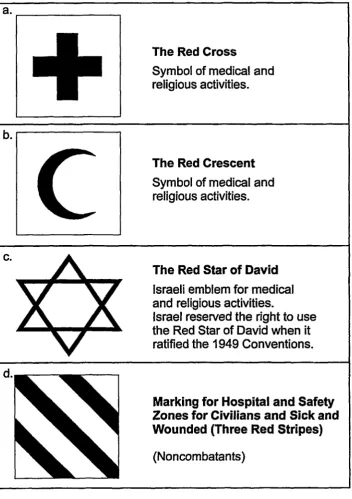
11.9.1 The Red Cross and Red Crescent. A red cross on a white field (Figure
ll-la) is the internationally accepted symbol of protected medical and religious
persons and activities. Moslem countries utilize a red crescent on a white field for
the same purpose (Figure Il-lb).77 A red lion and sun on a white field, once
75.( ... continued)
horrendous conditions and usually accomplished solely because the Occupying Power wanted additional manpower for labor in other areas (perhaps in armament factories in its home territories or, just as important, as agricultural workers), or because it desired to make room for the movement of its own nationals into the occupied territory.
Levie, 2 The Code ofIntemational Armed Conflict 720. GP I, art. 78, details restrictions on the evacuation of children applicable to parties to GP I. The United States supports the principle in article 78 that no nation arrange the evacuation of children except for temporary evacuation where compelling reasons of the health or medical treatment of the children or, except in occupied territory, their safety so require. Matheson remarks, paragraph 11.1, note 2 (p. 481), at 428. The complex body oflaw that may be applicable in the variety of situations involving the evacuation of children is carefully explained in ICRC, Commentary (GP I) 908-15.
Whether interned in occupied territory or in territory of a party to the conflict, an individual's status as an internee during hostilities is subject to periodic review at least every six months in domestic territory, and ifpossible, every six months in occupied territory. GC, arts. 43 & 72(2). If occupation is terminated by the withdrawal of the occupying power before the close ofhostilities, such power may not forcibly transfer internees out of the former occupied territory. GC, art. 49(1). Since the existence of hostilities is the main cause for internment, intemment should cease when hostilities cease. GC, art. 133(1).
76. GC, arts. 32 & 33. Professor Levie cites this extreme example of illegal imposition of collective punishment:
The execution of190 male residents, the deportation of the women, the dispersion of the children, and the razing of the town of Lid ice, in Czechoslovakia, on 10 June 1942, because of the assassination of the Nazi gauleiter Reinhard Heydrich ... by Czech resistance fighters parachuted in from Great Britain.
Levie, 1 The Code ofInternational Armed Conflict 444. See Calvocoressi & Wint, Total War 267 (1972); Asprey, War in the Shadows: The Guerrilla in History 421 (1975); and sources cited therein.
employed by Iran, is no longer used.78 Israel employs a red six-pointed star, which it reserved the right to use when it ratified the 1949 Geneva Conventions (Figure 11-1c). The United States has not agreed that it is a protected symbo1.79 Nevertheless, all medical and religious persons or o~ects recognized as being so marked are to be treated with care and protection. 0
11.9.2 Other Protective Symbols.
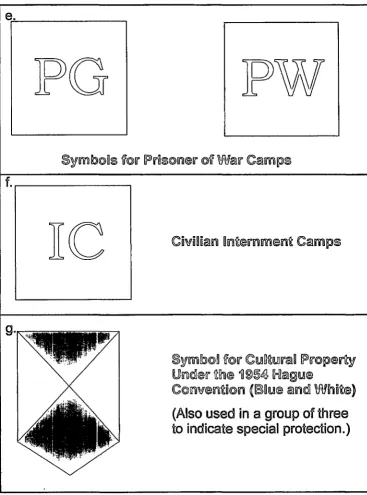
Other protective symbols specially recognized by international law include an oblique red band on a white background to designate hospital zones and safe havens for noncombatants (Figure 11_1d).81 Prisoner-of-war camps are marked by the letters "PW" or "PG" (Figure 11_1e);82 civilian internment camps with the letters "IC" (Figure78. As from 4 July 1980.1980 Int'l Rev. Red Cross 316-17.
79. The Israeli reservations to GWS, GWS-Sea and GC are quite similar. The reservation to the GWS reads:
Subject to the reservation that, while respecting the inviolability of the distinctive signs and emblems of the Convention, Israel will use the Red Shield of David as the emblem and distinctive sign of the medical services of her armed forces.
To GWS-Sea, Israel's reservation states:
... Israel will use the Red Shield of David on the flags, armlets and on all equipment (including hospital ships), employed in the medical service.
Schindler & Toman 576. The Director of the ICRC has argued that the Israeli statement constitutes merely a unilateral declaration. Pilloud, Reservations to the Geneva Conventions of 1949, 1976 Int'l Rev. Red Cross 121-22. Israel continues to use the Red Star of David as its protective emblem. CDDH/SR.37 Annex, 6 Official Records 78-79, Levie, 1 Protection ofWar Victims 309,4 id. 161.
The United States has rejected the Israeli reservations, as part of its rejection of all reservations to the 1949 Geneva Conventions, while accepting treaty relations with all parties "except as to the changes proposed by such reservations." Schindler & Toman 590. As a result, the use of the Red Shield of David (Magen David Adorn) has to be, and has been in the Arab-Israeli conflicts, recognized as a protective emblem by any other party to an armed conflict with Israel. Bothe, Partsch & Solfl03; Vienna Convention on the Law of Treaties, art. 20.5. Nevertheless, despite strenuous efforts, the Red Shield oillavid has not been formally recognized as a protective symbol in the relevant treaties. Rosenne, The Red Cross, Red Crescent, Red Lion and Sun and the Red Shield oillavid, 5 Israel Y.B. Human Rights 1 (1975). Multiplicity of protective emblems does not facilitate their recognition in the heat of battle. Gasser, The Protection of Journalists Engaged in Dangerous Professional Missions, 1983 Int'l Rev. Red Cross 10.
80. Pilloud, note 79, at 122; Levie, 2 The Code ofInternationalArmed Conflict, art. 1011.1.2, at 651. See also paragraph 11.9.7 (p. 499).
81. GC, art. 14 & Annex I, art. 6. A history ofhospital and safety zones may be found in 4 Pictet 121-24. Hospital zones for the wounded and sick combatants are to be marked with red crosses. GWS, art. 23 & Annex I, art. 6; 1 Pictet 422; 4 Pictet 634.
ll-1f).83 A royal-blue diamond and royal-blue triangle on a white shield is used
to designate cultural buildings, museums, historic monuments, and other
cultural objects that are exempt from attack (Figure ll_1g).84 In the Western
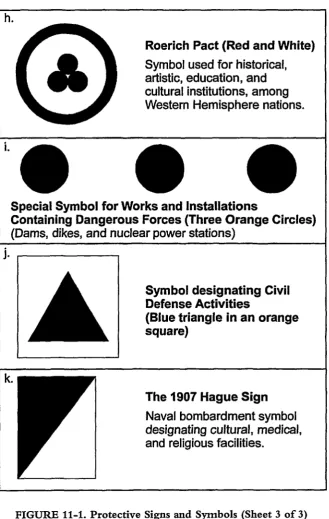
Hemisphere, a red circle with triple red spheres in the circle, on a white
background (the "Roerich Pact" symbol) is used for that purpose (Figure
ll_lh).85
Two protective symbols established by the 1977 Protocol I Additional to the
Geneva Conventions of 1949, to which the United States is not a party, are
described as follows for informational purposes only. Works and installations
containing forces potentially dangerous to the civilian population, such as dams,
dikes, and nuclear power plants, may be marked by three bright orange circles of
equal size on the same axis (Figure ll-li). 86 Civil defense facilities and personnel
may be identified by an equilateral blue triangle on an orange background
(Figure ll_1j).87
11.9.3 The 1907 Hague Symbol. A protective symbol of special interest to
naval officers is the sign established by the 1907 Hague Convention Concerning
Bombardment by Naval Forces in Time of War (Hague IX). The 1907 Hague
symbol is used to mark sacred edifices, hospitals, historic monuments, cultural
buildings, and other structures protected from naval bombardment. The symbol
consists of a rectangular panel divided diagonally into two triangles, the upper
black, the lower white (Figure ll_1k).88
11.9.4 The 1954 Hague Convention Symbol. A more recent protective
symbol was established by the 1954 Convention for the Protection of Cultural
Property in the Event of Armed Conflict.
89
Cultural sites that are of artistic,
historical, or archaeological interest, whether religious or secular, may be
marked with the symbol to facilitate recognition. The symbol may be used alone
83.
GC, art.83(3); 4
Pictet383-84.
The letters IC are used only if military considerationspermit and are to be placed so as to be clearly visible from the air in daytime. If the exact locations of
internment camps are provided as required by GC, art.
83(2),
the need for this marking may bereduced. The parties may agree on some other marking scheme. Areas other than internment
camps must not bear these markings. GC, art.
83(3).
84.
Convention for the Protection of Cultural Property in the Event of Armed Conflict, TheHague,
14
May1954, 249
U.N.T.S.240,
reprinted in Schindler & Toman749,
art.16.
85.
Treaty on the Protection of Artistic and Scientific Institutions and Historic Monuments,Washington,
15
April1935, 49
Stat.3267;
T.S.899; 3
Bevans254; 167
L.N.T.S.279,
art.3.
Parties to the Roerich Pact include Brazil, Chile, Colombia, Cuba, Dominican Republic, EI Salvador, Guatemala, Mexico, the United States, and Venezuela.
86.
GP I, art.56(7).
See paragraph8.5.1.7
(p.426).
87.
GP I, art.66(4).
Civil defense personnel are discussed in paragraph11.3,
note16
(p.484).
88.
Hague IX, art. 5. Hospitals should be marked with red crosses.or repeated three times in a triangular formation. It takes the form of a shield,
pointed below, consisting of a royal-blue square, one of the angles of which
forms the point of the shield, and of a royal-blue triangle above the square, the
space on either side being taken up by a white triangle (Figure 11-1g).
11. 9.5 The White Flag. Customary international law recognizes the white flag
as symbolizing a request to cease-fire, negotiate, or surrender. Enemy forces
displaying a white flag should be permitted an opportunity to surrender or to
•
fc
fi
. ,
90Commumcate a request or cease- re or negooaoon.
11.9.6 Permitted Use. Protective signs and symbols may be used only to
identify personnel, objects, and activities entitled to the protected status which
they designate.
91Any other use is forbidden by international law.
9211.9.7 Failure to Display. When objects or persons are readily recognizable as
being entitled to protected status, the lack of protective signs and symbols does
not render an otherwise protected object or person a legitimate target. Failure to
utilize internationally agreed protective signs and symbols may, however,
subject protected persons and objects to the risk of not being recognized by the
h .
d
93enemy as avmg protecte status.
90. Lieber Code, arts. 111-14; HR, arts. 23(f} & 32; GP I, art. 38(1); FM 27-10, paras. 53, 458,
460 & 467. See paragraph 11.7 (p. 489) for a discussion of surrender.
91. GWS, art. 44(1); GWS-Sea, art. 44; Hague Cultural Property Convention, art. 17. See
paragraph 11.9.2, note 84 (p. 498); GP I, art. 66(8) (civil defense). The United States has reserved
the right of a few ofits businesses to continue using the red cross commercially provided it was so
used prior to 1905. Schindler & Toman 590; 1 Pictet 387; Pilloud, paragraph 11.9.1, note 79
(p. 497) at 123.
92. HR, art. 23(f}; GWS, art. 53; GP I, art. 38; implemented in 18 U.S.C. sec. 706 (1982).
There are no express limitations on the use of the 'pecialsign of the Roerich Pact, the Hague 1907
sign, or for dams, dikes and nuclear power stations established by art. 56(7) ofGP I. However, "the
supervision and control of the special sign [for dams, dikes, and nuclear generating stations]
depends on the more general provisions of Art. 80 and the general prohibitions against improper
use of recognized emblems of Art. 38" ofGP I. Bothe, Partsch & Solf357. They are of the view that
in some (unspecified) circumstances, "the deliberate misuse of the special sign could constitute a
grave breach" under art. 85(3)(f) ofGP I. Ibid. The same rationale would apply to misuse of the
Roerich Pact and Hague 1907 signs. Improper use of protected signs and symbols constitutes
perfidy. See paragraph 12.1.2 (p. 509) for a discussion of perfidy. The protections for dams, dikes
and nuclear electrical generating stations are discussed in paragraph 8.5.1.7 and accompanying notes (p. 426).
93. 1 Pictet 307 recognizes there are circumstances when display of the distinctive emblem unnecessarily exposes noncombatants to risk of attack in violation of their immunity or compromises operational integrity. In the U.S. Army, authority to direct the protective emblem
not be used for tactical or operational reasons is held by the "major tactical commander." AR
750-1, Subj: Maintenance of Supplies and Equipment: Army Materiel Maintenance Policy and
11.10
PROTECTIVESIGNALS
Three optional methods ofidentifying medical units and transports have been created internationally.94 United States hospital ships and medical aircraft do not use these signals.
11.10.1
Radio Signals. For the purpose of identifying medical transports by radio telephone, the wordsPAN PAN
are repeated three times followed by the word "medical" pronounced as in the French MAY -DEE-CAL. Medical transports are identified in radio tele~ph by three repetitions of the group XXX followed by the single group YYy'9511.10.2
Visual Signals. On aircraft, the flashing blue light may be used only on medical aircraft. Hospital ships, coastal rescue craft and medical vehicles may also use the flashing blue light. Only by special agreement between the parties to the conflict may its use be reserved exclusively to those forms of surface medical transport.9611.10.3
Electronic Identification. The identification and location of medical ships and craft may be effected by means of appropriate standard maritime radar transponders as established by special agreement to the parties to the conflict. The identification and location of medical aircraft may be effected by use of the secondary surveillance radar (SSR) specified in Annex10
to the Chicago Convention. The SSR mode and code is to be reserved for the exclusive use of the medical aircraft.9794. GP I, art. 18(5-6) & Annex I, art. 5.
95. Radio Regulations (Mob 1983), art. 40,1984 Int'l Rev. Red Cross 54-56; International Code of Signals. H.O. Pub. 102, at 137 (rev. 1981); GP I, Annex I, art. 7; Bothe, Partsch & Solf 586-88; Levie, 2 The Code ofInternationai Armed Conflict 704-06; Eberlin, Protective Signs 12-16; ICRC, Commentary (GP I) 1216-45.
96. International Code of Signals, H.O. Pub. 102 (rev. 1981), change 136A, Notice to Mariners 52/85. at 11-2.5; GP I, Annex I, art. 6. See Bothe, Partsch & Solf585; Levie, 2 The Code ofInternationai Armed Conflict 703-04; Eberlin, The Identification of Medical Aircraft in Periods of Armed Conflict, 1982 Int'l Rev. Red Cross 207-09; Eberlin, Identification of Hospital Ships and Ships Protected by the Geneva Conventions of12 August 1949,1982 id. 315; Eberlin, The Protection of Rescue Craft in Periods of Armed Conflict, 1985 id. 140; ICRC, Commentary (GP I) 1206-11. Experiments conducted during the Falklands/Malvinas war by the British found the visibility of a flashing blue light was seven nautical miles, while normal visibility at sea was one mile. Junod, Protection of the Victims of Armed Conflict Falkland-Malvinas Islands (1982), at25. Similar results are reported in Cauderay, Visibility of the Distinctive Emblem on Medical Establishments, Units, and Transports, 1990 Int'l Rev. Red Cross 295. Its use ashore poses difficulties caused by the extensive use by many European and Asian police. fire and emergency vehicles of the flashing blue light.
97. Radio Regulations (Mob 1983), arts. 3219A & B; International Code of Signals. H.O. Pub. 102 (rev. 1981). change 136A, Notice to Mariners 52/85, at 11-2.5; Eberlin, Amendments to