Volume 32 Issue 3 Article 2
2005
Empirically Assessing Hadley v. Baxendale
Empirically Assessing Hadley v. Baxendale
George S. Geis
Follow this and additional works at: https://ir.law.fsu.edu/lr
Part of the Law Commons
Recommended Citation Recommended Citation
George S. Geis, Empirically Assessing Hadley v. Baxendale, 32 Fla. St. U. L. Rev. (2006) . https://ir.law.fsu.edu/lr/vol32/iss3/2
F
LORIDA
S
TATE
U
NIVERSITY
L
AW
R
EVIEW
E
MPIRICALLY
A
SSESSING
H
ADLEY V
.
B
AXENDALE
George S. Geis
V
OLUME
32
S
PRING
2005
N
UMBER
3
897
GEORGE S.GEIS*
I. INTRODUCTION... 897
II. THE HADLEY PROBLEM... 903
A. The Significance of a British Miller... 903
B. Theoretical “Solutions” to Hadley ... 907
1. The Majoritarian Solution... 908
2. The Penalty Default Solution... 909
3. Introducing Stochastic Damages... 914
C. The Indeterminacy Concern with Economic Contracts Scholarship... 917
III. AN EMPIRICAL CASE STUDY OF HADLEY V.BAXENDALE... 921
A. Developing a Working Model of Hadley ... 921
B. Estimating the Distribution of Buyer Valuations Empirically... 926
1. Data and Methodology... 926
2. Fitting the Data to a Probability Distribution... 930
3. An Aside: Testing the Majoritarian Solution to Hadley... 934
C. Selecting the Better Default Rule... 936
1. Pens... 937
2. Coca-Cola and Cake... 940
D. Qualifying the Findings... 942
1. High-Value Buyers Suffer Consequential Damages More Frequently.... 943
2. Low-Value Buyers “Take Most of the Benefits” from Tailored Precautions... 945
3. High-Value Buyers Incur Much Greater Transaction Costs... 947
4. The Impact of the Separation Variable... 948
IV. SUMMARY AND BROADER IMPLICATIONS... 949
V. USING MARKETING DATA IN CONTRACT LAW SCHOLARSHIP... 951
VI. CONCLUSION... 955
I. INTRODUCTION
Hadley v. Baxendale,1 one of the most celebrated cases in contract
law,2 sets forth the default rule that unforeseeable consequential
* Assistant Professor of Law, University of Alabama School of Law. [email protected]. B.S., University of California at Berkeley, 1992; J.D., M.B.A., Univer-sity of Chicago, 1998. I thank Barry E. Adler, Amitai Aviram, William S. Brewbaker, Frank Cross, Alan Durham, Dan Filler, Bill Henning, Peter Oh, Eric Posner, Keith Sharf-man, Robert Sitkoff, James Spindler, and Norman Stein for insightful comments on a draft, and I thank Mark Brandon, Alfred L. Brophy, Pamela Bucy, Michael Conoway, Aus-tan Goolsbee, Todd Henderson, Justin Levinson, Kenneth Rosen, and George Triantis for enlightening conversations and encouragement on the subject. Thanks to Klaus Werten-broch and Bernd Skiera for their willingness to share data from several marketing studies. An earlier version of this Article was presented at a faculty colloquium at The University of Alabama School of Law and at the 2004 annual meeting of the Midwestern Law and Economics Association. I am grateful for comments received during these presentations and for the support of Dean Kenneth C. Randall, my faculty colleagues, and the Law School Foundation. Finally, thanks to David Stras for help in early conceptualization, to Todd Hines for library assistance, to Erica Nicholson for administrative help, and to my research assistants, Daniel Hauser, Emily McCarson, and JJ Thomas, for their hard work.
1. Hadley v. Baxendale, 156 Eng. Rep. 145 (Ex. 1854).
damages are unrecoverable.3 The case has come to represent an
im-portant limit to the general rule awarding full expectation damages for breach.4 And over time, Hadley has taken on even greater
signifi-cance as an archetype for contract default rules that efficiently ex-pose asymmetric information.5
A sophisticated line of literature examines the Hadley rule from an economic point of view,6 building theoretical models to determine whether it is efficient.7 While many variables matter, one key
the jurisprudential firmament.”); Ian Ayres & Robert Gertner, Strategic Contractual Ineffi-ciency and the Optimal Choice of Legal Rules, 101 YALE L.J.729, 734-35 (1992) (“Hadley
continues to be one of the most analyzed contract cases in law and economics literature.”); Russell Korobkin, The Status Quo Bias and Contract Default Rules, 83 CORNELL L.REV. 608, 616 n.21 (1998) (“Perhaps the most famous case in all of contract law, Hadley has be-come the example that default rule theorists most often employ to illustrate their concep-tual arguments.”).
3. See 3 E. ALLAN FARNSWORTH,FARNSWORTH ON CONTRACTS § 12.14 (3d ed., Aspen Publishers 2004); JOHN EDWARD MURRAY,JR.,MURRAY ON CONTRACTS § 120 (4th ed., Lex-isNexis 2001); JOSEPH M.PERILLO,CALAMARI AND PERILLO ON CONTRACTS § 14.5 (5th ed. 2003).
4. See FARNSWORTH,supra note 3; MURRAY,supra note 3;PERILLO,supra note 3. 5. See Ian Ayres & Robert Gertner, Filling Gaps in Incomplete Contracts: An Eco-nomic Theory of Default Rules, 99 YALE L.J.87 (1989); Lucian Arye Bebchuk & Steven Shavell, Information and the Scope of Liability for Breach of Contract: The Rule of Hadley v. Baxendale, 7 J.L.ECON.&ORG. 284 (1991); Eric A. Posner, Contract Remedies: Foresee-ability, Precaution, Causation and Mitigation, in 3 ENCYCLOPEDIA OF LAW AND ECONOMICS
162, 163-69 (Boudewijn Bouckaert & Gerrit De Geest eds., 2000).
6. The economic approach to contracts permeates modern literature. See ROBERT
COOTER &THOMAS ULEN,LAW AND ECONOMICS 188-306 (4th ed., Pearson Addison Wesley 2004); 3 ENCYCLOPEDIA OF LAW AND ECONOMICS, supra note 5, at 1-72, 78-222 (publishing various articles on this subject); RICHARD A.POSNER,ECONOMIC ANALYSIS OF LAW §4.1-.15 (6th ed. 2003); STEVEN SHAVELL,FOUNDATIONS OF ECONOMIC ANALYSIS OF LAW 291-385 (2004); 1 THE NEW PALGRAVE DICTIONARY OF ECONOMICS AND THE LAW 174, 425, 436 (Pe-ter Newman ed., 1998). Of course, economic analysis is not the only way to understand contract law, and other approaches yield valuable insights. Economic analysis of contract law—along with the broader use of economics in the law—also receives its share of exter-nal criticisms. For an overview of these criticisms, see BRIAN BIX,JURISPRUDENCE:THEORY AND CONTEXT 210-13 (3d ed., Carolina Academic Press 2004); and Richard Craswell, In-commensurability, Welfare Economics, and the Law, 146 U.PA.L.REV. 1419 (1998). For representative critiques, see ELIZABETH ANDERSON, VALUE IN ETHICS AND ECONOMICS
(1993); AMARTYA SEN,DEVELOPMENT AS FREEDOM (1999); Martha C. Nussbaum, Flawed Foundations: The Philosophical Critique of (a Particular Type of) Economics, 64 U.CHI.L. REV.1197 (1997); Margaret Jane Radin, Market-Inalienability, 100 HARV.L.REV. 1849 (1987); and Cass R. Sunstein, Incommensurability and Valuation in Law, 92 MICH.L.REV. 779 (1994). This Article does not address these concerns. Instead, it takes the position that economic analysis is one way to shape contract law and that empirical analysis remains relevant even when a noneconomic approach to contract law is preferred.
cern is the distribution of buyer valuations for contract performance.8
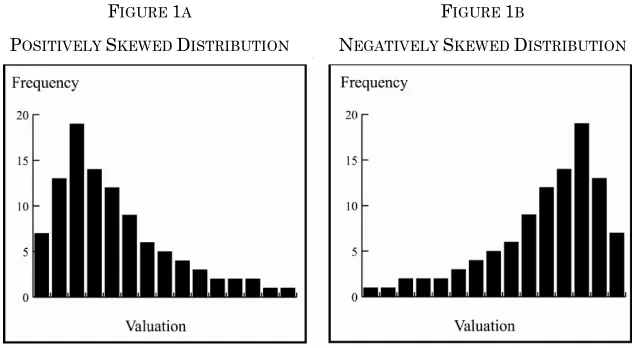
Economic theory suggests that if many buyers place a low value on performance while few buyers place a high value on performance (see Figure 1a)—and if a buyer’s valuation is private, unobservable in-formation—then the Hadley rule may be preferable to a rule that awards full expectation damages.9 Under these circumstances, a
Hadley default may force private information to be revealed in a way that encourages efficient precautions against breach and minimizes transaction costs from bargaining around the default.10 If the
valua-tion distribuvalua-tions are reversed (Figure 1b), the Hadley rule may be inefficient, and a full-damages default might be better.
Eric Posner, as part of a broader challenge to the economic analy-sis of contract law, has recently called to question the merits of this
Hadley model.11 He makes two arguments. First, it is simply too
diffi-cult to gather data needed to test Hadley.12 For instance, Posner
8. Ayres & Gertner, supra note 5, at 108; Lucian Arye Bebchuk & Steven Shavell,
Reconsidering Contractual Liability and the Incentive to Reveal Information, 51 STAN.L. REV. 1615, 1625 (1999) (“[I]t seems that the Hadley rule is clearly desirable for cases . . . in which a minority of buyers has valuations of performance that are substantially higher than the valuations of ordinary buyers.”).
9. See Ayres & Gertner, supra note 5, at 108-18; Bebchuk & Shavell, supra note 5, at 285-86.
10. See Ayres & Gertner, supra note 5, at 108-11. A comprehensive analysis of the op-timal default rule needs to consider additional variables, including transaction costs in-curred by high-value and low-value buyers to contract around the default rule, efficiency gains from tailored precautions, the probability of incurring consequential damages, and several other factors. See id.; Adler, supra note 7, at 1551-53. An extended discussion of the
Hadley solutions is found infra Part II.B.
11. Eric A. Posner, Economic Analysis of Contract Law After Three Decades: Success or Failure?, 112 YALE L.J. 829, 830 (2003) (“[T]he economic approach does not explain the current system of contract law, nor does it provide a solid basis for criticizing and reform-ing contract law.”).
12. Id. at 837-38.
FIGURE 1A
POSITIVELY SKEWED DISTRIBUTION
FIGURE 1B
doubts that buyer valuations can ever be determined empirically.13
Second, it is too hard to sum the impact of multiple variables in the model.14 Even if lawmakers can estimate buyer valuations, they may
find it impossible to pick an optimal default rule because other vari-ables—such as the transaction costs of contracting around a default, the efficiency gains from information revelation, and the probability of incurring consequential damages in breach—need to be added into the mix.15 In short, armchair economic theorizing is not a fruitful
en-deavor.
Posner’s critique echoes a broader cry for empirical analysis16
throughout legal scholarship.17 A wide range of academics,
13. Id.
14. Id. Using a choice-of-remedies example, Richard Craswell synthesizes Posner’s claim as follows:
[W]e cannot decide which remedy is “best” in any overall sense . . . unless we have some way of measuring the relevant effects, both good and bad, and then summing them to come up with a combined score for each of the possible reme-dies. But if we lack empirical data to measure the magnitudes of the various ef-fects, any such sum will be difficult—or even impossible—to construct, so we will never know which remedy is truly the most efficient.
Richard Craswell, In That Case, What Is the Question? Economics and the Demands of Contract Theory, 112 YALE L.J. 903, 908 (2003).
15. Posner, supra note 11, at 836-39.
16. It is important to distinguish between quantitative empirical analysis and quali-tative empirical analysis. Broadly speaking, empirical research uses evidence about the world based on observation or experience. Lee Epstein & Gary King, The Rules of Infer-ence, 69 U.CHI.L.REV. 1, 2 (2002). In the legal literature, the term “empirical analysis” of-ten refers more narrowly to quantitative data and statistical techniques. Id. But empirical analysis can also be qualitative (nonnumerical). Id. Many legal studies, of course, draw upon qualitative worldly observations to support a hypothesis or contention and can thus be considered empirical in nature. Id. at 2-3. In this sense, legal scholarship is often em-pirical. But consistent with other legal literature, all references to empirical analysis in this Article, unless specified otherwise, refer to quantitative empirical analysis.
ners, and judges believe that contract law—along with other legal disciplines—needs greater empirical analysis to test and support scholarly claims.18 The shortage of quantitative empirical scholarship
in the law is attributed to many factors: lack of training among pro-fessors, lower prestige for empirical work, greater expense burdens, and a longer research process incompatible with the law’s need for timely insights.19 For whatever reasons, empirical analysis of
contribute to [each] other.”). Around this same time, the University of Illinois Law Review
sponsored a symposium on empirical legal research, focusing less on the quality of histori-cal scholarship and more on the potential of future scholarship. Symposium, Empirical and Experimental Methods in Law, 2002 U.ILL.L.REV. 791.
18. See RICHARD A. POSNER, OVERCOMING LAW 210-11 (1995); Derek C. Bok, A Flawed System of Law Practice and Training, 33 J.LEGAL EDUC.570, 581-82 (1983); Ep-stein & King, supra note 16, at 4-6; Michael Heise, The Importance of Being Empirical, 26 PEPP.L.REV.807, 834 (1999) (“Our legal literature would be enriched if more academics, particularly law professors, became more engaged in empirical legal research and produced more of it.”); William M. Landes, The Empirical Side of Law & Economics, 70 U.CHI.L. REV. 167, 168-70 (2003) (inferring from data analysis of three journals—The Journal of Law and Economics, The Journal of Legal Studies, and the American Law and Economics Review—that empirical articles appear more frequently in economic journals than in law journals); Russell J. Weintraub, A Survey of Contract Practice and Policy, 1992 WIS.L. REV. 1, 2-4. The call for more empirical research comes from all ends of the legal realm.
See, e.g., Vicki Been & Joel C. Beauvais, The Global Fifth Amendment? NAFTA’s Invest-ment Protections and the Misguided Quest for an International “Regulatory Takings” Doc-trine, 78 N.Y.U. L. REV. 30, 134 (2003) (calling for more empirical data to determine whether NAFTA will chill efficient environmental regulation); Joseph A. Guzinski, Gov-ernment’s Emerging Role as a Source of Empirical Information in Bankruptcy Cases, AM. BANKR.INST.J., Oct. 1998, at 8 (arguing that a lack of empirical information has hindered efforts to reform the bankruptcy code); Michael Korybut, Searching for Commercial Rea-sonableness Under the Revised Article 9, 87 IOWA L.REV. 1383, 1405-06, 1457 (2002) (call-ing for empirical data to understand the treatment of commercial unreasonableness in foreclosure under the revised Article 9 of the Uniform Commercial Code); Michael A. Livingston, Reinventing Tax Scholarship: Lawyers, Economists, and the Role of the Legal Academy, 83 CORNELL L.REV. 365, 397 (1998) (raising a need for more empirical analysis in tax scholarship); Kevin R. Reitz, Sentencing Guideline Systems and Sentence Appeals: A Comparison of Federal and State Experiences, 91 NW.U.L.REV.1441, 1489 (1997) (raising a need for greater quantitative empirical work in the context of guideline sentence ap-peals).
tract law is in its infancy.20 And few have studied the Hadley rule
empirically.21
This Article takes up the task of empirically assessing Hadley in three simple markets. Drawing upon willingness-to-pay research in the field of marketing, this Article first estimates the distribution of buyer valuations for a can of Coca-Cola, a piece of pound cake, and an ergonomic pen.22 Monte Carlo simulation, a technique developed by Manhattan Project scientists, is then used to model complex in-teractions between multiple variables and the overall impact of al-ternative default rules on social welfare.23 Ultimately, this
should be noted, however, that the number of empirical legal articles may be on the rise. A search for the term empirical in the title of all American law reviews published between 1990 and 2000 revealed 231 results. Epstein & King, supra note 16, at 15-16 & 16 n.37. An updated search for all such articles published from 2001 to 2004 yields 216 results. This search was conducted in Westlaw’s Journals and Law Reviews (JLR) database on March 9, 2005, for the term empirical in the title field.
20. Russell Korobkin, Empirical Scholarship in Contract Law: Possibilities and Pit-falls, 2002 U.ILL.L.REV. 1033, 1036. A recent review of empirical contracts scholarship in over 500 law journals from 1985 to 2000 yields just twenty-seven articles. Id. at 1036-37 & app. By comparison, a search in just fifteen top law journals during the years 1980-2001 uncovers seventy-one economics-oriented articles and fifty-two noneconomics-oriented arti-cles on contracts. Gregory Scott Crespi, The Influence of Two Decades of Contract Law Scholarship on Judicial Rulings: An Empirical Analysis, 57 SMUL.REV. 105, 107 (2004) (analyzing the incidences of judicial citations of economic, noneconomic, and empirical con-tract scholarship). Several commentators bemoan the low level of empirical concon-tracts re-search. E.g., Korobkin, supra, at 1037 (“[T]he empirical study of contract law is a very un-derdeveloped genre of legal scholarship.”); Weintraub, supra note 18, at 4 (“Despite this need for data, however, to date there have been only a handful of empirical studies focus-ing on particular contract problems and relationships . . . .”). More broadly, a recent study estimates that just 20.9% of all articles on common law subjects (mainly contracts, torts, and property) published in TheJournal of Legal Studies from 1972 to 2002 were empirical. Landes, supra note 18, at 170 & tbl.1. By comparison, during this same time period, 55% of articles on crime, 52.3% of articles on procedure, and 50% of articles on public choice in the journal were empirical. Id. Landes also shows that empirical analysis enjoys an even greater use among economists outside the legal academy. For instance, 72.4% of all articles published in TheJournal of Law and Economics (a publication largely edited by business professors and largely focused on scholarship outside the legal academy) during the same thirty-year period were empirical in nature. Id. at 168-70 & 170 tbl.1.
21. For existing empirical work on the Hadley doctrine, see Richard Danzig, Hadley v. Baxendale: A Study in the Industrialization of the Law, 4 J.LEGAL STUD.249 (1975); Rich-ard A. Epstein, Beyond Foreseeability: Consequential Damages in the Law of Contract, 18 J.LEGAL STUD.105 (1989); Johnston, supra note 7, at 639-48; and Janet T. Landa, Hadley v. Baxendale and the Expansion of the Middleman Economy, 16 J.LEGAL STUD.455 (1987). 22. The buyer valuation estimations for these products are developed from marketing re-search by Klaus Wertenbroch and Bernd Skiera in Measuring Consumers’ Willingness to Pay at the Point of Purchase, 39 J.MARKETING RES.228 (2002). For additional research on the willing-ness-to-pay methodology, see Gerald E. Smith & Thomas T. Nagle, How Much Are Customers Will-ing to Pay?, MARKETING RES., Winter 2002, at 20; and HENRIK SATTLER &FRANZISKA VÖLCKNER, METHODS FOR MEASURING CONSUMERS’WILLINGNESS TO PAY (Inst. of Mktg., Retailing & Mgmt. Sci. at the Univ. of Hamburg, Research Papers on Marketing and Retailing No. 009, 2002), avail-able at http://www.henriksattler.de/publikationen/HS_FV_WillingnesstoPay.pdf.
23. On the links between Monte Carlo simulation and the Manhattan Project, see Roger Eckhardt, Stan Ulam, John Von Neuman, and the Monte Carlo Method, 15 LOS
tion of empirical and assumption-based analysis yields several im-portant insights.
The primary claim of this Article is that a Hadley default rule is more efficient than a full-damages default rule in the simple markets studied. The extended claim is that markets with similar conditions might also benefit from the Hadley rule. However, these findings are subject to four important qualifications. First, the Hadley rule is not preferable when high-value buyers systematically have a much greater chance of incurring consequential damages. Second, a full-damages default outperforms Hadley when most of the efficiency gains from information revelation go to low-value buyers. Third, the
Hadley rule is not optimal when the transaction costs of contracting around the default rule are much greater for high-value buyers than low-value buyers. Finally, the analysis assumes perfect competition, and introducing seller power into the empirical model might change the results.
The discussion is organized as follows. Part II reviews the Hadley
literature, including the concern that economic models of Hadley are indeterminate. Part III launches an empirical case study of the Had-ley rule. More specifically, Part III.A develops a working model of
Hadley from the existing economic literature, and Part III.B uses willingness-to-pay data to empirically estimate buyer valuations for three simple markets. Part III.C combines this work with other vari-ables to arrive at preliminary conclusions for each market. Part III.D qualifies the findings by conducting sensitivity analysis. Part IV pro-poses additional research to test the Hadley rule in more complicated markets. Finally, Part V suggests that the field of marketing may be a ready-made source of data for contract law scholars. If so, it might be premature to abandon empirical testing of economic theories, at least for the question of consequential damage defaults. A brief con-clusion summarizes the results.
II. THE HADLEYPROBLEM
A. The Significance of a British Miller
The classic contracts case Hadley v. Baxendale24 denies recovery
for unforeseeable consequential damages, that is, nonstandard dam-ages beyond contemplation of the promisor at the time of contract-ing.25 Hadley, a British mill operator, contracted with Baxendale to
JAMES E.GENTLE, RANDOM NUMBER GENERATION AND MONTE CARLO METHODS (2d ed. 2003); PETER JÄCKEL,MONTE CARLO METHODS IN FINANCE (2002); and ISTVÁN MANNO, INTRODUCTION TO THE MONTE-CARLO METHOD (1999).
24. 156 Eng. Rep. 145 (Ex. 1854).
deliver a broken shaft to a manufacturer, who needed the shaft as a model to make the replacement.26 Unfortunately, Baxendale was
de-layed, and the mill shut down for five days.27 The court denied
Had-ley compensation for profits lost during this time period because they were unforeseeable consequential damages.28
The case has come to represent an important limit to the general rule awarding full expectation damages for breach.29 Damages are divided into two types, general and consequential. General damages, arising naturally in the usual course of breach, are routinely recov-erable.30 Consequential damages, such as Hadley’s lost profits, are
not recoverable unless the loss is foreseeable at the time of contract-ing or the parties make alternative arrangements.31 In other words,
Hadley is a default rule that takes effect only when a contract is si-lent on the issue of consequential damages. Parties can contract around it if they wish.32
Much of contract theory deals with this concept of selecting ap-propriate default rules to govern incomplete contracts.33 Parties
can-not possibly anticipate everything that might happen over the course of a contract. Even if they could, the costs of negotiating every
26. Hadley, 156 Eng. Rep. at 146. 27. Id.
28. 3 FARNSWORTH, supra note 3, § 12.14.
29. The Hadley rule receives widespread acceptance. The Restatement (Second) of Contracts adopts the rule as follows: “Damages are not recoverable for loss that the party in breach did not have reason to foresee as a probable result of the breach when the con-tract was made.” RESTATEMENT (SECOND) OF CONTRACTS § 351 (1979). Article 2 of the Uni-form Commercial Code (UCC) codifies Hadley. U.C.C. § 2-715(2)(a) (2003). The United Na-tions Convention on Contracts for the International Sale of Goods limits damages to losses that the breaching party “foresaw or ought to have foreseen . . . as a possible consequence of the breach of contract.” United Nations Convention on Contracts for the International Sale of Goods, Apr. 11, 1980, art. 74, 52 Fed. Reg. 6262, 1489 U.N.T.S. 3.
30. See 3 FARNSWORTH, supra note 3, § 12.14, at 256. 31. Id. at 257, 259, 268.
32. In fact, many commercial contracts apparently modify this default rule to disclaim liability for all consequential damages, whether foreseeable or not. See DOUGLAS G.BAIRD ET AL.,GAME THEORY AND THE LAW 281 n.16 (1994); 3 FARNSWORTH, supra note 3, § 12.14, at 268. Richard Epstein puts it this way:
All in all, the optimal contracting strategy does not appear to call for the high consequential damages, subject to defense rules, that courts have tended to adopt. . . . [W]ithin the class of fixed damage awards, there is reason to expect these damages to be kept relatively limited, which is what the express con-tracts have typically provided.
Epstein, supra note 21, at 118. See also infra note 49 (exploring UCC drafting committee discussions to abandon the Hadley default rule for this reason).
tingency may outweigh the benefits of planning for small-probability events. As a result, no one drafts a complete contract.34
The law faces a choice, then, when parties to a contract come across a contingency not addressed by the initial agreement. One op-tion is to dismiss the contract entirely, expunging all contractual li-ability because the parties have not sufficiently stated a binding agreement.35 A second option is to fill these contractual gaps some-how and enforce the enhanced contract instead.36 Economic analysis
claims to offer a basis for choosing efficient default rules to govern incomplete contracts.
One way to select a default rule is to simply choose the term that most parties would prefer at the time of contracting.37 This
majori-tarian approach to default rules allows the law to economize on transaction costs by supplying standard contract terms that parties
34. See COOTER &ULEN, supra note 6, at 211-17; SHAVELL, supra note 6, at 299-301; Craswell, supra note 33. Alan Schwartz and Robert Scott recently put it this way: “[C]ontracts will inevitably be incomplete. There is an infinite number of possible future states and a very large set of possible partner types. When the sum of possible states and partner types is infinite and contracting is costly, contracts must contain gaps. Parties cannot write contracts about everything.” Alan Schwartz & Robert E. Scott, Contract The-ory and the Limits of Contract Law, 113 YALE L.J.541, 594-95 (2003). Parties may also remain silent for a number of strategic reasons. See Ayres & Gertner, supra note 5, at 94; Ayres & Gertner, supra note 2, at 760; Johnston, supra note 7.
35. Such is the approach taken in a number of classic common law cases. See, e.g., Varney v. Ditmars, 111 N.E. 822, 823 (N.Y. 1916) (holding a promise to give a “fair share of [the] profits” sufficiently vague to render the contract unenforceable). The Restatement (Second) of Contracts offers some support for this approach. See RESTATEMENT (SECOND)
OF CONTRACTS § 33(1) (1979) (“Even though a manifestation of intention is intended to be understood as an offer, it cannot be accepted so as to form a contract unless the terms of the contract are reasonably certain.”); id. § 33 cmt. b (“Contracts should be made by the parties, not by the courts, and hence . . . remedies for breach of contract must have a basis in the agreement of the parties.”); see also Robert E. Scott, A Theory of Self-Enforcing In-definite Agreements, 103 COLUM.L.REV.1641, 1643-61 (2003) (exploring situations where courts refuse to enforce incomplete contracts).
36. This approach receives support from the Uniform Commercial Code, which often seeks to supplement incomplete contracts with fair or reasonable terms, especially when parties fail to specify less important terms. See, e.g., U.C.C. § 2-305(1) (2003) (inserting a reasonable price when none is specified). For more general discussion, see Richard E. Spei-del, Restatement Second: Omitted Terms and Contract Method, 67 CORNELL L.REV.785 (1982). Other compromise approaches to enforcing incomplete contracts have also been suggested. See, e.g., Omri Ben-Shahar, “Agreeing to Disagree”: Filling Gaps in Deliberately Incomplete Contracts, 2004 WIS.L.REV.389 (suggesting an intermediate solution, in some circumstances, which holds parties partially accountable to honor incomplete contracts). 37. Craswell, supra note 33, at 2-5; Charles J. Goetz & Robert E. Scott, The Mitiga-tion Principle: Toward a General Theory of Contractual ObligaMitiga-tion, 69 VA.L.REV. 967, 971 (1983). The Restatement (Second) of Contracts suggests that lawmakers should supply an essential missing term with one “which is reasonable in the circumstances.” RESTATEMENT
would otherwise have to adopt by express agreement.38 While it may
be fiction to retroactively divine the parties’ intentions, economists can often reason that one term would have been selected over alter-natives. Perhaps one party can better manage the risk, for example, or avoid costs easier.39 By generalizing the preferences of many con-tracting parties in this manner—or even by looking historically at a large number of executed contracts—lawmakers could conceivably judge which default rules will minimize transaction costs.40
But, unfortunately, selecting default rules by majority preference may not always lead to the most efficient outcome. A second strain of economic theory suggests that lawmakers should, instead, sometimes choose default rules preferred by a minority of parties.41 The reason
is this: minority defaults can, at times, lead to information sharing that increases the overall welfare of an economic system.42 Selecting
the right default can prevent better-informed parties from taking ad-vantage of less-informed parties by compelling information to come forward that results in a greater social welfare.43
From an economic point of view, then, one key challenge is know-ing whether to choose majoritarian defaults that save on transaction costs or to choose penalty defaults that force information to be shared. This tension plays out most directly in the economic litera-ture evaluating Hadley.44 In fact, over time, the Hadley rule has
38. POSNER, supra note 6, § 4.1, at 96-97; cf. Frank H. Easterbrook & Daniel R. Fischel, Limited Liability and the Corporation, 52 U.CHI.L.REV. 89, 93 (1985) (“The legal rule [of limited liability] enables firms to obtain . . . benefits . . . at lower cost.”).
39. See ROBERT A.HILLMAN,PRINCIPLES OF CONTRACT LAW 254-56 (2004); Goetz & Scott, supra note 37, at 971-76. For an example of this in practice, see National Distillers & Chemical Corp. v. First National Bank of Highland Park, 804 F.2d 978, 982 (7th Cir. 1986), reasoning that “[a]mbiguities and gaps in contracts should be resolved by finding what the parties would have bargained for had they addressed the matter explicitly at the time.”
40. But see Russell Korobkin, The Endowment Effect and Legal Analysis, 97 NW.U.L. REV.1227, 1272 (2003) (suggesting that behavioral economic effects may cause contract de-fault rules to be “sticky,” preventing parties from efficiently contracting around the rules in some cases); Korobkin, supra note 2, passim (suggesting that default rule preferences of contracting parties may be influenced by the existing default rule).
41. See Ayres & Gertner, supra note 5, at 93-95; Craswell, supra note 33, at 5-9. 42. The intuition behind these penalty defaults, or “information-forcing defaults,” is to keep better-informed parties from strategically hiding socially valuable information during contract formation. Ayres & Gertner, supra note 5, at 94. To get the information out, “it may be efficient to choose a rule that a majority of people actually disfavor.” Id. at 95; see also Gwyn D. Quillen, Note, Contract Damages and Cross-Subsidization, 61 S.CAL.L.REV. 1125 (1988) (discussing cross-subsidization problems that result when better informed par-ties keep information private).
43. Ayres & Gertner, supra note 5, at 94, 99. This point is developed further infra
Parts II.B.1-2.
taken on much greater significance as an archetype for the power of contract default rules to efficiently expose asymmetric information.45
B. Theoretical “Solutions” to Hadley
The Hadley situation is usually modeled by dividing a population of buyers into two classes: those with a low valuation of contract per-formance and those with a high valuation.46 For example, purchasers of FedEx delivery services might be divided between buyers valuing delivery greatly (perhaps they need to deliver important documents to buy a house or apply for a job) and buyers with a low valuation of performance (perhaps they need to send a newsletter or another rou-tine document). Each buyer is risk-neutral and knows his valuation type. The selling party has no way to distinguish one type of buyer from the other and must rely instead on the buyer to reveal this pri-vate information. From a social point of view, it is desirable for sell-ers to know this information so they can take efficient precautions.47
For example, using the facts of Hadley, the carrier could hire another employee to ensure timely delivery for the highest-value buyers.48
While many default rules might govern the issue of consequential damages,49 two alternative rules are proposed: (1) a Hadley default
limiting unforeseeable consequential damages unless high-value buyers reveal their type and (2) a full-damages default allowing high-value buyers to recover everything without revealing any
45. See Adler, supra note 7, at 1548-53; Ayres & Gertner, supra note 5, at 101-04; Bebchuk & Shavell, supra note 5, at 286. More generally, contracting under asymmetrical information receives extensive treatment in the literature on game theory and the law.
See, e.g., BAIRD ET AL., supra note 32, at 79-158.
46. A more realistic approach might be to model the value of performance by the two classes of buyers as two continuous distributions with different means. Such an approach is suggested by Adler, supra note 7, at 1561 n.38. This Article extends the analysis in this manner. See infra Part III.
47. The model thus assumes that spending more on precautions will reduce the risk of breach and therefore the expected damages suffered by each buyer for nonperformance. Said another way, if the low-value and high-value buyers were conducting these activities themselves, they would each take different levels of care, which would reflect the optimal investments to reduce the risk of nonperformance. Other things being equal, one would prefer a default rule that leads to identical results. See BAIRD ET AL., supra note 32, at 150-51; Ayres & Gertner, supra note 5, at 97-104; Bebchuk & Shavell, supra note 5, at 287-92.
48. This might make sense if the costs of hiring the extra employee were more than offset by the benefits of a greater chance of timely delivery to Hadley. One can also imagine an inefficient investment in precautions—for example, hiring ten police to fend off an un-likely attempt at highway robbery. Such an investment might result in a price greater than what Hadley is willing to pay and is unlikely to occur once full negotiations have taken place.
tion.50 Which default rule will allow sellers to distinguish between
buyer types, thus enabling them to take efficient precautions that maximize social welfare?51
1. The Majoritarian Solution
A lawmaker might argue that the Hadley default is preferable be-cause it forces high-value buyers to reveal their type by negotiating protection for unforeseeable consequential damages.52 Of course, high-value buyers may initially resist disclosing this information to avoid a price increase. But as long as sellers are best situated to
50. E.g., Adler, supra note 7, at 1554-59; Ayres & Gertner, supra note 5, at 108; Bebchuk & Shavell, supra note 5, at 289-92.
51. The concept of greater social efficiency through more tailored precautions can be illustrated with a simple numerical example. Take a population of 100 buyers with a posi-tively skewed distribution of performance valuations as follows (Figure 1a, supra p. 899, displays this data visually):
VALUE PLACED ON
PERFORMANCE NUMBER OF BUYERS
1 7 2 13 3 19 4 14 5 12 6 9 7 6 8 5 9 4 10 3 11 2 12 2 13 2 14 1 15 1 TOTAL 100
MEAN 5.1
If sellers cannot distinguish among the types of buyers, they will take precautions reflect-ing the mean performance valuation of 5.1. However, if they can divide the buyers into just two groups—those above the mean and those below the mean—then they can take precau-tions reflecting a mean value of 3.2 for the 65 low-value buyers and precauprecau-tions reflecting a mean value of 8.7 for the 35 high-value buyers. More granular knowledge of the perform-ance valuations for different buyer classes results in two main benefits. First, sellers can avoid wasting precautions on the 65 low-value buyers who would prefer a lower price and higher chance of breach. Second, sellers can take additional precautions—greater than the average levels taken when all buyers are pooled together—to increase the probability of successful performance for the 35 high-value buyers. Social gains will continue to accrue with increasing levels of granularity (for example, subdividing the two groups of buyers into groups of four, eight, or ultimately down to groups of fifteen). Of course, these gains may be offset by the increased transaction costs needed to obtain this granularity.
vest in extra precautions,53 high-value buyers will realize that they
are better off paying the higher price and enjoying greater certainty of performance.
But what happens if a full-damages default rule is adopted instead? Now, high-value buyers will be compensated fully and need not reveal their special circumstances.54 Low-value buyers, however, will prefer that sellers take fewer precautions in exchange for a cheaper price.55 They will step forward to reveal this preference, allowing sellers to again distinguish between buyer types and take more granular precau-tions.56 Thus, in theory, either the Hadley or the full-damages default
rule will expose private information and lead to efficient precautions. Under a majoritarian approach, then, the optimal default rule is simply a function of the underlying valuation distribution for the market. The most efficient rule seeks only to minimize transaction costs by putting in place a default that most buyers need not contract around.57 Lawmakers should estimate the buyer valuation
distribu-tion for the market and select the default rule accordingly: if buyer valuations skew positively (Figure 1a58), then a Hadley rule is best; if
they skew negatively (Figure 1b59), then a full-damages default should be chosen. And if buyer valuations are normally distributed, the consequential damages default rule may not matter.60
2. The Penalty Default Solution
In some cases, however, a Hadley default can be better even when most buyers would not select this rule in advance. The logic is subtle: majority defaults may not lead buyers to reveal their type, while a penalty default rule—reflecting the preferences of fewer buyers— may expose this information.61
This can happen because the majoritarian model of Hadley assumes away important variables. For instance, the optimal default rule may depend on the magnitude of transaction costs—the costs of contracting around a dis-liked default rule.62 Or the best rule may change if low-value and high-value
53. One would expect this to be true in many cases. However, independent insurance markets, allowing buyers to self-insure if they wish, might exist for some types of con-tracts. This is ultimately another issue subject to empirical investigation.
54. See Craswell, supra note 33, at 7-8; Posner, supra note 11, at 836-37. 55. See Craswell, supra note 33, at 7-8; Posner, supra note 11, at 837. 56. See Craswell, supra note 33, at 7-8; Posner, supra note 11, at 837.
57. This analysis follows from Coasean contractual theory. See R.H. Coase, The Prob-lem of Social Cost, 3 J.L.&ECON. 1 (1960); Johnston, supra note 7, at 623-25.
58. See supra p. 899 fig.1a. 59. See supra p. 899 fig.1b. 60. Posner, supra note 11, at 854.
61. Adler, supra note 7, at 1549-50; Ayres & Gertner, supra note 5, at 97-98; Bebchuk & Shavell, supra note 5, at 290.
buyers face different transaction costs.63 The optimal default might also turn
on which buyers benefit the most from tailored precautions.64
Consider a situation where the majoritarian default leads to a poor out-come. Assume that a legal system selects a full-damages default to govern the negatively skewed market shown in Figure 1b.65 This default is majori-tarian because there are 65 high-value buyers who prefer a full-damages rule and just 35 low-value buyers. But the transaction costs incurred by low-value buyers to contract around the full-damages default may out-weigh the gains that they receive from the seller taking fewer precautions. If so, low-value buyers will not reveal their type, and sellers will take aver-age precautions for the entire buyer pool rather than more efficient tailored precautions. By contrast, this problem may not occur if lawmakers select a
Hadley default. If the gains from high-value buyers contracting around the
Hadley default rule sufficiently outweigh the transaction costs incurred, then they will reveal their type. Under these circumstances, a default rule preferred by a minority of buyers leads to greater social welfare, while a de-fault rule preferred by the majority is less efficient.
A stylized numerical example may help illustrate this point.66 Under
this example, simplify the market in Figure 1b67 even further so that there are 35 identical low-value buyers and 65 identical high-value buy-ers, and make the assumptions of Table 1.
TABLE 1
BUYER ASSUMPTIONS IN A NEGATIVELY SKEWED MARKET
BUYER TYPE NUMBER VALUATION ($) ACROUND OST TO DCEFAULT ONTRACT ($)
Low 35 50 15
High 65 500 10
Average 342.568
Gertner, supra note 5, at 114-15. But this need not be the case, and robust models will ex-plicitly take transaction cost variables into account. Id. at 117-18; see also Alan Schwartz & Joel Watson, The Law and Economics of Costly Contracting, 20 J.L.ECON.&ORG.2, 3 (2004) (noting that “contracting and renegotiation costs are treated as exogenous parame-ters, commonly assumed to be either very high or very low” and then “explor[ing] the mid-dle ground”).
63. Korobkin also explores this point. See Korobkin, supra note 20, at 1058. 64. Ayres & Gertner, supra note 5, at 116-18.
65. See supra p. 899 fig.1b. The distribution of buyer valuations for this market is the inverse of the one described supra note 51.
66. This example is adapted from the framework established by Bebchuk and Shavell.
See Bebchuk & Shavell, supra note 5, at 287-90 nn.9-17. Perfect competition is assumed, and all seller costs except precautions are excluded for simplicity.
67. See supra p. 899 fig.1b.
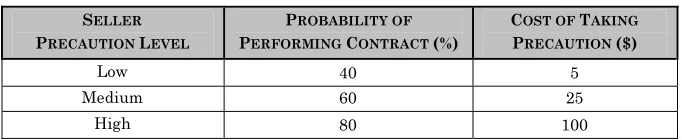
Assume further that sellers in a perfectly competitive market can choose from three different levels of precautions, as indicated in Table 2. Taking greater precautions increases the chances that sell-ers will successfully perform the contract, but doing so also costs more. For example, sellers taking medium precautions incur $25 in costs—which they pass on to buyers in perfect competition—and these precautions lead to successful contract performance 60% of the time.
TABLE 2
SELLER PRECAUTIONS ASSUMPTIONS
SELLER
PRECAUTION LEVEL
PROBABILITY OF
PERFORMING CONTRACT (%)
COST OF TAKING
PRECAUTION ($)
Low 40 5
Medium 60 25
High 80 100
With these assumptions, low-value buyers prefer contracts where sellers take low precautions:69
Utilitylow = 50 (40%) – 5 = 15
Utilitymed = 50 (60%) – 25 = 5
Utilityhigh = 50 (80%) – 100 = -60
Conversely, high-value buyers prefer contracts where sellers take high precautions:
Utilitylow = 500 (40%) – 5 = 195
Utilitymed = 500 (60%) – 25 = 275
Utilityhigh = 500 (80%) – 100 = 300
And if sellers cannot distinguish buyer types, they will take medium precautions, reflecting average expected preferences:
Utilitylow = 342.5 (40%) – 5 = 132
Utilitymed = 342.5 (60%) – 25 = 180.5
Utilityhigh = 342.5 (80%) – 100 = 174
Now imagine that this legal system selects the majoritarian de-fault rule of full damages. High-value buyers have no need to con-tract around this rule because they will be fully compensated un-der the default.70 But low-value buyers may choose to reveal their
type for a cheaper price.71 Will the economic system benefit if they
69. Buyer utility = [(valuation of successful performance) * (probability of successful performance)] - cost of precautions.
do so? Consider the social welfare in each possible outcome (Table 3).
TABLE 3
SOCIAL WELFARE UNDER FULL-DAMAGES DEFAULT RULE
SOCIAL WELFARE
LOW-VALUE BUYERS HIGH-VALUE
BUYERS TOTAL
Low-value buyers contract around default (separat-ing72)
073 19,50074 19,500
Low-value buyers do not contract around default (pooling75)
17576 17,87577 18,050*
* Equilibrium result
If low-value buyers incur the costs of contracting around the rule, the buyer population separates by type. Low-value buyers re-ceive low precautions and high-value buyers rere-ceive high precau-tions (without incurring transaction costs). Conversely, if low-value buyers do not reveal their type, the population pools and everyone receives medium precautions. Society is better off when low-value buyers contract around the default rule (19,500 > 18,050), but they will not do so. Each low-value buyer faces a cost of $15 to contract around the rule yet only benefits by $10—the difference between utility with low precautions and utility with medium precautions. The equilibrium is a pooling one where no one reveals information.
In this example, however, the results change when the Hadley de-fault is selected, even though fewer buyers prefer this rule. Now the 65 high-value buyers must decide whether to reveal their type.
72. A separating equilibrium occurs when one group of buyers offers information about their type, thus allowing the seller to distinguish between the groups of buyers and take tailored precautions. See Adler, supra note 7, at 1557-58; Ayres & Gertner, supra note 5, at 111-23.
73. This social welfare value is calculated as follows: (number of low-value buyers) * (utility to low-value buyer with low precautions – cost to low-value buyer of contracting around default) = (35) * (15 - 15) = 0. Thus, in this context, social welfare is the sum of par-ticipant utility and excludes third-party effects.
74. This social welfare value is calculated as follows: (number of high-value buyers) * (utility to high-value buyer with high precautions) = (65) * (300) = 19,500.
75. A pooling equilibrium occurs when no buyer group offers information about their type, thus forcing the seller to take the same level of precautions for the entire buyer “pool.” See Adler, supra note 7, at 1556; Ayres & Gertner, supra note 5, at 111-13.
76. This social welfare is calculated as follows: (number of low-value buyers) * (utility to low-value buyer with medium precautions) = (35) * (5) = 175.
sider the resulting social welfare under both outcomes as shown in Table 4.
TABLE 4
SOCIAL WELFARE UNDER HADLEYDEFAULT RULE
SOCIAL WELFARE
LOW-VALUE BUYERS HIGHB -VALUE
UYERS TOTAL
High-value buyers con-tract around default (sepa-rating)
52578 18,85079 19,375*
High-value buyers do not contract around default (pooling)
17580 17,87581 18,050
* Equilibrium result
Social welfare is greater when high-value buyers contract around the Hadley default rule (19,375 > 18,050), and they will do so. The increase in utility when they move from medium precautions to high precautions, a net gain of $25, outweighs the transaction costs of $10. While the greatest social welfare comes when low-value buyers con-tract around a full-damages default,82 this outcome never occurs.
Hadley thus offers the best obtainable outcome.
This example illustrates how self-interested buyer behavior some-times prevents majoritarian defaults from exposing socially valuable information. Different assumptions, of course, might support majori-tarian defaults.83 The penalty-default solution to Hadley argues that limited consequential damages should sometimes be imposed to force efficient precautions, even though the rule may be preferred by few contracting parties. This means that lawmakers considering the
78. This social welfare is calculated as follows: (number of low-value buyers) * (utility to low-value buyer with low precautions) = (35) * (15) = 525.
79. This social welfare is calculated as follows: (number of high-value buyers) * (util-ity to high-value buyer with high precautions – cost to high-value buyer of contracting around default) = (65) * (300 - 10) = 18,850.
80. Calculated as in supra note 76. 81. Calculated as in supra note 77.
82. This is true because total transaction costs incurred when low-value buyers contract around the default (35 * 15 = 525) are less than the total transaction costs incurred when high-value buyers do so (65 * 10 = 650). Cf. Bebchuk & Shavell, supra note 5, at 288-89, 295 (discuss-ing socially optimal behavior of buyers and sellers where, in contrast to this model, contract(discuss-ing high-buyers have lower transaction costs because they are in the minority). This need not al-ways be the case. If, for example, transaction costs of high-value buyers are reduced to $5, the resulting welfare when they contract around the Hadley default is 19,700—which exceeds the social welfare when low-value buyers contract around the full-damages default.
Hadley rule ought to analyze more than just the number of high-value and low-high-value buyers in a market. Additional buyer data— including the magnitude of performance valuations, costs incurred when contracting for other rules, and efficiency gains from tailored precautions—are needed to select the better default rule.
3. Introducing Stochastic Damages
The solution gets more complicated, however, when consequential damages are stochastic (occurring with some probability) instead of certain.84 Using the facts of Hadley, imagine, for example, that there
was only some chance that the miller would lose profits from a de-layed delivery—maybe he was searching neighboring mills for a spare shaft.85 Barry Adler recently modeled this nuance,86 finding
that the change narrows the circumstances where penalty defaults lead to the optimal outcome.87 A few changes to the previous example
are reflected in Table 5, which will illustrate this point.
TABLE 5
REVISED BUYER ASSUMPTIONS
BUYER
TYPE NUMBER
VALUATION:
GENERAL
DAMAGES ($)
VALUATION: CONSEQUEN
-TIAL
DAMAGES ($)
PROBABILITY OF INCURRING
C ONSE-QUENTIAL D
AM-AGES88 (%)
COST TO
C ON-TRACT
AROUND
DEFAULT
($)
Low 35 25 75 60 15
High 65 25 475 90 10
Average 25 33589 79.5
Buyer valuation is now split between general damages and conse-quential damages, and the Hadley rule is modeled differently. Conse-quential damages incurred by low-value buyers are considered fore-seeable and, thus, recoverable under Hadley.90 Consequential damages
beyond this amount are unforeseeable. High- and low-value buyers
84. See Adler, supra note 7, at 1560.
85. Or, to borrow from Adler, imagine that Hadley hired a mechanic who had a chance to fix the mill without the missing mill shaft. Id.
86. Id.
87. Id. at 1561-70.
88. For simplicity, this probability of incurring consequential damages is modeled with certainty. Cf.id. at 1561 n.38 (using a simplified presentation to convey the general idea). The working model used infra Part III.A models this variable stochastically.
also have different chances of suffering consequential damages. In this stylized example, then, the first $75 in consequential dam-ages is foreseeable, while the incremental $400 incurred by high-value buyers is not. High-value buyers also suffer damages with greater prob-ability. Assumptions for seller precautions remain the same.
With this modeling refinement, high-value buyers are more likely to conceal their type inefficiently, even under a Hadley default. As before, low-value buyers prefer contracts where sellers take low pre-cautions,91 high-value buyers prefer contracts where sellers take high
precautions,92 and sellers take medium precautions when they are
unable to distinguish buyer type.93 Under a full-damages regime, the
outcome mirrors the earlier example. Table 6 illustrates this point.
TABLE 6
REVISED SOCIAL WELFARE UNDER FULL-DAMAGES DEFAULT RULE
SOCIAL WELFARE
LOW-VALUE
BUYERS
HIGH-VALUE
BUYERS TOTAL
Low-value buyers contract around
default (separating) 28094 17,03095 17,310 Low-value buyers do not contract
around default (pooling) 59596 16,02397 16,618* * Equilibrium result
91. The calculation here is slightly more complicated, as buyer utility under each pre-caution level now depends on the probability of consequential damages occurring. Thus, the equation for buyer utility is as follows: [probability of no consequential damages * ((general damages * the probability of successful performance) – the cost of precautions)] + [probability of consequential damages * (((general damages + consequential damages) * the probability of successful performance) – the cost of precautions)]. Using this formula for low-value buyers, Utilitylow = [40% * ((25 * 40%) - 5)] + [60% * (((25 + 75) * 40%) - 5)] = 23
Utilitymed = 17
Utilityhigh = -44
92. For high-value buyers,
Utilitylow = [10% * ((25 * 40%) - 5)] + [90% * ((25 + 475) * 40%) - 5)] = 176
Utilitymed = 246.5
Utilityhigh = 262
93. For average buyers,
Utilitylow = [20.5% * ((25 * 40%) - 5)] + [79.5% * (((25 + 335) * 40%) - 5)] = 111.5
Utilitymed = 149.8
Utilityhigh = 133.1
94. This social welfare value is calculated as follows: (number of low-value buyers) * (value to low-value buyer with low precautions – cost to low-value buyer of contracting around default) = (35) * (23 - 15) = 280.
95. This social welfare value is calculated as follows: (number of high-value buyers) * (value to high-value buyer with high precautions) = (65) * (262) = 17,030.
96. This social welfare value is calculated as follows: (number of low-value buyers) * (value to low-value buyer with medium precautions) = (35) * (17) = 595.
Social welfare is greater if low-value buyers separate (17,310 > 16,618), but instead they will pool. Transaction costs of $15 exceed the net benefit of $6 that accrues to low-value buyers moving from me-dium to low precautions.98
In the earlier example, instituting a Hadley default resulted in a switch from a pooling equilibrium to a separating one. But this time, changing the default rule will not cause separation. Clearly, social welfare is again greater with buyer separation, as Table 7 illustrates. Further-more, the gains to high-value buyers moving from medium to high pre-cautions ($15.5) exceed the transaction costs of contracting around the de-fault rule ($10).99 But high-value buyers must now pay an additional cost
if they identify their type: sellers will charge them for the higher probabil-ity of incurring the initial $75 in consequential damages.100 In this
exam-ple, high-value buyers pay an extra $7.88 when identifying their type.101
Facing this calculus, high-value buyers keep quiet;102 this results in a
pooling equilibrium—even with the Hadley rule.
TABLE 7
REVISED SOCIAL WELFARE UNDER HADLEYDEFAULT RULE
SOCIAL WELFARE
LOW-VALUE
BUYERS
HIGH-VALUE
BUYERS TOTAL
High-value buyers contract around
de-fault (separating) 805
103 16,380104 17,185
High-value buyers do not contract
around default (pooling) 595
105 16,023106 16,618*
* Equilibrium result
This does not mean that penalty defaults never work.107 It means
only that they may work less frequently than otherwise believed.108 A
98. See supra p. 914 tbl.5 and note 91. 99. See supra p. 914 tbl.5 and note 92.
100. See Adler, supra note 7, at 1565-66 (describing a similar scenario between ship-pers and carriers).
101. This additional cost is calculated as follows: (probability of consequential damages for high-value buyers – probability of consequential damages for average buyers) * foresee-able consequential damages = (90% - 79.5%) * 75 = 7.88.
102. $15.50 in benefits < $17.88 in total costs.
103. This social welfare value is calculated as follows: (number of low-value buyers) * (value to low-value buyer with low precautions) = (35) * (23) = 805.
104. This social welfare value is calculated as follows: (number of high-value buyers) * (value to high-value buyer with high precautions – cost to high-value buyers of contracting around default) = (65) * (262 - 10) = 16,380.
nuanced model of Hadley, then, needs to add variables for the chances that high-value and low-value buyers will incur consequen-tial damages.
In summary, the choice of a default rule to govern consequential damages depends on several variables, including (1) the magnitude and distribution of valuations that buyers place on contract perform-ance;109 (2) the transaction costs incurred when high-value buyers bargain around a Hadley default or when low-value buyers bargain around a full-damages default;110 (3) the social efficiency gains when
high- or low-value buyers disclose private information, thus enabling more tailored precautions against breach;111 and (4) the probability
that high-value or low-value buyers will incur consequential dam-ages in breach.112 Given this complexity, it may be difficult for
law-makers to unpack these variables and determine which default rule should apply in any given context. One commentator has remarked that “accurate evaluation of a penalty-default rule’s efficacy in the
Hadley setting could be a heroic task.”113
C. The Indeterminacy Concern with Economic Contracts Scholarship
Eric Posner takes the argument further, suggesting that complex economic models of contract law—including the Hadley model for consequential damages—are indeterminate.114 In his view, economic analysis of contract law has become so complicated that the theories do not lead to observable implications or concrete normative sugges-tions. The argument is twofold. First, key variables in the economic
107. To see this in the example, change low-value buyer consequential damages from $75 to $25. With this modified assumption, the gains to high-value buyers from identifying themselves outweigh the costs of doing so, and buyers separate under the Hadley rule. 108. See Adler, supra note 7, at 1551-54. Responses to Adler’s article echo this belief.
See Ayres & Gertner, supra note 5, at 92-93; Bebchuk & Shavell, supra note 8, at 1618-19. 109. See Ayres & Gertner, supra note 5, at 101-02.
110. Seeid. at 97-100.
111. See Bebchuck & Shavell, supra note 5, at 287-89.
112. See Adler, supra note 7, at 1560. Other refinements to the model are possible. Most notably, Jason Scott Johnston has introduced a game theoretical model of the Hadley
rule where he relaxes assumptions of perfectly competitive markets. See Johnston, supra
note 7, at 626-39. In other words, sellers are no longer “identical price-taking firms.” Id. at 625. This introduces an incentive for sellers to learn about buyer valuations, not for the purpose of taking efficient precautions but rather to increase their individual profits. Id. at 625-26. It also introduces another dimension of information revelation, as buyers would now like to learn whether different sellers have different probabilities of breach. See id. at 625-26. Other commentators emphasize the complications of crafting defaults in markets with seller power. See Ayres & Gertner, supra note 2, at 732-33; Alan Schwartz, The De-fault Rule Paradigm and the Limits of Contract Law, 3 S.CAL.INTERDISC.L.J. 389, 397-99 (1993).
models cannot be estimated with any degree of confidence.115 Second,
even if one variable can be measured in isolation, there is no way to aggregate all of a model’s variables to obtain meaningful outcomes.116
Take each argument in turn.
The first claim is that key variables are too hard to measure. In other words, “we [do not] have enough empirical data to be able to guess which rule is based on assumptions that are closer to real-ity.”117 For Hadley, an example of an indeterminate variable might be
the distribution of buyer valuations. How could lawmakers ever es-timate the range of values for a given contract? What is the relevant population? How would they gather a sample? Why would partici-pants ever feel compelled to reveal their actual valuation?118 If there
is truly no way to estimate this variable empirically, then it may be impossible to state an optimal default rule for consequential dam-ages.
More generally, if most economic models of contract law contain unverifiable terms, then economic analysis may be of little use. Mod-els lacking a basis for empirical testing will ultimately fail to provide guidance to lawmakers. Even if more sophisticated models refine the variables and circumstances under which different default rules are preferable, they will remain indeterminate. Other approaches are needed to fill contract gaps at a more granular level.119
115. Id. at 864-65. 116. Id. at 865. 117. Id. at 837.
118. Posner concludes that “[n]o one has tried to determine the shape of this distribu-tion through empirical research, and indeed it is hard to imagine how this could be done.”
Id. at 854. Barry Adler puts it this way: “A determination [of the optimal default rule] de-pends on perhaps unobtainable information about the full range of each type’s [(high-value and low-value buyers)] expected damages from breach.” Adler, supra note 7, at 1552. 119. Or maybe contract gaps should not be filled at all. Alan Schwartz and Robert Scott suggest that lawmakers should dismiss contracts that run into contingencies not spelled out explicitly, at least for contracts between sophisticated parties. See Schwartz & Scott, supra note 34, at 594-609. They support this approach by arguing that most state-imposed default rules are inefficient and do not address the myriad of situations that occur in contract law. See id. at 598-601. Instead of lowering transaction costs, these rules may force parties to contract around the defaults and raise the overall costs of contracting. See id. at 608; Robert E. Scott, Rethinking the Default Rule Project, 6 VA.J.84, 85 (2003) (stat-ing that if parties do not like a legislatively enacted term, they will “expend resources drafting their own term[s]”). The buyer and seller would then be free to renegotiate terms or abandon the deal entirely. Schwartz & Scott, supra note 34, at 594-609. Ultimately, the parties might come to understand the consequences of this approach and adjust their con-tracting strategies accordingly. Id. Of course, this refusal to set default rules would itself be a type of default rule. Richard Craswell puts it this way:
The second claim is that the overall effects of multiple variables cannot be summed.120 In the Hadley context, even if lawmakers can
estimate buyer valuation distributions with confidence, they would still need to estimate all of the other variables for the same popula-tion and aggregate the impact. How significant are the transacpopula-tion costs? What are the efficiency gains from more tailored precautions? And what are the interactions between each of these variables? The optimal default rule could only be selected upon completion of this arduous analytic work.121
In fact, there may be further concerns. Suppose lawmakers can measure, with some confidence, all relevant variables in a single ex-periment, thus solving the “vague variable” and “summing-up” prob-lems. And imagine that they do this over several different markets. It is entirely possible that the optimal default rule in one market is empirically different than the optimal rule in another. Maybe the valuation distribution curves of home construction, for example, skew negatively, indicating a preference for a full-damages default, while valuations of delivery contracts skew positively, advocating a
Hadley rule. In this case, should lawmakers prefer customized de-fault rules—where each market gets its optimal dede-fault—or, in the interests of contracting certainty, should they select just one global default for the issue of consequential damages?122 A parallel problem exists for heterogeneous contractors within a single market.123 Should lawmakers use Hadley for one set of home builders and full damages for another? These choices raise fundamental jurispruden-tial issues of rules versus standards that permeate many areas of the law.124
At its heart, though, Posner’s challenge to economic contracts scholarship highlights a need for empiricism. If key variables are truly immeasurable, then the economic approach to contract default rules may be futile. But if there are ways to get at the variables—or at least at some of the variables—empirically, then economic models may offer a tangible foundation for reforming contract law. Posner
Craswell, supra note 33, at 2.
120. Posner, supra note 11, at 838, 880. 121. Id. at 836-37.
122. This tension is raised in Ayres & Gertner, supra note 5, at 125-27. 123. Id.; see also Craswell, supra note 33, at 4-5.
acknowledges that empirical analysis could conceivably spark a “ren-aissance” in the economic study of contract doctrine:
[Economic] models enjoy some intellectual advantages . . . for they would enable us to make complex and interesting predictions about contract law if we had sufficient information about empirical conditions. But because we do not have such information, and it is—in my view, though others might disagree—unlikely that we ever would, the complex economic theories do not get us much closer to an understanding of contract law . . . .125
And so far, empirical scholarship in contract law is indeed rare. A recent review of contracts scholarship in over 500 law journals from 1985 to 2000 yields just twenty-seven empirical articles, a surpris-ingly small body of work.126 In actuality, economists—largely outside the legal academy—have compiled a substantial body of empirical work on contracts, examining the contract terms selected in specific markets or situations.127 But this work rarely considers explicit
doc-trinal implications for contract law.128 Said differently, the models of
contract default rules developed by legal scholars have been sub-jected to little empirical testing. This is true even though scholars of-ten call for empirical study.129
An empirical analysis of Hadley, then, might take on a greater significance. If key variables can be measured empirically, a growing body of scholarship could test and refine economic models of contract
125. Posner, supra note 11, at 864-65.
126. See Korobkin, supra note 20, at 1036-37. Korobkin explains his results as follows: Despite the fact that . . . contract law is a relatively rich area for legal scholar-ship, I was able to identify fewer than thirty articles relevant to this review, and many of these either only arguably meet the definition of “empirical” or provide a tenuous link between the data gathered and any contract doctrine.
Id. (footnotes omitted). Also see supra note 20 for other sources of evidence that nonempiri-cal approaches to contract doctrine are much more prevalent.
127. See, e.g., Douglas Allen & Dean Lueck, Contract Choice in Modern Agriculture: Cash Rent Versus Cropshare, 35 J.L.&ECON. 397 (1992); Victor P. Goldberg & John R. Erickson, Quantity and Price Adjustment in Long-Term Contracts: A Case Study of Petro-leum Coke, 30 J.L.&ECON.369 (1987). For a survey of this work, see Pierre-Andre Chiap-pori & Bernard Salanié, Testing Contract Theory: A Recent Survey of Some Work, in 1 ADVANCES IN ECONOMICS AND ECONOMETRICS:THEORY AND APPLICATIONS 115 (Mathias Dewatripont et al. eds., 2003). While this literature dates back to the 1980s, much of the work has occurred in the past five years. Id. at 142. And even here, “the empirical valida-tion of the theory has long lagged behind the theoretical work.” Id. at 115.
128. See Korobkin, supra note 20, at 1036 (“[A]lthough there is a very large body of empirical studies of contracting, there is extremely little empirical contract law scholarship being produced in the legal academy today.”).
law. The next Part turns to this possibility through a case study as-sessing the Hadley rule.
III. AN EMPIRICAL CASE STUDY OF HADLEY V.BAXENDALE
This Part launches an empirical case study of the Hadley rule. Part III.A describes the model used for the test.130 Part III.B presents data from several marketing studies and uses this data to empiri-cally estimate buyer valuation distributions in three simple markets. Part III.C runs Monte Carlo simulations to incorporate the effects of multiple variables. These simulations indicate that a Hadley default typically generates more welfare than a full-damages default in each market studied. Finally, Part III.D qualifies these findings by con-ducting sensitivity analysis on other variables in the model.
A. Developing a Working Model of Hadley
Under the empirical model of Hadley, one hundred buyers must first decide whether to contract with a seller. Each buyer has a dif-ferent valuation of contract performance (VALUE) chosen randomly from a predetermined probability distribution.131 This valuation is
split between general damages (GD) and consequential damages (CD). Specifically, the first portion of damages is deemed general—up to a constant assumption for GD—and the balance of VALUE is CD.132 General damages always occur with breach, but buyers may not incur consequential damages.133 The probability of suffering con-sequential damages (PROBCD) is determined randomly for each buyer, again from a known distribution of values.134
The seller may take low, medium, or high precautions for each buyer. Greater levels of precautions increase the probability of suc-cessful contract performance (PROBLOW, PROBMED, PROBHIGH) but also cost more (COSTLOW, COSTMED, COSTHIGH). Without
130. The model is also available, upon request, from the author, at [email protected]. The model is built in Microsoft Excel, and users will also need to download and install Crystal Ball, an Excel add-in simulation program available from Decisioneering at http://crystalball.com (last visited Mar. 3, 2005).
131. The shape and parameters of the probability distribution differ for each market and are derived empirically. See infra Part III.B.
132. If the random VALUE for any buyer is less than the constant assumption for GD, then all damages are considered general. For example, if general damages are assumed to be $0.20 and buyer number 26 values contract performance at just $0.15, then all of that buyer’s damages are deemed general (GD = $0.15), and no damages are consequential (CD = $0.00).