Oh the Lemons in Life: Individual Differences
in Emotion Processing Predict Post-Trauma
Depression
Tabitha N. Alverio and Sara M. Levens, Ph.D.
University of North Carolina at CharlotteAbstract
The effect that trauma has on a person is variable—some individuals may develop depression, stress, or post-traumatic stress disorder, while others will cope more adaptively. A plethora of research has examined the negative effect of trauma on behavior and cognition. Yet less research has been conducted to elucidate what cognitive processes may underlie whether a person develops depression or is resilient after a stressful event. The goal of the present study is to investigate whether individual differences in emotion-processing in working memory may underlie the development of depression and stress (or not) in response to experiencing a recent trauma. Participants completed two experimental sessions. In the first session participants completed an emotion n-back task followed by questionnaires assessing depression, stress, and trauma history. In the second session 1 to 4 months later, participants again completed depression, stress, and trauma history questionnaires. Participants were grouped based on whether they had experienced a recent trauma (Trauma group) or had not experienced a trauma (No-trauma group) in the last 6 months. Emotion n-back task performance was compared between the Trauma and No-trauma group. In addition correlation analyses were conducted to determine whether engaging and disengaging from emotional content in the emotion n-back task predicted later levels of depression and stress in the trauma group. Results reveal that of the individuals who experienced a trauma, disengaging from positive content faster predicted higher levels of post trauma depression symptoms. These findings suggest that individuals who have trouble keeping positive information active develop higher levels of depression than individuals who easily maintain positive content. Furthermore these findings suggest that assessments of individual differences in emotion processing may be predictive of post trauma experiences, thoughts, and behavior.
Key Words:
Trauma, Emotion, Working memory, Updating
Trauma is defined as a negative emotional response to experiencing a disturbing life event such as combat, rape, or natural disaster (American Psychological Association, 2014). Some individuals who directly experienced a traumatic event, witnessed a traumatic event, or are facing a traumatic event may develop symptoms of depression and stress which can range in severity from mild, to moderate, to severe. Individuals who experience severe depression and stress may be diagnosed with Post Traumatic Stress Disorder (PTSD). PTSD is defined by the Diagnostic and Statistical Manual of Mental Disorders (DSM-5) as having one or
more intrusive symptoms (e.g. recurrent memories of the event), continuous avoidance of stimuli associated with the event, changes in reactivity and arousal to stimuli associated with the traumatic event, and adverse changes in cognition (American Psychiatric Association, 2013). PTSD is debilitating, yet even mild to moderate depression and stress can also lead to extensive behavioral and interpersonal issues. Critically, the cognitive mechanisms that underlie how an individual responds to trauma—whether they develop stress or depression, or are resilient—are unclear. The goal of the present study is to elucidate what
underlying cognitive and emotion processing interactions might underlie the development of depression and stress in response to traumatic events.
A plethora of research has revealed that encountering stressful emotional stimuli can create systematic physiological, biochemical and behavioral changes. Collectively these physiological, biochemical and behavioral changes are known as the stress response (Baum, 1990). The stress response can also affect how emotional information is processed and can lead to a negative cognitive response style that includes distorted thoughts (e.g. “It is my own fault this happened to me,”), maladaptive thoughts, (e.g. “I must be on guard or else something bad will happen,”) and changes in schemas (e.g. I must be a bad person because this terrible thing happened to me). The development of a negative cognitive response style has been suggested as a risk factor for depression following trauma (Robinson & Alloy, 2003).
On the other hand, some individuals experience a life-altering crisis, and respond in a more adaptive or positive way. They may not experience as much depression or stress and may exhibit what is known as post traumatic growth. Post Traumatic Growth is when an individual experiences a positive change psychologically after the traumatic event (Calhoun & Tedeschi, 1999). This positive change could be a new appreciation for life itself, interpersonal relationships may take on new meaning and become richer, and priorities may make a positive shift (Tedeschi & Calhoun, 2004). Individuals who exhibit post-traumatic growth tend to focus on ways of dealing with the event, such as, a mother becoming an advocate against drunk driving as a way to cope with the loss of their child in a drunk driving accident. Whether an individual copes with trauma in a negative or positive way may be determined by individual differences in how they tend to process emotional information (positive and negative). Emotions are changes in physiological arousal, cognitive processes and behavioral reactions to external stimuli (Gerrig & Zimbardo, 2002). Emotion processing is a cognitive
operation in which an individual appraises and encodes emotional stimuli and makes sense of it so that other emotional experiences can occur and behavior is not disrupted (Rachman, 1980). For most individuals recalling a traumatic event and the emotions associated with the event can be distressing and overwhelming. Being able to rapidly disengage from negative content to process positive content may be an emotion-cognition bias that is adaptive in response to trauma and indicative of resilience. Whereas problems disengaging from negative content and maintaining positive content may be a maladaptive emotion-cognition bias that supports the development of depression and stress.
A traumatic experience may change an individual’s thoughts, emotions and reactions to their environment thus shaping that individual’s way of relating to the world and influencing their behavior. For example, hyper vigilance to emotional stimuli following a trauma may lead to increased processing of negative emotional content, attention problems, and impaired working memory (Morey, et al., 2009). Working memory is an individual’s cognitive workspace. Working memory is crucial for simultaneously storing and processing information and learning complex tasks (Baddeley, 1992). Positive or negative emotions can also influence an individual’s cognitive style; the way an individual perceives an event may also influence how that information is encoded and decoded (Clore & Huntsinger, 2007).
n-back task. Specifically, Levens and Gotlib (2010) found that depressed individuals exhibited greater difficulty disengaging from negative content as well as difficulty maintaining positive content in working memory. Never-disordered controls on the other hand exhibited an opposite emotion processing pattern and revealed a greater tendency to keep positive content active in working memory than depressed individuals (Levens, & Gotlib, 2010). These findings suggest that emotion specific deficits in working memory may underlie the negative mood that is associated with depression. It is unclear however if the emotion processing deficits identified in working memory in depressed individuals occur as a consequence of the depressive episode or are pre-existing emotion processing individual differences that may predispose an individual to develop depression. It is also unclear if similar individual differences in working memory and emotional processing may underlie the development of a negative cognitive response style following trauma.
The goal of the present study is to determine if individual differences in emotion processing within working memory, specifically emotion updating, may predict depression and stress symptoms following trauma. To examine whether time to update emotional content predicts depression and stress symptoms following traumatic events, participants completed a two-part study. In part one; participants completed an emotion n-back task with happy, neutral, angry, fearful and sad stimuli. The emotion n-back task measures time to update emotional content in working memory; to perform the task participants need to integrate emotional content, match expressions when they are of the same emotion, and indicate when they are dissimilar. In part two, participants returned to the lab and completed questionnaires that assessed whether they had experienced anything traumatic in the last six months or not, as well as current emotional mood and symptoms of depression and stress. Based on previous findings that currently depressed individuals have greater difficulty disengaging from sad content as well as difficulty maintaining happy content in working
memory (Levens & Gotlib, 2010), we predict that time to update emotional content will be significantly different between the no trauma and recent trauma groups. In addition, we also predict that individual differences in time to update sad and happy content will predict post-trauma levels of depression and stress symptoms.
Method
Participants
Participants were recruited from an introductory psychology course and through the university’s SONA system for course credit. One hundred and nineteen participants completed the study. Participants were separated into two groups, based on whether they had experienced a recent trauma (Trauma Group; N = 27) or not (Non-trauma Group; N = 92). The Trauma group consisted of 2 males and 25 females with a reported mean age of 19.37 years old (SD = 6.13). The age ranged from 18-50 years old with 74.1% Caucasian, 11.1% African American and 14.8% other. The Non-trauma group consisted of 19 males and 73 females with a reported mean age of 18.67 years old (SD = 3.22). The age ranged from 18-47 years old with 68.5% Caucasian, 12% African American, and 19.6% other.
Measures
Depression symptoms. Depression symptoms were assessed using the Center for Epidemiological Studies Depression Scale (CES-D; Randolf et al., 2012). The CES-D contains 10 items that asks individuals to rate how often they have felt certain symptoms for the past week with ratings ranging from less than 1 day (0) to 5-7 days (3) on a four point Likert scale. Most of the questions were of negative affect such as “I felt that everything I did was an effort,” and two were positive, “I was happy,” and “I felt hopeful about the future.”
Participants ratings were on a five point Likert scale with ranges from never (1) to very often (5). Questions consisted of items such as “In the last month, how often have you been upset because of something that happened unexpectedly.”
Trauma. The Trauma History Questionnaire (THQ; Hooper.et al, 2011) was used to determine if participants had experienced a trauma in the past 6 months. The THQ asks participants whether they ever and/or in the past 6 months experienced a traumatic event, however only responses to whether a participant had experienced a trauma in the past 6 months were used to group participants. The THQ had a range of types of exposure to trauma such as victimization through physical or sexual assault, exposure to an active combat zone and natural disasters. The sum score of the THQ was used to separate participants into two groups, individuals who had not experienced trauma in the past 6 months (Non-Trauma group; n= 92) and those who had experienced a recent trauma within the past six months (Trauma group; n=27). Within the Trauma group, participants reported a range of 2 to 7 traumatic events with a mean of 2.62 (SD=1.2).
Emotion n-back task. The Emotion n-back task (Levens & Gotlib, 2010) measures the reaction times and responses of participants as they update emotional stimuli in working memory. For the task participants view a series of emotional facial expressions and need to determine whether the present emotional expression they were viewing was the same or different expression as the expression they saw two faces earlier. The emotional expressions consisted of happy, sad, neutral, angry, and fearful. The emotion n-back tasks consist of three trial types, match-set, break-set, and no-set trials. Match-set trials are when the current facial expression is the same as the expression presented two trials earlier which the individual must form an association between two similar stimuli that engages an overarching emotional concept. Break-set trials followed match-set trials and the individual had to break an association made between two stimuli which reflect the ability to disengage from one emotional stimulus to another. The no-set trials
followed break-set trials and the individual differentiated that the current emotional stimulus was different than the emotional expression seen two trials earlier but did not have to dissociate the stimulus from existing representations. Participants would either press “same,” or “different,” which was labeled on the keyboard during the trial. Reaction times for “same,” and “different trials were recorded for each stimulus (happy, sad, neutral, angry, fearful) which allowed us to record separate measurements of how long it was needed for an individual to categorize emotional faces and how long it was needed for an individual to update, and breakaway from information in their working memory.
Procedure
Analysis Plan
Reaction times (RT) and Accuracy was recorded for each trial, and a mean RT and accuracy were calculated for correct trials for each trial type in the Emotion n-back task. Although researchers often use accuracy as the dependent variable for the Emotion n-back, RT has been often analyzed as the first dependent variable (e.g. Druzgal & D’Esposito, 2000; Kensinger & Corkin, 2003; Kessler & Meiran, 2006) for between group comparisons (Ladouceur et al., 2005; Paramenter, Shucard, Benedict & Shucard, 2006; Paramenter, Shucard & Shucard, 2007). The present study used RT as the primary dependent variable in WM. Additionally Condition was also measured and recorded with RT and Accuracy. A three-way Group [Trauma, No-trauma] repeated over Emotion [Happy, Sad, Neutral, Angry, and Fearful] repeated over Condition [Match-set, Break-set, No-set] analysis of variance (ANOVA) was used to determine the accuracy and response rates during the task.
Reaction times for the Emotion n-back task are the actual time it takes for an individual to encode and decode information in working memory while also including the time it takes for updating the information and comparing the information to the earlier presented stimuli two trials earlier. In a study conducted by Faust et al., (1999) found that groups with slower RTs often contribute to a larger experimental effect. Trial type RTs were then converted to z-scores by the following equation; individual trial RT type mean minus from his/her overall RT mean then divided by the standard deviation of the trial type mean. To determine the time needed to update and link information in WM, z-score transformations were needed for the Emotion n-back task. Three-way ANOVAS, Group [Trauma, Nontrauma] repeated over Emotion [Happy, Sad, Neutral, Angry, Fearful] repeated over Condition [Match-set, Break-set, No-set], were conducted on RT z scores.
Results
Results are presented in three sections. The first section presents reaction time data, the
second section accuracy data, and the final section examines whether updating emotional content predicts levels of depression and stress an average of three months later. In the present sample participants reported Depression scores that ranged from 0-19 with a mean score of 7.56 (SD=4.813) and Perceived Stress scores that ranged from 13-41 with a mean score of 27.33 (SD=6.093). Depression and Stress were positively correlated (r =.692, p<.01).
Reaction Time Analysis
Accuracy and Response Rates
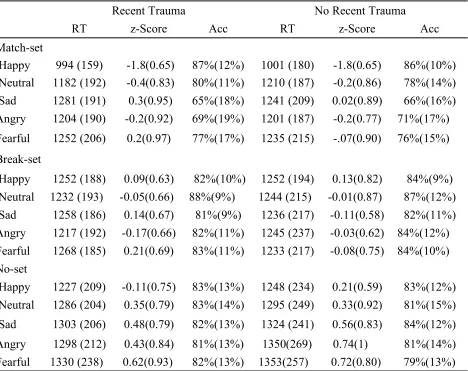
The three-way ANOVA conducted on the Emotion n-back accuracy rates produced significant main effects of Condition, F(2, 214) = 15.15, p < .01, Emotion, F(4, 428) = 18.37, p < .01, and an Emotion x Condition interaction, F(8, 856) = 9.42, p < .01. No other main effects or interactions were significant. The main effect of Condition was due to all trial types exhibiting significantly different accuracy levels from each other, ps < .05 with Break-set trials having the highest level of accuracy and Match-set trials the lowest level of accuracy. The main effect of Emotion in follow up t test revealed significant differences between all emotions, ps < .05, except Happy and Neutral trials which were similar with mean accuracy rates of 84% and 83% respectively. See Table 1 for all trial type accuracy rates.
Correlation Analysis
A correlation was conducted between all emotion n-back trial types (e.g. Sad break-set, happy, break-set, happy match-set, fearful match-set, etc…) and reported depression and stress levels. Days between assessment (Days between Time 1 and Time 2) and trauma experience (Trauma group versus no trauma group) were included as covariates. Only two trial types significantly predicted depression and stress symptoms three months later. Happy break-set z-scores had a significant negative correlation with depression, r(106) = -.19, p < .05. In addition, Sad no-set trial z-scores, positively correlated with depression r(106) = .27, p < .01 and stress, r(106) = .22, p < .05 symptoms.
Table 1. 2-back Trial Mean Reaction Times, z-Score and Accuracy Rates for Recent Trauma Group and No Recent Trauma Group
Recent Trauma No Recent Trauma
RT z-Score Acc RT z-Score Acc
Match-set
Happy 994 (159) -1.8(0.65) 87%(12%) 1001 (180) -1.8(0.65) 86%(10%) Neutral 1182 (192) -0.4(0.83) 80%(11%) 1210 (187) -0.2(0.86) 78%(14%) Sad 1281 (191) 0.3(0.95) 65%(18%) 1241 (209) 0.02(0.89) 66%(16%) Angry 1204 (190) -0.2(0.92) 69%(19%) 1201 (187) -0.2(0.77) 71%(17%) Fearful 1252 (206) 0.2(0.97) 77%(17%) 1235 (215) -.07(0.90) 76%(15%) Break-set
Happy 1252 (188) 0.09(0.63) 82%(10%) 1252 (194) 0.13(0.82) 84%(9%) Neutral 1232 (193) -0.05(0.66) 88%(9%) 1244 (215) -0.01(0.87) 87%(12%) Sad 1258 (186) 0.14(0.67) 81%(9%) 1236 (217) -0.11(0.58) 82%(11%) Angry 1217 (192) -0.17(0.66) 82%(11%) 1245 (237) -0.03(0.62) 84%(12%) Fearful 1268 (185) 0.21(0.69) 83%(11%) 1233 (217) -0.08(0.75) 84%(10%) No-set
Discussion
The goal of the study was to examine if the development of depression and stress in response to trauma was a result of underlying cognitive and emotion processing interactions in WM. We hypothesized that individual differences in the time to update happy and sad content would predict post-trauma levels of depression and stress symptoms. The results revealed two principle findings which will be discussed in turn.
One, as predicted emotion updating differed between the no trauma and recent trauma group, albeit the differences were trending toward significant. We predicted that trauma would impair emotion updating. Instead the effects of trauma on emotion updating are selective; individuals in the trauma group updated fearful and sad stimuli faster than the no trauma group, yet on the other hand, the trauma group updated angry stimuli slower than the no trauma group. There were no differences in the time to update happy and neutral content between trauma groups. The observed trending group differences are interesting as the negative content aligns with the trauma—following recent trauma individuals update sad and fearful content faster. Negative attention biases have been demonstrated in previous studies investigating depression (Gotlib & Joorman, 2010). Studies have also linked depression with difficulty in disengaging from negative content which supports the current study’s findings since individuals in our trauma group may be holding on to negative representations of their trauma experience and avoiding happy or positive content (Joorman, Levens & Gotlib, 2011).
Results also supported the second hypothesis that time to update emotional content would predict subsequent depression. Specifically results revealed that time to disengage from happy content predicted levels of depression an average of three months later. This finding is very interesting in the context of existing depression and emotion updating findings. Previous research by Levens and Gotlib (2010 & 2015) demonstrated that individuals who had depression and those who had
recovered from depression disengaged from positive content significantly slower than never disordered controls. Based on this research Levens and Gotlib concluded that the tendency to disengage from positive content more quickly could either be a scar effect of depression or an underlying cognitive bias that could make developing a depressive episode easier. The findings from the present study add significantly to the pattern of findings across studies as they suggests that the tendency to disengage from positive content quickly may not be a scar of depression but rather an underlying emotion-cognition bias that may contribute to the development of depression.
Critically, the findings also reveal that the predictive association between disengaging from positive content and depression symptoms is not only in those individuals who have experienced trauma. Results reveal that time to disengage from positive content predicts future depression symptoms regardless of trauma status. Individuals with problems disengaging from negative content and maintaining positive content may have an emotion-cognition profile that would encourage the development of depression regardless of whether a trauma was experienced or not. Past research has shown that intrusive negative thoughts in WM increase depressive symptomology (Joorman, Levens & Gotlib, 2011). This suggests that as negative information enters WM, it receives cognitive resources to be processed, interpreted and elaborated on. Given that WM is a limited capacity system, the negative content may influence other information that is within WM and via association may give it more of a negative valence (Clore & Huntsinger, 2007).
between stress and depression influences each other but how an individual updates information in working memory does not appear to have an impact on their perceived stress. A possible explanation for why rapidly disengaging from positive content predicts depression and not stress is that perceived stress is an evaluation of one’s external environment and their ability to cope with that environment. Depression however is associated with internal negative schemas that shape an individual’s behavior and how they relate to the world around them (Kozhevinkov, 2007; Morey et al., 2009). The perception of emotional stimuli has been show to influence the encoding and storage of information within long-term memory (Clore & Huntsinger, 2007). Therefore cognitive biases may build over time which could be influencing an individual’s cognitive style which could possibly shape negative schemas. Based on Beck’s Theory of depression, these negative schemas could be resulting in the depressive symptomology (Beck, 1967). The tendency to quickly disengage from positive valenced information could be suggestive of a negative cognitive response style, which Robinson & Alloy (2003) have suggested places individuals at a higher risk of depression.
The current study’s findings are supported by past research results between depressed subjects and controls conducted by Levens & Gotlib (2010), they found that depressed individuals disengage from Happy emotional content in working memory faster than controls. These results suggest that individuals who are disengaging from positive stimuli around them may be maintaining negative information that could negatively impact their perception of the world leading to higher levels of depression and longer bouts of depression. The present pattern of findings also aligns with positive attenuation research that has found lower reactivity to positive stimuli in individuals who are suffering from depression (Rottenberg, Gross & Gotlib, 2005). This suggests that if an individual has a decrease in their reactivity to positive stimuli they may not be engaging with that information long enough which could result in the development of a
negative mood as a function of time. As an individual encounters positive information in the external environment, cognitive resources may not be devoted to that information to further process and elaborate on that given stimulus. A reduced response to positive information could also dampen an individual’s ability to use that positive content to help him/her get out of a negative mood.
References
American Psychological Association. (2014). Retrieved May 18, 2014, from
http://www.apa.org/topics/trauma/inde x.aspx
Baddeley, A. (1992). Working memory. Science (New York, N.Y.), 255(5044), 556-559. Baum, A. (1990). Stress, intrusive imagery, and
chronic distress. Health Psychology, 9(6), 653-675.
Bomyea, J., Amir, N., & Lang, A. J. (2012). The relationship between cognitive control and posttraumatic stress symptoms. Journal of Behavior Therapy and
Experimental Psychiatry,43(2), 844-848. Calhoun, L. G., & Tedeschi, R. G. (1999).
Facilitating posttraumatic growth: A clinician's guide. Mahwah, NJ: Lawrence Erlbaum Associates.
Clore, G. L., & Huntsinger, J. R. (2007). How emotions inform judgment and regulate thought. Trends in Cognitive Sciences, 11(9), 393-399.
Cohen, S., Kamarck, T., & Mermelstein, R. (1983). A global measure of perceived stress. Journal of Health and Social Behavior, 24(4), 385.
Druzgal T.J., & D'Esposito M. (2001). Activity in fusiform face area modulated as a function of working memory load.
Cognitive Brain Research. 10(3), 355-364. Faust, M. E. , Balota, D. A., Spieler, D.H., & Ferraro,
F. R. (1999). Individual differences in information-processing rate and amount: Implications for group differences in response latency. Psychological Bulletin, 125, 777–799.
Gerrig, R. J., & Zimbardo, P. G. (2002). Glossary of psychological terms. Retrieved June 27, 2014, from
https://www.apa.org/research/action/gl ossary.aspx
Gotlib, I. H., & Joormann, J. (2010). Cognition and depression: Current status and future directions. Annual Review of Clinical Psychology, 6, 285-312.
Hooper, L. M., Stockton, P., Krupnick, J. L., & Green, B. L. (2011). Development, use, and psychometric properties of the trauma history questionnaire. Journal of Loss and Trauma,16(3), 258-283. Joorman, J., & Gotlib, I. H. (2010). Emotion
regulation in depression: Relation to cognitive inhibition. Cognition and Emotion 24(2), 281-298.
Joormann, J., Levens, S. M., & Gotlib, I.H. (2011). Sticky thoughts: Depression and
rumination are associated with difficulties manipulating emotional material in working memory.
Psychological Science, 22(8), 979-983. Kensinger, E. A., & Corkin, S. (2003) Effect of
negative emotional content on working memory and long-term memory. Emotion, 3(4), 378-93.
Kessler, Y., & Meiran, N. (2006). All updateable objects in working memory are updated whenever any of them is modified: Evidence from the memory updating paradigm. Journal of Experimental Psychology: Learning, Memory and Cognition, 32, 570-585.
Kozhevnikov, M. (2007). Cognitive styles in the context of modern psychology: Toward an integrated framework of cognitive style. Psychological Bulletin, 133(3), 464-481. Ladouceur, C. D., Dahl, R. E., Williamson, D. E.,
Birmaher, B., Ryan, N. D., & Casey, B. J. (2005). Altered emotional processing in pediatric anxiety, depression, and comorbid anxiety-depression. Journal of Abnormal Child Psychology. 33(2), 165-177.
Levens, S. M., & Gotlib, I. H. (2010). Updating positive and negative stimuli in working memory in depression. Journal of
Experimental Psychology: General,139(4), 654-664.
Levens, S. M., & Gotlib, I. H. (2015). Updating emotional content in recovered
depressed individuals: Evaluating deficits in emotion processing following a
Miyake, A., Friedman, N. P., Emerson, M. J., Witzki, A. H., & Howerter, A. (2000). The unity and diversity of executive functions and their contributions to complex “frontal lobe” tasks: A latent variable analysis. Cognitive Psychology, 41, 49-100. Morey, R. A., Dolcos, F., Petty, C. M., Cooper, D. A.,
Hayes, J. P., Labar, K. S., & Mccarthy, G. (2009). The role of trauma-related
distractors on neural systems for working memory and emotion processing in posttraumatic stress disorder. Journal of Psychiatric Research,43(8), 809-817. Paramenter, B. A., Shucard, J. L, Benedict, R. H. B.,
& Shucard, D. W. (2006). Working memory deficits in multiple sclerosis: Comparison between the n-back task and the Paced Auditory Serial Addition Test. Journal of the International
Neuopsychological Society, 12, 677-687. Paramenter, B. A., Shucard, J. L., & Shucard, D. W.
(2007). Information processing deficits in
multiple sclerosis: A matter of complexity. Journal of the International
Neuopsychological Society, 13, 417–423 Rachman, S. (1980). Emotional processing.
Behavior Research and Therapy,18, 51-60. Radloff, L. S. (1977). The CES-D scale: A
self-report depression scale for research in the general population. Applied
Psychologocial Measurement, 1, 385–401. Robinson, M. S., & Alloy, L. B. (2003). Negative
cognitive styles and stress-reactive
rumination interact to predict depression: A prospective study. Cognitive Therapy and Research, 27(3), 275-292.
Rottenberg, J., Gross, J. J., & Gotlib, I. H. (2005). Emotion context insensitivity in major depressive disorder. Journal of Abnormal Psychology, 114(4), 627-639.