Projectile Motion
The purpose of this lab is to study the properties of projectile motion. From the motion of a steel ball projected horizontally, the initial velocity of the ball can be determined from the measured range. For a given initial velocity, the projectile range will be measured for various initial angles, and also calculated by applying the theory for motion with constant acceleration. For further background information, refer to the sections in your textbook on projectile motion and motion with constant acceleration.
THEORY
For a given initial velocity, v0 , and initial position, s0 ,the position of a particle, s, as a function of time, undergoing constant acceleration, a is given by
r
s =r s 0 +v r 0t +1
2
r
a t2 (1)
This is a vector equation and can be broken up into its x, y, and z components. Since the motion is in a plane, we need only look at the x and y components. If we neglect air resistance, the acceleration in the y direction is -g, due to gravity. The acceleration in the x direction is zero. Hence, the vector equation (1) becomes two scalar equations:
x =x0+ v0xt (2)
y =y0+ v0yt -12gt2 (3)
In terms of the angle θ, and the initial speed vo, the initial velocity components are
(4)
v0x= v0cosθ and v0y= v0sinθ
A. For the case in which θ = 0° (initial velocity is horizontal), Eqs. (2) and (3) become
x =v0t and y =h -12gt2 (5)
If we eliminate t in Eqs.(5) we get y as a function of x.
2 2
2vo
gx h
y= − (6)
When the object hits the floor the x and y positions are x = R and y = 0. Hence, Eq. (6)
becomes 2 2 2 0 o v gR h− =
v0= R g
2h for the case θ = 0° (7)
B. Now consider the case in which θ≠ 0° (initial velocity is not horizontal). If we solve Eq. (2) for t and substitute the result into Equation 3, (using xo = 0 and yo = h) we get
y = h + v0y v0x
x - g
2v02x
x2
(8) We can use Eqs. (4) to rewrite this in terms of quantities you will measure:
y = h + xtanθ - x2 g
2v02cos2θ (9)
Again, the range R is the value of x when y = 0; substituting this gives
h + Rtanθ - R2 g
2v02cos2θ
= 0
(10) This is a quadratic equation in R; solving for R we get the range equation,
R = v02cosθ
g sinθ ± sin2θ +
2hg v02
(11)
APPARATUS
❏ Spring gun set-up ❏ Spring gun ball ❏ Gun mounted on frame w/ protractor ❏ Bar level ❏ Hook collar w/ pointer ❏ Two-meterstick ❏ 2 Bench clamps ❏ Plumb-bob ❏ 2 Aluminum bar supports w/ wing nut ❏ Masking tape
❏ Short rod ❏ Paper
EXPERIMENT
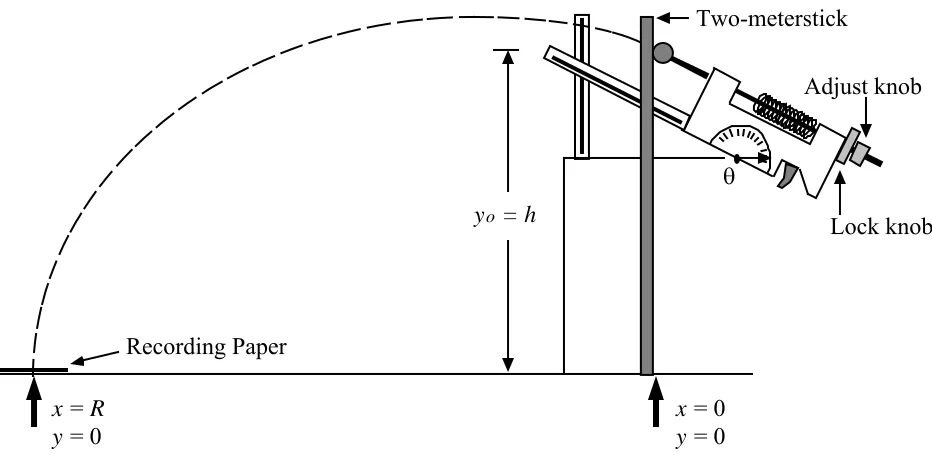
x = R y = 0
Recording Paper
x = 0 y = 0 yo = h
Adjust knob
Lock knob Two-meterstick
θ
Figure 1: The spring gun setup.
PROCEDURE
1. Level the gun using the level provided. Tighten the knurled brass screw. Now adjust the pointer so that it indicates 0°. Leave the gun in this position and be sure all screws and clamps are tight.
2. Use a plumb bob to locate the point on the floor directly under the point where the ball leaves the gun. Mark this point on a piece of paper or tape fastened to the floor. Measure the height h of the ball from the floor. (Should you measure to the center of the ball or the bottom of it?) Note that this height changes as the angle is varied.
3. Determine the approximate range of the ball by firing the gun a couple of times (place a backstop beyond the landing point to protect innocent passersby). In order to measure the position at which the ball strikes the floor, tape a sheet of paper to the floor such that the ball strikes the paper approximately in the center.
4. Fire at least ten shots; circle and number the impact positions on the sheet on the floor. If the positions are spread so much that they do not all hit the paper, check that everything is tight and that each time you use the same technique to project the ball.
5. Determine the range, R, by measuring the distance from the spot under the gun (x = 0 and y = 0) to the marks on the recording sheet. Use statistical methods to find the mean range and the standard deviation.
Before taking more data, vary the angle of launch and try to find the angle which gives the maximum range. You may want to try predicting it first. Make just a couple of shots at each angle. Are you surprised? If so, read question 6 below.
Repeat steps 2 through 5 for at least three more angles, between 10° and 50°. Be certain not to turn the spring adjusting knob during this procedure or you will change the initial velocity. Be sure to measure the new initial position (bothxo and yo) as the angle changes. 7. Dependence of Range on Initial Velocity vo (θ fixed).
a. Change the initial velocity of the ball by adjusting the knob on the back of the gun. Repeat Steps 2 through 5 with the gun in the horizontal position to obtain information for calculating vo. Then change the angle of launch to one of the angles used in Part 6 and again repeat steps 2 through 5.
b. Change the initial velocity again and repeat step 7a, using first θ = 0° and then the same non-zero angle θ for this initial velocity.
ANALYSIS & QUESTIONS
1. If we choose the point directly below the end of the gun as x = 0 and the floor level as y = 0, then xo = 0 and yo = h. Use this information and the mean range measured for the horizontal shots to calculate the initial velocity (using Eq. (7)) for each spring tension setting; vo is assumed to be the same independent of angle of projection. Is this a good assumption? 2. Using the rules for error propagation (see handout Errors and the Treatment of Data),
determine the standard deviation of vo from the measured standard deviation of Rmeas and the error in the measurement of h (see Eq. (7)). Show this calculation in your lab report. 3. Using the appropriate initial velocity, vo, determined in question 1, calculate the range,
R calc,for all non zero angles.
4. Compare and discuss your values for Rmeas and Rcalc as a function of angle and as a function of initial velocity. Are the differences Rmeas - Rcalc consistent with your calculated statistical and measurement errors? What factors or uncertainties associated with the apparatus contribute to the “spread” in the measured quantities? Can you estimate the uncertainty in the range resulting from any of these factors?
5. Based on your data (Step 6 of the procedure), for approximately what angle of projection was the range greatest? Explain qualitatively why this is so (see Question 6).
6. Show that for a launch from the floor (h = 0), Eq. (11) reduces to
the range equation in your text.
7. How might you directly measure the initial velocity of the ball? What additional apparatus would you need?
8. In the range equation, Eq. (11) of the Theory section, there is a ± sign. Which sign do you use? What, if any, is the significance of the other sign?
9. Ideally what mathematical curve is the trajectory?
DATA SHEET — PROJECTILE MOTION TA [ ]
✍
NAME: INSTRUCTOR:
PARTNER: SECTION: DATE:
Dependence of range on projection angle, for fixed initial velocity.
Horizontal: θ = 0° h = Rmeas = σ(Rmeas) = vo= σ(vo) =
# θ (deg) h (meters) Rmeas σ(Rmeas) Rcalc σ(Rcalc) Rmeas -Rcalc
1
2
3
4
Dependence of range on initial velocity at a fixed angle.
Recopy appropriate data from above for #1.
# θ h Rmeas σ(Rmeas) vo σ(vo) Rcalc σ(Rcalc) Rmeas -Rcalc
1 0° ••• ••• •••
1
2 0° ••• ••• •••
2
3 0° ••• ••• •••