Changes in the Status and Distribution of the Yellow-faced
Bumble Bee (
Bombus
vosnesenskii
) in British Columbia
D.F. FRASER
1, C.R. COPLEY
2, E. ELLE
3and R.A. CANNINGS
4ABSTRACT
Bombus vosnesenskii, the distinctively-patterned Yellow-faced Bumble Bee, has undergone a significant and rapid range extension in British Columbia. Known initially from a single record of a few specimens at Osoyoos in 1951, it was put forward in 1996 as a species that warranted a threatened or endangered status because of its severely restricted range in the province. However, since 2000, the species has expanded north in the Okanagan Valley, west to the Similkameen Valley and, especially, has become firmly established in south coastal regions of the province, including Vancouver Island. Population increases in B. vosnesenskii to the south of BC have also been reported. The reasons for the rapid expansion of B. vosnesenskii in BC are unclear. Particularly in lowland southwestern BC, the range expansion might have been enhanced through escapes from colonies kept as pollinators of agricultural crops. The spread of B. vosnesenskii has coincided with the decline of B. occidentalis, so the former may have been introduced or naturally expanded its range at the same time as a niche was becoming vacant. Recent changes in agricultural practices, such as the increase of cranberry crops, may also be a factor, as might climate warming. Clarification of the reasons for the rapid population increases and range expansion of B. vosnesenskii is needed but, in the meantime, it should no longer be considered a candidate for species-at-risk listing.
Key Words: Hymenoptera; Apidae; Bombus; Bombus vosnesenskii; range expansion; British Columbia
INTRODUCTION
Trends in pollinator populations are most frequently reported as declines, and the range of causes include habitat loss, disease, pesticides, climate change and competition with invasive species (Goulson et al. 2008, Potts et al. 2010, Cameron et al. 2011). At a time when several species of North American bumble bees are becoming increasingly endangered (e.g., Bombus occidentalis
Greene), others are exhibiting the opposite trend (Cameron et al. 2011, Colla and Ratti 2010).
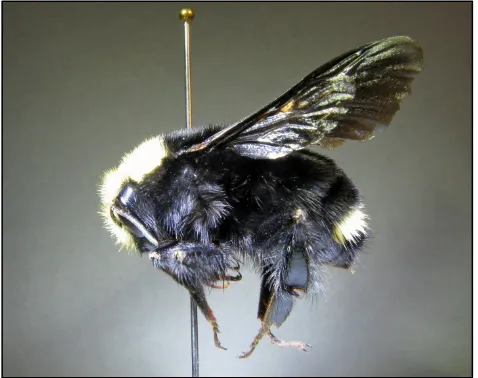
Bombus vosnesenskii Radoszkowski, the distinctively-patterned Yellow-faced Bumble Bee, has undergone a significant and rapid range expansion in British Columbia (BC). This species can be readily recognized by its bold coloration: setae on the face, front of the
thorax and a band on the fourth abdominal tergum are bright yellow; the remainder of the bee is covered by black setae (including all sternal segments) and the wings are dark brown (Fig. 1). In the Pacific Northwest, there are two similar-looking species, Bombus caliginosus (Frison) and Bombus vandykei
(Frison). Bombus caliginosus has been reported only as far north as the Olympic Peninsula and Okanogan Valley in Washington State (Krombein et al. 1979) and we are aware of only a single photographic record of a male
B. vandykei from BC (E-Fauna 2012). Bombus vosnesenskii is so readily recognizable, it is unlikely that any significant populations were previously overlooked in BC, and, instead, the dramatic increase in observations and collections documented in this paper represent
1BC Ministry of Environment, 2975 Jutland Avenue, Victoria, BC, V8W 9M9. [email protected]. (250)
387-9756.
2Royal British Columbia Museum, 675 Belleville Street, Victoria, BC, V8W 9W2. [email protected].
(250) 952-0696.
3Simon Fraser University, 8888 University Drive, Burnaby BC. V5A 1S6. [email protected]. (778) 782-4592.
4R o y a l B r i t i s h C o l u m b i a M u s e u m , 6 7 5 B e l l e v i l l e S t r e e t , Vi c t o r i a , B C , V 8 W 9 W 2 .
a real change in the species’ range and abundance in the province.
Bombus vosnesenskii ranges from southern BC south through Washington, Oregon, western Nevada and California to northern Baja California in Mexico (Thorp et al. 1983). Stephen (1957) noted that the bee was abundant in the coastal valleys and mountains of California and Oregon, but uncommon along the coast of southwestern Washington, Oregon and northern California. There it was mostly replaced by B. caliginosus. Around San Francisco Bay and Puget Sound, however,
B. vosnesenskii was the more common of the two. Also, at that time, the bee was scarce north of the Columbia River and east of the Cascade Range and there were no records from eastern Washington or Idaho (Stephen
1957). For many years in BC, B. vosnesenskii
was known from a single record of a few specimens collected at Osoyoos in 1925 (Buckell 1951) and, in 1994 and 1996 Scudder suggested that the severely restricted BC range warranted a threatened or endangered status for the species. At that time, he was unaware of the first known coastal BC specimen, a surprisingly early 1970 record from Burnaby in the Simon Fraser University collection. However, since 2000, the species has expanded north in the Okanagan Valley, west to the Similkameen Valley and, especially, has become firmly established in south coastal regions of the province. In many of these newly occupied areas, it is now among the most commonly noted bumble bee species.
MATERIALS AND METHODS
Data were collected from adult specimens of Bombus vosnesenskii from the collections of the Royal British Columbia Museum, Victoria, BC (RBCM); Department of Biological Sciences, Simon Fraser University, Burnaby, BC (SFU); Beaty Biodiversity Museum, University of BC, Vancouver, BC (UBC); and the Packer Collection, Biology Department, York University, Toronto, ON (PCYU). Photographic records were compiled from postings on the web sites indicated. In most cases, specimens were identified by the
collectors and vetted by experts. Specimens with an asterisk were identified by the authors.
CANADA: BRITISH COLUMBIA: Abbotsford, blueberry farm, 49.130992N 122.260036W, 4.vi.2011, L. Button (1♀, SFU 741525), 49.718425"N 122.388556W, 12.vi. 2011, L. Button (1♀, SFU 741644), 49.126239N 122.418817W, 12.vi.2011, L. Button (1♀, SFU 741742); Burnaby, 1.viii. 1970, J. Hicks (1♂, SFU), 10.x.2007, S. Lam (1♂, SFU), 10.ix.2009, B. Rajala (1♂, SFU); 15.x.2009 K. Lee (1♂, SFU); Cawston, Forbidden Fruit Winery, 14.vii.2010, D.
Marks (1♀, RBCM); Duncan, Mount Tzuhalem Ecological Reserve, 48.78617N 123.63399W, 7.v.2010, E. Elle, L. McKinnon (3♀, SFU 726540, 727653, 727660), Quamichan Lake, Cowichan Garry Oak Reserve, 48.808556N 123.631250W, 14.v. 2009, E. Elle (1♀, SFU 719624), 3.v.2010, G. Gielens (1♀, SFU 726491); Fraser Valley Regional District, Onnink property, 49.07833N 122.38778W, 6.v.2004, C. Ratti (1♀, PCYU), Randhawa property, 49.12806N 122.41806W, 22.v.2003, C. Ratti (1♀, PCYU), 28.v.2003, C. Ratti (1♀, PCYU); Greater Vancouver Regional District, Banns property, 49.22361N 122.75333W, 19.vi.2003, C. Ratti (1♀, PCYU), 1.vii.2003, C. Ratti (1♀, PCYU), 5.vii.2003, C. Ratti (2♀,PCYU), 17.vi.2004, C. Ratti (1♀, PCYU), Bissett property, 49.08833N 123.16388W, 16.iv.2004, C. Ratti (1♀, PCYU), Edwards property, 49.14778N 123.06528W, 26.vi.2003, C. Ratti (1♀, PCYU), 4.vii.2003, C. Ratti (1♀, PCYU), 8.vii.2003, C. Ratti (1♀, PCYU), 12.vii.2003, C. Ratti (5♀, PCYU), Fisher property, 49.14472N 123.07333W, 17.iv.2003, C. Ratti (1♀, PCYU), 4.vi.2003, C. Ratti (1♀, PCYU), .iv.2004, C. Ratti (1♀, PCYU), 9.iv. 2004, C. Ratti (2♀, PCYU), 21.v.2004, C. Ratti (2♀, PCYU); Hopcott property, 49.24972N, 122.71722, 5.vii.2003, C. Ratti, (1♀, PCYU), Mayberry property, 49.19250N, 123.04556, 26.vi.2003, C. Ratti (2♀, PCYU), 26.vi.2003, C. Ratti (1♀, PCYU), 4.vii.2003, C. Ratti (1♀, PCYU), 12.vi.2004, C. Ratti (1♀, PCYU), 17.vi.2004, C. Ratti (6♀, PCYU), 22.vi.2004, C. Ratti (2♀, PCYU), McKim property,49.08139N 123.12056, 30.iv. 2003, C. Ratti (2♀, PCYU), 23.iv.2004, C. Ratti (1♀, PCYU), 14.v.2004, C. Ratti (2♀, PCYU); Surrey farms property, 49.09833N 122.79194W, 8.v.2003, C. Ratti (1♀, PCYU), 11.v.2003, C. Ratti (1♀, PCYU), 1.vi.2003, C. Ratti (1♀, PCYU), Tilson property, 49.15611N 122.43389W, 24.vi.2004, C. Ratti (1♀, PCYU); Lake Cowichan, 15 km E, Stoltz Meadows, 48.781667N 123.885250W, 17.v. 2009, L. McKinnon (1♀, SFU 717264), Mesachie Lake, Cowichan Lake Forestry Station, 48.81885N 124.1381885W, 23.vi. 2009, E. Elle (1♀, SFU 719077); Okanagan Falls, Blasted Church Vineyards, 3.vi.2010, D. Marks (1♀, RBCM), Blue Mountain Vineyards, 23.vi.2010, D. Marks (1♀, RBCM); Osoyoos, 20.vii.1925, E.R. Buckell
48.466917N 123.466278W, 29.vi.2005, E. Elle (1♂, RBCM 012-000784).
Identifiable photographs of B. vosnesenskii
from BC are also available. On the E-Fauna BC (2012) website, photos are posted from Crescent Beach, Nanaimo, Port Alberni,
Richmond, Saanichton, and Vancouver. The Crescent Beach photo (#10577), from 14 July 2007, is the earliest taken. Flickr (2012) has identifiable photos from Vancouver but the BugGuide website (2012) has no BC photographs.
RESULTS AND DISCUSSION
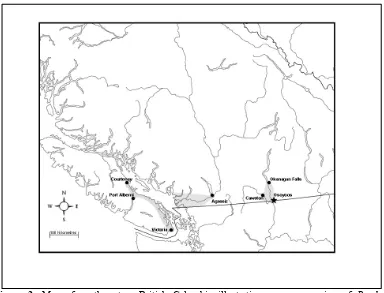
The present known range of Bombus vosnesenskii in BC is shown in Fig. 2. Winston and Graf (1982) and MacKenzie and Winston (1984) reported on bee diversity in surveys of both commercial berry crops and native vegetation in the Fraser Valley in 1981 and 1982, but did not record B. vosnesenskii. However, of 2248 bumblebees collected, 25 were identified as “other” in MacKenzie and Winston, and could potentially have included
B. vosnesenskii. The earliest record for the southwest coast of BC is from Burnaby in 1970; no others are known until 2000. Since then, the bee has been recorded frequently throughout the Lower Mainland. In
2000-2001, Tommasi et al. (2004) reported 38 individuals in urban surveys throughout Greater Vancouver. This compared to 801 B. flavifrons Cresson, 547 B. mixtus Cresson, 194
B. melanopygus Nylander, 16 of unknown species and 2 B. occidentalis, making B. vosnesenskii one of the less common species of the region. Ratti et al. (2008), in a crop pollination study in the Fraser Valley in 2003-04, found the species at 10 of 11 blueberry and cranberry fields surveyed. It was at the time still one of the less common
Bombus species, comprising 39 of the 3,683 specimens collected. The bee was observed at all 15 sites surveyed at farms in the Fraser
Valley between 17 July and 21 September 2009 (Bains et al. 2009) and, by 2010, when they documented the bee in 25 of 64 sites surveyed from Delta east to Agassiz, Parkinson and Heron (2010) could state that it was one of the most common late season
Bombus species in Greater Vancouver and the Fraser Valley.
Also in 2010, similar pollinator surveys in the South Okanagan and Similkameen valleys recorded B. vosnesenskii at three farms from Okanagan Falls south to Cawston (Marks and Heron 2010), the first records in the Interior since Buckell’s initial collections in 1925. However, population expansion in the Okanagan has been much less obvious than on the South Coast. Other surveys in 2010 in the grasslands of the South Okanagan, in which about 10,000 pollinating insects were collected, recorded no B. vosnesenskii
specimens (Elwell 2012). In 2012 we asked a number of biologists and naturalists throughout the Okanagan to watch for the distinctive species, but none were seen.
On Vancouver Island the Yellow-faced Bumble Bee is well established and expanding its range. In 1951 Buckell intimated that B. vosnesenskii could occur in Victoria; nevertheless, the first specimen record on the Island is from near Prospect Lake, Saanich, on 25 May 2005. Another specimen was collected the same year on 29 June at Thetis Lake Regional Park, during the third author’s pollination research there. That year, she and her students pan-trapped at eight sites from Victoria to Campbell River and caught no other individuals. In 2007 they sampled with nets and pans at 19 sites on the Saanich Peninsula and collected seven specimens, out of 884 Bombus collected (less than 1%). In a net-only survey in the same area in 2012, 301 out of 2139 Bombus collected (14%) were B. vosnesenskii. In the Cowichan Valley in 2009, three were captured at three sites; in 2010 in the same region, four were collected at two localities. By 2009 the species was found as far north on the Island as Port Alberni (E-Fauna BC: photo #12718) and in 2012 it was photographed in Courtenay (T. Thormin, pers. comm.). Bombus vosnesenskii is now among the most common bumble bee species on the south coast of BC, especially in urban and farmland habitats.
Population increases in B. vosnesenskii to the south of BC have also been reported. In Oregon, Thorp (2008) conducted surveys for
Bombus franklini (Frison) from 1998 to 2007 and noted that more than 50% of all Bombus
reported in 2006 and 2007 were B. vosnesenskii, up from approximately 30% in 1998. Cameron et al. (2011) noted that B. vosnesenskii populations are stable in the western United States relative to historic data, at a time when several other Bombus species are declining.
The reasons for the rapid expansion of B. vosnesenskii in BC are unclear. One p o s s i b i l i t y, p a r t i c u l a r l y i n l o w l a n d southwestern BC, is that the bee could have been assisted in its range expansion through escapes from colonies kept as pollinators of agricultural crops. In 1991, B. vosnesenskii
was tested as a greenhouse pollinator of tomatoes in Surrey south of Vancouver, although it was not intentionally released during that study (Dogterom et al. 1998). In adjacent Washington State, colonies are currently commercially available for crop pollination of raspberries, blueberries, cranberries, strawberries, peaches, plums, cherries and cabbage (Mike Juhl, pers. comm., http://www.hornetnestsfreeremoval.com/ 29601.html). Bumble bee escapes from greenhouses are well documented elsewhere, have contributed to the out-of-range introductions of other Bombus species, and have been implicated in the introduction of bumble bee diseases (Velthuis and van Doorn 2006, Colla et al. 2006). Greenhouse escapes likely resulted in the introduction of B. vosnesenskii to Australia (Planck 1999).
In BC the spread of B. vosnesenskii has coincided with the decline of B. occidentalis
(Colla and Ratti 2010), so the former may have been introduced or naturally expanded its range at the same time as a niche was becoming vacant. As a study by Allen et al. (1978) showed, B. vosnesenskii has large colonies (including, in one, an estimate of the production of 650 queens), implying that it has an impressive capacity for colonization. Cameron et al. (2011) reported that B. vosnesenskii has a greater genetic diversity and a lower prevalence of the fungal pathogen
population patterns. It is unknown, however, whether these observations indicate cause and effect, or if they apply to BC.
Recent changes in agricultural practices may also be a factor. Declines in some species of bumble bees have been attributed to the intensification of agriculture (Goulson et al. 2008), and even B. vosnesenskii populations have been shown to be closely linked to the proximity of natural habitat (Greenleaf and Kremen 2006). But B. vosnesenskii is frequently reported pollinating cultivated cranberries in Oregon, and in BC this industry has undergone considerable expansion in recent years. There are currently 1150 hectares under cranberry production, particularly in the Fraser Valley, as well as a few operations on Vancouver Island (Ministry of Agriculture 2012).
Modest population expansion in the South Okanagan-Simikameen, where we can find no reports of pollinator introductions, suggests that a natural cause is at work there. A number of species across a wide variety of taxa show changes in their distributions due to the effects of climate warming (Parmesan 2006, David and Handa 2010, Feeley 2012, Moreno-Rueda
et al. 2012). Their life histories make insects especially good at adapting quickly to changes in the environment (Robinet and Roques 2010), so the spread of B. vosnesenskii may be facilitated by anthropogenic climate change.
Clarification of the reasons for the rapid population increases and range expansion of
B. vosnesenskii is needed but, in the meantime, it should no longer be considered a candidate for species-at-risk listing.
ACKNOWLEDGEMENTS
Dr. Andrew Bennett (Canadian National Collection of Insects, Arachnids and Nematodes, Agriculture and Agri-Food Canada, Ottawa, ON), Sheila Colla (Department of Biology, York University, Toronto, ON), Steve Halford (Department of Biological Sciences, Simon Fraser University, Burnaby, BC), Karen Needham (Beaty Biodiversity Museum, University of BC, Vancouver, BC), Meghan Noseworthy (Pacific Forestry Centre, Canadian Forest Service, Victoria, BC), Dr. Cory Sheffield (Royal Saskatchewan Museum, Regina, SK)
examined specimens and provided data on material in their care. Jennifer Heron (BC Ministry of Environment, Vancouver, BC) supplied information and reports on BC Ministry of Environment surveys. Orville Dyer (BC Ministry of Forests, Lands and Natural Resource Operations, Penticton, BC) and other biologists and naturalists in the Okanagan watched for Bombus vosnesenskii
in the spring and summer of 2012. The comments of two reviewers improved the paper.
REFERENCES
Allen, T., S. Cameron, R. McGinley and B. Heinrich. 1978. The role of workers and new queens in the ergonomics of a bumblebee colony. Journal of the Kansas Entomological Society 51: 329-342.
Bains, B., A. Caldicott, and J. Heron. 2009. Western Bumblebee (Bombus occidentalis) and other pollinator surveys within the lower Fraser Valley, B.C. Unpublished draft report, Ministry of Environment, Vancouver, BC. 39 pp. Buckell, E.R. 1951. Records of Bees from British Columbia: Bombidae. Proceedings of the Entomological Society
of British Columbia 47: 7-23.
BugGuide. 2012. http://bugguide.net/index.php?q=search&keys=Bombus+vosnesenskii&search=Search. (accessed August 2012).
Cameron, S.A., J.D. Lozier, J.P. Strange, J.B. Koch, N. Cordes, L.F. Solter and T.L. Griswold. 2011. Patterns of widespread decline in North American bumble bees. Proceedings of the National Academy of Sciences 108: 662-667.
Colla, S.R. and C.M. Ratti..2010. Evidence for the decline of the Western Bumble Bee (Bombus occidentalis
Greene) in British Columbia. Pan-Pacific Entomologist 86(2): 32-34.
Colla, S.R., M.C. Otterstatter, R.J. Gegear, and J.D. Thomson. 2006. Plight of the bumble bee: pathogen spillover from commercial to wild populations. Biological Conservation 129: 461-467.
Dogterom, M.H., J.A. Matteoni and R.C. Plowright. 1998. Pollination of greenhouse tomatoes by western North American Bombus vosnesenskii (Hymenoptera: Apidae). Journal of Economic Entomology 91: 71-75.
E-Fauna BC. 2012. Klinkenberg, Brian. (Editor). 2012. E-Fauna BC: Electronic Atlas of the Fauna of British Columbia. Lab for Advanced Spatial Analysis, Department of Geography, University of British Columbia, Vancouver. www.efauna.bc.ca (accessed August 2012).
Elwell, S. 2012. The effects of livestock grazing and habitat type on plant-pollinator communities of British Columbia’s endangered shrubsteppe. MSc Thesis, Simon Fraser University, Burnaby BC.
Feeley, K.J. 2012. Distributional migrations, expansions, and contractions of tropical plant species as revealed in dated herbarium records. Global Change Biology. 18(4): 1335-1341.
Flickr. 2012. http://www.flickr.com/search/?q=Bombus+vosnesenskii&m=text (accessed August 2012).
Goulson, D., G.C. Lye, and B. Darvill. 2008. Decline and conservation of bumble bees Annual Review of Entomology. 53:191-208.
Greenleaf, S.S. and C. Kremen. 2006. Wild bee species increase tomato production and respond differently to surrounding land use in Northern California Biological Conservation. Volume: 133(1): 81-87
Krombein, K.V., P.D. Hurd, Jr, D.R. Smith and B.D. Burks. 1979. Catalog of Hymenoptera in America North of Mexico. Volume 2: Apocrita (Aculeata). Smithsonian Institution Press. 2209 pp.
MacKenzie, K.E. and M.L. Winston. 1984. Diversity and abundance of native bee pollinators on berry crops and natural vegetation in the Lower Fraser Valley, British Columbia. The Canadian Entomologist. 116: 965–974. Marks, D. and J. Heron. 2010. Surveys for Western Bumble Bee (Bombus occidentalis) and other arthropod species
at risk on private and municipal lands in the south Okanagan –Similkameen, British Columbia, 2010. BC Ministry of Environment, Vancouver BC. 204 pp.
Ministry of Agriculture 2012. http://www.agf.gov.bc.ca/aboutind/products/plant/cranberry.htm (accessed August 2012).
Moreno-Rueda, G., J.M. Pleguezuelos, M. A. Pizarro and A. Montori. 2012. Northward shifts of the distributions of Spanish reptiles in association with climate change. Conservation Biology. 26 (2): 278-283.
Parkinson, L and J. Heron. 2010. Surveys for Western Bumble Bee (Bombus occidentalis) and other pollinators on private and municipal lands in southwestern British Columbia. BC Ministry of Environment, Vancouver BC. 372 pp.
Parmesan, C. 2006. Ecological and evolutionary responses to recent climate change. Annual Review of Ecology, Evolution and Systematics. 37: 637–69.
Planck, J. 1999. Bumble Bee, Bombus vosnesenskii, a new species in Australia. Agdex 300/620.
Potts, S.G., J.C. Biesmeijer, C. Kremen, P. Neumann, O. Schweiger, W.E. Kunin. 2010. Global pollinator declines: trends, impacts and drivers Trends in Ecology and Evolution. 25 (6):345-353.
Ratti, C.M., H.A. Higo, T.L. Griswold and M.L. Winston. 2008. Bumble bees influence berry size in commercial
Vaccinium spp. cultivation in British Columbia. The Canadian Entomologist. 140: 348-363.
Robinet, C. and A. Roques. 2010. Direct impacts of recent climate warming on insect populations. Integrative Zoology. 5(2): 132-142.
Scudder, G.G.E. 1994. An annotated systematic list of the potentially rare and endangered freshwater and terrestrial invertebrates in British Columbia. Entomological Society of British Columbia. Occasional paper 2:92 pp. Scudder, G.G.E. 1996. Terrestrial and freshwater invertebrates of British Columbia: priorities for inventory and
descriptive research. Research Branch, BC Ministry of Forests, and BC Ministry of Environment, Lands and Parks. Victoria, BC. Working Paper 9. 206 pp.
Stephen, W.P. 1957. Bumble Bees of Western North America (Hymenoptera: Apoidea). Agricultural Station, Oregon State College Technical Bulletin 40: 1-163.
Thorp, R.W. 2008. Franklin’s Bumble Bee Bombus (Bombus) franklini (Frison) (Hymenoptera: Apidae): Report on 2006-2007 Seasons. Unpublished report.
Thorp, R.W., D.S. Horning, Jr. and L.L. Dunning. 1983. Bumble Bees and Cuckoo Bees of California (Hymenoptera: Apidae). Bulletin of the California Insect Survey 23: 1-79. http://essig.berkeley.edu/documents/ cis/cis23.pdf. (accessed June 2012).
Tommasi, D., H.A. Higo and M.L. Winston. 2004. Bee diversity and abundance in an urban setting. The Canadian Entomologist 136: 851-869.
Velthuis, H.H.W. and A. van Doorn. 2006. A century of advances in bumblebee domestication and the economic and environmental aspects of its commercialization for pollination. Apidologie 37: 421-451.