Does Basic Work Needs Satisfaction Mediate between Psychological Empowerment and
Career Commitment of Teachers?
Dr. Sesan O. Mabekoje
1*Dr. R. Olugbenga Azeez
1Dr. Olusola O. Okunuga
2Dr. Abel O. Bamgbose
31Faculty of Education, Olabisi Onabanjo University, Ago Iwoye, Nigeria 2Faculty of Social and Management Sciences, Olabisi Onabanjo University, Ago Iwoye, Nigeria 3Ogun State Television, Abeokuta, Nigeria
*Correspondance Author Email : [email protected]; [email protected]
Doi:10.5901/ajis.2016.v5n3p187
Abstract
This study investigated the mediating effects of the satisfaction of basic work psychological needs (autonomy, competence, and relatedness) on the relationship between psychological empowerment and career commitment among teachers. Two hundred and twelve (212) teachers randomly sampled from 24 secondary schools in Ijebu North Local Government Area of Ogun State, Nigeria participated in the study. Data were collected using three validated instruments and analysed using the parallel mediation process of the multiple mediation macros (Hayes, 2013) on SPSS 21.0 with bootstrapping set at 1,000. Findings revealed that psychological empowerment had significant total (c = .183; p < .05) and direct (c’ = .092; p < .01) effects on teachers’ career commitment. Keeping other mediators constant, there were significant indirect effects of autonomy (Coeff = .161; p < .05) and competence (Coeff = .445; p < .001) but no significant indirect effect of relatedness (Coeff = .019; p > .05) on the relationship between psychological empowerment and teachers’ career commitment. Psychological empowerment therefore has significant total and direct effects on career commitment. It also has significant indirect effect on career commitment through the mediating roles of autonomy and competence but not through relatedness. Implications of the study along with suggestions for practice and research were highlighted.
Keywords: Basic Work Psychological Needs Satisfaction; Career Commitment; Mediating Effects; Psychological Empowerment
1. Introduction
Entrance into the teaching profession over the years in Nigeria has been mostly by chance and not by choice. This is observable when candidates for admission into University programmes failed to meet the cut-off point for their preferred courses and were asked to go for education as an option. It is expected therefore that career commitment of teachers would be a mixture of the positive and the negative. Also, when government fails to provide the necessary enabling environment for appropriate, adequate and meaning teaching and learning, it is expected that career commitment would be lowered. Again, in the event that salaries and emoluments are not paid, teachers may tend to find other means of survival rather than being committed to their career.
noted and studied. However, career commitment has not been given much attention as organisational commitment has enjoyed.
Career commitment has been defined in several ways. Meyer, Allen, and Smith (1993) thought career commitment to be people's motivation to work towards personal advancement in their profession. However, Colarelli and Bishop (1990) expressed career commitment in terms of the development of personal career goals, the attachment to, identification with, and involvement in those goals. They noted that career commitment entail self-generated goals and devotion to one’s own career. To Goulet and Singh (2002), career commitment is the extent to which employees identify with and values their profession or vocation and the amount of time and effort spent acquiring relevant knowledge. Drawing from the works of Blau (1985), Greenhaus (1971), Hall (1971) and London (1983), Carson and Bedeian (1994) suggest an alternative multidimensional idea of career commitment which comprise of three dimensions: career identity, career planning and career resilience. Career identity involves the establishing a close emotional association with one’s career, while career planning determines one’s developmental needs and setting career goals, and career resilience deals with resisting career disruption in the face of adversity (Lydon & Zanna, 1990).
Employees with high career commitment therefore are expected to show such characteristics that would enhance career success (Kidd & Green, 2006), subjective career success as in career satisfaction, and objective career success as in salary level (Poon, 2004; career satisfaction through self-efficacy (Ballout, 2009) as well as learning motivation and learning transfer (Cheng & Ho, 2011). Literature has established relationships between career commitment and such variables like students’ professional identity (Orkibi, 2010), self-efficacy (Niu, 2010), calling (Duffy, Dik, & Steger, 2011), satisfaction with nature of work and contingency rewards (Schudrich et al., 2012), career satisfaction (Day & Allen, 2004; Goulet & Singh, 2002), career success (Jones & Withmore, 1995; Poon, 2004), job involvement (Blau, 1989). Lee, Carswell, and Allen (2000) contend that the higher the job satisfaction of an employee, the higher the tendency for career commitment. Also, when the level of organisational commitment is high, there is the tendency for career commitment to be high (Cohen, 1996; Lee, Carswell, & Allen, 2000; Morrow & McElroy, 1986).
Specifically, career commitment has been shown to be influenced by intern anxiety and internships outcomes (Wang et al., 2014), career satisfaction (Fu, 2011; Fu & Chen, 2015), professional self-efficacy, threat of professional obsolescence and career investment (Fu, 2011), employees’ clear perception of their role (Kalkavan & Katrinli, 2014), and career satisfaction (Aryee & Debah, 1993; Myrtle, Chen, Lui, & Fahey, 2011). In all, research on career commitment of teachers has not been relegated. Several studies (Adeyemo & Aremu, 1999; Adio & Popoola, 2010; Arogundade, Arogundade, & Oladapo, 2014; Smith, Conley, & You, 2015; Tamir & deKramer, 2011; You & Conley, 2015) have been conducted on career commitment on teachers. This emphasizes the importance of the concept to the entire school organisation in general and teachers in particular.
As far back as 1988, the practice of empowering subordinate is a principal component of managerial and organisational effectiveness (Conger & Kanungo, 1988). Much has been written on empowerment in different levels vis-à-vis individual/psychological; sociological, and management/organisational. More broadly, however, empowerment explains the ability of management to create a working environment that shapes an individual’s perception of his/her work role in a way that motivates work behaviour (Conger & Kanungo, 1988). This includes (i) worker’s perception of the meaning of their job on them; (ii) their sense of competence in the job; (iii) how much self-determination they believe they have in the job; and (iv) low much impart they believe they have in their job (Thomas & Velthouse, 1990).
The focus of this study however, is psychological empowerment that is designed to produce a psychological state within which teachers feel more in charge of their own work (Wan, 2005). Psychological empowerment has been described in several studies as individual subjective feelings of competence, responsibility and greater control over one’s life (Bracht, 1999; Rissel, 1994; Wallerstein, 1992; Zimmerman & Rappaport, 1988). To be psychologically empowered therefore means that the individual moves towards autonomy, and is explained as being able to decide personal plans (Tengland, 2007). Psychological empowerment is a motivational construct. This is built around teachers’ individual subjective experience of being empowered. Spreitzer (1995) defines employees empowerment as intrinsic task motivation manifested in a set of four cognitions (meaning, competence, self determination and impact) reflecting an individual’s orientation to his or her work role. Whereas meaning is the worth of work goals or purposes judged by an individual’s insight relative to his or her own personal assignment or expectations, self-determination is an individual’s sense of having choice in instigating and regulating actions. Competence refers to self-efficacy specific to work; that is, the individual’s capacity to carry out work activities with necessary skills and knowledge. Impact on the other hand is the extent to which a person can manipulate strategic, administrative or operating outcomes at work.
Sparrowe, 2000; Niehoff, Enz, & Grover, 1990), organisational commitment (Eisenberg, Fasolo, & Daris-La Mantro, 1990; Kanter, 1983; Kraimer, Seibert, & Liden, 1999; Liden et al., 2000), and job performance (Ashforth, 1989; Lawler, 1992; Liden et al., 2000). Psychological empowerment also predicts job satisfaction and productivity (Patah et al., 2009; Spreitzer, 1995) and commitment (Malik, Chugtai, Iqbal, & Ramzan, 2013). Teacher empowerment is a vital dimension of the school’s organization. This has been defined as empowering teachers to participate in group decisions and to have real decision making roles in the school community (Leiberman, 1989).
Teachers’ empowerment has been severally studied (Bogler & Somech, 2004; Ghaemi & Sabokrouh, 2014; Kimwarey, Chirure, & Omondi, 2014; Lie & Nie, 2014). In fact teacher’s empowerment has been found to be related to organisational citizenship behaviour (Aksel, Serinkan, Kiziloglu, & Aksoy, 2013; Cheasakul & Varma, 2016), organisational commitment (Hamid, Nordin, Adnan, & Sirun, 2013) and teacher self-efficacy (Veisi, Azizifar, Gowhary, & Jamalinesari, 2015). Several studies have indicated positive relationships between psychological empowerment and commitment. However, more of the researches have been on organisational commitment (Ambad & Bahron, 2012; Choong, Wong, & Lau, 2011; Khanna & Gupta, 2016; Malik et al., 2013) than career commitment specifically.
In most educational reforms, the role of teachers has been found to be played down (Wan, 2005). For teachers to be truly empowered, they need a supporting environment in which they are cared for, not isolated, and are given opportunities to participate regularly in decision making that affects them as teachers (Peters & Austin, 1985). When teachers participate in decision making, commitment, willingness, and dedication to work become very strong.
Central to the Self-Determination Theory (SDT) is the concept of basic psychological needs that are assumed to the innate and universal. According to the theory, the needs must be uninterruptedly satisfied for individuals to develop and function in healthy or optimal ways (Deci & Ryan, 2000). Within the SDT, basic psychological needs are defined as the nutrients needed by humans to fulfil their potentials and maintain their growth, integrity and health (Van de Broeck, Vansteenkiste, DeWitte, & Lens, 2008). Basic psychological needs are determined as: autonomy, relatedness, and competence. These are intrinsic psychological needs. The need for autonomy refers to one’s willpower, and desire to act freely in accordance with one’s own interests and values. The need for relatedness implies one’s need to interact, connect to and care for other people. The need for competence is one’s having a sense of effectiveness while doing something (Deci & Vansteenkiste, 2004). In all, autonomy, belongingness and competence lead to positive feelings especially when we accomplish, produce or succeed at something, experience a close relationship with another person, and become autonomous and self-regulating (Sheldon & Schüler, 2011). The satisfaction of basic needs have been observed to engender work engagement (Silman, 2004), employee wellbeing (Lynch, Plant, & Ryan, 2005), job satisfaction (Ilardi, Leone, Kasser, & Ryan, 1993) and job performance (Baard, Deci, & Ryan, 2004). Specifically, satisfaction of basic needs have been employed within the work setting.
Mediation analysis is a statistical method employed in the explanation of the phenomena wherein some antecedent independent variables transmit their effects on the consequent dependent variable through an intervening mediating variable. The model can be simple (with one mediator) or multiple with more than one mediator. Even in multiple mediation, is it parallel or serial (Hayes, 2013). Literature exists in the investigation of multiple mediation models, especially of the parallel nature. For example, models involving two mediators (Calogero & Jot, 2011; Lee et al., 2007), three mediators (Duffy, Allen, & Dik, 2011; Reid & Palomores, 2009), four mediators (Buffardi & Campbell, 2008; Lecheler, de Vreese, & Slouthuus, 2011) as well as five mediators (Brandt & Reyna, 2010; Zadeh, Farnia, & Ungerleider, 2010) have been investigated. In some cases, six mediators (Barnhofer & Chittka, 2010; Gonzales, Reynolds, & Skewes, 2011) and even seven mediators (Anagnostopoulos, Slater, & Fitzsimmons, 2010; Hsu et al., 2012) have been examined. Studies have established the mediating role of work basic psychological needs satisfaction between the transformational behaviours of a coach and athlete training behaviours (Smith et al., 2012). Also, basic needs satisfaction mediates the effect of social context on outcomes such as well-being and performance (Ryan & Deci, 2000). The satisfaction of the three basic psychological needs mediates the relationship between job autonomy, manager support for autonomy and job heuristic with the autonomous motivation types (Hewett, 2000). Specifically, autonomy has been found to mediate between context and intrinsic and integrated motivation (Reeve & Deci, 1996). Also, competence has been observed to mediate in the relationship between context and identified motivation (Reeve & Deci, 1996).
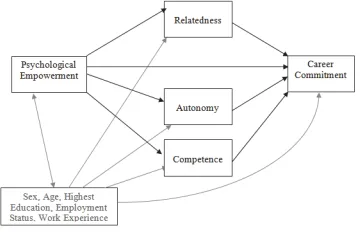
as basic work psychological needs would mediate the relationship between psychological empowerment and career commitment of teachers.
Figure 1: Conceptual model for the study
2. Method
2.1 Design
A survey research design was adopted for this study. The dependent variable of the study was career commitment; the independent variable was psychological empowerment while the mediating variables are the work psychological needs satisfaction dimensions of autonomy, competence and relatedness.
2.2 Participants
Two hundred and twelve teachers were sampled from 24 out of the existing 36 secondary (Junior and Senior) schools in Ijebu North Local Government Area of Ogun State. The teachers were selected through a stratified random sampling process. The local government area was divided into the two political zones with 12 schools selected randomly from each zone. From each of the schools, teachers who gave expressed verbal consent to participate in the study were surveyed. A total of 240 questionnaire protocols were distributed out of which 212 returned and usable protocols were used for analysis. A return rate of 88.33% was recorded. The study sample consisted of 58 (27.4%) male and 154 (72.6%) female teachers within the age bracket of below 35 to above 55 years.
2.3 Measures
2.3.1 Psychological Empowerment Instrument.
Psychological empowermentwas accessed using the Psychological Empowerment Instrument designed by Spreitzer (1985) to measure psychological empowerment based on Thomas and Velthouse’s (1990) four-dimensional definition to meaning, competence, self-determination, and impact. This is a 12-item self-report scale (three items per sub scale) anchored on a 7-point Likert Scale ranging from very strongly disagree = 1 to very strongly agree = 7.
Sample items include for meaning “The work I do is meaningful”; for competence “I have mastered the skills necessary to do my job”; for self-determination “I can decide on my own how to go about doing my work”; and for impact “I have a great deal of control over what happens in my department”. Criterion-related validity reveals that subscale scores were significantly but moderately related to career intentions and organizational commitment. Internal consistency ranges from .62 to .74 for the total scale and from .79 to .85 for the subscales. Higher score indicates higher perception of empowerment.
2.3.2 Career Commitment Measure.
the problems I encounter in this line of work/career field, I sometimes wonder if I get enough out of it); for career identity (4 items e.g. This line of work/career has a great deal of personal meaning to me); and for career planning (3 items e.g. I do not have a strategy for achieving my goals in this line of work/career field). The scale is measured along a 5-point Likert scale ranging from 1 = strongly disagree to 5 = strongly agree. Reliability coefficients for the three factors ranged from 0.79 to 0.85 (Carson & Bedeian, 1994).
2.3.3 Basic Needs Satisfaction at Work Scale.
Basic work needs satisfaction was assessed using the Basic Needs Satisfaction at Work Scale; a 21-item questionnaire developed by Deci et al. (2001) to assess the extent to which employees experience satisfaction of their three intrinsic needs of autonomy, relatedness, and competence on their job. There were 6 items for competence, 8 items for relatedness, and 7 items for autonomy, to which participants responded on 7-point, Likert-type scales ranging from 1 = not at all true to 7 = very true. Sample items are as follows: for autonomy, “I feel pressured at work”; for relatedness, “There are not many people at work that I am close to”; and for competence, “I do not feel very competent when I am at work”.
The Cronbach’s alpha ranging from .83 to .89 has been reported for the total need-satisfaction and for the autonomy .62 to .79; relatedness .57 to .84, and competence .73 to .81 subscales. Intrinsic need satisfaction have been reported to be positively correlated with work performance ratings and with psychological adjustment (Baard et al., 2000). The Basic Need Satisfaction at Work Scale has been used most often (Deci et al., 2001; Ilardi et al., 1993; Kasser, Davey, & Ryan, 1992).
2.4 Procedure
The instruments were administered personally by the researcher to the participants in their various schools. Principals of the sampled schools were approached for permission to conduct of the study. Participants were met at their staff rooms and addressed on the purpose of the study. They were informed that responses would be kept classified and that data collected would be strictly used for the purpose of the research. The instruments were collected back immediately and later scored. The data obtained from the instruments were analysed using descriptive statistics of means, standard deviation, range as well as Pearson Product Moment Correlation and inferential statistics. The parallel mediation model of the multiple mediation on process macros (Hayes, 2013) on Multiple Regression Analysis to test the research hypothesis with bootstrapping set at 1,000.
3. Results
3.1 Preliminary Analysis
Initial analysis was conducted on the data to determine the range, mean, and standard deviation of the scores of the variables of the study. Pearson Product Moment Correlation was also conducted. Results are as presented in Table 1.
Table 1: Descriptive Statistics including minimum, maximum, mean and standard deviation of study variable
N Min. Max. Mean SD
Psychological Empowerment 212 22.00 84.00 65.613 13.673
Autonomy 212 15.00 47.00 32.693 6.556
Competence 212 16.00 42.00 33.269 6.291
Relatedness 212 22.00 56.00 40.797 6.511
Career Commitment 212 12.00 60.00 43.033 7.572
Table 2: Correlations coefficients of the bivariate relationships among study variables
1 2 3 4 5
1 Psychological Empowerment
-2 Autonomy .344***
-3 Competence .339*** .334***
-4 Relatedness .342*** .423*** .450***
-5 Career Commitment .331*** .302*** .455*** .273*** -
The results in Table 2 indicated that there are highly significant positive relationships among the study variables. Career commitment correlated with psychological empowerment, autonomy, competence, and relatedness. Also psychological empowerment was significantly related to autonomy, competence, and relatedness. Autonomy, competence, and relatedness as dimensions of work psychological needs satisfaction were found to be significantly and positively correlated.
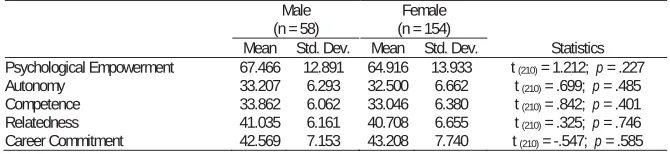
Table 3: Independent t-test statistics of differences in psychological empowerment, autonomy, competence, relatedness and career commitment by sex
Male
(n = 58) (n = 154) Female
Mean Std. Dev. Mean Std. Dev. Statistics
Psychological Empowerment 67.466 12.891 64.916 13.933 t (210)= 1.212; p = .227
Autonomy 33.207 6.293 32.500 6.662 t (210)= .699; p = .485
Competence 33.862 6.062 33.046 6.380 t (210)= .842; p = .401
Relatedness 41.035 6.161 40.708 6.655 t (210)= .325; p = .746
Career Commitment 42.569 7.153 43.208 7.740 t (210)= -.547; p = .585
The results in Table 3 revealed that there are no significant differences between male and female participants’ level of psychological empowerment, autonomy, competence, relatedness and career commitment. Generally, the p-values are greater than .05
3.2 Multiple Mediation Analysis
Results of data analysis are presented in Table 4
Table 4: Regression Coefficients, Standard Errors, and Model Summary Information for the Parallel Mediation of Autonomy, Competence and Relatedness between Psychological Empowerment on Career Commitment of Teachers
Consequent
Antecedent M1(Autonomy) M2 (Competence) M3(Relatedness) Y (Career Commitment)
Coeff SE p Coeff SE p Coeff SE p Coeff SE p
X Psychological Empowerment a1.165 .031 <.001 a2.157 .030 <.001 a3.162 .031 <.001 c' .092 .037 .014
M1 Autonomy - - - - - - - - - b1 .161 .081 .049
M2 Competence - - - - - - - - - b2 .445 .085 <.001
M3 Relatedness - - - - - - - - - b3 -.019 .085 .822
Constant im122.283 3.300 <.001 im228.043 3.182 <.001 im334.150 3.287 <.001 iY 15.136 4.626 <.001
R2 = .157 R2 = .149 R2 = .152 R2 = .278
F(6,205) = 6.382; p < .001 F(6,205) = 6.382; p < .001 F(6,205) = 6.382; p < .001 F(6,205) = 6.382; p < .001 *p < .05; **p < .01; ***p < .001
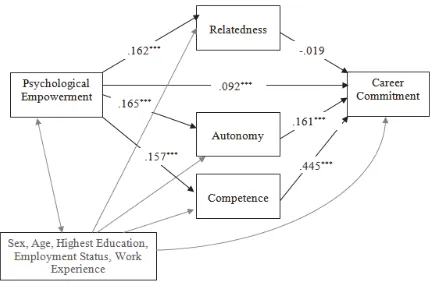
The results in Table 4 revealed that when sex, age, highest educational level, employment status, and work experience were kept constant, there was an evidence of total effect of psychological empowerment on career commitment of teachers (c = .185; p < .001). There was also an evidence of direct effect of psychological empowerment on career commitment of teachers, independent of autonomy, competence, and relatedness (c’ = .092; p < .05).
Results showed that there was a significant indirect effect of autonomy on psychological empowerment on career commitment of teachers when both competence and relatedness were kept constant (Coeff = .161; p < .05). This implies that teachers who differ in one unit of psychological empowerment are estimated to differ by .027 units in their reported level of career commitment as a result of the tendency for teachers under relatively more psychological empowerment top feel more autonomous which in turns would translate to grater career commitment.
Results however showed that there was no significant indirect effect of relatedness on psychological empowerment on career commitment of teachers when both autonomy and competence were kept constant (Coeff = -.019; p > .05). The implication being that teachers who differ in one unit of psychological empowerment are estimated to differ by -.003 units in their reported level of career commitment consequent upon inclination of teachers under rather more psychological empowerment not to feel more in relatedness which in turns could consequently not translate to grater career commitment. The statistical model for the study is presented in Figure 2.
Figure 2: Statistical model for the study (*p < .05; **p < .01; ***p < .001)
4. Discussion
This study examined the mediating effects of work psychological needs satisfaction factors of; autonomy, competence, and relatedness on the relationship between teachers’ psychological empowerment and career commitment.
First, preliminary analysis on the relationships among the study variables was conducted. Analyses showed that psychological empowerment has significant relationships with autonomy, competence and relatedness. Also, the relationships between career commitment and autonomy, relatedness, and competence were significant and positive.
It is not out of place to observe positive significant relationships among the study variables. These trends of relationships are expected, going by previous researches. Whereas no direct studies have been conducted on the relationship between psychological empowerment and career commitment, relationships have been found between psychological empowerment and organisational commitment (bin Abdullah, Almadhoun, & Ling, 2015; Choong et al., 2011; Huang, Shi, Zhang, & Cheung, 2006; Joo & Shim, 2010). Studies have also indicated the possibilities of significant relationship between psychological empowerment and basic needs satisfaction. For example, Quaglia, Marion, and McIntire (1991) noted that satisfied teachers have more positive attitudes toward students, higher self-efficacy, increased feelings of empowerment. Satisfying basic needs therefore makes individuals feel fully functional (Ryan, Huta, & Deci, 2008). These feelings motivate people intrinsically to maintain this level of needs satisfaction by internalizing extant values and regulations in social contexts (Baard et al., 2004). When organizations offer fulfilment to employees it would engender commitment (Greguras & Diefendorff, 2009).
commitment to the organization and their profession. In essence, the higher the feeling of psychological empowerment, the higher is the level of organizational commitment (Raub & Robert, 2007).
Psychological empowerment also affects organizational commitment for senior and middle level managers in banking sector of Pakistan. The effect of psychological empowerment on organizational commitment for lower level managers was insignificant (Hashmi, Irshad, & Shafiq, 2013). Indirect effect of psychological empowerment on organizational commitment via mediating effect of job satisfaction have also been observed Hashemi, Nadi, Hosseini, Rezvanfar (2012). Psychological empowerment also predicts work engagement (Stander & Rothmann, 2010).
It is not amazing to observe that psychological empowerment has direct effects on work needs satisfaction of autonomy, competence and relatedness respectively. Empowering employees tend to produce the feeling of need satisfaction. According to self-determination theory, growth tendency must be viewed as a dynamic potential that requires proximal and distal conditions of nurturance (Deci & Ryan, 2002).
Whereas psychological empowerment has a direct and total effect with a significant prediction of career commitment, the effects of psychological empowerment on career commitment were by competence and autonomy but not by relatedness. The findings of this study are however surprising but revealing, from one perspective, it would have been expected, judging by the findings of previous studies and correlation among variables as observed by this study, that all the factors of basic work psychological needs would mediate between psychological empowerment and career commitment. It is expected that the satisfaction of basic work psychological needs would enhance positive feelings. These positive feelings should reinforce the attainment of natural affiliation and attainment incentives (Sheldon & Schüler, 2011). SDT theory means that for goal pursuit and success, people’s basic psychological needs should be satisfied. The concept of needs as noted by Deci and Ryan (2000) is related to the content of motivation which forms a basis for the energization and direction of action.
However, the indirect effect of psychological empowerment on career commitment through work needs satisfaction dimensions of autonomy and competence still points to the influence of the satisfaction of work psychological needs on career commitment. Such differential moderating effects have been observed by Shuhaimi and Marzuki (2015). In a study of the moderating effects of basic needs satisfaction at work on the relationships between burnout, work-family conflict and organizational commitment, it was observed that autonomy moderates the relationships between exhaustion and continuance commitment, and relatedness moderates the relationships between work-family conflict and continuance commitment.
The findings may have great implications on the concept of needs satisfaction in that it may not be in all case that needs satisfaction will lead to career commitment. By the findings of this study, if the sense of belongingness in a work environment is marred, no matter the empowerment of staff, the expected career commitment may not be achieved. Therefore in practice, administrators will have to look into the social interaction pattern and workers’ sense of relatedness if any empowerment programme is to be implemented. However, there is a high relationship between psychological empowerment and relatedness but a low relationship between relatedness and career commitment (Table 1). The low correlation between relatedness and career commitment could have accounted for its insignificant mediating effect between psychological empowerment and career commitment. One may also have to see the findings of this study from the perspective of some extraneous variables interplaying the moderating effect of relatedness in the relationship between psychological empowerment and career commitment. Such variables could be identified and further investigated.
5. Conclusion
From the findings of this study, it was concluded that psychological empowerment has significant total and direct effects on career commitment. It also has significant indirect effect on career commitment through the mediating roles of autonomy and competence but not through relatedness.
6. Recommendations
The findings of this study have established the total and direct effects of psychological empowerment on career commitment. Hence, it would be recommended that for teachers to be committed to their career, psychological empowerment policies and programmes should be put in place. This could be in terms of participatory decision making, delegation of authority, and encouragement of initiatives.
relationship between psychological empowerment and career commitment. Teachers should be able to take charge of some school responsibilities without much interference or influence from school authorities. In-service training and development programmes such as workshops, seminars and conferences that would enhance teachers’ level of competence should be encouraged.
Further studies may examine factors that may influence the mediating role of relatedness in the relationship between psychological empowerment and career commitment. This study has taken both psychological empowerment and career commitment as one-dimensional, further analysis exploring the dimensions of the variables may be considered. This could be in the form of structural equation modeling.
References
Adeyemo, D. A. & Aremu, A. O. (1999). Career commitment among secondary school teachers in Oyo State, Nigeria: The role of biographical mediators. Nigerian Journal of Applied Psychology, 5, 184-194.
Adio, G. & Popoola, S. O. (2010). Job satisfaction and career commitment of librarians in federal university libraries in Nigeria, Library Review, 59(3), 175 - 184
Akinbode, G. A. & Fagbohungbe, O. B. (2012). Leadership and organizational factors as predictors of employees organisational commitment in Nigeria: An empirical analysis. Business and Management Research, 1(2), 69-87
Akinyemi, B. O. (2014). Organizational commitment in Nigerian banks: The influence of age, tenure and education, Journal of Management and Sustainability, 4(4), 104-115.
Aksel, I., Serinkan, C., Kiziloglu, M., & Aksoy, B. (2013). Assessment of teachers’ perceptions of organizational citizenship behaviors and psychological empowerment: An empirical analysis in Turkey. Procedia - Social and Behavioral Sciences, 89(10), 69-73. Ambad, S. N. A. & Bahron, A. (2012). Psychological empowerment: The influence on organizational commitment among employees in
the construction sector. The Journal of Global Business Management. 8(2), 73-81.
Anagnostopoulos, F., Slater, J., & Fitzsimmons, D. (2010). Intrusive thoughts and psychological adjustment to breast cancer: Exploring the moderating and mediating role of global meaning and emotional expressivity. Journal of Clinical Psychology in Medical Settings, 17, 137–149.
Arogundade, O. T., Arogundade, A. B., & Oladipo, O. M. (2014). The Influence of Career Commitment on Organizational Commitment among Selected Bankers in Lagos Metropolis, Nigeria. European Journal of Business and Management, 6(39), 36-41
Aryee, S., & Debrah, Y. A. (1993). A cross cultural application of career planning model. Journal of Organizational Behavior, 14, 119– 127. http://dx.doi.org/10.1002/job.4030140203
Ashforth, B. E. (1989). The experience of powerlessness in organizations. Organizational Behavior and Human Decision Processes, 43, 207-42.
Baard, P., Deci, E. L. & Ryan, R. M. (2004). Intrinsic need satisfaction: A motivational basis of performance and well-being in two work settings. Journal of Applied Social Psychology, 34, 2045-2068.
Ballout, H. I. (2009). Career commitment and career success: moderating role of self efficacy. Career Development International, 14 (7), 655–669. http://dx.doi.org/10.1108/13620430911005708
Barnhofer, T., & Chittka, T. (2010). Cognitive reactivity mediates the relationship between neuroticism and depression. Behaviour Research and Therapy, 48, 275–281.
bin Abdullah, A. G. K., Almadhoun, T. Z., & Ling, Y. (2015). Psychological empowerment, job satisfaction and commitment among Malaysian secondary school teachers. Asian Journal of Educational Research, 3(3), 34-42.
Blau, G. J. (1985). Measurement and prediction of career commitment. Journal of Occupational Psychology, 58(4), 277–288. http://dx.doi.org/10.1111/j.2044-8325.1985.tb00201.x
Blau, G. J. (1989). Testing the generalizability of a career commitment measure and its impact on employee turnover. Journal of Vocational Behavior, 35, 88î103, doi:10.1016/0001-8791(89)90050-X
Bogler, R. & Somech, A. (2004). Influence of teacher empowerment on teachers’ organizational commitment, professional commitment and organizational citizenship behavior in schools. Teaching and Teacher Education, 20(3), 277-289.
Bracht, N. (1999). Health promotion at the community level 2. new advances. London: Sage Publications.
Brandt, M. J., & Reyna, C. (2010). The role of prejudice and the need for closure in religious fundamentalism. Personality and Social Psychology Bulletin, 36, 715–725.
Brown, S. P. & Peterson, R. A. (1994). The effect of effort on sales performance and job satisfaction. Journal of Marketing, 58(2), 70-80. Buffardi, L. E. & Campbell, W. K. (2008). Narcissism and social networking websites. Personality and Social Psychology Bulletin, 34,
1303-1314
Calogero, R. M., & Jot, J. T. (2011). Self-subjugation among women: Exposure to sexist ideology, self objectification, and the protective function of the need to avoid closure. Journal of Personality and Social Psychology, 110, 211–228.
Carson, K. D., & Bedeian, A. G. (1994). Career commitment: construction of a measure and examination of its psychometric properties. Journal of Vocational Behavior, 44, 237–262. http://dx.doi.org/10.1006/jvbe.1994.1017
mediated by organizational commitment. Contaduría y Administración, 61(3), 422-440
Cheng, E. W. L. & Ho, D. C. K. (2001). The influence of job and career attitudes on learning motivation and transfer. Career Development. International, 6(1), 20-27. doi:10.1016/j.edurev.2011.04.001
Chiang, Y., Lee, H., Chu, T., Han, C., & Hsiao, Y. (2016). The impact of nurses' spiritual health on their attitudes toward spiritual care, professional commitment, and caring. Nursing Outlook, 64(3), 215-224.
Choong, Y. O., Wong, K. L., & Lau, T. C. (2011). Psychological empowerment and organizational commitment in the Malaysian Private Higher Education Institutions: A review and research agenda. Academic Research International, 1(3), 236-245.
Choong, Y. Wong, K. & Lau, T. (2011). Psychological empowerment and organizational commitment In the Malaysian private higher education institutions: A review and research agenda. Academic Research International, 1(3), 236-245.
Cohen, A. (1996). On the discriminant validity of the Meyer and Allen (1984) measure of organizational commitment: How does it fit with the work commitment construct? Educational and Psychological Measurement, 56, 494-503
Collarelli, S. M., & Bishop, R. C. (1990). Career commitment: Functions, correlates, and management. Group and Organization Studies, 15, 158–176. http://dx.doi.org/10.1177/105960119001500203
Conger, J. A. & Kanungo, R. N. (1988). The empowerment process: Integrating theory and practice. Academy of Management Review, 13, 471--482.
Day, R., & Allen, T. (2004). The relationship between career motivation and self-efficacy with protege career success. Journal of Vocational Behavior, 64, 72–91. http://dx.doi.org/10.1016/S0001-8791(03)00036-8
Deci, E. L. & Vansteenkiste, M. (2004). Self-determination theory and basic need satisfaction: understanding human development in positive psychology. Ricerche di Psicologia, 1(27), 23-39.
Deci, E. L., & Ryan, R. M. (2002). Overview of self-determination theory: An organismic dialectical perspective. In E. L. Deci & R. M. Ryan (Eds.), Handbook of self-determination research (pp. 3-33). Rochester, NY: University of Rochester Press.
Deci, E. L., Ryan, R. M., Gagne, M., Leone, D. R., Usunov, J., & Kornazheva, B. P. (2001). Need satisfaction, motivation, and well-being in the work organizations of a former eastern bloc country: A cross-cultural study of self-determination. Personality and Social Psychology Bulletin, 27(8), 930–942.
Deci, E., & Ryan, R. (2000). The ‘what’ and ‘why’ of goal pursuits: Human needs and the self-determination of behavior. Psychological Inquiry, 11(4), 227.
Duffy, R. D., Allen, B. A., & Dik, B. J. (2011). The presence of a calling and academic satisfaction: Examining potential mediators. Journal of Vocational Behavior, 79, 74–80.
Duffy, R. D., Dik, B. J., & Steger, M. F. (2011). Calling and work-related outcomes: Career commitment as a mediator. Journal of Vocational Behavior, 78(2), 210-218. doi:10.1016/j.jvb.2010.09.013
Eisenberger, R., Fasolo, P., & Davis-La Mastro, V. (1990). Perceived organizational support and employee diligence, commitment, and innovation. Journal of Applied Psychology, 75, 51-59.
Erdheim, J., Wang, M., & Zickar, M. J. (2006). Linking the Big Five personality constructs to organizational commitment. Personality and Individual Differences, 41(5), 959-970.
Farrell, D. & Rusbult, C. E. (1981). Exchange variables as predictors of job satisfaction, job commitment, and turnover: The impact of rewards, costs, alternatives, and investments. Organizational Behavior and Human Performance, 28 (1), 78-95.
Fu, J. & Chen, J. H. F. (2015). Career commitment of information technology professionals: The investment model perspective. Information & Management, 52 (5), 537-549.
Fu, J. (2011). Understanding career commitment of IT professionals: Perspectives of push–pull–mooring framework and investment model. International Journal of Information Management, 31(3), 279-293.
Ghaemi, F., & Sabokrouh, F. (2014). Teacher empowerment and its relationship to job satisfaction: A case study in mazandaran university. International Journal of Language Learning and Applied Linguistics World 5(2), 287 - 298
Gonzales, V. M., Reynolds, B., & Skewes, M. C. (2011). Role of impulsivity in the relationship between depression and alcohol problems among emerging college drinkers. Experimental and Clinical Psychopharmacology, 19, 303–313.
Goulet, L. R. & Singh. P. (2001). Career commitment: A reexamination and an extension. Journal of Vocational Behavior, 61,73–91. http://dx.doi.org/10.1006/jvbe.2001.1844
Greenhaus, J. H. (1971). An investigation of the role of career salience in vocational behavior, Journal of Vocational Behavior, 1, 209-16. Greguras, G. J., & Diefendorff, J. M. (2009). Different fits satisfy different needs: Linking person–environment fit to employee
commitment and performance using self-determination theory. Journal of Applied Psychology, 94, 465–477.
Gwyn, P. G. (2011). The quality of mentoring relationships' impact on the occupational commitment of nursing faculty. Journal of Professional Nursing, 27(5), 292-298.
Hackman, J. R., & Oldham, G. R. (1980). Work redesign. Reading, MA: Addison-Wesley
Hall, D. T. (1971). A theoretical model of career subidentity development in organizational settings. Organizational Behavior and Human Performance, 6, 50–76. http://dx.doi.org/10.1016/0030-5073(71)90005-5
Hamid, S. F., Nordin, N., Adnan, A. A., & Sirun, N. (2013). A study on primary school teachers’ organizational commitment and psychological empowerment in the District of Klang. Procedia - Social and Behavioral Sciences, 90, (10), 782-787
Hashemi, S, M. K., Nadi, H. K., Hosseini, S. M., & Rezvanfar, A. (2012). Explaining agricultural personnel's intrapreneurial behavior: The mediating effects of job satisfaction and organizational commitment. International Journal of Business and Social Science, 3(6), 299-308
banking sector of Pakistan. World Applied Sciences Journal,25(12), 1713-1717.
Hassan, E. M., Hassan, T., & Mabekoje, S. O. (2008). A canonical correlation analysis of the causal relationship between organizational commitment and job satisfaction. International Journal of Multi-Disciplinary Research, 1(1), 13 – 24.
Hayes, A. F. (2013). An introduction to mediation, moderation, and conditional process analysis: A regression-based approach. New York: Guildford Press.
Herzberg, F., Mausner, B. & Snyderman, B. (1959). The motivation to work (Second Ed.). New York: John Wiley & Sons.
Hsu, L., Woody, S. R., Lee, H. J., Peng, Y., Zhou, X., & Ryder, A. G. (2012). Social anxiety among East Asians in North America: East Asian socialization or the challenge of acculturation? Cultural Diversity and Ethnic Minority Psychology, 18, 181–191.
Huang, X., Shi, K., Zhang, Z., & Cheung, Y.L. (2006). The impact of participative leadership behaviour on psychological empowerment and organizational commitment in Chinese state-owned enterprises: the moderating role of organizational tenure. Asia Pacific Journal of Management, 23, 345-367.
Ilardi, B., Leone, D., Kasser, T. & Ryan, R.M. (1993). Employee and supervisor ratings of motivation: Main effects and discrepancies associated with job satisfaction and adjustment in a factory setting. Journal of Applied Social Psychology, 23, 1789-1805. Jones, R. G., Whitmore, M. D. (1995). Evaluating developmental assessment centers as interventions, Personnel Psychology, 48,
377-388
Joo, B. K. & Shim, J. H. (2010). Psychological empowerment and organizational commitment: the moderating effect of organizational learning culture. Human Resource Development International, 13(4), 425–441.
Kalkavan, S. & Katrinli, A. (2014). The effects of managerial coaching behaviors on the employees’ perception of job satisfaction, organisational commitment, and job performance: Case study on insurance industry in Turkey. Procedia - Social and Behavioral Sciences, 150, 1137-1147
Kanter, R. M. (1983). The change masters. New York: Simon & Schuster.
Kasser, T., Davey, J., & Ryan, R. M. (1992). Motivation and employee-supervisor discrepancies in a psychiatric vocational rehabilitation setting. Rehabilitation Psychology, 37(3), 175–188. doi:10.1037/h0079104
Khanna, S. & Gupta, V. (2016). The Impact of Psychological Empowerment on Job Satisfaction and Organizational Commitment. International Journal of Research in Organizational Behavior and Human Resource Management, 4.(1), 24-36.
Kidd, J. M., & Green, F. (2006). The careers of research scientists: predictors of three dimensions of career commitment and intention to leave science. Personnel Review, 35(3), 229–251. http://dx.doi.org/10.1108/00483480610656676
Kimwarey, M. C., Chirure, H. N., & Omondi, M. (2014). Teacher empowerment in education practice: strategies, constraints and suggestions. IOSR Journal of Research & Method in Education (IOSR-JRME), 4(2), 51-56
Kirkman, B. L., & Rosen, B. (1999). Beyond self-management: Antecedents and consequences of team empowerment. . Academy of Management Journal, 42(1), 58-74.
Klassen, R. M. & Chiu, M. M. (2011). The occupational commitment and intention to quit of practicing and pre-service teachers: Influence of self-efficacy, job stress, and teaching context. Contemporary Educational Psychology, 36 (2), 114-129.
Kong, L., Chen, X., Shen, S., Li, G., Gao, Q., Zhu, N., ..., & Li, P. (2016). Professional commitment and attributional style of medical-college nursing students in China: A cross-sectional study. Nurse Education Today, 40, 154-160.
Kontos, S. & Riessen, J. (1993). Predictors of job satisfaction, job stress, and job commitment in family day care. Journal of Applied Developmental Psychology, 14(3), 427-441.
Kraimer, M. L., Seibert, S. E. & Liden, R. C. (1999). Psychological empowerment as a multidimensional construct: a test of construct validity. Educational and Psychological Measurement, 59(1), 127-142.
Lawler, E. E. (1992). The Ultimate Advantage. San Francisco: Jossey-Bass.
Lecheler, S., de Vreese, C.,& Slouthuus, R. (2011). Issue importance as a moderator of framing effects. Communication Research, 79, 400–425.
Lee, A. N. & Nie, Y. (2014). Understanding teacher empowerment: Teachers' perceptions of principal's and immediate supervisor's empowering behaviours, psychological empowerment and work-related outcomes. Teaching and Teacher Education, 41, 67-79 Lee, J. R., Nass, C., Brave, S. B., Morishima, Y., Nakajima, H., & Yamada, R. (2007). The case for caring colearners: The effects of a
computer-mediated colearner agent on trust and learning. Journal of Communication, 57, 183-204
Lee, K., Carswell, J. J., & Allen, N. J. (2000). A meta-analytic review of occupational commitment: Relations with person- and work-related variables. Journal of Applied Psychology, 85(5), 799-811. doi:10.1037/0021-9010.85.5.799
Liden, R. C., Wayne, S. J., & Sparrowe, R. T. (2000). An examination of the mediating role of psychological empowerment on the relations between the job, interpersonal relationships, and work outcomes. Journal of Applied Psychology, 85, 407–416 Lieberman, A. (1989). On teacher empowerment: A conversation with Ann Lieberman. Educational Leadership, 46 (8), 24.
Liu, A. M. M., Fellows, R., & Chiu, W. M. (2006). Work empowerment as an antecedent to organisational commitment in the Hong Kong quantity surveying profession. Surveying and Built Environment., 17(2), 63-72.
London, M. (1983). Toward a theory of career motivation, Academy of Management Review, 8, 620-30.
Lydon, J. E. & Zanna, M. P. (1990). Commitment in the face of adversity: A value affirmation approach, Journal of Personality and Social Psychology, 58, 1040-1047.
Lynch, M., Plant, R. & Ryan, R. M. (2005). Psychological needs and threat to safety: Implications for staff and patients in a psychiatric hospital for youth. Professional Psychology Research and Practice, 36, 415-425.
Malik, F., Chugtai, S., Iqbal, Z., & Ramzan, M. (2013). Does psychological empowerment bring about employee commitment? Evidence from telecommunication sector of Pakistan. Journal of Business Studies Quarterly, 5(1), 14-21
Mathieu, J. E., & Zajac, D. M. (1990). A review and meta-analysis of the antecedents, correlates, and consequences of organisational commitment. Psychological Bulletin, 108, 171-194.
Meyer, J. P., & Allen, N. J. (1991). A three-component conceptualization of organizational commitment. Human Resource Management Review, 1, 61-89.
Meyer, J. P., & Allen, N. J. (1997). Commitment in the workplace. Thousand Oaks, CA: Sage.
Meyer, J. P., Allen, N. J., & Smith, C. A. (1993) Commitment to organizations and occupations: Extension and test of a three-component conceptualization. Journal of Applied Psychology, 78(4), 538-551.
Morrow, P. C. & McElroy, J. C. (1986). Assessing measures of work commitment. Journal of Occupational Behaviour, 7, 139-145. Morrow, P. C. (2011). Managing organizational commitment: Insights from longitudinal research. Journal of Vocational Behavior, 79(1),
18-35.
Morrow, P. C., McElroy, J. C., & Scheibe, K. P. (2012). Influencing organizational commitment through office redesign. Journal of Vocational Behavior, 81(1), 99-111.
Mowday, R. T., Porter, L. W., & Steers, R. M. (1982). Employee-organization linkages: the psychology of commitment, absenteism, and turnover. Academic Press, London.
Myrtle, R. C., Chen, D. R., Lui, C., & Fahey, D. (2011). Job and career influences on the career commitment of health care executives. Journal of Health Organization and Management, 25(6), 693–710. http://dx.doi.org/10.1108/14777261111178565
Nägele, C. & Neuenschwander, M. P. (2014). Adjustment processes and fit perceptions as predictors of organizational commitment and occupational commitment of young workers. Journal of Vocational Behavior, 85(3), 385-393.
Nesje, K. (2016). Personality and professional commitment of students in nursing, social work, and teaching: A comparative survey. International Journal of Nursing Studies, 53, 173-181.
Ng, T. W. H. & Feldman, D. C. (2008). Can you get a better deal elsewhere? The effects of psychological contract replicability on organizational commitment over time. Journal of Vocational Behavior, 73(2), 268-277.
Ng, T. W. H. & Feldman, D. C. (2011). Affective organizational commitment and citizenship behavior: Linear and non-linear moderating effects of organizational tenure. Journal of Vocational Behavior, 79 (2), 528-537.
Ng, T. W. H., Butts, M. M., Vandenberg, R. J. DeJoy, D. M. & Wilson, M. G. (2006). Effects of management communication, opportunity for learning, and work schedule flexibility on organizational commitment. Journal of Vocational Behavior, 68(3), 474-489 Niehoff, B. P., Enz, C. A., & Grover, R. A. (1990). The impact of top management actions on employee attitudes and perception, Group
& Organization Studies.
Niu, H. (2010). Investigating the effects of self-efficacy on foodservice industry employees’ career commitment. International Journal of Hospitality Management, 29 (4), 743-750.
Ogunjinmi, A. A., Onadeko, S. A., Ladebo, O. J., & Ogunjinmi, K. O. (2014). Personal characteristics and training opportunities as determinants of organisational commitment among Nigeria national parks’ employees. European Scientific Journal 10(5), 221- Orkibi, H. (2010). Creative arts therapies students’ professional identity and career commitment: A brief pilot study report. The Arts in
Psychotherapy, 37 (3), 228-232.
Orkibi, H. (2016). Highly artistic-social personalities buffer the effects of burnout on career commitment. The Arts in Psychotherapy, 50, 75-83.
Patah, M. O. R. A., Radzi, S. M., Abdullah, R., Adzmy, A., Zain., R. A., & Derani, N. (2009). The influence of psychological empowerment on overall job satisfaction of front office receptionists. International Journal of Business Management, 4(11), 167-176.
Perry, S. J., Hunter, E. M., & Currall, S. C. (2016). Managing the innovators: Organizational and professional commitment among scientists and engineers. Research Policy, 45(6), 1247-1262.
Peters, T., & Austin, N. (1985). A passion for excellence.The leadership difference. New York: Random House.
Poon, J. M. L. (2004). Career commitment and career success: moderating role of emotion perception. Career Development
International, 9(4), 374–390. http://dx.doi.org/10.1108/13620430410544337
Quaglia, R., Marion, S. F., & McIntire, W. G. (1991). The relationship of teacher satisfaction to perceptions of school organization, teacher empowerment, work conditions, and community status. Education, 112(2), 206-216.
Raub, S., & Robert, C. (2007). Empowerment and organizational citizenship: Moderation by culture in a multi-national sample. Academy of Management Proceedings, 1-6.
Reeve, J. & Deci, E. L. (1996). Elements within the competitive situation that affect intrinsic motivation. Personality and Social Psychology Bulletin, 22, 24–33.
Reid, S. A., Palomares, N. A., Anderson, G. L., & Bondad-Brown, B. (2009). Gender, Language, and Social Influence: A Test of Expectation States, Role Congruity, and Self-Categorization Theories. Human Communication Research, 35(4), 465-490. Rissel, C. (1994). Empowerment: the holy grail of health promotion? Health Promotion International, 9(1), 39-47.
Ryan, R. M., Huta, V., & Deci, E. L. (2008). Living well: A self-determination theory perspective on eudaimonia. Journal of Happiness Studies, 9, 139–170.
Ryan, R., & Deci, E. (2000). Self-determination theory and the facilitation of intrinsic motivation, social development, and well-being. American Psychologist, 55(1), 68–78.
workers and child care workers employed at voluntary agencies. Children and Youth Services Review, 34(1), 84-90
Sheldon, K. M. & Schüler, J. (2011). Wanting, having, and needing: Integrating motive disposition theory and self-determination theory. Journal of Personality and Social Psychology, 101(5), 1106-1123.
Shuhaimi, S. M. & Marzuki, N. A. (2015). The moderating effects of basic needs satisfaction at work on the relationships between burnout, work-family conflict and organizational commitment: Relevance of the Conservation of Resources (COR) Theory. Mediterranean Journal of Social Sciences, 6(4), 506-516
Silman, T. (2014).Work-related basic need satisfaction as a predictor of work engagement among academic staff in Turkey. South African Journal of Education, 34(3), 1-5.
Smith, J. L., Conley, S., & You, S. (2015). Perceptions of retirement affect career commitment: The mediating role of retirement system satisfaction for two teacher age groups. Educational Gerontology, 41(4), 267-281.
Smith, M. J., Arthur, C., & Oliver, E. (2012). Examining the impact of transformational coaching behaviors and basic needs satisfaction on athlete training behaviors. Journal of Sport & Exercise Psychology, 34(Suppl.), S195-S309
Spreitzer, G. M. (1995). Psychological empowerment in the workplace: Dimensions, measurement, and validation. Academy of Management Journal, 38(5), 1442-1465.
Tamir, E. & de Kramer, R. M. (2011). Teacher retention and career commitments among delet graduates: the intersection of teachers' background, preparation for teaching, and school context. Journal of Jewish Education, 77(2), 76-97.
Tengland, P. A. (2007). Empowerment: A Goal or a Means for Health Promotion. Medicine, Health Care and Philosophy, 10(2), 197-207. Thomas, K. W. & Velthouse, B. A. 1990. Cognitive elements of empowerment. Academy of Management Review, 15, 666-681. Van den Broeck A, Vansteenkiste M, De Witte H, & Lens W. (2008). Explaining the relationships between job characteristics, burnout
and engagement: The role of basic psychological need satisfaction. Work and Stress. 22(3), 277-294
Veisi, S., Azizifar,A., Gowhary, H., & Jamalinesari, A. (2015). The relationship between iranian efl teachers’ empowerment and teachers’ self-efficacy Procedia - Social and Behavioral Sciences, 185, (13), 437-445
Wallerstein, N. (1992). Powerlessness, Empowerment and health: Implications for health promotion programs. American Journal of Health Promotion, 6(3), 197-205.
Wan, E. (2005). Teacher empowerment: Concepts, strategies, and implications for schools in Hong Kong. Teachers College Record, 107(4), 842e861.
Wang, Y., Chiang, M., & Lee, Y. (2014). The relationships amongst the intern anxiety, internship outcomes, and career commitment of hospitality college students. Journal of Hospitality, Leisure, Sport and Tourism Education, 15, 86-93.
Weng, Q & McElroy, J. C. (2012). Organizational career growth, affective occupational commitment and turnover intentions. Journal of Vocational Behavior, 80(2), 256-265.
You, S. & Conley, S. (2015). Workplace predictors of secondary school teachers' intention to leave: An exploration of career stages. Educational Management Administration & Leadership, 43 (4), 561-581.
Zadeh, Z. Y., Farnia, F., & Ungerleider, C. (2010). How home enrichment mediates the relationship between maternal education and children’s achievements in reading and math. Early Education and Development, 21, 568–594.