International Doctorate School in Information and
Communication Technologies
DISI
∼
University of Trento
E
MPIRICAL
M
ETHODS FOR
E
VALUATING
V
ULNERABILITY
M
ODELS
Viet Hung Nguyen
Advisor Committee
ProfessorFabio Massacci ProfessorMassimiliano Di Penta
Università degli Studi di Trento Università degli Studi del Sannio
ProfessorAlexander Pretschner
Technische Universität München
ProfessorLaurie Williams
North Carolina State University
T
HISdissertation focuses on the following research question: “how to independently and systematically validate empirical vulnerability models?”. Based on the survey on past studies about the vulnerability discovery process, the dissertation has pointedout several critical issues in the traditional methodology for evaluating the performance of
vulnerability discovery models (VDMs). Such issues did impact the conclusions of several studies in the literature. To address such pitfalls, a novel empirical methodology and a data
collection infrastructure are proposed to conduct experiments that evaluate the empirical
performance of VDMs. The methodology consists of two quantitative analyses, namely qual-ityandpredictabilityanalyses, which enable analysts to study the performance of VDMs, and to compare them effectively.
The proposed methodology and the data collection infrastructure have been used to
as-sess several existing VDMs on many major versions of the major browsers (i.e.,Chrome, Fire-fox, Internet Explorer, and Safari). The extensive experimental analysis reveals an interesting
finding about the VDM performance in terms of quality and predictability: the simplest
lin-ear model is the most appropriate one for predicting vulnerability discovery trend within the first twelve months since the release date of browser versions; later than that, logistic models
are more appropriate.
The analyzed vulnerability data exhibits the phenomenon of after-life vulnerabilities, which have been discovered for the current version but also attributed to browser versions
out of support –deadversions. These vulnerabilities however may not actually exist, and may have an impact on past scientific studies, or on compliance assessment. Therefore, this
dissertation has proposed a method to identify code evidence for vulnerabilities. The results
of the experiments show that a significant amount of vulnerabilities has been systematically
I would like to express my deep appreciation to many people, without whom, I could not
finish the dissertation for my PhD graduation.
At first, I would like to thank Professor Fabio Massacci, who supervised my PhD work at
University of Trento. It is my luck to be his student and colleague. I would like to thank a lot
for his helpful advices, his endless patience, and his guidance during the last five years and beyond. I have received invaluable supports from him for my travels to summer schools,
conferences, and project meetings. This helped to broaden not only my research horizonal,
but also my social knowledge.
I would like to thank Dr. Riccardo Scandariato who was the mentor for my internship at
University of Leuven. I have learnt many things from him. His working style has indeed
in-fluenced me a lot. I also want to thank all other colleagues at Ditri Net (University of Leuven)
for their kindness and helpfulness.
I am grateful to Professor Laurie William (North Carolina State University, United States), Professor Alexander Pretschner (University of Munich, Germany), and Professor
Massimil-iano Di Penta (University of Sannio, Italy) for being committee members in my defence. They
have taken their time for reading my dissertation carefully, giving me many helpful and
con-structive feedback, and for challenging me with interesting questions that helped to improve
the quality of this dissertation.
I am thankful to Dr. Stephan Neuhaus for his collaboration in the very first year of my
PhD study. I also would like to thank to my colleagues and my friends at University of Trento.
However I decided not to list their names here because it is more likely that I would forget some of them at the time of writing. They have contributed a lot of useful advices,
discus-sions, and also nice and welcome distraction.
I would like to thank to anonymous reviewers whom I will never know. Their comments
have frustrated me at the first sight, but they really were fruitful criticism that dramatically
helped me to improve my writing works, resulting in publications which the dissertation is
built upon.
Finally I would like to dedicate this dissertation to my sweetheart, Le Minh Sang Tran, for
her true love and deep understanding. Without her encouragements and supports I would
Abstract
Acknowledgements
Contents i
List of Tables v
List of Figures vii
Acronyms ix
1 Introduction 1
1.1 Contributions . . . 2
1.2 Terminology . . . 3
1.3 Structure of the Dissertation . . . 4
1.4 Publications . . . 7
2 Research Roadmap 9 2.1 Research Objective . . . 9
2.2 Research Method and Research Questions . . . 10
2.2.1 Survey State-of-the-Art . . . 12
2.2.2 Acquire Experimental Data . . . 13
2.2.3 Perform Observation on Experimental Data . . . 13
2.2.4 Invent Method(s) . . . 14
2.2.5 Evaluate Method(s) . . . 15
2.3 Chapter Summary . . . 16
3 A Survey of Empirical Vulnerability Studies 17 3.1 The Method to Conduct the Survey . . . 18
3.2 A Qualitative Overview to Primary Studies . . . 21
3.2.1 Fact Finding Studies . . . 21
3.2.2 Modeling Studies . . . 24
3.2.3 Prediction Studies . . . 26
3.3 A Qualitative Analysis of Vulnerability Data Sources . . . 28
3.3.1 Classification of Data Sources . . . 28
3.3.2 Features in Data Sources. . . 33
3.4 Chapter Summary . . . 37
4 Data Infrastructure for Empirical Experiments 39 4.1 Software Infrastructure for Data Acquisition. . . 40
4.1.1 Acquiring Vulnerability Data for Firefox . . . 41
4.1.2 Acquiring Vulnerability Data for Chrome, IE, and Safari . . . 44
4.2 Potential Biases in Collected Data Sets . . . 45
4.3 Market Share Data . . . 47
4.4 Chapter Summary . . . 49
5 After-Life Vulnerabilities 51 5.1 The Ecosystem of Software Evolution . . . 52
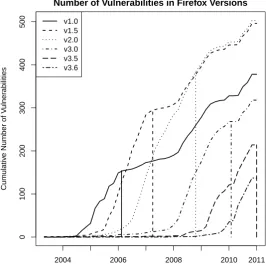
5.2 After-life Vulnerabilities and the Security Ecosystem. . . 55
5.3 Threats to Validity . . . 59
5.4 Chapter Summary . . . 60
6 A Methodology to Evaluate VDMs 63 6.1 An Observation on the Traditional Validation Methodology. . . 65
6.1.1 The Traditional Methodology . . . 66
6.1.2 The Validation Results of VDMs in Past Studies . . . 67
6.2 Research Questions . . . 69
6.3 Methodology Overview . . . 72
6.4 Methodology Details . . . 76
6.4.1 Step 1: Acquire the Vulnerability Data . . . 76
6.4.2 Step 2: Fit a Vulnerability Discovery Model (VDM) to Observed Samples 78 6.4.3 Step 3: Perform Goodness-of-Fit Quality Analysis . . . 80
6.4.4 Step 4: Perform Predictability Analysis . . . 83
6.4.5 Step 5: Compare VDMs . . . 85
6.5 Chapter Summary . . . 86
7.1 Research Questions . . . 90
7.2 Experimental Setup . . . 90
7.2.1 The Software Infrastructure . . . 91
7.2.2 Collected Vulnerability Data Sets . . . 92
7.3 An Assessment on Existing VDMs . . . 93
7.3.1 Goodness-of-Fit Analysis for VDMs . . . 94
7.3.2 Predictability Analysis for VDMs . . . 97
7.3.3 Comparison of VDMs . . . 99
7.4 Discussion . . . 100
7.5 Threats to Validity . . . 102
7.6 Chapter Summary . . . 103
8 A Method to Assess Vulnerabilities Retro Persistence 105 8.1 Research Questions . . . 107
8.2 The Method to Identify Code Evidence for Vulnerability Claims . . . 108
8.2.1 Step 1: Acquire Vulnerability Data . . . 110
8.2.2 Step 2: Locate Bug-Fix Commits . . . 111
8.2.3 Step 3: Identify Vulnerable Code Footprints . . . 113
8.2.4 Step 4: Determine Vulnerability Evidences . . . 115
8.3 Related Work . . . 116
8.4 Chapter Summary . . . 117
9 The Assessment of the NVD Vulnerability Claims 119 9.1 Research Questions . . . 120
9.2 The Assessing Experiment of Vulnerability Claims . . . 121
9.2.1 The Software Infrastructure . . . 121
9.2.2 Descriptive Statistics . . . 123
9.2.3 The Analysis on the Spurious Vulnerability Claims . . . 127
9.3 The Impact of Spurious Vulnerability Claims . . . 129
9.3.1 The Majority of Foundational Vulnerabilities. . . 129
9.3.2 The Trend of Foundational Vulnerability Discovery . . . 133
9.4 Threats to Validity . . . 138
9.5 Chapter Summary . . . 139
10.2 Limitation and Future Directions . . . 145
10.2.1 The Need of Experiment Replication . . . 145
10.2.2 The Need of a Maturity Model for Vulnerability Data . . . 145
Bibliography 147
A Appendix 159
2.1 Summary of research questions. . . 11
3.1 Details of primary studies. . . 20
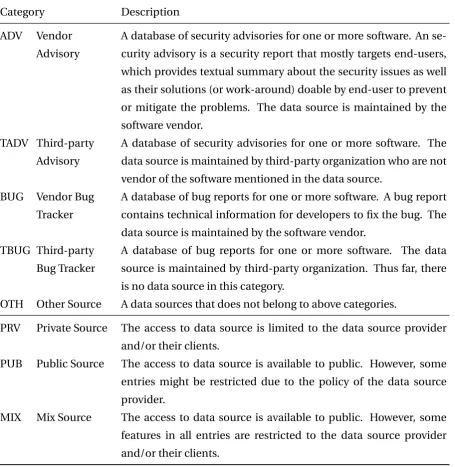
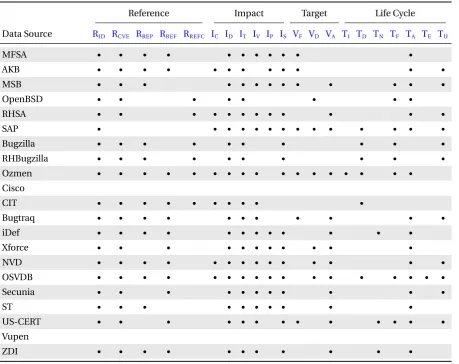
3.2 Classification of vulnerability data sources. . . 30
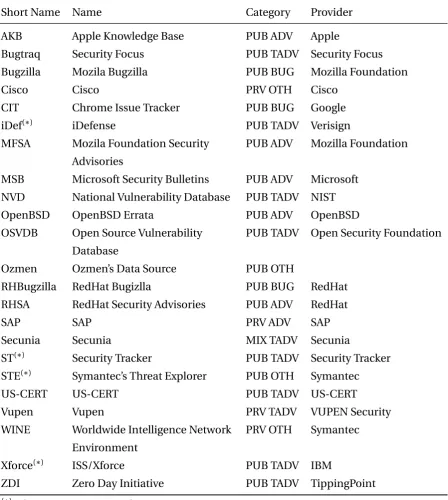
3.3 Vulnerability data sources in past studies. . . 31
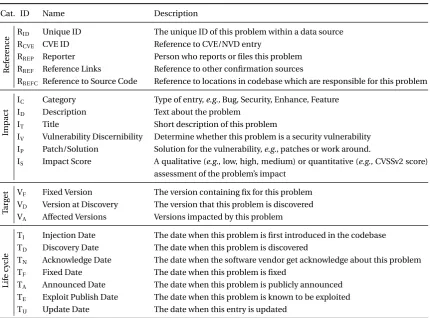
3.4 Potential features in a vulnerability data source. . . 34
3.5 Features of vulnerabilities data sources. . . 35
4.1 Vulnerability data sources of browsers. . . 40
4.2 Descriptive statistics of browsers market share. . . 49
5.1 Vulnerabilities in Firefox . . . 58
5.2 Vulnerabilities in individual versions of Firefox . . . 58
6.1 Summary of VDM validation studies. . . 67
6.2 Summary of VDM validation results (p-values) in the literature. . . 68
6.3 Methodology overview. . . 73
6.4 Formal definition of data sets. . . 77
7.1 Descriptive statistics of observed data samples . . . 92
7.2 The VDMs in evaluation and their equation.. . . 93
7.3 The number of evaluated samples. . . 94
7.4 Suggested models for different usage scenarios.. . . 100
7.5 A potentially misleading results of overfitting VDMs in the largest horizon of browser releases, usingNVDdata sets. . . 101
7.6 Performance summary of VDMs. . . 104
8.1 Overview of the proposed validation method. . . 109
8.2 The execution of the method on few Chrome vulnerabilities. . . 115
9.1 Descriptive statistics for vulnerabilities of Chrome and Firefox . . . 123
9.2 Descriptive statistics of vulnerability claims of Chrome. . . 124
9.3 Descriptive statistics of vulnerability claims of Firefox.. . . 125
9.4 The Wilcoxon signed-rank test results for the majority of foundational and
inher-ited vulnerabilities.. . . 133
9.5 Number of events (i.e.,significant quarterly trends) . . . 135
A.1 Inconsistent events in Laplace test for quarterly trends in Chrome. . . 171
2.1 Essential steps of the research methodology. . . 10
2.2 An overview to the research activities and produced artifacts. . . 12
3.1 Classification of primary studies yearly. . . 19
3.2 The usage of data sources in all research topics (left) and its breakdown (right). . . 29
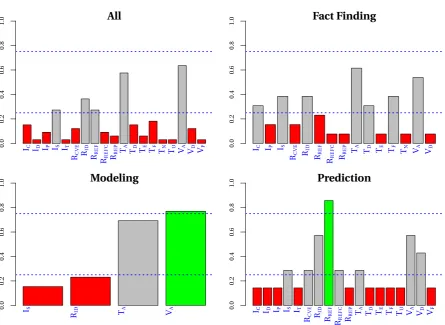
3.3 The usage of third-party data sources. . . 33
3.4 Usage of features by primary studies in each research topic. . . 36
4.1 The infrastructure to collect vulnerability data for Firefox . . . 41
4.2 Different patterns of BUG and CVE references in MFSA. . . 43
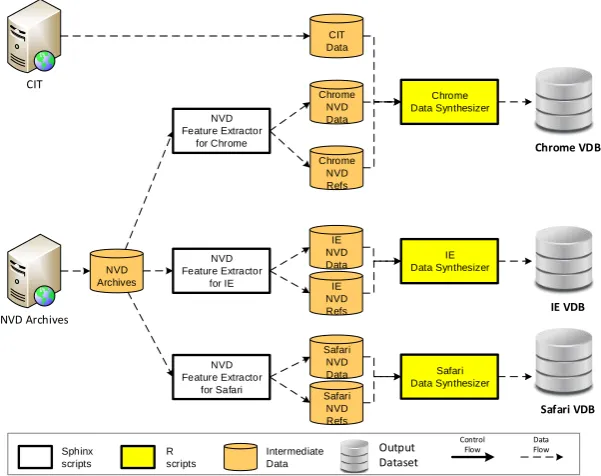
4.3 The infrastructure to collect vulnerability data for Chrome, IE, and Safari. . . 45
4.4 Histogram of number of MBugs per NVD entry, reported by MFSA. . . 46
4.5 The market share of browsers since Jan 2008. . . 48
5.1 Release and retirement dates for Firefox. . . 53
5.2 Size and lineage of Firefox source code . . . 54
5.3 Firefox Users vs. LOC Users . . . 55
5.4 Vulnerabilities discovered in Firefox versions . . . 56
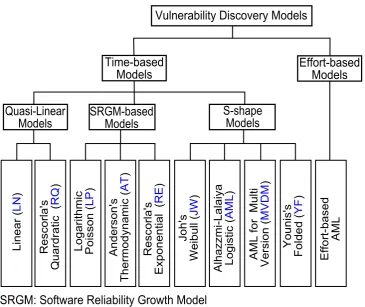
6.1 Taxonomy of Vulnerability Discovery Models. . . 64
6.2 The two folds of the vulnerability counting issue. . . 71
6.3 Fitting the AML model to theNVDdata sets for Firefox v3.0, v2.0, and v1.0. . . 79
6.4 Moving average of the temporal quality of sample AML and AT models. . . 83
6.5 The prediction qualities of AML and AT at fixed horizonsτ=12 and 24 to some variable prediction time spans. . . 85
7.1 The software infrastructure of the experiment. . . 91
7.2 The trend of temporal qualityQω=0.5(τ) of the VDMs in first 72 months. . . 95
7.3 The temporal quality distribution of each VDM in different periods of software lifetime. . . 96
7.4 The predictability of VDMs in different prediction time spans (∆). . . 98
7.5 The comparison results among VDMs in some usage scenarios. . . 99
8.1 Thevulnerable software and versionsfeature of theCVE-2008-7294. . . 106
8.2 Selected features from a CVE (a), and from an MFSA report (b). . . 111
8.3 Bug-fix commits of Chrome (a) and Firefox (b). . . 112
8.4 Excerpts of the output ofdiff(a), and of the output ofannotate(b).. . . 114
9.1 The software infrastructure for assessing the vulnerabilities retro persistence.. . . 122
9.2 The number of bugs per bug-fix commit in Chrome (a) and in Firefox (b). . . 125
9.3 The complexity of bug-fix commits by number of source components (a) and by number of vulnerable code footprints (b). . . 126
9.4 The average error rates (with error bars) of Chrome (a) and Firefox (b) along the lifetime of individual versions. . . 128
9.5 Foundational vulnerabilities by NVD: all vulnerability claims (left) and spurious vulnerability claims excluded (right). . . 131
9.6 The ratios of inherited vulnerabilities in Chrome and Firefox. . . 132
9.7 The actual discovery trends of foundational vulnerabilities.. . . 135
9.8 The Laplace test for quarterly trends in Chrome v5 foundation vulnerabilities. . . 136
9.9 The Laplace test for quarterly trends in Firefox v3.0 foundation vulnerabilities. . . 136
9.10 The distribution of inconsistent events in National Vulnerability Database (NVD) and Verified NVD. . . 137
A.1 Laplace test for trend in quarterly foundational vulnerability discovery for Chrome160
AE Average Error
AB Average Bias
AIC Akaike Information Criteria
AKB Apple Knowledge Base
BSIMM Building Security In Maturity Model
CDG Component Dependency Graph
CERT Computer Emergency Response Team/Coordination Center
CIT Chrome Issue Tracker
CSV Comma Separated Values
CVE Common Vulnerabilities and Exposures
CVS Concurrent Version System
CVSS Common Vulnerabilities Scoring System
LoC Line of Code
MBug Mozilla Bugzilla
MDG Member Dependency Graph
MFSA Mozilla Foundation Security Advisories
MSB Microsoft Security Bulletin
NIST National Institute of Standards & Technology
NVD National Vulnerability Database
OSVDB Open Source Vulnerability Database
PCI DSS Payment Card Industry Data Security Standard
SCAP Security Content Automation Protocol
SDL Security Development Lifecycle
SQL Structured Query Language
SVM Support Vector Machine
C
H
A
P
T
1
I
NTRODUCTION
This chapter presents the motivation of this dissertation. It describes the overall research questions and research method that drive the subsequent chapters. It also summarizes the major contributions of this work, as well as published/in submission publications on which the dissertation is built upon.
R
ECENTyears have seen major efforts addressing the insecurity of software from guide-lines for secure software development [McG09;HL03;HL06] to studies attempting tounderstand the nature of vulnerabilities. Our survey of 59 recent studies in the field
from 2005 to 2012 whose contributions were (partially) relied on (or validated by) empirical experiments showsfact findingpapers (i.e.,reporting the findings with/without some statis-tics [Ozm05;OS06;Fre06;Res05;Li12;Sha12]),modelingpapers (i.e.,proposing mathemat-ical models, or metrics, or methodologies concerning vulnerabilities [Alh07; And02;Res05;
You11; Joh08], or economic models [Shi12; AM13]), andpredictionpapers (i.e.,predicting the vulnerabilities in code base, [Shi11;CZ11;Geg09b;Neu07;Boz10]).
Vulnerability data sources now are employed not only in scientific studies, but also in
the compliance assessment for deployed software. The US National Institute of Standards
& Technology (NIST) Security Content Automation Protocol (SCAP) [Qui10], and Payment
Card Industry Data Security Standard (PCI DSS)[WC12] have been applied to evaluate the
compliance of software-related products. They both employNVD. Any mistakes in NVD
might result in unfair fines raking hundreds of thousand of euros in companies. For instance,
if a product embeds an older version of browser (e.g.,Chrome v4), it might lose compliance
with PCI DSS due to a large number of unfixed vulnerabilities. Then the product vendor
might either update to new version, or pay a fine, or be kicked out of the market.
This dissertation does not aim to provide a novel model of the vulnerability discovery
process, nor an outperform approach to early detect vulnerabilities. Instead, motivating by
the fact that several models on vulnerabilities are based on empirical experiments, the
dis-sertation lays its focus on the research question: “how to independently and systematically validate empirical vulnerability models?".
The rest of this chapter is organized as follows. Section1.1briefly summarizes the main
contributions of the dissertation. Section1.3describes the chapters in the dissertation, as
well as a short summary for each chapter. Section1.4shows the ordinal publications that I have (co)authored during the course of the PhD study.
1.1 Contributions
This section briefs the major contributions of the dissertation as follows.
i) An empirical methodology to evaluate the performance of time-based vulnerability dis-covery models (VDMs). Several VDMs have been proposede.g.,[Alh05;Joh08;You11], and have been claimed to be workable by their proponents. However, there were some
criticisms that these models might not work due to the violation of their implicit
as-sumptions [Ozm05]. We have pointed out some issues that might affect the valida-tion experiments on the performance of VDMs. We have proposed a novel
empiri-cal methodology to validate the performance of VDMs. The methodology consists of
two quantitative analyses, namely quality andpredictability, which enable analysts to study the performance of VDMs, and to compare them effectively. Moreover, the
methodology addresses all identified issues that might be problematic while
validat-ing VDMs.
ii) A systematic assessment on the performance of existing VDMsbased on our proposed methodology. The conducted experiment assesses 8 out of 10 existing VDMs on 30
major versions of dominant web browsers (i.e.,Chrome, Firefox, IE, and Safari). The experiment results have revealed an interesting finding about the VDM performance
in terms of quality and predictability: the simplest linear model (Ω(t)=Ax+B) is the champion within first 12 months since the release date of browsers in predicting the
iii) An empirical technique to quickly identify evidences for the existence of vulnerabilities in retro versions of software. Apart from the findings about the majority offoundational vulnerabilities [OS06] which are introduced in the very first version and continue to survive in later versions, Chapter5shows that many of vulnerabilities have been
re-ported for “dead" software, which we calledafter-life vulnerabilities. Such vulnerabil-ities are byproducts when researchers (or attackers) study and report security flaws in
the latest release of the software. These vulnerabilities however may not actually exist,
and may have an impact on past studies (e.g., Ozment and Schechter [OS06]), or on compliance assessment (e.g.,[Qui10;WC12]). Therefore, we have proposed a method to quickly identify code evidence for vulnerabilities. The method has been empirically
tested in an experiment showing that a significant amount of vulnerabilities has been
systematically misreported for old versions of browsers. Consequently, old versions of
software (e.g.,Chrome v4) seem to have less vulnerabilities than reported.
1.2 Terminology
Vulnerability is “an instance of a [human] mistake in the specification, development, or configuration of software such that its execution can [implicitly or explicitly] violate
the security policy"[Krs98;Ozm07a].
Vulnerability entry is an entry, which reports security problem(s), in a vulnerability data source, for instanceNVDentries (a.k.a Common Vulnerabilities and Exposuress (CVEs)) of theNVDdata source.
Vulnerability claim is a statement by a data source that a particular software version is vul-nerable to a particular vulnerability entry. Figure8.1shows an example of the claims
ofCVE-2008-7294.
Spurious vulnerability claim is a vulnerability claim which is not correct.
Data set is a collection of vulnerability data extracted from one or more data sources.
Release refers to a particular version of an applicatione.g.,Firefox v1.0.
Observed vulnerability sample (or observed sample, for short) is a time series of monthly cumulative vulnerabilities of a major release since the first month after release to a
particular horizon.
Evaluated sample is a tuple of an observed sample, aVDMmodel, and the goodness-of-fit of this model to this sample.
Commit is a unit of changes in source code, managed by the code base repository.
Bug-fix commit is a commit that contains changes to fix a (security) bug.
Vulnerable code footprint is a piece of code which is changed (or removed) in order to fix a security bug. The intuition to identify such vulnerable code footprints is to compare
the revision where a security bug is fixed (i.e.,bug-fix commit) to its immediate parent revision. Pieces of code that appear in the parent revision, but not in the bug-fixed
revision are considered vulnerable code footprints, see Section8.2.3for more details.
1.3 Structure of the Dissertation
Chapter1: Introduction. This chapter presents the motivation and the contributions of the dissertation. It also describes the organization of the dissertation.
Chapter2: Research Roadmap. This chapter presents the research objective of the disser-tation, as well as research questions refined from the objective. It also describes how
other chapters could help to attain the research objective.
Chapter3: A Survey of Empirical Vulnerability Studies. This chapter presents a survey on empirical vulnerability studies. It focuses on the usage of data sources, and the major
focuses of those studies.
Related publication(s):This chapter has been partially published in:
• Fabio Massacci and Viet Hung Nguyen. “Which is the Right Source for
Vulnera-bilities Studies? An Empirical Analysis on Mozilla Firefox”. In:Proceedings of the International ACM Workshop on Security Measurement and Metrics (MetriSec’10). 2010
This chapter includes the software infrastructure, and some heuristic rules to collect
the data from public sources.
Related publication(s):This chapter has been partially published in/ or being submit-ted to:
• Fabio Massacci and Viet Hung Nguyen. “Which is the Right Source for
Vulnera-bilities Studies? An Empirical Analysis on Mozilla Firefox”. In:Proceedings of the International ACM Workshop on Security Measurement and Metrics (MetriSec’10). 2010
• Fabio Massacci, Stephan Neuhaus, and Viet Hung Nguyen. “After-Life
Vulnera-bilities: A Study on Firefox Evolution, its Vulnerabilities and Fixes”. In: Proceed-ings of the 2011 Engineering Secure Software and Systems Conference (ESSoS’11). 2011
• Viet Hung Nguyen and Fabio Massacci. An Empirical Methodology to Validated
Vulnerability Discovery Models. Tech. rep. (under submission to IEEE Transac-tions on Software Engineering). University of Trento, 2013
Chapter5: After-Life Vulnerabilities. This chapter presents our findings based on the col-lected vulnerability data. We find that there are a lot of vulnerabilities discovered after the browsers are out-of-support. We also revisit the claim about the majority of
foun-dation vulnerabilities made in [OS06].
Related publication(s):This chapter has been published in:
• Fabio Massacci, Stephan Neuhaus, and Viet Hung Nguyen. “After-Life
Vulnera-bilities: A Study on Firefox Evolution, its Vulnerabilities and Fixes”. In: Proceed-ings of the 2011 Engineering Secure Software and Systems Conference (ESSoS’11). 2011
Chapter6: A Methodology to Evaluate VDMs.This chapter describes a methodology to em-pirically evaluate the performance of vulnerability discovery models (VDMs). The
chapter reviews the traditional validation methodology in past studies, as well as
criti-cal issues that potentially bias the experiments in past studies. The proposed method
addresses all these issues in its data collection and analysis steps. All notions and
concepts in the methodology are exemplified by real data from the experiment on
Related publication(s):This chapters has been partially published in/or being submit-ted to:
• Viet Hung Nguyen and Fabio Massacci. “An Independent Validation of
Vulnera-bility Discovery Models”. In: Proceeding of the 7th ACM Symposium on Informa-tion, Computer and Communications Security (ASIACCS’12). 2012
• Viet Hung Nguyen and Fabio Massacci. An Empirical Methodology to Validated
Vulnerability Discovery Models. Tech. rep. (under submission to IEEE Transac-tions on Software Engineering). University of Trento, 2013
Chapter7: The Evaluation of Existing VDMs. This chapter applies the methodology pro-posed in the previous chapter to conduct a validation experiment to review the
perfor-mance of existing VDMs. The experiment assesses the perforperfor-mance of eight VDMs in
different usage scenarios based on the vulnerability data of 30 major releases of
domi-nant browsers (i.e.,Chrome, Firefox, IE, and Safari).
Related publication(s):This chapters has been partially published in/or being submit-ted to:
• Viet Hung Nguyen and Fabio Massacci. “An Idea of an Independent Validation of
Vulnerability Discovery Models”. In: Proceedings of the 2012 Engineering Secure Software and Systems Conference (ESSoS’12). 2012
• Viet Hung Nguyen and Fabio Massacci. “An Independent Validation of
Vulnera-bility Discovery Models”. In: Proceeding of the 7th ACM Symposium on Informa-tion, Computer and Communications Security (ASIACCS’12). 2012
• Viet Hung Nguyen and Fabio Massacci. An Empirical Methodology to Validated
Vulnerability Discovery Models. Tech. rep. (under submission to IEEE Transac-tions on Software Engineering). University of Trento, 2013
Chapter8: A Method to Assess Vulnerabilities Retro Persistence. This chapter describes an empirical method that automatically assess the retro persistence of vulnerabilities.
The proposed method extends the work by Sliwerskiet al.[Sli05] to identify evidences for the existence of vulnerabilities in retro versions of software.
• Viet Hung Nguyen and Fabio Massacci. “The (Un) Reliability of NVD Vulnerable
Versions Data: an Empirical Experiment on Google Chrome Vulnerabilities”. In:
Proceeding of the 8th ACM Symposium on Information, Computer and Communi-cations Security (ASIACCS’13). 2013
• Viet Hung Nguyen and Fabio Massacci. An Empirical Assessment of Vulnerabili-ties Retro Persistence. Tech. rep. (to be submitted to Empirical Software Engineer-ing, journal, Springer). University of Trento, 2013
Chapter9: The Assessment of the NVD Vulnerability Claims. This chapter applies the pro-posed assessment method for vulnerabilities retro persistence to conduct an experi-ment on 33 major versions of Chrome and Firefox. The purpose is to test the proposed
method, and to validate the rule “version X and all its previous versions are vulnerable"
adopted byNVDsecurity team. The experiment results have shown that, on average,
more than 30% of vulnerability claims to each of these versions are erroneous. The
errors do not negligibly happen by chance, but are significant and systematic
phe-nomenon along the browser age, and individual version age. Furthermore, we have
shown that these errors could negatively impact the conclusions withdrawn from some
vulnerability analyses.
Related publication(s):This chapter has been partially published in/or being submit-ted to:
• Viet Hung Nguyen and Fabio Massacci. “The (Un) Reliability of NVD Vulnerable
Versions Data: an Empirical Experiment on Google Chrome Vulnerabilities”. In:
Proceeding of the 8th ACM Symposium on Information, Computer and Communi-cations Security (ASIACCS’13). 2013
• Viet Hung Nguyen and Fabio Massacci. An Empirical Assessment of Vulnerabili-ties Retro Persistence. Tech. rep. (to be submitted to Empirical Software Engineer-ing, journal, Springer). University of Trento, 2013
Chapter10: Conclusion. This chapter summarizes the major contributions of the disserta-tion and describes possible future direcdisserta-tions based on the results.
1.4 Publications
• Fabio Massacci and Viet Hung Nguyen. “Which is the Right Source for Vulnerabilities
Studies? An Empirical Analysis on Mozilla Firefox”. In:Proceedings of the International ACM Workshop on Security Measurement and Metrics (MetriSec’10). 2010
• Viet Hung Nguyen and Le Minh Sang Tran. “Predicting Vulnerable Software
Compo-nents using Dependency Graphs”. In:Proceedings of the International ACM Workshop on Security Measurement and Metrics (MetriSec’10). 2010
• Fabio Massacci, Stephan Neuhaus, and Viet Hung Nguyen. “After-Life Vulnerabilities:
A Study on Firefox Evolution, its Vulnerabilities and Fixes”. In: Proceedings of the 2011 Engineering Secure Software and Systems Conference (ESSoS’11). 2011
• Viet Hung Nguyen and Fabio Massacci. “An idea of an independent validation of
vul-nerability discovery models”. In: Proceedings of the 2012 Engineering Secure Software and Systems Conference (ESSoS’12). 2012, pp. 89–96
• Viet Hung Nguyen and Fabio Massacci. “An Independent Validation of Vulnerability
Discovery Models”. In: Proceeding of the 7th ACM Symposium on Information,
Com-puter and Communications Security (ASIACCS’12). 2012
• Viet Hung Nguyen and Fabio Massacci. “The (Un) Reliability of NVD Vulnerable Ver-sions Data: an Empirical Experiment on Google Chrome Vulnerabilities”. In: Proceed-ing of the 8th ACM Symposium on Information, Computer and Communications Secu-rity (ASIACCS’13). 2013
• Viet Hung Nguyen and Fabio Massacci.An Empirical Methodology to Validated Vulner-ability Discovery Models. Tech. rep. (under submission to IEEE Transactions on Soft-ware Engineering). University of Trento, 2013
• Viet Hung Nguyen and Fabio Massacci. An Empirical Assessment of Vulnerabilities
Retro Persistence. Tech. rep. (to be submitted to Empirical Software Engineering, jour-nal, Springer). University of Trento, 2013
• Riccardo Scandariato, Viet Hung Nguyen, Fabio Massacci, and Wouter Joosen.
C
H
A
P
T
2
R
ESEARCH
R
OADMAP
This chapter presents the global research objective of the dissertation, as well as sev-eral research questions refined from this objective. The chapter discusses the research method to attain the research objective, and also discusses how various artifact pre-sented in other chapters could fit together to obtain the global objective.
T
HISchapter presents the general research objective of the dissertation, and themethod-ology to achieve the objective. The chapter describes various research questions
re-fined from the general objective, and gives an overview how and where these
ques-tions are answered in the dissertation. The chapter is organized as follows. Section 2.1
presents the global research objective. Section2.2discusses the research methodology and
various research questions refined from the objective. Section2.3summarizes the chapter.
2.1 Research Objective
Recent years have seen a growing interest of studies in quantitative security assessment and
the use of empirical methods on software vulnerabilities. Most of studies address the
knowl-edge problems such aswhat are the interesting phenomena in vulnerabilities?" or focus on the ability to capture characteristics of vulnerabilities:e.g., what is the mathematical model for the discovery of vulnerabilities? orcould we predict vulnerabilities? Obviously, attaining such insights would help to improve the security of software.
This dissertation is inspired by two key observations on past studies. First, only few
stud-ies [Res05; OS06] provided some claims about the quality of the data sources they used in
their experiments. Second, many proposed empirical models about vulnerabilities were
evaluated by researchers who are the authors of the models, except few independent
dis-cussion [OZMEN-07-QOP]. This motivates for the research objective that drives the rest of this dissertation:
“How to perform an independent empirical evaluation of vulnerability models?”
2.2 Research Method and Research Questions
Figure2.1illustrates the steps of the research method used in this dissertation:
• Experimental setup. We gather background knowledge, facts, and requisites that need to carry out the research.
• Observation. We observe on collected information in the previous step for interesting phenomena.
• Induction. Based on observed phenomena plus background knowledge, we propose a technique, a method, or an artifact that explains in more general terms the obser-vations. Since our research goal focuses on an independent empirical evaluation of
vulnerability models, we have not invented our own version of a method or model
that predicted the observed data. Rather during the induction phase we have invented
methods to evaluate other work.
Experiment Setup
Observation
Induction
Evaluation
Table 2.1: Summary of research questions.
Research Question Answered In
Activity: Survey State-of-the-Art
RQ1 Which are the popular data sources for vulnerability studies? Chapter3
RQ2 Which data sources and features are used for which studies? Chapter3
Activity: Invent Method(s)
RQ3 How to evaluate the performance of a VDM? Chapter6
RQ4 How to compare between two or more VDMs? Chapter6
RQ5 How to estimate the validity of a vulnerability claim to a retro version
of software?
Chapter8
Activity: Evaluate Invented Method(s)
RQ6 Is the proposed VDM evaluation methodology effective in evaluating VDMs?
Chapter7
RQ7 Among existing VDMs, which one is the best? Chapter7
RQ8 Is the proposed assessment method effective in assessing the retro
persistence of vulnerabilities?
Chapter9
RQ9 To what extend are vulnerability claims by NVD trustworthy? Chapter9
RQ10 To what extend does the bias in vulnerability claims by NVD (if any)
impact conclusions of a vulnerability analysis?
Chapter9
• Evaluation. We conduct empirical experiments to evaluate the methods invented in the previous step.
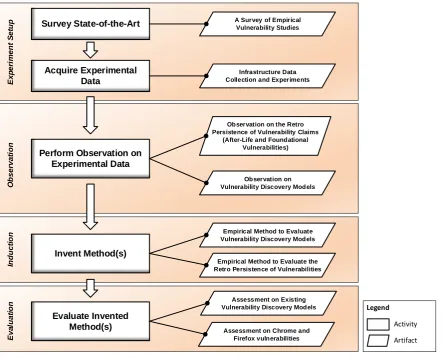
Figure2.2shows how we apply the research method in this dissertation, and how various
artifacts in subsequent chapters could fit to the research method. In this figure, rectangles
are activities and parallelograms represent artifacts produced in each activity. In general
the dissertation consists of following activities: Survey State-of-the-Art(Chapter3),Acquire Experimental Data(Chapter4),Perform Observation on Experimental Data(Chapter5, and Chapter6),Invent Method(s)(Chapter6, Chapter8), andEvaluate Invented Method(s) (Chap-ter7, Chapter9).
As parts of these activities, we have conducted several empirical experiments. In these
experiments, we have refined the research objective into several technical research
Survey State-of-the-Art
Acquire Experimental Data
Perform Observation on Experimental Data Invent Method(s) Evaluate Invented Method(s) E x p e ri m e n t S e tu p O b s e rv a ti o n In d u c ti o n E v a lu a ti o n
A Survey of Empirical Vulnerability Studies
Infrastructure Data Collection and Experiments
Observation on the Retro Persistence of Vulnerability Claims
(After-Life and Foundational Vulnerabilities)
Observation on Vulnerability Discovery Models
Empirical Method to Evaluate Vulnerability Discovery Models
Empirical Method to Evaluate the Retro Persistence of Vulnerabilities
Assessment on Existing Vulnerability Discovery Models
Assessment on Chrome and Firefox vulnerabilities
Activity
Artifact
Legend
Figure 2.2: An overview to the research activities and produced artifacts.
questions, which will be described in the rest of this section, and are summarized in
Ta-ble2.1.
The details of these activities and research questions are discussed in the sequel.
2.2.1 Survey State-of-the-Art
This activity is a part of the experiment setup where we gather background knowledge for
the research. Since the major focus of this dissertation lays on the area of empirical studies,
we conduct a survey about empirical studies on software vulnerabilities. The survey aims
to understand the following characteristics in past research studies: the research questions
which past studies have addressed, and the vulnerability data sources, particularly data
the following research questions:
RQ1 Which are the popular data sources for vulnerability studies?
RQ2 Which data sources and features are used for which studies?
The outcome of this activity is aSurvey of Empirical Vulnerability Studies. The details of the survey is described in Chapter3.
2.2.2 Acquire Experimental Data
Data is a common requisite for an empirical study about vulnerabilities since data plays a
crucial role in an empirical experiment. As a part of the experiment setup, this activity leads
to anInfrastructure Data Collection and Experimentsto acquire vulnerability data. The in-frastructure describes the software inin-frastructure and rules for compiling vulnerability data
from various data sources discussed in the survey of the previous activity. The details of the
data infrastructure are discussed in Chapter4.
2.2.3 Perform Observation on Experimental Data
Based on the collected data, we can start the observation for interesting phenomena. We also
challenge the claims in past studies on the same data sources as we have an independent
validation of these claims. In particular, we have made the following observations:
• Observation on the Retro Persistence of Vulnerabilities (After-Life Vulnerabilities and Foundational Vulnerabilities). We observe Firefox vulnerabilities in order to look for an empirical evidence whethersoftware-evolution-as-a-security-solutionis actually a solution. This observation reveals that a non-negligible amount of after-life
vulnera-bilities is a counter-evidence the solution. We also use the vulnerability data to check
the claim whether foundational vulnerabilities are the majority [OS06]. More detailed
discussion on this observation is described in Chapter5.
On the other side, we observe an implicit rule in reporting vulnerability claims by the
NVDsecurity team: they will claimall versionsof a software vulnerable to a particu-lar vulnerability without any additional validation if its description has something like
“version X and its previous versions are vulnerable”. This rule might be overdosed, and could be a threat to validity of not only empirical vulnerability studies, but also
• Observation on Vulnerability Discovery Models. We observe many issues that exist in the traditional validation method to evaluateVDMs. They bias the outcome ofVDM
validation experiments that follow this traditional method. Additionally, existing
vali-dation experiments in the past were conducted by the own authors of the model. This
observation motivated the invention of an empirical method that could independently and systematically evaluate the performance ofVDM. This observation is described in
Chapter6.
2.2.4 Invent Method(s)
From the observations done in the previous step, we propose two empirical methods:
• Empirical Method to Evaluate Vulnerability Discovery Models. During the observation activity, we have observed several issues in the traditional validation method forVDMs.
This potentially biases the outcome of VDMvalidation experiments that follow this
method. This motivates the following research questions:
RQ3 How to evaluate the performance of a VDM?
RQ4 How to compare between two or more VDMs?
We answer the above research questions by proposing an empirical method to eval-uate the empirical performance ofVDMs. The method consists of two key analyses:
goodness-of-fit qualityanalysis andgoodness-of-fit predictabilityanalysis. These anal-yses allow researchers (or practitioners) to evaluate the performance ofVDM, as well
as to compareVDMs. With these analyses, the proposed method delivers a better
in-sight than the traditional method. Moreover, the proposed method addresses all issues
of the traditional method. The outcome of aVDMvalidation experiment following the
proposed method is thus more reliable than the traditional analysis. We describe the
methodology in Chapter6.
• Empirical Method to Evaluate the Retro Persistence of Vulnerabilities. The observation on the retro persistence of vulnerability claims motivates following research question:
RQ5 How to estimate the validity of a vulnerability claim to a retro version of software?
We propose an empirical method that could quickly identify whether a vulnerability
claims made to a retro version of software is valid or not. The method quickly looks for
in the repository of the software. Then the method scans through the code base of
a software version, searching vulnerable code footprints. If none of them exists, it is
more likely that the vulnerability claim is not valid. The details of this method are
presented in Chapter8.
2.2.5 Evaluate Method(s)
We conduct two experiments on browser vulnerabilities to test the two proposed empirical
methods. These experiments are:
• Assessment on Existing Vulnerability Discovery Models. We validate the methodology to evaluateVDMs described in Chapter6by conducting an evaluation experiment on
several existingVDMs. The experiment addresses the following research questions:
RQ6 Is the proposedVDMevaluation methodology effective in evaluatingVDMs?
RQ7 Among existing VDMs, which one is the best?
By the word“effective”, we mean the proposed methodology is able to evaluateVDMs at least as good as the traditional methodology to conduct the experiment. We
com-pare the outcomes of each methodology. The comparison shows that the proposed
methodology provides more informative and interesting answers than the traditional
one. The experiment also studies the quality and predictability ofVDMs in different
period of software lifetime. The details of this experiment are reported in Chapter7.
• Assessment on Vulnerabilities of Chrome and Firefox. We test the method to assess the validity of (retrospective) vulnerability claims in an experiment with many major
ver-sions of Chrome and Firefox. The experiment address the following research
ques-tions:
RQ8 Is the proposed assessment method effective in assessing the retro persistence of vulnerabilities?
RQ9 To what extend are vulnerability claims byNVDtrustworthy?
RQ10 To what extend does the bias in vulnerability claims byNVD(if any) impact con-clusions of a vulnerability analysis?
NVD contains significant biases, which may significantly impact the conclusion of a
vulnerability analysis. The details of this experiment are presented in Chapter9.
2.3 Chapter Summary
This chapter presented the research objective, as well as the research method to attain the
objective in this dissertation. The major focus of this work is to propose empirical method(s)
to evaluate empirical vulnerabilities. We followed the inductive inference research
method-ology to carry out the research. During the course of the dissertation, we have refined the
objective into several technical research questions. The answers to these research questions will help to meet the research objective.
C
H
A
P
T
3
A S
URVEY OF
E
MPIRICAL
V
ULNERABILITY
S
TUDIES
This chapter describes a survey about empirical vulnerability studies. The survey focuses on the data usage of past studies, in which we study which data sources have been used, and which data features are available in these data sources. We present some descriptive statistics about the usage of data sources in these studies. Finally, the survey briefly reviews past studies.
A
N important stepping stone for conducting research is to have a sufficientknowl-edge about the literature. A traditional way, which is also very good, to achieve such
knowledge is to conduct a survey. Since we are interested in evaluation of empirical
studies, the objective of the survey on empirical vulnerability studies focuses on the
follow-ing research questions:
RQ1 Which are the popular data sources for vulnerability studies?
RQ2 Which data sources and features are used for which studies?
To find the answers for these questions, we conduct a survey on the vulnerability studies
that based their contributions on top of vulnerability data sources. For the first question,
RQ1, we look at past studies to learn their research questions and which data sources are
used in order to fulfill the research purposes. For the second one,RQ2, we examine the data
sources for provided features and see which features are for which research questions.
The rest of this chapter is organized as follows. Section3.1describes the method that
we follow to conduct the survey. Section 3.2 reviews past studies. Section 3.3presents a
qualitative analysis on data sources used in past studies. Section3.4summarizes the chapter.
3.1 The Method to Conduct the Survey
We partially adopt the guidelines of Kitchenham [Kit04] and Webster and Watson [WW02] to conduct the survey. We select candidate papers in leading journals, conferences, and
work-shops. We search the Scopus (www.scopus.com) for computer science publications with
fol-lowing keywords: “empirical stud(ies)/analysis, software vulnerabilit(ies), software security". We also apply the similar search on Google Scholar. Finally we manually evaluate the
rele-vance of the papers based on their title and abstract. For selected papers, we look at their
bibliography for other candidates. Next, we describe the inclusion criteria for selected
pub-lications.
Included papers are published between 2005 and 2012. Moreover, selected papers should
have their major contributions based on (or validated by) some vulnerability data sources.
Some works in the same series by same authors and with very similar content such as a
conference/workshop paper and its extended journal version are intentionally classified and
evaluated as separate studies for a more rigorous analysis.
Indeed, research studies in the field of software vulnerabilities are diversity and cover
different research topics which might or might not employ a vulnerability data set. Hence,
this chapter mostly scopes out research works that explicitly relied on vulnerability data sets.
Concretely, we focus on past papers in the following research horizons:
• Fact Finding. Works in this horizon describe the state of practice in the field, e.g.,
[Ozm05; OS06; Res05]. These studies provide data and aggregate statistics but do
not provide models for prediction. Some research questions picked from prior studies
are“What is the median lifetime of a vulnerability?"[OS06],“Are reporting rates declin-ing?"[OS06;Res05].
• Modeling. Studies in this area aim to find models that captures certain aspects of vul-nerabilities. For example, in [Alh07;AM05b;AM08;And02;Res05], researchers invent
mathematical models for the evolution of vulnerability, and collect vulnerability data
• Prediction.Such works in this horizon focus on predicting particular attributes of vul-nerabilities based on historical data. Mostly they predict the existence of
vulnerabil-ities in code base, e.g.,[CZ11;Geg09b;Jia08;Men07; Neu07; Ozm05; SW08b; SW08a;
ZN09;Zim07]. The main concern of these papers is to find a metric or a set of metrics
that correlates with vulnerabilities in order to predict vulnerable source files.
If we look at the issue of the lifetime of vulnerabilities,Fact Finding papers will provide statistics on various software and the related vulnerability lifetime. Meanwhile,Modeling
papers will try to identify a mathematical law that describes the lifetime of vulnerabilities
e.g.,a thermodynamic model [And02], or a logistics model [AM05b]. The good papers in the group will provide experimental evidences that support the models,e.g.,[Alh07;AM05b;
AM08]. Studies on this topic aim to increase the goodness-of-fit of their modelsi.e.,try to answer the question“How well does our model fit the facts?". Predictionstudies identified software characteristics (or metrics) that correlate with the existence of vulnerabilities, and
then used these metrics to predict whether a software component will exhibit a vulnerability
during its lifetime. These papers usually use statistics and machine learning methods and
back up their claim with some empirical evidence. These studies focus on the attribute and
the quality of prediction, and they aim to answer the question“How good are we at predict-ing?"
We collected 59 papers that were in the scope of this study. These 59 papers are referred
2005 2006 2007 2008 2009 2010 2011 2012
0
2
4
6
8
10
12
14
Workshop Conference Journal
(a) by publication type
2005 2006 2007 2008 2009 2010 2011 2012
0
2
4
6
8
10
12
14
Facts.Findings Modeling Prediction
(b) by research topics
Note: a paper could be classified into one or more research topics depended on its contributions.
Table 3.1: Details of primary studies.
Studies are formatted according to their contributions:FF– fact findings,M– modeling, P – prediction.
Year Type Primary Studies FF M P All
2005 W [Ozm05] 1 1 0 1
J [Res05] 1 1 0 1
C [AM05b],[AM05a],[Alh05] 0 3 0 3
2 5 0 5
2006 W [Abe06],[Fre06],[Man06],[Ozm06] 2 2 0 4
J [Aro06] 1 0 0 1
C [AM06b],[AM06a],[OS06],[Woo06b],[Woo06a] 1 4 0 5
4 6 0 10
2007 J [Alh07] 0 1 0 1
C [Kim07], [Neu07] 0 1 1 2
0 2 1 3
2008 W [Geg08b],[SW08a] 1 0 1 2
J [AM08] 0 1 0 1
C [Joh08], [SW08b] 0 1 1 2
1 2 2 5
2009 C [Geg09a], [Geg09b],[JM09],[MW09b],[SM09],[Sch09b],[Sch09a],[Vac09],[Wan09] 5 2 3 9
2010 W [Fre10],[MN10], [NT10],[Ran10] 3 0 1 4
J [Aro10],[LZ10] 1 1 0 2
C [Boz10], [CZ10],[Cla10], [Zim10] 1 0 3 4
5 1 4 10
2011 J [CZ11],[MW11],[Sch11], [Shi11],[Woo11] 1 2 2 5
C [Gal11],[Mas11],[You11], [Zha11] 1 2 1 4
2 4 3 9
2012 W [AM12] 1 0 0 1
J [WD12] 0 0 1 1
C [BD12],[EC12],[NM12c],[NM12a],[Sha12],[Shi12] 3 3 0 6
4 3 1 8
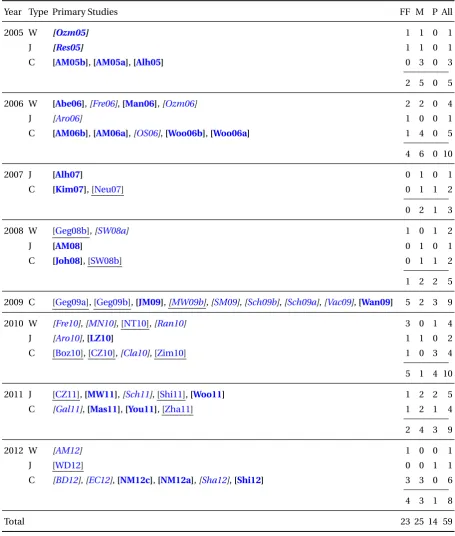
to asprimary studies[Kit04]. Of these, 12 were published in workshops, 35 in conferences, and 12 in journals. Figure3.1classifies primary studies yearly by publication types(a), and
research topics(b). It reveals a stable trend of publications in years.
Table 3.1lists all primary studies with respect to their publication years, and types of
the venue (i.e.,W–workshop, C–conference, and J–journal). We format the primary studies according to their research horizons:italic–fact finding studies,bold–modeling studies, and underline–prediction studies. Notice that some primary studies are classified into several
research horizons. Their format will be the combination, such asbold italicfor fact findings
and modeling studies. Therefore, the sum of all studies might be different from the sums of
all individual horizons.
Among the collected primary studies, I also included my own empirical studies during
the PhD course. However, the reviews for these studies are not presented in this chapters as
they will be presented in the rest of the dissertation.
3.2 A Qualitative Overview to Primary Studies
3.2.1 Fact Finding Studies
The work by Freiet al. [Fre06; Fre10] can be easily described as the representative of the security and economics fields. It offers a detailed landscape of which security vulnerabilities affect which systems but does not provide a concrete answer to any research questions.
Ozment [Ozm05] pointed out many problems that NVD database suffered, which are
chronological inconsistency,incomplete selection, andlack of effort normalization. The chrono-logical inconsistency referred to the inaccuracy in the versions affected by a vulnerability.
The second problem was thatNVDdoes not cover every vulnerability detected in a software
system. In fact, only vulnerabilities that are discovered after 1999 and assignedCVE
identi-fiers are included. The third problem referred to the fact that data is not normalized for the
number of testers. The paper also discussed techniques to address the two first problems: the bugs’ birth dates were approximated by adopting the repository log mining technique
[Sli05], the incomplete selection was compensated by making use of additional data sources.
The authors collected a vulnerability data set for OpenBSD, and used this data set to validate
many software reliability models in another study [Ozm06].
Aroraet al.[Aro06] conducted an analysis to understand how software vulnerability in-formation should be made public. The study correlated the software attacks in the wild
honeynet.org). The empirical result exhibited that vulnerabilities which were published and patched appealed more attacks than others. Additionally, the attacks on non-disclosed
vulnerabilities increased slowly overtime until these vulnerabilities were published.
In another empirical analysis, Aroraet al.[Aro10] analyzed the correlation between se-curity patches and the disclosure of vulnerabilities. The authors collected vulnerability data
from Computer Emergency Response Team/Coordination Center (CERT), Bugtraq to
con-duct their study. The outcome of the study was validated again vulnerability data reported
byNVD. Their study revealed that vulnerabilities which were disclosed, or had high
sever-ity were quickly patched. Also, open source vendors tended to deliver patched faster than
closed source vendors.
Ozment and Schechter [OS06] extended the data set discussed in their previous work
[Ozm05] to study whether software security improves with age. The most important findings
in that work was that foundation vulnerabilities were the majority in OpenBSD. However,
their data set did not include data for the first version of OpenBSD, but started from version
v2.3. This would be a validity threat to their findings.
Shin and Williams [SW08a] checked for whether code complexity could account for
vul-nerabilities. They collected known vulnerabilities reported by Mozilla Foundation Security
Advisories (MFSA), and corresponding bugs reported by Mozilla Bugzilla (MBug). Their
study reported a weak correlation between complexity metrics and the occurrences of
vul-nerabilities in Java Script Engine of Firefox v2.0 and retrospective versions.
Vache [Vac09] studied the vulnerability life cycle and the exploit appearance. They have
studied 52000 vulnerabilities reported by Open Source Vulnerability Database (OSVDB) since
December 1998. The study were mostly relied on the time features of the data entries. They
found that they could use Beta distribution to characterize the distribution of the disclosure
date, patch date, and exploit date.
Scarfone and Mell [SM09] performed an analysis on the Common Vulnerabilities
Scor-ing System (CVSS) version 2, which is adopted byNVDto score the severity of its published
vulnerabilities. They analyzed severity scores ofNVDentries to understand the effectiveness
ofCVSSv2 with respect toCVSSv1. The analysis showed that most changesCVSSv2 have
met the desire goals (i.e., they are actually better thanCVSSv1), but some changes com-plicated the calculation of severity score while providing negligible effect. Gallon [Gal11]
developed another analysis on the distribution ofCVSSscores inNVDvulnerabilities. The
study pointed out some deficiencies which might impact the vulnerability discrimination of
CVSSv2.
about the security difference between two kinds of software: open source and closed source.
The study compared 17 applications in several aspects: disclosed vulnerabilities, mean time
between disclosure, vulnerability severity, and patches. The empirical results did not show
any significant evidence about the difference between open source and close source.
Ransbotham [Ran10] studied the exploits on vulnerabilities of open source software to
understand whether disclosing source code would improve the security of software. To con-duct his analysis, the author employed data from three sources: intrusion detection system
alert logs, vulnerabilities reported byNVD, and manual justification whether software was
open source or closed source. The author employed Cox proportional hazard model to
ana-lyze the risk of first exploitation attempt, and two-stage Heckman model to study the number
of alerts per each vulnerability. His study revealed that, compared with closed source
soft-ware, vulnerabilities in open source software have higher risk of exploitation, the attacks
dif-fused sooner and with higher total penetration, and higher volume of exploitation attempts.
Clarket al.[Cla10] worked on the honeymoon effect of 38 software systems (both close and open source) in various categories: operation systems, server applications, and
com-mon user applications. The honeymoon effect was defined as the period of time counting when a software product was released until its first vulnerability was publicly reported. They
collected security advisories from seven sources: Securina, US-CERT, SecurityFocus, IBM
ISS X-Force, SecurityTracker, iDefense’s (VDC) and TippingPoint (ZDI). They calculated the
honeymoon ratiop0/p0+1, in whichp0was the honeymoon period, andp0+1was time
pe-riod between the discovery of the first and second vulnerabilities. All time measurements
were done on theinitial disclosure date, which was the earliest published date of an advisory in several sources. They find that most of software have a positive honeymoon (p0/p0+1>1),
and open-source software seem to have a longer honeymoon than close-source, contradict
to the fact that attackers cannot study the source code of the close-source software. How-ever, they did not show any analysis on code bases of software systems. It is obviously the
limit in their study.
Allodi and Massacci [AM12] performed an analysis for the relation between
vulnerabili-ties’ severity score and their real attacks in the wild. That analysis focused on the question
that whether severity scores byNVD(i.e.,CVSS), and Exploit-DB – a de facto standard data base showing proofs of concept to exploit vulnerabilities, are actually representative for
at-tacks found in the wild. To identify real atat-tacks, they relied on Symantec’s Threat Explorer,
and their own constructed data set called EKITS which contained vulnerabilities used by
exploit kits in the black market. Their findings showed thatNVDand Exploit-DB are no a
Shahzadet al.[Sha12] described a large scale analysis on the life cycle of software vulner-abilities. The analysis were based on data collected fromNVD,OSVDB, and a data set from
other study [Fre06]. The authors highlighted that the patching of vulnerabilities in
close-source software is faster compared to open-close-source software. It is however contradict with
findings by [Aro10]. Such contradiction in these two studies might because they were based on different data sources, and in different time frames.
Bilge and Dumitras [BD12] conducted an analysis on the data of real attacks in the wild.
The data set was built on Worldwide Intelligence Network Environment (WINE) [Win],
de-veloped by Symantec Research Labs, and public vulnerability data sources such asOSVDB,
Microsoft Security Bulletin (MSB), Apple Knowledge Base (AKB). The authors described a method to identify zero-day attacks by mining the conducted data sets. They have
identi-fied 18 zero-day vulnerabilities, and analyzed the evolution of their attacks in time. Their
most important findings included: most zero-day attacks could not be detected in a timely
manner using current policies and technologies, and most of them were targeted attacks;
the public disclosure of vulnerabilities will significantly increase the volume of attacks (up to
five orders of magnitude).
Edwards and Chen [EC12] studied the correlated between several metrics generated by
Static Code Analyzers (SCAs), as well as SCA-identified issues, and the actual vulnerability
rates (in terms of number ofCVEentries). The study outcome showed that SCAs could be
sued to make some assessment of risk due to the significant relation between the number of
SCA-identified issues and the actual vulnerability rates in next releases of software. However,
metrics generated by SCAs could not be used for the same purpose due to an insignificant
correlations between metrics values and vulnerability rates.
3.2.2 Modeling Studies
Anderson [And02] discussed the trade-off in security in open source and close source
sys-tems. On one side ‘to many eyes, all bugs are shallow’, but in the other side, ‘potential hackers
have also had the opportunity to study the software closely to determine its vulnerabilities’.
He proposed aVDM, namely Anderson’s Thermodynamic – AT, based on reliability growth
models. In the AT model, the probability of a security failure at timet, whenn bugs have been removed, was in inverse ratio tot for alpha testers. This probability was even lower for beta testers,λtimes more than alpha testers. However, he did not conduct any experiment
to validate the proposed model
many shortcomings ofNVD, his study heavily relied on it. By studying vulnerability reports
of several applications inNVD, Rescorla introduced two mathematical models to capture the
discovery trends of vulnerabilities. These models wereRescorla’s Linear modelandRescorla’s Exponential model, to identify trends in vulnerability discovery.
Alhazmiet al. [AM05a; AM05b; Alh07] observed vulnerabilities of Windows and Linux systems from different sources. For Windows systems, the data sources were mostlyNVD,
other papers, and private sources. For Linux systems, data was fromNVDand Bugzilla for
Linux. The authors tried to model the cumulative vulnerabilities of these system into two
models: thelogistic modeland thelinear model. Based on the goodness of fit on each model, the authors gave a forecast about the number of undiscovered vulnerabilities, and
empha-sized the applicability of the new metric called vulnerability density which was obtained by dividing the total of vulnerabilities by the size of the software systems. Also based on
these vulnerability data, Alhazmi and Malaiya [AM08] compare their proposed models with
Rescorla’s [Res05] and Anderson’s [And02]. The result showed that their logistic model had a
better goodness of fit than others.
Wooet al.[Woo06a] carried out an experiment with AML on three browsers IE, Firefox and Mozilla. However, it was unclear which versions of these browsers were analyzed. Most likely, they did not distinguish between versions. In their experiment, IE has not been fitted,
Firefox was fairly fitted, and Mozilla was good fitted. From this result, we could not
con-clude anything about the performance of AML. In another experiment, Wooet al.[Woo06b] validated AML against two web servers: Apache and IIS. Also, they did not distinguish
be-tween versions of Apache and IIS. In this experiment, AML has demonstrated a very good
performance on vulnerability data.
Kimet al.[Kim07] introduced AML for Multiple-Version (MVDM) which was the gener-alization of AML. MVDM divides vulnerabilities of a version into several fragments. The first
fragment included vulnerabilities affecting a version and its past versions, and other
frag-ments included shared vulnerabilities of a version and its future versions. The authors
com-pared MVDM to AML on Apache and MySQL. Both models were well fitted the data. MVDM
was slightly better, but not significant.
Johet al.[Joh08] proposed JW model, and compared it to AML on WinXP, Win2K3 and Linux (RedHat and RedHat Enterprise). The goodness-of-fit of JW was slightly worse than
AML. In other work, Youniset al.[You11] proposed YF model and compared it to AML on Win7, OSX 5.0, Apache 2.0, and IE8. The results showed that YF was sometime better than
AML.
software based on existing vulnerabilities and historical vulnerabilities in a software service.
The metrics were derived from the severity of vulnerabilities. The authors conducted an
experiment usingNVDdata to evaluate their metrics. However the result of the experiment
was not clearly reported.
Manadhataet al. [MW09a; Man06; MW11] worked on a system-level metric called at-tackability, which estimated the opportunities to attack. This metric was first introduced in
[How05]. Manadhataet al. categorized the attackability of a software system into different abstract dimensions. These dimensions together defined the attack surface of the system,
which was how much the software was exposed to attacks. The attackability is therefore
measured by the total area of the attack surface. The authors have conducted some
experi-ments to validate the proposed metrics.
Liu and Zhang [LZ10] analyzed the severity scores of a large set of vulnerabilities in
sev-eral data sources, including IBM ISS X-Force, Vupen, andNVD. Their analysis exhibited the
significant difference between the severity scores of vulnerabilities by different data sources.
Based on the outcome of the analysis, the author proposed a new system for rating and
scor-ing vulnerabilities.
3.2.3 Prediction Studies
Hereafter, we briefly review studies on this area after 2005. For older studies, interested
read-ers can find more details in the review of Catal and Diri [CD09].
Neuhauset al.[Neu07] constructed a tool called Vulture to predict vulnerable compo-nents for Mozilla products with a hit rate of 50%. Vulture used a vulnerability database for
Mozilla products for training its predictor. This database was compiled upon three main
different sources: MFSA,MBugand Concurrent Version System (CVS) archive. Vulture
col-lected the import patterns and function-call patterns in many known vulnerable modules
and then applied the Support Vector Machine (SVM) technique classify new modules.
Meneely and Williams [MW09b] performed an empirical case study examining the
cor-relation between the known vulnerabilities and develop