S H O R T G E N O M E R E P O R T
Open Access
Genome sequences of copper resistant and
sensitive
Enterococcus faecalis
strains
isolated from copper-fed pigs in Denmark
Siyu Zhang
1,2, Dan Wang
3, Yihua Wang
1, Henrik Hasman
4, Frank M. Aarestrup
4, Hend A. Alwathnani
5,
Yong-Guan Zhu
2,6and Christopher Rensing
1,6*Abstract
Six strains ofEnterococcus faecalis(S1, S12, S17, S18, S19 and S32) were isolated from copper fed pigs in Denmark. These Gram-positive bacteria within the genusEnterococcusare able to survive a variety of physical and chemical challenges by the acquisition of diverse genetic elements. The genome of strains S1, S12, S17, S18, S19 and S32 contained 2,615, 2,769, 2,625, 2,804, 2,853 and 2,935 protein-coding genes, with 41, 42, 27, 42, 32 and 44 genes encoding antibiotic and metal resistance, respectively. Differences between Cu resistant and sensitiveE. faecalis strains, and possible co-transfer of Cu and antibiotic resistance determinants were detected through comparative genome analysis.
Keywords:Enterococcus faecalis, Copper resistance, Antibiotic resistance, Genome sequence, Comparative genomics
Introduction
Copper is an essential trace element with an ubiquitous cellular distribution and performs several biological functions [1]. It serves as an important structural com-ponent or catalytic co-factor for a wide range of different enzymes in various important biochemical pathways in bacteria, plants and animals [2]. Because Cu, among many other micronutrients, is beneficial for growth pro-motion and feed efficiency of farm animals [3, 4], it is extensively used as an additive in swine feed. Normally, the concentration of Cu used in animal feed is in excess of the nutritional requirements of animals as it is used as an alternative to in-feed antibiotics for prevention of diarrheal disease [5]. Therefore, enteric bacteria, both commensal and pathogenic, in these animals have typic-ally acquired several additional Cu resistance determi-nants to survive its toxicity [1, 6, 7].
Enterococci belong to the gastrointestinal flora of humans and animals, and have been known for more than a century for their pathogenicity to humans, caus-ing urinary tract and surgical wound infections, bacter-aemia and endocarditis [8]. Currently, more than 30
species within the genus Enterococcus have been
de-scribed, and the two most studied enterococcal species are Enterococcus faecium and Enterococcus faecalis [9].
Over the last two decades, E. faecalis and E. faecium
have become increasingly important nosocomial patho-gens worldwide and are difficult treat due to their increasing multidrug resistance [10]. The intrinsic resist-ance ofEnterococcusto many antibiotics and its acquisi-tion of resistance determinants to other antimicrobial
agents led to the emergence of Enterococcus as a
noso-comial pathogen [11, 12]. Recently, the co-selection of MDR isolates by antibiotics, metals and biocides has
been reported [13, 14], and the resistance of
Entero-coccus to both Cu and antibiotics has been established [15, 16]. However, few studies have addressed gene transfer and the underlying molecular mechanisms of
the various Cu resistance determinants in E. faecalis
[17]. Herein, we present the genome sequences along with the main features of six E. faecalis strains showing * Correspondence:[email protected]
1
Department of Plant and Environmental Science, University of Copenhagen, Frederiksberg, Denmark
6
Key Laboratory of Urban Environment and Health, Institute of Urban Environment, Chinese Academy of Sciences, Xiamen, China Full list of author information is available at the end of the article
the differences between Cu resistant and sensitive strains of E. faecalis, and suggesting possible co-transfer of Cu and antibiotic resistance determinants in these bacteria.
Organism information Classification and Features
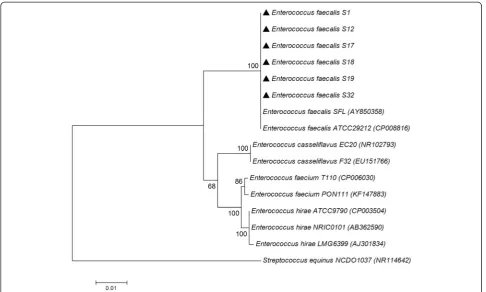
Phylogenetic analysis was performed using the 16S rRNA gene sequences on the six strains S1, S12, S17, S18, S19 and S32 and related species. Sequences were aligned using Clustal W, and a phylogenetic tree was constructed using neighbor-joining (NJ) method imple-mented in MEGA version 6.0. The resultant tree topolo-gies were evaluated by bootstrap analyses with 1,000 random samplings. Phylogenetic analysis based on 16S rRNA gene sequences showed that the six strains clus-tered together withE. faecalisATCC 29212 andE.
faeca-lis SFL with a high bootstrap value (100 %). All the E.
faecalisare in a distinct branch with the other enterococci, such as E. casseliflavus, E. faecium, E. hirae and the
an-other pig gut Firmicute, that is Streptococcus equinus
NCDO 1037 (Fig. 1). The six strains could be classified as
members of the genus Enterococcus based on their 16S
rRNA gene phylogeny and phenotypic characteristics (Table 1).
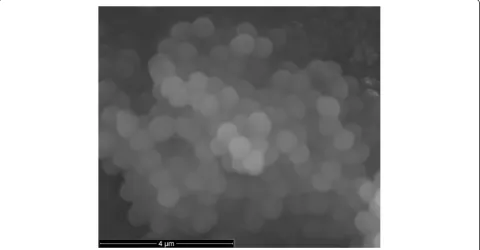
E. faecalis is a Gram-positive, oval-shaped, and often highly pathogenic bacterium classified as a member of the genusEnterococcus(Table 1 and Fig. 2) [18, 19]. It is
a natural inhabitant of the mammalian gastrointestinal tract and is commonly found in soil, sewage, water and food [8].E. faecalisis quite versatile and able to survive a variety of physical and chemical challenges by the acquisi-tion of diverse genetic elements, which may contribute to their adaption to different hosts and environments [20, 21]. They are able to grow in temperatures ranging from 0 °C up to 50 °C, and can survive in the presence of 6.5 % NaCl and in broth at pH 9.6 [22]. They can also be resistant to heavy and transition metals [17], as well as many different antibiotics [23–25], especially vancomycin [20, 21].
Genome sequencing information Genome project history
TheE. faecalisstrains (S1, S12, S17, S18, S19 and S32) were isolated from Cu-fed pigs as part of the Danish Integrated Antimicrobial Resistance Monitoring (DAN-MAP) surveillance program [23]. The isolates were collected from healthy animals at or just prior to
slaughter. Those whole-genome shotgun projects
have been deposited in DDBJ/EMBL/GenBank under the accession number JTKS00000000, JTKT00000000, JTKU00000000, JTKV00000000, JTKW00000000 and JTKX00000000. Table 2 presents the project information and its association with MIGS version 2.0 compliance [26]. Cu resistant strains are E. faecalis strains S1, S18, S32, while the other three strains are Cu sensitive.
Fig. 1Phylogenetic tree highlighting the position of the sixE. faecalisstrains relative to phylogenetically closely related type strains within the genusEnterococcus. The sequences were aligned using Clustal W, and the neighbor-joining tree was constructed based on kimura 2-parameter distance model using MEGA 6.0. Bootstrap values above 50 % are shown obtained from 1,000 bootstrap replications. Bar, 0.02 substitutions per nucleotide position. GenBank accession numbers are displayed in parentheses. Large triangles represent the sixEnterococcusstrains sequenced in this study
Growth conditions and genomic DNA preparation
E. faecalis were streaked on Slanetz agar (BD Difco) plates and grown for 48 h at 42 °C. Each strain was inoc-ulated separately into 25 ml of brain heart infusion broth at 37 °C for 24 h. Genomic DNA was purified from the isolates using the Easy-DNA extraction kit (Invitrogen), and DNA concentrations were determined by the Qubit dsDNA BR assay kit (Invitrogen).
Genome sequencing and assembly
Whole genome sequencing of E. faecalis strains S1, S12,
S17, S18, S19 and S32 was carried out on an Illumina Miseq platform (Illumina, Inc., San Diego, CA). Genomic libraries were prepared by the Nextera XT DNA sample preparation kit (Illumina, cat. No. FC-131-1024), and then sequenced using v3, 2 × 300 bp chemistry on the Illumina MiSeq platform. Genomic assemblies were constructed using Velvet version 1.1.04, generating 24, 57, 20, 103, 34 and 89 contigs, respectively.
Genome annotation
The resulting contigs were uploaded onto the Rapid Annotation using Subsystem Technology server databases and the gene-caller GLIMMER 3.02 [27, 28] to predict open reading frames. The predicted ORFs were translated and annotated by searching against clusters of orthologous groups using the SEED databases [29], as well as NCBI da-tabases. RNAmmer 1.2 [30] and tRNAscan SE 1.23 [31] were used to identify rRNA genes and tRNA genes, re-spectively. CRISPR repeats were examined using CRISPR recognition tool (CRT) [32].
Genome properties
Whole genome sequencing ofE. faecalisstrains S1, S12,
S17, S18, S19 and S32 resulted in 156, 162, 240, 84, 172 and 200 fold coverage of the genomes, respectively. The draft genome sizes were 2,762,808, 2,896,725, 2,786,673, 2,888,656, 2,969,229 and 3,037,709 bp in length, with an average GC content of 37.6, 37.4, 37.5, 37.4, 37.2 and Table 1Classification and general features of the sixEnterococcus faecalisstrains according to the MIGS recommendations [26]
MIGS ID Property Term Evidence codea
Current classification Domain:Bacteria TAS [38]
Phylum:Firmicutes TAS [39]
Class:Bacilli TAS [40]
Order:Lactobacillales TAS [41]
Family:Enterococcaceae TAS [42]
Genus:Enterococcus TAS [18,19]
Species:Enterococcus faecalis TAS [43]
Strain: S1, S12, S17, S18, S19, S32 NAS
Gram stain Positive TAS [42]
Cell shape Oval cocci TAS [42]
Motility None TAS [44]
Sporulation Non-sporulating TAS [43]
Temperature range 10-45 °C TAS [22]
Optimum temperature 37 °C TAS [22]
pH range 4.6-9.9 (Optimum pH at 7.5) TAS [22]
MIGS-6 Habitat Gastrointestinal tracts of humans and other mammals TAS [8]
MIGS-6.3 Salinity 0-6.5 % TAS [22]
MIGS-22 Oxygen Facultatively anaerobic TAS [44]
MIGS-15 Biotic relationship Commensal bacterium TAS [8]
MIGS-14 Pathogenicity Highly pathogenic TAS [43]
MIGS-4 Geographic location Denmark NAS
MIGS-5 Sample collection 2011 NAS
MIGS-4.1 Latitude Unknown NAS
MIGS-4.2 Longitude Unknown NAS
MIGS-4.3 Altitude Unknown NAS
a
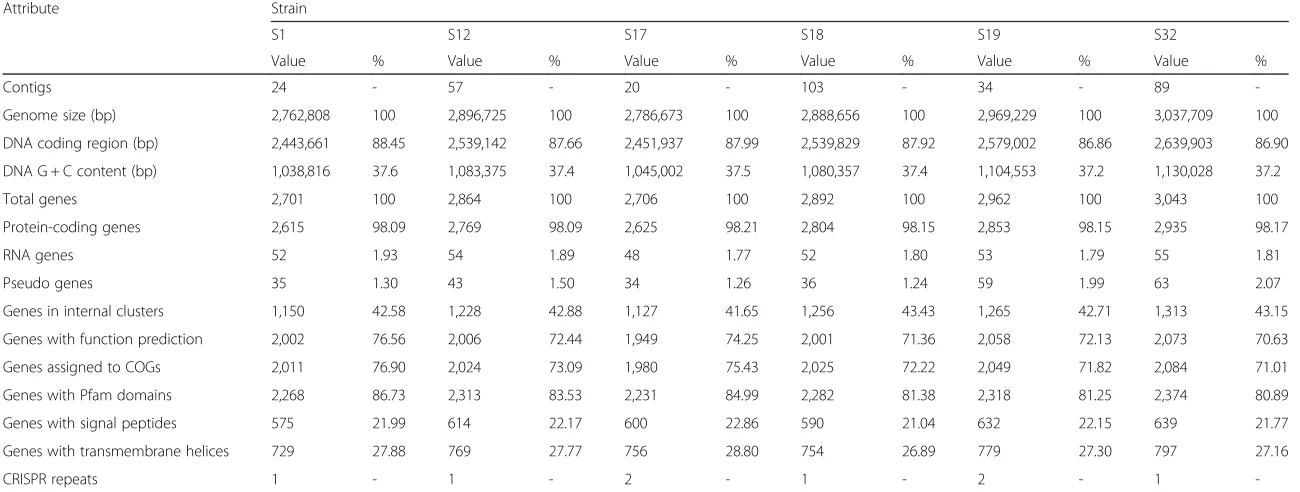
37.2 %, respectively, and comprises 2,615; 2,769; 2,625; 2,804; 2,853 and 2,935 protein coding sequences, re-spectively. Of the protein coding genes, 2,002; 2,006; 1,949; 2,001; 2,058 and 2,073 were genes with function predictions, with 41, 42, 27, 42, 32 and 44 genes respon-sible for antibiotics and toxic compounds resistant, respectively. There are 52 (4 rRNA genes and 48 tRNA genes), 54 (3 rRNA genes and 51 tRNA genes), 48 (3
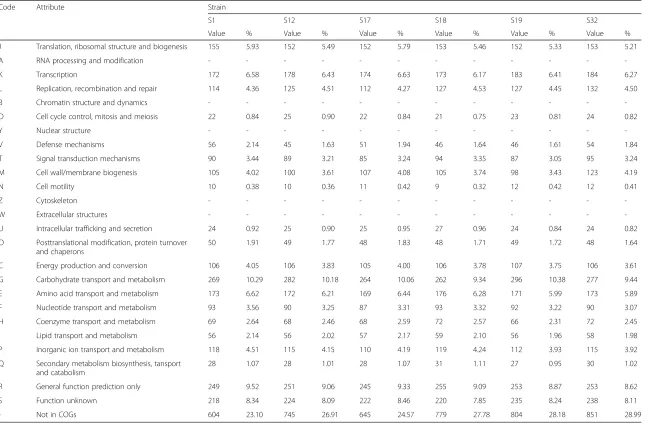
rRNA genes and 45 tRNA genes), 52 (4 rRNA genes and 48 tRNA genes), 53 (3 rRNA genes and 50 tRNA genes) and 55 (5 rRNA genes and 50 tRNA genes) RNA genes for strains S1, S12, S17, S18, S19 and S32, re-spectively. The properties and statistics for the genome are summarized in Table 3. The distribution of genes into COG functional categories is presented in Table 4 and Fig. 3.
Fig. 2Micrograph ofE. faecalisstrains obtained by scanning electron microscopy. Scale bar, 4 m
Table 2Project information
MIGS ID Property Term/Strains
S1 S12 S17 S18 S19 S32
MIGS-31 Finishing quality High-quality draft
MIGS-28 Libraries used One paired-end Illumina library
MIGS-29 Sequencing platforms Illumina Miseq
MIGS-31.2 Fold coverage 156 162 240 84 172 200
MIGS-30 Assemblers Velvet version 1.1.04
MIGS-32 Gene calling method Glimmer 3.0
Genbank ID JTKS00000000 JTKT00000000 JTKU00000000 JTKV00000000 JTKW00000000 JTKX00000000
Genbank Date of Release 2014/12/02
Bioproject PRJNA267758 PRJNA268957 PRJNA268240 PRJNA268137 PRJNA267759 PRJNA268241
Project relevance Environmental
MIGS-13 Source Material Identifier Strain: 1 Strain: 12 Strain: 17 Strain: 18 Strain: 19 Strain: 32
Project relevance Environment, bacteria isolated from copper fed pigs
Copper resistant strains are marked in red (S1, S18 and S32)
Table 3Genome statistics
Attribute Strain
S1 S12 S17 S18 S19 S32
Value % Value % Value % Value % Value % Value %
Contigs 24 - 57 - 20 - 103 - 34 - 89
-Genome size (bp) 2,762,808 100 2,896,725 100 2,786,673 100 2,888,656 100 2,969,229 100 3,037,709 100
DNA coding region (bp) 2,443,661 88.45 2,539,142 87.66 2,451,937 87.99 2,539,829 87.92 2,579,002 86.86 2,639,903 86.90
DNA G + C content (bp) 1,038,816 37.6 1,083,375 37.4 1,045,002 37.5 1,080,357 37.4 1,104,553 37.2 1,130,028 37.2
Total genes 2,701 100 2,864 100 2,706 100 2,892 100 2,962 100 3,043 100
Protein-coding genes 2,615 98.09 2,769 98.09 2,625 98.21 2,804 98.15 2,853 98.15 2,935 98.17
RNA genes 52 1.93 54 1.89 48 1.77 52 1.80 53 1.79 55 1.81
Pseudo genes 35 1.30 43 1.50 34 1.26 36 1.24 59 1.99 63 2.07
Genes in internal clusters 1,150 42.58 1,228 42.88 1,127 41.65 1,256 43.43 1,265 42.71 1,313 43.15
Genes with function prediction 2,002 76.56 2,006 72.44 1,949 74.25 2,001 71.36 2,058 72.13 2,073 70.63
Genes assigned to COGs 2,011 76.90 2,024 73.09 1,980 75.43 2,025 72.22 2,049 71.82 2,084 71.01
Genes with Pfam domains 2,268 86.73 2,313 83.53 2,231 84.99 2,282 81.38 2,318 81.25 2,374 80.89
Genes with signal peptides 575 21.99 614 22.17 600 22.86 590 21.04 632 22.15 639 21.77
Genes with transmembrane helices 729 27.88 769 27.77 756 28.80 754 26.89 779 27.30 797 27.16
CRISPR repeats 1 - 1 - 2 - 1 - 2 - 1
-The total is based on either the size of the genome in base pairs or the total number of protein coding genes in the annotated genome
Standards
in
Genomic
Sciences
(2015) 10:35
Page
5
of
Table 4Number of genes associated with the 25 general COG functional categories
Code Attribute Strain
S1 S12 S17 S18 S19 S32
Value % Value % Value % Value % Value % Value %
J Translation, ribosomal structure and biogenesis 155 5.93 152 5.49 152 5.79 153 5.46 152 5.33 153 5.21
A RNA processing and modification - - -
-K Transcription 172 6.58 178 6.43 174 6.63 173 6.17 183 6.41 184 6.27
L Replication, recombination and repair 114 4.36 125 4.51 112 4.27 127 4.53 127 4.45 132 4.50
B Chromatin structure and dynamics - - -
-D Cell cycle control, mitosis and meiosis 22 0.84 25 0.90 22 0.84 21 0.75 23 0.81 24 0.82
Y Nuclear structure - - -
-V Defense mechanisms 56 2.14 45 1.63 51 1.94 46 1.64 46 1.61 54 1.84
T Signal transduction mechanisms 90 3.44 89 3.21 85 3.24 94 3.35 87 3.05 95 3.24
M Cell wall/membrane biogenesis 105 4.02 100 3.61 107 4.08 105 3.74 98 3.43 123 4.19
N Cell motility 10 0.38 10 0.36 11 0.42 9 0.32 12 0.42 12 0.41
Z Cytoskeleton - - -
-W Extracellular structures - - -
-U Intracellular trafficking and secretion 24 0.92 25 0.90 25 0.95 27 0.96 24 0.84 24 0.82
O Posttranslational modification, protein turnover and chaperons
50 1.91 49 1.77 48 1.83 48 1.71 49 1.72 48 1.64
C Energy production and conversion 106 4.05 106 3.83 105 4.00 106 3.78 107 3.75 106 3.61
G Carbohydrate transport and metabolism 269 10.29 282 10.18 264 10.06 262 9.34 296 10.38 277 9.44
E Amino acid transport and metabolism 173 6.62 172 6.21 169 6.44 176 6.28 171 5.99 173 5.89
F Nucleotide transport and metabolism 93 3.56 90 3.25 87 3.31 93 3.32 92 3.22 90 3.07
H Coenzyme transport and metabolism 69 2.64 68 2.46 68 2.59 72 2.57 66 2.31 72 2.45
I Lipid transport and metabolism 56 2.14 56 2.02 57 2.17 59 2.10 56 1.96 58 1.98
P Inorganic ion transport and metabolism 118 4.51 115 4.15 110 4.19 119 4.24 112 3.93 115 3.92
Q Secondary metabolism biosynthesis, tansport and catabolism
28 1.07 28 1.01 28 1.07 31 1.11 27 0.95 30 1.02
R General function prediction only 249 9.52 251 9.06 245 9.33 255 9.09 253 8.87 253 8.62
S Function unknown 218 8.34 224 8.09 222 8.46 220 7.85 235 8.24 238 8.11
- Not in COGs 604 23.10 745 26.91 645 24.57 779 27.78 804 28.18 851 28.99
The total is based on the total number of protein coding genes in the annotated genome
Zhang
et
al.
Standards
in
Genomic
Sciences
(2015) 10:35
Page
6
of
Insights from the genome sequence
All of the six strains contain a four gene operon,
copY-ZAB, encoding a Cu resistance determinant (Table 5),
which was initially observed in the Gram-positive bacter-iumE. hirae[33]. CopA and CopB are P-type ATPases
re-sponsible for ATP-dependent Cu+ transport across the
cytoplasmic membranes. The Cu chaperone CopZ binds two Cu+atoms in a solvent accessible manner, presumably to facilitate their transfer to the transcriptional regulator
CopY. Upon binding Cu+, CopY undergoes a
conform-ational change and is released from the copA operator
allowing expression of the copYZAB operon [1]. A gene
encoding the cytoplasmic Cu homeostasis protein CutC was identified in all six strains (Table 5), and CutC has
been demonstrated to be involved in Cu homeostasis in E. faecalis [34]. In addition, another possible gene
encoding a putative Cu+-translocating P-type ATPase,
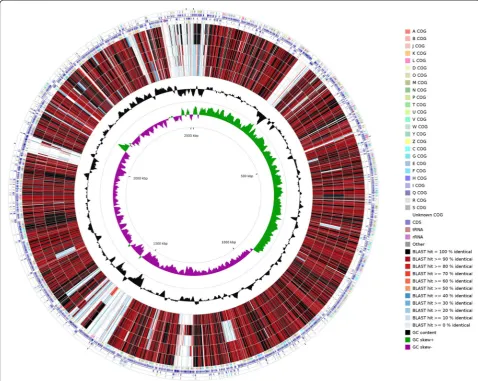
was identified in all six strains namedctpAin this study (Table 5). The genome comparisons of the sixE. faecalis strains using E. faecalis S32 as the reference strain by CGview comparison tool [35] indicated that S1 and S18 were more similar to the reference strain S32 than the other three strains (Fig. 3).
The tcrYAZB operon was initially identified on the
pA17sv1 plasmid in E. faecium, which also carried
genes encoding resistance to erythromycin (ermB) and
E. faecalis which encodes a Cu+-translocating P-type
ATPase homologous to CopB encoded on copYZAB
operon [37]. Comparing these six E. faecalis strains
against others previously identified with increased Cu
resistance, the tcrYAZB operon and adjacent cueO
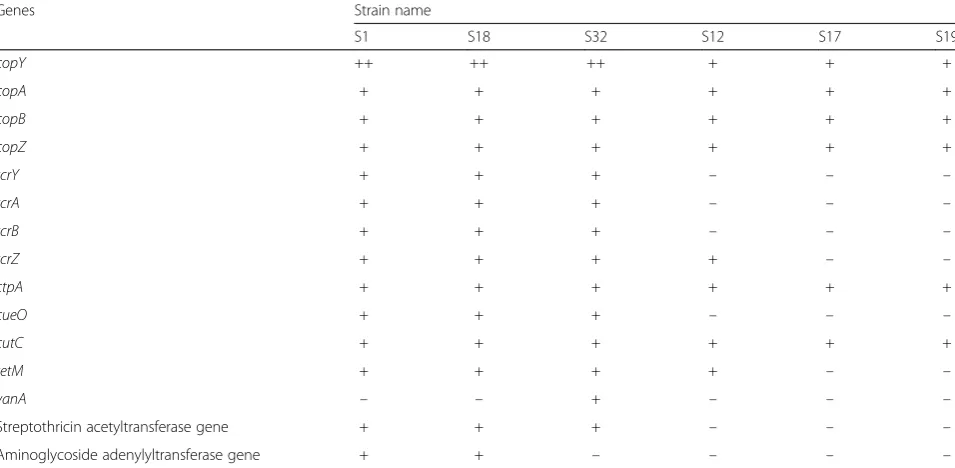
encoding a multicopper oxidase were only identified in E. faecalis S1, S18 and S32 (Table 5). Blasting of the tcrYAZB operon against the contigs of the other three
strains verified that they were indeed lacking Cu
resist-ance genes. ThecueOgene identified in putative copper
resistant strains encodes a multicopper oxidase that is transported across the cytoplasmic membrane and oxi-dizes Cu(I) to Cu(II) and so aids protection from high
Cu concentrations in Enterococcus [9] or other
Gram-positive strains [16]. The approximate 20-gene copper
pathogenicity/fitness island present in E. faecalis S1,
Table 5Copper and antibiotic resistance genes inE. faecalisstrains. S1, S18 and S32 represent the three Cu resistantE. faecalis strains, and S12, S17 and S19 represent the three Cu sensitiveE. faecalisstrains
Genes Strain name
S1 S18 S32 S12 S17 S19
copY ++ ++ ++ + + +
copA + + + + + +
copB + + + + + +
copZ + + + + + +
tcrY + + + – – –
tcrA + + + – – –
tcrB + + + – – –
tcrZ + + + + – –
ctpA + + + + + +
cueO + + + – – –
cutC + + + + + +
tetM + + + + – –
vanA – – + – – –
Streptothricin acetyltransferase gene + + + – – –
Aminoglycoside adenylyltransferase gene + + – – – –
copYABZcopper resistance genes in sensitive strains (For S1, S18 and S32, one of thecopYis on the Cu resistant island, and the other is on the chromosome.);
tcrYABZcopper resistance genes in resistant strains;ctpA: copper resistance genes;cueO: multicopper oxidase genes;cutC: genes encoding cytoplasmic copper homeostasis protein;tetM: tetracycline resistance genes;vanA: vancomycin resistance genes; Streptothricin acetyltransferase gene: streptothricin resistance genes
Fig. 4Cu pathogenicity island inE. faecalisS1, S18 and S32.a: prolipoprotein diacylglyceryl trPropertyansferase,b: intergral membrane protein,c: chaperone,d: hypothetical protein,e:transposase,f: disrupted P-type ATPase,g: integrase,h: adenylate kinase,i: resolvase,copY: CopY family transcriptional regulator,cueO: multicopper oxidase,cusR: Cu(I)-sensing regulator,cusS: Cu(I)-sensing sensor,tcrY:tcrYAZBoperon regulator,tcrA: putative copper-efflux CPx-type ATPase,tcrB: Cu+-translocating CPx-type ATPase,tcrZ: putative chaperone
S18 and S32, show cueO is located in close vicinity of tcrYAZB and probably regulated by an adjacent two-component regulator system (Cu(I)-sensing regulator (cusR) and Cu(I)-sensing sensor (cusS)) (Fig. 4). Trans-posase and mobile element protein genes were also identified on this pathogenicity/fitness island next to tcrYAZB, indicating mobility. Moreover, genes encoding prolipoprotein diacylglyceryl transferase, which is re-sponsible for oxidative stress tolerance potentially also
caused by Cu+, could be identified on these potential
pathogenicity and/or fitness islands as well. For the
other three Cu sensitive E. faecalis S12, S17 and S19,
tcrYAZB,cueO,cusR,cusSor genes encoding a prolipo-protein diacylglyceryl transferase could not be detected.
The antibiotic resistance gene tetM (resistance to
tetracycline) could be identified in the three Cu resistant E. faecalisS1, S18, S32, and Cu sensitiveE. faecalisS12;
vanA (encoding vancomycin resistance) was identified
only in Cu resistant E. faecalisS32; streptothricin ace-tyltransferase gene was identified in the Cu resistant E. faecalis S1, S18, S32; and aminoglycoside adeny-lyltransferase gene was identified in two Cu resistant E. faecalisS1 and S18 (Table 5).
Conclusions
Since the co-transfer of genes encoding antibiotic resist-ance along with Cu tolerresist-ance genes in one transcon-jugant has been demonstrated [14], the results in this study might provide valuable information corroborating the co-transfer of genes encoding additional Cu resistance and genes encoding numerous antibiotic resistances. Also, the identified antibiotic resistance genetetMin all the Cu resistant strains is consistent with the MDR Enterococcus strains observed in the environment [13–16].
Abbreviation MDR:Multidrug-resistant.
Competing interests
The authors declare that they have no competing interests. Authors’contributions
SZ drafted the manuscript, performed laboratory experiments, and analyzed the data. DW and YW performed the comparative genome analysis. HH, FA and HA sequenced, assembled, and annotated the genome. YZ revised the manuscript. CR organized the study and revised the manuscript. All authors read and approved the final manuscript.
Acknowledgements
This work was supported by the Center for Environmental and Agricultural Microbiology (CREAM) funded by the Villum Kann Rasmussen Foundation. Author details
1Department of Plant and Environmental Science, University of Copenhagen,
Frederiksberg, Denmark.2State Key Laboratory of Urban and Regional Ecology, Research Center for Eco-Environmental Sciences, Chinese Academy of Sciences, Beijing, China.3State Key Laboratory of Agricultural Microbiology, College of Life Sciences and Technology, HuaZhong Agricultural University, Wuhan, China.4National Food Institute, Technical University of Denmark, Kgs. Lyngby, Denmark.5Department of Botany and Microbiology, King Saud
University, Riyadh, Saudi Arabia.6Key Laboratory of Urban Environment and Health, Institute of Urban Environment, Chinese Academy of Sciences, Xiamen, China.
Received: 9 February 2015 Accepted: 19 May 2015
References
1. Samanovic MI, Ding C, Thiele DJ, Darwin KH. Copper in microbial pathogenesis: meddling with the metal. Cell Host Microbe. 2012;11(2):106–15.
2. Yazdankhah S, Rudi K, Bernhoft A. Zinc and copper in animal
feed–development of resistance and co-resistance to antimicrobial agents in bacteria of animal origin. Microb Ecol Health Dis. 2014;25.
3. Cunha T. Swine feeding and nutrition. New York: Elsevier; 2012.
4. Jacob ME, Fox JT, Nagaraja T, Drouillard JS, Amachawadi RG, Narayanan SK. Effects of feeding elevated concentrations of copper and zinc on the antimicrobial susceptibilities of fecal bacteria in feedlot cattle. Foodborne Pathogens Dis. 2010;7(6):643–8.
5. Monteiro SC, Lofts S, Boxall A. Pre-assessment of environmental impact of zinc and copper used in animal nutrition. 2010.
6. Hodgkinson V, Petris MJ. Copper homeostasis at the host-pathogen interface. J Biol Chem. 2012;287(17):13549–55.
7. Amachawadi R, Shelton N, Shi X, Vinasco J, Dritz S, Tokach M, et al. Selection of fecal enterococci exhibitingtcrB-mediated copper resistance in pigs fed diets supplemented with copper. Appl Env Microbiol.
2011;77(16):5597–603.
8. Murray BE. The life and times of theEnterococcus. Clin Microbiol Rev. 1990;3(1):46–65.
9. van Schaik W, Top J, Riley DR, Boekhorst J, Vrijenhoek JE, Schapendonk CM, et al. Pyrosequencing-based comparative genome analysis of the nosocomial pathogenEnterococcus faeciumand identification of a large transferable pathogenicity island. BMC Genomics. 2010;11(1):239.
10. Willems RJ, Top J, van Schaik W, Leavis H, Bonten M, Sirén J, et al. Restricted gene flow among hospital subpopulations ofEnterococcus faecium. Mbio. 2012;3(4):e00151–00112.
11. Paulsen I, Banerjei L, Myers G, Nelson K, Seshadri R, Read T, et al. Role of mobile DNA in the evolution of vancomycin-resistantEnterococcus faecalis. Science. 2003;299(5615):2071–4.
12. de Regt MJ, van Schaik W, van Luit-Asbroek M, Dekker HA, van Duijkeren E, Koning CJ, et al. Hospital and community ampicillin-resistantEnterococcus
faeciumare evolutionarily closely linked but have diversified through niche adaptation. PLoS One. 2012;7(2):1–9.
13. Novais C, Freitas AR, Silveira E, Antunes P, Silva R, Coque TM, et al. Spread of multidrug-resistantEnterococcusto animals and humans: an underestimated role for the pig farm environment. J Antimicrob Chemother. 2013;1–9.
14. Silveira E, Freitas AR, Antunes P, Barros M, Campos J, Coque TM, et al. Co-transfer of resistance to high concentrations of copper and first-line antibiotics amongEnterococcusfrom different origins (humans, animals, the environment and foods) and clonal lineages. J Antimicrob Chemother. 2014;69(4):899–906.
15. Hasman H, Kempf I, Chidaine B, Cariolet R, Ersbøll AK, Houe H, et al. Copper resistance inEnterococcus faecium, mediated by thetcrBgene, is selected by supplementation of pig feed with copper sulfate. Appl Environ Microbiol. 2006;72(9):5784–9.
16. Solioz M, Abicht HK, Mermod M, Mancini S. Response of Gram-positive bacteria to copper stress. JBIC J Biological Inorganic Chem. 2010;15(1):3–14. 17. Hasman H. The tcrB gene is part of thetcrYAZBoperon conferring copper
resistance inEnterococcus faeciumandEnterococcus faecalis. Microbiol. 2005;151(9):3019–25.
18. Schleifer K, Kraus J, Dvorak C, Kilpper-Bälz R, Collins M, Fischer W. Transfer of
Streptococcus lactisand related streptococci to the genusLactococcusgen. nov. Syst Appl Microbiol. 1985;6(2):183–95.
19. Devriese L, Baele M, Butaye P. The genusEnterococcus. In: The Prokaryotes: Volume 4:Bacteria:Firmicutes,Cyanobacteria.2006. p. 163–74.
20. Arias CA, Murray BE. The rise of theEnterococcus:beyond vancomycin resistance. Nat Rev Microbiol. 2012;10(4):266–78.
proteolytic activity and biogenic amine production ofEnterococcus faecalis. Int J Food Microbiol. 2001;64(1):105–17.
23. DMAMAP. Use of antimicrobial agents and the occurrence of antimicrobial resistance in bacteria from food animals, foods and humans in Denmark. 2005. 24. Mazaheri Nezhad Fard R, Heuzenroeder MW, Barton MD. Antimicrobial and
heavy metal resistance in commensal enterococci isolated from pigs. Vet Microbiol. 2011;148(2):276–82.
25. Kim J, Lee S, Choi S. Copper resistance and its relationship to erythromycin resistance inEnterococcusisolates from bovine milk samples in Korea. J Microbiol. 2012;50(3):540–3.
26. Field D, Garrity G, Gray T, Morrison N, Selengut J, Sterk P, et al. The minimum information about a genome sequence (MIGS) specification. Nat Biotechnol. 2008;26(5):541–7.
27. Aziz RK, Bartels D, Best AA, DeJongh M, Disz T, Edwards RA, et al. The RAST Server: rapid annotations using subsystems technology. BMC Genomics. 2008;9(1):75.
28. Meyer F, Paarmann D, D'Souza M, Olson R, Glass EM, Kubal M, et al. The metagenomics RAST server–a public resource for the automatic phylogenetic and functional analysis of metagenomes. BMC Bioinformatics. 2008;9(1):386.
29. Hemmerich C, Buechlein A, Podicheti R, Revanna KV, Dong Q. An Ergatis-based prokaryotic genome annotation web server. BMC Bioinformatics.
2010;26(8):1122–4.
30. Lagesen K, Hallin P, Rødland EA, Stærfeldt H-H, Rognes T, Ussery DW. RNAmmer: consistent and rapid annotation of ribosomal RNA genes. Nucleic Acids Res. 2007;35(9):3100–8.
31. Lowe TM, Eddy SR. tRNAscan-SE: a program for improved detection of transfer RNA genes in genomic sequence. Nucleic Acids Res. 1997;25(5):0955–64.
32. Bland C, Ramsey TL, Sabree F, Lowe M, Brown K, Kyrpides NC, et al. CRISPR recognition tool (CRT): a tool for automatic detection of clustered regularly interspaced palindromic repeats. BMC Bioinformatics. 2007;8(1):209. 33. Odermatt A, Suter H, Krapf R, Solioz M. An ATPase operon involved in
copper resistance by Enterococcus hirae. Ann NY Acad Sci. 1992;671:484. 34. Latorre M, Olivares F, Reyes-Jara A, López G, González M. CutC is induced
late during copper exposure and can modify intracellular copper content in
Enterococcus faecalis. Biochem Bioph Res Co. 2011;406(4):633–7.
35. Grant JR, Arantes AS, Stothard P. Comparing thousands of circular genomes using the CGView Comparison Tool. BMC Genomics. 2012;13(1):202. 36. Hasman H, Aarestrup FM.tcrB, a gene conferring transferable copper
resistance in Enterococcus faecium: occurrence, transferability, and linkage to macrolide and glycopeptide resistance. Antimicrob Agents Chemother. 2002;46(5):1410–6.
37. Amachawadi RG, Shelton NW, Jacob ME, Shi X, Narayanan SK, Zurek L, et al. Occurrence oftcrB, a transferable copper resistance gene, in fecal enterococci of swine. Foodborne Pathog Dis. 2010;7(9):1089–97. 38. Woese CR, Kandler O, Wheelis ML. Towards a natural system of organisms:
proposal for the domainsArchaea,Bacteria, andEucarya. Proc Natl Acad Sci. 1990;87(12):4576–9.
39. Schleifer K-H. Phylum XIII. Firmicutes Gibbons and Murray. In:Bergey’s
Manual of Systematic Bacteriology. New York: Springer; 2009: 19–1317. 40. Ludwig W, Schleifer K, Whitman W. Class I. Bacilli class nov.Bergey's Manual
of Systematic Bacteriology. 2009;3:19–20.
41. Ludwig W, Schleifer K, Whitman W. Order II. Lactobacillales ord novBergeys
Manual of Syst Bacteriol. 2009;3:463–513.
42. Amyes SG. Enterococci and streptococci. Int J Antimicrob Agents. 2007;29:S43–52.
43. Rôças IN, Siqueira Jr JF, Santos K. Association ofEnterococcus faecalisWith Different Forms of Periradicular Diseases. J Endod. 2004;30(5):315–20. 44. Stuart CH, Schwartz SA, Beeson TJ, Owatz CB.Enterococcus faecalis: Its role
in root canal treatment failure and current concepts in retreatment. J Endod. 2006;32(2):93–8.
45. Ashburner M, Ball CA, Blake JA, Botstein D, Butler H, Cherry JM, et al. Gene Ontology: tool for the unification of biology. Nat Genet. 2000;25(1):25–9.
Submit your next manuscript to BioMed Central and take full advantage of:
• Convenient online submission
• Thorough peer review
• No space constraints or color figure charges
• Immediate publication on acceptance
• Inclusion in PubMed, CAS, Scopus and Google Scholar
• Research which is freely available for redistribution
Submit your manuscript at www.biomedcentral.com/submit
![Table 1 Classification and general features of the six Enterococcus faecalis strains according to the MIGS recommendations [26]](https://thumb-us.123doks.com/thumbv2/123dok_us/671723.2065984/3.595.58.542.98.467/classification-general-features-enterococcus-faecalis-strains-according-recommendations.webp)