CURRICULUM AND EDUCATION
EvolvingSTEM: a microbial
evolution-in-action curriculum that enhances
learning of evolutionary biology
and biotechnology
Vaughn S. Cooper
1,2,3*, Taylor M. Warren
3, Abigail M. Matela
1,2, Michael Handwork
4and Shani Scarponi
4Abstract
Evolution is a central, unifying theory for all of life science, yet the subject is poorly represented in most secondary-school biology courses, especially in the United States. One challenge to learning evolution is that it is taught as a conceptual, retrospective subject with few tangible outcomes for students. These typical passive learning strate-gies lead to student disengagement with the material and misunderstanding of evolutionary concepts. To promote greater investment and comprehension, we developed EvolvingSTEM, an inquiry-based laboratory curriculum that demonstrates concepts of natural selection, heredity, and ecological diversity through experimental evolution of a benign bacterium. Students transfer populations of Pseudomonas fluorescens growing on plastic beads, which selects for biofilm formation and mutants with new, conspicuous phenotypes. We introduced our curriculum to four introductory high school biology classes alongside their standard curriculum materials and found that students who learned evolution through EvolvingSTEM scored significantly better on a common assessment targeted to Next Generation Science Standards than students taught only the standard curriculum. This latter group subsequently achieved similar scores once they too completed our curriculum. Our work demonstrates that inquiry-based, hands-on experiences with evolving bacterial populatihands-ons can greatly enhance student learning of evolutihands-onary chands-oncepts.
© The Author(s) 2019. This article is distributed under the terms of the Creative Commons Attribution 4.0 International License (http://creat iveco mmons .org/licen ses/by/4.0/), which permits unrestricted use, distribution, and reproduction in any medium, provided you give appropriate credit to the original author(s) and the source, provide a link to the Creative Commons license, and indicate if changes were made. The Creative Commons Public Domain Dedication waiver (http://creat iveco mmons .org/ publi cdoma in/zero/1.0/) applies to the data made available in this article, unless otherwise stated.
Introduction
Understanding evolutionary processes is fundamental to all areas of life science because evolution serves as a conceptual framework to organize other life science top-ics, such as organismal diversity and ecological interac-tions. Furthermore, some of the most significant threats to human health are evolutionary phenomena; therefore, knowledge of evolutionary processes has a direct impact on public health and medicine (Wells et al. 2017). For example, antimicrobial resistance and cancer are caused by the rapid evolution of microbes and our own cells, respectively (Karatan and Watnick 2009; Greaves and Maley 2012; Berendonk et al. 2015; Makohon-Moore and
Iacobuzio-Donahue 2016; Alizon and Méthot 2018). In addition, ongoing revolutions in biotechnology and per-sonalized medicine, such as gene-editing (i.e., CRISPR), can only be understood in the context of the evolution-ary concept of descent from a shared ancestral lineage (Makarova et al. 2015; Knott and Doudna 2018). A strong knowledge base of evolution is therefore invaluable for a literate society to understand scientific and medical advances and for a prepared workforce to excel in jobs in science, technology, and engineering. The value of evolu-tionary biology knowledge is highlighted by its inclusion as a core concept for STEM education practices (National Research Council 2012; NGSS Lead States 2013; NSTA
2013).
Although the importance of evolutionary biology is well-established, misconceptions of its basic principles remain prevalent among students, the general public, and even the teachers who are providing instruction
Open Access
*Correspondence: [email protected]
1 Department of Microbiology and Molecular Genetics, University of Pittsburgh, School of Medicine, Pittsburgh, PA, USA
lectures and textbook readings. Current evolution cur-riculum design runs counter to evidence that student-centered, active learning strategies are the most effective method for science teaching and have been shown to improve student understanding of evolutionary concepts (Nehm and Reilly 2007; Nelson 2008; Freeman et al. 2014; Romine et al. 2017). Courses that provide students with authentic research experiences are especially effective at increasing student engagement and promoting a deeper understanding of evolution (Jordan et al. 2014; Ratcliff et al. 2014; Broder et al. 2018).
There is therefore a critical need for engaging and informative evolutionary biology curricula that pro-vide K-12 students the opportunity to explore the con-cept of changing frequencies of inherited traits just as they attempt to quantify gravity in physics or acid–base reactions in chemistry. To meet this need, we developed EvolvingSTEM, a curriculum that provides inquiry-based learning of evolution, microbiology, ecology, and hered-ity with a laboratory experiment that employs real scien-tific research practices. EvolvingSTEM allows students to visualize evolutionary adaptations arising in real time by growing populations of the harmless bacterium Pseu-domonas fluorescens under conditions that select for the formation of a biofilm. A biofilm is a surface dwelling community of microbes encased in a protective coat-ing of self-produced polymers; biofilms are the domi-nant form of microbial life (Costerton et al. 1987). They are also structured, heterogeneous environments that include varied ecological niches (Karatan and Watnick
2009). Bacteria with advantageous mutations colonize these niches, and their adaptations cause visible differ-ences in colony morphology from the ancestral geno-type (Rainey and Travisano 1998; Flynn et al. 2016). This evolution-in-action occurs within days, requires little specialized equipment, and can be offered in any class-room laboratory that can support sterile technique. Our curriculum is intended to replace standard, passive learn-ing curricula to meet competencies for natural selec-tion and evoluselec-tion described in the Next-Generaselec-tion Science Standards (HS-LS4, (NGSS Lead States 2013)). We hypothesized that students who learn evolutionary concepts with our curriculum would have significant increases in content knowledge relative to students that were provided only the standard curriculum.
tunistic pathogens Burkholderia cenocepacia and
Pseu-domonas aeruginosa (Poltak and Cooper 2011; Flynn
et al. 2016). These species are particularly threatening to persons with cystic fibrosis, where they cause chronic airway infections by forming biofilms (Starkey et al.
2009; Ashish et al. 2013). Biofilm-associated infections are inherently more resistant to host immunity and antimicrobials because secreted adhesive polymers are protective and the cells within grow more slowly (Harri-son et al. 2005). Eventually, some bacteria disperse from the colony, either as individuals or clusters, to inhabit new surfaces and resume the biofilm lifecycle (Poltak and Cooper 2011; Martin et al. 2016).
In order to study the dynamics of bacterial evolution in vitro, we developed a simple method to model the bio-film lifecycle of surface attachment, biobio-film formation, dispersal, and recolonization (Fig. 1, Poltak and Cooper
2011; Traverse et al. 2013; O’Rourke et al. 2015; Flynn et al. 2016; Turner et al. 2018). In short, we culture bac-teria for 24 h in test tubes containing growth media and a polystyrene bead. A subset of the bacteria colonize the bead and form a biofilm. We then transfer only the bio-film-covered bead to a new tube with a fresh bead. We repeat this process daily to select for bacterial mutants that are best adapted to aspects of the entire biofilm lifecycle. Conveniently, we found that biofilm adapted mutants also display altered colony morphologies when grown on agar plates, making them conspicuous to students.
In collaboration with science teachers and adminis-trators at Winnacunnet High School (Hampton, NH, USA), we modified our research laboratory proto-col to accommodate implementation in a high school classroom. We selected the plant probiotic bacterium,
Pseudomonas fluorescens SBW25, as our study subject
by rugose or rosette-like colony morphologies result-ing from greater production of polysaccharides for attachment (Rainey et al. 2000). We found that experi-mental evolution of P. fluorescens SBW25 in the bio-film lifecycle model selected for a high frequency of adaptive mutants with novel colony morphologies in less than 2 weeks.
To accelerate this process and ensure that our experi-ment could be performed within the timeframe of a high school biology lesson, we conducted a series of trials in different media to determine conditions that resulted in predictable, rapid adaptations. We found that growth in King’s B medium (KB) generated multi-ple, heritable colony phenotypes within 7 days. In the interest of accelerating the evolutionary dynamics, we repeated the experiment in KB medium with various glycerol concentrations. We found that an increase from 1.5 to 2.5% glycerol selected for novel colony morpholo-gies at detectable frequencies in 4 days. We named this modified media recipe “Queen’s B” (QB) and used this recipe thereafter. Media recipes are available in Addi-tional file 1.
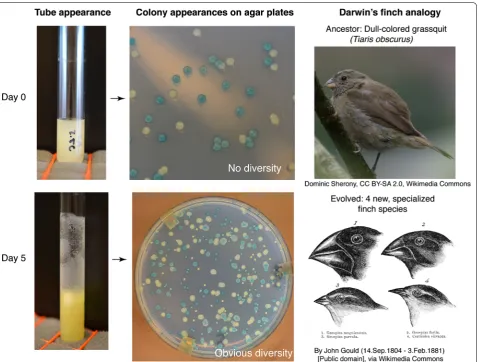
Students can use our modified protocol to guide an inquiry-based experiment that allows them to visual-ize evolution in their bacterial populations in only six class periods (Fig. 2). For example, on Monday, stu-dents inoculate glass test tubes containing QB media and a polystyrene bead with a clone of P. fluorescens
SBW25, and then perform bead transfers for the fol-lowing 3 days (Tuesday–Thursday). During the pro-cess of bead transfer, students can identify effects of natural selection by observing increased biofilm
production on the walls of their test tubes. In addition, at the beginning and end of the week, students sam-ple their populations by growing individual bacterial colonies on agar plates. Students can make observa-tions of mutant colonies on the Monday of the follow-ing week and compare these colonies to those of the ancestral population that were plated earlier in the week. Students can be given additional curriculum materials, such as homework and pretests, to prepare them for each step in the laboratory protocol and provide opportunities for them to link the heritable, adaptive evolutionary change they observe in their experiment to the evolutionary processes that pro-duced this dynamic. Through EvolvingSTEM, students can acquire the knowledge to meet Next Generation Science Standards for Natural Selection and Evolution (Box 1; (NGSS Lead States 2013)). Curriculum materi-als are available as Additional files 2, 3 and 4.
24 hours
of growth of growth24 hours
Planktonic Cells
Bead Bead +Biofilm
Fig. 1 Biofilm lifecycle model. Bacteria are grown in test tubes with plastic beads on which biofilm forms. Daily bead transfers select for bacterial attachment, assembly, dispersal, and reattachment (figure adapted from Turner et al. 2018)
Box 1. Next Generation Science Standards (NGSS) Targeted by EvolvingSTEM
NGSS (2013) are based on A Framework for K-12 Sci-ence Education: Practices, Crosscutting Concepts, and Core Ideas (National Research Council 2012) and designed through a collaboration between 26 states, the National Research Council, the National Science Teachers Association, the American Association for the Advancement of Science, and Achieve, Inc.
to increase in number, (2) the heritable genetic variation of individuals in a species due to muta-tion and sexual reproducmuta-tion, (3) competimuta-tion for limited resources, and (4) the proliferation of those organisms that are better able to survive and reproduce in the environment.
3. Apply concepts of statistics and probability to sup-port explanations that organisms with an advanta-geous heritable trait tend to increase in propor-tion to organisms lacking this trait.
4. Construct an explanation based on evidence for how natural selection leads to adaptation of popu-lations.
5. Evaluate the evidence supporting claims that changes in environmental conditions may result in (1) increases in the number of individuals of some species, (2) the emergence of new species over time, and (3) the extinction of other species.
In addition, for HS-LS4-2, students will learn:
• Random mutation results in genetic variation between members of a population.
• Genetic variation can result in trait variation that leads to performance differences among individu-als.
• Competition for limited resources results in dif-ferential survival. Individuals with more favorable phenotypes are more likely to survive and repro-duce, thus passing traits to subsequent genera-tions.
• Evolutionary fitness is measured by reproductive success.
• An adaptation is a heritable genetic variant mani-fested as a trait that provides an advantage to an individual in a particular environment.
• In addition to natural selection, chance and ran-dom events can influence the evolutionary pro-cess, especially for small populations.
In addition, students will be skilled at:
• Developing experimental investigations that can be used to test specific hypotheses.
population size to increase, (2) genetic variation, (3) competition for resources, and (4) proliferation of individuals better able to survive and reproduce in a particular environment.
• Applying basic mathematics to calculate the fit-ness advantages of selected mutants and/or to compare differences in levels of biofilm produc-tion.
• Developing generalizations of the results obtained and/or the experimental design and applying them to new problems, including the design of new experiments and interpreting results in the context of natural and infectious bacterial bio-films.
Learning outcomes
The exact outcome of any individual experiment is unknown because the biofilm selection acts on randomly occurring mutations in the bacterial populations that were founded from a single clone. In fact, this variability among these independent “replays” of evolution is realis-tic and demonstrates effects of chance and contingency on evolution (Blount et al. 2018). Nonetheless, student groups propagate multiple populations in different cul-ture tubes under identical experimental conditions, and this replication means they are very likely to see mutants with novel morphologies in at least one experimental population. In addition, students compare their experi-mental populations to a control population that does not contain the bead and therefore is not under selection for increased biofilm production. Students can examine the phenotypes found in each population over time, compare their findings to those of other classmates, and develop their own explanations for their observations. This allows students to apply the comparative method of evolution-ary biology and begin the process of scientific inquiry. Students are encouraged to consider why their replicate populations vary and propose reasons for that variation, ranging from experimental error, to peculiarities of the bead transfers, to genuine evolutionary randomness.
Consequently, selection often favors the evolution of diverse, conspicuous phenotypes within each tube and not just a single, more adherent type. This result not only simulates the process of adaptive radiation often illustrated using Darwin’s finches in textbooks (Fig. 2), but also reproduces the selection for traits associated
with adherence that often occurs during biofilm-associ-ated infections (Traverse et al. 2013; Cooper et al. 2014; O’Rourke et al. 2015; Gloag et al. 2018). The “wrinkly” colony morphologies that evolve in our model are geneti-cally and functionally identical to those commonly iso-lated from infections of the reiso-lated species Pseudomonas aeruginosa in the airways of cystic fibrosis patients and in chronic skin wounds (Starkey et al. 2009; Gloag et al.
2018). Students can therefore connect their classroom experiments to recent findings at the interface of evolu-tionary biology and medicine to see how basic biological research impacts their everyday lives. Furthermore, mak-ing connections from classroom activities to real-world examples can increase students’ understanding of evolu-tion and their engagement with the material (Beardsley et al. 2011; Infanti and Wiles 2014).
Table 1 Composition of study groups Group Class—teacher Number
of students per class
Total number of students per group
1 A—Teacher MH 19 41
B—Teacher SS 22
2 C—Teacher SS 18 37
D—Teacher SS 19
Assessment of student learning
We used a delayed intervention approach to assess learn-ing in 4 classes of 9th grade biology honors students at Winnacunnet High School, a suburban public high school in New England. Group 1 included classroom A, taught by MH, and classroom B, taught by SS. This group used an earlier version of our EvolvingSTEM curriculum that did not use a control population alongside their standard curriculum materials, which included textbook readings, lectures, and an educational video. Group 2 included classrooms C and D, both taught by SS. This group first received the standard curriculum with additional lecture materials, followed by EvolvingSTEM (Table 1). Students conducted the experiments and analyses for our curricu-lum in groups of three or four individuals, requiring col-laborative teamwork.
A summative assessment was used to determine whether students achieved an increased understanding of evolutionary concepts. The test consisted of multiple choice and free response questions to address student learning of higher-order critical thinking aligned to NGSS. Specifically, test questions were devised to assess whether students met NGSS (NGSS Lead States 2013) performance expectations HS-LS4-1, 2, 3, and 5. We
developed a grading rubric for the free response ques-tions based on templates suggested by Wiggins and McTighe (2005) that required answers with accurate information, specific vocabulary, and a well-structured defense that incorporated outside examples (Wiggins and McTighe 2005). Our assessment and grading rubric are available as supplemental files (Additional file 5). All assessments were conducted by one of us (TW) on anonymized tests as proscribed by our IRB.
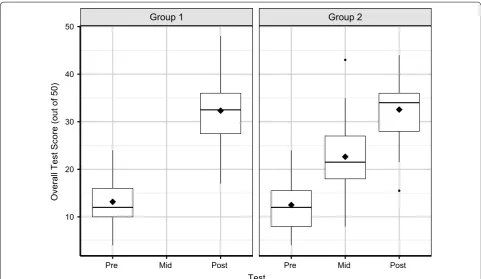
Pretests were given to both groups prior to the start of classroom evolution activities. Group 1 students were given a posttest after completing the EvolvingSTEM cur-riculum. Group 2 students were given a midtest after completing the standard curriculum, and then a post-test after completing EvolvingSTEM. We found no sig-nificant difference between the average pretest score of Group 1 and Group 2 students (13.17 (26%) vs. 12.5 (25%) out of 50 points total; t = 0.60, p = n.s.), indicat-ing that all students began with a similar knowledge base (Fig. 3). Quantitative analyses of student knowledge gains revealed that students who completed EvolvingSTEM (Group 1) showed significant improvement on their aver-age posttest scores, with an averaver-age gain of 19.16 points, thereby increasing their overall score by 38% between the
Pre Mid Post Pre Mid Post
10 20 30
Test
Overall Test Score (out of 50
)
pre- and posttest (t = 16.61, p < 0.0001). Students pro-vided the standard curriculum (Group 2) also showed significant improvement on their average midtest score, which increased by 10.14 points (t = 9.72, p < 0.0001), resulting in an overall increase of 21% between pre- and midtest. Although both student groups showed improve-ment, Group 1 achieved significantly higher average test scores after completing EvolvingSTEM than Group 2 did after completing the standard curriculum (t = 5.87, p < 0.0001). Students who learned evolution with Evolv-ingSTEM therefore achieved significantly greater gains in comprehension of evolution than students who learned it from the standard curriculum.
Once students in Group 2 were exposed to Evolving-STEM, their average posttest scores increased by 20% in comparison to their midtest scores, reaching knowl-edge gains made by Group 1 students (Fig. 3). Knowledge gains by both Groups were overwhelmingly attributable to increased scores on the free-response section of the assessment. Average free-response scores from pretests to posttests increased by 18.09 points (48%) for Group 1 students and 20.59 points (54%) for Group 2 students. In comparison, average multiple-choice scores increased by 1.07 points for Group 1 students and decreased by 0.54 points for Group 2 students. These results may indicate that EvolvingSTEM has a greater impact on improving students’ higher-order cognitive skills, such as apply-ing knowledge to an unknown problem and performapply-ing data analysis. There was no significant difference between Group 1 and 2 posttest scores (t = 0.14, p = n.s.), even though Group 2 students were provided more detailed verbal instruction and took one additional assessment. This result speaks to the power of EvolvingSTEM to increase student knowledge and suggests that our cur-riculum can serve to replace, rather than supplement, the standard evolution curriculum.
Discussion
We developed an inquiry-based microbiology curricu-lum to improve the engagement of high school biology students with topics central to evolutionary biology and their subsequent understanding of related NGSS con-cepts. We observed high levels of engagement when students participated in our curriculum. Students were assigned concept and readiness tests each night to ensure that they arrived prepared for the next day’s microbiology experiments and evolution curriculum (Additional file 4). Their high rates of completion indicated increased enthu-siasm. While we acknowledge this is a simple observa-tion, teachers and coauthors (MH and SS) also indicated that students who rarely participated in class-based dis-cussions emerged as enthusiastic group leaders while performing the EvolvingSTEM experiment. Informal
post-surveys of student attitudes towards the curricu-lum were overwhelmingly positive. Students indicated that they were enthusiastic about the bacterial model, enjoyed coming to class to work on the experiment, and felt that our curriculum was better at teaching them than the standard lecture-style class. The group format for the experiments and analyses encouraged the students to collaborate and support one another throughout the pro-gram. Students tended to hold one another accountable, but also demonstrated cohesion when groups compared their replicate populations, demonstrating both friendly competition and pride and ownership in their results. Further, many students expressed that they felt like “real scientists” using equipment like pipettes, vortexes, and the incubator. They shared a greater sense of what sci-ence was actually like and asked more questions about microbiology and evolution research and other scientific careers.
Crucially, teachers found EvolvingSTEM to be effective at demonstrating evolution in action, thereby increasing student understanding of natural selection, mutation, and the effects of chance, and increasing student interest and engagement with biology. Student assessments also demonstrated the substantial benefit of our curriculum to student learning, and consequently, our curriculum replaced the standard, honors biology WHS evolution curriculum in subsequent years. The sustainability of the EvolvingSTEM curriculum has been greatly facilitated by the involvement of returning students who demonstrated particular interest in the program and who served as de facto teaching assistants through an Extended Learning Opportunity program. (More information about this pro-gram will be the subject of a future report.) This teaching experience was made possible by engaging first-year stu-dents in laboratory research, which allowed them to help teach new students for up to three subsequent years prior to graduating.
ter (Cooper et al. 2014; Gloag et al. 2018), which coordi-nates bacterial surface recognition with increased biofilm production (Hickman and Tifrea 2005). Students are likely to identify wsp mutants in their classroom experi-ments and can therefore connect how changes in DNA can result in changes in protein structure and intracel-lular signaling that lead to increased biofilm production and changes to colony morphology, supporting a greater understanding of DNA, protein structure, and cellular function (NGSS HS-LS1). Furthermore, the bacterial adaptations are in response to environmental changes that provide new niches, supporting a greater under-standing of interdependent relationships in ecosystems (NGSS HS-LS2). Classroom experiments that build upon the core evolution study can therefore span much of the NGSS-recommended introductory biology curriculum and have been adapted to cover more advanced topics for Advanced Placement (AP) Biology as well as to early biol-ogy courses in community colleges or 4-year colleges.
This study was limited to one school and two teachers from a suburban public school in New Hampshire, which naturally raises the question of its efficacy in other set-tings. However, since the program launch and assess-ments reported here, EvolvingSTEM has expanded to be offered in 13 high schools in four different US states with continued growth. These schools range from independ-ent private schools, to suburban public schools, to urban public and magnet high schools, and the classes include introductory “academic” and honors biology, upper-level biotechnology, and AP biology. The core experimental protocol described here has been shown to be robust to different class schedules and student populations, pro-vided that the classroom has the laboratory resources detailed in Additional file 1, including the capacity to prepare sterile growth media either onsite or through a partner laboratory. Additional assessments of learning and motivation towards STEM subjects are ongoing in these schools, but informal teacher and student feedback has been overwhelmingly positive.
Summary
EvolvingSTEM is an engaging, inquiry-based curricu-lum that provides students with a hands-on approach to visualize evolutionary change occurring in real time. It also can be delivered at a low cost per student (< $5
identical phenotypes seen in clinically relevant biofilm-associated bacterial infections. In addition, students are provided an introduction to microbiological tech-niques that have important applications for biotechnol-ogy. A particularly powerful aspect of our curriculum is its positive effect on teacher and student engagement. Teachers and students embark on the research experi-ment together, which provides a collaborative class-room environment where both have the opportunity for greater understanding and discovery. EvolvingSTEM has exceptional ability to improve scientific literacy and the promise of promoting broad acceptance of evolution as a central, unifying theory for life science.
Additional files
Additional file 1. Materials needed and media recipes. Additional file 2. EvolvingSTEM experimental protocol. Additional file 3. Curriculum overview.
Additional file 4. Pre and post lab questions. Additional file 5. Student test and grading rubric.
Authors’ contributions
VSC: study design, data analysis, data interpretation, writing of manuscript, editing of Manuscript. TMW: study design, data collection, data analysis, data interpretation, editing of Manuscript. AMM: data analysis, data interpreta-tion, writing of manuscript, editing of manuscript. MH, SS: study design, data collection, editing of manuscript. All authors read and approved the final manuscript.
Author details
1 Department of Microbiology and Molecular Genetics, University of Pitts-burgh, School of Medicine, PittsPitts-burgh, PA, USA. 2 Center for Evolutionary Biol-ogy and Medicine, University of Pittsburgh, School of Medicine, Pittsburgh, PA, USA. 3 Department of Molecular, Cellular, and Biomedical Sciences, University of New Hampshire, Durham, NH, USA. 4 Winnacunnet High School, Hampton, NH, USA.
Acknowledgements
We thank Stephen Hale from the University of New Hampshire for assistance in designing the assessment and Caroline Turner and Cassie Quigley for critical feedback. This research was conducted according to IRB protocol #5937 from the University of New Hampshire.
Competing interests
The authors declare that they have no competing interests.
Availability of data and materials
Funding
This research was supported by NSF CAREER DEB-0845851, NASA CAN-7NNA15BB04A, and discretionary funds from the University of Pittsburgh, School of Medicine to VSC.
Publisher’s Note
Springer Nature remains neutral with regard to jurisdictional claims in pub-lished maps and institutional affiliations.
Received: 14 January 2019 Accepted: 29 March 2019
References
Alizon S, Méthot P-O. Reconciling Pasteur and Darwin to control infectious diseases. PLoS Biol. 2018;16(1):e2003815.
Ashish A, Paterson S, Mowat E, Fothergill JL, Walshaw MJ, Winstanley C. Extensive diversification is a common feature of Pseudomonas aeruginosa populations during respiratory infections in cystic fibrosis. J Cystic Fibro-sis. 2013;12(6):790–3.
Beardsley PM, Stuhlsatz MAM, Kruse RA, Eckstrand IA, Gordon SD, Odenwald WF. Evolution and medicine: an inquiry-based high school curriculum supplement. Evolution. 2011;4(4):603–12.
Berendonk TU, Manaia CM, Merlin C, Fatta-Kassinos D, Cytryn E, Walsh F, et al. Tackling antibiotic resistance: the environmental framework. Nat Rev Microbiol. 2015;13(5):310–7.
Blount ZD, Lenski RE, Losos JB. Contingency and determinism in evolution: replaying life’s tape. Science. 2018;362(6415):5979.
Broder ED, Angeloni LM, Simmons S, Warren S, Knudson KD, Ghalambor CK. Authentic science with live organisms can improve evolution education. Am Biol Teach. 2018;80(2):116–23.
Cooper VS. Experimental evolution as a high-throughput screen for genetic adaptations. mSphere. 2018;3(3):45–7.
Cooper VS, Staples RK, Traverse CC, Ellis CN. Parallel evolution of small colony variants in Burkholderia cenocepacia biofilms. Genomics. 2014;104(Part A):447–52.
Costerton JW, Cheng KJ, Geesey GG, Ladd TI, Nickel JC, Dasgupta M, et al. Bac-terial biofilms in nature and disease. Ann Rev Microbiol. 1987;41:435–64. Cunningham DL, Wescott DJ. Still More “Fancy” and “Myth” than “Fact” in
Stu-dents’ conceptions of evolution. Evolution. 2009;2(3):505–17.
Flynn KM, Dowell G, Johnson TM, Koestler BJ, Waters CM, Cooper VS. Evolution of ecological diversity in biofilms of Pseudomonas aeruginosa by altered cyclic diguanylate signaling. J Bacteriol. 2016;198(19):2608–18. Freeman S, Eddy SL, McDonough M, Smith MK, Okoroafor N, Jordt H, et al.
Active learning increases student performance in science, engineering, and mathematics. Proc Natl Acad Sci USA. 2014;111(23):8410–5. Glaze AL, Goldston MJ. US science teaching and learning of evolution: a critical
review of the literature 2000–2014. Sci Educ. 2015;99(3):500–18. Gloag ES, Marshall C, Snyder D, Lewin GR, Harris JS, Chaney SB, et al. The
Pseudomonas aeruginosa Wsp pathway undergoes positive evolutionary selection during chronic infection. bioRxiv. 2018 (under review). Greaves M, Maley CC. Clonal evolution in cancer. Nature.
2012;481(7381):306–13.
Green JH, Koza A, Moshynets O, Pajor R, Ritchie MR, Spiers AJ. Evolution in a test tube: rise of the Wrinkly Spreaders. J Biol Educ. 2011;45(1):54–9. Gregory TR. Understanding natural selection: essential concepts and common
misconceptions. Evolution. 2009;2(2):156–75.
Harrison JJ, Turner RJ, Ceri H. Persister cells, the biofilm matrix and tolerance to metal cations in biofilm and planktonic Pseudomonas aeruginosa. Environ Microbiol. 2005;7(7):981–94.
Hickman JW, Tifrea H. A chemosensory system that regulates biofilm forma-tion through modulaforma-tion of cyclic diguanylate levels. Proc Natl Acad Sci. 2005;102(40):14422–7.
Infanti LM, Wiles JR. “Evo in the News:” Understanding evolution and students’ attitudes toward the relevance of evolutionary biology. Bioscene. 2014;40(2):9–14.
Jordan TC, Burnett SH, Carson S, Caruso SM, Clase K, DeJong RJ, et al. A broadly implementable research course in phage discovery and genomics for first-year undergraduate students. MBio. 2014;5(1):493–8.
Karatan E, Watnick P. Signals, regulatory networks, and materials that build and break bacterial biofilms. Microbiol Mol Biol Rev. 2009;73(2):310–47. Knott GJ, Doudna JA. CRISPR-Cas guides the future of genetic engineering.
Science. 2018;361(6405):866–9.
Makarova KS, Wolf YI, Alkhnbashi OS, Costa F, Shah SA, Saunders SJ, et al. An updated evolutionary classification of CRISPR–Cas systems. Nat Rev Microbiol. 2015;13(11):722–36.
Makohon-Moore A, Iacobuzio-Donahue CA. Pancreatic cancer biology and genetics from an evolutionary perspective. Nat Rev Cancer. 2016;16(9):553–65.
Martin M, Hölscher T, Dragoš A, Cooper VS, Kovács ÁT. Laboratory evo-lution of microbial interactions in bacterial biofilms. J Bacteriol. 2016;198(19):2564–71.
National Research Council. A framework for K-12 science education: practices, crosscutting concepts, and core ideas. Washington, DC: The National Academies Press; 2012.
Nehm RH, Reilly L. Biology majors’ knowledge and misconceptions of natural selection. Bioscience. 2007;57(3):263–72.
Nelson CE. Teaching evolution (and all of biology) more effectively: strategies for engagement, critical reasoning, and confronting misconceptions. Integr Comp Biol. 2008;48(2):213–25.
NGSS Lead States. Next generation science standards: For states, by states. Washington, DC: The National Academies Press; 2013.
NSTA. NSTA position statement: the teaching of evolution. Journal of College Science Teaching. 2013;27:1–7.
O’Rourke D, FitzGerald CE, Traverse CC, Cooper VS. There and back again: con-sequences of biofilm specialization under selection for dispersal. Front Genet. 2015;6:e225.
Pobiner B. Accepting, understanding, teaching, and learning (human) evolution: obstacles and opportunities. Am J Phys Anthropol. 2016;159(3):232–74.
Poltak SR, Cooper VS. Ecological succession in long-term experimen-tally evolved biofilms produces synergistic communities. ISME J. 2011;5(3):369–78.
Rainey P, Buckling A, Kassen R, Travisano M. The emergence and maintenance of diversity: insights from experimental bacterial populations. Trends Ecol Evol. 2000;15(6):243–7.
Rainey PB, Travisano M. Adaptive radiation in a heterogeneous environment. Nature. 1998;394(6688):69.
Ratcliff WC, Raney A, Westreich S, Cotner S. A novel laboratory activity for teaching about the evolution of multicellularity. Am Biol Teach. 2014;76(2):81–7.
Romine WL, Walter EM, Bosse E, Todd AN. Understanding patterns of evolution acceptance—a new implementation of the Measure of Acceptance of the Theory of Evolution (MATE) with Midwestern university students. J Res Sci Teach. 2017;54(5):642–71.
Sickel AJ, Friedrichsen P. Examining the evolution education literature with a focus on teachers: major findings, goals for teacher preparation, and directions for future research. Evolution. 2013;6(1):1105–15.
Smith MU. Current status of research in teaching and learning evolution: I. Philosophical/epistemological issues. Sci Educ. 2010a;19(6–8):523–38. Smith MU. Current status of research in teaching and learning evolution: II.
Pedagogical Issues. Sci Educ. 2010b;19(6–8):539–71.
Spiers AJ. The Pseudomonas fluorescens SBW25 wrinkly spreader biofilm requires attachment factor, cellulose fibre and LPS interactions to main-tain strength and integrity. Microbiology. 2005;151(9):2829–39. Spiers AJ. Getting Wrinkly spreaders to demonstrate evolution in schools.
Trends Microbiol. 2014;22(6):301–3.
Starkey M, Hickman JH, Ma L, Zhang N, De Long S, Hinz A, et al. Pseu-domonas aeruginosa rugose small-colony variants have adaptations that likely promote persistence in the cystic fibrosis lung. J Bacteriol. 2009;191(11):3492–503.
•fast, convenient online submission
•
thorough peer review by experienced researchers in your field
• rapid publication on acceptance
• support for research data, including large and complex data types
•
gold Open Access which fosters wider collaboration and increased citations maximum visibility for your research: over 100M website views per year
•
At BMC, research is always in progress.
Learn more biomedcentral.com/submissions