Hand Gesture Recognition Algorithm for
Smart Cities based on Wireless Sensor
https://doi.org/10.3991/ijoe.v13i06.7022
Thittaporn Ganokratanaa
Chulalongkorn University, Pathum Wan, Bangkok [email protected]
Suree Pumrin*
Chulalongkorn University, Pathum Wan, Bangkok [email protected]
Abstract—The relationship between humans and computers is called human computer interaction (HCI). HCI is a major research topic in the area of assis-tive technology. In the field of medical assisassis-tive technology specifically, a hand gesture is considered a suitable method to convey information. It can help elder-ly people, who are unable to walk or speak, communicate with caregivers whenever they need help. This paper proposes a system to recognize the hand gestures of elderly people using an inexpensive Raspberry Pi. A vision-based algorithm is developed to detect and classify dynamic hand gestures in real time on the Raspberry Pi embedded platform. There are three main procedures; con-tour detection, convex extraction, and rule-based classification. The system can detect six different gestures on both hands in various orientations. The experi-ment showed good results in detecting and classifying their meanings as lingual descriptions.
Keywords—Hand gesture recognition, assistive technology, Rule-based, Vi-sion-based
1
Introduction
As the availability of low cost sensors and processors increase, computer vision systems are now being used as the primary interface in various assistive system appli-cations. Human-computer interaction (HCI) techniques that utilize computer vision play an important role in helping medical systems analyze data collected from moni-toring systems that track the patient’s physical activities and emotions [1]. This type of interface is beneficial to the sick, physically handicapped, and elderly. However, even though HCI is used widely, it is not often calibrated for a specific type of pa-tient, especially the elderly people. Hand gestures are especially useful for elderly people who stay alone and cannot be able to walk or express their feelings with words.
elder-ly need to stay in a hospital or at home under full-time care and that there are many difficulties in taking care of them. For example, it is tough for the caregivers to keep careful watch in the hospital because they have many patients to take care of. As a result, some elderly patients are not able to contact anyone when they need help or when they want to eat, drink or use the restroom [3].
As mentioned above, a monitoring system is very useful for both the patient and the caregivers as it helps monitor the activities of patient and can generate alarms for the caregiver. One common design of these monitoring systems is to use an embedded platform that includes both a camera and a processor. A popular embedded system platform is the Raspberry Pi. The use of Raspberry Pi board and Raspberry Pi’s cam-era are included for processing and monitoring real-time scenes as Raspberry Pi is a low cost device, easy to implement and has its computing processor. It can be inte-grated with vision-based techniques that provide effective results without interaction with additional devices. The key of a vision-based interface is to find the algorithm that suits for the hand gesture recognition in each environment and situation. The proposed vision-based system has many advantages such as silent, low cost, safety, and flexible use of algorithms.
For this application, the goal is to interact with the computer in a natural manner. Hand gesture is classified as an intuitive way to communicate with the computer be-cause people can easily and instinctively control their hand movements for conveying information and conveying their thoughts [4]. There is a topic of research called hand gesture recognition that focuses on the development of algorithm-based machine learning applications. Its performances are able to detect, monitor, and classify or recognize the hand gestures. Also, it can interpret the meanings of the hand gestures as a lingual description.
For the hand gestures used in the system, simple six hand gestures are provided in order to help the elderly in remembering and demonstrating the correct gestures - complicated hand gestures with complex meanings are avoided. The main idea is that the meanings of the hand gestures should depend on the agreement between the elder-ly patient and the caregiver. Since the elderelder-ly patients might have different cultures and different types of knowledge, the patients can associate the hand gesture with the meaning by themselves. Thus, they will remember and understand each gesture cor-rectly. Additionally, according to [5], some elderly patients might not be able to keep their hands steady because of their physical characteristics such as numbness or tin-gling and shaking hands. Thus, to reduce the risk of health hazard, the dynamic hand gesture is detected instead of the static hand gestures.
2
Related Works
There are a variety of techniques for hand gesture recognition used by different re-searchers. Some may use additional devices considered as contact-based devices such as gloves, trackers for the hand, and orientation sensors for the wrist. Others are using the computer-vision-based interfaces that require the development of algorithms. In previous works, contact based devices are more likely to be used because they are easy to implement and provide accurate recognition results. However, they encumber the users and make an interaction more cumbersome. In the case of an elderly user, having to wear additional devices on their hand, wrist, arm, or body may cause health issues [6]. Hence, a vision-based algorithm is the focus of this paper and is considered to be more suitable for hand gesture recognition system than a contact based device. For a dynamic hand gesture, there are several conditions to consider such as the movement of the hand posture, location, and orientation at time. Some interesting results of dynamic hand gesture recognition are provided as below.
Shan, C. et al. [7] proposed the hand tracking system by the use of the mean shift embedded with the particle filter (MSEPF) implemented in real-time. They provided the advantages of two integrated approaches, the MS optimization and particle filter for improving the hand tracking for control interface for a robotic wheelchair in dy-namic environments. MSEPF enhanced the sampling efficiency. The results of the hand tracking showed that the MSEPF was better than the PF and MS tracker. Five dynamic gestures were provided, including wave, move horizontally, move vertically, move clockwise, and move counterclockwise. The experiment implemented the se-quences of the hand gestures more than 30 files. Each sequence had 400 frames at rate 12 fps. The MSEPF which required 50 particles gave better optimized tracking per-formance than the PF which required the MS with 200 particles. The percentage of the PF, MSEPF, and MS tracking were 100, 100, and 73 percent, respectively. The tracking performance was 85 percent.
accuracy in each gesture. The overall accuracy of dynamic hand gesture was 95.66 percent.
Suk, H.I. et al. [9] proposed the dynamic Bayesian network DBN-based hand ges-ture model and the design of a gesges-ture network model to enhance the media control and slide presentation. It focused on the extraction, modeling, motion tracking, and recognition. Both were believed to have a strong potential for developing applications related to sign language recognition. Many techniques were used such as discrete techniques for achieving the features, skin color model for detecting skin color pixels in YIQ color model, and blob for tracking the hand motion with optical flow for more accuracy. DBN were used with a cross-validation for the hand gesture recognition. However, it was quite complicated processes because it required the analysis of hand shapes. The accuracy of the recognition result by using DBN for the isolated hand gesture was 99.59 percent. While, the recall of continuous hand gesture was 84 per-cent and the accuracy was 80.77 perper-cent.
According to the review, we found that most of vision based techniques in hand gesture recognition are suitable for either the hand is dynamic or statistic gestures and one or two-handed [10]. Some techniques are not flexible with the conditions. Also, it is still a challenge for real time dynamic two-handed gestures with various illumina-tions and for using with the embedded system in real world.
3
System Design
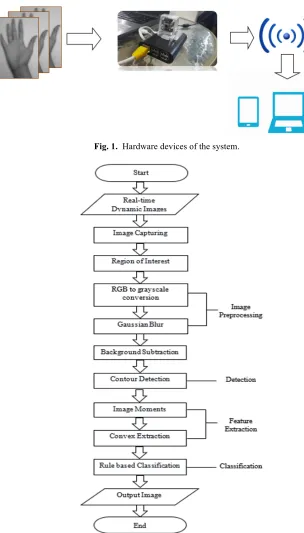
To design the system, the limitation of the numbers of the gestures is needed to the users. This system is implemented with six hand gestures and designed by the devel-oped algorithm with Raspberry Pi 2 Model B and its camera module. The hardware devices of the system are shown in Fig. 1.
3.1. Camera Module
Camera module is connected to Raspberry Pi 2 Model B board in order to monitor the hand gestures from the elder people in real-time and send the captured image to implement in the board. The output image size is equal to a camera resolution. This system sets the resolution at 800x600 pixels.
3.2. Raspberry Pi 2 Model B
This board receives the image from the camera module and then processes all im-age processing operations. Its power enables to charge with 5-volt power supply.
4
Proposed Method
Fig. 1. Hardware devices of the system.
4.1. Image Requiring
First procedure is to require the real-time image frames from a camera by splitting the image frames into single frame. The frame will be the same size as the camera resolution.
4.2. Image Capturing
The system stores all sub-frames in the stacked array and divides to frames. After that, it collects all frames to display in the storage module in the frame buffer for analysis in the next process.
4.3. Region of Interest
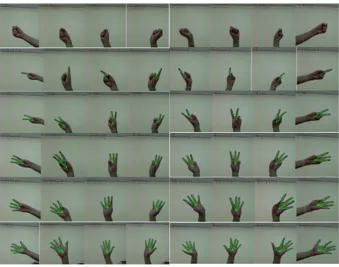
This procedure can be done by defining the rectangle bounding box to specify only the hand region as shown in Fig. 3.
Fig. 3. Results of region of interest; (a) the closed fist, (b) the pointing finger, (c) the two pointing fingers, (d) the three pointing fingers, (e) the four pointing fingers, and (f) the
open palm.
4.4. RGB to Grayscale Conversion
The RGB hand region image is converted into grayscale image as shown in Fig. 4. Grayscale image is easier to implement than RGB image. It only accesses in the gray levels that their channels are less than the RGB channels.
Fig. 4. Results of RGB to grayscale conversion.
!
4.5. Background Subtraction
Background subtraction is applied with the static camera. It extracts the foreground object from the background and shows in binary image by calculating the difference between the current and reference frame and then removing those background pixels. Its method begins with the conversion of RGB to gray scale image. Gaussian filter is also used to remove noise signal. Then, threshold is defined to convert gray scale to binary image. For the color of pixels in binary image, white represents hand and black represents background as shown in Fig. 5. Its equation is
!𝑜𝑖𝑗!𝑐𝑖𝑗!𝑟𝑖𝑗 1)
where oij is the output result between the current and reference frames, cij is the current frame, and rij is the reference frame.
Fig. 5. Results of background subtraction.
4.6. Image Moments
Moment features implemented without considering the image location and size of the hand [11]. Image moments are shown in Fig.6 and can be calculated by the fol-lowing equations
!!! !"!!!!!! !! (2)
!!! !"!!!!!! !! (3)
The function M(i,j) defines the hand in the image and generates the moments Mijto provide features of the hand. Image moments consist of center of mass, variance, and orientation as follow.
Fig. 6. Results of image moments.
!
Center of Mass: Center of mass is used to locate the center of palm called centroid and can be found by calculating the distance of the hand both of x- and y-axis. Then, using circle shape to determine the radius of the center of palm. This circle shape will be defined to a square frame that includes all pixels of the hand gestures.
!!"! !!!!!! !!!!!! (4)
!!"! !"!!!!!! !!!!!! (5)
For the calculation, M(i,j) is defined as the intensity at each point (i,j) of the given image (M). M is represented the mass of (i,j).
Variance: Variance (!2) is obtained from the second moment of the centroid (!!"!!). It is calculated as
!!!! !!"!! !!!"! !!"!! (6)
!!!! !!"!! !!!"! !!"!! (7)
Orientation: Orientation represents the angle of axis of the least moment of the inertia. The calculation is shown in equation (8), (9), and (10)
!!"# !! ! !!!!
!!"!!!" (8)
unless M11= 0 and M20 = B02 , consequently,
!"# !! ! !!!!!
!!!!!!! !!"!!!" ! (9)
!"# !! ! ! !!"!!!"
!!!!! !!!!"!!!" ! (10)
4.7. Contour Detection
After locating image moments, contour detection is the next procedure used to find the curve of the hand. The hand curve can be presented as many lines [12]. The green outline represents the largest contour of the hand which is shown in Fig. 7.
In modeling, the contour is defined as a parametric curve in the (x, y) plane of the image as shown in the equation (11)
!!!! ! !! ! ! ! ! ! (11)
Contour detection provides energy (!!"#$%) which is defined as the sum of the three energy terms including, !!"#, !!"#, and !!"#$, representing internal, external and constraint, respectively. The energy is calculated as
!!"#$% ! !!"#! !!"#! !!"#$ (12)
Elastic energy represents an elastic potential energy that decreases stretching and suits for shrinking the contour. The elastic energy is provided in the equation (13)
!!"#$!!! !! ! !!!!!!!" (13)
where weight is presented as ! ! for controlling the elastic energy with different parts of contour.
Bending Energy (ebend) applied for a thin metal strip. It is calculated by the sum of squared curve of the contour. The equation of the bending energy is shown as
!!"#$ !!! !! ! !!!!!!!!" (14)
where b(s) is served as similar role to !!!!. Thus, the internal energy can be calcu-lated as
!!"# ! !!"#$! !!"#$! !!!!!!!!!!! !!!!!!!!!" (15)
For finding an external energy, the external energy implements on small values in-cluding boundaries. It can be derived from the image defined by a function eimg(x,y),
!!"#! !!"#!! ! !! !" (16)
Thus, the energy (esnake) equation which finds a contour v(s) can be calculated to minimize the energy function of the hand by Lagrange equation as shown in follow-ing equation:
!!"#$%! !!!!!!!!!!!!! !!!!! !
!!!!! ! !!"#!! ! !!!
! (17)
!!!!! !!!!!!!!!!!!"#! ! (18)
Fig. 7. Results of contour detection.
4.8. Convex Extraction
Convex hull: It is the largest contour provided without the curve of the hand as shown in the red line in Fig.8. The convex hull can be divided into three parts, includ-ing lines, segments, and polygons as explained below:
!" ! !" !! ! ! (19)
Lines can be represented as l performs a triple (a,b,c), in which a, b, and c are the coefficients of the linear equation
!!!! !!!!!! !
!!!!
!!!!! (20) then we derive:
!! !! ! !! (21)
! ! ! !! ! !! (22)
! ! !! !! ! !! ! !! !! ! !! (23)
where segment s is represented by giving the pair (p,q) of points in the (x,y) plane that forms the endpoints of s and gives the line through the points with a range of xy coordinates that restricted to s. And polygon P is represented by performing a circular sequence of points called the vertices of P. The edges of P are the segments between P consecutive vertices. Polygon is considered as convex when it is simple shape, nonin-tersecting line, and all its angles are less than ".
Fig. 8. Convex extraction procedure
(a) (b)
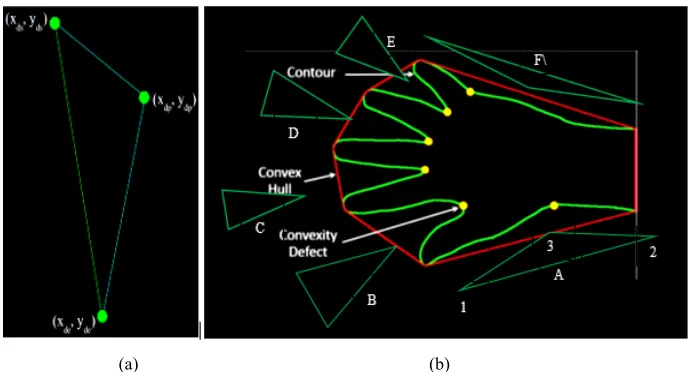
Fig. 9. (a) The illustration of contour, convex hull, and convexity defect with the six defect triangles; A,B,C,D,E,F, and (b) the three coordinates; the defect start (xds, yds), defect end (xde, yde), and defect position points (xdp, ydp), labeled as 1,2, and 3, respectively.
In classification, the feature vectors are derived from the hull defects. The convexi-ty defect in the hull is the distance between the contour line and actual hand. When the camera monitors the hand, the three coordinate points of defect, including the start (xds, yds), end (xde, yde), and position points (xdp, ydp), labeled as 1, 2, and 3, re-spectively, can be described by six defect triangles (A, B, C, D, E, F) in each frame as shown in Fig. 9. Thus, defect triangle A can be described as the following vector, called V_td^A, including [A (xds) A (yds) A (xdp) A (ydp) A (xde) A (yde)].
From the convex defects, five largest defect areas of the hand is defined based on the defect position points (xdp, ydp) from the top six triangles: A, B, C, D, E, F. Ac-curate registration is important between the frames for further analysis.
4.9. Euclidean Distance
The distance between two pixels can be found by Euclidean distance as shown in Fig.10. In x and y coordinates that restricted to s, we assume that the distance d can be calculated by defining the value of pixel one at the (i1, j1) and pixel two at the (i2, j2) as shown in equation (24)
Fig. 10.The illustration of Euclidean distance.
4.10. Rule-Based Classification
Rule based classification provides a set of encoded rules extracted from input ges-tures and compared with feature inputs. The output gesture is shown by matching the input gestures and the rules [15]. The rules consider the distance between the centroid of the hand and any point of fingertips. The threshold is set at 200 pixels. If the dis-tance is less than 200 pixels, it will classify the gesture as stop. Conversely, if the distance is more than 200 pixels, it will classify the gesture according to the number of lines that occurred. The rules are divided into six procedures as shown in Fig.11.
Rule based classification provides a set of encoded rules extracted from input ges-tures and compared with feature inputs. The output gesture is shown by matching the input gestures and the rules [14]. The rules consider the distance between the centroid of the hand and any point of fingertips. The threshold is set at 200 pixels. If the dis-tance is less than 200 pixels, it will classify the gesture as stop. Conversely, if the distance is more than 200 pixels, it will classify the gesture according to the number of lines that occurred. The rules are divided into six procedures as shown in Fig.11 and can be described below:
Rule 1: The system interprets the lingual description of the close fist image that has no straight line longer than 200 pixels from the centroid of the hand drawn to any point of fingertips as “stop”.
Rule 2: The system interprets the lingual description of the pointing finger image that has a straight line longer than 200 pixels drawn from the centroid of the hand towards the pointing fingertip as the requirement of “toilet”.
Rule 3: The system interprets the lingual description of the image of pointing and middle fingers that has two straight lines longer than 200 pixels drawn from the cen-troid of the hand towards the pointing and middle fingertips as “ok”.
Rule 4: The system interprets the lingual description of the image of pointing, mid-dle, and forth fingers that has three straight lines longer than 200 pixels drawn from the centroid of the hand towards the pointing, middle, and fourth fingertips as the requirement of “food”.
Rule 5: The system interprets the lingual description of the image of pointing, mid-dle, forth, and little fingers that has four straight lines longer than 200 pixels drawn from the centroid of the hand towards the pointing, middle, fourth, and little fingertips as the requirement of “water”.
Rule 6: The system interprets the lingual description of the open palm image that has five straight lines longer than 200 pixels drawn from the centroid of the hand towards the five fingertips as the requirement of “help”.
5
Experimental Results
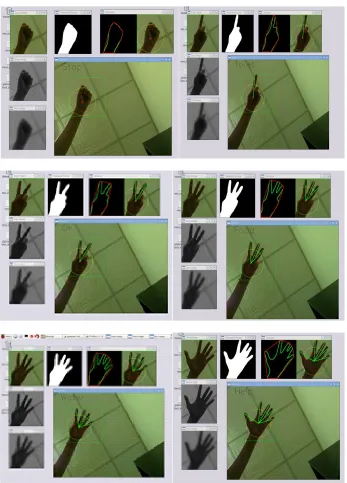
The hand gesture recognition system is implemented by analyzing the images of the six different static hand gestures under the closed environment. The camera is set from the top level above the hand about 30 centimeters. A static white paper placed at the reference level to be used as a scene in the background. The light source comes from fluorescent bulb that was about two meters above the reference level. The results show the good performance of classification as follows:
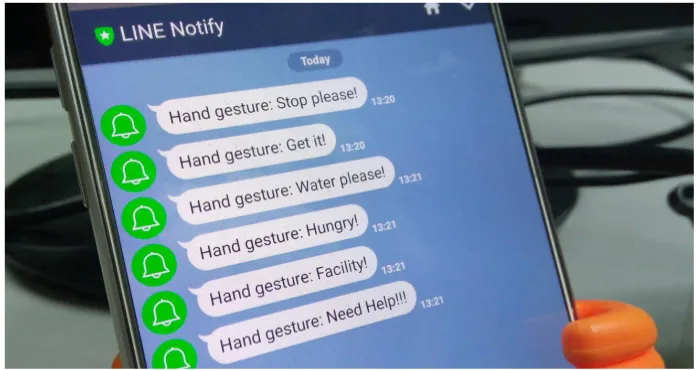
“food”, the pointing, middle, forth, and little fingers represent “water”, and the open palm represents “help”. These meanings have sent to the line application over wire-less sensor to alert the caregiver as shown in Fig. 15.
Fig. 12.The results of the open right palm gesture of the real-time dynamic hand gesture recog-nition system for elderly people in various degrees; (a) 65 degrees (b) 45 degrees (c) 0
degrees and (d) -45 degrees.
Fig. 15.The results of the hand gesture recognition system in the line application.
6
Conclusions
This paper proposed the hand gesture recognition techniques applied for the elder-ly. The process consists of three main parts, including detection, feature extraction, and classification using contour, convex hull, and rule-based algorithms, respectively. The system focuses on vision-based hand gesture recognition of the six static hand gestures. From the experimental results, the hand gesture recognition system provides good results in detecting and classifying all the six hand gestures as the lingual de-scriptor. The system can work in real time application for elderly. The results depend on some conditions such as the static background, the distance between the camera and hand, and the light conditions.
7
References
1. C. Acharya, H. Thimbleby, and P. Oladimeji, "Human computer interaction and medical devices," in Proceedings of the 24th BCS Interaction Specialist Group Conference, 2010, pp. 168-176.
2. J. M. Ortman, V. A. Velkoff, and H. Hogan, "An aging nation: the older population in the United States," Washington, DC: US Census Bureau, pp. 25-1140, 2014.
3. Ankit Chaudhary and Jagdish L. Raheja, "A Health Monitoring System for Elder and Sick Persons," presented at the International Journal of Computer Theory and Engineering, Vol. 5, No. 3, June 2013, 2013.
4. Siddharth S. Rautaray and Anupam Agrawal, "Visionbasedhandgesture recognition for human computer interaction: a survey," Artificial Intelligence Review, vol. 43, pp. 1-54, 2015.https://doi.org/10.1007/s10462-012-9356-9
6. S. Athavale and M. Deshmukh, "Dynamic Hand Gesture Recognition for Human Comput-er intComput-eraction; A Comparative Study," International Journal of Engineering Research and General Science, vol. 2, pp. 38-55, 2014.
7. C. Shan, T. Tan, and Y. Wei, "Real-time hand tracking using a mean shift embedded parti-cle filter," Pattern recognition, vol. 40, pp. 1958-1970, 2007. https://doi.org/10.1016/j.patcog.2006.12.012
8. C.-C. Hsieh and D.-H. Liou, "Novel Haar features for real-time hand gesture recognition using SVM," Journal of Real-Time Image Processing, vol. 10, pp. 357-370, 2015. https://doi.org/10.1007/s11554-012-0295-0
9. H.-I. Suk, B.-K. Sin, and S.-W. Lee, "Hand gesture recognition based on dynamic Bayesi-an network framework," Pattern Recognition, vol. 43, pp. 3059-3072, 2010. https://doi.org/10.1016/j.patcog.2010.03.016
10. G. Plouffe, A.-M. Cretu, and P. Payeur, "Natural human-computer interaction using static and dynamic hand gestures," in Haptic, Audio and Visual Environments and Games
(HAVE), 2015 IEEE International Symposium on, 2015, pp. 1-6. https://doi.org/10.1109/have.2015.7359473
11. Chonbodeechalermroong, A., Chalidabhongse, T. H.: Dynamic contour matching for hand gesture recognition from monocular image. In: Computer Science and Software Engineer-ing (JCSSE), 2015 12th International Joint Conference on, pp. 47-51. IEEE (2015)
https://doi.org/10.1109/jcsse.2015.7219768
12. Peterfreund, N.: Robust tracking of position and velocity with Kalman snakes. In: Pattern Analysis and Machine Intelligence, IEEE Transactions on, vol. 21, no. 6, pp. 564-569 (1999)https://doi.org/10.1109/34.771328
13. Goodrich, M. T., & Tamassia, R.: Algorithm design: foundation, analysis and internet examples. John Wiley & Sons (2006)
14. M. M. Youssef, "Hull convexity defect features for human action recognition," University of Dayton, 2011.
15. T. Hachaj and M. R. Ogiela, "Rule-based approach to recognizing human body poses and gestures in real time," Multimedia Systems, vol. 20, pp. 81-99, 2014. https://doi.org/10.1007/s00530-013-0332-2
8
Acknowledgement
This research has been supported by Embedded System and IC Design research la-boratory, Department of Electrical Engineering and Chulalongkorn Academic Ad-vancement into Its 2nd Century Project. The Scholarship from the Graduate School, Chulalongkorn University to commemorate the 72nd anniversary of his Majesty King Bhumibala Aduladeja and the 90th Anniversary of Chulalongkorn University Fund (Ratchadaphiseksomphot Endowment Fund) are also gratefully acknowledged.
9
Authors
The 90th Anniversary of Chulalongkorn University Fund (Ratchadaphiseksomphot Endowment Fund).
Suree Pumrin received the B.Eng. in Electronics Engineering, King Mongkut’s Institute of Technology Ladkrabang, Thailand, M.S.E. in Electrical Engineering, Arizona State University, U.S.A and Ph.D. in Electrical Engineering, University of Washington, U.S.A. Dr. Suree Pumrin is an assistant professor in Department of Elec-trical Engineering, Chulalongkorn University, Thailand.