Technology trends in ICT – towards data-driven,
farmer-centered and knowledge-based hybrid
cloud architectures for smart farming
Jiannong Xin
1*, Fedro Zazueta
2(1. Office of Information Technology, Institute of Food and Agricultural Sciences, University of Florida, Gainesville, FL 32611, USA 2. Office of the CIO, University of Florida, Gainesville, FL 32611, USA)
Abstract: Over the past four decades, advances in Information and Communication Technology (ICT) have resulted in unprecedented opportunity and innovation for improving farming outcomes. Ongoing innovations such as mobile, social media, agricultural drones, Internet of Things (IoT), big data, and cloud computing presented new challenges and opportunities for agribusinesses to redefine and rethink the role of ICT towards achieving better farming outcomes. With recent advances in infrastructure, data (collection, storage and retrieval), and a better understanding of all aspects of the food chain, new challenges and opportunities are presented. Unstructured data is now being generated real time, in large volumes, at high speed and unknown quality that results in challenges to current approaches for decision making, and requires a focus on analytics. These new sources of data create the opportunity to inform and drive a change in decision making from one that is highly intuitive to one that is data driven and processed in real-time. This paper highlights recent trends in ICT and introduces hybrid cloud architecture for smart farming. The proposed architecture emphasizes data-driven, farmer-centered, and knowledge-based decision tools through service integration, aggregation and interoperation. As a customized solution for farmers, the proposed architecture contains components of 1) data integration of on-farm sensors and data from public sources, 2) farm management modules, 3) knowledge-based software solutions from different providers, 4) service integration, aggregation and interoperation, and 5) a customized dashboard focused on usefulness and usability. This cloud-based solution allows the integration of businesses services, things, and technology from any channel and can be used anywhere. At this time, hybrid cloud environments have shown promise to integrate these different services and provide smart farming solutions to both big and smallholder farmers.
Keywords: mobile, big data, IoT, farm management, decision tools
Citation: Xin, J. N., and F. Zazueta. 2016. Technology trends in ICT-towards data-driven, farmer-centered and
knowledge-based hybrid cloud architectures for smart farming. Agricultural Engineering International: CIGR Journal, 18(4):275-279.
1 Introduction
1Agricultural development faces multiple challenges
including 1) climate change, 2) sustainable natural
resource management, 3) food security, 4) shortages of
fresh water, 5) limited availability of agricultural land,
and 6) changing consumer expectations. In this context,
ICT can play an important role in improving efficiency
and leading to smart farming in the future of agriculture
(Guerrini, 2015).
Received date: 2016-08-02 Accepted date: 2016-10-23 *Corresponding author: Xin, Jiannong, Office of Information Technology, Institute of Food and Agricultural Sciences, University of Florida, Gainesville, FL 32611, USA Email: [email protected]
In the ubiquitous computing world, everything we
do is mediated through digital. Current ICT technology
drivers include mobile, cloud, IoT, big data, and social
media. According to Gartner, by 2020, over seven billion
people and businesses, and 30 billion devices will be
connected to the Internet (Lopez, 2014). Digital
business integrates IoTs, connected and intelligent, with
people and business. Today’s modern farms are adopting
new technologies and generating unprecedented amounts
of data, including field-specific information, yield
mapping, soil moisture and nutrition, weather, leaf-area
index, insects, and farm management data. Data
collected from farms are a fundamental block for
data into value to support better farming decision making.
ICT now plays increasingly important role in future
farming and “in various guises, information technology is taking over agriculture.” (The Economist, 2016)
To improve farm management, universities and
organizations have developed many decision tools that
range from crop and livestock simulation models(Jones
et al., 2003; De Vries, 2016; AgrClimate, 2016), as well
as extension publications (EDIS, 2016), crop disease
management tools and other mobile solutions(Xin et al.,
2015). In addition, a wealth of information, such as farm
Best Management Practices (BMPs), is available from
extension services. Many of these knowledge-based
systems are developed by researchers or the extension
arm of land-grant universities. Although many of these
solutions have been successful, they are in general not
easily transportable to a cloud-based environment.
As mobile and cloud technologies mature, the notion
of each individual having their own computer has
changed to every business having a cloud in which useful
apps with high business value are executed. Major cloud
service providers such as Amazon, Google and
Microsoft* have matured, allowing businesses to create
their own virtual private cloud (VPC), interface IoT
devices, and integration with other trusted public or
private services. Beecham Research (2014) indicates
that everyday farming apps are starting to move to cloud.
The concept of a hybrid cloud environment for smart
farming is to provide farmers with a service catalog by 1)
aggregating data for data-driven farming decisions, 2)
integrating farm management tools in a single interface so
they can be accessed anytime, anywhere, on multiple
devices, 3) integrating farm decision tools developed by
various parties, and 4) implementing predictive analytics
with clear business value.
2 Technology trends
*
Mention of trade names does not institute endorsement by authors or the University of Florida.
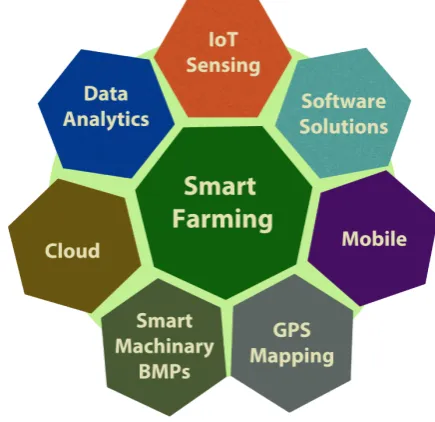
Figure 1 Elements of smart farming
Digital technologies are changing or even disrupting
businesses everywhere by revolutionizing the role ICT
plays in our everyday lives. Gartner (2012) and the
IEEE Computer Society (2015) have presented their
predictions for the top technology trends for 2016.
Innovations in smart devices are driving radical changes
in business practices. Additionally, the “Nexus of Forces”
- the convergence and mutual reinforcement of mobility,
social media, cloud, and information (big data) (Gartner,
2012) – drives new business scenarios and continues to
evolve as it combines with the IoT. “Cloud first, mobile first” have become widely accepted IT strategies for
businesses. While mobile apps have provided
unprecedented solutions at users’ fingertips, the cloud
offers a promising infrastructure for integration of data,
services, and applications. It becomes an enabler for
unified solutions to aggregate various pieces of new and
existing solutions in a cloud environment.
Cloud computing has transformed the IT landscape
for both individuals and businesses. It has changed the
nature how we access, store, and share information in a
way that fundamentally alters how business is conducted.
As the cloud paradigm has matured, businesses are
shifting their applications to cloud environments and the
growth of adoption is fast, particularly for the hybrid
“Nexus of Forces” will continue evolving and expand
into a new set of business scenarios. A clear trend is
that “smartness” is everywhere: smart phones, smart
houses, smart cities and smart farming. As
agribusinesses are embracing innovations in ICT, there
are clear technology trends towards smart farming
(Wehrspann, 2016). Figure 1 illustrates technology
elements related to smart farming. Among these elements,
IoT is in the beginning of a huge wave of growth, and
could be one of the key technologies to transform
agriculture towards smart farming.
3 Proposed cloud-based agriculture
Cloud platforms such as Amazon’s AWS provide
excellent infrastructure with the capability of virtual
servers in the cloud (EC2), isolated virtual private cloud
(VPC), scalable storage (S3), managed relational and
NoSQL databases, and mobile and enterprise apps.
These cloud platforms are mature and enable hybrid and
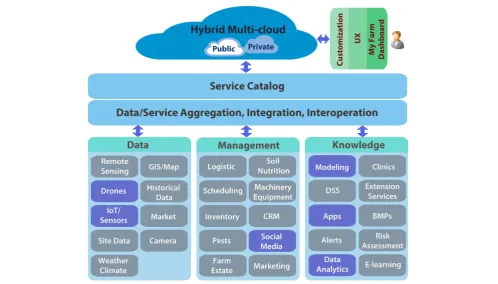
multi-cloud applications. The proposed cloud-based
architecture is an infrastructure to provide a unified
solution for data, farm management, and
knowledge-based decision tools. A key principle is that
any cloud architecture has to be flexible enough to
support services provided by different parties and allow
users to configure the set of services that brings the best
value to their business. Figure 2 shows the proposed
architecture, and it is divided into five layers as described
below.
3.1 Data services
Data collection on modern farms is becoming a
common operational task (Vogt, 2016). Figure 2 shows
the diverse types of data that can be collected on a farm.
With the explosive adoption of farm-based “smart”
devices, solutions are needed that process farm data and
provide insight for decision-making. This could be
provided by cloud-based data integration services. It is
very appealing that cloud platforms, such as Amazon’s
AWS, have integrated IoT as a cloud solution to connect
smart devices.
Whenever dealing with data collected from a farm,
data confidentiality issues must be addressed in any
shared with trusted advisors, and the hybrid cloud
architecture may address this problem by segmenting data
not only virtually but also physically. In addition, an
open data standard is important to facilitate
interoperability so that we can turn data into value and
achieve data-driven decision-making.
3.2 Farm management services
Farmers may use applications to manage their daily
operations, such as tracking field activities, managing
machinery and inventories, book keeping, accounting and
scheduling. These services could be readily available
from different vendors, but they have to be customized
and tailored to their needs in a cloud environment.
3.3 Knowledge-based services
Knowledge-based decision tools, such as crop
simulation models, decision support systems, BMPs,
extension services, education modules, and pest and
disease management are widely available and they are
valuable resources for smart farming. However, many of
these apps lack useful APIs or are not easily configured
for site-specific farm information. While cloud
computing provides a solution as
Infrastructure-as-a-Service (IaaS), knowledge-based
software systems should be designed as
Software-as-a-Service (SaaS) for better cloud integration.
Effort is required to extend these decision tools to cloud
environments and leverage these existing solutions for
smart farming.
3.4 Farmer-centered dashboard
Ease of use and user experience (UX) are often the
most important factors for end users. UX design should
be farmer-centered and tailored for end users in the
environment that they work in. A customized solution is
key so that farmers can select apps they need and use
their farm specific data. The effectiveness of user
adoption largely rests on the quality of UX, and quality of
the apps is equally important. The concept of a
dashboard and mobile friendly design should be
considered to enhance data visualization and deliver a
fluid UX. Mobile friendly interfaces are particularly
important if a task needs to be conducted in the field.
3.5 Service integration and aggregation
Service integration, aggregation, and interoperation
are essential elements that enable multi-sourced data and
software services provided by various service providers
to operate as one tailored smart farming solution.
Through service integration, a service catalog that
contains data services, farm management, and
knowledge-based decision tools can be used by end-users.
As data and services may come from many sources, an
open and secure data standard, robust software APIs, or
SaaS must be implemented to achieve integration,
aggregation, and interoperability of cloud-based
applications. However, a challenge remains in the
implementation of service brokers that result in the
effective integration of multi-sourced services into a
unified cloud-based solution.
4 Conclusion
The drivers of digital transformation create new
opportunities to provide intelligent tools for future
farming. Farmers are increasingly interested in the
adoption of smart farming technology. Cloud-based
solutions, through integration and aggregation of
multi-sourced services, could provide a comprehensive
service catalog to meet farmers’ needs. The cloud-based
service catalog could change vertical and isolated
applications into a centralized and coherent set of smart
farming solutions. Successful integration of IoT, mobile,
farm management and knowledge-based software
solutions, and real-time analytics in a cloud environment
will create new solutions for smart farming. Given that
many decision tools developed in the public and private
sectors are already available, an integration of these tools
into a cloud environment could serve farmers better,
especially smallholder farmers. By making farm specific
data and analysis tools available, farmers can assess
different scenarios resulting from different farming
environment requires multidisciplinary expertise and
collaboration amongst service providers that are often in
competition with each other, and overcoming technical
issues such as the definition of a common language, creation of standards, service buses, and API’s. The
adoption of such an environment largely depends on
features, ease-of-use, services, and more importantly the
business value that the system can provide for farm.
Although such work remains to be done, it is clear that
future of agriculture will be data-driven,
knowledge-based, and farmer-centered smart farming
solutions in a cloud or mobile cloud application models.
References
AgroClimate, 2016. Crop decision tools for managing climate risk. http://agroclimate.org/, Accessed March 2016.
Beecham Research, 2014. Towards Smart Farming – agriculture embracing the IoT vision.
De Vries, D. 2016. Dairy valuation Iteration program, https://devries.ifas.ufl.edu/, Accessed March, 2016.
EDIS. 2016, Extension digital information system, http://edis.ifas.ufl.edu, Accessed March 2016.
Gartner, 2012. The Nexus of Forces: Social, Mobile, Cloud and Information, www.gartner.com/doc/2049315, 14 June. Guerrini, F. 2015. The future of agriculture? smart farming, Forbes,
http://www.forbes.com/sites/federicoguerrini/2015/02/18/the-f
uture-of-agriculture-smart-farming/#5708f01a337c, Accessed March 2016.
IEEE, 2015. IEEE Computer Society Predicts Top 9 Technology Trends for 2016, Los Alamitos, Calif., Dec. 15.
Lopez, J. 2014. Digital Business is Everyone's Business. http://www.forbes.com/sites/gartnergroup/2014/05/07/digital-business-is-everyones-business/#17679ebf2d66, Accessed April 2016.
Jones, J. G. Hoogenboom, C. Porter, K. Boote, W. Batchelor, L. Hunt, P. Wilkens, U. Singh, A. Gijsman, J. Ritchie. 2003. The DSSAT cropping system model. European Journal of Agronomy, 18(3-4):235‐265.
Plummer, D. et al. 2015. Top Strategic Predictions for 2016 and Beyond: The Future Is a Digital Thing, Gartner, Oct.
RightScale. 2016. State of The Cloud Report, http://assets.rightscale.com/uploads/pdfs/RightScale-2016-Stat e-of-the-Cloud-Report.pdf, 2016.
The Economist, 2016. Technology Quarterly, The future of agriculture,
http://www.economist.com/technology-quarterly/2016-06-09/f actory-fresh, Accessed June 2016.
Vogt, W. 2016. 3 ways to create value with information. Farm Industry News, March.
Wehrspann, J. 2016. 7 tech trends we gleaned from the National Farm Machinery Show. Farm Industry News, March.
Xin, J. F. Zazueta, P. Vergot III, X. Mao, N. Kooram, Y. Yang, 2015. Delivering Knowledge and Solutions at Your Fingertips: Strategy for Mobile Apps and Development in Agriculture,