ON-SITE STORAGE AND HANDLING
1.
SCOPE AND OBjECfIVES
Improper storage of hazardous wastes can cause serious accidents. health and safety problems. and damage to the emironment. The objective ofiliisdocumentistopIm-ide
gUidelines for safe. on-site storage and handling of hazardous waste. Currently. solid hazardous wastes are temporarily accumulated on-site and periodically transferred10 local dumpsites for off-sire disposal. Liquid hazardous wastes are generally discharged into the sewerswith
or without adequate treatment. Gaseous hazardous waste can be in the fonn of "empry- cylinders containing residual gas
thatishazardous.orll"fl<'l"leddueto physical
or chemical reactionsoforner waste.
-I" tbecoWel1o/the co"Wwous efforts tomotlen,ue clIul e"baacetheu-eil-M"R ('{IN
£g)plio"people.I bOl'etbe pkasure 10 i"troducelheseetlsy-guw?SforHa=anblS- \f,b1'e Jlanageme7l111'b,<:b come as a" appIicaUo" of /au'-I (199-1J
These easy - gUides certify tbe cooperahon belllW" the Ime"'lIllStrif:':s.~w.'enJn,e'U, agencies andbotblbeell,1andlbe'nduslrlLu.so.:."ieties Su(.-b a cOCflemlKmCti'k#jsl)!t>nsahk
u'ben Itcomes to tbee,w,rrmnrelllalaspet-t5 tbatullimalt?~raa_-'llt! 10 tM
'.'/xJe
j(~-~' IemmOibUI gil'en~l'lhanks and awn>r:lOhon 10I~ulx, tu:blt:'ttd IbIS u"OlP't. pelrtk-:Jarly tbe Progmm SUfPO"l11i1 oflbeEEPP multbf:'.llini.stne5 ({IkrUit- Elet.mCII)'..~rk,:nihln? IlIIerior. Indusl,,·and Petro/f.'1,mFi"a/~r. 11ismy u'ishlhallhi.;;publlcahon basIlSefulll{l)Ik'OIJOllSmid~'rn~ll$d n'ft!n?r:.:t.~ 10 parties,m-ollmin generaling. 5/oring. IrrmsportmR-tn.wing. '#lspo5:in~""lln:'t.)'l.-lmg of hazardousIUlSlesinf~)p'- ~
2. REGULATORY
FRAMEWORK
Law4of1994is the overalllegalinstrument
that regulatesemironrnenul pollution rontrol
inEgypt. Articles 1. 5. 29. 30 to 33. 85. 88. 95. 99. and 101 to 10.. of thisLawand the ExecutiveRegulationsforLaw-t.Articles 2')
through 33 are the rele\"ant articles for
management of hazardous wasle_
3. UCENSE FOR HANDIJNG
HAZARDOUSWASTE
The applicant submits his application in writing containing rhe dala identified in Article 26, of the exeanh'e regulation. The license shall be \'alid for a maximum of :; years and subjed10renewal tAnicie 1--).
It canberevoked or suspendedif:
• Itwas obtained using false data,
• Its condition.<; are violated.
• Cnforeseen dangerous en,-ironmenral effects or new rechnologies make (he Iicen.se im·alid.
• If EEAA concludes that it is uns.:J.fe ro handle the waste_
4. CHARACfERIZATION OF
HAZARDOUS WASTE
According to Article.!8par.gr.ph 1Bojthe Executi'·e ReguLllions of law .1. en:r-y eslablishment must char.Il..""terize the waste generated in temlS of horh quantity and quality_ :\ new hazardous w:.L..:.te da...ifk""'300n system ha.." been pUI in place_
S. TYPES
OF STORAGE
FAaunES
Hazardous waste stor.l~ebcilities ('~n he either on-sire. at the property where the waste is generated_ or ofT-sire. ar a (.ummon hazardousv."35te Slordgea.nddi~1 facihty
EE."-"'- recommenJs me U'SCofthrtt ~-pes
ofon-Sill"Slora~fa(."ilil.ics.
• 5toragt." 10 dlUms. (onl.1lnmg Sffi.lH quamillC'::" oi h'lutd or~~Idw;,t:Sote 1e-.,1.."~· tohandle-.md~lk>'\.,.forc-.J....~.~t1O(l of inoxnp•.nihkv.--.a..'tes5U(h.1....com.N"e and re--,J....,j,,·ew L~es ~
• StorJji.?:t." 10 t.m',5 lor hulk qU.Jntltt(>S of
hqUld.. T.lnk... ·:"mheCOf'L"trU...'tt'd Jioo,,'e ground or hUlled underltfound EE."'-.\.
<.Joe;.fl(l( recOIlmend~1UflIdt:mks
t"'CllL<eojthe1:(omplexm~.md thehigh
m,k of em·iml,menul d.un.age uquid" Schould 1--:JX'1l<-dk.~. pumped to ,-'If\--sitc
rrt"'3trnen1s~~('J-~or1I:ln'iiem."d to t:.mkcrs for otl-slleU't;."".;lrne1ll Anddi.~1
• Stora.~10Ufg'.·((101.Uflcr'5.Igt"1lt"T"J.Uy,-\t"
Sled irom I1< !t)",on."10oC:.J.p.1cury} for
hulkqwnllt~of~--,jtd... 1be"':OOUlOt"f'S. an." d~llUled I ) be luuled hy trucks to
an o(f,slIedL"-r0'SOJI IJcllin-.100 rerumed
forreiilhng
:l§l!i!il'• • • • • • • • • • • • • •
IIIIIII.II
::'"::
•
lock should be properly l::.tbeled and kept in a secured office. A dupllcate or master key should be available in case of emergencies.
• Have at least two access gates: one for normal use, the other for emergencies. • Have a person responsible for the security
of the storage area.
• Be controlled: only trained personnel can enter the hazardous waste storage area. • Ilave a restricted area sign: a hazardous
waste storage area.
• Be well lighted for security at night. • Be designed to accommodate temporary
containment of spills and equipment to respond to spill incidences.
~
....
~...•
_-_.
r.)nCO
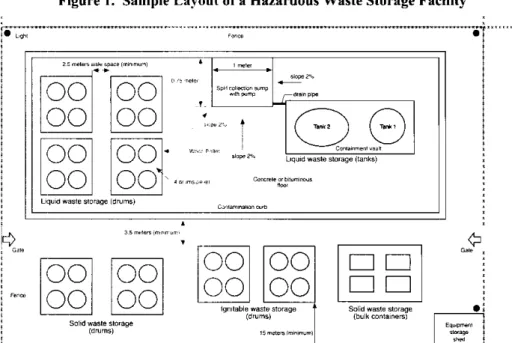
Figure
I.Sample Layout of a Hazardous Waste Storage Facility
2.'mol.""",,, "pacoImin,mu",)
•
'''''''''
[ggJ"[g8J
"
',-n<le, ~A5p',jcoli,.;'ion""mp idl.inpipe
..,'''""mp
,
00
00
•
G8
H'",,""o I
,
[g8J
[gEj'
~.",,--Hie' Conl.lnmentv","slope2"o
L,qu;d waste storage (tanks)
00
00
'""m,.,_•." Conc""eorbi'"minous-,
liquid waste storage (drums)
G",'.mlna'IOOCU'O
•
responding to fire and othlCr eIllcrgency situations.
• Adequate separation of incompatible wastes, satt' movement of wash' (( lntainers using mechanical equipIllt'CI. and adequate access for inspecrion.
• Ignitable or reactive V\'aste C"oIid or liquid) should be stored ;.It least 1')nJcler" from the faCility's property line, Fi.v;urt' Is!lo'V,'s the lavout for such a facility
6.4
SHTRITY
Ie:>
',5me'.",:""",",,",,,¢o
Gale
[g8J
00
G.,.,
I:~:~l
,
[g8J [g8J
,
00 00
DD
,
,
,
Feo,",00
00
,
Ignitable waste storage Solid waste stmage
,,
(drums) (bulk containers),
Solid waste storage:
(drums) 15 mete", [minimum),
iL_~._
...
~_.._... "...".."..
The storage area should
• Be secured with a 3 meter \v:t11 or fence and have locked gate.". TilL' kn-" to the
6. REQUIREMENTS FOR
STORAGE FACILITY
• Must he a secure site with limited admission.
• Must be located away from slOrage areas.
particularly those for hazardouschemicds. and from drinking water sources and any residential areas.
• Must have access for loading, unloading. and responding to emergency situations. • Must have electrical pov..'er, including
emergenL)' powersupply.
• Must have a \vater supply for cleaning and firefighting.
6.1 LOCATION
6.2
CAPACITY
63
LAYOUT
Severdl fac10rs shouldbeconsidered such as present and projeaed waste quantities, types of wastes and their incompatibility, storage time, and cost of bulk versus drum storage including transportation and disposal.
Outdoor storage is recommended for ea."e of accessibility, handling, safety, and cost considerations. Indoor storage is vital to
protect srored waste from extreme heat or for other considerations.
Storage space should be laid outtocontain all types of hazardous ,,,aste produced by the industry.
Itshould proVide for:
• Access from at least two sides for
Figure 2. Drum Storage for Hazardous Waste Liquids
high (maximum)
Sump
Dmmst\votiers
Pallet
Aisle2.')m
(minimum)
4 drums per pellct (maximum)
20em
(minim\lm Label Fence or wall
c . ' ~
6.5 DESIGN
The most common type forSlOGlgeofliquid and solid hazardous waste are the 2())..liter steel drums. The drums should be made of orlined'\\ithmaterial.. that"illnotreaQ \\ith the hazardous waste (0beslored. liquid
wastes need aneJX>:\'}"--based coating or anti-corrosive paint for lining the inside of the drums.Solid\"\'aSte requires a polyethylene
liner for corrosive '\\"'3Stes. Drumsshouldbe stored upright on
wexxten
pallets.as sho\\n infigure 2.Each drum mUSl be labeled and Slacked so the labelisvisible. The storage area should bedivided into two sections. one fordrums containing liquids and the other for drums
containing solids. A containment system 'witha curb sufficient to contain1(')'%of the
totaldrums "olurne should be built around the boundaryof the SlOr.1gearea for liquids. Thefloorshouldslope(2%minimumslope) to a collection area to remo\-e liquids
resulting from spills and leaks.
Vnderground tanks require double v.-alled construction. excavation. shoring, and leak
detection and monitoring systems. They
must have a corrosionresistaIUcoating and cathodic protection. Considering the complexity of installation and operation. and the high riskofemirorunemaldamage. it is not recommended to use underground tanks for the storage of hazardous \V35tes. This document only prO\ides guidelines for above ground tanks.
TanksofSleetor fiberglassreinforcedplastic
(FRP) should be installed above ground. Alltanks should be dearly labeledandha'-e sufficient structuralstrengthto hold contents,
becompatible v.ith the wastes to be stored and have corrosion protection.
The foundation for the tank shouldbea
reinforcedconcreleslabofadequatestrength
and thickness to prevent failure due to settlement. compression. or uplift pressure. Secondary containment can be prO\'ided by a double-waDed tank or a \'ault around single·walled tanks or group of tanks. Double-walledtanks should be designed as an integralstructureto contain anyliquid releases from the inner tank.
Vauh systems consist of a wall enclosing the tank area and should contain 1Wi}of the capacity of the largest tank in the enclosure. plus the estimated volwneofthe maximum 24-hour rainfall. as shown in figure 3.
These are rectangubr steel bins. fined with rigid CO\'ers (0 keep out r.Jin and en~ure
againsl wind dishursemem of m.ltenab They could range in l."'dpacity from 1[0..?o
Ions of solid hazardous waste:-. TIlt' comainers should be located on a concn'1.e pad with a minimum lhicknes...(, of -.::'l...1ll.
They should be c1e-.rl\·laheledandmarl<ed. Tahle1gi\'es specifk-ation.(, forhomvettil."'dl andhorizontal above ground Sloragetank~.
[-' ..., 'I F\II'TY CHF\l!C \L'"
l'()'\T-\!'\U\ ....
Improper useofempty chemical containers can result in serious risks. The owner uf the facility should detennine chemk--als tlut areharmfulto human health.ha.o;edonthe "taterial Safety Data Sheet supplied hy the manufacturer.
Di.';;poseof empty containers as follows' 1)Cardhoard boxes and paper and plastic
bags should he crushed on-:-.ite and disposed of along with solid hazardou.... waste.
2) SleetandpIasllcdnunsshouldhe collected by the supplier from the manuf:1l.'turing faciliry. If not they should he crushed on-site and stored separately from hulk stor.Jge for other hazardous wa:-tes
3)Steel drums elJl be sold to a scr.Ip metal redamation fadiIv. afterhetn~ thoroughl,-cleanedand decontamina'ed.and<-ru"ihed or cut up on-site.
-4)Dis-posahlelinesin...idethedrum.... should be removedanddisposedofashaz;udou,;
solid waste.
Coder no condition should an empty cont.ainer of hazardous chemicals he
dispa.-.ed of off-sile wilhout crushing lhe container on-site.
7. OPERATION AND
MANAGEMENT OF
STORAGE FAOUTY
-.1
ORG.-\-...
Iz.\nO~.-\-...
0
RESI'O:\S: BlliTlES
E:<ouhla:;.h ,J team for m.anagemenl of
haLmJou.:;.",~.qe ,,,ith.l~Iedm.uuger with O\·er.J1I re::;.lOn:s.lblht~· .and au(horit~,
from lht.' POIOI ::tf F:ener.1tI0n 10 off-sile di5pos;.ll Teamme11l~should:<oupern.."ie
operallon:<o durir F: all s.hifts and io every
depal1Jll<'nt Thetram>hould!u,eregular
TTk.·'etm~
Teams :<ohould f''''l...-en'e tr3mm~ on W.1.5-te handhnF: pr.lllit es. pers,on.al he-31th .and safetyn'k.~.J."Uf'e'S.and~~.response
pmcrtfuR'":'-(or"~li.lL...
- . j
RECORD K..EEI'I:\G ....
:\0
THE
HVARIX'
n
\\:-\.STI
REGISTER
En:ry e';'lahlishnent s.hould m..tinUtn .,1
~i~ct Wllh (hef,,-~Ion.mgtniornutlOO II 'arne .Jnd.l&.~
at
theesuhb..~t. 2l 'arne Jnd I.'lh Hlle of the person~for
maJJ1UlIllllll
thehaz;udou,;n.'3.SIe~~et
:\1The pt"'nod cC""en-d~-the..::urrentdau -41 Any spn:I.l1 .'ondltion.... I.S,..,-ued (or the
e"l.ahlL.Jlmem hy EF_\..,,_
"I A 1is,1 of the (~~ ..md qU.;lntities of
h.1Zardou:<o v-as-Ie genef3IN hy the
e:r>I.3h1L....hmem~.J...1I\"1tJeS.
6).\tethod of luz.ardou.~w.J5o(edbposal
-l The n.J"1e~ ni panies <:ona--Ji<:ted for lrans,ponalu n .J:1d dls-pos.al of the hazardousn.-;~e
H)Daleofreporm~
- - -
-Figure 3. Tank Storage for Hazardous Waste Liquids
Fence or wall
3 meters (minimum)
Lahel
/
Containment
vault wall sump
TABLE
(l)
ABOVEGROUND STEEL TANK
MINIMUM WALL THICKNESS
IIORlZONTAL TANKS
\ll11imLlm
\ktal
Thil knc"is
(em)' I
I.\Iaximum Diameter
(cm)'11Thlckncss
«(
111)' IICarbon Sted
,
Stainless Sted
1,800 121.92 0.236 0.180
2,000-4,000 162.56 0.312 0.218
4,001-34,000 193.04 0.424 0.292
34,001-132,500 36576 0.609 0.401
132,501-189,250 365.7
6
0.927 0.609VERTICAL TANKS
Shel]<2)
TIlickness (em
Y
1 )Carbon Steel
Bottom
Shel1
12 )Stainless Steel
Bottom
Top
< 4000 liters >4000 liters
0.236
0.424
0.236
0.609
(J 21 H
0.292
0.236
0.312
0.218
0.401
0.218
0.086
Source: Underwriters Laboratory, Inc.. L'L 1·i2, "Steel Aboveground Tanks for FI:I111mable and Combustible Liquids," (984)
Notes:
en
Dimensions are exclusive of corrosion allowance or variations in density11t't;mkcontents.7.4 SEGREGATION k'lD STORAGE
1le:M:dwi.,Codr L'SEPA-. 1980..-\ methoo for detennining
Hazardous "";Isle compatibility. (lOO 2-BO 0-6
" "
,
,
,
2
Akohob&glwob
2
3
:\z(«lffipound.~_dcu<:>
,om"
~ii:-
~ ~ H8 &hnir;u~
E
F
G
GF
GT
H
P
5
L
Ifo'tidizmg .JcKb or
mirerab12'1aremL~ed\'\ilh
dlltio..--.:tm.mutesII.!'.they ou·-~(ehe.lliH).
flJrmuNe psIGf\,
;lfK fun.'" f.
---"--'
:~ ,e! H".,
EX-",-'IPLE 10 ~~~- -~-- -Explosion FireInnocLious and non-fl:J.mnuhle~ ~'n()on FlanUTUhlega.'"gener.llion
Toxic~.s gt.~er.ltion
Heal generalion \ 'ialentpol~meriza.tjon
SolubiliLltion ofloxi\.'suosun('"t-....
'lay he hazardoushulunknov.TI
10
"
12 Ii H H,
".
H"
H " H•
"
"
H H•
H•
'<
H HH H H
H
i
!-! 11
,
•
G1" (;7-,-;r
,;f 'A;..Cf
H H H
..:;.. C.f (,f
;';T
" f (,f
H H L·f
II Cy..rude:> 12 Di~rhurulle.;
14 &h0"f"5,
---~
19 Kel.~
~leT'CC'O'pu=.~o···.-::...,;;;:;;---'-.T-"o---H---20 Of!I:J.ruc" - , ! f l d e ' : < . , , f '" If ,{ H !E'
!>1t''f.lk ..lkJ.lJ&~
21 t"uh.de-menu]
~,:Ih.I-~&~"""
22 ~md!..~~(.'Il.:
~Ie-.:lh&~teul(urnpo;..onili
23 1m" ~ 11
Mex='=pu=~=.=.:-::".:;:::...,:---~~'---'-'---~~----~---
~~,~~~'~rodeo=----___ccc_c;_-_.",,_---~----~----~~H~~ H .if~~f ~ ~~
15:\itCJdt>s f G~~H ! l f f H fj H i i
H H
G7 f !! e,
"
•
,
.·f"
•
"
,
H•
"•
H,
H\'~_.iliplutK 28 WL'ioaflmllled31 Ph<.-noi.&~
33 Sulfide;..~ H
"
,
H 11.:'1 ~~-~----
-
'-'~--'----,
H '!,
., j j H
f f !
.
,
II If If "
-H " li
•
"
H ,',F ,Of , '! '!
"
,
H,
H "•
H "• •
"
,
H,
!I !! H H
!' ! ' ! '
H H H
[ [
H
, , ,
H H II
};I Epuxie:!.
eo"""'-.,--.-ilikC---c.--o"""""----,""C. ' . 0 _ ; : .
-101 ~ f
ID'llenah.TlU~
102 Ex~=
' c C ,
-103 Po.menr..Wk~
8. CLOSURE PIAN
Every facility should have Closure Plan to ensure that all hazardous waste is adequately removed.Itshould include:
1) A description of how each hazardous waste management unit will be closed, details of removal of residual hazardous waste, and decontamination of equipment, structures, and soils. 2) A description of the sampling and resting
procedure for the soils and groundwater to identify existing contamination.
3) An estimate of the total inventory of hazardous waste stored, including types and quantities of different types of waste. 4) A description of how and by whom the Wd.ste was transp=:>rted, and at which facilities the waste \vas disposed of off-site.
7.9 INSPECTION AND
MONlTORINC
Inspect at least once weekly, to look for leaking drums, tanks, and containers, and for deterioration of any of the containers. Also look for proper storage of the drums. labeling, segregation, aisle space access, handling equipment, personal protective equipment, and general housekeeping requirements. The secondary containment system also should be inspected at this time toensure there is no accumulation of dehris or blockage of the liquid collection and sump area. The walls of the secondary containment should be inspected to ensure that its integrity is maintained. The tanks shouldbeinspe<-1ed daily for overfill controls, leaks, spills, flow, level control, pressure, and temperature gauges. Sample inspection checklist are included on the following ruges.
~.8
PERSONAL PROffer
,c
I',\ND
HEALTH AND S,\ITI',
5) \'(!ater at adequate volume~jndpressure.
Facility should prepare a ContingetlL')' and Emergency Response Plan that includes:
1)DeSCription of actions to respondIt)spills.
fires, and explosions.
2) Arrangements with the locl! poliu:, and fire departments, and hospiLlls to coordinate emergency se'Tices
3) List of names, addresses. :lnd phone numbers of emergency coordinators. 4) List of all emergencyrespon.~et'(juipment at the facility, including fir."t ;lid "lations and where they are located.
'S) Description of the evacu3!ion plan for facility personnel includingdetai!~of rhe signals to usc to start n-anI3tion, evacuation routes. and altemJteC\;lcuation
routes. Anemergcncy coordinator should be designated for the faciht}
In the evcnt of an incident. emergency coordinator should:
1) Ensure that any hazard()Ils wastes generated are disposed of in tilL' proper manner.
2) Ensure that all emergencv \.·qllipmcnt used and listed in the Contingencv Plan
is cleaned and fit for its intentlt'tl use hefore operations are resumed
3) Prepare a report on the incitltTJ! that includes:
a. date, time, and location of the incident, h. type of incident.
c. type and quantity ofmateri~llsaffected, d. an assessment of damage and extent
of injuries, if any,
e. an assessment of actual or potential hazards,
f. estimated quantity and type ofwasres generated, and method of di"'posal.
Personnel should be provided with the proper clothing and equipment to adequ:ltely protec1 them from exposure to the hazardous waste: protective coveralls, hard hal", safety shoes/work boots, safety g!a...;s\.·,,, ..~IO\es, dust and fume protective masks. air-pUlifying respirators with cartridges. spbsh resistant aprons, and disposahle coveralls.
;;:--
--~~-::--"
;:...
'<:
I~-j
li ..
"';;;,.l
·"1 ";;~ilil:;;&!iIII
• • • • • • • • • • • • • • • •
13.&.2• • • • • • • • •
",":!lf'"7.5 WASTE HANDLING
7.6 PACKAGING AND LABELINC
Bulk liquid should be moved using pumps of material compatible with and capable of handling the type of liquid waste being stored.
During transfer of bulk solid hazardous waste, attention should be paid to spillage as of the waste is moved to the container. Drums shouldbetransferred using forklifts. which sometimes must be flame-proofed.
1) An internal communications or alarm system.
2) A telephone or hand-held tv.'o-way radio.
3)Portable fire extinguishers, fire and spill control equipment
4) First aid stations to include emergency showers, eye-wash facilities, basic first aid facilities, stretchers, fire blankets. emergency lighting, and luminous tape. Labels in Arabic should shov.' :
1)Clear signs or symbols indicating the hazardous nature of the contents. 2) The container's contents active
substances, and concentrations. 3) The original source of the waste. 4) Total and net weights.
5) Dare when the container was filled and when the waste was generated. 6) Name and contacts for the person
responsible for filling the container. 7) Safe storage method and \vaming about mixing with other reactive substances or wastes.
8) Personal protective gear needed for handling.
9) The best manner for dealing with emergencies (leakage, spills, fire, etc.). 10) Special precautions for opening and
emptying.
Dike
Tank BaseArea
SumpArea
Hazard Warning labels
Pipes.Valves and Fittings
AccessLadder
Tank
Fire Extinguishers
li~hting
Cracks. hroken
Cracks. uneven senlemem. spills or stains
Sumppump failure. vah'e failure.
doggeddrain. broken berms.cr.lCk..., etc
~tissingor dam.aged
Leaks.corrosion. ,,,I\"esstickin~.damaged vah"e handle. \'alves sticking.me(er,;;nor:
working. overfill control\':l.1n~malfufKlion
Corrosion, damaged
Leaks.conusion.pain!<ttippin~.damaged
Damaged. nor: (ested on 5(.·hedule
Bulbsmissingor nor working
, , ' c ...
\ ~;"".i;'~ 1 ·.<,~t.i\·. ~(
.f·~
) .. 'v
, \._' .. '. \, J L<
~\
(
<~/
",~,,-
.,'-['\'1'1 (
[10'\ III \1Drum Segregation
Labels
Drum Conditions
Aisle's
P()II '\1[\1 PH( )JJU'\I'
Incompatihilities nOl segregated
Improper or no labels
Leaks, bulging
Not adequate space
' [ \ II S
Ai...ll'puhle [n,!(
(cpt.Ahle
()IN H\ ....'110'\')
Containment Area
Roof
Fence
Lighting
Fire Extinguishers
Spills, valve failure, sump pump failure,
clogged drdin, broken berms, cracks, etc.
Water leak.;
Broken areas, gate unlocked, key
misplaced
Bulbs missing or not working
Damaged, missing, not tested on schedule
i I
/~
..l
\