Interactions of Economic Development, Government
Intervention and Real Estate Price
Based on the Analysis of the Impulse-response Function
Shengnan Zhao1 & Hong Xu1
1
School of Business, Shandong Normal University, Jinan, China
Correspondence: Shengnan Zhao, School of Business, Shandong Normal University, Jinan, Shandong, 250014, China
Received: April 1, 2016 Accepted: April 18, 2017 Online Published: April 26, 2017
doi:10.5430/afr.v6n2p163 URL: https://doi.org/10.5430/afr.v6n2p163
Abstract
Using the PVAR model, impulse-response function and variance decomposition, this paper analyzes the interaction between Chinese economic development level, government intervention degree and real estate price, based on the inter-provincial panel data from 2000 to 2013 of China. The results show that the economic development level and the marketization degree have a positive impact on housing price, and in the long run, the self-regulation of marketization is the main factor that affecting the housing price; the government intervention can effectively curb the promotion of real estate price, but if the enthusiasm of the government to implement the intervention is not high, the excessive price of the real estate will hinder the Chinese economic development. The Chinese government should accurately grasp the relationship between real estate price and macroeconomic factors, playing a role in the market to promote the healthy and orderly development of the real estate market.
Keywords: PVAR model, Impulse response, Economic development, Government intervention, Real estate price
1. Introduction
In the 21st century in China, along with the deepening of housing reform, the improving of the economic development level, the rapid development of real estate, and the sustained rise of the real estate price, buying houses become the country's largest consumer spending. At the same time, housing price grow much faster than the income growth during recent years, causing the insufficient consumption of others. Contradictions were increasing caused by the decline of people's satisfaction. And the government took measures frequently recent years, intending to stabilize housing price and develop the market as an important means to maintain the national economy and the people's livelihood. However, the momentum of real estate price expansion had not been curbed, and housing price had risen instead of reduced. The regulation did not achieve the desired results, and the people criticized constantly.
Based on the PVAR model, impulse-response function and variance decomposition, this paper tries to analyze the interaction between economic development level, government intervention degree, marketization level and real estate price, which based on the inter-provincial panel data from 2000 to 2013 of China, so as to provide reference for the stable and healthy development of the future real estate market.
The purpose of this study is to explore the interaction between economic development level, government intervention degree and real estate price of China. The results of the research will provide theoretical basis for the healthy development of Chinese real estate market. The structure of this paper is as follows: The first part is the introduction; the second part is the literature review; the third part is the variable selection and model construction; and the fourth part is the empirical research; the fifth part is the conclusions and suggestions.
2. Literature Review
volatility, and the positive impact has less impact on housing price volatility and shorter duration. Xiaowen Yi (2007) considered that the increase in income makes the real estate demand increased. Yingzi Zhu and Dan Xu (2013) believed that the degree of financial marketization and housing price showed an inverted U-shaped relationship, that is, the rate of housing price growth speed up with the level of financial marketization to reach a certain extent and then slow down subjected to the level of financial marketization constraints. Wei Hu (2012) pointed out that the high housing price inhibits social consumption, resulting in serious social speculation.
Jing Xu (2013) studied that the housing price and economic growth showed a dilated negative decoupling state in Chinese eastern and central region. Housing price growth significantly more than economic growth, and seriously hampered the improvement of people's livelihood quality, which become the incentive to intensify social conflicts. Jiansheng Cheng (2007) argued that the country's current real estate macro-control effort is unsatisfactory, and there are some problems still grim such as rising price, market turmoil and so on. Murong Ren and Guoqiang Su (2010) carried out that the rising of housing price is related to the lack of supply since 2003, from the empirical study of the real estate price macro-control since 2003. Rukai Gong and Zongyuan Huang (2012) considered the impact of institutional factors on the rapid rise in housing price, while land finance has become the main factor to promote housing price. Qingbin Meng (2014) pointed out that economic growth will inhibit the housing price in the long term. On the contrary, the land price can promote housing price in the long term. Dagang Wang and Yisheng Liu (2015) indicated that in the new normal of the economic development, the real estate market under the pressure of downward, and the market must play a decisive role, so as to establish a long-term mechanism for the real estate market to a smooth operation.
It is the Chinese special structure of housing price constitutions, that makes the housing price affected distinctly by land price, and coupled with the speeding of the urbanization process recent years, it makes the land increased for urban construction. With the sharply rose of the real estate demand, the speed of housing price and per capita income are imbalanced seriously.
3. Variable Selection and Model Construction
3.1 Data Source and Variable Setting
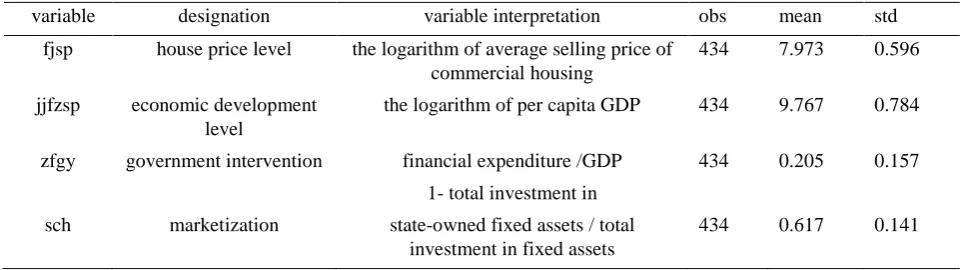
This paper extracts the data from the CSMAR, such as the average selling price of the commercial housing, GDP value, per capita GDP, the total annual financial expenditure, the total investment in state-owned fixed assets and the total investment in fixed assets, about the provinces and municipalities directly under the central government. And then deal with the data to construct indicators, such as the housing price level (fjsp), economic development level (Jjfzs), government intervention (zfgy) and marketization (sch). The specific indicators are as follows:
Table 1. Variable Setting and Statistics
variable designation variable interpretation obs mean std
fjsp house price level the logarithm of average selling price of
commercial housing
434 7.973 0.596
jjfzsp economic development
level
the logarithm of per capita GDP 434 9.767 0.784
zfgy government intervention financial expenditure /GDP 434 0.205 0.157
sch marketization
1- total investment in
state-owned fixed assets / total investment in fixed assets
434 0.617 0.141
3.2 Model Setting
Table 2. Lag Order Selection
Lag AIC BIC HQIC
1 -12.4132 -10.9383* -11.8274*
2 -12.4883* -10.7303 -11.7848
3 -11.9553 -9.88207 -11.1265
4 -11.0512 -8.60438 -10.0697
5 -11.0996 -8.20955 -9.93619
4. Empirical Analysis
4.1 Estimate VAR from the Panel Data
This paper eliminates the individual effect by the method named first-order forward difference, and then obtains the estimation result of the coefficient by the GMM method.
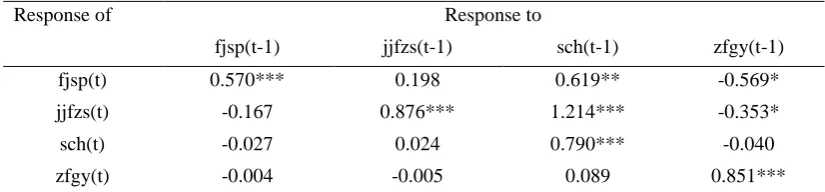
Table 3. PVAR (1) Estimated results
Response of Response to
fjsp(t-1) jjfzs(t-1) sch(t-1) zfgy(t-1)
fjsp(t) 0.570*** 0.198 0.619** -0.569*
jjfzs(t) -0.167 0.876*** 1.214*** -0.353*
sch(t) -0.027 0.024 0.790*** -0.040
zfgy(t) -0.004 -0.005 0.089 0.851***
Note: ***, **, * indicates that in the 1%, 5% and 10% level, the estimation is significant.
First of all ,as can be seen from table 3 above, the dynamic response value is 0.198, which performed by the level of housing price to the level of economic development, while the dynamic response value is -0.167, which performed by the level of economic development to the level of housing price. The results indicate that the rapid development of Chinese economy today promotes the rapid development of the real estate industry, and the prosperity of the real estate industry is inseparable from the development of the national economy. With the improvement of economic level, the per capita income of the people has been improved, and the urbanization process has been accelerated, meanwhile, the urban population has been increasing, and the housing demand has increased. At the same time, with the continuous development of the economy, the urban infrastructure has been improved, and the quality of housing has been better. All the factors will continue to increase the value of real estate. Seen from the inhibition effect from the level of housing price to the level of economic growth, the economy has developed rapidly, urbanization has continued to expand, and the demand of housing has risen and other reasons, all caused the condition that Chinese real estate price growth rate is far greater than the rate of per capita income growth recent years. People put too much capital into the housing consumption, resulted in that other consumption spending was significantly reduced. The level of economic development was driven by the level of consumption, so high housing consumption reduced the level of domestic economic development.
Secondly, the dynamic response value is 0.619 performed by the level of housing price to marketization level, and at the meantime, the dynamic response value is -0.027,which performed by the marketization degree to the level of housing price. We can draw a conclusion that the degree of marketization can promote the value of real estate. In contrast, the value of real estate has a negative impact on the degree of marketization. In the domestic, many state-owned enterprises join to real estate industry and become an important reason for the rapid development of the real estate. The state-owned enterprises have strong financial strength and broader social and political relations, so that in the process of land bidding, they have an absolute advantage. Because of the real estate is a capital-intensive enterprise, a great of funds is demand, so it greatly enhances the investment rate of state-owned assets, and then rises the price of real estate. The huge operating profits attract numerous state-owned enterprises to join in the real estate industry, so a large number of investments of state-owned assets reduce the degree of marketization.
contradictions increased sharply, and the government began to increase effective interventions to stabilize the housing price. Because of the main way that government intervention in housing price mainly to curb the purchase needs, the role played was limited. And because of a short period of time, the inhibition of housing price brought to the slowdown in economic growth, the government had a low enthusiasm to further increase the intensity of intervention to curb housing price.
4.2 Impulse-response Function
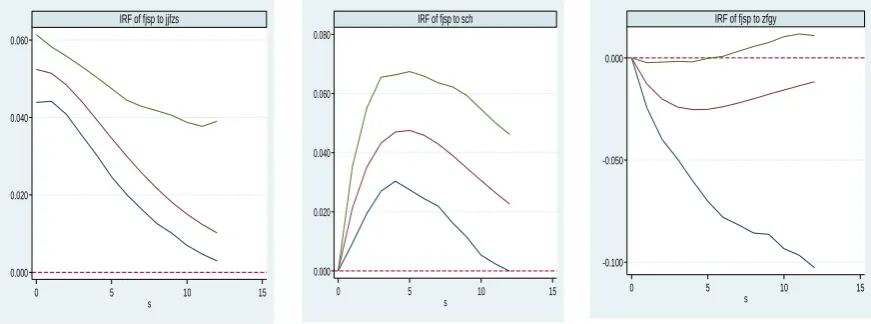
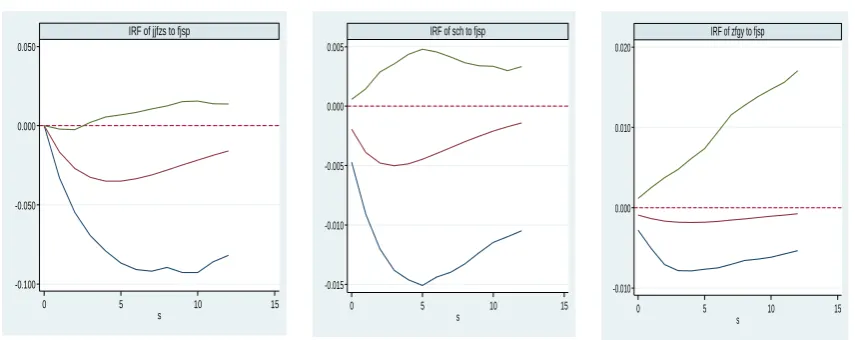
Given an impact of a standard deviation respectively to the variables, and we can get the impulse-response function about the housing price level to each variable shown in figure 1. In the impulse-response function, the horizontal axis represents the number of response periods of the impact, while the vertical axis represents the degree of response of the endogenous variable to the impact. This paper ignores the response of each variable to the impact of its own variable. In the figure, the horizontal axis represents the lag order of the response of each variable to the housing price level, and the vertical axis represents the degree of the response of the housing price level to each variable. The middle is the curve of response function, and the outer two curves represent for the 95% confidence interval. Taking into account the purpose of this study, we focus on the interactive effect of the level of economic development, the degree of marketization and government intervention to the housing price.
As shown in figure 1, from left to right, respectively, represents the response of impact for the level of housing price to the level of economic development, the degree of marketization and the government intervention. The level of economic development and the degree of marketization have a positive effect on the housing price level, but with the passage of time the level of economic development on the positive impact of housing price gradually weaken, and the degree of marketization effect on the housing price level is firstly enhance and then weaken, which indicating that with the level of the domestic economic development and the degree of marketization gradually improved, the real estate price will rise further. From the response of the housing price level to the government intervention, the government intervention has a negative effect on the housing price. In the 5th period, the effect of impulse reaches the maximum, and then gradually weakens up.
Figure 1. Impulse-response for 1 Lag
Figure 2 is the response of the impact for the economic development level, the degree of marketization and government intervention to the housing price. From the response of the level of economic development and the degree of marketization to the level of housing price, after the impact both in the fourth period reach the maximum response value, and both have a negative response, which indicate that the current high housing price level has produced a negative effect on the level of economic development and the degree of marketization. The risen of housing price has attracted a lot of investment for the real estate industry, greatly reducing the expenditure of other consumption investment, curbing the enthusiasm of the people's consumption, and weakening people's other demand for consumption. Simultaneously, it hinders the process of marketization, and makes a negative effect on the level of economic development.
0.000 0.020 0.040 0.060
0 5 10 15
s
IRF of fjsp to jjfzs
0.000 0.020 0.040 0.060 0.080
0 5 10 15
s
IRF of fjsp to sch
-0.100 -0.050 0.000
0 5 10 15
s
Figure 2. Impulse-response for 1 Lag
4.3 Variance Decomposition
Variance decomposition can get the contribution degree of the perturbation term to predict the mean square error (MSE) of the vector autoregressive model, and then can gain the relative role of various factors. The same as the time series data, the error variance of the panel data prediction is the result of its own perturbation and system disturbance. Table 4 shows the variance decomposition results for the 10th and 20th forecast periods. In the 10th period, respectively, economic development and marketization degree cause the housing price changing in the level of 32.6% and 32.4%. And in the 20th, both cause housing price changing in 30.2% and 35.1%. The degree of marketization and the level of economic development are the two main factors influencing the change of housing price.
In contrast, government intervention only causes 9.9% of housing price changes, which shows that the enthusiasm of government is not strong in reducing housing price and stabilizing people's livelihood. At the same time, the level of housing price, the level of economic development and the degree of marketization cause the change of government intervention in the 20th period is only 5%, indicating that the three calls for government intervention is not strong. The degree of marketization is the first factor that causing the change of economic development level, reaching 48.7% in the 20th period. And the housing price level, the level of economic development and the government intervention have a weak influence on the change of the degree of marketization, showing that the domestic market mainly depends on its adjust itself.
Table 4. Variance Decomposition Results
S fjsp jjfzs sch zfgy
fjsp 10 0.258 0.326 0.324 0.092
jjfzs 10 0.117 0.392 0.469 0.022
sch 10 0.052 0.091 0.853 0.004
zfgy
fjsp
10
20
0.013
0.247
0.001
0.302
0.033
0.351
0.953
0.099
jjfzs 20 0.127 0.364 0.487 0.023
sch 20 0.055 0.090 0.851 0.004
zfgy 20 0.014 0.001 0.035 0.950
5. Conclusions and Recommendations
This paper carries out empirical analysis about the interaction between housing price level, economic development level, degree of marketization and government intervention, using the panel vector autoregressive model (PVAR). Empirical test's results found: Firstly, the level of economic development and the degree of marketization have a positive impact on housing price, and in the long run, the self-regulation of the marketization is the main factor affecting housing price; Secondly, in the short term, government intervention can play a role in reducing housing price, but the effect is weak, and the enthusiasm of government intervention is not strong; Thirdly, from the long
-0.100 -0.050 0.000 0.050
0 5 10 15
s
IRF of jjfzs to fjsp
-0.015 -0.010 -0.005 0.000 0.005
0 5 10 15
s
IRF of sch to fjsp
-0.010 0.000 0.010 0.020
0 5 10 15
s
term, the rising of the housing price level will hinder the further development of Chinese marketization process and economic level; Fourthly, the further improvement of the degree of marketization is an important factor that influencing the development of the national economy.
In recent years, high housing price was an important factor affecting people's living standards, and also the main factor to stimulate social contradictions. The real estate promotes the growth of GDP rapidly, and at the same time also seriously inhibited the people's domestic consumption expenditure, which has a negative impact on the level of economic development. It is can't be ignored that housing price growth higher than the per capita income growth is bound to inhibit the future development of the real estate market. In this background, the government introduced a variety of interventions to curb housing price and stable people's livelihood, but the effect is poor.
In response to the above questions, this paper proposes the following policy recommendations: First of all, the government should improve the financial supervision system, and regulate the local government's land financial behavior. Be appropriated to increase the proportion of local governments in the fiscal revenue, dilute the revenue of the land transfer payments, and regulate the rational provision of land; Secondly, change the standard performance evaluation system based on GDP growth, and reduce the adverse effects that local government seizes benefits on the real estate price; Again, speeding up the marketization process of real estate, so as to replace the government regulation system by market regulation; Finally, keep balance of the supply and demand market. It is crucial that diversion needs, rent and buy simultaneously, strengthen market supervision, and increase the supply of commercial housing effectively.
The results of this study are consistent with other findings. But this study is only applicable to China, and there is no exploration of the world real estate market, so the future research can be done.
References
Charles Collyns & Abdelhak Senhadji. (2002). Real Estate Bubbles and the Asian Crisis. IMF Working Paper.
Dagang Wang, Yisheng Liu. (2015). Research on the relationships between Chinese real estate price and
macroeconomic dynamics. Price Theory and Practice, 6, 67-69. Norman Miller and Liang
Jing Xu. (2013). Decoupling analyze of housing price and economic growth. Management of the world, 9, 172-173.
Jiansheng Cheng. (2007). Some think about real estate regulation and control on the current. Chinese Finance, 16.
Murong Ren, Guoqiang Su. (2010). Chinese real estate price macro-control - based on the empirical since 2003.
Central University of Finance and Economics, 6, 55-60.
Peng. (2006). Exploring Metropolitan Housing Price Volatility. Journal of Real Estate Finance and Economics, 33,
5-18. https://doi.org/10.1007/s11146-006-8271-8
Qingbin Meng, Chen Rong. (2014). Macroeconomic factors on the long-term impact of real estate prices. Statistical
Research, 6, 25-32.
Rukai Gong, Zongyuan Huang. (2012). What promoted the Chinese housing prices rose? --Evidence from
institutional variables. Southern Economy, 9, 3-16.
Wei Hu. (2012). The harm of High price to the Chinese economy. Journal of Shanxi University of Finance and
Economics, 3, 20-21. https://doi.org/10.13781/j.cnki.1007-9556.2012.s3.123
Xiaowen Yi. (2007). Study on the Effective Demand of Chinese Housing - Based on Expected Utility and Demand
Income Elasticity.Jiangxi Social Sciences, 4,101-105.
Yingzi Zhu, Dan Xu. (2013). Official promotion pressure, financial marketization and house price growth. Finance