REVIEW
The two-wavelength laser cleaning
methodology; theoretical background
and examples from its application on CH objects
and monuments with emphasis to the Athens
Acropolis sculptures
Paraskevi Pouli
1*, Evi Papakonstantinou
2, Katerina Frantzikinaki
2, Anastasia Panou
2, Giasemi Frantzi
2,
Costantinos Vasiliadis
3and Costas Fotakis
1Abstract
The two-wavelength laser cleaning methodology has been introduced and developed in order to meet demand-ing cleandemand-ing challenges in CH. The innovation lies on the combined use of two laser beams, allowdemand-ing thus control of the laser ablation effective regimes towards an efficient and safe cleaning result. A series of studies on technical samples and real fragments aimed at defining and refining this methodology in order to ensure that the original surface, including its details and historic traces, will be safeguarded. In this paper related research and applications will be presented in an attempt to enlighten the associated laser ablation processes, as well as the potential cleaning applications in CH field. Laser-assisted removal of pollution accumulations from the Athens Acropolis monuments and sculptures is a unique highlight on the use of this methodology in practice. IESL-FORTH in collaboration with the Acropolis Restoration Service and the Acropolis Museum has developed an innovative cleaning methodology and a prototype laser cleaning system, which since 2002 have been introduced to the everyday conservation practice and will be presented in this paper.
Keywords: Two-wavelength laser cleaning, Pollution crust, Yellowing, Plaster, Acropolis sculptures, Parthenon West Frieze, Caryatids
© 2016 Pouli et al. This article is distributed under the terms of the Creative Commons Attribution 4.0 International License (http://creativecommons.org/licenses/by/4.0/), which permits unrestricted use, distribution, and reproduction in any medium, provided you give appropriate credit to the original author(s) and the source, provide a link to the Creative Commons license, and indicate if changes were made. The Creative Commons Public Domain Dedication waiver (http://creativecommons.org/ publicdomain/zero/1.0/) applies to the data made available in this article, unless otherwise stated.
Background
Laser cleaning relies on the ablation effect as a result of intense and short pulse irradiation at wavelengths that are strongly absorbed by the materials. The laser induced removal of unwanted material from unique Cultural Her-itage (CH) objects and monuments is a complex process, closely dependent on the material properties and laser parameters [1, 2]. In fact selective and controlled material removal, with minimal thermal load or interaction to the
substrate, can be achieved upon thorough knowledge of the materials involved and careful study and optimization of the related processes. In this framework a number of diverse cleaning challenges have been successfully tack-led over the last 25 years, establishing laser technology as a fine, delicate and practical conservation tool in the ser-vice of conservators-restorers.
The laser cleaning project on the Athens Acropolis sculptures is a unique example of laser cleaning appli-cation in CH field. The selected and controlled removal of soot deposits and black encrustations from the sur-face of archaeological material has revealed the authen-tic surface of these fine-sculpted objects in all its detail and beauty. The multidisciplinary collaboration of the
Open Access
*Correspondence: [email protected]
1 Institute of Electronic Structure and Laser, Foundation for Research and Technology-Hellas (IESL-FORTH), PO Box 1835, 71110 Heraklion, Greece
research team of the Institute of Electronic Structure and Lasers (IESL-FORTH), the Acropolis Restoration Service (YSMA) and the Acropolis Museum resulted into the development of a prototype laser cleaning system and an innovative cleaning methodology, which since 2002 have been introduced to the everyday cleaning practice of the conservators who care for these unique sculptures. The innovation lies on the combined use of two laser beams in spatial and temporal overlapping. This arrangement allows the control of the laser ablation effective regimes towards a safe and controlled cleaning result, ensuring that the original surface will be safeguarded.
This methodology was introduced in an attempt to overcome a number of potential complications, associ-ated mainly with colour alteration observed onto the underlying original surfaces. Its successful application on the Athens Acropolis monuments influenced further work and new applications have been studied and opti-mised. These case-applications as well as a brief discus-sion on the methodology, its potential and restrictions will be discussed in this paper.
The two‑wavelength cleaning methodology; background information and principles of operation
The discoloured appearance of laser cleaned surfaces, which may appear under certain conditions, poses limita-tions to the practice and wide application of laser tech-nology in CH conservation and thus urges for thorough investigation. Laser-induced colour changes are directly dependant to the involved materials and can be distin-guished as follows:
• Discoloration on stonework: yellowing alteration is mainly associated with the use of infrared (IR) radia-tion (1064 nm) of nanosecond (ns) pulse duraradia-tion to remove pollution encrustations from stonework [3–6]. Revealing of pre-existing historic layers and/ or patinas [3], ‘staining’ of the original surface (as a result of the migration of the yellowish fraction which is present within the pollution crust and originates from polar organic compounds) [7–9], and selective vaporization of the various dark-coloured airborne particles (which are embedded in the gypsum-rich matrix of the pollution crust) at rather low laser flu-ences [4, 10], were among the scenarios introduced to explain such undesired coloration. In parallel, dis-coloration into grey has been also reported upon use of ultraviolet (UV) radiation to treat pollution crusts [4, 11].
• Darkening phenomena observed on painted surfaces upon intense and direct laser irradiation. The sensi-tivity of most pigments to the direct exposure to laser
irradiation is an important issue, which requires care-ful study and thorough approach. Relevant research [12–16] has pointed out that darkening or, in the worst case scenario, blackening of painted surfaces is a material related alteration which occurs upon direct exposure to laser radiation. Although initially it was believed that such undesired alteration is irrelevant to the binding medium as it affects both paints and pigments in raw form, recent studies on the basis of different ablative methodologies using lasers of vari-ous wavelengths and pulse durations, proved that the presence of a binding media that absorbs highly the employed laser wavelength may safeguard the pig-ment itself [16]. Therefore for cleaning applications that involve painted components or surfaces a num-ber of parameters must be thoroughly considered.
Discoloration issues have been extensively and long studied and a number of publications have been focused on their understanding [3, 17–19], while emphasis has been also given to the development of eliminative and remedial approaches on the basis of careful choice and fine-tuning of the operative laser parameters (such as the laser wavelength [11, 18, 21–23] and pulse duration [17,
24].
The two-wavelength methodology has been introduced initially to overcome yellowing discoloration of sculpted marbles. The cautious “blending” of two laser beams, which overlap in space and time, has been suggested in an attempt to bridge the inefficient and unsuccessful cleaning result from the individual use of the two beams. An important parameter that must be taken into account in this methodology is the relative ratio of the intensity of the two beams, which has a decisive role as regards the prevailing ablation processes and thus the cleaning result. A brief description of background work that influenced the development of the methodology is highlighted in the following:
Laser-assisted encrustation removal using IR wave-lengths (1064 nm) of ns pulse duration is a well established cleaning methodology for removal of dark-coloured over-layers from light-dark-coloured substrates with numerous applications worldwide [1, 2, 11, 25, 26, 27, 28,
encrustation removal is significant lower than the one for substrate/marble damage and thus selective and self-lim-iting cleaning is feasible. Typical F threshold values deter-mined for 1064 nm ablation of black pollution crust and Pentelic marble are 0.8 and 3.5 J/cm2, respectively [18].
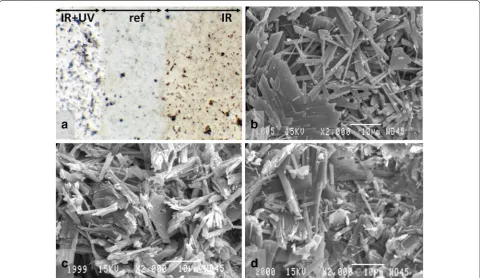
Nevertheless, the use of IR laser beams both on tech-nical samples simulating pollution encrustation, as well as on real marble fragments with pollution crusts, often resulted in surfaces discoloured to yellow–brown. A series of preliminary experiments, which took place on technical samples made of gypsum (CaSO4 2H2O) and 5–10 % wt of charcoal particulates (with size in the range of 50–150 μm) in a simplistic simulation of pollution crusts, aimed at studying the removal mechanisms of the pollution crusts in this IR regime (1064 nm, 30 ns). The irradiated surfaces appeared yellow, while it was evident that discoloration is more intense for higher charcoal percentages (10 %) [20]. Thus it was related with pref-erential charcoal particulate removal and consequently insufficient ablation of the bulk material (gypsum). Fur-thermore, the fact that IR irradiation of gypsum pellets without any particulates does not cause any colour or chemical (on the basis of Raman analysis [20]) changes suggest the thermal dissociation of the charcoal par-ticulates as a reason for this alteration [20]. Indeed assessment of the treated surfaces under the optical microscope (OM) and the scanning electron microscope (SEM) pointed out the presence of voids/craters of vari-ous sizes without any significant damage to the gypsum crystals, indicating that at fluence values close to the ablation threshold of the crust, charcoal particulates, either individually or in clusters (Fig. 1a, c), are preferen-tially removed.
Similar results were also observed on real fragments bearing thin homogeneous pollution crusts which have been cleaned with 1064 nm of ns pulse duration. Evalu-ation of the treated surfaces pointed out that at F val-ues slightly above the ablation threshold the crust is not totally removed and a thin layer of matrix material still remains on the surface (Fig. 2a, c). This layer, which has lost its initial dark colour and has a beige-yellow colora-tion, cannot be easily removed. Its removal is possible using significantly high fluence values, which are close to the ablation threshold of the marble and thus such an intervention cannot be considered “self-limited”.
Conversely no yellow–brown discoloration is observed upon UV irradiation. Tests on the technical gypsum-charcoal samples using 355 nm with pulse duration of few ns [5, 6, 11, 21] resulted into relatively faded/ bleached surfaces. Under the OM minimal void for-mation and relatively homogeneous surface relief is observed indicating that material removal takes place on the basis of the “layer-to-layer” ablation model and the
whole structure (gypsum-charcoal) is gradually removed. It has to be noted that for effective material removal in this regime high fluence values are required, which may result into damaged gypsum crystals as confirmed with SEM (Fig. 1d).
On the other hand attempts to remove real pollution crusts from marble fragments using 355 nm were not sat-isfactory as regards the cleaning efficiency and the degree of control. Although thin and homogeneous crusts could be removed without yellow discoloration their cleaning rate was rather slow and inefficient, especially on areas with micro-relief. Furthermore thick and inhomogeneous pollution accumulations could not be eliminated satisfac-torily resulting into irregular surfaces. It has to be noted that in the UV ablation regime the difference between the absorption coefficients of encrustation and substrate is not enough to ensure significant differences to the abla-tion thresholds of the two materials and thus a ‘self-limit-ing’ cleaning process [21].
To avoid discoloration and overcome the above issues the combined use of the two laser beams was suggested. Initially the attention was focused on their sequen-tial (SQ) use with the intension to employ the UV laser beam to correct the discoloration induced by the IR beam [30]. The result was not satisfactory; the discolora-tion could be rectified to a certain degree, however the surface morphology appears seriously uneven under the microscope. This can be explained due to the fact that the “new” crust surface, which resulted upon the IR irradia-tion, shows different physicochemical properties to the untreated crust and the ablation effect with the UV beam is thus different from the one that has been reported on the crust itself. Similarly insufficient was the encrustation removal obtained when the IR beam was applied to rec-tify the effect of UV irradiation.
The synchronous (SN) use of the two wavelengths in spatial and temporal overlapping was then tested [10,
30, 31]. Tripled QS Nd:YAG lasers emit simultaneously in 1064 nm, as well as their 2nd (532 nm), 3rd (355 nm) etc. harmonic frequencies and thus offer a convenient basis to exploit the possibility to combine the different cleaning mechanisms (in this case the IR at 1064 nm and UV at 355 nm). Key feature is the adjustment of the energy density ratio of the two beams (FIR/FUV) and thus the regulation of the contribution of the indi-vidual ablation mechanism for different encrustations and substrates. Moreover, another important aspect that must be taken into account is the total F value
(Ftotal=FIR+FUV). In order to avoid damaging effects
threshold for dark pollution encrustation removal (i.e. FIR_crust ~ 0.8 J/cm2).
An illustrative example of the different effects upon laser ablation of pollution crusts from individual, sequen-tial and synchronous use of the two wavelengths is shown in Fig. 3. In this Figure a series of laser irradiation experi-ments on a real fragment of marble is shown, which was added as a corner complement to replace missing ele-ments and reinforce the Parthenon Frieze blocks during their restoration intervention in the 1960s. This piece of new marble of the same origin to the ancient marble pieces (Pentelic quarry) shows the same encrustation to the rest of the Parthenon Frieze and thus could be used for the purpose of this study. Previous studies [32,
33] have determined the ablation threshold values for the thin pollution crust in the IR and UV regime to be respectively FIR_crust = 0.8 J/cm2 and FUV_crust = 0.6 J/cm2, while the corresponding values for damaging the marble are FIR_marble = 3.5 J/cm2 and FUV_marble = 1.2 J/cm2. The fragment was treated dry with 20 pulses of various laser beams and combinations as shown in the schematic of Fig. 3.
Irradiation with the IR laser beam at 1064 nm (left column, areas 1, 2 and 3) shows yellow discoloration. Treatment at F values close (FIR_2 = 0.8 J/cm2) and below
(FIR_3 = 0.4 J/cm2) the ablation threshold of the crust shows insufficient crust removal while the final surface is yellow. For F above the ablation threshold (FIR_1 = 1.5 J/ cm2) cleaning is efficient but the marble surface has still a slight yellow hue. Similar insufficient result is obtained upon irradiation with the UV laser beam at 355 nm (sec-ond to the left column, areas 4, 5 and 6). In this case for F values in the range of 0.1–0.2 J/cm2 the crust appears rather discoloured into grey, while at F slightly higher (FUV_4 = 0.4 J/cm2) damage of the marble substrate is vis-ible as broken shiny marble crystals are revealed.
The SQ use of the two beams has been also compara-tively studied and is shown in Fig. 3 (the two columns on the right). Areas 10, 11 and 12 have been irradiated ini-tially with the IR laser beam (at the same conditions to 1, 2 and 3) and then, following a ~5 mm shift to the right for comparison purposes, with the UV beam (at the same conditions to 4, 5 and 6). It is obvious that the result of the SQ irradiation varies significantly to the SN one on every aspect (colour-wise and efficiency).
The synchronous (SN) use of the two wavelengths in spatial and temporal overlapping is shown in the middle column (areas 7, 8 and 9). In this case the exact param-eters of the individual IR and UV beams have been combined effectively with the aim to reach an optimum Fig. 1 a surface photo of a gypsum-charcoal technical sample irradiated with 1064 nm (10 pulses at FIR= 1.5 J/cm2) and a combination of
1064 nm and 355 nm (10 pulses at FIR= 1.5 J/cm2 and F
UV= 0.9 J/cm2). The width of the reference stripe is 5 mm. b–d SEM photos of
cleaning result without discoloration or other altera-tions. As seen in Fig. 3 areas irradiated with the synchro-nous beam are less discoloured to the ones treated with the individual beams. For example the colour of area 9 (which is the combination of the beams that treated areas 3 and 6) is closer to the colour of the untreated crust. Indeed, the final surface of area 9 appears less yel-low to area 3 (FIR_3 = 0.4 J/cm2) and less grey to area 6 (FUV_6 = 0.1 J/cm2), although it has to be mentioned that all three areas are considered under-cleaned. In this example area 8 appears to have an optimal cleaning level and final surface (judging on its colour and surface mor-phology) while area 7 is undoubtedly over-cleaned.
The irradiated areas shown in Fig. 3 illustrate the supe-riority of the two-wavelength laser cleaning methodol-ogy as regards the final colour, surface morpholmethodol-ogy and homogeneity of the cleaned areas, while indicating the limitations of the individual IR and UV cleaning regimes, as well as of their SQ use. The methodology has been thoroughly tested through a series of studies, both on technical samples and real fragments [18, 30, 31], in order to determine the optimal conditions for its application. Fig. 2 OM photographs (a and b) and cross-sections (c and d) of real fragments of marble with thin pollution accumulations irradiated with 50 pulses at 1064 nm (FIR= 0.85 J/cm2) (a and c) and 355 nm (FUV= 0.35 J/cm2) (b and d). Dark areas on the right in a and b are reference/untreated
areas, while dashed lines in the cross sections c and d indicate the border between the marble structure and the crust
These results have allowed its adaptation and fine-tun-ing for the cleanfine-tun-ing challenges of the Athens Acropolis Sculptures and Monuments with success. However it must be underlined that the choice of the laser param-eters and cleaning methodology relies strongly to the materials involved and the specific conservation chal-lenge. The combinative use of the two beams is an option that may answer difficult and demanding cleaning issues. A couple of such examples is highlighted in the following including its application on the Athens Acropolis.
Case applications
Acropolis of Athens
Cleaning interventions on the Sculptures and Monu-ments of the Athenian Acropolis aimed at the removal of dark deposits and encrustations accumulated on their surface mainly due to environmental pollution. The Athenian Acropolis is a unique complex of monuments located on a hill in the centre of Athens. These fine-curved architectural elements made of fine white Pentelic marble, are exposed to the environmental conditions and weathering for about 2500 years now. Their surface con-dition has been further and significantly altered within the past 70 years due to the rapid industrialization of Athens, which increased significantly the pollution rates and resulted to the deposition of soot and suspended particles on the monuments. As a result extensive lay-ers of soiling crusts were formed, disfiguring the marble surface while hiding historical details. Their analysis [34] indicated the presence of soot and heavy metals such as copper (Cu), lead (Pb), iron (Fe), zinc (Zn) etc. in their bulk. Moreover the presence of sulphur dioxide in the atmosphere led to the formation of a gypsum layer on the marble surface, which up to a certain thickness preserves details of the relief and therefore must be safeguarded [35].
On the basis of their morphology, thickness and com-position these encrustations were classified as follows [32–34]:
1. Loose deposits. Rich in gypsum, organic compounds and traces of minerals loose deposits form a rather uniform veil that obscures surface details. They are the thinnest deposits layers observed on the monu-ment with their thickness reaching up to 100 μm. 2. Homogenous compact crusts. Thicker layers (up to
150 μm) of accumulated deposits well adhered to the marble hiding any surface traces and details.
3. Dendritic black crusts; “Stalagmitic” formations of significant thickness consisting of re-crystallized and re-precipitated calcium carbonate and a mixture of gypsum and other atmospheric particles. Their thick-ness may be significant and their removal necessary.
In late nineties the Committee for the Conservation of the Acropolis Monuments (ESMA) indicated that these encrustations should be removed from the archaeological material in order to reveal the original surfaces. The deci-sion on the cleaning level relied on a thorough under-standing and study of the stratigraphy of the original surfaces. Preliminary studies under the scientific guid-ance of late professor Th. Skoulikidis [36] investigated the surface condition underneath the pollution crusts and tested a number of cleaning methodologies.
Furthermore, the presence of two monochromatic sur-face layers preserved on the marble was pointed out:
1. ‘Epidermis’ (skin) which forms the lower surface layer. This thin (30–100 μm) orange-brown layer, rich in calcium oxalates, calcium phosphates and iron oxides [32] is well-adhered to the marble surface and often encountered on many Classical and Roman monuments.
2. ‘Coating’; this artificial outer layer (80–120 μm thick) of beige colour covers the epidermis and is composed mainly of calcium carbonate.
Both of these surface layers [37] which cover a significant part of the sculpted surfaces (especially on the Parthenon West Frieze) indicate the presence of historical details (colour and original tooling traces) and thus should be preserved upon cleaning.
With the aim to safeguard these historic layers and reveal the original surface a number of conservation methodologies were tested as regards their efficiency and result and the following four were shortlisted for further study: (1) absorptive poultices, (2) micro-blasting, (3) inversion of gypsum layer into calcite and (4) laser clean-ing. The superiority of laser cleaning over the other three conventional methods was confirmed, as the majority of stonework encrustations could be removed effectively and selectively, however scepticism as regards yellow col-oration effects documented on the treated surfaces urged for further studies.
optimum cleaning parameters such as the energy flu-ence and the appropriate number of pulses for a desirable depth of cleaning. Additionally, the optimum ratio of UV to IR contribution to achieve a satisfactory cleaning was determined.
According to this research a prototype hybrid port-able laser cleaning instrument was developed (Fig. 4) on the basis of a Q-switched Nd:YAG system emit-ting at the fundamental (1064 nm) and the third har-monic (355 nm), with the option of using the two laser beams individually or in combination and in various ratios. The maximum energy density in the IR does not exceed the 1.8 J/cm2 (for “dendritic”-type encrusta-tion) while working fluencies in the synchronous oper-ation lie in the range of 0.3–0.8 J/cm2 for the IR and 0.1–0.2 J/cm2 for the UV and the optimum ratio for the F values of the two combined laser beams is FIR/ FUV = 4/1 [32].
The Parthenon West Frieze was the first assemblage from the Acropolis to benefit from this laser cleaning methodology (2002–2005). The aesthetic value of the sculptures was thus restored, while ancient monochro-matic surface layers, as well as other historic information, such as tool-marks and colour traces that have survived on the surface of sculptures, were revealed. Upon the completion of the Parthenon West Frieze blocks, the laser cleaning methodology has been employed for the cleaning of a number of sculptures from the Parthenon, the Erechtheion and the Temple of Athena Nike. In the period 2006–2010 a total of seventeen metopes from the north and east sides of the Parthenon, along with four pedimental sculptures (the Kekrops and Pandrosos group and the horses of Helios and Selene), the upper body of Caryatid “F” and four blocks from the Frieze of the Tem-ple of Athena Nike were restored.
Following the opening of the new Acropolis Museum (in 2009) and the transfer of the exhibits to their new location in 2010, the Acropolis Museum commenced a conservation project for the Caryatids (the lady figures supporting/holding the Erectheion porch) after their removal from the monument in 1979. To avoid any risks entailed in an additional transportation it was decided not to move the Caryatides from the Museum galler-ies and perform any preserving activitgaller-ies in situ at their exhibition area. For this purpose a temporal, but at the same time advanced laser laboratory has been set-up on the visitors’ floor where the Caryatids are exhibited. The cleaning procedure took place inside a specially designed platform that “embraces” and isolates one sculpture at a time (Fig. 5a, b). This arrangement brought the visitors of the Acropolis Museum in contact with the conserva-tion intervenconserva-tions that until now were limited inside restricted access laboratory environments. Following the
completion of the laser cleaning interventions of the Car-yatids in 2014, the project continues with other sculp-tures in the Acropolis Museum.
At the same time, during the period 2008–2010, another laser cleaning project was undertaken on the Acropolis hill; a second prototype laser system was accommodated inside the Caryatids’ porch in the Ere-chtheion with the aim to clean the coffered-ceiling of the porch (Fig. 5c). This intervention was particularly demanding from the technical point of view, as the cof-fered structures were located to the ceiling of the temple
and necessary ergonomic measures should be taken for an efficient work. Furthermore, this challenging laser cleaning project involved along to the pollution accumu-lation the removal of soot (from fires) and a number of unconventional materials (from past unsuccessful resto-rations i.e. cement). The project was completed in 2010 and a number of analytical measurements has proven the efficiency of the cleaning intervention.
Dark soiling on plaster objects
Another cleaning challenge that has been effectively approached with the two-wavelength laser cleaning methodology is the removal of dark over-layers from plaster objects. Models (moulds) for three dimensional objects are often prepared with plaster and through the years they found covered with dark crusts. This is a rather composite problem as this crust may have soiling particles (internal dust), organic materials (from cast-ing processes), as well as biological organisms. Given the sensitivity of gypsum [38–39], as well as its solubility to water, cleaning interventions on such objects are particu-larly demanding.
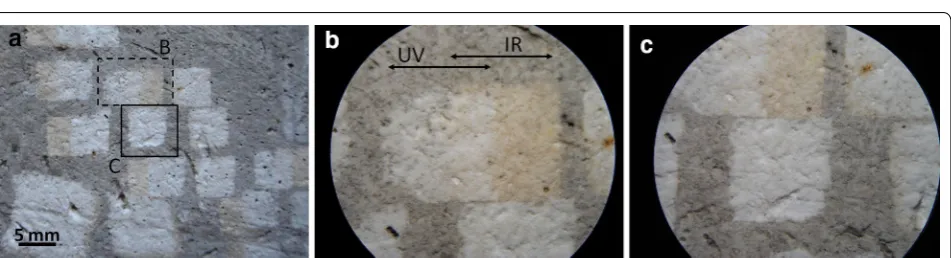
Initial tests (Fig. 6) with 1064 nm (ns pulse duration) resulted into cleaned but discoloured (yellow) surfaces [19] while the 355 nm laser radiation could not efficiently remove the crust leaving behind dark spots which are mainly located to in-homogeneities and micro-relief of the gypsum surface. Their combination was investigated (Fig. 6b) with encouraging results. Experiments apply-ing sequentially the two beams (Fig. 7a, b) were not completely satisfying, while their synchronous use could reach the optimum cleaning level without surface or col-our alterations (Fig. 7c). In this case the chosen operative laser irradiation parameters are FIR/FUV = 2/3. Raman analysis [20] supported the results as it was proven that the chosen laser parameters do not cause any change to the hydration state of the cleaned gypsum surface as no peaks indicating de-hydration states of the calcium sul-phate hemi-hydrate were detected.
For the purpose of this cleaning challenge (thin soiling on plaster) the two-wavelength methodology was found to be able to remove the unwanted over-layer without damage or discoloration to the very sensitive gypsum surface. In this case the F ratio chosen favours the domi-nant contribution of the UV laser beam as the aim is the “layer-by-layer” removal of such thin and homogeneous crust. The contribution of the IR beam is minor and aims mainly to the removal of particulates trapped inside the surface micro-relief. On-going research aims to confirm the above results to other similar objects with the same type of crusts in order to establish this methodology for the laser conservation needs of plaster objects.
Conclusions and prospectives
Laser radiation is a unique conservation tool enabling the conservators to remove unwanted layers and materials in a highly controlled way, ensuring selectivity, precision and no harmful or uncontrolled by-products. Its appli-cation within the past 20 years in a number of cleaning challenges was proven able to restore the original sur-faces while revealing fine details, historical tool-marks and traces of colour, information valuable for the CH historic research. Along these lines the two-wavelength methodology was suggested and developed aiming to address a number of conservation challenges and side-effects; yellowing discoloration of stone surfaces being the most characteristic. The methodology allows the regulation of different laser material ablation regimes and thus can be adapted to different cleaning issues with emphasis to cases in which conventional laser cleaning methodologies (i.e. using IR wavelengths) are not effec-tive or successful. As a general rule for the combination of the 1064 and 355 nm their relative ratio is determined
on the basis of the composition and morphology of the material to be removed. In order to remove relatively thick and inhomogeneous crusts the contribution of the IR beam (which is highly absorbed by the bulk of the crust) must be dominant, while for thinner soiling lay-ers UV favoured ablation is recommended. Another important limitation is the cautious choice of the F value of each of the two beams and/or their sum, in order to operate below the threshold F values for damaging the substrate.
Fine-tuning of the two-wavelength methodology on a number of technical simulation samples and real frag-ments allowed its optimisation and implementation to the cleaning needs of Athens Acropolis sculptures where it has been operating for the past twelve years. Work in progress aims at the investigation and study of the com-bination of different laser wavelengths with encourag-ing results, as for example the combination of 1064 and 532 nm, which has been found particularly promising for the removal of biological encrustation from stonework. Fig. 6 a Series of 1064 nm (lower line) and 355 nm (upper line) of spot irradiation tests to remove dark over-layers from plaster (1 pulse at various F),
b Series of spot irradiation tests using the two laser beams simultaneously (1 pulse at various FIR/FUV ratios)
Fig. 7 a Series of SQ and SN irradiation tests to remove dark over-layers from plaster, b SQ irradiation (four pulses at FIR= 0.4 J/cm2 and following
Authors’ contributions
The work presented in this review paper was performed by the corresponding author under the scientific guidance of CF and in collaboration with a number of colleagues and students their research work is cited along the paper and their names are addressed in the acknowledgements. The work performed at the Acropolis Monuments and Sculptures is a collaborative effort with: EP, KF (Initial experiments towards the optimisation of the methodology for the Parthenon West Frieze), EP, KF, AP, CV (Parthenon West Frieze), GF, EP (Erech-theion Porch), CV (Caryatids and other sculptures in the Acropolis Museum). All authors read and approved the final manuscript.
Author details
1 Institute of Electronic Structure and Laser, Foundation for Research and Technology-Hellas (IESL-FORTH), PO Box 1835, 71110 Heraklion, Greece. 2 Acropolis Restoration Service, 10 Polygnotou Str, PO Box 10555, Athens, Greece. 3 Acropolis Museum, 15 Dionysiou Areopagitou Str, PO Box 11742, Athens, Greece.
Acknowledgements
The author would like to thank the A’ Ephorate of Prehistoric and Classical Antiquities, the Committee for the Preservation of the Acropolis Monuments and D. Pantermalis, president of the Acropolis Museum, for their guidance, and the following archaeologists and conservators, for their invaluable work on-site: E. Maniadaki, G. Marakis, C. Vlassopoulou (Acropolis Restoration Service, West Parthenon Frieze), A. Maridaki, D. Garbis (Acropolis Restoration Service, Erechtheion), I. Farmaki, V. Rachioti, M. Gavrinioti (Acropolis Museum). The valuable work of V. Zafiropulos, K. Melessanaki, Th. Ditsa, G. Totou, M. Tsafantaki, A. Papanikolaou in the realisation of the work presented in this review, as well as the assistance offered by the technical personnel of IESL-FORTH (A. Egglezis, A. Petrakis, Y. Labrakis. G. Gousis, J. Koutsaidis) in the development and mainte-nance of the prototype laser systems are greatly appreciated.
Competing interests
The author declare they have no competing interests.
Received: 27 November 2015 Accepted: 30 March 2016
References
1. Fotakis C, Anglos D, Zafiropulos V, Georgiou S, Tornari V. Lasers in the preservation of cultural heritage. Principles and applications. New York: Taylor and Francis; 2006.
2. Cooper MI. Laser cleaning in conservation: an introduction. Oxford: Butterworth-Heinemann; 1998.
3. Vergès-Belmin V, Dignard C. Laser yellowing myth or reality. Journal of Cultural Heritage. 2003;4(Suppl):238s–44s.
4. Zafiropulos V, Balas C, Manousaki A, Marakis Y, Maravelaki-Kalaitzaki P, Melesanaki K, Pouli P, Stratoudaki T, Klein S, Hildenhagen J, Dickmann K, LukYanchuk BS, Mujat C, Dogariu A. Yellowing effect and discolora-tion of pigments: experimental and theoretical studies. J Cult HeriT. 2003;4:249–56.
5. Klein S, Ferksanati F, Hildenhagen J, Dickmann K, Uphoff H, Marakis Y, Zafiropulos V. Discoloration of marble during laser cleaning by Nd:YAG laser wavelengths. Appl Surf Sci. 2001;171:242–51.
6. Dickmann K, Klein S, Zafiropulos V. Laser cleaning of marble: discoloration effects using various Nd:YAG laser wavelengths (ω, 2ω, 3ω). In: Salimbeni R, editor. Laser techniques and systems in art conservation, vol. 4402. Washington: SPIE—The International Society for Optical Engineering; 2001. p. 54–67.
7. Gavino M, Hermosin B, Castillejo M, Oujja M, Rebollar E, Vergès-Belmin V, Nowik W, Saiz-Jimenez C. Black crusts removal: the effect of stone yellow-ing and cleanyellow-ing strategies. In: Saiz-Jimenez C, editor. Air Pollution and cultural heritage. London: AA Balkema; 2004. p. 239–45.
8. Gracia M, Gaviño M, Vergès-Belmin V, Hermosin B. Mössbauer and XRD study of the effect of Nd:YAG-1064 nm laser irradiation on hematite present in model samples. In: Dickmann K, Fotakis C, Asmus JF, editors. The Proceedings of the 5th International Conference on Lasers in the
Conservation of Artworks (LACONA V). Springer proceedings in physics 100. Heidelberg: Springer; 2005. p. 341–6.
9. Potgieter-Vermaak SS, Godoi RHM, van Grieken R, Potgieter JH, Oujja M, Castillejo M. Micro-structural characterization of black crust and laser cleaning of building stones by micro-Raman and SEM techniques. Spec-trochim Acta A. 2005;61:2460–7.
10. Zafiropulos V, Pouli P, Kylikoglou V, MaravelakiKalaitzaki P, Lukyanchuk BS, Dogariu A. Synchronous use of IR and UV laser pulses in the removal of encrustation: mechanistic aspects, discoloration phenomena and ben-efits. In: Dickmann K, Fotakis C, Asmus JF, editors. The Proceedings of the 5th International Conference on Lasers in the Conservation of Artworks (LACONA V) Springer Proceedings in Physics 100. Heidelberg: Springer; 2005. p. 311–8.
11. Zhang J, Birnbaum AJ, Yao YL, Xu F, Lombardi JR. Effect of fluence on the discoloration of marble cleaned with UV lasers. Appl Surf Sci. 2007;253:3083–91.
12. Pouli P, Emmony DC, Madden CE, Sutherland I. Analysis of the laser-induced reduction mechanisms of medieval pigments. Appl Surf Sci. 2001;173:252–61.
13. Castillejo M, Martin M, Oujja M, Silva D, Torres R, Manousaki A, Zafiropulos V, Van den Brink OF, Heeren RMA, Teule R, Silva A, Gouveia H. Analytical study of the chemical and physical changes induced by KrF laser clean-ing of tempera paints. Anal Chem. 2002;74:4662–71.
14. Cooper MI, Fowles PS, Tang CC. Analysis of the laser-induced discolora-tion of lead white pigment. App. Surf. Sci. 2002;201:75–84.
15. Hildenhagen J, Chappé M, Dickmann K. Reaction of historical colours and their components irradiated at different Nd:YAG laser wavelengths (ω, 2ω, 3ω, 4ω). In: Dickmann K, Fotakis C, Asmus JF, editors. The Proceedings of the 5th International Conference on Lasers in the Conservation of Artworks (LACONA V). Springer Proceedings in Physics 100. Heidelberg: Springer; 2005. p. 297–302.
16. Oujja M, Sanz M, Rebollar E, Marco JF, Castillejo M, Pouli P, Kogou S, Fota-kis C. Wavelength and pulse duration effects on laser induced changes on raw pigments used in paintings. Spectrochim. Acta A. 2013;102:7–14. 17. Siano S, Margheri F, Pini R, Mazzinghi P, Salimbeni R. Cleaning processes
of encrusted marbles by Nd:YAG lasers operating in free-running and Q-switching regimes. Appl Opt. 1997;36:7073–9.
18. Pouli P, Oujja M, Castillejo M. Practical issues in laser cleaning of stone and painted artefacts: optimization procedures and side effects. Appl Phys A. 2012;106:447–64.
19. de Oliveira C, Vergès-Belmin V, Demaille D, Bromblet P. Lamp black and hematite contribution to laser yellowing: A study on technical gypsum samples. Stud Conserv. 2015. doi:10.1179/2047058415Y.0000000003. 20. Papanikolaou A. Towards the understanding of the double wavelength
laser cleaning in avoiding laser yellowing on stonework. PhD Thesis. University of Crete, Department of Physics, 2015.
21. Marakis G, Pouli P, Zafiropulos V, Maravelaki-Kalaitzaki P. Compara-tive study on the application of the first and the third harmonic of a Nd:YAG laser system to clean black encrustation on marble. J Cult Herit. 2003;4:S83–91.
22. Bartoli L, Pouli P, Fotakis C, Siano S, Salimbeni R. Characterization of stone cleaning by Nd:YAG lasers with different pulse duration. Laser Chemistry. 2006;81750.
23. de Cruz A, Wolbarsht ML, Palmer RA, Pierce SE, Adamkiewicz E. Er:YAG laser applications on marble and limestone sculptures with polychrome and patina surfaces. In: Dickmann K, Fotakis C, Asmus JF, editors. The Proceedings of the 5th International Conference on Lasers in the Con-servation of Artworks (LACONA V) Springer Proceedings in Physics 100. Heidelberg: Springer; 2005. p. 113–24.
24. Siano S, Giamello M, Bartoli L, Mencaglia A, Parfenov V, Salimbeni R. Laser cleaning of stone by different laser pulse duration and wavelength. Laser Phys. 2008;18:27–36.
25. Asmus JF, Seracini M, Zetler MJ. Surface morphology of laser-cleaned stone. Lithoclastia. 1976;1:23–46.
26. Beadman K, Scarrow J. Laser cleaning Lincoln Cathedral’s Romanesque Frieze. Journal of Architectural Conservation. 1998;4:39–53.
28. Calcagno G, Pummer E, Koller M. St. Stephen’s church in Vienna: criteria for Nd:YAG laser cleaning on an architectural scale. J Cult Herit. 2000;1(Suppl):S111–7.
29. Siano S, Giusti A, Pinna D, Porcinai S, Giamello M, Sabatini G, Salimbeni R. The conservation intervention on the Porta della Mandorla. In: Dickmann K, Fotakis C, Asmus JF, editors. The Proceedings of the 5th International Conference on Lasers in the Conservation of Artworks (LACONA V). Springer Proceedings in Physics 100. Heiderberg: Springer; 2005. p. 171–8.
30. Pouli P, Fotakis C, Hermosin B, Saiz-Jimenez C, Domingo C, Oujja M, Castillejo M. The laser-induced discoloration of stonework; a comparative study on its origins and remedies. Spectrochim Acta A. 2008;71:932–45. 31. Pouli P, Zafiropulos V, Fotakis C. The combination of ultraviolet and
infrared laser radiation for the removal of unwanted encrustation from stonework; a novel laser cleaning methodology. In: Kwiatkowski D, Lofv-endahl RR, editors. The Proceedings of the 10th International Congress on Deterioration and Conservation of Stone ICOMOS, Stockholm Sweden. Sweden: ICOMOS; 2004. p. 801–8.
32. Pouli P, Frantzikinaki K, Papakonstantinou E, Zafiropulos V, Fotakis C. Pollu-tion encrustaPollu-tion removal by means of combined ultraviolet and infrared laser radiation: The application of this innovative methodology on the surface of the Parthenon west Frieze. In: Dickmann K, Fotakis C, Asmus JF, editors. The Proceedings of the 5th International Conference on Lasers in the Conservation of Artworks (LACONA V), Springer Proceedings in Phys-ics 100. Heidelberg: Springer; 2005. p. 333–40.
33. Frantzikinaki K, Marakis G, Panou A, Vasiliadis C, Papakonstantinou E, Pouli P, Ditsa Th, Zafiropulos V, Fotakis C. The cleaning of the Parthenon West Frieze by means of combined infrared and ultraviolet radiation. In: Nimmrichter J, Kautek W, Schreiner M, editors. The Proceedings of the 6th International Conference on Lasers in the Conservation of Artworks (LACONA VI) Springer Proceedings in Physics 116. Heidelberg: Springer; 2007. p. 97–104.
34. Maravelaki-Kalaitzaki P. Black crusts and patinas on Pentelic marble from the Parthenon and Erechtheum (Acropolis, Athens): characterization and origin. Anal Chim Acta. 2005;532:187–98.
35. Skoulikidis T, Charalambous D, Papakonstantinou E, Beloyannis N. The mechanism of marble sulfation by SO2 action. In: The Proceedings of the 3rd International Congress on Deterioration and Preservation of Stones, Venice. Padua: Univ degli Studi di Padova; 1979. p. 439–452.
36. Skoulikidis T. Proposal for the cleaning of the Acropolis monuments. In study for the restoration of the Parthenon, vol. 3c. Athens: Greek Ministry of Culture: The Acropolis Restoration Service; 1994 (in Greek with Eng‑ lish summaries).
37. Galanos A, Doganis Y. The remnants of the epidermis on the Parthe-non; a valuable analytical tool for assessing condition. Stud Conserv. 2003;48:3–16.
38. Tanguy E, Huet N, Vinçotte A. Lasers cleaning of patrimonial plasters. In: Dickmann K, Fotakis C, Asmus JF, editors. The Proceedings of the 5th International Conference on Lasers in the Conservation of Artworks (LACONA V) Springer Proceedings in Physics 100. Heidelberg: Springer; 2005. p. 125–32.