Two new species in
Iris
series
Chinenses
(Iridaceae)
from south-central China
Carol A. Wilson1
1 University and Jepson Herbaria, University of California, Berkeley, 1001 Valley Life Sciences Building, Berkeley, California 94720-2465, USA
Corresponding author: Carol A. Wilson ([email protected])
Academic editor: Lorenzo Peruzzi | Received 16 June 2020 | Accepted 3 August 2020 | Published 15 September 2020
Citation: Wilson CA (2020) Two new species in Iris series Chinenses (Iridaceae) from south-central China. PhytoKeys 161: 41–60. https://doi.org/10.3897/phytokeys.161.55483
Abstract
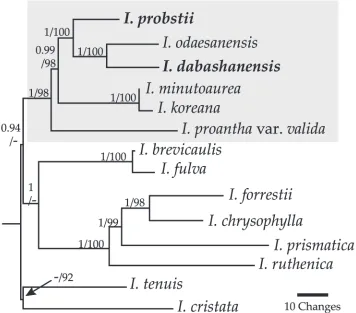
Iris dabashanensis C.A.Wilson, sp. nov. and I. probstii C.A.Wilson, sp. nov. from China are described and illustrated. Both species occur on grassy slopes in mountainous regions of south-central China. The for-mer is known from the Daba Mountains in rocky, calcareous soils associated with shrubs or mixed conifer and hardwood forests, while the latter is known from a region of karst terrain beside rice fields or under pine woods in Guizhou Province. Molecular data resolves both species in series Chinenses in a subclade that also includes I. odaesanensis, while morphologically they are similar to I. henryi. These newly described species are two of four members of series Chinenses that occur in south-central China.
Keywords
Daba Mountains, Guizhou Province, karst terrain, phylogeny
Introduction
Iris series Chinenses G.H.M. Lawr. comprises several Asian species that have short rhi-zomes, stolons, and small, open flowers where petals and sepals are horizontal. Dykes (1913) included four species in his informal group (the Chinese group), Lawrence (1953) circumscribed the series to include five species, Mathew (1989) recognized six species, and BIS (1997) recognized seven species in the series (Table 1). The two new http://phytokeys.pensoft.net
Copyright Carol A. Wilson. This is an open access article distributed under the terms of the Creative Commons Attribution License (CC BY 4.0), which permits unrestricted use, distribution, and reproduction in any medium, provided the original author and source are credited.
species are from south-central China where I. henryi Baker and I. proantha Diels also occur, although none of their distributions overlap. Iris minutoaurea Makino, I. odae-sanensis Y.N. Lee, and I. rossii Baker occur in northeastern China and adjacent regions in Korea and/or Japan and I. koreana Nakai is endemic to Korea. A species often in-cluded in the series, I. speculatrix Hance, is widespread in central and southern China. A phylogenetic study of the genus (Wilson 2011) that included five species from series Chinenses resolved the series as monophyletic, however I. speculatrix was not sampled. Guo and Wilson (2013) resolved I. speculatrix outside of series Chinenses in their study on crested species from several lineages in Iris. Tillie et al. (2001) included I. speculatrix as well as two series Chinenses species, I. minutoaurea and I. rossii, in their preliminary molecular phylogenetic study on Iris. Tillie et al. (2001) resolved I. minutoaurea and I. rossii as sister species and I. speculatrix outside of series Chinenses. Mavrodiev et al. (2014) suggested at least 23 genera should be recognized in Iris s.l., including a genus representing series Chinenses species. Crespo et al. (2015) formalized the splitting of Iris and circumscribed species from series Chinenses in the genus Zhaoanthus M.B. Crespo, Mart-Azorín & Mavrodiev. Iris speculatrix was not included in analyses of Mavrodiev et al. (2014) but based on several shared morphological characters was included in Zhaoanthus by Crespo et al. (2015).
Based on molecular studies (Tillie et al. 2001; Guo and Wilson 2013) and its morphology, including larger flowers and rhizomes, I. speculatrix is not considered a member of series Chinenses in this study. However, two taxa that are synonymized with I. speculatrix have not been recently examined. The first is I. grijsi Maxim. that was described based on a plant from Fujian Province in southeastern China. Maximowicz (1880) described I. grijsi as similar to I. ruthenica Ker Gawler, another species not resolved in series Chinenses (Wilson 2011; fig. 1), and gave several characters that dis-tinguish it from I. ruthenica, including the presence of reduced leaves at the base of the flowering stem, a thicker rhizome, and inflorescences with three versus one flower. Col-lections assigned to I. grijsi are from central or eastern China. The second is I. cavaleriei H. Lév. from Guizhou Province (using the historic name, Kouy-Tchéou Province), the
Table 1. Taxonomic treatments of Iris series Chinenses. Mathew (1989) included I. grijsi and I. specu-latrix in the addendum. Section Lophiris and subsection Evansia circumscribe the same species at differ-ent ranks. Dykes (1913) and Lawrence (1953) used the illegitimate name I. minuta Franch. & Sav. for I. minutoaurea.
Species Dykes (1913) Lawrence (1953) Mathew (1989) BIS (1997)
I. cavaleriei H.Lév. Synonym of I. grijsi Not included Not included Not included
same province where one of the new species occurs. Léveillé (1905) noted the pres-ence of narrow, short “interior” leaves and short vertical rhizomes in his recognition of the new species. Dykes (1913) interpreted the specimen of I. cavaleriei as having one elongated stem and a second flowering stem that was not yet visible, thus reducing the number of subtending smaller leaves, yet considered the taxon a synonym of I. grijsi.
In 2003, Darrell Probst collected one of the new species, I. probstii, at two sites in its native habitat in Guizhou Province and considered its flowers different from other species known from China. He sent materials of these plants to the author for further study. During this study it became apparent that the type specimen for I. henryi that was collected by Augustine Henry in 1885 and its description by Baker (1892) do not match the description of I. henryi in the Flora of China (Zhao et al. 2000) and most of the specimens identified as I. henryi that were studied by the author in Chinese herbaria in 2010. In addition, specimens at UC that were collected in 2001 by Darrell Probst in the Daba Mountains of northeastern Sichuan Province as I. henryi fit the description in Zhao et al. (2000) and are morphologically distinct from the type and description of I. henryi.
This study was undertaken to access the status of these two new species. The first goal was to determine morphological similarities and differences among these two new species, I. dabashanensis and I. probstii, and other species in series Chinenses. A second goal was to determine if species synonymized in I. speculatrix (I. cavaleriei and I. grijsi) are morphologically similar to I. speculatrix and distinct from each of the two new species. A third goal was to study materials of I. henryi and its illegitimate synonym, I. gracilipes Pamp., to determine if these two taxa are mor-phologically similar. Iris gracilipes Pamp. is illegitimate because the name was pre-viously used by Asa Gray for a different species of Iris that is in section Lophiris Tausch (Gray 1858). A fourth goal was to use DNA sequence data to determine if I. dabashanensis and I. probstii are resolved in series Chinenses. A final goal was to comprehensively examine collections from southern China to identify previously collected specimens that represent these two new species.
Materials and methods
Morphological observations
May 2010 and E in May 2014. In July 2018 and October 2019 images of specimens were accessed and studied on the Natural History Museum data portal (BM; http:// data.nhm.ac.uk), Harvard University Herbaria (A, ECON, GH; https://kiki.huh.har-vard.edu/databases/image_search.php), and Muséum National d’Histoire naturelle vascular plant collection (P; https://science.mnhn.fr/institution/mnhn/collection/p/ item/search). Images of specimens on the Chinese Virtual Herbarium (CVH; http:// www.cvh.ac.cn/en) were accessed in September and October 2018 and August 2019 to study collections not previously seen, including a specimen of I. odaesanensis that was collected at the type locality and deposited in KUN after the visit in 2010. Col-lections of I. gracilipes Pamp. were not unearthed in these searches. In September 2019 materials of I. gracilipes Pamp. were requested from the herbarium at the Natural His-tory Museum in Florence, Italy (Herbarium Universitatis Florentinae; FI) and six im-ages were received, including the type. For this study, herbarium sheets or imim-ages of herbarium sheets of I. cavaleriei (1), I. gracilipes Pamp. (6), I. grijsi (23), I. henryi (54), I. odaesanensis (1), I. proantha (47), and I. speculatrix (322) were studied.
Phylogenetic analyses
Genomic DNA of the new species, I. probstii, was isolated from silica-dried leaf materials using protocols modified from the CTAB method of Doyle and Doyle (1987). Modifi-cations of this procedure included RNase treatment and an ethanol precipitation with ammonium acetate following the initial isopropanol precipitation. Plastid sequence data of the protein-coding matK gene, about 1,100 bp of the flanking trnK introns, and the in-tergenic spacer region trnL–F were generated and added to previously gathered data (Wil-son 2009, 2011; Guo and Wil(Wil-son 2013). The new species, I. dabashanensis, was included in previous studies (Wilson 2011; Guo and Wilson 2013) but at the time was considered I. henryi. DNAs were amplified in 25 ml reactions using GoTaq Flexi DNA polymer-ase (Promega, Madison, Wisconsin, U.S.A.) following the manufacturer’s instructions, except that 1–2 ml of glycerol was added to the mix. Reaction conditions were: 97 °C for 1 min; 40 cycles of 97 °C for 10 s, 48 °C for 1 min, 72 °C for 20 s; 72 °C for 4 min. The matK gene and flanking trnK introns were amplified together in two reactions while trnL–F was amplified in a single reaction. Amplification and sequencing primers are giv-en in Wilson et al. (2016). Amplicons were purified using the UltraClean PCR clean-up kit (Mo Bio, Carlsbad, California, U.S.A.). Purified PCR products were processed using a BigDye Terminating (Applied Biosystems, Foster City, California, U.S.A.) cycle sequenc-ing reaction followsequenc-ing the manufacturer’s instructions except that 5% DMSO was added to the reaction mix. Cycle sequencing products were purified using filter plates packed with Sephadex (Amersham Biosciences, Piscataway, New Jersey, U.S.A.) and run on an Applied Biosystems 3130 automated sequencer. Molecular data was gathered by the au-thor at the Rancho Santa Ana Botanic Garden, Claremont, California, U.S.A.
Distribution and mapping
Collection sites of specimens representing the two new species were located on Google Earth Pro vers. 7.3.2.5776 (Google LLC, Menlo Park, California, U.S.A.) to deter-mine the known range of each species. Maps were produced in QGIS vers. 2.18.13 (QGIS Development Team 1991) using the free vector and raster map data available through Natural Earth (https://www.naturalearthdata.com). Maps were imported into Adobe Illustrator vers. 15.0.0 where species ranges were drawn.
Data resources
The data underpinning the analyses reported in this paper are deposited in the Dryad Digital Repository at: https://doi.org/10.6078/D1C695
Results
Morphological comparisons
The two new species are morphologically most similar to I. henryi but differ in several characters as described below in the new species’ diagnoses. The two new species and I. henryi share several characteristics that distinguish them from I. cavaleriei, I. grijsi, and I. speculatrix, including smaller flowers, slender rhizomes that are also short, and long slender pedicels that result in exerted flowers and ovaries. The two new species and I. henryi also lack reduced basal leaves that are present in I. cavaleriei and I. grijsi. Iris proantha differs morphologically from the new species and I. henryi in several charac-ters, including slightly larger flowers, longer floral tubes, and pedicels that are shorter and wider. Pedicels in I. proantha are more similar to those in I. cavaleriei, I. grijsi, and I. speculatrix than to the new species or I. henryi. Collections from the Daba Mountains and identified as I. henryi were determined to represent the new species, I. dabashanen-sis. Recent descriptions of I. henryi either fit I. dabashanensis (Zhao et al. 2000) or are broad enough to include this new species as well as I. henryi (Mathew 1989; BIS 1997).
rather is documented from Korea and is reported from adjacent areas in Jilin Province, northeastern China. The flowers of I. odaesanensis are white with yellow on the center of the sepals; a distinct color and patterning that is not seen in other Asian Iris. Several characters, including short floral tubes, long pedicels, and exerted flowers and ovaries are shared among I. odaesanensis, the two new species, and I. henryi.
Study of specimens and type descriptions revealed morphological differences among I. cavaleriei, I. grijsi, and I. speculatrix. The former two taxa are considered syn-onyms of I. speculatrix. Each of these three taxa are distinct from the two new species because they lack the long pedicels, and short floral tubes present in I. dabashanensis and I. probstii and have larger flowers and rhizomes than species in series Chinenses. Notes from examination of the I. cavaleriei holotype deposited at the Royal Botanic Garden Edinburgh (E) describes a plant with basal leaves that are 0.3 cm in width with two veins, unequal lower bracts (9 and 12 cm), flower exerted above bracts, ovary hidden by bracts, sepals that are ca. 2.5 cm long x 0.4 wide, and reduced leaves around the base of the flower stem. Photographs taken at E show an ovary enclosed in bracts with the visible portion of the floral tube greater than 1 cm. A more precise descrip-tion of the floral tube requires re-examinadescrip-tion of the type because this measurement was not included in notes taken at E and Léveillé (1905) did not include measure-ments when he described the species. Images of herbarium sheets of I. grijsi from CVH, KUN, P, and PE, including the type (P), were studied as well as its description. The leaves of I. grijsi appear wider than those of I. cavaleriei and are given as 0.4–1 cm in the description while the bracts are long and narrow, similar to I. cavaleriei. Dykes (1913) gave the bract length of I. grijsi as 2–3 in (ca. 5–7 cm). Neither the flower nor ovary of I. grijsi are exerted above the bracts, although the flower is visible because it extends beyond the shorter of the two bracts due to its floral tube that is ca. 1.2 cm in length. Similar to I. cavaleriei, reduced leaves are present at the plant base. In contrast to these two taxa, I. speculatrix lacks reduced basal leaves, has a shorter floral tube (< 1 cm), and short unequal bracts (ca. 2.5 and 3.5 cm). It also has a flower that is ex-erted above the bracts and an oblong ovary within or partially exex-erted above the bracts but visible because the bracts are spreading.
Additional collections of the new species
No additional collections of the new species from Guizhou Province, I. probstii, were identified during study of herbarium specimens and images of specimens, although three specimens from Guizhou Province were examined. One specimen identified as I. speculatrix was collected in 2013 and deposited at the Guizhou Academy of Sciences (HGAS; 123147). Two specimens identified as I. grijsi were collected in 1898 and 1900 and deposited at the Muséum National d’Histoire (P; 01840535 and 0184536, respectively). Study of the image of the former specimen revealed that it fit the descrip-tion and type of I. speculatrix. Images of the two specimens identified as I. grijsi were also studied and are most similar to other collections of I. grijsi. Specimen 01840535 is particularly informative, although a scale was not included when imaged. This speci-men illustrates the short leaves at the base of the plant that are typical for this taxon and the longer bracts when compared to I. speculatrix.
The study of herbarium records revealed 34 additional specimens from the Daba Mountains that are the new species, I. dabashanensis, but were identified as other spe-cies. These represent sheets from nine separate collections from the Chongqing Mu-nicipality and one from the Shennongjia Forest Region in Hubei Province. Three bota-nists, Père Paul Guillaume Farges in 1892, Tain Lun Dai in 1958, and Du Wei in 2014 made these collections. Eight of the collections were identified as I. henryi while the 2014 collection was identified as I. proantha. It is not surprising that these collections were mostly identified as I. henryi because I. dabashanensis is similar to this species and in particular has long slender pedicels and flowering stems that are shorter than leaves at flowering, two characters considered distinguishing for I. henryi. A few other collections from near the Daba Mountains may also represent I. dabashanensis but a determination could not be made because flowers were lacking or important characters were not clearly visible.
Phylogenetics
The aligned, combined dataset was 3,551 bp with 398 (11%) variable and 153 (4%) potentially parsimony informative characters. The matK/trnK marker was more in-formative than trnL–F because it contributed 2,696 bp with 322 variable and 114 potentially parsimony informative characters. The resulting models from RAxML and MrBayes analyses differed only slightly in the three substitution rate and gamma dis-tribution values (the numbers given are based on RAxML). Both assumed unequal base frequencies, three substitution rates (1.0000, 2.8325, 0.1513), a gamma distribu-tion of 0.5726 and 0.3177 invariable sites. The single ML tree from RAxML and the consensus tree from MrBayes each had a log likelihood = -7,779 and shared the same topology (Fig. 1). Posterior probability and bootstrap values are given in Figure 1.
including long slender pedicels and short floral tubes. They were resolved with high support within the series Chinenses clade and share several characters with other species in the series, including small, horizontally spreading flowers where petals are not up-right, an overall small and delicate stature, short rhizomes, and an Asian distribution. All taxa in series Chinenses, except I. henryi, the nominative form of I. proantha, and I. rossii, were included in this study. Further studies to resolve relationships within the series should include these three taxa and also I. grijsi, I. cavaleriei, and I. speculatrix. The former two taxa are considered synonyms of I. speculatrix but in this study were shown as morphologically distinct. The type locality for I. henryi is not precise and the species has not been relocated in the area of its initial discovery.
Other findings
The study also resulted in the discovery of two type collections and one correction to a species description citation. The type of I. speculatrix (C. Ford 18465) was discovered in BM collections stored as a type of I. henryi and the type of I. grijsi (de Grijs 8583) in P collections but not designated as a type. The description of I. cavaleriei is typically cited as Liliac. & C. Chine 18 1905, but previous searches for this journal were not successful. During this study the author searched journals where Augustin Abel Hector Léveillé published species descriptions, focusing on journals where he published infre-quently. The correct citation is given in the references (Léveillé 1905). In this publica-tion Léveillé lists Iridaceae known from China and provides a descrippublica-tion of I. cavaleriei sp. nov. citing the collection of Julien Cavalerie from Kouy-Tcheou (Guizhou) Prov-ince on May 15, 1900.
Taxonomy
Iris dabashanensis C.A.Wilson, sp. nov. urn:lsid:ipni.org:names:77211598-1 Figures 2A–C, 3
Diagnosis. Morphologically similar to I. henryi the new species differs in having nar-rower leaves (0.9–2 mm versus 4–4.5 mm), shorter bracts (2–4 cm versus 4–7 cm), and shorter style branches (1 cm versus 1.8 cm).
Type. China. Sichuan Province: About 5 km N of Wanyuan, Wanyuan County,
1,140 m, 32°11.720'N, 108°05.310'E, 3, May 2001 (fl), voucher from cultivated ma-terial, D. Probst CPC3.5.01.3 (holotype: UC!; isotypes: PE!, E!).
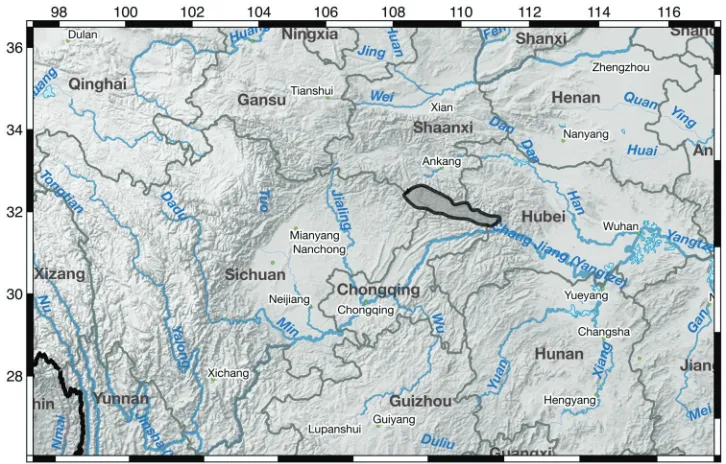
slightly glossy, 28–44 cm long, 0.9–2 (3) mm wide, 1–2 veins; crowded in clumps. Flowering stem ca. 8–18 cm with 1 or 2 cauline leaves, with upper cauline leaf extend-ing well above mid stem. Inflorescence with two opposite bracts (spathes) subtend-ing 2 (3) flowers, terminal flower opensubtend-ing first with a ssubtend-ingle bract subtendsubtend-ing each subsequent flower; lower bracts ± equal, 2.0–4 cm long, 0.4–0.5 cm wide; pedicels long (2.5–5 cm) and slender. Flowers light violet, open, ca. 3 cm diameter, radial with petals slightly angled upward, sepals light violet, horizontal and recurved distally; floral tube 0.2–0.5 cm; sepals ovate, shallow apical notch, narrowed at base, 2–3 cm long, 0.6–1.1 cm wide, obvious median ridge cream-colored with violet spots, a lateral ridge on either side of the median, yellow patch between lateral ridges and extending beyond ridges; petals light violet, rotund, apical notch, 1.6–2.1 cm long, ca. 1.0 cm wide, clawed in lower 1/4; stamens cream, ca. 0.8 cm long, anthers = filaments; style branches petaloid, light violet, ca. 1 cm long, 0.3 cm wide, bi-lobed distally, lobes ca. 0.4 cm long, stigma broad, slightly rounded. Capsule rounded, ca. 1 cm long. Seed light to me-dium brown, ca. 0.4 cm, with conspicuous white appendage. Flowering: April to May. Distribution and ecology. Iris dabashanensis is known from the Daba Mountains in Sichuan and Hubei Provinces and Chongqing Municipality (Fig. 4) on open rocky slopes with calcareous soils associated with shrubs or mixed conifer and hardwood forests.
Etymology. The new species is named for the Daba Mountains in China where
it occurs.
Preliminary conservation status. Following the criteria and categories of IUCN (2012), Iris dabashanensis is given a preliminary status of Least Concern (LC). One of the known populations is in the Shennongjia Forest Region of Hubei Province. Although the precise location of the I. dabashanensis population is unknown, the Shen-nongjia National Nature Reserve occurs within the region and has protected status.
Other specimens examined. China. 4 ⚥ Chongqing Municipality, Chengkou
County; 29 April 1958; T.L. Dai leg.; 100265; HNWP 34156, PE 01012365, SZ 00043052, SZ 00043057; · 5 ⚥ Chongqing Municipality: Chengkou County; 1 May 1958; T.L. Dai leg.; 100335; CDBI 0169543, IBK 00251078, SZ 00043056, PE 00034001, PE 01012364; · 4 ⚥ Chongqing Municipality: Liangzhong Hewu ji, Chengkou County; 20 April 1958; T.L. Dai leg.; 100150; PE 00034002, SZ 00043055, HNWP 34209, IBK 00251010; · 1 ⚥ Chongqing Municipality: Liang Yizh, Chengkou County; 2 April 1958; T.L. Dai leg.; 100154; CDBI 0169546; · 6
⚥ Chongqing Municipality: Yizi Liang Hengyan pengwuji, Chengkou County; 24 May 1958; T.L. Dai leg.; 100583; IBK 00081641, CDBI 0169544, CDBI 0169545, HNWP 34583, SZ 00043061, PE 01012366; · 1 ⚥ Chongqing Municipality: Cheng-kou County; sin. date; Farges leg.; 101; P 02163317; · 4 ⚥ Chongqing Municipality: Chengkou County; 1892; Farges leg.; 1024; P 02163312, P 02163313, P 02163314, P 02163316; · 11 ⚥; Hubei Province: Shennongjia Forest Region; 27 April 2014; Du Wei leg.; 1407; WH 1933.
Figure 3. Illustration of I. dabashanensis. A Habit B inflorescence C sepal D petal E style branch, anther
Iris probstii C.A.Wilson, sp. nov. urn:lsid:ipni.org:names:77211599-1 Figures 2D–F, 5
Diagnosis. Morphologically similar to I. henryi, the new species differs in having wider sepals (ca. 7 mm versus 4 mm) and style branch lobes that are shorter (ca. 2–3 mm versus 6 mm).
Type. China. Guizhou Province: about 24 km south of Yanhe on road to Xiushan, 970 m, 28°25.643'N, 108°42.044'E, 24, July 2003 (fl), voucher from cultivated mate-rial, D. Probst CPC24.7.03.1 (holotype: UC!; isotypes: PE!, E!).
Description. Small evergreen herbaceous plant with aerial flowering stems shorter than basal leaves. Bracts, cauline leaves, base of basal leaves ± tinged with red. Rhi-zomes short (< 4 mm), branched, hidden by leaf remains. Stolons present. Roots high-ly branched distalhigh-ly with small tubers. Basal leaves distichous, linear with acute apex, bright green, slightly glossy on upper surface, dull green on lower surface, leaf edges obscurely membraneous, 12–40 cm long, 0.4–0.6 cm wide, veins slightly thickened; crowded in clumps. Flowering stem ca. 15 cm with 2 (3) cauline leaves on lower half. Inflorescence with two opposite bracts (spathes) subtending 2 (3) flowers, termi-nal flower opening first with a single bract subtending each subsequent flower; lower bracts ± unequal, 3.5–6 (7) cm long, 0.4–0.5 cm wide; pedicels long (3–4.5 cm) and slender. Flowers cream with light violet, open, ca. 3 cm diameter, radial with
Figure 5. Illustration of I. probstii. A Habit B inflorescence C sepal D petal E style branch, anther
petals slightly angled upward, sepals horizontal and recurved distally; floral tube 0.3– 0.4 cm; sepals cream adaxially, light yellow abaxially, narrowly obcordate, ± shallow apical notch, narrowed at base, 2.2–2.9 cm long, 0.6–0.9 wide, obvious yellow-orange median ridge, purple spot beginning at ca. midpoint and extending distally beyond ridge with two bright yellow patches flanking ridge distally; petals cream with light violet tint that is more prominent along median, narrowly spathulate, 1.8–2.2 cm long, 0.6–0.7 cm wide, clawed in lower 1/4; stamens cream, ca. 1 cm long, anthers = filaments; style branches medium violet, 1.2–1.5 cm long, 0.3–0.4 cm wide, bi-lobed distally, light violet lobes ca. 0.2–0.3 cm long with several teeth, stigma broad, slightly rounded. Capsule rounded with short apical beak. Seed light to medium brown, ca. 0.4 cm, with conspicuous white appendage. Flowering: April to May.
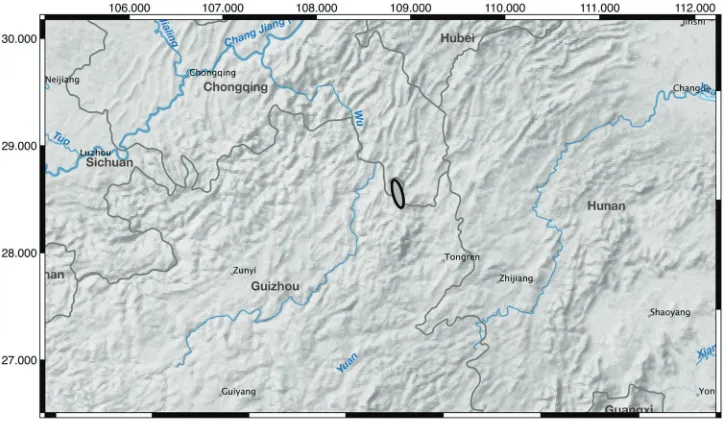
Distribution and ecology. Iris probstii is currently known from two locations
south of Yanhe in Guizhou Province China (Fig. 6) at about 800 to 1,000 m and a third unverified location about 165 km south of Yanhe. This third site, southeast of Tongren, Guizhou, China near Minhezhen (Minhe town), is based on photographs taken by C. Yang in 2016 and uploaded to the Plant Photograph Bank of China (http://ppbc.iplant.cn/tu/6166544). A study of herbarium records from CVH, KUN, and PE did not reveal additional collections but it is likely that this new species occurs in other areas within this region. The species occupies open slopes along edges of rice paddies or under low pine woods in grassy sites associated with rocky, karst soils.
Etymology. The new species is named in honor of the U.S. horticulturist, Dar-rell Probst, in recognition of his work to expand our knowledge of species from series Chinenses in their native habitats.
Preliminary conservation status. Following the criteria and categories of IUCN (2012), Iris probstii is given a preliminary status of Vulnerable (VU D2) due to its restricted area of known occupancy (< 20 km2) and number of locations (< 5). The area of occurrence does not have protected status. If the third location is verified and vouchered the conservation status might change.
Other specimens examined. China. Guizhou Province: about 55 km south of
Yanhe on road to Xiushan, 825 m, 28°19.651'N, 108°41.390'E, 9, January 2002 (fl), D. Probst CPC9.1.02.2 (photo of living plant, UC).
Notes. D. Probst collected a small rhizome segment at the second site that he grew but did not voucher. An image of the plant was obtained for documentation and de-posited in UC. A specimen voucher will be made and also dede-posited at UC when the plant reflowers.
Discussion
Morphologically these two new species are most similar to I. henryi because they share several characters, including long (> 2.5 cm) slender pedicels, short floral tubes, and narrow leaves (< 0.6 cm). Iris odaesanensis shares the characters of short floral tubes and long pedicels with the two new species and I. henryi but it has leaves that are about 1 cm in width. Molecular data indicates that the two new species are closely related to I. odaesanensis. Unfortunately, because materials of I. henryi were not available for molecular studies it is unknown if all series Chinenses species with short floral tubes and long pedicels are resolved in a clade. These four species can easily be distinguished from each other using several characters. Iris odaesanensis has flowering stems that are almost equal or slightly longer than leaves at flowering while I. dabashanensis, I. henryi, and I. probstii have flowering stems that are substantially shorter than their leaves at flowering. Iris dabashanensis has very narrow (ca. 1–2 mm) leaves while the width of I. henryi and I. probstii leaves are similar at 4–6 mm. Iris dabashanensis also has a median and two lateral ridges while I. henryi, I. odaesanensis, and I. probstii have only a median ridge. Iris probstii has style branches where lobes are 0.2–0.3 cm long which is ca. 1/4 of their total length while lobes in I. dabashanensis and I. henryi are > 0.4 cm and ca. 1/2 of their total length.
An examination of available materials suggests that I. cavaleriei and I. grijsi are similar to each other but morphologically distinct from I. speculatrix. They are also morphologically distinct from the two new species and other series Chinenses species. Previous research utilizing molecular data (Tillie et al. 2001; Guo and Wilson 2013) concluded that I. speculatrix is not within series Chinenses, a finding consistent with the larger flowers and rhizomes of I. speculatrix compared to species in series Chinenses. The larger flowers and rhizomes of I. speculatrix are shared with I. cavaleriei and I. grijsi. The status of I. cavaleriei, which was described after I. grijsi, is not certain although results of this study indicate leaves of I. cavaleriei are narrower than those of I. grijsi and the flower is only partially exerted above the bracts while it is entirely exerted in I. grijsi. These observations are based on only one collection, the holotype, of I. cavaleriei. Examining additional plants from the type locality for I. cavaleriei and/or the iden-tification of additional existing collections is required to determine if the differences observed in the one known collection are consistent within the taxon and if the taxon is distinct from I. grijsi.
It is surprising that during this study of over 450 specimens representing six Iris species with collections in southern China, only three were collected in Guizhou Prov-ince. Guizhou Province is a mountainous rural region that is recognized as having high plant diversity (Zhang and Ma 2008; Liu et al. 2018) and endemism (Liu et al. 2018). The karst landscape and ecology is considered an important contributor to the high biodiversity of the Province. Iris may be undercollected within the region indicating that further fieldwork is necessary to more fully understand Iris diversity in the Prov-ince and the entire range of I. probstii.
Key to Iris series Chinenses
1 Leaves > 1 cm wide ...2 – Leaves < 1 cm wide ...3 2 Floral tube ca. 1 cm long, flowers yellow ...I. koreana
– Floral tube ca. 0.5 cm long, flowers white ...I. odaesanensis
3 Floral tube > 2.0 cm long, pedicels < 2 cm long ...4 – Floral tube < 1.0 cm long, pedicels > 2 cm long ...6 4 Floral tube ca. 6 cm long ...I. rossii
– Floral tube 2–3.5 cm long ...5 5 Flowers pale violet, floral tube 2.5–3.5 cm long ...I. proantha
5a Flowering stem to bract < 5 cm tall, leaves < 0.4 cm wide ...var. proantha
– Flowering stem to bract > 7 cm tall, leaves > 0.5 cm wide ...var. valida
– Flowers yellow, floral tube ca. 2 cm ...I. minutoaurea
6 Leaves < 3 mm wide, lateral crests flanking median ...I. dabashanensis
– Leaves > 3 mm wide, median crest only ...7 7 Style branch lobes 2–3 mm long, sepals ca. 7 mm wide ...I. probstii
Acknowledgements
I thank Jan Sacks and Marty Schafer for information on seed characteristics, photo-graphs of fruits for both species, and helpful comments on an earlier version of the manuscript, Darrell Probst for photographs of underground structures of I. dabashan-ensis and information on his collections of these two new species, and X. Zhang for searching for the type locality of I. henryi. I also thank Jaemin Lee who assisted with phylogenetic analyses, Diane Bland who illustrated the new species, reviewers, David Boufford, Manuel Crespo, and Evgeny Mavrodiev, who provided valuable comments, and the associate editor for this paper, Lorenzo Peruzzi. Suggestions by David Boufford were particularly helpful because of his knowledge of the flora and geography of China.
Publication made possible in part by support from the Berkeley Research Impact Initiative (BRII) sponsored by the UC Berkeley Library.
References
Baker JG (1892) Handbook of the Irideae. George Bell & Sons, London, 6 pp. https://doi. org/10.5962/bhl.title.15431
BIS (1997) Series Chinenses. In: The Species Group of the British Iris Society (Eds) A Guide to Species Irises, Their Identification and Cultivation. Cambridge University Press, 121–126. Crespo MB, Martínez-Azorín M, Mavrodiev EV (2015) A new comprehensive generic arrange-ment of the ‘Iris sensu latissimo’ clade (Iridaceae), congruent with morphology and mo-lecular data. Phytotaxa 232(1): 1–78. https://doi.org/10.11646/phytotaxa.232.1.1
Doyle JJ, Doyle JL (1987) A rapid DNA isolation procedure for small quantities of fresh leaf tissue. Phytochemical Bulletin 19: 11–15.
Dykes WR (1913) The Genus Iris. Dover Publications, Inc, New York, 245 pp. https://doi. org/10.5962/bhl.title.116246
Felsenstein J (1981) Evolutionary trees from DNA sequences: A maximum likelihood approach. Journal of Molecular Evolution 17(6): 368–376. https://doi.org/10.1007/BF01734359
Felsenstein J (1985) Confidence limits on phylogenies: An approach using the bootstrap. Evolution; International Journal of Organic Evolution 39(4): 783–791. https://doi. org/10.1111/j.1558-5646.1985.tb00420.x
Gray A (1858) Diagnostic characters of new species of phaenogamous plants, collected in Japan by Charles Wright, botanist of the U. S. North Pacific Exploring Expedition. (Published by request of Captain John Rodgers, commander of the expedition.) With observations upon the relations of the Japanese flora to that of North America and of other parts of the northern temperate zone. Memoirs of the American Academy of Arts and Sciences 6: 1–412. https://doi.org/10.2307/25057953
Guo J, Wilson CA (2013) Molecular phylogeny of crested Iris based on five plastid markers (Iri-daceae). Systematic Botany 38(4): 987–995. https://doi.org/10.1600/036364413X674724
Lawrence GHM (1953) A reclassification of the genus Iris. Gentes Herbarum 8: 346–371. Lee YN (1974) New taxa on Korean flora. Korean Journal of Botany 17: 33–35.
Léveillé H (1905) Liliacées, Amaryllidacées, Iridacées et Hérmodoracées de Chine. Memorie Pontificia Accademia Romana dei Nuovi Lincei 23: 1–346.
Liu B, Zhang M, Bussmann WR, Liu H-M, Liu Y-Y, Peng Y-D, Zu K-L, Zhao Y-M, Liu Z-B, Yu S-X (2018) Species richness and conservation gap analysis of karst areas: A case study of vascular plants from Guizhou, China. Global Ecology and Conservation 16: e00460
https://doi.org/10.1016/j.gecco.2018.e00460
Mathew B (1989) The Iris, Reprint with Revisions. B. T. Batsford Ltd, London, 215 pp. Mavrodiev EV, Martínez-Azorín M, Dranishnikov P, Crespo MB (2014) At least 23 genera
instead of one: The case of Iris L. s.l. (Iridaceae). PLoS ONE 9(8): e106459. https://doi. org/10.1371/journal.pone.0106459
Maximowicz CJ (1880) Iris L. Bulletin de l'Académie impériale des sciences de St.-Pétersbourg series 3, 26: 1–515.
QGIS Development Team (1991) QGIS geographic information system. Open Source Geo-spatial Foundation Project. http://qgis.osgeo.org
Ronquist F, Teslenko M, van der Mark P, Ayres DL, Darling A, Höhna S, Larget B, Liu L, Suchard MA, Huelsenbeck JP (2012) MrBayes 3.2: Efficient Bayesian phylogenetic infer-ence and model choice across a large model space. Systematic Biology 61(3): 539–542.
https://doi.org/10.1093/sysbio/sys029
Stamatakis A (2014) RAxML version 8: A tool for phylogenetic analysis and post-analysis of large phylogenies. Bioinformatics (Oxford, England) 30(9): 1312–1313. https://doi. org/10.1093/bioinformatics/btu033
Tillie N, Chase MW, Hall T (2001) Molecular studies in the genus Iris L.: A preliminary study. Annali di Botanica (Roma) 1: 105–112.
Wilson CA (2009) Phylogenetic relationships among the recognized series in Iris section Lim-niris. Systematic Botany 34(2): 277–284. https://doi.org/10.1600/036364409788606316
Wilson CA (2011) Subgeneric classification in Iris re-examined using chloroplast sequence data. Taxon 60(1): 27–35. https://doi.org/10.1002/tax.601004
Wilson CA, Padiernos J, Sapir Y (2016) The royal irises (Iris subg. Iris sect. Oncocyclus): Plastid and low-copy nuclear data contribute to an understanding of their phylogenetic relation-ships. Taxon 65(1): 35–46. https://doi.org/10.12705/651.3
Zhang YB, Ma KP (2008) Geographic distribution patterns and status assessment of threat-ened plants in China. Biodiversity and Conservation 17(7): 1783–1798. https://doi. org/10.1007/s10531-008-9384-6
Supplementary material 1
Supplementary file for Dryad Authors: Carol A. Wilson
Data type: Nucleotide dataset, phylogenetic tree
Explanation note: This is a draft file for submission to Dryad as supporting materials. Copyright notice: This dataset is made available under the Open Database License
(http://opendatacommons.org/licenses/odbl/1.0/). The Open Database License (ODbL) is a license agreement intended to allow users to freely share, modify, and use this Dataset while maintaining this same freedom for others, provided that the original source and author(s) are credited.