Persicaria jucunda
var.
rotunda
(Polygonaceae, Persicarieae), a distinct distylous taxa
raised to specific rank
Yue-Ning Guo1, Shao-Feng Chen1, Ming-Lin Chen2, Bo Li3
1 School of Life Sciences, Nanchang University, Nanchang 330031, Jiangxi, China 2 Provincial Key Laboratory of Biotic Environment and Ecological Safety in Anhui, Anhui Normal University, Wuhu 241000, Anhui, China
3 Research Centre of Ecological Sciences, Jiangxi Agricultural University, Nanchang 330045, Jiangxi, China
Corresponding author:Bo Li ([email protected])
Academic editor:Alexander Sukhorukov | Received 14 April 2019 | Accepted 13 June 2019 | Published 16 July 2019
Citation: Guo Y-N, Chen S-F, Chen M-L, Li B (2019) Persicaria jucunda var. rotunda (Polygonaceae, Persicarieae), a distinct distylous taxa raised to specific rank. PhytoKeys 126: 127–138. https://doi.org/10.3897/phytokeys.126.35442
Abstract
Persicaria jucunda (Meisn.) Migo var. rotunda (Z.Z.Zhou & Q.Y.Sun) Bo Li was originally published in the genus Polygonum L. and treated as a variety of P. rotundum Meisn. [≡Persicaria jucunda (Meisn.) Migo]. After carefully comparing the macro- and micro-morphological characteristics of the achenes, leaf epidermis and tepals and the habitat between the variety and its typical variety, we confirmed that
P. jucunda var. rotunda is clearly different from P. jucunda and should not be treated as a variety, but be raised to a specific rank as P. rotunda (Z.Z.Zhou & Q.Y.Sun) Bo Li. The species is distylous and could be easily distinguished from all other Persicaria taxa by a combination of morphological characters, such as completely decumbent leafless basal branches, almost sessile leaves, linear-lanceolate with rounded leaf bases, spicate, short and dense inflorescences, slender pedicels longer than bracts and dimorphic flowers and achenes. P. rotunda is endemic to several large wetlands of eastern China and usually occurs as one of the dominant species in some plant communities.
Keywords
Distyly, micro-morphology, new combination, Polygonum, variety
Introduction
Persicaria (L.) Mill., after separation from the former polyphyletic genus Polygonum
L., is currently placed within the tribe Persicarieae of Polygonaceae. The genus contains approximately 150 species of annual or perennial herbs and occurs mainly
http://phytokeys.pensoft.net
Copyright Yue-Ning Guo et al. This is an open access article distributed under the terms of the Creative Commons Attribution License (CC BY 4.0), which permits unrestricted use, distribution, and reproduction in any medium, provided the original author and source are credited.
in temperate and subtropical regions of the Northern Hemisphere (Brandbyge 1993).
Persicaria is characterised by having usually entire, ciliate or pectinate ocrea, many-flowered, spike-like or capitate inflorescences, 4–5-lobed tepals with trifid venation, 4–8 stamens, spheroidal pollen grains with reticulate exine and epidermis of pericarp with narrow rectangular cells and undulating anticlinal walls (Haraldson 1978, Ronse Decraene and Akeroyd 1988, Brandbyge 1993, Ronse Decraene et al. 2000). The genus has been subdivided into four sections on the basis of anatomical traits (Haraldson 1978), viz., sect. Persicaria, sect. Cephalophilon (Meisn.) H.Gross, sect.
Echinocaulon (Meisn.) H.Gross and sect. Tovara (Adans) H.Gross, while Galasso et al. (2009) proposed to include another two sections, sect. Amphibia Tzvelev and sect.
Truelloides Tzvelev, based on molecular phylogenetic studies. In Persicaria, a number of species have been observed or confirmed as distylous, such as P. chinensis (L.) H.Gross (≡Polygonum chinense L.) (Reddy et al. 1977), P. japonica (Meisn.) H.Gross (Hiratsuka and Nakao 1996), P. jucunda (Meisn.) Migo (≡Polygonum rotundum Meisn.) (Chen and Zhang 2010), P. hastato-sagittatua (Mak.) Nakai ex Mori (≡Polygonum hastato-sagittatum Mak.) (Chen 2012), P. wugongshanensis Bo Li (Li 2014) and P. odorata
(Lour.) Soják subsp. conspicua (Nakai) Yonek. (Kong and Hong 2018). Distyly is a type of heterostyly which is characterised by the reciprocal placement of stigmas and anthers in two (distyly) or three (tristyly) floral morphs in a species (Lloyd and Webb 1992).
Persicaria jucunda var. rotunda (Z.Z.Zhou & Q.Y.Sun) Bo Li (Li et al. 2013) was originally published in the genus Polygonum and treated as a variety of P. rotundum
(≡Persicaria jucunda) (Zhou et al. 2007). The variety resembles P. rotundum in hav-ing glabrous stems and prostrate at base, densely spicate inflorescences, pinkish tepals, slender pedicels longer than bracts and trigonous achenes, but differs from the typi-cal variety in having truncate and linear-lanceolate leaf blades with barely noticeable petioles (Zhou et al. 2007). However, when conducting a micro-morphological study of Chinese Persicaria species, we found that there are a number of distinct differences between the two taxa, including the shape of epidermal cells of both leaf sides, the oc-currence of stomata on adaxial leaf surface, the stomatal type of abaxial leaf surface and the sculpture of achene surface. After re-examining the macro-morphology and the habitat of the two taxa, we confirmed that P. jucunda var. rotunda is clearly different from P. jucunda and should not be treated as a variety, but be raised to a specific rank as Persicaria rotunda (Z.Z.Zhou & Q.Y.Sun) Bo Li.
Materials and Methods
of four quantitative characters (leaf length, leaf width, number of leaf lateral vein pairs, inflorescence length) was evaluated using univariate statistics (box plots) by SPSS 11.5 statistical software package (SPSS Inc., Chicago, IL, USA). To confirm the distyly in P. rotunda, the height of stigmas and anthers were measured for a single flower removed from 30 individuals per style morph. Methodology follows Chen and Zhang (2010).
For light microscopy (LM) observation of leaf epidermis, samples were taken from the mature leaves fixed in FAA solution, dissected under a OPTPro stereoscope (Chongqing Optec Instrument Co. Ltd., China), stained in a solution of 1% safranin, and cleaned in distilled water three times before being mounted in glycerine jelly. Observations and micrographs were conducted randomly from 5 prepared slides per species under LM. Terminology follows Hou (2006).
For scanning electron microscopy (SEM) observations, samples of achenes were removed from mature fruits and dried in silica gel. After cleaned in 95% ethanol, mounted on to cupreous stubs and coated by JFC-1100E sputter coater (JEOL Led., Japan), samples were examined under JSM-6360LV SEM (JEOL Led., Japan) at a voltage of 25 KV. Terminology follows Ronse Decraene et al. (2000).
Taxonomy
Persicaria rotunda (Z.Z.Zhou & Q.Y.Sun) Bo Li, comb. & stat. nov.
urn:lsid:ipni.org:names:77199242-1
Figures 1, 2
≡Polygonum jucundum Meisn. var. rotundum Z.Z.Zhou & Q.Y.Sun, Acta Phytotax. Sin. 45(5): 714 (713–718; figs.). 2007. Type: CHINA. Anhui Province, Dong-zhi County, Shengjin Lake, on riparian plains, Alt. 6–20 m, 4 October 2006,
Z.Z.Zhou 0602 (holotype: PE!, isotype: ANU).
≡Persicaria jucunda (Meisn.) Migo var. rotunda (Z.Z.Zhou & Q.Y.Sun) Bo Li, Phyto-taxa 91 (1): 24. 2013.
Diagnosis. This species is easily distinguished from other Persicaria taxa by its com-pletely decumbent leafless basal branches, almost sessile leaves, truncate, linear-lan-ceolate leaf blades, spicate, short and dense inflorescences, pedicels longer than bracts and dimorphic flowers and achenes. It occurs as one of the dominant species of some lakeshore plant communities in several large wetlands of northern Jiangxi and south-western Anhui provinces, eastern China.
base round, apex acuminate, margin entire, shortly ciliate. Ocrea tubular, 4.5–11.5 mm long, membranous, sparsely appressed pubescent, apex truncate, fimbriate, cilia 2.2–5.3 mm long. Inflorescence terminal, erect, spicate, dense, 0.5–3.8 cm long; pe-duncle 3.5–6.5 cm long, glabrous; bracts purplish-red, funnel-shaped, sparsely pubes-cent, margin submembranous, shortly ciliate, each bract contains 4–7-flowers. Pedicel
longer than bracts, 1.5–2.5 mm. Flowers dimorphic; perianth 5-parted, pinkish-white; Figure 1. Persicaria rotunda (Z.Z.Zhou & Q.Y.Sun) Bo Li A plant community with P. rotunda
long-styled flowers (called as L-morph) 3.9–4.4 mm long, stamens 8, 2.6–3.2 mm, styles 3, connate to below middle, 4.3–5.1 mm, exserted; short-styled flowers (called as S-morph) 3.7–4.2 mm long, stamens 8, 3.8–4.9 mm, exserted, styles 3, connate to below middle, 2.4–2.9 mm; stigmas capitate; nectaries 8, arranged at the base of ovary.
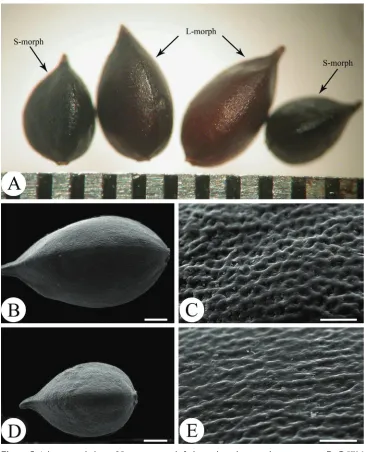
Achenes included in persistent perianth, dimorphic; L-morph dark brown, ellipsoid, trigonous, base rounded to broadly cuneate, apex acuminate, surface opaque, densely reticular - pitted, 3.6–4.2 mm long, 2.1–2.3 mm wide; S-morph black, ovoid, trigo-nous, base broadly cuneate, apex acute, surface opaque, densely pitted, 2.9–3.3 mm long, 1.8–2.1 mm wide.
Phenology. Flowering was observed from July to December and fruiting from late July to January.
Distribution and habitat. Persicaira rotunda is currently known only from several wetlands in north of Jiangxi Province and southwest of Anhui Province, eastern China and mainly grows in marshy and grassy areas around Daguan Lake, Lihu Lake, Long-gan Lake, Poyang Lake Qingcao Lake, Shengjin Lake, Shimeng Lake and Wuchang Lake, which are several small to large lakes located near the Yangtze River. It usually occurs as one of the dominant species of some lakeshore plant communities (Fig. 1A).
Specimen examined. CHINA. Jiangxi Province, Xingzi County, Shenling Lake, on grassy lakeside, Alt. 10 m, 29.270044N, 116.040173E, 16 July 2008, B.Li JX046
(IBSC); Jiangxi Province, Yongxiu County, Wucheng Town, Poyang Lake, in wet mead-ow, Alt. 14 m, 29.114364N, 116.032021E, 11 December 2017, B.Li LB0778 (JXAU); Jiangxi Province, Yongxiu County, Wucheng Town, Poyang Lake, in wetland marsh, Alt. 6 m, 29.133935N, 116.053571E, 15 October 2018, B.Li LB0901 (JXAU).
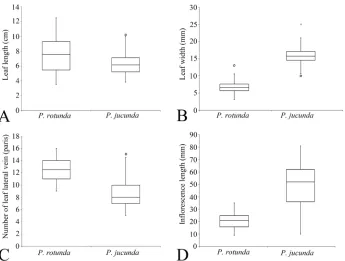
Notes. As noted by Zhou et al. (2007), P. rotunda is most similar to P. jucunda (Fig. 3) in gross morphology, particularly in having uninterrupted spicate inflorescences with dense flowers and slender pedicels longer than bracts. However, the authors did not notice that both of the species are distylous, which is another important similarity between the two taxa. The distyly of P. jucunda was firstly observed and confirmed by Chen and Zhang (2010). In the present study, we confirmed that P. rotunda is also a typical distylous species. The heights of the stigmas (4.63 ± 0.191 mm vs. 2.61 ± 0.056 mm, morph vs. S-morph) and anthers (2.74 ± 0.092 mm vs. 4.68 ± 0.178 mm, L-morph vs. S-L-morph) are reciprocal in the two L-morphs. However, P. rotunda is clearly different from P. jucunda, not only in some morphological traits (Fig. 4), but also in several micro-morphological characters (Table 1).
Besides the differences summarised by Zhou et al. (2007), such as leaf shape, leaf width, petiole length and stem diameter, we observed several additional morphological traits that are clearly distinct between P. rotunda and P. jucunda. The stems of P. rotunda
have 6–26 basal branches which are leafless and completely decumbent with numerous fibrous roots at each node. On the upper nodes of each basal branch, there are 3–12 flowering shoots which are prostrate to erect and normally bearing leaves and inflorescences (Fig. 1C). However, the stems of P. jucunda are mostly erect or only prostrate at the base and the number of its branches are much fewer than those of
Table 1. Differences between Persicaria rotunda and P. jucunda.
Persicaria rotunda P. jucunda
Habitat wetlands forest margins, grassy slopes or moist valleys
Branches the primary branches completely decumbent, leafless and the secondary
branches prostrate to erect
ascending to erect, without leafless branches
Leaves Petiole nearly absent 3–6 mm long Shape narrowly lanceolate to linear-lanceolate lanceolate or elliptic-lanceolate
Lateral veins (pairs) 9–16 6–10
Adaxial epidermis polygonal epidermal cells with straight
anticlinal walls no stomata no glands irregular epidermal cells with straight to curved anticlinal walls stomata mostly anisocytic or occasionally paracytic sparse
two-celled peltate glands Abaxial epidermis irregular epidermal cells with curved to
sinuolate anticlinal walls stomata anisocytic plenty of four-celled peltate and spheroidal
glands
irregular epidermal cells with sinuolate to sinuate anticlinal walls stomata paracytic
no glands
Length of Inflorescences (cm) 0.5–3.8 1.0–8.2
Tepals Length (mm) L-morph 3.9–4.4, S-morph 3.7–4.2 L-morph 2.8–3.3, S-morph: 2.7–3.2 Epidermis anticlinal walls of epidermal cells curved to
sinuolate 10–14 sinuate striates on cuticular layer
anticlinal walls of epidermal cells sinuolate to sinuate 12–18 straight to sinuolate striates
on cuticular layer
Achenes Size (length × width, mm) L-morph 3.6–4.2 × 2.1–2.3, S-morph
2.9–3.3 × 1.8–2.1 L-morph 2.1–2.6 × 1.6–1.8, S-morph 2.2–2.7 × 1.7–1.9
Surface opaque, densely pitted shiny, smooth
Epidermal ornamentations reticulate Indistinctly reticulate
Figure 4. Box plots of four quantitative characters, leaf length (A) leaf width (B) number of leaf lateral vein pairs (C) and inflorescence length (D) of Persicaria rotunda and P. jucunda. The boxes (rectangle region) represent the interquartile range and the whiskers (vertical line) represent the range excluding the outliers (circles). The three upper, middle and lower lines on the boxes represent the 75%, 50% and 25% of the variables, respectively. The upper and lower ends of the whiskers represent the maximum and mini-mum values of the variable, respectively. The circles represent the single value, where the variable value exceeds 1.5 times the difference between the 75% and 25%.
Though both of P. rotunda and P. jucunda have dimorphic flowers, the achenes of
P. rotunda are also dimorphic, with the L-morph ellipsoid in shape and dark brown in colour, whereas the S-morph achene is ovoid in shape and black in colour (Fig. 5A). Additionally, the L-morph achenes of P. rotunda have larger size and more raised retic-ulate epidermal ornamentations than those of the S-morph (Figs. 5B–E). In contrast, the achenes of P. jucunda are homomorphic with the same smooth surfaces in both morphs (Chen and Zhang 2010). Amongst the distylous taxa reported in Persicaria, P. rotunda is, so far, the only species that shows dimorphic features on achenes.
Figure 5. Achene morphology of Persicaria rotundaA dimorphic achenes under a stereoscope B–C SEM micrograph of L-morph achene B whole view C partial view showing its epidermis sculpture D–E SEM micrograph of S-morph achene D whole view E partial view showing its epidermis sculpture. Scale bars: 500 μm (B, D); 50 μm (C, E).
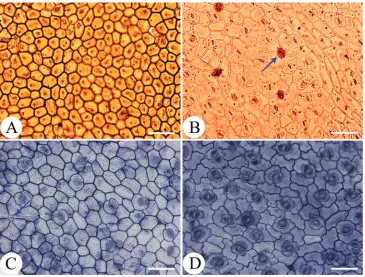
Figure 6. LM micrographs of leaf epidermis of Persicaria rotunda (A, B) and P. jucunda (C, D). A, C upper epidermis B, D lower epidermis. Arrow in B shows the four-celled peltate and spheroidal glands of P. rotunda
and in C indicates the two-celled peltate glands of P. jucunda. Scale bars: 500 μm.
found, the stomata are paracytic and the anticlinal walls of epidermal cells are sinu-olate to sinuate (Fig. 6D).
In the protologue, Zhou et al. (2007) also investigated the tepal micro-charac-teristics of P. rotunda and P. jucunda and listed their differences: the anticlinal walls of epidermal cells are curved to sinuolate in P. rotunda, while sinuolate to sinuate in
P. jucunda; the cuticular layer has longitudinally 10–14 of sinuate striates in P. rotunda, while 12–18 straight to sinuolate striates in P. jucunda. Taking all the above morpho-logical and micro-morphomorpho-logical evidence together, we think that P. rotunda represents a distinct species in Persicaria and it should not be placed under P. jucunda as a variety, but be treated as a separate species.
Acknowledgements
References
Brandbyge J (1993) Polygonaceae. In: Kubitzki K, Bittich V (Eds) The Families and Genera of Vascular Plants, Vol. 2. Flowering plants. Dicotyledons: Magnoliid, Hamamelid and Caryophyllid Families. Springer Verlag, Berlin, 531–544. https://doi.org/10.1007/978-3-662-02899-5_63
Chen ML (2012) Floral morphology and breeding system in Polygonum hastato-sagittatum Mak. (Polygonaceae). Flora 207(5): 365–371. https://doi.org/10.1016/j.flora.2012.01.012 Chen ML, Zhang XP (2010) Distyly in Polygonum jucundum Meisn. (Polygonaceae). Plant
Sys-tematics and Evolution 288(3–4): 139–148. https://doi.org/10.1007/s00606-010-0318-x Galasso G, Banfi E, Mattia FD, Grassi F, Sgorbati S, Labra M (2009) Molecular phylogeny of
Polygonum L. s.l. (Polygonoideae, Polygonaceae), focusing on European taxa: Preliminary results and systematic considerations based on rbcL plastidial sequence data. Atti della Societa Italiana di Scienze Naturali e del Museo Civico di Storia Naturale di Milano 150: 113–148. https://doi.org/10.1007/s00606-010-0318-x
Haraldson K (1978) Anatomy and taxonomy in Polygonaceae subfamily Polygonoideae Meisn. emend. Jaretzky. Symbolae Botanicae Upsalienses 22: 1–95.
Hiratsuka A, Nakao R (1996) Persicaria japonica (Meisn.) H. Gross, a heterostylous species in the Polygonaceae. Shokubutsu Kenkyu Zasshi 71: 98–104.
Hou YT (2006) Systematic studies on the tribe Polygoneae of China. Shandong Normal Uni-versity, Jinan.
Kong MJ, Hong SP (2018) Morphological traits of a distylous taxon, Persicaria odorata subsp.
conspicua (Polygonaceae). Flora 243: 58–66. https://doi.org/10.1016/j.flora.2018.03.010 Li B (2014) Persicaria wugongshanensis (Polygonaceae: Persicarieae), an odoriferous and
disty-lous new species from Jiangxi, eastern China. Phytotaxa 156(3): 133–144. https://doi. org/10.11646/phytotaxa.156.3.4
Li B, Fan DM, Lei SQ, Zhang ZY (2013) New combinations in Persicaria (Polygonaceae: Per-sicarieae) for the Flora of China. Phytotaxa 91(1): 24–26. https://doi.org/10.11646/phyto-taxa.91.1.2
Lloyd DG, Webb CJ (1992) The evolution of heterostyly. In: Barrett SCH (Ed.) Evolution and function of heterostyly. Springer, Berlin, 151–178. https://doi.org/10.1007/978-3-642-86656-2_6
Reddy NP, Bahadur B, Kumar PV (1977) Heterostyly in Polygonum chinense L. Journal of Ge-netics 63(2): 79–82. https://doi.org/10.1007/BF02984278
Ronse Decraene LP, Akeroyd JR (1988) Generic limits in Polygonum and related genera (Po-lygonaceae) on the basis of floral characters. Botanical Journal of the Linnean Society 98(4): 321–371. https://doi.org/10.1111/j.1095-8339.1988.tb01706.x
Ronse Decraene LP, Hong SP, Smets E (2000) Systematic significance of fruit morphology and anatomy in tribes Persicarieae and Polygoneae (Polygonaceae). Botanical Journal of the Linnean Society 134(1–2): 301–337. https://doi.org/10.1111/j.1095-8339.2000. tb02356.x
Yasmin G, Khan MA, Shaheen N, Hayat MQ (2010) Taxonomic significance of leaf epidermal anatomy of selected Persicaria Mill. species of family Polygonaceae from Pakistan. African Journal of Biotechnology 9: 3759–3768.
Zhou ZZ, Sun Q, Xu W, Shen J, Xu L, Zhao X (2007) Polygonum jucundum var. rotundum
Z.Z. Zhou & Q.Y. Sun, a new variety of Polygonaceae from Anhui, China. Zhiwu Fenlei Xuebao 45(05): 713–718. https://doi.org/10.1360/aps06205