Camellia puhoatensis
(Sect.
Archecamellia
– Theaceae),
a new species from Vietnam
Danh-Hùng Nguyễn1, Văn-Dũng Lương2, Thi-Hương Lê3, Quốc-Thành Trần4, Ngọc-Đài Đỗ1,5, Ngọc-Sâm Lý1,6
1 Graduate University of Science and Technology, VAST, 18 Hoang Quoc Viet, Cau Giay District, Ha Noi, Vietnam 2 Faculty of Biology, Da Lat University, 1 Phu Dong Thien Vuong Road, District 8, Da Lat City, Lam Dong Province, Vietnam 3 School of Natural Science Education, Vinh University, 182 Le Duan, Vinh City, Nghe An Province, Vietnam 4 Department of Science and Technology Nghe An, 75, Nguyen Thi Minh Khai, Vinh City, Nghe An Province, Vietnam 5 Faculty of Agriculture, Forestry and Fishery, Nghe An College of Economics, 51 Ly Tu Trung, Vinh City, Nghe An Province, Vietnam 6 Department of Biological Resources, Institute of Tropical Biology, VAST, 85 Tran Quoc Toan, District 3, Ho Chi Minh City,Vietnam
Corresponding author: Ngọc-Sâm Lý ([email protected])
Academic editor: C. Morden | Received 15 December 2019 | Accepted 8 June 2020 | Published 16 July 2020
Citation: Nguyễn D-H, Lương V-D, Lê T-H, Trần Q-T, Đỗ N-D, Lý N-S (2020) Camellia puhoatensis (Sect. Arche camellia – Theaceae), a new species from Vietnam. PhytoKeys 153: 1–11. https://doi.org/10.3897/phytokeys.153.49388
Abstract
A new species of Theaceae, Camellia puhoatensis N.S. Lý, V.D. Luong, T.H. Le, D.H. Nguyen & N.D. Do, sp. nov., is described and illustrated from Nghe An Province, North Central Coastal Region, Viet-nam. It is most similar to C. chrysanthoides, C. flavida and C. petelotii within sect. Archecamellia in shape and colouration of leaf, petal, ovary and glabrous stamen, but differs by its young puberulous shoot, mature leaf sparsely puberulous abaxially and leaf base rounded or broadly obtuse, petiole and pedicel puberulous, tepals 12–13, ovary and style pubescent. The comparison between the new species and C. velutina and C. dormoyana is presented. Data on distribution, ecology, phenology, use and provisional conservation assessment of the new species are given along with an illustration and a colour plate.
Keywords
Camellia, section Archecamellia, taxonomy, Theaceae, Vietnam
http://phytokeys.pensoft.net
Copyright Danh-Hùng Nguyễn et al. This is an open access article distributed under the terms of the Creative Commons Attribution License (CC BY 4.0), which permits unrestricted use, distribution, and reproduction in any medium, provided the original author and source are credited.
introduction
Camellia Linnaeus (1753) is the largest genus of the family Theaceae, with recent authors recognising species between 120 (Ming and Bartholomew 2007) and 280 (Chang 1981; Gao et al. 2005), distributed widely in East and Southeast Asia, from the Himalayas east to Japan and Indonesia (Chang and Ren 1998; Ming and Bartholomew 2007). The high-est species diversity is found in China and Vietnam (Chang and Ren 1998; Ming 2000; Orel and Wilson 2012b). Camellia is distinguished from other genera of Theaceae by its usually large and apically dehiscent capsules and wingless (semi-)globose or polygonal seeds with an umbilicate hilum (Ming and Bartholomew 2007). The general introduc-tion to the genus, with particular focus on Vietnam, was given in recent publicaintroduc-tions by various authors (e.g. Orel et al. 2012, 2013, 2014a, b; Luong et al. 2016a; Nguyen et al. 2018; Pham et al. 2019; Do et al. 2019a, b). So far, more than 75 species of Camellia have been reported in Vietnam, with many localised endemic species (e.g. Pitard 1910; Gagne-pain 1941; Rosmann 1999; Tran 1998a, b; Pham 2000; Hakoda and Tran 2001; Hakoda et al. 2007; Orel 2006; Orel and Wilson 2010a, b, 2012a, b; Orel and Curry 2014; Orel et al. 2012, 2013, 2014a, b; Tran et al. 2012; Tran and Luong 2012, 2013; Tran and Le 2013, 2015; Luu et al. 2015, 2018; Luong et al. 2016a, b; Le et al. 2017; Nguyen et al. 2018; Pham et al. 2019; Do et al. 2019a, b), but the actual number is expected to be higher in the near future (Le and Luong 2016, Do et al. 2019b).
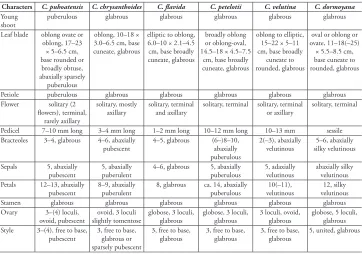
During recent extensive floristic surveys in the North Central coastal region in Vi-etnam, several interesting species of Camellia in yellow flower were collected by one of us (N.-D. Do) and colleagues in 2018–2019 (e.g. Tran and Luong 2013; Tran and Le 2015; Luong et al. 2016a, b; Le et al. 2017; Nguyen et al. 2018; Pham et al. 2019; Do et al. 2019a, b). Critical examination of living flowers, dried specimens and comparison with type material and protologues of all related yellow Camellia in Vietnam and China (e.g. Sealy 1958; Chang 1981; Chang and Bartholomew 1984; Gao et al. 2005; Ming 2000; Ming and Bartholomew 2007; Pham 2000; Orel and Curry 2014) led to the dis-covery of several new taxa, two of which were recently described and named C. pukhan gensis D.N. Do, D.V. Luong, S. T. Hoang & H.T. Le and C. ngheanensis N.D. Do, V.D. Luong, N.S. Ly, T.H. Le & D.H. Nguyen (Do et al. 2019a, b), while some other col-lections are still awaiting description. In this paper, we describe a further new Camellia from the Pu Hoat Nature Reserve, Nghe An Province, Vietnam. The overall plant habit, somewhat ovate leaf blades, orbicular sepals and bright yellow tepal of these plants in Pu Hoat NR show similarities with C. chrysanthoides H.T. Chang, C. flavida H.T.Chang, C. petelotii (Merr.) Sealy and C. dormoyana (Pierre) Sealy (Sealy 1949, 1958; Chang 1979, 1981). However, it shows significant differences in its vegetative and floral struc-tures (see Table 1) and we describe it here as a new species to science, C. puhoatensis.
Materials and methods
specimens of the most closely-related species of yellow camellias were examined from the following herbaria: DLU, HN, P, NSW and VNM (herbarium codes follow Thiers 2018). Hi-resolution digital images available were also accessed from botanical websites (e.g. https://science.mnhn.fr/, http://www.cvh.org.cn/, https://avh.ala.org.au/, https:// plants.jstor.org/). All morphological characters were described using the general termi-nology and standard works of Sealy (1958), Chang (1981), Chang and Bartholomew (1984), Chang and Ren (1998), Gao et al. (2005), Ming (2000) and Ming and Bar-tholomew (2007). The conservation status was assessed, based on field observations in accordance with the IUCN Red List Categories and Criteria version 3.1 (IUCN 2017).
Taxonomic treatment
Camellia puhoatensis N.S. Lý, V.D. Luong, T.H. Le, D.H. Nguyen & N.D. Do, sp. nov.
urn:lsid:ipni.org:names:77210595-1
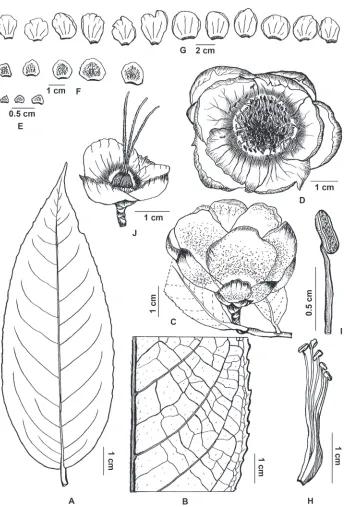
Figures 1, 2
Diagnosis.Camellia puhoatensis is morphologically similar to C. chrysanthoides, C. fla vida and C. petelotii, but differs in having young puberulous shoots, mature leaves sparsely puberulous abaxially with leaf bases rounded or broadly obtuse, petioles and pedicels puberulous, tepals 12–13 and the ovary and styles pubescent.
Type. VIETNAM. Nghe An Province: Que Phong District, Dong Van Commune, Pu Hoat NR, 19°43'31"N, 105°05'43"E, 270 m elev., 30 December 2018, Do Ngoc Dai, Le Thi Huong, Nguyen Danh Hung, DHH682 (holotype VNM; isotypes P, DLU).
pedicel stout, covered by purplish-red perulae, 7–10 mm long, puberulous; flower buds unevenly globose in shape, 2.2–2.6 × 2.0–2.3 cm, yellowish-red tinted, open flow-ers somewhat circular; bracteoles (sensu Sealy 1958) 3–4, opposite, orbicular, 1.5–2.5 × 1.5–3.0 mm, abaxially red to yellow-red tinted, adaxially paler, glabrous, margins ciliate, persistent; sepals 5, persistent, orbicular or subglobose, 0.6–1.5 × 0.8–1.8 cm, abaxially dull red and pubescent, adaxially pale yellowish and glabrous, margins cili-ate; petals 12–13, arranged in 3 whorls, bright yellow, sometimes with large red patch on the outer ones; outermost whorl comprising 3 or 4 petals, orbicular to broadly obovate, 2.2–2.8 × 1.6–2.3 cm, abaxially pubescent, adaxially glabrous; middle whorl comprising 4 or 5 petals, broadly obovate, 2.4–3.3 × 1.8–2.5 cm, abaxially pubescent, adaxially glabrous; innermost whorl of 3 or 4 petals, orbicular to broadly obovate, 2.3–2.5 × 1.7–2.2 cm, abaxially pubescent, adaxially glabrous, basally united with out-ermost filaments 5–7 mm. Androecium numerous stamens, in 4–5 whorls, light yellow, 2.5–2.8 cm long, glabrous; outer filaments basally united for 1.5–1.8 cm forming a cup, inner ones basally united for 3–5 mm, free above union; anthers yellow, 2.2–2.8 × 1–1.5 mm, with two longitudinal striations, dorsifixed. Gynoecium superior, 3–(4)-loc-uled, ovoid terminating into 3–(4) styles, 2.5–3.0 × 3.0–3.5 mm, slightly longitudinal striations, pubescent, 2 ovules per locule; styles free to the base, 1.8–2.3 cm long, pu-bescent. Capsule not seen.
Phenology. Flowering from November to January of the next year.
Distribution and habitat.Camellia puhoatensis is currently found only from the type locality. It grows on moist fertile and sandy soils along mountain streams and hill slopes in evergreen broad-leaved forests in Pu Hoat Nature Reserve, Vietnam, at eleva-tions of 270–450 m.
Provisional conservation assessment. At present, only a single population of about 300 scattered mature individuals of Camellia puhoatensis was observed in the type locality, with an estimated extent of occurrence (EOO) less than 100 km2 and an
area of occupancy (AOO) less than 1 km2. The population is highly threatened due
to loss of habitat within its range and high market demands for wild, yellow-flowered camellias which are intensively collected for sale by local people. Therefore, C. puhoat ensis is preliminarily categorised as Critically Endangered [B1ab (i, ii, iii) + 2ab (ii, iii), D], according to the IUCN Categories and Criteria (IUCN 2017).
Etymology. The specify epithet ‘puhoatensis’ refers to the type locality. Uses. Leaves and flowers were harvested and used for tea by the local people. Additional specimens examined.Paratypes. Vietnam. Nghe An Province: Que Phong District, Dong Van Commune, Pù Hoạt NR, 19°48'45"N, 105°5'39"E, 320 m elev., 2 September 2018, Đỗ Ngọc Đài, Nguyễn Danh Hùng, Lê Thị Hương, DHH 120 (VNM); the same locality, 19°48'31"N, 105°05'43"E, 280 m elev., 16 January 2019, Đỗ Ngọc Đài, Nguyễn Danh Hùng, Lê Thị Hương, DHH 790 (DLU), DHH 791 (HN).
Vernacular name. Vietnamese language: Trà hoa vàng pù hoạt.
taxo-Figure 2.Camellia puhoatensis. A young shoot B terminal buds C solitary bud and axillary flower (side view) D flower and pollinated flower (side view) e close-up of flower (front view) F immature fruit Ga part of branch showing leaves abaxial and opening flower H leaves adaxially i bracteoles J sepals K petals
Similarly, C. velutina is readily distinguished from C. puhoatensis by its glabrous young shoots, mature leaves and petioles, sepals that are silky velutinous abaxially and velu-tinous adaxially, the 10 (occasionally 11) petals that are silky veluvelu-tinous and glabrous ovary and style (see Table 1).
Acknowledgements
We are grateful to the manager and staff of Pu Hoat Nature Reserve and to Mr. Tran Quoc Thanh, director of Nghe An Provincial Department of Science and Technology for their helpful cooperation during the fieldwork. We thank Mr. Bruce Maslin (PERTH herbarium, Australia) for helping to improve the English text and to the anonymous reviewers for their constructive comments that helped improve the manuscript.
references
Chang HT (1979) Chrysantha, a section of golden camellias from Cathaysian flora. Acta Scien-tiarum Naturalium Universitatis Sunyatseni 18: 69–74.
Chang HT (1981) A taxonomy of the genus Camellia. Acta Scientiarum Naturalium Universi-tatis Sunyatseni Monograph Series 1: 1–180.
Table 1. Morphological comparison of C. puhoatensis with its most closely-related taxa (based on Sealy 1958; Chang and Bartholomew 1984; Tran and Hakoda 1998; Pham et al. 2019).
Characters C. puhoatensis C. chrysanthoides C. flavida C. petelotii C. velutina C. dormoyana
Young
shoot puberulous glabrous glabrous glabrous glabrous glabrous Leaf blade oblong ovate or
oblong, 17–23 × 5–6.5 cm, base rounded or broadly obtuse, abaxially sparsely
puberulous
oblong, 10–18 × 3.0–6.5 cm, base cuneate, glabrous
elliptic to oblong, 6.0–10 × 2.1–4.5 cm, base broadly cuneate, glabrous
broadly oblong or oblong-oval, 14.5–18 × 4.5–7.5
cm, base broadly cuneate, glabrous
oblong to elliptic, 15–22 × 5–11 cm, base broadly
cuneate to rounded, glabrous
oval or oblong or ovate, 11–18(–25)
× 5.5–8.5 cm, base cuneate to rounded, glabrous
Petiole puberulous glabrous glabrous glabrous glabrous glabrous Flower solitary (2
flowers), terminal, rarely axillary
solitary, mostly
axillary solitary, terminal and axillary solitary, terminal solitary, terminal or axillary solitary, terminal
Pedicel 7–10 mm long 3–4 mm long 1–2 mm long 10–12 mm long 10–13 mm sessile Bracteoles 3–4, glabrous 4–6, abaxially
pubescent 4–5, glabrous (6–)8–10, abaxially puberulous
2(–3), abaxially
velutinous silky velutinous5–6, abaxially
Sepals 5, abaxially
pubescent 5, abaxially puberulent 4–6, glabrous 5, abaxially puberulous 5, adaxially velutinous abaxially silky velutinous Petals 12–13, abaxially
pubescent 8–9, abaxially puberulent 8, glabrous ca. 14, abaxially puberulous velutinous10(–11), velutinous12, silky Stamen glabrous glabrous glabrous glabrous glabrous glabrous Ovary 3–(4) loculi,
ovoid, pubescent slightly tomentoseovoid, 3 loculi globose, 3 loculi, glabrous globose, 3 loculi, glabrous 3 loculi, ovoid, glabrous globose, 5 loculi, glabrous Style 3–(4), free to base,
pubescent 3, free to base, glabrous or sparsely pubescent
3, free to base,
Chang HT, Bartholomew B (1984) Camellias. Timber Press Portland London, 1–211. Chang HT, Ren SX (1998) Theaceae (Theoideae). In: Chang HT (Ed.) Flora Reipublicae
Pop-ularis Sinicae, Vol. 49 (3). Science Press Beijing, 1–194.
Do ND, Luong VD, Nguyen DC, Hoang TS, Le TH, Han JE, Park HS (2019a) A new yellow Camellia species from Central Vietnam. Korean Journal of Plant Taxonomy 49(1): 90–95.
https://doi.org/10.11110/kjpt.2019.49.1.90
Do ND, Luong VD, Le TH, Nguyen DH, Nguyen TN, Ly NS (2019b) (paper in review) Camellia ngheanensis (Sect. Chrysanthae: Theaceae), a new species from central northern-Vietnam. Phytotaxa.
Gagnepain F (1941) Ternstroemiacées nouvelles d'Indochine. Notulae Systematicae 10: 112–131. Gao J, Clifford RP, Du YQ (2005) Collected species of the genus Camellia: an illustrated
out-line. Zhejiang Science and Technology Press Guangzhou, 1–302.
Hakoda N, Tran N (2001) Plate 426: Camellia flava. Curtis’s Botanical Magazine 18(4): 190– 193. https://doi.org/10.1111/1467-8748.00313
Hakoda N, Kirino S, Tran N (2007) New species of genus Camellia in Vietnam. International Camellia Journal 39: 54–57.
IUCN (2017) Guidelines for Using the IUCN Red List Categories and Criteria. Version 13. Prepared by the Standards and Petitions Committee.
https://www.iucnredlist.org/resourc-es/redlistguidelines [accessed: 18 June 2019]
Le NNH, Luong DV (2016) General information about the yellow Camellia species in Viet-nam. In: Li J-Y (Ed.) Proceedings of Dali International Camellia Congress, Dali Yunnan – China, 21–26 February, 2016: 80–84.
Le NHN, Chiyomi U, Hironori K, Nguyen TL, Tran N, Luong VN, Hoang TS (2017) Ca mellia tuyenquangensis (Theaceae) a new species from Vietnam. Korean Journal of Plant Taxonomy 472(2): 95–99. https://doi.org/10.11110/kjpt.2017.47.2.95
Linnaeus C (1753) Species plantarum 2. Impensis Laurentii Salvii, Holmiae [Stockholm]. Luong VD, Luu HT, Nguyen TQT, Nguyen QD (2016a) Camellia luteopallida (Theaceae),
a new species from Vietnam. Annales Botanici Fennici 53(1–2): 135–138. https://doi. org/10.5735/085.053.0224
Luong VD, Le A, Nguyen TH, Nguyen TL (2016b) Camellia thuongiana: A new yellow Camel lia species from Vietnam. Dalat University Journal of Science 6(3): 338–344. https://doi. org/10.37569/DalatUniversity.6.3.78(2016)
Luu HT, Nguyen QD, Nguyen TQT (2015) Camellia sonthaiensis (Theaceae), a new species from Vietnam. Annales Botanici Fennici 52(5-6): 289–295. https://doi. org/10.5735/085.052.0502
Luu HT, Tran G, Nguyen QD, Nguyen HC (2018) A new species of the family Theaceae from central Vietnam. Academia Journal of Biology 40(4): 23–28.
Ming TL (2000) Monograph of the genus Camellia. Yunnan Science and Technology Press Kunming, 1–120.
Ming TL, Bartholomew B (2007) Theaceae. In: Wu ZY, Raven PH (Eds) Flora of China, Vol.12. Science Press Beijing and Missouri Botanical Garden Press St Louis, 366–478. Nguyen TL, Tran N, Chiyomi U, Hironori K, Luong VD, Hoang TS, Nguyen KD, Nguyen
Orel G (2006) A new species of Camellia section Piquetia (Theaceae) from Vietnam. Novon 16(2): 244–247. https://doi.org/10.3417/1055-3177(2006)16[244:ANSOCS]2.0.CO;2
Orel G, Curry AS (2014) A new species of Camellia Section Dalatia (Theaceae) from Vietnam. Telopea 17: 99–105. https://doi.org/10.7751/telopea20147551
Orel G, Wilson PG (2010a) Camellia luteocerata sp nov and a new section of Camellia Dala tia from Vietnam. Nordic Journal of Botany 28(3): 280–284. https://doi.org/10.1111/ j.1756-1051.2010.00652.x
Orel G, Wilson PG (2010b) A new species of Camellia sect Stereocarpus (Theaceae) from Viet-nam. Novon 20(2): 198–202. https://doi.org/10.3417/2008096
Orel G, Wilson PG (2012a) Camellia cattienensis: a new species of Camellia sect. Archaeca mellia: Theaceae from Vietnam. Kew Bulletin 66(4): 565–569. https://doi.org/10.1007/ s12225-012-9317-0
Orel G, Wilson PG (2012b) Camellia cherryana (Theaceae) a new species from China. Annales Botanici Fennici 49(4): 248–254. https://doi.org/10.5735/085.049.0405
Orel G, Wilson PG, Curry AS, Luu HT (2012) Camellia inusitata (Theaceae), a distinctive new species and a new section Bidoupia from Vietnam. Edinburgh Journal of Botany 69: 347–355. https://doi.org/10.1017/S0960428612000170
Orel G, Wilson PG, Curry AS, Luu HT (2013) Camellia oconoriana (Theaceae), a new species from Vietnam. Edinburgh Journal of Botany 70(3): 439–447. https://doi.org/10.1017/ S0960428613000103
Orel G, Wilson PG, Luu HT (2014a) Camellia curryana and C longyi spp nov. (Theaceae) from Vietnam. Nordic Journal of Botany 32(1): 42–50. https://doi.org/10.1111/j.1756-1051.2013.00399.x
Orel G, Wilson PG, Curry A, Luu HT (2014b) Four new species and two new sections of Camel lia (Theaceae) from Vietnam. Novon 23(3): 307–318. https://doi.org/10.3417/2012076
Pham HH (2000) Cây cỏ Việt Nam [An illustrated flora of Vietnam] Vol. 1. Youth Publishing House Ho Chi Minh City, 412–434. [In Vietnamese with English summary]
Pham VT, Luong VD, Averyanov LV, Trinh NB, Nguyen TL, Nguyen TLT (2019) Camellia velutina (Theaceae: Sect. Chrysanthae), a new species from northern Vietnam. Pakistan Journal of Botany 51(4): 1441–1446. https://doi.org/10.30848/PJB2019-4(33)
Pitard CJ (1910) Ternstroemiacées. In: Lecomte MH (Ed.) Flore Générale de l’Indo-Chine, tome 1 fasc. 4. Masson et Cie Paris, 330–352.
Rosmann JC (1999) Une nouvelle espèce de Camellia (Theaceae) du Viêt-Nam. Adansonia 21: 319–322.
Sealy JR (1949) New name in Camellia. Kew Bulletin 4(2): 215–222. https://doi. org/10.2307/4113679
Sealy JR (1958) A revision of the genus Camellia. Royal Horticultural Society London, 1–239. Thiers B (2018) [continuously updated] Index Herbariorum: a global directory of public her-baria and associated staff. New York Botanical Garden’s Virtual Herbarium.
http://sweet-gum.nybg.org/science/ih/ [accessed on 21 April 2020]
Tran N (1998a) Camellia cucphuongensis: A new species of yellow Camellia from Vietnam. International Camellia Journal 30: 71–72.
Tran N, Hakoda N (1998) Camellia petelotii: A species of yellow Camellia from Vietnam. In-ternational Camellia Journal 30: 81–83.
Tran N, Le NHN (2013) The yellow Camellias of the Tam Dao National Park. International Camellia Journal 45: 122–128.
Tran N, Le NHN (2015) A new yellow Camellia species from North of Vietnam. International Camellia Journal 47: 36–39.
Tran N, Luong VD (2012) Camellia dalatensis: A new species and precious gene should be con-served. VNU Journal of Science: Natural Science and Technology 28(2S): 34–36. Tran N, Luong VD (2013) Camellia dilinhensis: A new yellow species from Vietnam.
Interna-tional Camellia Journal 45: 87–89.