Provenance of invaders has scale-dependent impacts in
a changing wetland ecosystem
Kathryn L. Amatangelo1, Lee Stevens2, Douglas A. Wilcox1, Stephen T. Jackson3,
Dov F. Sax2
1 Department of Environmental Science and Ecology, The College at Brockport – State University of New York, Brockport, NY, USA 2 Ecology and Evolutionary Biology, Brown University, Providence, RI, USA 3 De-partment of the Interior Southwest Climate Adaptation Science Center, U.S. Geological Survey and De De-partment of Geosciences and School of Natural Resources and Environment, University of Arizona, Tucson, AZ, USA
Corresponding author:Kathryn L. Amatangelo ([email protected])
Academic editor:S.M. Thomaz | Received 6 August 2018 | Accepted 12 October 2018 | Published 19 November 2018
Citation: Amatangelo KL, Stevens L, Wilcox DA, Jackson ST, Sax DF (2018) Provenance of invaders has scale-dependent impacts in a changing wetland ecosystem. NeoBiota 40: 51–72. https://doi.org/10.3897/neobiota.40.28914
Abstract
Exotic species are associated with a variety of impacts on biodiversity, but it is unclear whether impacts of exotic species differ from those of native species with similar growth forms or native species invading disturbed sites. We compared presence and abundance of native and exotic invaders with changes in wetland plant species diversity over a 28-year period by re-surveying 22 ponds to identify factors cor-related with observed changes. We also compared communities found within dense patches of native and exotic emergent species with similar habits. Within patches, we found no categorical diversity differences between areas dominated by native or exotic emergent species. At the pond scale, the cover of the exotic grass Phragmites australis best predicted change in diversity and evenness over time, likely owing to its sig-nificant increase in coverage over the study period. These changes in diversity and evenness were strongest in younger, less successionally-advanced ponds. Changes associated with cover of P. australis in these ponds were not consistent with expected diversity decreases, but instead with a dampening of diversity gains, such that the least-invaded ponds increased in diversity the most over the study period. There were more mixed effects on evenness, ranging from a reduction in evenness gains to actual losses of evenness in the ponds with highest invader cover. In this wetland complex, the habit, origin and invasiveness of species contrib-ute to diversity responses in a scale- and context-dependent fashion. Future efforts to preserve diversity should focus on preventing the arrival and spread of invaders that have the potential to cover large areas at high densities, regardless of their origin. Future studies should also investigate more thoroughly how changes in diversity associated with species invasions are impacted by other ongoing ecosystem changes.
Copyright K.L. Amatangelo et al. This is an open access article distributed under the terms of the Creative Commons Attribution License (CC BY 4.0), which permits unrestricted use, distribution, and reproduction in any medium, provided the original author and source are credited.
Keywords
wetland, invasion, exotic, Phragmites, Typha, scale, richness
Introduction
The impacts of exotic species on native species and plant communities are diverse. In many cases, exotic species have caused or contributed to extinction of native spe-cies (Ricciardi 2004; Sax and Gaines 2008; Pysek et al. 2017). However, in other cases, they benefit native species–for instance, by providing critical habitat or resources (Schlaepfer et al. 2011). In some cases, exotic species have led to local extirpation of natives and declines in local biodiversity (Vellend et al. 2013), whereas in other cases, no such losses in native diversity are apparent (Heard et al. 2012). These disparate and often contradictory impacts of exotic species have contributed to two ongoing debates relevant to both our ecological understanding of species invasions and their implica-tions for conservation.
In the first debate, Davis et al. (2011) argued that the dichotomy between natives and exotics may be of little value and that species should instead be judged relative to their impacts. This point of view has been challenged (Simberloff et al. 2011; Simber-loff et al. 2013). Indeed, if exotic species have some distinct advantage, such as escape from co-evolved enemies (Keane and Crawley 2002) or an intrinsic evolutionary fit-ness advantage (Fridley and Sax 2014), then they might be expected and, in some situations, have been shown to have disproportionately large impacts on native biota compared to native species (e.g. Paolucci et al. 2013). On the other hand, native species that are released from constraints by environmental change (e.g. climate change, severe disturbance) might also become ‘invasive’ and exert strong influences on ecological communities as their populations increase (Carey et al. 2012). Prominent examples of native invasive species include increases in the abundance of mountain bark beetle
(Dendroctonus ponderosae) associated with climate change, which have led to the loss of
native forests in western USA and increases in the abundance of white-tailed deer (
Odo-coileus virginianus) associated with a loss of predation pressure, which has negatively
impacted native plant biodiversity in North American forests (Côté et al. 2004; Bentz et al. 2010). Likewise, eastern redcedar (Juniperus virginiana) is invading beyond its native range in central USA, where it is converting grasslands to forested habitat, with a corresponding loss of herbaceous plant diversity (Briggs et al. 2002), whereas fishes in western USA have often been moved small distances beyond their historic range boundaries, but nevertheless had large impacts on aquatic systems (Carey et al. 2012).
consequence of environmental change - including invasions - has been a paradigm of recent ecological research. As a result, little attention has been placed on evaluation of diversity increases (e.g. Hector et al. 1999). However, while there are clearly docu-mented declines in local-scale biodiversity following species invasions (Vellend et al. 2013), there are also well-documented counter-examples of no change or an increase in richness following invasions (Castilla et al. 2004; Sax et al. 2005). Meta-analyses of long-term change in ecological communities indicate that net increases in richness are at least as likely as net decreases in diversity at local scales (Vellend et al. 2013; Dornelas et al. 2014b; Elahi et al. 2015). However, the relevance and generality of these findings is debated (Cardinale 2014; Dornelas et al. 2014a; Vellend et al. 2017; Cardinale et al. 2018) and the role of invaders per se is difficult to determine, as too little of the data analysed to date explicitly examine the net impacts of invaders on species diversity (e.g. just 7 of the cases analysed in the meta-analysis by Vellend et al. 2013). This limitation is particularly acute within invaded systems that might simultaneously be experiencing succession or other environmental changes that impact species composition, where exotic invasive species may be ‘passengers’ rather than ‘drivers’ of change (MacDougall and Turkington 2005). Whether and when invaders might reduce diversity in a system that would otherwise be increasing in diversity is not well-understood.
While these two debates (species’ provenances and invader-driven change in local diversity) have often been considered separately, they are, in fact, related. Intrinsic dif-ferences between native and exotic invaders could determine whether particular inva-sions are more likely to lead to decreases or increases in local-scale biodiversity. The answers to both debates are also likely to be influenced by the ways in which changes in biodiversity are measured (McGill et al. 2015) and whether species are considered native or exotic in a particular ecosystem. Here, we consider taxa to be exotic if their gene pool was introduced from a different continent; this typically applies to species but can also apply to genotypes that have been introduced from another continent and potentially hybrid species. We consider species to be native if they are known to occur historically within the region of study. Both native and exotic species can be considered invaders (with significant impacts on native ecosystems) if they have increased significantly in abundance over a period of interest (as we define here for our study system in Methods).
Determining whether native and exotic invaders have categorical differences in how they impact ecological communities and determining whether these impacts cause decreases in some measure of biodiversity is often difficult. The most straightfor-ward comparisons will be possible when both native and exotic invaders have arrived or increased in abundance over similar time-frames, with relatively long periods of study. The Miller Woods section of the Indiana Dunes National Lakeshore is uniquely suited for a long-term comparison of the impacts of native and exotic invaders. This area has an extensive network of over 150 shallow ponds (Suppl. material 1: Figure S1), disturbed by fragmentation and hydrological change since the late 19th Century, that
human disturbance (Jackson et al. 1988) and an ecological survey conducted in 1982 (Wilcox and Simonin 1987) provides a baseline for comparing changes associated with invaders that have arrived or increased in abundance since that time.
In this study, we evaluated how native and exotic invader abundances are related to changes in vegetation richness, evenness and compositional similarity over 28 years. We examined these relationships for five invaders (two exotic, two native and one na-tive-exotic hybrid) individually and in combination. We also considered whether other environmental variables such as pond age (and successional stage) can help explain the changes observed in these communities over the 28 years that have elapsed between surveys. Furthermore, we examined how one native-exotic hybrid, one exotic invader and two native dominants (one of which is an invader) are related to the richness and evenness of plant species at sub-pond spatial scales. These comparisons allowed us to consider the likelihood that the potential influence of native and exotic invaders differs within this wetland complex and to determine whether either set of invaders decreases biodiversity at local scales.
Methods
Study System
The over 150 shallow ponds in the Miller Woods section of the Indiana Dunes National Lakeshore formed in relatively discrete rows as Lake Michigan receded to its present lev-el (Jackson et al. 1988). Pond age is thought to range from a few hundred years for those closest to the shore to > 3000 years for the oldest ponds (Futyma 1985; Jackson et al. 1988). The ponds are generally well-buffered with low nutrient concentrations, without large differences in water or sediment chemistry between young and old ponds (Wilcox and Simonin 1987). Ponds closest to the shoreline are irregularly shaped and are gen-erally smaller, deeper and have less sediment than older ponds (Wilcox and Simonin 1987). Dunes around these ponds are large and hummocky and vegetated primarily by dune grasses and scattered cottonwood trees, Populus deltoides. Ponds further from the Lake Michigan shoreline are typically large and linear in shape. These ponds are situated in oak (Quercus velutina) woodlands, although pre-settlement woodlands also included pines (Pinus strobus, P. banksiana) (Jackson et al. 1988). Many ponds are fragments of historically larger ponds that were bisected by sand migration and powerline, railroad or road rights-of-way prior to initial vegetation surveys; some roads or railroads have been abandoned, but the causeways that alter pond hydrology remain in place.
Pond resurveys
resa-mpling 12 in 2010 and 10 in 2011. In 2011, we also resampled five ponds sampled in 2010 to evaluate between-year consistency. As richness was highly correlated between years (P < 0.05, R2 = 0.80), for ponds resampled in both years, we only report the 2010
data. In 1982, researchers placed four 1-m2 quadrats randomly along five evenly spaced
north-south transects that spanned the width of each surveyed pond. Transects were not permanently marked or mapped and pond size and shape had often changed, so we could not precisely relocate the original sample locations. In the resample, we placed 1-m2 quadrats randomly along four to ten evenly spaced north-south transects, for a
to-tal of 20 to 145 1-m2 samples in each pond, with larger sample sizes in larger ponds. In
each quadrat, we recorded percent cover of all species, water depth and sediment type. Percent cover was estimated as total area covered when visualised from directly above the tallest plants, including cover above the water, within the water and just above the sub-strate surface. When the subsub-strate surface in deep water was not visible due to plants in the water column or due to murky water, then we gently moved plants aside or waited for sediment to settle before taking measurements down to the deepest level visible. In locations with deeper submersed aquatic vegetation, we physically pulled samples to en-sure we had not missed any species. Total percent cover values of quadrats could exceed 100% because of the multiple strata of plants (emergents, floating-leaved, submerged).
We subsampled 2010 and 2011 quadrats down to 20 quadrats per pond to provide equivalent sampling effort to the 1982 dataset for some analyses, including richness and evenness. A total of 20 quadrats were selected to best replicate the Wilcox and Simonin (1987) sampling layout, with 4–5 quadrats selected using a random number generator on each of 4–5 transects selected to span the length of the pond. To evaluate the impact of subsampling our data, we calculated sample-based rarefaction curves us-ing all quadrats we sampled for each pond. We then calculated the correlation between subsampled richness and analytically estimated richness at 20 quadrats. Richness esti-mates were calculated in EstimateS v.8.0 (Colwell 2009). Subsampled and analytically estimated richness of 2010/2011 data were highly correlated, with an adjusted R2 of
0.938 and the intercept was not significantly different from zero. Given the high cor-relation between sampling strategies within the resample period, we are confident the resample data adequately replicated the original sampling strategy.
We updated the names of taxa from the 1982 sample to reflect modern taxonomy. Species within some genera (e.g. Persicaria, Nuphar) had been split or joined in the inter-vening time, so we analysed those taxa at their lowest resolution. Other taxa contained species with variable morphology that were sampled in a vegetative state; those species could not be definitively identified, so we combined those species into morphotaxa.
plant communities between these groups may have changed distinctly over 28 years due to factors such as initial vegetation conditions or differential physical character-istics of the ponds. We used the ruler function in arcGIS 9.3 (ESRI 2010) on aerial photos to measure the fraction of pond perimeters comprising road or railroad rights-of-way, all of which were emplaced before 1982.
We used single classification G-tests and replicated tests for goodness-of-fit to identify taxa that were significantly increasing or decreasing in quadrat frequency of occurrence within and across ponds (Sokal and Rohlf 1995). The single-classification G-statistic tests for a change in frequency of occurrence of a particular species at a given pond. The Gtotal statistic for a species tests for changes in frequency in either direction across all ponds. The Gpooled statistic tests for overall net increases or decreases in frequency by combining data from all ponds. We classified species as “increasers” or “decreasers” if their changes were large enough and consistent enough to result in sig-nificant Gtotal and Gpooled test statistics (after the false discovery rate p-value correction for multiple hypothesis tests). Taxa were only investigated in this manner if they had greater than 1% frequency of occurrence (13 quadrats) in our study.
Species were classified as “Invaders” in our study if they both increased significantly in frequency of occurrence over the past 28 years across the wetland complex (Suppl. material 1: Table S1) and, for native species, also had their greatest long-term abun-dance (judged from macrofossil or pollen records spanning the last 3000 years) within the past 150 years (Jackson et al. 1988). This 150-year time period was chosen to reflect the significant changes European settlement had on the dunes landscape, when large shifts in community composition are visible in paleoecological records (Jackson et al. 1988). Using these criteria, five species were classified as invaders. Typha × glauca (hy-brid cattail), a swarm of hy(hy-brids of native Typha latifolia and exotic Typha angustifolia
(Freeland et al. 2013, but see Pederson et al. 2005), is an emergent taxon that has been abundant since the original survey was performed in the 1980s (Wilcox and Simonin 1987). The majority of the cattails present in the Upper Midwest, including Indiana Dunes, are T. × glauca hybrids (Travis et al. 2010). Historically, the native Typha
lati-folia was scarce before Euro-American settlement, increasing in abundance in the late
1800s (Jackson et al. 1988). Phragmites australis (common reed), probably a European genotype (Saltonstall 2002; Chun and Choi 2009), is an emergent grass that was rare in the 1982 surveys but expanded in the region between 1972 and 1990 (Tonkovich 2003). Cephalanthus occidentalis (buttonbush), an emergent native wetland shrub, was rare pre-settlement but increased substantially in the 20th Century, dominating some
were five other native taxa identified as ‘increasers’ in the past 28 years (Suppl. mate-rial 1: Table S1), these taxa were most abundant prior to 150 years ago based on paleo-ecological data, so they were not counted as ‘invaders’.
To evaluate whether provenance or habit predicted direction of change over the 28 years as evaluated by Gtests (increasers, decreasers or no change), we performed tests for association using the Fisher Exact test with the Freeman-Halton extension. To evaluate the effect of growth form, we categorised native taxa into emergent and submersed/floating habits, based on where the majority of their foliage is typically found. To evaluate the effect of provenance, we split our data into native or exotic/ hybrid species.
Importance values (IV) were calculated for each species in each sampling period and pond. Importance values were calculated on subsampled data by summing relative frequency and relative cover. An NMDS ordination of ponds in both time periods was performed using species with summed importance values of at least 0.05 across the dataset (out of a possible maximum of 2). NMDS was performed using the Sorensen distance matrix in PCORD using the ‘slow and thorough’ option, with random start-ing coordinates and 50 runs (McCune and Mefford 2006).
We calculated pond-scale species richness and Pielou’s evenness on subsampled data for all taxa in each time period (Beisel et al. 2003). We also calculated pond-scale richness values that excluded exotic and invader species. Results of analyses were not qualitatively different, so we only present total richness. We evaluated pairwise simi-larities amongst all ponds using subsampled data and calculated Bray-Curtis similarity on log-transformed frequency data. Differences in richness and evenness across time were evaluated by mixed-model ANOVAs, with age, year and their interaction as fixed variables and pond as a random variable. Similarity differences across time were evalu-ated via paired-t-tests; we tested changes amongst all 22 ponds and also tested changes within pond groups binned by age (‘young’ vs. ‘old’).These tests were performed after ensuring that data satisfied assumptions of normality.
We calculated proportional changes in richness and evenness for each pond to serve as response variables in the analyses of community change. We did not calculate a cover-change metric due to differences in sampling months and estimation methods between the 1982 and 2010/2011 surveys. As we were interested in the impact of each invader on community change over 28 years, we performed five mixed-model ANOVAs to evaluate how each invader contributed to richness and evenness change. We used the invaders’ cover values in 2010/2011 for these analyses. In each model, the fixed predictors were the target invader’s cover in 2010/2011, a combined metric summing the cover of the other four invaders, pond age and interactions between those three factors. Interactions were removed if they were not significant (p >0.05). We also modelled the relationship between Phragmites australis and richness and evenness change in young ponds using simple linear regression.
and lowest AIC score. We compared pond area covered by each of our invaders in 2010/2011 across the two pond ages via a Wilcoxon test.
Prior to ANOVA and regression analyses, 2010/2011 biotic proportion cover vari-ables and proportion shoreline disturbance were arcsine(sqrt)-transformed and depth and area were log-transformed to approximate normality.
Patch-scale surveys
A subset of species in this wetland complex, regardless of their status as invaders, form dense emergent, often clonal patches that may (but do not necessarily) exclude other species. To evaluate the effects of monodominant emergent taxa, we performed ad-ditional sampling in 2011 in patches dominated by each of four taxa: three invaders
(Typha × glauca, a native-exotic hybrid, Phragmites australis, an exotic and
Cephalan-thus occidentalis, a native) and one additional native species (Schoenoplectus acutus). We
chose Schoenoplectus acutus rather than our other native invader (Persicaria
hydropiper-oides) because S. acutus has a more similar habit to the invasive grass species (Phragmites
australis). Each of the four selected taxa forms monodominant stands, which we define
as dense, largely monospecific emergent patches of vegetation, in many shallow ponds in the Miller Woods wetlands. We selected six ponds that each contained at least two of our focal species (Suppl. material 1: Figure S1), so that each focal species was sampled within at least three ponds. Within patches of our focal species, we placed three or four 0.5×1 m quadrats along an 8–10 m transect for at least 37 quadrats across all ponds. Within each quadrat, we recorded percent cover and number of individuals of all spe-cies, water depth, light availability at three points using a LI-COR LI-250A light meter and the height of the tallest focal species individual. In every pond, we additionally sampled three transects (twelve quadrats) of reference areas – areas not dominated by any of our focal species – in comparable water depths as close as possible to our focal patches (Suppl. material 1: Table S5).
For 0.5-m2 patch quadrat data, we calculated richness and Pielou’s evenness of
each quadrat using individuals. Quadrat-level richness and evenness were compared amongst patch types using nested, mixed-model ANOVAs. Pond and transects nested in ponds were included as random variables and patch type (monodominant species) was a fixed variable – we did not have enough replication to consider the patch-by-pond interaction. Variables were log-transformed before analysis to satisfy assumptions of normality. When the overall model was significant (p < 0.05), we used Tukey’s HSD test to evaluate significant differences between patch types.
To evaluate the effect of monodominant species on richness accumulation, we calculated sample-based rarefaction curves for all quadrats sampled in each patch type
(Typha × glauca, Phragmites australis, Cephalanthus occidentalis, Schoenoplectus acutus
at an intermediate scale by analytically estimating richness at 12 quadrats for each patch type/pond combination where at least 12 quadrats were sampled. We compared 12-quadrat level richness estimates in a mixed model ANOVA that included patch type as a fixed effect and pond as a random effect.
Results
Three exotic and seven native taxa significantly increased in frequency of occurrence over the 28 years of this study (Suppl. material 1: Table S1). The exotic taxa Lythrum
salicaria, Phragmites australis and Typha × glauca, each emergent aquatic species, were
each found in at least 15 of the 22 ponds surveyed in the 2010 period. Both Phragmites
and Typha were present in the 1982 sample, while Lythrum has colonised the wetland
complex in the ensuing 30 years. Native ‘increaser’ species varied in habit from emer-gent aquatic (Cephalanthus occidentalis, Persicaria hydropiperoides, Zizania palustris), floating aquatic (Nymphaea odorata), submerged aquatic (narrow-leafed Potamogeton
spp., Utricularia macrorhiza) and shoreline taxa (Carex spp.). Fifteen native taxa, in-cluding the monodominant species Schoenoplectus acutus, decreased significantly in frequency of occurrence. Thirteen taxa did not change significantly in frequency of occurrence across ponds. ‘Decreaser’ and ‘no change’ taxa each also included emergent, floating/submerged and shoreline taxa.
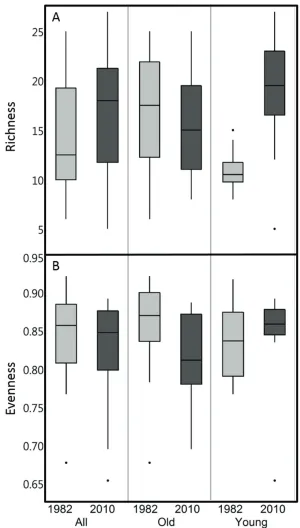
Pond-scale richness was significantly predicted by year (p = 0.0287) and the interac-tion between pond age and year (p = 0.0016, Table 1). Richness increased over time in young ponds and decreased in old ponds (Figure 1A). Richness was greater in old ponds than in young ponds in the 1982 sampling period, but that difference disappeared by the recent survey period. Pond-scale evenness did not change significantly over time, al-though the interaction term of the two-way mixed model ANOVA was marginally sig-nificant (Table 1, Figure 1B). Bray-Curtis similarity increased over time across all ponds but decreased in young ponds, resulting in significantly greater Bray-Curtis similarity amongst old ponds than amongst young ponds in the resurvey (t = -1.96, p < 0.05).
The final NMDS ordination of 22 sites in each time period, based on species im-portance values, had a stress of 12.984 after 399 iterations (Figure 2). Axes 1, 2 and 3 Table 1. Results of mixed-model ANOVAs explaining pond-scale total species richness and species even-ness between two time periods (1982, 2010/2011) and two categorical age groups of ponds (young, old). Pond was included as a random effect.
Response Source DF F Ratio P
Total richness Age 1 0.720 0.4062
Year 1 5.559 0.0287*
Age * Year 1 13.240 0.0016*
Species evenness Age 1 0.085 0.7734
Year 1 1.674 0.2104
Age * Year 1 3.122 0.0925†
Figure 2. NMDS ordination of 22 sites in two time periods (1982 and 2010/2011) based on species’ im-portance values. Grey symbols and arrows represent “old” ponds, black symbols and arrows indicate “young” ponds. Arrows pair the same site in two time periods, the arrowhead indicates the later (2010/2011) sample. Dashed lines indicate biplots of variables with r >0.300. Species centroids of invader and monodominant taxa are indicated. PHRAUS: Phragmites australis, SCHACU: Schoenoplectus acutus, LYTSAL: Lythrum salicaria, POLHYD: Persicaria hydropiperoides, CEPOCC: Cephalanthus occidentalis, TYPHA: Typha × glauca.
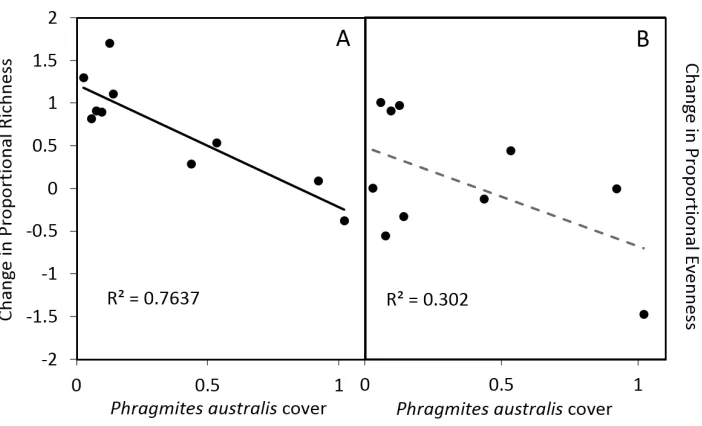
Figure 3. Relationship between Phragmites australis cover (as proportion of area sampled) and the pro-portional change in richness (A) and evenness (B) in young ponds. The solid line indicates a significant (p <0.05) relationship and dashed line indicates p <0.10.
Invaders reached their greatest cover in ponds that were altered by railroads or roads (Suppl. material 1: Figure S2). The best stepwise model explaining invader cover in 2010/2011 was pond age, fraction of shoreline altered and their interaction, with a final adjusted R-squared of 0.6789. Disturbance was positively related to invader cover and that relationship was steeper in young ponds than in old ponds. Invaders differed in the extent to which they dominated ponds; Lythrum salicaria and Persicaria
hydropiperoides covered less than 1% of pond area, native Cephalanthus covered ~2.5%
and Typha (hybrid) and Phragmites (exotic) covered around 10% each (Suppl.
mate-rial 1: Table S2). Phragmites was significantly more abundant in young ponds, whereas
Cephalanthus and Typha were significantly more abundant in old ponds.
Of the five species identified as ‘invaders’ in this system, only Phragmites australis
cover was related to changes in richness (Suppl. material 1: Table S3). The effect of
Phragmites cover was significantly different across age sections, where increasing cover
in young ponds, but not old ponds, depressed richness gains. No ponds with greater than 25% Phragmites cover gained species, regardless of pond age. Only the interac-tion between Typha cover and section was significant in predicting change in evenness (Suppl. material 1: Table S3).When young ponds were modelled separately,
increas-ing Phragmites cover was significantly negatively related to richness gains (p = 0.009,
Figure 4 . Conceptual figure illustrating three possible ways invasive species abundance could negatively correlate with changes in diversity. A At high abundance, invaders could cause declines in diversity over time. B At low invader abundance, diversity increases through natural processes, but at high abundance, invaders prevent arrival of new species. C A combined model, where richness increases in the absence of invaders and invader presence above a threshold causes declines in diversity over time. Note that these hypothesised relationships may not be linear but may include threshold processes.
“decreases” in diversity (Fig. 4A), but instead more consistent, respectively, with “damp-ening increases” and “mixed effects” (Figs 4B, C).
Native species in this system were more likely to decrease or have no change than in-crease in frequency (7 of 35 species were inin-creasers, while all three exotics were increas-ers, Suppl. material 1: Table S1). This difference amongst natives was significant when evaluated by a Fisher Exact Probability Test with the Freeman-Halton extension (PA = 0.014; PB = 0.014). A Fisher test revealed no association between growth form
(emer-gent or submersed/floating) and status of change over 28 years (PA = 0.907; PB = 0.907). The four monodominant taxa (Cephalanthus occidentalis, Schoenoplectus acutus,
Phragmites australis, Typha × glauca) altered their abiotic environments similarly. Each
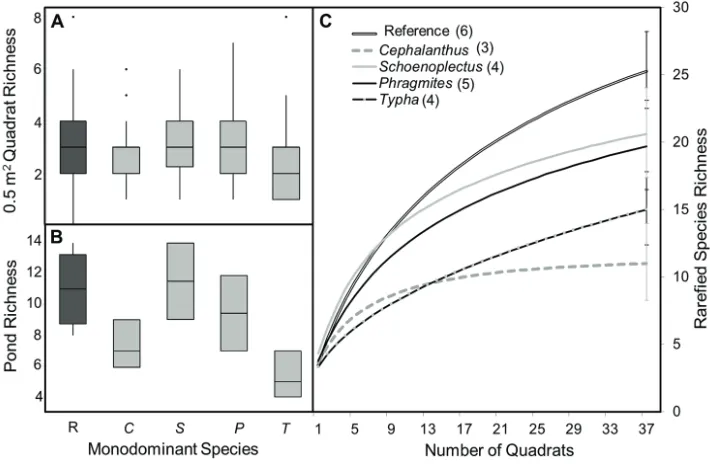
covered about 70% of the quadrat area, blocking 73–88% of the light reaching the water surface (Suppl. material 1: Table S4). Within quadrats, richness ranged from 2.3 to 3.3 species per 0.5-m2 quadrat across patch types (Figure 5A); native S. acutus and
reference patches supported the largest richness while T. × glauca (native-exotic hybrid) the lowest. These differences were not significant when evaluated using a mixed-model ANOVA. Richness aggregated across 12 quadrats was also greatest in S. acutus and ref-erence quadrats (Figure 5B). Diffref-erences in 12-quadrat aggregated richness were signif-icant as evaluated by a mixed-model ANOVA (F = 3.81, p = 0.035, model R2 = 0.58),
although pairwise differences were not significant. Total richness across 37 quadrats, as estimated by Mao-tau, was greatest in reference quadrats, followed in decreasing order
by S. acutus (native), P. australis (exotic), T. × glauca (native-exotic hybrid) and C.
oc-cidentalis (native) quadrats (Figure 5C). Quadrat-level evenness amongst 0.5-m2
Figure 5. Richness at three scales in patches dominated by Cephalanthus occidentalis (C), Schoenoplectus acutus (S), Typha × glauca (T), Phragmites australis (P) or reference areas (R). A 0.5 m2 quadrats B ag-gregated pond-level richness (12 quadrats) C Mao-Tau sampling-richness relationships, with the number of ponds each type was sampled in indicated in parentheses. Error bars indicate standard deviation at 37 quadrats. Patch type (monodominant species) was a significant predictor of pond-level richness as evalu-ated via a mixed-model ANOVA (F = 3.81, p = 0.035, model R2 = 0.58).
Discussion
This study provides insight into two major unresolved questions in invasion biology. Can species impacts be predicted based on their provenance? Do species invasions, regardless of provenance, decrease biodiversity at local scales? In this wetland complex, monodomi-nant emergent invaders have likely altered the trajectory of pond community change over 28 years but in ways that are not fully consistent with an expectation of biodiversity loss or of categorical variation by provenance. Invader cover is only minimally correlated with changes in evenness over time and, rather than decreasing richness, invader cover
(Phragmites australis) is correlated with suppression of richness gains in some ponds.
Further, in this study, invaders that entered the community recently (“exotic invaders”) or were present at low levels historically but increased following human disturbance (“native invaders”), do not show strong categorical differences in how they impact these communities with respect to changes in diversity at local, quadrat scales. However, exotic and native invaders altered temporal trajectories of richness in ponds over 28 years.
of a loss of species over time. Indeed, in our study, average net richness of species in ponds increased between surveys. To understand this apparent contradiction, it is useful to consider three qualitative ways that a negative correlation between invader cover and change in biodiversity could manifest in communities that have shown a net increase in richness between surveys (Fig. 4). A single biodiversity measure, such as richness, could show a loss of species associated with high cover (Fig. 4A), but alternatively, change in richness could be ‘dampened,’ such that the most invaded ponds do not increase in rich-ness, whereas the least invaded ponds do (Fig. 4B); finally, a mixed effect could occur, such that the least invaded ponds increase in diversity, whereas the most invaded de-crease (Fig. 4C). Our results, with respect to species richness, are largely consistent with diversity increases being dampened and not with loss or mixed effects, whereas change in species evenness is most consistent with mixed effects. One possible explanation for these patterns is that invasion of Phragmites has altered the successional trajectory of these young ponds; a proposition supported by the consistent movement of ponds to-wards Phragmites in an ordination of compositional change in young ponds (Fig. 2).
Regardless of the mechanism, however, these patterns raise an important challenge for ecological studies of long-term change – namely, determining the relative influence of invaders versus other changes in the environment in driving change in diversity. In the meta-analysis by Vellend et al. (2013), the effect of invasion (seven studies) was a decrease in diversity, whereas the effect of recent disturbance (and presumably the early stages of succession – thirteen studies) was an increase in local diversity. More studies, particu-larly those that explicitly consider both types of change simultaneously will be needed to understand this issue better. We believe that the qualitative alternatives for change in diversity presented here (Fig. 4) can provide a point of context for framing these studies. Better understanding this issue will likely become increasingly important in the context of ongoing changes in climate that are matched with new species invasions.
This lack of evidence for significant loss of diversity, in spite of pronounced inva-sions, not just in young ponds but across our broad set of ponds, might be due to several factors – in addition to the possibility of pond succession, described above. Many un-common taxa are still present in this wetland complex and no ‘un-common’ taxa were extir-pated from the ponds we surveyed during the 28-year period. It is possible that seasonal and between-year variations in water levels may provide opportunities for continued survival or regeneration of species with differing requirements, maintaining some degree of balance between invading emergent stands and diverse sedge meadows, as elsewhere in the Great Lakes (Wilcox et al. 2008). It is also possible that these ecosystems are sim-ply heterogeneous enough (within a given season or year) to support many taxa, in spite of the dominance of a few highly abundant species. Another possibility is that the deeper waters of some ponds might provide a refuge for enough species and that the impacts of these emergent shallow-water invaders are muted. Regardless of the mechanism, these alternative outcomes in changes of biodiversity measures should be relevant to consider whenever a system’s metric of interest (such as species richness) changes over time.
ponds, the exotic invader Phragmites australis had the greatest impact on change in richness over time. However, Phragmites australis has a pond-scale impact not because of unique within-patch processes, but because of the number and size of patches it had invaded. At the scale of individual habitat patches, there was no evidence that native and exotic monodominant species had categorically different effects on plant diversity. Although neither natives nor exotics showed categorical differences at this scale, species accumulation measures showed that both natives and exotic invaders were associated with reduced diversity relative to uninvaded reference areas. In other studies, both T. × glauca and P. australis are reported to decrease plant richness in
freshwater wetlands (Meyerson et al. 2000; Angeloni et al. 2006; Mitchell et al. 2011) and so might native monodominant species. Given the similar reductions in light we found, in combination with other work finding similar environmental changes between dense native and exotic emergents that form dense patches (Bunch et al. 2010), we can conclude that the habit of these species – forming dense patches that block light and crowd out other species at both the water and soil surface – is more important than whether those species are native or exotic. Other wetland studies have reached similar conclusions; species provenance is not a consistent indicator of wheth-er or not an individual species will be common and dominant. Instead, individual species traits are apparently better predictors of species dominance in these habitats (Houlahan and Findlay 2004; McGlynn 2009).
Historical disturbance in this wetland complex may have provided opportunities for invaders to colonise and spread, ultimately leading to different species accumulation trajectories in the recent past. As a consequence, it is difficult to disentangle the extent to which patterns observed are driven by the invaders or instead driven by disturbance, per se, which may have also benefited the invaders, i.e. it is difficult to know if the in-vaders are ‘drivers’ or ‘passengers’ of observed change. We do know that invader abun-dance in these ponds is positively correlated with shoreline alterations and hydrological disturbances; this is particularly true in younger ponds, where the large differences in invader cover are apparent between ponds with and without disturbed shorelines. Dif-ferences in the responses observed in younger and older ponds are consistent with the important differences these ponds have with respect to their natural history but might also reflect differences in susceptibility to the influences of invasion with successional stage. In both pond types, however, the initial creation of roads and railroads may have altered the environment in a manner known to be favourable for emergent wetland vegetation, including the three exotic invaders studied here (Galatowitsch et al. 1999). Railroad and road rights-of-way can also increase the movement of weedy propagules via human and other animal dispersers. It is possible that disturbances could also have directly affected the dynamics of non-invader species in this wetland complex. Altera-tions of hydrology leading to aquatic dispersal limitation or loss of populaAltera-tions and habitat during the initial disturbance could have affected trajectories of species change in these ponds (Trombulak and Frissell 2000; Houlahan et al. 2006).
on biodiversity in these wetlands, particularly since there can be time lags before some impacts are manifest (Jackson and Sax 2010). To preserve diversity in this wetland complex and others like it, managers may need to evaluate the necessity of mapping and controlling the spread of both native and exotic emergent invaders, regardless of provenance. This includes early detection efforts, which are critical when a known invader is approaching an uninvaded area. Whenever possible, managers should inte-grate knowledge of historical (pre-settlement) abundances in evaluating which species should be monitored rather than focusing exclusively on exotic invaders. Indeed, in some cases, the most impactful invaders may be native species (Carey et al. 2012).
Although our results cannot resolve the debates regarding the importance of spe-cies provenance or the impact of exotic spespe-cies on local diversity, they do provide an important point of reference for these debates and highlight the potential interactions between them. The recent meta-analysis by Vellend et al. (2013) found that sites that had been invaded showed a net decrease in richness over time, but this result was based on only seven studies. Our results provide an important counter-example, indicating that sites colonised by exotic species need not experience reductions in local rich-ness (as measured here at the pond scale). Here, instead, invader cover of Phragmites
australis was correlated with suppression of richness gains. This suggests that change
in local richness following invasions might ultimately be idiosyncratic - a conclusion supported by the more general results across all local sites studied by both Vellend et al. (2013) and Dornelas et al. (2014b). Likewise, although species’ provenance might be important in predicting impacts (Simberloff et al. 2011; Fridley and Sax 2014), it did not have consistent categorical predictive power in these communities. In this context, it is perhaps less surprising that exotic species in our study were not associated with decreases in species richness of ponds. Decreases in richness, following arrival of exotic species, might only be expected in cases when categorical differences between natives and exotics are large and apparent, but this can only be assessed when more studies directly comparing the impacts of native and exotic ‘invaders’ have been conducted. Future observational and experimental research is needed to continue to resolve these two debates.
Acknowledgements
References
Angeloni NL, Jankowski KJ, Tuchman NC, Kelly JJ (2006) Effects of an invasive cattail species (Typha× glauca) on sediment nitrogen and microbial community composition in a fresh-water wetland. Fems Microbiology Letters 263: 86–92. https://doi.org/10.1111/j.1574-6968.2006.00409.x
Beisel JN, Usseglio-Polatera P, Bachmann V, Moreteau JC (2003) A comparative analysis of evenness index sensitivity. International Review of Hydrobiology 88: 3–15. https://doi. org/10.1002/iroh.200390004
Bentz BJ, Regniere J, Fettig CJ, Hansen EM, Hayes JL, Hicke JA, Kelsey RG, Negron JF, Seybold SJ (2010) Climate change and bark beetles of the western United States and Canada: Direct and indirect effects. BioScience 60: 602–613. https://doi.org/10.1525/bio.2010.60.8.6 Briggs JM, Hoch GA, Johnson LC (2002) Assessing the rate, mechanisms, and consequences
of the conversion of tallgrass prairie to Juniperus virginiana forest. Ecosystems 5: 578–586. https://doi.org/10.1007/s10021-002-0187-4
Bunch AJ, Allen MS, Gwinn DC (2010) Spatial and temporal hypoxia dynamics in dense emergent macrophytes in a Florida lake. Wetlands 30: 429–435. https://doi.org/10.1007/ s13157-010-0051-9
Cardinale B (2014) Overlooked local biodiversity loss. Science 344: 1098–1098. https://doi. org/10.1126/science.344.6188.1098-a
Cardinale BJ, Gonzalez A, Allington GRH, Loreau M (2018) Is local biodiversity declining or not? A summary of the debate over analysis of species richness time trends. Biological Conservation 219: 175–183. https://doi.org/10.1016/j.biocon.2017.12.021
Carey MP, Sanderson BL, Barnas KA, Olden JD (2012) Native invaders – challenges for sci-ence, management, policy, and society. Frontiers in Ecology and the Environment 10: 373–381. https://doi.org/10.1890/110060
Castilla JC, Lagos NA, Cerda M (2004) Marine ecosystem engineering by the alien ascidian
Pyura praeputialis on a mid-intertidal rocky shore. Marine Ecology Progress Series 268: 119–130. https://doi.org/10.3354/meps268119
Chun YM, Choi YD (2009) Expansion of Phragmites australis (Cav.) Trin. ex Steud. (Common Reed) into Typha spp. (Cattail) wetlands in northwestern Indiana, USA. Journal of Plant Biology 52: 220–228. https://doi.org/10.1007/s12374-009-9024-z
Colwell RK (2009) EstimateS: Statistical estimation of species richness and shared species from samples. Version 8.2. http://purl.oclc.org/estimates.
Côté SD, Rooney TP, Tremblay J-P, Dussault C, Waller DM (2004) Ecological impacts of deer overabundance. Ann Rev Ecol Evol System 35: 113–147. https://doi.org/10.1146/ annurev.ecolsys.35.021103.105725
Davis M, Chew MK, Hobbs RJ, Lugo AE, Ewel JJ, Vermeij GJ, Brown JH, Rosenzweig ML, Gardener MR, Carroll SP, Thompson K, Pickett STA, Stromberg JC, Del Tredici P, Suding KN, Ehrenfeld JG, Grime JP, Mascaro J, Briggs JC (2011) Don’t judge species on their origins. Nature 474: 153–154. https://doi.org/10.1038/474153a
Dornelas M, Gotelli NJ, McGill B, Shimadzu H, Moyes F, Sievers C, Magurran AE (2014b) Assemblage time series reveal biodiversity change but not systematic loss. Science 344: 296–299. https://doi.org/10.1126/science.1248484
Elahi R, O’Connor MI, Byrnes JEK, Dunic J, Eriksson BK, Hensel MJS, Kearns PJ (2015) Recent trends in local-scale marine biodiversity reflect community structure and human impacts. Current Biology 25: 1938–1943. https://doi.org/10.1016/j.cub.2015.05.030 Freeland J, Ciotir C, Kirk H (2013) Regional differences in the abundance of native,
intro-duced, and hybrid Typha spp. in northeastern North America influence wetland invasions. Biological Invasions 15: 2651–2665. https://doi.org/10.1007/s10530-013-0481-4 Fridley JD, Sax DF (2014) The imbalance of nature: revisiting a Darwinian framework for
inva-sion biology. Global Ecology and Biogeography 23: 1157–1166. https://doi.org/10.1111/ geb.12221
Futyma RP (1985) Paleobotanical studies at Indiana Dunes National Lakeshore. Report to the National Park Service. Porter, Indiana, USA.
Galatowitsch SM, Anderson NO, Ascher PD (1999) Invasiveness in wetland plants in temper-ate North America. Wetlands 19: 733–755. https://doi.org/10.1007/BF03161781 Heard MJ, Sax DF, Bruno JF (2012) Dominance of non-native species increases over time in
a historically invaded strandline community. Diversity and Distributions 18: 1232–1242. https://doi.org/10.1111/j.1472-4642.2012.00918.x
Hector A, Schmid B, Beierkuhnlein C, Caldeira MC, Diemer M, Dimitrakopoulos PG, Finn JA, Freitas H, Giller PS, Good J, Harris R, Hogberg P, Huss-Danell K, Joshi J, Jumpponen A, Korner C, Leadley PW, Loreau M, Minns A, Mulder CPH, O’Donovan G, Otway SJ, Pereira JS, Prinz A, Read DJ, Scherer-Lorenzen M, Schulze ED, Siamantziouras ASD, Spehn EM, Terry AC, Troumbis AY, Woodward FI, Yachi S, Lawton JH (1999) Plant diversity and productivity experiments in European grasslands. Science 286: 1123–1127. https://doi.org/10.1126/science.286.5442.1123
Houlahan JE, Findlay CS (2004) Effect of invasive plant species on temperate wetland plant diversity. Conservation Biology 18: 1132–1138. https://doi.org/10.1111/j.1523-1739.2004.00391.x
Houlahan JE, Keddy PA, Makkay K, Findlay CS (2006) The effects of adjacent land use on wetland species richness and community composition. Wetlands 26: 79–96. https://doi. org/10.1672/0277-5212(2006)26[79:TEOALU]2.0.CO;2
Jackson ST, Futyma RP, Wilcox DA (1988) A paleoecological test of a classical hydrosere in the Lake Michigan dunes. Ecology 69: 928–936. https://doi.org/10.2307/1941248
Jackson ST, Sax DF (2010) Balancing biodiversity in a changing environment: extinction debt, immigration credit and species turnover. Trends in Ecology & Evolution 25: 153–160. https://doi.org/10.1016/j.tree.2009.10.001
Keane RM, Crawley MJ (2002) Exotic plant invasions and the enemy release hypothesis. Trends in Ecology & Evolution 17: 164–170. https://doi.org/10.1016/S0169-5347(02)02499-0 MacDougall AS, Turkington R (2005) Are invasive species the drivers or passengers of change
in degraded ecosystems? Ecology 86: 42–55. https://doi.org/10.1890/04-0669
McGill BJ, Dornelas M, Gotelli NJ, Magurran AE (2015) Fifteen forms of biodiversity trend in the Anthropocene. Trends in Ecology & Evolution 30: 104–113. https://doi.org/10.1016/j. tree.2014.11.006
McGlynn CA (2009) Native and invasive plant interactions in wetlands and the minimal role of invasiveness. Biological Invasions 11: 1929–1939. https://doi.org/10.1007/s10530-008-9370-7
Meyerson LA, Saltonstall K, Windham L, Kiviat E, Findlay S (2000) A comparison of Phrag-mites australis in freshwater and brackish marsh environments in North America. Wetlands Ecology and Management 8: 89–103. https://doi.org/10.1023/A:1008432200133 Mitchell ME, Lishawa SC, Geddes P, Larkin DJ, Treering D, Tuchman NC (2011)
Time-dependent impacts of cattail invasion in a great lakes coastal wetland complex. Wetlands 31: 1143–1149. https://doi.org/10.1007/s13157-011-0225-0
Paolucci EM, MacIsaac HJ, Ricciardi A (2013) Origin matters: alien consumers inflict greater damage on prey populations than do native consumers. Diversity and Distributions 19: 988–995. https://doi.org/10.1111/ddi.12073
Pederson DC, Peteet D, Kurdyla D, Guilderson T (2005) Medieval warming, little ice age, and Eu-ropean impact on the environment during the last millennium in the lower Hudson Valley, New York, USA. Quaternary Research 63: 238–249. https://doi.org/10.1016/j.yqres.2005.01.001 Pysek P, Blackburn TM, Garcia-Berthou E, Perglova I, Rabitsch W (2017) Displacement and
local extinction of native and endemic species. Impact of biological invasion on ecosystem services. Springer, pp 157–175. https://doi.org/10.1007/978-3-319-45121-3_10
Ricciardi A (2004) Assessing species invasions as a cause of extinction. Trends in Ecology & Evolution 19: 619–619. https://doi.org/10.1016/j.tree.2004.09.021
Saltonstall K (2002) Cryptic invasion by a non-native genotype of the common reed, Phrag-mites australis, into North America. Proceedings of the National Academy of Sciences of the United States of America 99: 2445–2449. https://doi.org/10.1073/pnas.032477999 Sax DF, Gaines SD (2003) Species diversity: from global decreases to local increases. Trends
in Ecology & Evolution 18: 561–566. https://doi.org/10.1016/S0169-5347(03)00224-6 Sax DF, Gaines SD (2008) Species invasions and extinction: The future of native
biodiver-sity on islands. Proceedings of the National Academy of Sciences of the United States of America 105: 11490–11497. https://doi.org/10.1073/pnas.0802290105
Sax DF, Kinlan BP, Smith KF (2005) A conceptual framework for comparing species assem-blages in native and exotic habitats. Oikos 108: 457–464. https://doi.org/10.1111/j.0030-1299.2005.13402.x
Hewitt C, Hierro JL, Hulme P, Hutchings P, Jarosik V, Jeschke JM, Johnson C, Johnson L, Johnston EL, Jones CG, Keller R, King CM, Knols BGJ, Kollmann J, Kompas T, Kotanen PM, Kowarik I, Kuhn I, Kumschick S, Leung B, Liebhold A, MacIsaac H, Mack R, Mc-Cullough DG, McDonald R, Merritt DM, Meyerson L, Minchin D, Mooney HA, Mori-sette JT, Moyle P, Heinz MS, Murray BR, Nehring S, Nelson W, Nentwig W, Novak SJ, Occhipinti A, Ojaveer H, Osborne B, Ostfeld RS, Parker J, Pederson J, Pergl J, Phillips ML, Pysek P, Rejmanek M, Ricciardi A, Ricotta C, Richardson D, Rilov G, Ritchie E, Robertson PA, Roman J, Ruiz G, Schaefer H, Schaffelke B, Schierenbeck KA, Schmitz DC, Schwindt E, Seeb J, Smith LD, Smith GF, Stohlgren T, Strayer DL, Strong D, Sutherland WJ, Ther-riault T, Thuiller W, Torchin M, van der Putten WH, Vila M, Von Holle B, Wallentinus I, Wardle D, Williamson M, Wilson J, Winter M, Wolfe LM, Wright J, Wonham M, Zabin C, Signatories (2011) Non-natives: 141 scientists object. Nature 475: 36–36. https://doi. org/10.1038/475036a
Simberloff D, Martin JL, Genovesi P, Maris V, Wardle DA, Aronson J, Courchamp F, Galil B, Garcia-Berthou E, Pascal M, Pysek P, Sousa R, Tabacchi E, Vila M (2013) Impacts of biological invasions: what’s what and the way forward. Trends in Ecology & Evolution 28: 58–66. https://doi.org/10.1016/j.tree.2012.07.013
Sokal RR, Rohlf FJ (1995) Biometry. W. H. Freeman and Company, New York, 887 pp. Tonkovich GS (2003) A survey of the emergent vascular plan species in wetlands of the Miller
unit of the Indiana Dunes National Lakeshore, 2002–2003. Report to the National Park Service, Porter, IN.
Toussaint A, Charpin N, Beauchard O, Grenouillet G, Oberdorff T, Tedesco PA, Brosse S, Villéger S (2018 )Non-native species led to marked shifts in functional diversity of the world freshwater fish faunas. Ecology Letters 21: 1649–1659. https://doi.org/10.1111/ele.13141 Travis SE, Marburger JE, Windels S, Kubatova B (2010) Hybridization dynamics of invasive cat-tail (Typhaceae) stands in the Western Great Lakes Region of North America: a molecular analysis. Journal of Ecology 98: 7–16. https://doi.org/10.1111/j.1365-2745.2009.01596.x Trombulak SC, Frissell CA (2000) Review of ecological effects of roads on terrestrial and
aquatic communities. Conservation Biology 14: 18–30. https://doi.org/10.1046/j.1523-1739.2000.99084.x
Vellend M, Baeten L, Myers-Smith IH, Elmendorf SC, Beausejour R, Brown CD, De Frenne P, Verheyen K, Wipf S (2013) Global meta-analysis reveals no net change in local-scale plant biodiversity over time. Proceedings of the National Academy of Sciences of the United States of America 110: 19456–19459. https://doi.org/10.1073/pnas.1312779110
Vellend M, Dornelas M, Baeten L, Beausejour R, Brown CD, De Frenne P, Elmendorf SC, Gotelli NJ, Moyes F, Myers-Smith IH, Magurran AE, McGill BJ, Shimadzu H, Sievers C (2017) Estimates of local biodiversity change over time stand up to scrutiny. Ecology 98: 583–590. https://doi.org/10.1002/ecy.1660
Wilcox DA, Kowalski KP, Hoare HL, Carlson ML, Morgan HN (2008) Cattail invasion of sedge/grass meadows in Lake Ontario: Photointerpretation analysis of sixteen wetlands over five decades. Journal of Great Lakes Research 34: 301–323. https://doi.org/10.3394/0380-1330(2008)34[301:CIOGMI]2.0.CO;2
Supplementary material 1
Supplementary tables and figures
Authors: Kathryn L. Amatangelo, Lee Stevens, Douglas A. Wilcox, Stephen T. Jackson, Dov F. Sax
Data type: species data
Copyright notice: This dataset is made available under the Open Database License
(http://opendatacommons.org/licenses/odbl/1.0/). The Open Database License
(ODbL) is a license agreement intended to allow users to freely share, modify, and use this Dataset while maintaining this same freedom for others, provided that the original source and author(s) are credited.