A new LED lamp for the collection of nocturnal Lepidoptera
and a spectral comparison of light-trapping lamps
G
unnarB
rehm11 Institut für Spezielle Zoologie und Evolutionsbiologie mit Phyletischem Museum, University of Jena, Vor dem Neutor 1, 07743 Jena, Germany. email: [email protected]
http://zoobank.org/2DB5B76D-CC0A-4393-8830-017E2B0F9676
Received 20 January 2017; accepted 16 February 2017; published: 24 April 2017 Subject Editor: Jadranka Rota.
Abstract. Most nocturnal Lepidoptera can be attracted to artificial light sources, particularly to those that emit a high proportion of ultraviolet radiation. Here, I describe a newly developed LED lamp set for the use in the field that is lightweight, handy, robust, and energy efficient. The emitted electromagnetic spectrum corresponds to the peak sensitivity in most Lepidoptera eye receptors (ultraviolet, blue and green). Power LEDs with peaks at 368 nm (ultraviolet), 450 nm (blue), 530 nm (green), and 550 nm (cool white) are used. I compared the irradiance (Ee) of many commonly used light-trapping lamps at a distance of 50 cm. Between wavelengths of 300 and 1000 nm, irradiance from the new lamp was 1.43 W m-2. The new lamp proved to be
the most energy efficient, and it emitted more radiation in the range between 300 and 400 nm than any other lamp tested. Cold cathodes are the second most energy-efficient lamps. Irradiation from fluorescent actinic tubes is higher than from fluorescent blacklight-blue tubes. High-wattage incandescent lamps and self-ballast-ed mercury vapour lamps have highest irradiance, but they mainly emit in the long wave spectrum. The use of gauze and sheets decreases the proportion of UV radiation and increases the share of blue light, probably due to optical brighteners. Compared with sunlight, UV irradiance is low at a distance of 50 cm from the lamp, but (safety) glasses as well as keeping sufficient distance from the lamp are recommended. In field tests, the new LED lamp attracted large numbers of Lepidoptera in both the Italian Alps and in the Peruvian Andes.
Introduction
implications of anthropogenically driven selection on flight behaviour in urban areas (Altermatt and Ebert 2016).
A wide range of lamp and trap types for light-trapping has been used in entomological research. Although standardisation is desirable, the availability of new designs and lamps has continually led to changes in the lamp set-ups used. Depending on the requirements of research, it is (a) either more important to stress continuity and use a standard method that has been used in previous studies, or it is (b) more important to apply the most efficient and best available technology. A good example of (a) are Rothamsted traps (Williams 1948) that are operated with strong incandescent lamps with a tungsten filament. The use of this ‘old-fashioned’ technology can be justified in long-term moni-toring programmes that are intended to be continued without a substantial methodological change (Southwood et al. 2003). Established methods such as the use of incandescent or high-pressure mercury vapour (MV) self-ballasted lamps also offer the advantage of long-term experience and published comparative studies on their performance (e.g., Intachat and Woiwod 1999).
The use of established light trapping methods does, however, have some disadvantages. For example, incandescent lamps have largely been abandoned in Europe because they are primarily producing long-wave radiation including a large proportion of invisible infrared radiation (Fig. 5a) that contributes relatively little to attracting insects (e.g. Cowan and Gries 2009), while the lifespan of such lamps is rather limited (Infusino et al. 2017). MV lamps emit a more favourable spectrum of radiation (Fig. 5a), but the longevity of the commonly employed self-ballasted type is similarly limited as incandescent lamps (Infusino et al. 2017). Moreover, high pressure MV lamps are being phased out due to their content of toxic mercury, which is banned by new legislations in many countries. Both types of lamps require high voltage, which means that during field work heavy and bulky generators are required. Despite containing mercury, fluorescent tubes of all types are still widely used (e.g. ‘energy-saving lamps’). For insect collectors, particularly popular types of fluorescent tubes emit large proportions of UV radiation, including actinic / blacklight (BL) tubes as well as blacklight-blue (BLB) tubes – the latter with a dark-blue filter coating that absorbs most light. More recently, cold cathodes have become available through their use as backlighting of monitors and as decorative illumination in computer cases. These vary in their wavelengths and one can therefore choose those that include the UV range. However, little seems to be known about their performance in light-trapping so far. The use of LEDs is now increasingly common in light-trapping (Green et al. 2012; Price and Baker 2016; Infusino et al. 2017). LEDs have also been employed in experimental studies because a wide range, with different radiation peaks, is available (e.g. Cowan and Gries 2009; Kadlec et al. 2016).
Although lamp emission data are sometimes provided by the manufacturers, standardized com-parisons of the emission or irradiation of different lamps are rare in the entomological literature. A comparison of six light sources with an emphasis on street lighting was given by van Grunsven et al. (2016). Papers can also easily be overlooked if published in journals or in languages with limited readership, as exemplified by a paper by Steidel and Plontke (2008) that graphically shows the qualitative emission spectra of various lamps.
than fluorescent BL and BLB tubes used in many previous field studies (e.g. Brehm and Axmacher 2005), and to provide a higher output than in previously described LED-based designs (Green et al. 2012; Price and Baker 2016; White et al. 2016; Infusino et al. 2017).
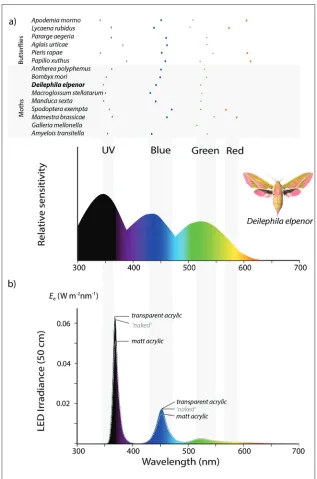
The spectral composition of the lamp is orientated towards the peak sensitivity of lepidopteran eye receptors as suggested e.g. by Steidel and Plontke (2008), Mobbs (2016), and Price and Baker (2016). The available data on lepidopteran eye receptor sensitivity is still limited but includes a broad range of taxa (Briscoe and Chittka 2001, Fig 1a). These data suggest that three types of receptors are commonly found in moths, exemplified in the hawkmoth Deilephila elpenor (L.) (Johnsen et al. 2006): one in the ultraviolet, one in the blue, and one in the green range (Fig. 1a).
Synanthedon myopaeformis (Borkhausen) (Sesiidae) is sensitive both in the ultraviolet and green range (Eby et al. 2013). Further receptors can be present and are possibly even widespread, such as red receptors known from the noctuids Spodoptera exempta (Walker) and Mamestra brassicae
(L.) (Fig. 1a). As an extreme case, photoreceptors of 15 distinct spectral sensitivities were found in the butterfly species Graphium sarpedon (L.) (Papilionidae) (Chen et al. 2016). Given the large empirical success of lamps with a high proportion of UV radiation (including MV lamps, fluores-cent tubes, cold cathodes, and UV LEDs), the emission of this short wave radiation was considered
to be particularly important.
The emission of the new lamp is described in detail and quantitatively compared with a range of lamps commonly used by entomologists. Measurements include transparent clear and matt pro-tective acrylic glasses, sheets, and gauze. Lamp emissions at different distances are compared with sunlight and the roles of spectacles and sun spectacles as eye protection are discussed briefly. Finally, the new LED lamp was tested under field conditions in more than 50 sampling events in the Italian Alps and Peruvian Andes, to confirm that nocturnal Lepidoptera were indeed attracted to the lamp and opening perspectives for further research.
Material and methods
Lamp design0° UV
90° UV 270° UV
180° UV 0° White
90° Blue 270° Blue
180° Green
b) cross sections
a) side view
Air
4 UV LEDs
Boost constant current source Fan
137 mm
60 mm
1 Green LED
1 Cool White LED on star circuit boards 2 Blue LEDs
Gauze
Gauze
Air
Plexiglas XT cylinder Heat sink
PVC cap
PVC bottom
Plexiglas XT roof
}
Figure 2. Design of the new LED lamp (scale 1:2). A total of 8 Power LEDs is arranged at two levels (4 UV, 2 blue, 1 green, 1 cool white).
prevents small insects and dirt from entering, and a transparent acrylic (Plexiglas® XT) roof pro-tects the lamp from rain. The protective cylinder around the LEDs also consists of Plexiglas XT characterized by high transmission rates including for UV radiation (Fig. 1b). Alternatively, a matt Plexiglas cylinder can be used (Fig. 1b, Table 1). The bottom and top of the lamp are made of PVC. Inside is a cooling aggregate (heat sink) and outside a Plexiglas cylinder. In future models, PVC will be replaced by anodized aluminium. LEDs are connected in series to a Boost LED constant current source (pcb components Led Senser V2 Rev.2) that allows an input current in the given design of ca. 5–12 V DC. After performance tests with different currents, the output current was set to 350 mA.
Spectral measurements
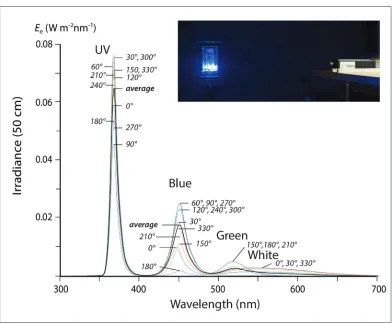
Figure 3. The irradiance of the new lamp was measured at a distance of 50 cm around its circumference at 12 points giving 30° between each. Average value: black line.
a receiving surface, the terms “radiance” and “emission” refer to the radiant source. Irradiance was calculated in total as well as separately for the spectral bands 300–400 nm, 401–650 nm, and 651–1000 nm. Because of the unequal emission patterns of the new LED lamp, irradiance was measured 12 times, at 30° angular intervals around the lamp, and the average was calculated for each wavelength (Fig. 3). Apart from the LED lamp, a number of lamps commonly used in light-trapping were also assessed (Table 1, Appendix 1). In cases where more than one lamp was measured, modest variation in the data was observed, as expected for standard industry products. For a comparison of UV irradiance of lamps and sunlight, irradiance from sunlight was measured on a sunny but hazy day on 17.iii.2016 at 10:50 in Jena, Germany (50.9° N). In addition, lamp and sunlight were filtered with regular clear glasses (Fielmann: Essilur, allyl diglycol carbonate (= CR 39) with additives, super-nonreflecting) and sun glasses (Fielmann: Rupp and Hubrach, allyl diglycol carbonate with additives, polarized, 85% grey).
watt-Table 1. Irradiation of selected lamps and LEDs at wavelengths between 300 and 1000 nm, measured at a distance of 50 cm. A full list is provided in Appendix 1. Italics: Measurement of lamp within a gauze tower. Grey cells: wavelength band with highest irradiance. *Unlike other lamps in the test, the GemLight emits only into a single direction (max. 180°). ** Wattage and efficiency of the new LED lamp depend on the input voltage; Values are provided for 12 V and 5 V DC input, respectively.
Lamp 300–400 nm 401–650 nm 651–1000 nm 300–1000 nm Effective wattage (W)
Irradiation/ wattage (efficiency) Low pressure mercury vapour
350 nm actinic tube in acrylic glass 0.44 0.04 0.01 0.49 8 0.06
in gauze tower 0.25 0.10 0.01 0.36 8
--350 BLB in acrylic glass 0.14 0.01 0.01 0.15 8 0.02
in gauze tower 0.08 0.02 0.01 0.11 8
--368 nm actinic tube
in acrylic glass 0.45 0.04 0.01 0.50 8 0.06
in gauze tower 0.26 0.12 0.01 0.39 8
--8 W BLB in acrylic glass 0.04 0.00 0.01 0.05 4 0.01
in gauze tower 0.02 0.01 0.01 0.04 4
--Revoltec cold cathodes (twin sets)
Cold cathode UV 0.32 0.01 0.00 0.33 3.9 0.09
Cold cathode blue 0.00 0.48 0.01 0.49 3.9 0.13
Cold cathode green 0.01 0.23 0.00 0.24 6.8 0.04
Tungsten filament lamps
160 W mercury vapour 0.57 3.316 7.09 10.98 190 0.06
in gauze tower 0.33 3.010 6.45 9.79 190
--200 W incandescent 0.04 1.54 8.36 9.94 180 0.06
LED lamps
GemLight* 0.10 0.02 0.00 0.13 --
--400 nm Infusino et al. (2017) 0.13 0.10 0.00 0.23 8 0.03
New LED lamp**
(350 mA) in Plexiglas cylinder 0.77 0.64 0.01 1.43 10.4 / 13.4 0.14 / 0.11
without Plexiglas cylinder 0.77 0.66 0.01 1.44 10.4 / 13.4 0.14 / 0.11
with matt Plexiglas cylinder 0.64 0.59 0.01 1.24 10.4 / 13.4 0.11 / 0.09
with sheet in background 0.76 0.94 0.02 1.72 10.4 / 13.4
--in gauze tower 0.34 0.71 0.01 1.06 10.4 / 13.4
--age at 50 cm between 300 and 1000 nm expresses the energy efficiency of the lamps. Temperature of LEDs was measured with an Omega hypodermic needle probe connected to an Omega HH21
thermometer.
Field work performance
valley (Cusco province, Peru) for more than 50 sampling events (23.viii.–4.ix.2016, 12.8868° S, 71.4012° W–13.2003° S, 71.6172° W, 520–3500 m). Detailed analyses of this sampling campaign will be published in due course, but selected photographs illustrate the attraction of Lepidoptera
to the lamp.
Results
Features of the new LED lamp
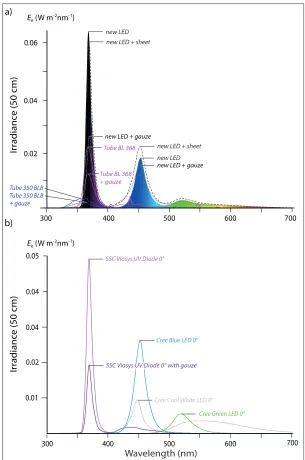
Pronounced irradiation peaks from the new LED lamp occur at 368 nm (UV), at 450 nm (blue), and at 520 nm (green) (Figs 1, 3–6). The mean irradiance of wavelengths between 300 and 1000 nm at a distance of 50 cm is 1.43 W m-2. The irradiance without the protective Plexiglas cylinder is only minimally higher (1.44 W m-2, Fig 1b), and the irradiance with a matt Plexiglas cylinder is ca. 13% lower (1.24 W m-2, Fig. 1b). As expected, UV irradiation is relatively constant at all angles around the lamp, whereas more pronounced spatial peaks occurred with the blue, green, and white LEDs (Fig. 3). A white sheet in the background behind the lamp increases irradiance to 1.72 W
m-2 (Fig. 4a). However, in this case irradiance is a theoretical value because a sheet can only be placed on one side of the lamp, and irradiance on the reverse of the sheet will be far lower. A gauze tower around the lamp led to a decrease of irradiance to 1.07 W m-2 (Fig. 4a), but in-depth com-parisons are hindered by increased stray light–the whole gauze tower appears illuminated (Fig. 7). Remarkable in both cases is a partial shift from UV to blue irradiation. This can also be observed when measurements with and without a surrounding gauze tower are compared for a single UV LED (Fig. 4b).
When operated with a 12 V battery, the wattage of the lamp is ca. 10.4 W. When operated with a 5 V (powerbank) battery, the wattage is ca. 13.4 W. Without an axial fan, the LEDs reach (at room temperature) temperatures of between 43 and 53° C. With an operating fan, the temperature range is 30–33° C with a 12 V battery, and 33–39° C with a 5 V battery.
Comparison of lamps
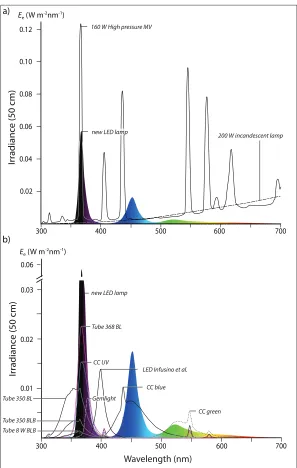
Both the self-ballasted MV and the incandescent lamp assessed surpass by far the irradiance (full range 300–1000 nm) of the new LED lamp (Fig. 5a, Table 1). However, ca. two thirds of their respective irradiation is in the long wave spectrum (> 650 nm), much of it infrared. Remarkably, irradiation from the new LED lamp in the near-UV range between 300 and 400 nm is higher (Table 1)–despite having more than tenfold lower wattage. The MV lamp shows various narrow radiation peaks reflecting the characteristic spectral lines of mercury vapour and an increasing proportion of long wave radiation due to the tungsten filament. The incandescent lamp produces a continuously increasing long wave radiation spectrum but practically no UV radiation.
None of the other lamps that were compared surpass the irradiation from the new LED lamp, neither in total nor in a single wavelength band (Fig. 5b, Table 1, Appendix 1). All tested fluores-cent low-pressure mercury tubes (BL / BLB) either show peaks around 350 or 368 nm (Fig. 5b). The highest total irradiation is from 368 nm and 350 nm actinic BL tubes (0.50 and 0.49 W
SSC Viosys UV Diode 0°
300 400 500 600
Ir
radianc
e (50 cm)
0.04
0.04 0.05
Ee (W m-2nm-1)
700 0.02
0.01
Cree Blue LED 0°
Cree Green LED 0°
SSC Viosys UV Diode 0° with gauze
Cree Cool White LED 0°
300 400 500 600 700
Ir
radianc
e (50 cm)
0.04
0.02
Wavelength (nm)
0.06
Ee (W m-2nm-1)
new LED + sheet
new LED
new LED + gauze
new LED
new LED + sheet Tube BL 368
Tube BL 368 + gauze
Tube 350 BLB Tube 350 BLB + gauze
new LED + gauze a)
b)
300 400 500 600
Ir
radianc
e (50 cm)
300 400 500 600
Ir
radianc
e (50 cm) 0.02
0.01
Wavelength (nm) 0.03
700 0.06
0.12
0.10
0.08
0.06
0.04
0.02
CC green CC UV
Tube 350 BL
Tube 368 BL
CC blue LED Infusino et al. 160 W High pressure MV
Ee (W m-2nm-1)
new LED lamp
Ee (W m-2nm-1)
new LED lamp
200 W incandescent lamp a)
b)
Gemlight
Tube 8 W BLB Tube 350 BLB
700
300 400 500 600 700
Ir
radianc
e
Wavelength (nm)
Ee (W m-2nm-1)
sunlight
sunlight with spectacles glass
sunlight with sunglasses
800 0.4
0.8
0.6
0.2
new LED lamp 50 cm new LED lamp 25 cm
new LED lamp 12.5 cm
Figure 6. Irradiance from sunlight (in colour; 50.9° N, on a sunny, hazy day at 10:50h in March 2016), irradi-ance from sunlight with clear synthetic glasses (solid line), irradiirradi-ance from sunlight with synthetic sunglasses (dashed line), and irradiance from the new LED lamp at distances of 50 cm (see all other Figs), 25 cm, and 12.5 cm. The two spectacle lens types almost completely absorb UV radiation.
Sunlight comparison and UV protection
Fig. 6 shows a comparison of the irradiance on a sunny March day in Jena with the irradiance of the new LED lamp at different distances from the measuring device. The UV irradiation from the new lamp at a distance of 50 cm (the same as in all standardized measurements) is small compared with the irradiance from the sun. However, irradiance from the LED lamp becomes higher at short-er distances. Normal spectacle glasses (allyl diglycol carbonate with additives) almost completely filter away UV radiation but allow almost full transmission of radiation > 400 nm. Sunglasses (allyl diglycol carbonate with additives) again filter UV radiation and also a large proportion of longer wavelengths.
First results from field work
a)
b)
c)
d)
house wall in South Tyrol (Fig. 7a), in front of a white sheet in Peru (Fig. 7b) or in a gauze tower in Peru (Figs 7c,d). Most individual moths along the rain forest elevational gradient in Peru were collected at low and medium elevations. The “busiest” night in Peru occurred two days after new moon (3.ix.2016) at 1940 m (Figure 7c). Geometrid moths were the most abundant moth family at this elevation, and I estimate that at least 1000 individuals were attracted within less than three hours after dusk. Only one night later, far fewer specimens (ca. 100 individuals of Geometridae) were collected in a partly clear night at 2890 m (Fig. 7d).
Discussion
The new LED lamp was constructed with the aims of being lightweight, handy, robust, and en-ergy efficient, and these aims were clearly fulfilled. First field tests have demonstrated that the lamp is very attractive to nocturnal Lepidoptera (Fig. 7), and a detailed analysis of the samples will be published in due course. The measurements carried out concentrate on irradiance rather than on total emission of the lamp, first because the required measuring device, a two-meter diameter Ulbricht sphere, was not available in Jena. Second, the chosen approach allowed com-parison of irradiance from lamps in combination with gauze and sheets, as well as with incoming sunlight. Generally, comparisons between different lamps are never simple because lamps differ in their design, in their dimensions, and in the way radiation is emitted. All of these factors could possibly influence moth behaviour, and therefore measurement results should be regarded as an approximation of potential moth attractiveness, to be supplemented by field studies and physio-logical measurements.
The age and the cumulative operating hours of the lamps could have an impact on their perfor-mance, but it was beyond the scope of this paper to explore this effect in detail. For example, the emission of fluorescent tubes drops with age to ca. 80% in new-generation lamps (Sylvania BL 368 nm) and to ca. 50% in old-generation tubes (e.g. Sylvania BL 350 nm) (Havells-Sylvania 2012). Decreases are also expected to occur in LEDs, accelerated by high temperatures and high currents. For this reason, LEDs in the lamp are not being operated at the maximum possible current (700 mA) but only at 350 mA, aided by an efficient cooling system. Ageing of acrylic glass and other materials possibly also influences the radiation flux.
Clearly, a cross calibration study with other lamps is desirable. Such comparative studies have regularly shown that even lamps with fundamentally different light spectra attract similar moth as-semblages. For example, Geometroidea samples attracted to an incandescent and a MV lamp were surprisingly similar (Intachat and Woiwod 1999; Infusino et al. 2017; Jonason et al. 2014). On the other hand, noctuid moths were more attracted to short wave radiation than geometrid moths (Somers-Yeates et al. 2014), so certain differences in samples obtained with different methods must be expected.
An unexpected result was the appearance of a blue peak at ca. 440 nm when ‘light tower’ gauze and a white sheet were used in combination with various lamps. In all cases, a part of the UV ra-diation is absorbed and re-emitted by the textile as blue light, caused by commonly used optical brighteners in textile production and in washing powders. This means that supposedly ‘pure’ UV sources such as BLB tubes and UV LEDs combined with a textile also emit a certain amount of blue light. This lowers energy efficiency to some extent, but the additional blue light possibly
The lamp itself has a weight of less than 500 g, and it can be operated for five to six hours with a standard powerbank, e.g. an Easy Acc battery (5 V, 26 Ah, 400 g). Since powerbank batteries are a mass product on the market used for mobile phones etc., their prices are reasonable, they can easily be transported in carry-on baggage and recharged with mobile solar panels in remote areas. The total equipment, including the lamp, powerbank and charging device (220 V AC to 5 V DC USB charger) weighs less than 1 kg. In comparison, any equipment operated with generators is far heavier because a generator alone weighs ca. 13 kg. Equipment operated with 12 V is usually con-nected to (heavy) lead batteries. For example, field work in Ecuador and Costa Rica (Brehm and Axmacher 2005; Brehm 2007) was undertaken with a 15 W actinic BL tube and a 15 W BLB tube, operated with a lead battery (12 V, 7 Ah, 2 kg). Together with the charging device, the equipment weighed ca. 4 kg. The size of the new LED lamp (6 x 14 cm) is also small, so that it easily fits into travel bags and backpacks. The lamp has furthermore proven to be robust in the field. In one case, the axial fan broke when a gauze tower was blown down in a thunderstorm. However, the lamp remained fully functional without the fan, but since a working fan reduces the temperature of the LEDs (by ca. 10° C), which leads to a longer lifetime of the diodes, it is recommended that a bro-ken fan is replaced when it is practical to do so (it takes only a few minutes).
In terms of energy efficiency, the new LED lamp outperformed every other lamp that was tested (Table 1, Appendix 1), and total irradiance between 300 and 400 nm was greater than from any other tested lamp, even including strong, self-ballasted MV bulbs. If efficiency is to be maxi-mized, the use of 12 V batteries is recommended but from a weight-optimising point of view, 5 V powerbank batteries are the better choice. The second most energy-efficient tested lamps are cold cathodes with an input voltage of 12 V (Table 1). Their use nonetheless requires heavier batteries or a step-up converter that lowers energy efficiency. Cold cathodes (especially blue ones) are very lightweight and appear to have the best price / performance ratio.
The new LED lamp emits the desired spectrum of different wavelengths (UV, blue, and green). Half of the LEDs are UV diodes because UV is particularly attractive to moths. However, the ad-ditional diodes are expected to contribute further to the attractiveness of the lamp, and to stimulate eye receptors sensitive to longer waves. When MV lamps are compared with BL and BLB tubes, MV lamps usually attract more moth species and individuals (e.g., Jonason et al. 2014; Tikoca et al. 2016). A possible reason is that MV lamps emit not only more UV radiation, but also a much broader spectrum, than fluorescent tubes. A major advantage of LEDs is that a light mix can ex-perimentally be assembled from a wide range of available diodes (Cowan and Gries 2009; Kadlec et al. 2016). Future studies could assess whether a maximisation of UV radiation on the one hand versus a mixture of wavelengths on the other hand, results in a higher number of attracted moth species and individuals. The new LED lamp could easily be used for such experiments, and mix-tures of different LEDs could be tested. In principle, the lamp could also be modified in such a way that more diodes, e.g. 12, 16, or 20, are mounted on an extended design.
Safety considerations
of 50 cm from the lamp is low compared with sunlight, which was relatively weak (51° N, low angle) compared to sunlight at lower latitudes, at higher angles, and at high elevations. This of course does not mean that UV lamps are generally harmless: irradiance strongly increases as distance decreases between lamp and exposed surface. As a general rule, it is certainly advisable to keep a reasonable dis-tance from the lamp, depending on its type, and to avoid exposure of skin and eyes to the UV source at a short distance. High quality glasses (but not normal spectacle glasses) will often provide a sufficient protection, but UV transmission of glasses should individually be checked by an optician. In doubt, one can easily purchase safety-glasses which also protect from stray light. Good quality sun-glasses also protect from UV radiation, but only models with weak shading will be practicable for use at night.
Outlook
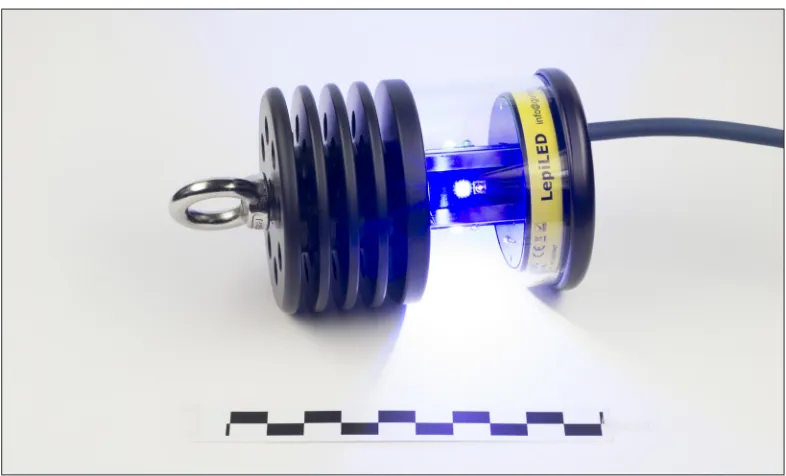
Further studies are required with regard to cross-calibration of the new LED lamp with existing lamps, including cold cathodes, which have been poorly studied so far. The lamp design is also open to experimental approaches in the field with different sets of LEDs. So far, only a small series of lamps has been available. However, a professionally manufactured model will be available for 395 € from the author ([email protected]) in 2017. This model uses the same basic design as the lamp described in this paper. It weighs ca. 470 g, has a height of 88 mm and a diameter of 62 mm, the same input voltage (5–12 V) and a very similar set of LEDs (manufacturer: Nishia). Also, this model has almost identical emissions to the lamp described here. It is manufactured with anodized aluminium and borosilicate glass, and instead of a fan, it uses a passive cooling element and is totally waterproof. This model will hopefully make the LED technology available to a larger community of lepidopterists and other entomologists.
Figure 8. First exemplar of the commercially available lamp “LepiLED”, height ca. 88 mm, diameter ca. 62
Acknowledgements
I am indebted to Jan Axmacher, Konrad Fiedler, Jeremy Holloway, Luisa Jaimes, Bernard Landry, Rolf Mörtter, and Eric Warrant for providing helpful comments, hints to literature, and linguistic assistance with the manuscript. Rainer Bark, Tobias Borchert, and Daniel Veit helped me to techni-cally realize the project, B. Kühn checked the manuscript with regard to physics, and D. Veit kindly provided the photospectrometer for multiple measurements. Jan Axmacher, Konrad Fiedler, Egbert Friedrich, Kai Grajetzki, Marco Infusino, Rolf Mörtter, Rando Müller, Stefano Scalercio, and Axel Steidel kindly provided lamps and Jürgen Schmidl (Bioform) gauze for measurements. Field work in Peru was conducted together with Daniel Bolt, Juan Grados, Gerardo Lamas, and Matthias Nuß. Stella Beavan is thanked for the final language check of the manuscript.The Peru project was sup-ported by the Deutsche Forschungsgemeinschaft (BR 2280/6-1).
References
Altermatt F, Ebert D (2016) Reduced flight-to-light behaviour of moth populations exposed to long-term urban light pollution. Biology Letters 12: 20160111. http://dx.doi.org/10.1098/rsbl.2016.0111
Brehm G (2007) Contrasting patterns of vertical stratification in two moth families in a Costa Rican lowland rain forest. Basic and Applied Ecology 8: 44–54. https://doi.org/10.1016/j.baae.2006.02.002
Brehm G, Axmacher JC (2005) A comparison of manual and automatic moth sampling methods (Lepidop-tera: Arctiidae, Geometridae) in a rain forest in Costa Rica. Environmental Entomology 35: 754–764. Briscoe DB, Chittka L (2001) The evolution of color vision in insects. Annual Review in Entomology 46:
471–510. https://doi.org/10.1146/annurev.ento.46.1.471
Chen P-J, Awata H, Matsushita A, Yang E-C, Arikawa K (2016) Extreme spectral richness in the eye of the Common Bluebottle Butterfly, Graphium sarpedon. Frontiers in Ecology and Evolution 4: 18. https://doi. org/10.3389/fevo.2016.00018
Cowan T, Gries G (2009) Ultraviolet and violet light: attractive orientation cues for the Indian meal moth, Plodia interpunctella. Entomologia Experimentalis et Applicata 131: 148–158. https://doi.org/10.1111/ j.1570-7458.2009.00838.x
Eby C, Weis M, Gardiner MGT, Judd GJR, Gries G (2013) Spectral efficiency and microstructure of the com-pound eyes of Synanthedon myopaeformis (Lepidoptera: Sesiidae). Canadian Entomologist 145: 529–538. https://doi.org/10.4039/tce.2013.25
Emmet AM (1991) The scientific names of the British Lepidoptera. Their history and meaning. Harley Books, Colchester. 288 pp.
Green D, MacKay D, Whalen M (2012) Next generation insect light traps: The use of LED light technology in sampling emerging aquatic macroinvertebrates. Australian Entomologist 39: 189–194.
Havells-Sylvania (2012) Blacklight lamps. Havells-Sylvania, Tienen, 12pp. [Brochure]
Huemer P, Kühtreiber H, Tarmann GM (2011) Anlockwirkung moderner Leuchmittel auf nachtaktive Insek-ten–Ergebnisse einer Feldstudie in Tirol (Österreich). Wissenschaftliches Jahrbuch der Tiroler Landesmu-seen 4: 110–135.
Holloway JD, Kibby G, Peggie D (2001) The families of Malesian moths and butterflies. Fauna Malesiana Handbook 3. Brill, Leiden, Boston, Köln.
InfusinoM, Brehm G, Di Marco C, Scalercio S (2017) Assessing the efficiency of UV LEDs as light sources for macro-moth diversity sampling. European Journal of Entomology 114: 25–33. https://doi.org/10.14411/
Intachat J, Woiwod IP (1999) Trap design for monitoring moth biodiversity in tropical rainforests. Bulletin of Entomological Research 89: 153–163. https://doi.org/10.1017/S0007485399000243
Johnsen S, Kelber A, Warrant E, Sweeney AM, Widder EA, Lee Jr RL, Hernández-Andrés J (2006) Crepus-cular and nocturnal illumination and its effects on color perception by the nocturnal hawkmoth Deilephila elpenor. Journal of Experimental Biology 209: 789–800. doi:10.1242/jeb.02053
Jonason D, Franzén M, Ranius T (2014) Surveying moths using light traps: effects of weather and time of year. PLoS ONE 9: e92453. https://doi.org/10.1371/journal.pone.0092453
Kadlec T, Pikner M, Piknerova G (2016) Sex-biased response in activity to light sources with different spectral composition in geometrid moths with flightless females (Lepidoptera: Geometridae). Bulletin of Entomo-logical Research 106: 581–590. https://doi.org/10.1017/S0007485316000298
Macgregor CJ, Evans DM, Fox R, Pocock MJ (2017) The dark side of street lighting: impacts on moths and evidence for the disruption of nocturnal pollen transport. Global Change Biology 23: 697–707. https://doi. org/10.1111/gcb.13371
Mobbs P (2016) A better moth trap using LEDs? https://petermobbs.wordpress.com/2015/05/09/a-better-moth-trap-using-leds [Accessed 22.xi.2016]
O’Sullivan N-A, Tait CP (2014) Tanning bed and nail lamp use and the risk of cutaneous malignancy: A re-view of the literature. Australasian Journal of Dermatology 55: 99–106. https://doi.org/10.1111/ajd.12145 Pawson SM, Bader MK-F (2014) LED lighting increases the ecological impact of light pollution irrespective
of color temperature. Ecological Applications 24: 1561–1568. https://doi.org/10.1890/14-0468.1
Price B, Baker E (2016) NightLife: A cheap, robust, LED based light trap for collecting aquatic insects in remote areas. Biodiversity Data Journal 4: e7648. https://doi.org/10.3897/BDJ.4.e7648
Somers-Yeates R, Hodgson D, McGregor PK, Spalding A, Ffrench-Constant RH (2013) Shedding light on moths: shorter wavelengths attract noctuids more than geometrids. Biology Letters 9: 20130376. http:// dx.doi.org/10.1098/rsbl.2013.0376
Southwood TRE, Henderson PA, Woiwod IP (2003) Stability and change over 67 years-the community of Heteroptera as caught in a light-trap at Rothamsted, UK. European Journal of Entomology 100: 557–562. https://doi.org/10.14411/eje.2003.084
Steidel A, Plontke R (2008) Lichtfangtechnik auf Reisen. Mitteilungen des Thüringer Entomologenverbandes e.V. 15: 22–31.
Taylor LR, French RA (1974) Effects of light-trap design and illumination on samples of moths in an English woodland. Bulletin of Entomological Research 63: 583–594. https://doi.org/10.1017/S0007485300047829 Tikoca S, Hodge S, Tuiwawa M, Brodie G, Pene S, Clayton J (2016) An appraisal of sampling methods and
effort for investigating moth assemblages in a Fijian forest. Austral Entomology 55: 455–462. https://doi. org/10.1111/aen.12209
van Grunsven RH, Donners M, Boekee K, Tichelaar I, Van Geffen KG, Groenendijk D, Berendse F, Veenendaal EM (2014) Spectral composition of light sources and insect phototaxis, with an evaluation of existing spectral response models. Journal of Insect Conservation 18: 225–231. https://doi.org/10.1007/ s10841-014-9633-9
van Langevelde F, Ettema JA, Donners M, Wallis DeVries MF, Groenendijk D (2011) Effect of spectral composition of artificial light on the attraction of moths. Biological Conservation 144: 2274–2281. https:// doi.org/10.1016/j.biocon.2011.06.004
White PJT, Glover K, Steward J, Rice A (2016) The technical and performance characteristics of a low-cost, simply constructed, black light moth trap. Journal of Insect Science 16: 25. https://doi.org/10.1093/jisesa/ iew011
Appendix 1
Table 2.Full list of tested lamps and LEDs with irradiance measured in dif
ferent bands of wavelengths. Grey cells: LEDs used for the new LED lamp.
Type
Remarks / angle
W attage effective (W) Brand Nr 300–400 nm 401–650 nm 651–1000 nm 300–1000 nm
Low pressure MV
actinic tube
(BL)
naked
8
Sylvania
Blacklight 368 F15W/T8/BL368
0.427
0.039
0.008
0.474
Low pressure MV
actinic tube
(BL)
naked in gauze
tower
8
Sylvania
Blacklight 368 F15W/T8/BL368
0.256
0.090
0.007
0.353
Low pressure MV
actinic tube
(BL)
acrylic glass
8
Sylvania
Blacklight 368 F15W/T8/BL368
0.438
0.040
0.009
0.487
Low pressure MV
actinic tube
(BL)
acrylic glass in gauze tower
8
Sylvania
Blacklight 368 F15W/T8/BL368
0.251
0.098
0.008
0.357
Low pressure MV
actinic tube
(BL)
naked
8
Sylvania
Blacklight F15W/350 BL-T8
0.469
0.041
0.007
0.517
Low pressure MV
actinic tube
(BL)
naked in gauze
tower
8
Sylvania
Blacklight F15W/350 BL-T8
0.264
0.126
0.008
0.398
Low pressure MV
actinic tube
(BL)
acrylic glass
8
Sylvania
Blacklight F15W/350 BL-T8
0.450
0.039
0.008
0.497
Low pressure MV
actinic tube
(BL)
acrylic glass in gauze tower
8
Sylvania
Blacklight F15W/350 BL-T8
0.256
0.124
0.008
0.388
Low pressure MV
actinic tube
(BL)
naked
9
Philips
PL-S 9W/12 Made in Poland
0.223
0.057
0.013
0.293
Low pressure MV
actinic tube
(BL)
naked in gauze
tower
9
Philips
PL-S 9W/12 Made in Poland
0.109
0.063
0.012
0.184
Low pressure MV
actinic tube (BL) naked 13 Exo Terra
Repti Glo 5.0 UVB 13
W
0.053
0.492
0.054
0.599
Low pressure MV
actinic tube
(BL)
naked in gauze
tower
13
Exo
Terra
Repti Glo 5.0 UVB 13
W
0.029
0.482
0.053
0.563
Low pressure MV
actinic tube
(BL)
naked
12
Osram
Dulux S Blue UV
A, 78 Color
0.441
0.075
0.022
0.538
Low pressure MV
actinic tube
(BL)
naked in gauze
tower
12
Osram
Dulux S Blue UV
A, 78 Color
0.247
0.137
0.016
Type
Remarks / angle
W attage effective (W) Brand Nr 300–400 nm 401–650 nm 651–1000 nm 300–1000 nm
Low pressure MV
actinic tube
(BL)
naked
30
Kelly
Bug Killer 40W
, ESL Lamp Nr . 71468 1.014 0.355 0.005 1.374
Low pressure MV
actinic tube
(BL)
naked in gauze
tower
30
Kelly
Bug Killer 40W
, ESL Lamp Nr . 71468 0.548 0.471 0.005 1.024
Low pressure MV
blacklight-blue tube (BLB)
naked 8 No brand F15 T8 BLB 0.144 0.005 0.013 0.162
Low pressure MV
blacklight-blue tube (BLB)
naked in gauze
tower 8 No brand F15 T8 BLB 0.080 0.024 0.01 1 0.1 15
Low pressure MV
blacklight-blue tube (BLB)
acrylic glass 8 No brand F15 T8 BLB 0.135 0.005 0.010 0.149
Low pressure MV
blacklight-blue tube (BLB)
acrylic glass in gauze tower
8 No brand F15 T8 BLB 0.076 0.022 0.009 0.106
Low pressure MV
blacklight-blue tube (BLB)
naked 8 No brand F15 T8 BLB 0.141 0.004 0.007 0.152
Low pressure MV
blacklight-blue tube (BLB)
naked in gauze
tower 8 No brand F15 T8 BLB 0.080 0.021 0.007 0.108
Low pressure MV
blacklight-blue tube (BLB)
acrylic glass 8 No brand F15 T8 BLB 0.129 0.003 0.006 0.138
Low pressure MV
blacklight-blue tube (BLB)
acrylic glass in gauze tower
8 No brand F15 T8 BLB 0.070 0.021 0.007 0.098
Low pressure MV
blacklight-blue tube (BLB)
naked
19
Omnilux
Ener
gy Saving Lamp 3U 20W
E27
0.184
0.009
0.004
0.197
Low pressure MV
blacklight-blue tube (BLB)
naked in gauze
tower
19
Omnilux
Ener
gy Saving Lamp 3U 20W
E27
0.105
0.034
0.003
0.142
Low pressure MV
blacklight-blue tube (BLB)
naked 4 no brand 0.041 0.002 0.008 0.051
Low pressure MV
blacklight-blue tube (BLB)
naked in gauze
tower 4 no brand 0.021 0.008 0.006 0.035
Cold cathode (twin set)
naked 3,9 Revoltec UV RM130 0.324 0.009 0.001 0.334
Cold cathode (twin set)
naked 3,9 Revoltec Blue RM128 0.004 0.483 0.005 0.492
Cold cathode (twin set)
Type
Remarks / angle
W attage effective (W) Brand Nr 300–400 nm 401–650 nm 651–1000 nm 300–1000 nm
High pressure MV
lamp, self-ballasted naked 190 Osram HVL 160 W 0.567 3.316 7.093 10.975
High pressure MV
lamp,
self-ballasted
naked in gauze
tower 190 Osram HVL 160 W 0.331 3.010 6.454 9.794
High pressure MV
lamp, self-ballasted naked 190 Osram 0.694 3.132 6.330 10.156
High pressure MV
lamp,
self-ballasted
naked in gauze
tower 190 Osram 0.348 2.443 4.879 7.671
High pressure MV
BLB lamp, self-ballasted naked 190 Omnilux UV Lampe 160 W / E27 0.306 0.048 1.475 1.829
High pressure MV
BLB lamp,
self-ballasted
naked in gauze
tower 190 Omnilux UV Lampe 160 W / E27 0.21 1 0.1 13 1.466 1.789 Incandescent lamp naked 180 no brand 200 W (E27) 0.035 1.541 8.364 9.940 LED UV + Green naked nA W orldwide Butterflies GemLight 0.104 0.024 0.000 0.129 LED UV + Green
naked in gauze
tower nA W orldwide Butterflies GemLight 0.055 0.035 0.000 0.090 LED UV naked 8 no brand 0.129 0.104 0.000 0.234 LED UV
naked in gauze
tower 8 no brand 0.069 0.108 0.000 0.178 LED UV 0°
at 350 mA
SSC Viosys UV CUN66A1B 0.610 0.005 0.000 0.615 LED UV
0° gauze I
at 350 mA
SSC Viosys UV CUN66A1B 0.274 0.099 0.000 0.373 LED UV
0° gauze II
at 350 mA
SSC Viosys UV CUN66A1B 0.275 0.100 0.001 0.375 LED UV 30°
at 350 mA
SSC Viosys UV CUN66A1B 0.526 0.01 1 0.002 0.539 LED UV 60°
at 350 mA
SSC Viosys UV CUN66A1B 0.397 0.009 0.002 0.408 LED UV 0°
at 350 mA
Nishia NCSU033B 0.446 0.004 0.000 0.450 LED UV 30°
at 350 mA
Nishia NCSU033B 0.452 0.003 0.001 0.456 LED UV 60°
at 350 mA
Type
Remarks / angle
W attage effective (W) Brand Nr 300–400 nm 401–650 nm 651–1000 nm 300–1000 nm LED UV 90°
at 350 mA
Nishia NCSU033B 0.000 0.000 0.000 0.000 LED UV
0° in gauze tower
at 350 mA
Nishia NCSU033B 0.189 0.047 0.000 0.236 LED UV 0°
at 350 mA
W inger WEPUV3-S2 Blacklight 0.137 0.252 0.001 0.391 LED UV
0° gauze I
at 350 mA
W inger WEPUV3-S2 Blacklight 0.062 0.203 0.001 0.266 LED UV
0° gauze II
at 350 mA
W inger WEPUV3-S2 Blacklight 0.064 0.213 0.001 0.278 LED UV 30°
at 350 mA
W inger WEPUV3-S2 Blacklight 0.109 0.247 0.001 0.357 LED UV 60°
at 350 mA
W inger WEPUV3-S2 Blacklight 0.096 0.225 0.001 0.322 LED UV 0°
at 350 mA
no brand 0.188 0.010 0.000 0.199 LED UV 30°
at 350 mA
no brand 0.160 0.009 0.000 0.169 LED UV 60°
at 350 mA
no brand 0.093 0.006 0.000 0.100 LED UV 90°
at 350 mA
no brand 0.002 0.000 0.000 0.003 LED Turquoise 0°
at 350 mA
Bridgelux Turquoise 0.000 0.237 0.000 0.238 LED Turquoise 30°
at 350 mA
Bridgelux Turquoise 0.001 0.214 0.000 0.215 LED Turquoise 60°
at 350 mA
Bridgelux Turquoise 0.000 0.249 0.000 0.250 LED Turquoise 90°
at 350 mA
Bridgelux Turquoise 0.000 0.029 0.000 0.029 LED Blue 0°
at 350 mA
Cree
XP-E2 Royal Blue
0.003 0.665 0.002 0.670 LED Blue 30°
at 350 mA
Cree
XP-E2 Royal Blue
0.002 0.555 0.003 0.560 LED Blue 60°
at 350 mA
Cree
XP-E2 Royal Blue
0.001 0.447 0.002 0.451 LED Blue 0°
at 350 mA
Bridgelux Royal Blue 0.003 0.502 0.002 0.507 LED Blue 30°
at 350 mA
Bridgelux Royal Blue 0.004 0.61 1 0.002 0.617 LED Blue 60°
at 350 mA
Bridgelux Royal Blue 0.003 0.556 0.002 0.560 LED Blue 90°
at 350 mA
Bridgelux Royal Blue 0.000 0.099 0.001 0.101 LED Blue
0° in gauze tower
at 350 mA
Bridgelux Royal Blue 0.002 0.404 0.000 0.407 LED Blue 0°
at 350 mA
W
inger
WEPRB3-S1 Royal Blue
0.002
0.483
0.002
0.487
LED Blue
0° gauze I
at 350 mA
W
inger
WEPRB3-S1 Royal Blue
0.002
0.366
0.002
0.371
LED Blue
0° gauze II
at 350 mA
W
inger
WEPRB3-S1 Royal Blue
0.001 0.364 0.003 0.368 LED Blue 30°
at 350 mA
W
inger
WEPRB3-S1 Royal Blue
0.002
0.408
0.001
0.41
Type
Remarks / angle
W attage effective (W) Brand Nr 300–400 nm 401–650 nm 651–1000 nm 300–1000 nm LED Blue 60°
at 350 mA
W
inger
WEPRB3-S1 Royal Blue
0.000 0.013 0.001 0.014 LED Green 0°
at 350 mA
Cree XP-E2 Green 0.000 0.228 0.003 0.231 LED Green 30°
at 350 mA
Cree XP-E2 Green 0.000 0.222 0.002 0.225 LED Green 60°
at 350 mA
Cree XP-E2 Green 0.000 0.166 0.002 0.169 LED Green 0°
at 350 mA
Bridgelux Emerald Green 0.000 0.213 0.001 0.214 LED Green 30°
at 350 mA
Bridgelux Emerald Green 0.000 0.216 0.001 0.217 LED Green 60°
at 350 mA
Bridgelux Emerald Green 0.000 0.202 0.000 0.202 LED Green 90°
at 350 mA
Bridgelux Emerald Green 0.000 0.030 0.000 0.031 LED Green
0° in gauze tower
at 350 mA
Bridgelux Emerald Green 0.000 0.230 0.001 0.231 LED Green 0°
at 350 mA
W inger WEPGN3-S1 Green 0.000 0.236 0.001 0.237 LED Green
0° gauze I
at 350 mA
W inger WEPGN3-S1 Green 0.000 0.167 0.001 0.167 LED Green
0° gauze II
at 350 mA
W inger WEPGN3-S1 Green 0.000 0.168 0.001 0.169 LED Green 30°
at 350 mA
W inger WEPGN3-S1 Green 0.000 0.236 0.000 0.237 LED Green 60°
at 350 mA
W inger WEPGN3-S1 Green 0.000 0.213 0.000 0.214 LED Cool White 0°
at 350 mA
Cree XP-L V6 Cool White 0.001 0.647 0.051 0.699 LED Cool White
0° gauze I
at 350 mA
Cree XP-L V6 Cool White 0.001 0.417 0.036 0.453 LED Cool White 30°
at 350 mA
Cree XP-L V6 Cool White 0.001 0.532 0.045 0.578 LED Cool White 60°
at 350 mA
Cree XP-L V6 Cool White 0.001 0.359 0.034 0.394 LED Cool White 0°
at 350 mA
Bridgelux Cool White 0.001 0.482 0.034 0.518 LED Cool White 30°
at 350 mA
Bridgelux Cool White 0.001 0.399 0.030 0.429 LED Cool White 60°
at 350 mA
Bridgelux Cool White 0.000 0.312 0.025 0.338 LED Cool White 90°
at 350 mA
Bridgelux Cool White 0.000 0.014 0.001 0.015 LED Cool White
0° in gauze tower
at 350 mA
Bridgelux Cool White 0.001 0.348 0.027 0.375 LED Cool White 0°
at 350 mA
W inger WEPCW3-S1 Cool White 0.001 0.314 0.015 0.331 LED Cool White
0° gauze I
at 350 mA
W inger WEPCW3-S1 Cool White 0.000 0.225 0.012 0.237 LED Cool White
0° gauze II
at 350 mA
W inger WEPCW3-S1 Cool White 0.001 0.237 0.012 0.250 LED Cool White 30°
at 350 mA
W inger WEPCW3-S1 Cool White 0.001 0.274 0.014 0.289 LED Cool White 60°
at 350 mA