Vol. 8, No. 6 (2018): 2002-2008 Research Article
Open Access
I
ISSSSNN::22332200--66881100
UPLC Analytical Method Development and Validation for
the Simultaneous estimation of Sofosbuvir, Velpatasvir
and Voxilaprevir in Dosage form
K. PushpaKumari
1,* and D. Gowri Sankar
21
Research Scholar, Department of Pharmaceutical Analysis, Andhra University, Visakhapatnam.
2
Professor, Department of Pharmaceutical Analysis, Andhra University, Visakhapatnam
* Corresponding author: K. PushpaKumari, e-mail: [email protected]
ABSTRACT
In the current study, a rapid, an exact and precise Ultra Performance Liquid Chromatography (UPLC) method was developed and approved for simultaneous estimation of sofosbuvir, velpatasvir and voxilaprevir in its dosage form (400 mg, 100 mg and 100 mg) by choosing chromatographic parameters. The UPLC method was developed using 100 × 3 mm, reverse phase C18 segment (Acquity UPLC CHS C18 1.7 µm) with mobile phases contain 0.01N KH2PO4
buffer and acetonitrile in the ratio of 60:40 as mobile phase and water: acetonitrile (50:50) as diluent and the run considered as an isocratic elution. Stream rate was 0.3 ml/min with UV identification at (λmax) 260 nm and the
injection volume was set at 0.5 µL with run time 3 min. The method was approved by utilizing a variety of validation parameters like accuracy, precision, linearity and specificity. These results show the process could find practical application as a quality control tool for examination of the drug in its dosage form in pharmaceutical industries. The developed approved method and stability testing of new dosage forms as per Q2 (R1) and ICH-Q1C guidelines applicable for the examination of bulk drug and in its dosage form.
Keywords:
UPLC, sofosbuvir, velpatasvir , voxilaprevir, validation ad ICH.1. INTRODUCTION
Ultra Performance Liquid Chromatography (UPLC) is arelatively new recent technique which gives a new direction for liquid chromatography and it is valid for particle having less than 2 µm in diameter to acquire better resolution, speed and sensitivity as compared with High-Performance Liquid Chromatography (HPLC). It Utilizes fine particles and saves time and decrease solvent consumption. The UPLC method decrease examination time up to nine times comparing to the conventional method using 5 μm particle packed analytical columns. In UPLC the separation is performed under remarkable pressures (up to 100 MPa is possible), but it has no negative impact on analytical column as well as other components of chromatographic system. Separation efficiency remains maintained and also it is even improved more [1-4].
Hepatitis C is the infection of the liver caused by the HCV virus. VOSEVI is the directly acting antiviral prescription used to treat Hepatitis C. VOSEVI is the
fixed dose combination of three antiviral drugs sofosbuvir (400mg), velpatasvir (100mg) and voxilaprevir (100mg). Directly acting antivirals block the ability of the virus to reproduce. Sofosbuvir acts as a defective substrate for NS5B, an RNA-dependent RNA polymerase which is needed for the transcription of Hepatitis C viral RNA and controls further reproduction of virus. The molecular formula and molecular weight of sofosbuvir are C22H29FN3O9P and 529.458 g/mol
correspondingly [5]. Chemical structure is given in
Figure 1a.Velpatasvir inhibits protein NS5A (hepatitis virus non-structural protein 5A), which plays an chief role in Hepatitis C virus replication, assembly and modulation of host immune responses. The molecular formula and molecular weight of velpatasvir are C49H54N8O8 and 883.019 g/mol correspondingly [6].
Chemical structure is given in Figure 1b. Voxilaprevir acts by reversibly binding and stopping the NS3/4A serine protease and meddles the production of new
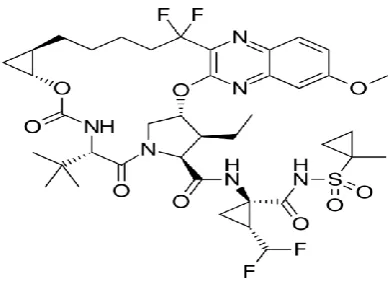
virus particles. The molecular formula and molecular weight of voxilaprevir are C40H52 F4N6O9S and 868.943
g/mol correspondingly [7]. Chemical structure is given
in Figure 1c. The objective of the current study was to develop and validate stability indicating UPLC (Ultra Performance Liquid Chromatography) technique for the simultaneous examination of sofosbuvir, velpatasvir and voxilaprevir in marketed formulation.
Literature survey explains that there are only few reported HPLC methods for analysis of these drugs [8-10].
Compared to report procedure the developed technique decreases the time of examination, consumption of solvents and cost effective. So, it can be applied for routine examination in quality control laboratories.
Figure 1a. Chemical structure of Sofosbuvir
Figure 1b. Chemical structure of velpatasvir
Figure 1c. Chemical structure of voxilaprevir
2. MATERIALS AND METHODS
2.1 Chemicals
The drugs sofosbuvir, velpatasvir and voxilaprevirpure sample were get from Spectrum Labs,Hyderabad.The reagents and chemicals used in the process are Potassium di-hydrogen ortho phosphate (Molychem) is of analytical grade, Acetonitrile (Merck) UPLC grade,
Orthophosphoric acid analytical grade (RFCL,limitedMolychem) and milli-Q water from Milli-QRO water purification method.
2.2 Equipment
(Saritorius), pH meter (Mestar), sonciator (Labman) and vaccum pump (Crompton).
2.3 Chromatographic conditions
Chromatographic separations were performed on a CHS C18 100 x 3 mm, 1.7µ column Utilizing an Acquity Waters UPLC method. The mobile phase was consist of buffer and acetonitrile in the ratio of 60:40 v/v. Isocratic elution mode was utilized and the column temperature was maintained at 300 C. The total run
time was 3 min at a flow rate of 0.3 ml/min. The peaks were detected at wavelength of 260 nm.
2.4 Preparation of mobile phase and diluent: The mobile phase consists of buffer (0.01N KH2PO4)
and acetonitrile in the ratio of 60:40. Buffer was prepared by dissolving 1.36 gm of potassium di-hydrogen phosphate in 900 ml of milli-Q water, the solution was sonicated and makeup the solution to 1000 ml. finally pH was set to 4.0 using dil. orthophosphoric acid.Water and Acetonitrile in 50:50 was used as diluent.
2.5 Preparation of Standard Stock solution:
Accurately 40 mg of sofusbuvir, 10mg of velpatasvir and 10mg of voxilaprevirpure drugs were weighed and transferred into 10ml volumetric flask, 5ml of diluent was added and sonicated for 10 min and final volume was set using diluent to make standard stock solution consist of 4000 µg of sofosbuvir, 1000 µg of Velpatasvir and 1000 µg of Voxilaprevir.
2.6 Preparation of Working Standard Solution: This solution was equipped by diluting 1ml of Standard stock solution to 10 ml with diluent to get working standard solution containing concentration of 400 µg Sofosbuvir, 100 µg of Velpatasvir and 100 µg of Voxilaprevir.
2.7 Assay Preparation:
Six tablets were weighed and powdered. Powder equal to one tablet was weighed and poured to 100 ml volumetric flask, 75 ml of diluent was added and sonicated for 25 min and final volume was set utilizing diluent. The resultant solution was filtered utilizing 0.45 µ HPLC filters. From this solution 1ml was taken and diluted to 10 ml with diluent. The resultant solution was injected into chromatographic system, peaks were recorded. The amount of drugs in definition was calculated by using formula, where
% Assay= (area of sample/area of std)*(conc of Std/Conc of Sample)*(Label claim/Avg. wt of formulation)*(potency/100)*100
2.8 Method development
The method was developed by choosing different columns and mobile phase to get good resolution of the peaks and to satisfy the method suitability parameters drafted by ICH. Firstly, the separation was carried on HSS C18 100 x 3 mm column utilizing 50: 50 ratio of methanol and water with 0.3 ml/min flow rate, the
results were unsatisfactory which contain no resolution of peaks. In Second trail, HSS C18 100 x 3 mm column, 50: 50 ratio of methanol and OPA as mobile phase was utilized with 0.3 ml/min flow rate, results contain all the three peaks merged with failure of theoretical plates. In third trail, column was changed to CHS C18 100 x 3 mm, 50:50 ratio of Acetonitrile and Ortho phosphoric acid, we observed good resolution but with low plate count. In the next trail, using the equal column and mobile phase contain was changed to 40: 60 ratio of Acetonitrile and Potassium di-hydrogen phosphate buffer, the results were satisfactory (good resolution of peaks, theoretical plates and tailing factor are within the limits).
2.9 Method Validation
The developed UPLC method for simultaneous evaluation of sofosbuvir,velpatasvir and voxilaprevir was validated according to the guidelines drafted in ICH Q2(R1).system validation parameters contain method suitability,linearity,precision,accuracy,precision,robust ness,ruggedness,limit of detection and quantification [11].
2.9.1 System suitability
This test was utilized to check whether the analytical system was stable during the examination. The parameters calculated are theoretical plates, tailing factor and % RSD of six standard injections. As per guidelines, theoretical plates should not be less than 2000, tailing factor not more than 2, % RSD not be more than 2.0.
2.9.2 Precision
System precision was evaluated by injecting six replicas of working standard solution and %RSD of peak areas was calculated. Intermediate precision was evaluated by injecting six working standard solutions on different day by different analyst and % RSD of peak areas was calculated. The % RSD should be not more than 2.0%. Six injections of sample solution was injected into the method, from the calculated values % assay values was calculated to establish method precision.
2.9.3 Linearity
This was utilized to verify the ability of the system to give linear response within a given concentration range. It was determined by injecting six various concentrations (25 %, 50 %, 75 %, 100 %, 125 % and 150 % of standard concentration) and caluculating the peak response. Concentration of standard solution on X-axis versus peak response on Y-axis was plotted from the recorded data, correlation coefficient was calculated from the plot.
2.9.4 Limit of detection and quantification:
2.9.5 Accuracy
Additional spiking method was utilized to establish accuracy.The sample solution was spiked with a exact standard concentration at 3 different levels (50%, 100 %, and 150%), % recovery was calculated. The % recovery should be within 98%-102%.
2.9.6 Robustness
The robustness of an analytical method estimates its capability to remain unaffected by small, but deliberate variations in process parameters and provide an signal of its reliability during normal usage. process robustness was established by consider the variations in mobile phase ratio (±10% organic phase), flow rate (±10%), Column oven temperature (±5oC).The % RSD
was calculated and it should be not more than 2.0%.
Forced Degradation Studies:
The drugs sofosbuvir, voxilaprevir and velpatasvir were subjected to the stress conditions of oxidative, acid, base, hydrolytic, thermal and photolytic degradation. Acidic degradation study was performed by heating the standard stock solution in 0.1 N HCl at 80 °C for 2.0 h and mixture was constant. Alkaline degradation study was performed by heating the standard stock solution in 1 M NaOH at 80 °C for 2 h
and mixture was constant. Oxidation degradation study was performed by heating the standard stock solution in 3% (v/v) H2O2 at 80 °C for 1 h. Thermal degradation
was performed by uncovering standard stock solution at 80 °C for 72 h. Photolytic degradation study was performed by uncovering the drug content in UV-light for 72 h. The resultant stress solutions were equilibrated to room temperature, diluted and analysed.
3. RESULTS AND DISCUSSION
Method optimization
After performing different trials, the top chromatographic separation was observed when reverse phase Acquity UPLC CHS C18 column 100 × 3
mm, 1.7 µm with mobile phases consist of 0.01N KH2PO4buffer and acetonitrile in the ratio of 60:40 as
mobile phase was utilized with isocratic elution mode. Flow rate was 0.3 ml/min with UV detection at (λmax)
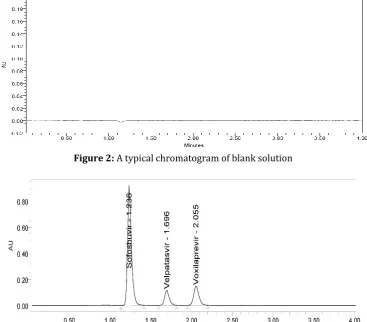
260 nm and the injection volume was set at 0.5 µL with run time 3 min. The retention time (RT) for sofosbuvir, velpatasvir and voxilaprevir was found to be 1.236, 1.696 and 2.055 correspondingly with resolution more than 3.0. Included chromatograms of blank and standard solution in Figures 2 & 3.
Figure 2: A typical chromatogram of blank solution
Figure 4: A typical chromatogram of formulation sample
Table 1: Repeatability data of sofosbuvir, velpatasvir and voxilaprevir
S.No Sofosbuvir Velpatasvir Peak Areas Voxilaprevir
Intra day Inter day Intra day Inter day Intra day Inter day
1 3137149 3154572 454455 445229 615941 597872
2 3156000 3124700 456120 447042 615496 598377
3 3101698 3134726 463143 446991 618626 601544
4 3157898 3138672 454647 442352 612261 587886
5 3164945 3112147 462945 448590 615487 593342
6 3169808 3117002 459350 451955 614657 605164
Mean 3150070 3130303 458443 447027 615411 597364
STDEV 25243.9 15598.3 3972.2 3219.3 2055.3 6092.7
% RSD 0.8 0.5 0.9 0.7 0.3 1.0
Method Validation System suitability
The % RSD of the peak area response of six replicate injections of working standard solution of sofosbuvir, velpatasvir and voxilaprevir were 0.8%, 0.9% and 0.3% correspondingly which are within the restrictions specified (% RSD NMT 2.0%). The average number of theoretical plates (N) for the newly developed system was within the restrictions specified (NLT 2000).
Precision
The % RSD valuesfor repeatability of inter-day and intra-day precision results were found to be less than 2.0 which is within the specified restrictions. The results were given in table 1. The % assay was found to be 99.21±0.3 for sofosbuvir, 99.3±0.49 for velpatasvir,
99.72±0.25 for voxilaprevir. The chromatogram of formulation is given in figure 4.
Linearity
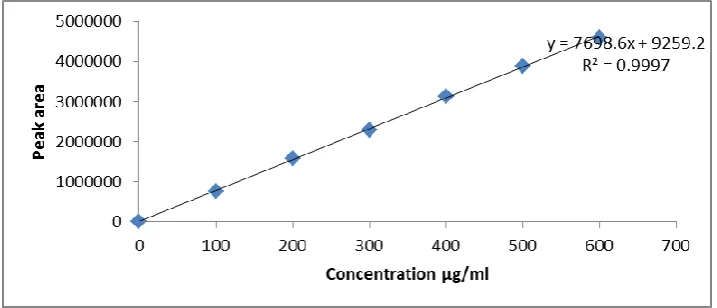
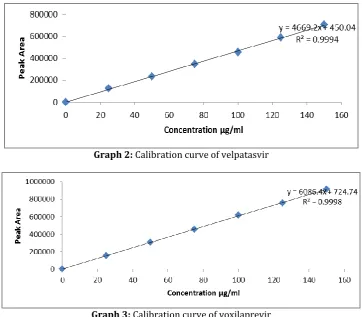
The linearity of the Finalized process was resolute for 6 concentrations and the correlation coefficient was found to be 0.9997 for sofosbuvir, 0.9994 for velpatasvir and 0.9998 for voxilaprevir which is within the restrictions specified (NLT 0.99). It showed that the developed process followed Beer-Lambert’s law within the range of 100–600 µg/ml for sofosbuvir, 25-150 µg/ml for velpatasvir and 25-150 µg/ml for voxilaprevir is linear for assurance of percentage purity of all the three drugs in formulation. Calibration graphs of sofosbuvir, velpatasvir and voxilaprevir were included as Graph 1, 2 and 3respectively.
Graph 2: Calibration curve of velpatasvir
Graph 3: Calibration curve of voxilaprevir
LOD and LOQ
The LOD and LOQ values of sofosbuvir, velpatasvir and voxilaprevir are 1.02 µg/ml & 3.10µg/ml, 0.23µg/ml & 0.68 µg/ml, 0.24 µg/ml & 0.72 µg/ml correspondingly.
Accuracy
The accuracy of the system was tested at three different concentration levels 50%, 100% and 150% of target concentration in triplicate injections. The % recoveries were considered from the y-intercept and slope of the calibration curve. The results are given in table 2.
Table 2: Accuracy data of sofosbuvir, velpatasvir and voxilaprevir
Accuracy level Mean % Recovery
Sofosbuvir Velpatasvir Voxilaprevir
50% 99.10 100.08 99.87
100% 99.12 99.53 99.45
150% 99.10 98.97 99.84
Robustness
A little difference in retention time was observed when the flow rate, temperature and organic content in
mobile phase was changed. The % RSD of the observed values was less than 2% which is within the specified restrictions. The results are included in table 3.
Table 3: Robustness data of sofosbuvir, velpatasvir and voxilaprevir
S.No Condition %RSD (Retention time)
Sofosbuvir Velpatasvir Voxilaprevir
1 Flow rate (-10%) 1.2 1.2 0.7
2 Flow rate (+10%) 1.5 0.8 1.1
3 Mobile phase (-10% organic phase) 0.8 0.9 0.8
4 Mobile phase (+10% organic phase) 1.5 1.2 1.3
5 Temperature (-10%) 1.3 1.2 0.9
Forced degradation studies
The drugs were subjected to the stress conditions of oxidative, acid, base, hydrolytic, thermal and photolytic degradation. There were initiate to degrade significantly in acid and base stress
conditions Degradation studies were carried out as per ICH guidelines. The sample solutions were subjected to acidic, basic, peroxide, water and light. The percentage of drug degraded under different stress conditions were given in table 4.
Table 4: Degradation data of sofosbuvir, velpatasvir and voxilaprevir
Degradation type % Drug degraded
Sofosbuvir Velpatasvir Voxilaprevir
Acid 6.98 6.34 5.47
Alkali 5.12 5.90 4.87
Peroxide 4.48 4.26 3.69
Thermal 3.02 3.81 2.74
Photolytic 1.87 1.84 1.87
Neutral 1.15 0.40 0.09
4. CONCLUSION
The UPLC method was Finalized and initiate to be economical, reproducible, accurate, linear, precise, and robust. The developed and validated system was utilized for the separation, identification, and quantitation of thesofosbuvir, velpatasvir and voxilaprevir in bulk and formulation. According to the qualitative and quantitative results, the system could be applied to the quality control of pharmaceutical preparations.
5. REFERENCES
1. Michael E.Swartz. UPLCTM: An Introduction and Review.J LiqChromatogrRelatTechnol.2005;28, (8),1253-1263. 2. Taleuzzaman M, Ali S, Gilani SJ, Imam SS and Hafeez A.Ultra
performance liquid chromatography (UPLC) – A Review.Austin J Anal Pharm Chem.2015;2(6).
3. K Naresh, S Bhawani and T Maneesh Kumar.Ultra Performance Liquid Chromatography.Int J Pharm Med & Bio Sc.2014; 3(3), 84-94.
4. Michael W Dong, Kelly Zhang.Ultra high pressure liquid chromatography (UHPLC) in method development.Trac Trends AnalytChem. 2014; 6(3), 21-30.
5. https://pubchem.ncbi.nlm.nih.gov/compound/sofosbuvir. 6. https://pubchem.ncbi.nlm.nih.gov/compound/velpatasvir.
7. https://pubchem.ncbi.nlm.nih.gov/compound/voxilaprevi r.
8. MarakaSridevi, Dr.T.Siva Rao and ChallaGangu Naidu. Development and validation of liquid chromatographic method for simultaneous determination of sofosbuvir, velpatasvir and voxilaprevir in fixed tablet dosage form. Ejbps.2018; 5, 351-360.
9. J. Sandya Rani and N. Devanna. Development and validation of RP –HPLC method for the simultaneous estimation of sofosbuvir, velpatasvir and voxilaprevir in bulk and tablet dosage forms. RASAYAN J.Chem.2018; 11, 452-459.
10. B. Balaswami, P. VenkataRamana, B. Subba Rao and P. Sanjeeva. A New simple stability indicating RP-HPLC-PDA method for simultaneous estimation of triplicate mixture of sofosbuvir, velpatasvir and voxilaprevir in tablet dosage form. Research J. Pharm and Tech. 2018; 11, 4147-4156. 11. Guidelines for Validation of Analytical Procedures, Q2 (R1),
ICH, 1994.
*****