Research helps students learn how to ask new
questions and solve complex problems. We believe
that these skill sets are valuable in every field and
instill in students a sense of excitement about
learning and the development of new knowledge.
Jonathan Alger, President of James Madison University
Research helps students learn how to
ask new questions and solve complex problems.
We believe that these skill sets are valuable
in every field and instill in students
a sense of excitement about learning
and the development of new knowledge.
Letter from the Editors and Editorial Board Members 4 Volume Five Faculty Reviewers and Acknowledgements 5
The Birds and the Bees 6
The Impact of Parent-Child Communication on Adolescent Sexual Health
Hannah Adams - Communication Studies
Alzheimer’s Disease and the Impact of Music Therapy 11
A Systematic Literature Review
Hayley Guess - Nursing
Critical Thinking Skills Across the Semester in Lecture- 21
and Team-Based Learning Classes
Zachary Buchin - Psychology
Hackers and the Dark Net 33
A Look into Hacking and the Deep Web
Danielle LeFrancois, Christina Reilly, Russell Munn, Andy Strasel, Jess Garcia, and Lindsey Chiles - Media Arts & Design
Steve McCurry in India 35
A Balanced Approach to a Complicated Country
Sam Taylor - Media Arts & Design
“Expanding That Story” 42
How Nonprofit Leaders Portray the Populations They Serve
Sarah Koth - Communications Studies
Dorothea Lange 53
Capturing the Reality of the Great Depression and the New Deal Era
Laura VanDemark - History
Hematological Changes in Response to a Drastic 65 Increase in Training Volume in Recreational Cyclists
Jessie Axsom - Kinesiology
Indigenous Language Revival 71
The Wôpanâak Language Reclamation Project as a Case Study in Indigenous Identity, Representation, and Place-Based Knowledge
Kyle Woodward - Geographic Science
About the Contributors 81
Photography Contest Winners 84
Celebrating Five Volumes 85
JMURJ
Dear Reader,
We are proud to present Volume Five of the James Madison Undergraduate Research Journal. This volume features nine examples of undergraduate research and scholarship, the most we have ever published in an academic year. It represents multiple disciplines here on campus, showcasing work from Geographic Science, Psychology, Kinesiology, Nursing, History, and Communication Studies. We’ve also included a teaser from “Hackers and the Dark Net,” a Media Arts & Design multimedia article available online through the JMURJ Scholarly Commons site.
Across two semesters, 23 students from 12 different majors and 15 minors served on the Volume 5 JMURJ Editorial Board. Students in two new leadership positions—managing editor and intern—put countless hours into administrative and editorial work to ensure the success of the journal. Our editing team collaborated with undergraduate researchers and scholars in more than 25 majors to revise manuscripts for accuracy, accessibility, and consistency. Our design team worked heroically, starting from blank pages, to reimagine the journal’s look, layout, and artwork.
JMURJ participated in JMU’s Undergraduate Research Review process and, with help from our marketing team, promoted undergraduate research and scholarship at the Spring 2018 Honors Symposium and during Centennial Scholars and JMU X-Labs meetings. Our marketers also coordinated JMURJ’s third annual photography contest, publishing the winning photographs on this volume’s front, inside, and back covers.
We would especially like to thank the JMU faculty members, administrators, and administrative assistants who have supported JMURJ through the years. It is an honor to have worked with these individuals and an honor to publish a volume that truly represents the time and hard work we all put into creating it. We are excited to continue growing in the years to come and are pleased to have you, the reader, along for the journey.
All the best,
The JMURJ Editorial Board
MANAGING EDITOR
Catherine Evans
INTERNS
Matt Cappo Maria Castro
ADVISORS
Kevin Jefferson Kurt Schick
EDITING
Callie Bingen John Corvari Olivia DePasquale Eric Fox
Caroline Henry Marissa Kircher Wyatt Lam Magi Jo Linscott Caroline Mohan Becky Reid Fiona Wirth
DESIGN
Paige Franklin Isabel Kerr Maddie Matarazzo Jenna Welch Catie Willett
MARKETING AND
OUTREACH
Skyler Campbell Dylan Owens
VOLUME FIVE EDITORIAL BOARD
Dr. Melinda Adams, Political Science Dr. Chris Arndt, History
Dr. David Babcock, English
Dr. Stephanie Baller, Health Sciences Dr. Andrew Barnes, Communication Studies Dr. Dennis Beck, Theatre and Dance Dr. Terry Beitzel, Justice Studies Dr. Sarah Blackstone, Health Sciences Dr. Charles Blake, Political Science Dr. Dennis Blanton, Anthropology Dr. Dudley Bonsal, ISAT
Dr. James Briscoe, Communication Studies Dr. Lori Britt, Communication Studies Dr. Richard Busi, Mathematics & Statistics Dr. Jennifer Byrne, Political Science Dr. Nevin Cavusoglu, Economics and International Business
Dr. Jennifer Coffman, ISAT Dr. Idelle Cooper, Biology Dr. Kerry Crawford, Political Science Dr. Jessica Davidson, History Dr. Laura Desportes, Educational Foundations & Exceptionalities Dr. Laureen Donovan, Nursing Professor Lesley Eicher, Health Sciences Dr. Raymond Enke, Biology
Dr. Theresa Enyeart Smith, Health Sciences
Dr. Jody Fagan, Library & Educational Technologies Dr. Windsor Fields, Economics
Dr. Dolores Flamiano, Media Arts & Design Professor William Flint, Biology
Dr. Michael Galgano, History
Dr. Janet Gloeckner, Health Professions Dr. Mollie Godfrey, English
Dr. Keith Grant, Political Science Dr. Steven Guerrier, History
Dr. Linda Cabe Halpern, University Programs Dr. Trent Hargens, Kinesiology
Dr. Laura Henigman, English Dr. Dayna Henry, Health Sciences Dr. Philip Herrington, History Dr. Bridget Ann Houlahan, Nursing Dr. Linda Hulton, Nursing
Dr. Oliver Hyman, Biology Dr. Karen Jagiello, Nursing Dr. Mary Kimsey, ISAT Dr. Stephanie Kurti, Kinesiology
Dr. Jennifer Lang-Rigal, Foreign Languages Dr. Alan Levinovitz, Philosophy and Religion Dr. Dennis Lo, English
Dr. Claire Lyons, Psychology
Dr. Marianne Mason, Foreign Languages Dr. Kristen McCleary, History
Dr. Lisa McGuire, Social Work
Dr. Benjamin Meade, Justice Studies Dr. Laura Merrell, Health Sciences Dr. Galen Murton, ISAT
Dr. Leigh Nelson, Communication Studies Dr. Andre Neveu, Economics
Dr. Sarah Newman, Anthropology Dr. Adebayo Ogundipe, Engineering Dr. Uchenna Onuzulike, Media Arts & Design Dr. Ji Hyung Park, Political Science Dr. Heidi Pennington, English Professor Nancy Puffenbarger, Nursing Professor Jamie Robinson, Nursing Dr. Ken Rutherford, Political Science Dr. John Scherpereel, Political Science Dr. Kyle Seifert, Biology
Dr. Michael Seth, History
Dr. Roger Soenksen, Media Arts & Design Dr. Alexis Stevens, Mathematics & Statistics Dr. Bradley Striebig, Engineering
Dr. Jeffrey Tang, ISAT Dr. Wayne Teel, ISAT Dr. Mary Thompson, English Dr. Brett Tjaden, Computer Science Dr. Tim Walton, ISAT
Dr. Siân White, English Dr. Andrew Witmer, History Dr. William Wood, Economics
JMURJ
VOLUME FIVE FACULTY REVIEWERS
We would like to thank all of the 175+ faculty reveiwers who have volunteered their time through the first five volumes of JMURJ, starting with the 79 Volume 5 faculty reviewers listed above. We also want to acknowledge Vice Provost Yvonne Harris, Ms. Becky Rohlf, and Mr. Ben Delp in the Office of Research and Scholarship for their guidance and assistance. Thank you to photographers Carrie Chang (front and back covers) and Mary Kate Appel (inside cover) for their contributions to our publication. We are also grateful to Dr. Brad Newcomer, Dr. Phil Frana, Mr. Jared Diener, Ms. Tammy Steele, and Ms. Dianne Fulk of the JMU Honors College. We appreciate JMU’s Digital Collections Librarians, Ms. Amanda Minchin and Ms. Grace Barth, for their assistance in publishing JMURJ on JMU’s Scholarly Commons. Thanks also are due to Mr. Michael Dioszeghy in JMU’s Learning Centers for his vital technical support. The Director of the School of Writing, Rhetoric and Technical Communication, Dr. Traci Zimmerman, has been an enduring champion for JMURJ. Finally, we would like to thank President Jonathan Alger and Provost Heather Coltman for their interest and encouragement as we work to promote, publish, and share undergraduate research and scholarship throughout the JMU community.
JMURJ
ABSTRACT
Having “the talk” with children can be difficult and uncomfortable. However, recent behavioral research indicates that having this conversation, and having it often, is important for raising sexually healthy adolescents. This paper provides an overview of the literature surrounding the role of parent-adolescent communication in the development of sexually healthy young adults, including benefits for LGBTQIA+ youth. The findings suggest that non-judgmental parental communication can encourage condom use, delay initiation of intercourse, and reduce mental health issues arising from a perceived lack of support for sexual choices.
THE BIRDS
AND
THE BEES
The Impact of Parent-Child Communication on
Adolescent Sexual Health
Parenting children is a complex business, and raising sexually healthy adolescents is no simple task. Both parents and peer groups have been shown to be significant predictors of the sexual behaviors of adolescents, making these groups two of the best resources in the fight against risky sexual behaviors and the promotion of healthy attitudes (Sneed, Tan, & Meyer, 2015). The purpose of this paper is to provide a comprehensive review of the literature concerning the role of parent-adolescent communication in the development of sexually healthy young adults. Sexually healthy people, as discussed in this paper, refers to individuals who engage in low risk behaviors while expressing themselves sexually with a consensual partner. These low risk behaviors include the use of condoms, limiting substance abuse, delaying sexual activity, and reducing the number of sexual partners. The factors focused on include parenting style, communication behaviors, and their effects on condom usage in the adolescent and young adult population.1 The research also
analyzed the mental and sexual health impacts that exist within these relationships between adolescents who do not identify as heterosexual and their parents.
IMPACT OF PARENTING STYLE ON CONDOM USE
One of the most preventable epidemics facing teenagers today is the spread of sexually transmitted infections (STIs). The use of condoms and other barrier methods greatly reduce the risk of contracting an STI, making them one of the most important ways to promote sexual health. However, not all adolescents who engage in intercourse are using one of these methods; in June 2015, about 40% of adolescents reported not using a condom during sexual intercourse (U.S. Department of Health and Human Services [HHS], 2015a). While more adolescents in the past two decades have reported using condoms, young adults ages 15–24 represented over half of the 20 million newly diagnosed STD cases in 2015 (HHS, 2015b).One factor for reducing these numbers is the employment of authoritative parenting methods. Two of the core values of this style are warm, facilitative communication between parent and adolescent and parental monitoring2 of teen
behavior. Both of these elements are needed to effectively employ the authoritative parenting style. Askelson, Campo,
1 For the purposes of this paper, the term “adolescent” refers to any child of high school age, specifically ages 13–18. Some studies referenced in this paper refer to behaviors and practices of “young adults,” or persons aged 18–26. The term “parent” refers to the primary caregiver of an adolescent. While primary caregivers are often biological mothers and fathers, they can also be nontraditional caregivers, such as grandparents, foster parents, or adoptive parents.
2 “Parental monitoring” refers to parents engaging in active conversations with their teen about certain behaviors. The term can also include monitoring teens’ interactions with peers, with others on social media, and with sexual or non-sexual partners.
and Smith (2012) studied this method as it occurred between mothers and daughters. They found that an authoritative style generally leads to more parent-child communication about important sexual topics, such as sexual intercourse, STIs, contraceptives, and menstruation. Parent-child communication on these topics educates adolescents and consistently leads to better health outcomes. The study also revealed that this type of communication between parents and adolescents leads to “delay[ed] sexual activity and an increase in contraceptive and condom use” (Askelson, Campo, & Smith, 2012, p. 439).
Parent-child communication on these topics
educates adolescents and consistently
leads to better health outcomes.
Parents who had a more authoritative parentng style were also more effective in reducing other risk behaviors (Baxter, Bylund, Imes, & Routsong, 2009). Teenagers of authoritative parents were less likely to engage in risky substance use, including alcohol and tobacco, and more likely to use condoms during intercourse (Baxter et al., 2009). These behaviors can lessen risky sexual choices, such as unprotected sex.
In a separate study looking at the communication between generations in families, the researchers found that parental monitoring was a vital aspect to effective parenting. The researchers looked at Caucasian, Hispanic, and African American families, and concluded that African American families who had open conversations about sex in conjunction with frequent parental monitoring, or authoritative parenting, raised adolescents who reported an increase in condom usage, though results were inconclusive for Caucasian and Hispanic families (Nappi et al., 2008). The conclusions of these studies suggest that communication about these topics is crucial to decreasing risky sexual behaviors, but regulation and monitoring is also necessary.
Communication between parents and adolescents about family planning has been shown to help decrease this issue. In a study looking at the communication between a father and daughter after watching the popular television shows 16 and Pregnant and Teen Mom, researchers found that more frequent communication about sex between fathers and daughters led to a decreased chance of sexual intercourse (Wright, Randall, & Arroyo, 2012). While no correlation was found between mother-daughter conversations and the chance of sexual intercourse, the study seems to imply that the father plays an important role in the developing sexuality of his teenage daughter.
Another study found that community-based workshops promoting conversations between parent and child greatly decreased the incidence of teenage pregnancy and helped the teen learn important lessons about sexuality (Green & Documét, 2005). These “Parent Peer Education” workshops were successful in educating parents about how to talk to their children about these sensitive topics. Educated parents are more likely to raise healthy young adults, influencing better sexual behaviors in their teens.
EFFECT OF PERCEIVED PARENTAL SUPPORT ON
MENTAL AND SEXUAL HEALTH
Mental health is closely linked to sexual health, partly due to the emotional connections many people feel after sexual experiences. Specifically with the LGBTQIA+ population, perceived parental support of sexual identification can either harm or help the psyche of developing teens. In general, lesbian women and gay men perceive lower levels of parental support and family connectedness than heterosexual women and men (Needham & Austin, 2010). Both of these groups are also shown to have more suicidal thoughts on average than their heterosexual counterparts (Needham & Austin, 2010).
Teens value parents being prepared,
nonjudgmental, and willing to initiate
the conversation, while parents value
knowing more about their teens.
Teenagers within a sexual minority face unique challenges, and the parental communication style and messages conveyed are important to the sexual health of the teens as they grow up. In a study looking at African American young men who have sex with men, researchers found that teens who have positive perceptions of communication with their
parents reported less risky sexual behaviors (Rose, Annang, Spencer, & Lindley, 2013). Some of the topics discussed between parents and adolescents included both HIV/ AIDS and sexual orientation—crucial issues where formal education can sometimes be lacking. After these talks, both the parents and the young men reported increased knowledge and connectedness, and the young men felt that they could turn to their parents as a source of support and guidence (Rose et al., 2013).
Rose et al. (2013) also looked at factors that would inhibit these talks. Some of the perceived obstacles included discomfort for both parties, as well as lack of knowledge, and fear experienced on the part of the teen. Some of the parents indicated they felt that there were no barriers inhibiting the communication process, which presents an issue if their teens feel differently. The researchers also gathered recommendations for communication improvement between parent and child. They found that teens value parents being prepared, nonjudgmental, and willing to initiate the conversation, while parents value knowing more about their teens (Rose et al., 2013).
One of the biggest trials non-heterosexual adolescents can experience is disclosing their sexual orientation to their parents. Commonly termed “coming out,” this event usually is significant in adolescents’ lives. In a study looking at the parents’ reactions to their teens coming out, researchers found that the children of parents who reacted in opposition were at a higher risk for a myriad of health complications, and were more likely to engage in riskier behaviors such as binge drinking and illicit drug use (Rothman, Sullivan, Keyes, & Boehmer, 2012). The study also found that gay, lesbian, and bisexual teens who had yet to disclose to their parents reported much higher rates of risk behaviors and poorer overall health than those teens who had come out (Rothman et al., 2012). Both the nonverbal tone of the communication as well as the message can play a major role in the future sexual health of adolescents.
FUTURE RESEARCH
sex. There has been little research on specific parental behaviors that decrease STIs spread by these methods, which parents and teens alike often view as less risky than vaginal intercourse because they cannot lead to pregnancy.
Parents who communicate with their
children about sex more frequently
in a receptive manner have a greater
chance of raising sexually healthy
adolescents and young adults.
There also seems to be a lack of longitudinal research looking at specific sexual health consequences as teenagers become adults. Attention to the concern would be especially useful for parents who have non-heterosexual children and do not know the best way to protect them. Lastly, there is a huge research gap when it comes to parent-teen communication about gender identity. This relatively new concern is not yet heavily researched. Further studies could help determine whether the health of the adolescents is impacted by parental reactions to non-conformational gender identification.
CONCLUSION
REFERENCES
Askelson, N. M., Campo, S., & Smith, S. (2012). Mother-daughter communication about sex: The influence of authoritative parenting style. Health Communication, 27(5), 439-448. doi:10.1080/10410236.2011.606526
Baxter, L. A., Bylund, C. L., Imes, R., & Routsong, T. (2009). Parent-child perceptions of parental behavioral control through rule-setting for risky health choices during adolescence. Journal of Family Communication, 9(4), 251-271. http://dx.doi.org/10.1080/15267430903255920
Bratter, J. L. & King, R. B. (2008). “But will it last?”: Marital instability among interracial and same-race couples. Family Relations, 57, 160-171. doi:10.2471/BLT.10.079608
Centers for Disease Prevention and Control. (2015). About teen pregnancy. Retrieved from http://www.cdc.gov/teen-pregnancy/about/index.htm
Green, H. H., & Documét, P. I. (2005). Parent peer education: Lessons learned from a community-based initiative for teen pregnancy prevention. Journal of Adolescent Health, 37(3), 100-107. doi:10.1016/j.jadohealth.2005.05.002
Holman, A., & Kellas, J. K. (2015). High school adolescents’ perceptions of the parent–child sex talk: How communication, relational, and family factors relate to sexual health. Southern Communication Journal, 80(5), 388-403. doi:10.1080/104179 4X.2015.1081976
Nappi, C. M., Thakral, C., Kapungu, C., Donenberg, G. R., DiClemente, R., Brown, L., & Project STYLE Study Group. (2009). Parental monitoring as a moderator of the effect of family sexual communication on sexual risk behavior among adolescents in psychiatric care. AIDS and Behavior, 13(5), 1012-1020. doi:10.1007/s10461-008-9495-9
Needham, B. L., & Austin, E. L. (2010). Sexual orientation, parental support, and health during the transition to young adulthood. Journal of Youth and Adolescence, 39(10), 1189-1198. doi:10.1007/s10964-010-9533-6
Rose, I. D., Friedman, D. B., Annang, L., Spencer, M. S., & Lindley, L. L. (2013). Health communication practices among parents and sexual minority youth. Journal of LGBT Youth, 11(3), 316-335. doi:10.1080/19361653.2013.864964
Rothman, E. F., Sullivan, M., Keyes, S., & Boehmer, U. (2012). Parents’ supportive reactions to sexual orientation disclosure associated with better health: Results from a population-based survey of LGB adults in Massachusetts. Journal of Homosexuality, 59(2), 186-200. doi:10.1080/0091836 9.2012.648878
Sneed, C. D., Tan, H. P., & Meyer, J. C. (2015). The influence of parental communication and perception of peers on adolescent sexual behavior. Journal of Health Communication, 20(8), 888-892. doi:10.1080/10810730.2015.1018584
U.S. Department of Health and Human Services. (2015a). Contraceptive and condom use. Retrieved from http://www.hhs. gov/ash/oah/adolescent-health-topics/reproductive-health/ contraceptive-use.html#_ftn4
U.S. Department of Health and Human Services. (2015b). Sexually transmitted diseases. Retrieved from http://www.hhs. gov/ash/oah/adolescent-health-topics/reproductive-health/ stds.html
U.S. Department of Health and Human Services. (2015c). Virginia adolescent reproductive health facts. Retrieved from http://www.hhs.gov/ash/oah/adolescent-health-topics/ reproductive-health/fact-sheets/state.html?s=virginia
Wright, P. J., Randall, A. K., & Arroyo, A. (2012).
doi:10.1007/s12119-012-9137-Although a cure for Alzheimer’s disease (AD) has yet to be discovered, several non-pharmacological treatments can improve patients’ quality of life and provide temporary relief from the disabling symptoms. One of these treatments is music therapy. This systematic literature review evaluates the existing research on the relationship between Alzheimer’s disease and music therapy, with a narrowed focus on familiar music therapy, the potential mechanisms of action that explain the efficacy of this intervention, and the resulting nursing implications that may be utilized in practice. A search of the Cumulative Index to Nursing and Allied Health Literature (CINAHL) database returned 13 articles, which were analyzed and compared based on their level of evidence, sample size, intervention, outcome measures, results, and limitations. The results of the literature review affirm a clear relationship between music therapy and improved memory and cognition.
JMURJ
ABSTRACT
ALZHEIMER’S DISEASE AND THE
IMPACT OF MUSIC THERAPY
A Systematic Literature Review
Currently the sixth leading cause of death in the United States, Alzheimer’s disease (AD) has become the most prevalent form of dementia, a term commonly associated with memory loss and other progressive cognitive deficits that compromise patients’ lives. What may begin as a misplaced object or a momentary inability to recall newly learned information will eventually advance to a loss of personal identity, forgotten loved ones, and utter misperception of reality. Although a cure for AD has yet to be discovered, several non-pharmacological treatments can improve patients’ quality of life and provide temporary relief from the disabling manifestations. One of these treatments is music therapy. Music can be deeply connected with emotional processing and memory recall, and, when utilized as an interventional therapy for AD patients, can yield numerous cognitive and behavioral symptomatic benefits. The purpose of this project is a systematic literature review that evaluates the therapeutic relationship between AD and music therapy with a narrowed focus on familiar music therapy, the potential mechanisms of action that explain the efficacy of this intervention, and the resulting nursing implications that may be utilized in practice.
METHODS
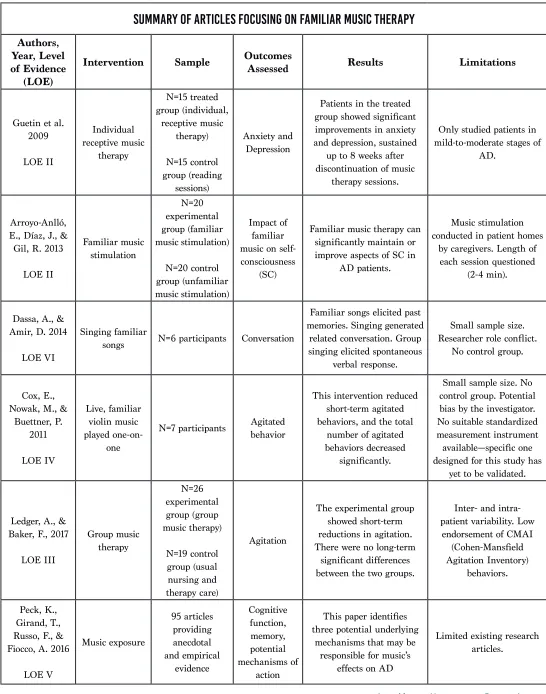
An exhaustive literature review was conducted using the database CINAHL (EBSCO). The search terms included “Alzheimer’s disease AND music therapy,” “Alzheimer’s AND music therapy,” “Alzheimer’s disease symptoms AND music therapy,” “Alzheimer’s disease AND music therapy AND familiar music,” and “Alzheimer’s disease AND active music therapy.” The literature search included full text articles from academic journals in the English language, including international articles. Only articles published between 2007 through 2017 were reviewed, with the exception of one relevant article from 2005. From the initial search results, 35 articles matched the preliminary criteria and were further reviewed if they addressed a) Alzheimer’s disease, b) elements and types of music therapy, c) outcomes of music therapy, d) scientific explanation of music therapy efficacy, and e) nursing implications. A total of 13 articles met the inclusion criteria and were included in the literature review. Six of these articles focused on familiar music therapy and are summarized in Table 1.
ALZHEIMER’S DISEASE
Alzheimer’s disease (AD), an irreversible progressive brain disorder, has an unrelenting course that adversely impacts every aspect of a patient’s reality and often results in utter dependency on others for self care. With a new diagnosis every 66 seconds, AD affects more than five million individuals in the United States alone, and the Alzheimer’s Association (2017) estimates this number to more than triple by 2050.
While AD often progresses gradually through three stages—mild, moderate, and severe—every patient endures the associated manifestations differently, which can make it difficult to discern which stage a person is experiencing. An individual displaying the early symptoms of AD may show signs of forgetfulness, possibly misplacing objects or failing to recall a friend’s name, but will likely remain independent through the first stage of the disease. As the patient’s condition progresses into the middle stage, personality and behavior changes will be noted, such as frustration, anger, refusing to shower, etc., as well as a greater need for assistance with daily activities. The most disabling manifestations of the disease appear in the final stage, including a loss of environmental awareness, severe communication impairments, crippling physical limitations, and the need for constant supervision and care (Alzheimer’s Association, 2017).
Non-pharmacological therapies
for AD symptom management have
been identified and implemented
to improve patients’ quality of life.
One of the most troubling aspects of AD lies in the inevitable imminence of death once the disease begins to unfold, despite the pharmacological options that exist. Treatment efforts for AD patients currently focus on symptom management utilizing a multidisciplinary approach that combines both pharmacological and non-pharmacological interventions to achieve the highest possible quality of life. While beneficial, most pharmacological treatments yield limited improvement and may result in further patient deterioration due to the adverse effects associated with antipsychotic and/or psychotropic drugs (Guetin et al., 2013). In contrast, the various non-pharmacological therapies for AD symptom management have been identified and implemented to improve patients’ quality of life, and researchers continue to vigorously pursue answers to better understand the disease, determine effective treatment options, and prevent its development entirely.
MUSIC THERAPY
TABLE 1
SUMMARY OF ARTICLES FOCUSING ON FAMILIAR MUSIC THERAPY
Authors,Year, Level of Evidence
(LOE)
Intervention Sample Outcomes Assessed Results Limitations
Guetin et al. 2009 LOE II Individual receptive music therapy N=15 treated group (individual, receptive music therapy) N=15 control group (reading sessions) Anxiety and Depression
Patients in the treated group showed significant improvements in anxiety and depression, sustained
up to 8 weeks after discontinuation of music
therapy sessions.
Only studied patients in mild-to-moderate stages of
AD.
Arroyo-Anlló, E., Díaz, J., & Gil, R. 2013
LOE II Familiar music stimulation N=20 experimental group (familiar music stimulation) N=20 control group (unfamiliar music stimulation) Impact of familiar music on self-consciousness
(SC)
Familiar music therapy can significantly maintain or improve aspects of SC in
AD patients.
Music stimulation conducted in patient homes
by caregivers. Length of each session questioned
(2-4 min).
Dassa, A., & Amir, D. 2014
LOE VI
Singing familiar
songs N=6 participants Conversation
Familiar songs elicited past memories. Singing generated
related conversation. Group singing elicited spontaneous
verbal response.
Small sample size. Researcher role conflict.
No control group.
Cox, E., Nowak, M., &
Buettner, P. 2011 LOE IV Live, familiar violin music played one-on-one
N=7 participants Agitated behavior
This intervention reduced short-term agitated behaviors, and the total
number of agitated behaviors decreased
significantly.
Small sample size. No control group. Potential bias by the investigator. No suitable standardized measurement instrument available—specific one designed for this study has
yet to be validated.
Ledger, A., & Baker, F., 2017
LOE III Group music therapy N=26 experimental group (group music therapy) N=19 control group (usual nursing and therapy care) Agitation
The experimental group showed short-term reductions in agitation. There were no long-term
significant differences between the two groups.
Inter- and intra-patient variability. Low
endorsement of CMAI (Cohen-Mansfield Agitation Inventory)
behaviors.
Peck, K., Girand, T., Russo, F., & Fiocco, A. 2016
LOE V Music exposure 95 articles providing anecdotal and empirical evidence Cognitive function, memory, potential mechanisms of action
This paper identifies three potential underlying
mechanisms that may be responsible for music’s
effects on AD
by the World Federation of Music Therapy, is “the use of music and/or its musical elements (sound, rhythm, melody and harmony) by a qualified music therapist, with a client or group, in a process designed to facilitate and promote communication, relationships, learning, mobilization, expression, organization, and other relevant therapeutic objectives in order to meet physical, emotional, mental, social, and cognitive needs” (Guetin et al., 2013, p. 621).
There is hieroglyphic evidence suggesting
the Egyptians treated a variety of
ailments, such as pain, depression, and
sleep disorders, with melodic hymns
and incantations.
While music therapy has gained popularity in recent years as an effective tool to manage a variety of health care needs, such as procedural pain control, behavioral disorder manifestations, and physical rehabilitation, this non-pharmacological intervention has ancient roots dating as far back as the sixth century BCE (Cox, Nowak, & Buettner, 2011). There is hieroglyphic evidence suggesting the Egyptians treated a variety of ailments, such as pain, depression, and sleep disorders, with melodic hymns and incantations (Guetin et al., 2013). Plato, during ancient Grecian times, dubbed musical training a form of “mental hygiene,” as well as “medicine for the soul” (Guetin et al., 2013, p. 622). The 20th century brought about the scientific discovery of the physiological effects music can produce on blood pressure and heart rate, which helps explain the earlier findings detected by dental surgeons, who noticed their patients seemed to experience decreased pain and anxiety during procedures if a phonograph was playing simultaneously (Guetin et al., 2013).
Although primitive, these historical efforts laid the foundation to legitimize music therapy professionally. The National Association for Music Therapy, created in the United States during the mid-20th century, became the original representative professional organization and was shortly followed by the emergence of the American Association for Music Therapy in 1971. Since then, these two associations have been consolidated into the present-day American Music Therapy Association (AMTA), which is responsible for setting the educational requirements for aspiring music therapists. In order to become Music Therapist-Board Certified (MT-BC) in the United States, these individuals must receive a bachelor’s, master’s, or doctoral degree from an accredited program, complete a
clinical internship, and partake in 1200 clinical training hours before sitting for the board certification examination (Ahn & Ashida, 2012). The AMTA also established professional competencies, standards of clinical practice, and a code of ethics to maintain the quality of services provided by the music therapy profession. The standards of clinical practice outline the general order in which music therapy services are delivered: 1) referral and acceptance, 2) assessment, 3) treatment planning, 4) implementation, 5) documentation, and 6) termination (American Music Therapy Association, 2015).
ACTIVE VS. RECEPTIVE MUSIC THERAPY
Although the exact physiological mechanisms responsible for the efficacy of music therapy on Alzheimer’s disease are not yet fully understood, the behavioral, cognitive, and physical improvements that have been noted during both therapy sessions and research studies are undeniably significant. The degree of improvement following musical intervention is primarily influenced by music therapists’ understanding of how best to utilize the distinct elements within music, which is further based on their knowledge of how each aspect will impact a patient’s cognitive and behavioral status (Guetin et al., 2009). The broader concept of music therapy encompasses two fundamental methods, active and receptive. Active music therapy requires the patient to be physically engaged, such as through the use of sound-producing objects, singing, dance-like movement, or playing instruments (Guetin et al., 2013). Receptive music therapy, considered a “controlled method for listening to music,” is comprised of specifically selected songs or live music played for the patient, with song choice based on individually meaningful elements, such as generation, culture, or personal history (Guetin et al., 2009). Both active and receptive music therapy can be used to target specific AD symptoms, such as memory loss, language deficits, depression, anxiety, and/or agitation, with the degree of symptomatic improvement primarily dependent on which method is utilized. Therapists may use a single method individually or combine methods, depending on the desired outcome.
maintain articulation, and support breath control. This type of music therapy heavily encourages physical engagement, purposefully exercising parts of the body through specific activities. Rhythm-based exercises pinpoint psychomotility (bodily movements influenced by mental processes), allowing patients to maintain a feasible level of mobility and coordination, and playing instruments assists in improving fine and gross motor skills (Guetin et al., 2013).
Receptive music therapy, generally considered to be a more passive approach, encompasses three distinct techniques: analytical, reminiscent, and relaxation. Analytical receptive music therapy is a type of psychotherapy in which the therapist utilizes music as a therapeutic tool to evaluate the patient before and after listening to carefully selected songs, with the intent of promoting expression and thought development. Reminiscent receptive music therapy involves playing meaningful and familiar songs unique to each patient, and aims to improve short- and long-term memory, evoke forgotten memories, and boost patient confidence to facilitate social interactions. The objective of relaxation receptive music therapy is to overcome distressing symptoms, such as pain, depression, and anxiety, by providing a calming environment. This result is most commonly accomplished through use of “U” sequences, or “music sequences of 20-30 minutes, subdivided into several phases,” which guide the patient progressively towards a state of relaxation (Guetin et al., 2013, p. 625).
Flexibility and adaptability are key concepts the music therapist must consider during sessions in order to maximize patients’ engagement and participation (Ahn & Ashida, 2012). Therefore, the musical techniques selected are tailored to patients’ ability level, as well as behavioral and cognitive status (Guetin et al., 2013). Specific therapeutic activities that hold meaning for these individuals, or that somehow relate to their earlier years of life, should be utilized since musical interventions that include an element of familiarity will elicit the most beneficial outcomes (Guetin et al., 2013).
FAMILIAR MUSIC & THE PERSONAL PLAYLIST
Due to the “close links that exist between the elements that make up music and the subject’s individual history,” the use of meaningful, familiar songs with both active and receptive interventions often acts as a key, unlocking forgotten memories and allowing them to resurface to the patient’s conscious mind temporarily (Guetin et al., 2013, p. 623). In order to determine familiar music, music therapists conduct a thorough patient assessment, following the previously listed standards of clinical practice. By exploring the patient’s cultural background, assessing aspects such as socioeconomic status, religion/spirituality, race, ethnicity, language, family experiences, etc., music therapists are able to formulate anindividualized music therapy program (American Music Therapy Association, 2015). Selecting music, both active and passive, that reflects patients’ generation, personal experiences, and/or emotional associations will stimulate neural networks in several parts of the brain to regenerate affiliated memories through the auditory pathways. Based on this understanding, researchers developed the concept of personal playlists, providing Alzheimer’s patients with instant access to personally evocative music through a simple, inexpensive digital audio player, such as an iPod Shuffle or MP3 player (Tomaino, 2011).
Researchers developed the concept
of personal playlists, providing
Alzheimer’s patients with instant
access to personally evocative music.
This idea originated from the “Well-Tuned: Music Players for Health” program, which was collaboratively created by MusicandMemory.org and the Institute for Music and Neurological Function, and sanctioned by licensed music therapists (Tomaino, 2011). The success of this program is rooted in the personalization of music, which is achieved by customizing playlists to incorporate songs related to personal “experiences, cultural backgrounds, and frame of reference” (Tomaino, 2011, p. 20).
Patients are encouraged to have access to multiple individualized playlists because the musical selections in each can be modified to elicit specific desired outcomes throughout the day, such as rousing patients early in the morning or soothing them as bedtime approaches (Tomaino, 2011). Furthermore, these uniquely tailored playlists can assist patients in achieving other therapeutic goals, such as relaxation or exercise, which become more difficult over time as the disease progresses (Tomaino, 2011).
of the participants’ SC in comparison to unfamiliar music (Arroyo-Anlló et al., 2013).
The study’s inclusion criteria mandated that all participants be in the mild to moderate stages of AD; they were then evenly divided to eliminate any age, gender, or educational discrepancies, and randomly assigned to either the experimental or control group. Both groups underwent the same pre- and post-intervention assessments, during which each participant completed two cognitive tests and a SC questionnaire. The SC questionnaire, previously devised by the same researchers for an earlier study, was comprised of 14 simple questions designed to assess the seven components of SC. The intervention phase introduced a 36-week period of musical stimulation, which was broken down into 2-4 minute sessions, three times a week. In a manner equivalent to that of the personal playlist, each patient in the experimental group listened to pre-selected popular Spanish music in their homes via headphones, while those in the control group were assigned unfamiliar non-Spanish songs (Arroyo-Anlló et al., 2013).
Researchers determined from the pre-intervention questionnaire results that there were no significant differences in any aspects of SC between the experimental and control groups. However, following the musical interventions, a slight change was noted in the experimental group’s overall SC questionnaire score, while the control group’s score indicated further deterioration. Therefore, researchers found a significant difference in the pre- and post-intervention scores between the two groups. All SC aspects of the control group demonstrated further impairment or were left unchanged following musical intervention with the exception of body representation, which was shown to improve (Arroyo-Anlló et al., 2013). Additionally, the experimental group revealed significant improvements in personal identity, affective state, moral judgments, and body representation after familiar music stimulation, while anosognosia, prospective memory, and introspection remained unchanged (Arroyo-Anlló et al., 2013).
Arroyo-Anlló et al. (2013) concluded that the results confirmed their initial hypothesis, which surmised that exposing AD patients to familiar musical selections would lead to improvements in their SC. Although the control AD group demonstrated progressive mental decline throughout the study, it remains undetermined whether this symptomatic deterioration was due to the unfamiliar musical exposure, the progression of AD, or other potential explanations. Regardless, the findings of this study led the researchers to conclude that “familiar music could be considered as an enhancer not only of SC in AD, but also of the general cognitive state,” suggesting that familiar music intervention could be an important therapeutic tool to improve quality of life for these unfortunate patients (Arroyo-Anlló et al., 2013, p. 6).
THERAPEUTIC INDICATIONS: SYMPTOM RELIEF
Due to the cognitive, affective, and behavioral stimulatory responses elicited through both active and passive familiar music therapy, there are a diverse number of indications for the use of this therapeutic intervention with AD patients (Guetin et al., 2013). Music therapy arouses autobiographical memories, evokes conversation through speech facilitation, alleviates anxiety and depression, and diminishes the occurrence of agitated outbursts.Music therapy arouses autobiographical
memories, evokes conversation
through speech facilitation, alleviates
anxiety and depression, and diminishes
the occurrence of agitated outbursts.
MEMORY LOSS
Memory loss is one of the most distinguishing symptoms of AD, gradually stealing away individuals’ personal identities, recognition of loved ones, and most cherished lifelong experiences. Fortunately, however, “emotionally charged memories are better encoded and remembered than those with a low affective valence,” allowing patients to recall sentimental events more easily than unremarkable ones, reinforced through the stimulation of personally significant music (Guetin et al., 2013, p. 629). The temporary recollection of such meaningful autobiographical memories can help trigger patients’ remaining cognitive abilities, potentially leading to a revival of verbal expression as they attempt to communicate these past experiences (Guetin et al., 2013).
SPEECH AND COMMUNICATION DEFICITS
In one study exploring the impact of familiar music on conversational abilities in patients with middle- to late- stage AD, the researcher encouraged the six participants to accompany her in singing carefully selected songs, each followed by conversation facilitated through the use of open-ended questions. As intended, the topics of each question evoked related memories that spurred conversation pertaining to relevant concepts, experiences, or emotions. The results of this study revealed several other enlightening findings, especially about the unexpectedly enduring conversational abilities that remain well into the later stages of AD. The researcher discovered, for example, that the act of singing elicited spontaneous remarks from the participants. These included comments expressing not only their individual enthusiasm and pride for successfully partaking in the interventions, but also the unity and sense of belonging they experienced as a group—an important revelation to note, for the inability of AD patients to communicate with others can result in feelings of isolation and loneliness (Dassa & Amir, 2014).
DEPRESSION AND ANXIETY
Depression and anxiety become apparent as the patient shows signs of disinterest and apathy towards social interaction and/or previously enjoyed activities (Guetin et al., 2009). As each manifestation of AD progressively worsens, the patient’s sense of identity unravels, which according to theoretical literature is closely connected to escalating feelings of depression and anxiety. When researchers then explored this proposed connection between identity, mood, and quality of life, the resulting empirical evidence was corroboratory (Caddell & Clare, 2012). Thus, interventions that preserve patients’ sense of identity can lessen the burden of depressive and anxious symptoms.
In order to assess the efficacy of therapeutic musical intervention on both depression and anxiety, Guetin et al. (2009) conducted a randomized, controlled study utilizing receptive music therapy, in which the experimental group participated in weekly music therapy sessions guided by the “U” technique, while the control group took part in reading sessions conducted under the same conditions. The music therapy group demonstrated significant symptomatic improvements in anxious and depressive behaviors, which were sustained for up to eight weeks following the cessation of treatment, confirming music therapy as an effective therapeutic tool for the short-term alleviation of anxiety and depression (Guetin et al., 2009).
AGITATION
Agitated behaviors are a particularly troublesome manifestation of the disease, occurring in approximately 90% of AD patients. Agitation in AD patients can be exhibited aggressively
or non-aggressively through both physical and verbal mannerisms (Cox et al., 2011). The incidence of agitated behaviors tends to fluctuate intermittently throughout the course of the disease, with the severity of symptoms remaining fairly consistent over time. Often occurring simultaneously with unmet personal needs, periods of under- or over-stimulation, or interactions hindered by communication impediments, agitation is viewed as an expression “of despair, frustration, boredom, or loneliness” (Ledger & Baker, 2007, p. 331). Music therapy can lessen these agitated behaviors by heightening patients’ level of arousal, redirecting their attention, creating a less fearful environment, providing an outlet for self-expression, and potentially reinstating meaning back into their lives (Ledger & Baker, 2007).
Music therapy can lessen these
agitated behaviors by heightening
patients’ level of arousal,
redirecting their attention, [and]
creating a less fearful environment.
One study conducted in a Specialized Care Unit explored the impact of relaxing music on the overall agitation level commonly present during dinnertime. Using the Cohen-Mansfield Agitation Inventory to measure the participants’ agitation behavioral level, Hicks-Moore (2005) discovered there was a reduced incidence of agitated behaviors during the two weeks that relaxing music accompanied dinnertime, in comparison to music-free dinner times during the other observed two weeks. This musical intervention yielded not only a reduced level of agitation, but also an increase in socialization and communication among residents (Hicks-Moore, 2005).
THEORIES OF MECHANISMS OF ACTION
While ample evidence exists that demonstrates the beneficial effects of music-based interventions for AD patients, there is a research gap regarding the potential mechanisms of action responsible for the witnessed effects of music therapy (Peck, Girard, Russo, & Fiocco, 2016). This specific body of knowledge, once better explored and established, would provide the means to legitimize music therapy as an evidence-based treatment for AD, rather than a non-pharmacological alternative intervention (Ahn & Ashida, 2012).
cortex are deeply involved in emotional regulation and decision-making, and work closely with the limbic system to integrate emotional and sensory information (Peck et al., 2016). As the disease interrupts neural connections and leads to brain cell death, these structures eventually become compromised; however, these areas are some of the last to encounter these destructive effects, thus allowing the stimulatory properties of music to influence AD patients well into the final stages of the disease (Tomaino, 2011).
Peck et al. (2016) hypothesize that three underlying mechanisms are responsible for the efficacy of music therapy, stemming from pathways that involve dopamine, the autonomic nervous system, and neuronal connectivity. While each mechanisms of action independently plays a role in the neurocognitive responses to music, all three are closely intertwined (Peck et al., 2016).
Dopamine, a neurotransmitter vitally important in the regulation of reward and motivation, is partially responsible for learning, memory consolidation, and various aspects of the reward system, such as acquisition and anticipation. Dopaminergic depletion is a damaging byproduct of AD, associated with cognitive impairment in patients due to the reduced availability of dopamine in limbic structures and decreased receptor binding. However, regions in the brain influenced by dopaminergic pathways, such as the hypothalamus and amygdala, have demonstrated responsiveness to music, leading researchers to ponder whether “music can be used to stimulate and strengthen dopaminergic pathways and interconnected brain structures that are commonly compromised in persons with AD” (Peck et al., 2016, p. 953). If proven scientifically effective, music therapy could then be utilized to specifically target these areas, ultimately enhancing AD patients’ reward systems and motivational drive (Peck et al., 2016).
Emotionally impactful music activates the autonomic nervous system, which induces physiological changes through sympathetic and parasympathetic activity. The sympathetic nervous system, responsive to louder, faster music, increases autonomic functions, such as blood pressure, heart rate, and respiration, when aroused; whereas slower, relaxing music activates the parasympathetic nervous systems, sequentially slowing these physiological responses. In the case of AD patients exhibiting agitated behaviors, likely originating from heightened physiological arousal, studies have concluded that therapeutically relaxing music drastically reduces these symptoms—a result, researchers postulate, that may be attributable to the activation of the parasympathetic nervous system (Peck et al., 2016).
There is extensive neuronal connectivity throughout the brain, including the default mode network (DMN), which
“is a system of interconnected brain regions that are active during resting state when individuals are awake and alert, but not actively engaged in directed attentional task” (Peck et al., 2016, p. 954). Many of the self-referential processes influenced by the DMN, such as introspection and autobiographical memory recollection, become impaired with the progression of AD. Research suggests that the damaging effects of AD cause brain regions connected by the DMN to atrophy, leading to the network’s dysfunction in areas of cognitive functioning, such as memory retrieval. Fortunately, studies have revealed that high activity music can activate the DMN, stimulating the network connectivity to an optimal level and allowing the patient’s introspective ability, autobiographical memory retrieval, and memory processing to improve (Peck et al., 2016).
NURSING IMPLICATIONS
The rapidly increasing prevalence of AD in the elderly population means that there is a range of opportunities to integrate therapeutic music interventions into the scope of nursing practice, including interdisciplinary collaboration between music therapists and nurses, educating family members and/or caregivers about the benefits of music therapy, or simply a bedside intervention to alleviate bothersome symptoms.
There is a range of opportunities to
integrate therapeutic music interventions
into the scope of nursing practice.
In both long-term care facilities and acute care settings, nurses are frequently tasked with ensuring that patients receive adequate nutrition, regular baths, and other daily self care. The findings of the study conducted by Hicks-Moore (2005) on the effects of relaxing music on agitation levels during dinner time may be applicable to nursing practice in a broader sense, perhaps demonstrating how receptive music therapy can facilitate a more alert and oriented state of mind in AD patients, thus allowing nurses to perform activities of daily living (ADLs) without the agitation and resistance that often hinder the fulfillment of such tasks. Caregivers, for example, have reported instances of engaging patients through singing while simultaneously assisting with ADLs—a tactic that bedside nurses might implement when performing similar activities (Carson, 2012).
to subdue an agitated individual may not only decrease the need for physical and chemical restraints, but can also provide the facility with a noninvasive, cost-effective alternative (Witzke, Rhone, Backhaus, & Shaver, 2008). Even with potentially provocative situations, such as painful blood draws or wound dressings, the nurse can use music as preventative tool to avoid aggressive encounters altogether (Carson, 2012).
The interdisciplinary teamwork that transpires between music therapists and nurses may be potentially beneficial, particularly during group sessions where continued assessment of patients’ responses would be required. The nurse would likely assume this responsibility, additionally monitoring for any unsatisfactory or objectionable reactions elicited in the participants. During an exercise utilizing headphones, for example, the nurse would adjust the volume for each individual to ensure the optimal level of auditory stimuli was being provided (Witzke et al., 2008).
Music therapy offers AD patients an
escape, a means through which they
can regain their sense of personal
identity, recall their most significant life
experiences, and once again recognize
their beloved family and friends.
Another potential way in which music therapy could be integrated into nursing practice might be through the initial assessment of newly admitted AD patients into nursing homes, where nurses would examine any existing need for music therapy. Furthermore, nurses could play a role in the implementation of music therapy as well, possibly utilizing this therapeutic intervention as a means to engage the individual while providing patient-centered care, or while partaking in interdisciplinary teamwork, as discussed above. If nurses were to become this involved in the implementation of music therapy at the bedside, they could then educate patients’ family members and/or caregivers on the numerous benefits of including music therapy in patients’ treatment plans.
LIMITATIONS
Overall, the greatest limitations of this literature review include 1) a lack of clinical research aimed at understanding how music interacts with the underlying bodily systems, and 2) a lack of research studying the long-term effects of music therapy. A full list of limitations of the six articles that address familiar music therapy included in the review
is available earlier in Table 1. Common limitations included small sample size (Cox et al., 2011; Dassa & Amir, 2014), participant variability (Ledger & Baker, 2007), no control group (Cox et al., 2011; Dassa & Amir, 2014), research bias or role conflict (Cox et al., 2011; Dassa & Amir, 2014), and a lack of standardized measurement instruments (Cox et al., 2011).
CONCLUSION
REFERENCES
Ahn, S., & Ashida, S. (2012). Music therapy for dementia.
Maturitas, 71(1), 6-7. Retrieved from http://www.maturitas.
org/article/S0378-5122(11)00363-X/pdf
Alzheimer’s Association (2017). 2017 Alzheimer’s disease facts and figures. Retrieved from http://www.alz.org/facts/ overview.asp
American Music Therapy Association (2015). AMTA standards of clinical practice. Retrieved from https://www. musictherapy.org/about/standards/
Arroyo-Anlló, E. M., Díaz, J. P., & Gil, R. (2013). Familiar music as an enhancer of self-consciousness in patients with Alzheimer’s disease. Biomed Research International. doi: 10.1155/2013/752965
Caddell, L., & Clare, L. (2012). Identity, mood, and quality of life in people with early-stage dementia.
International Psychogeriatrics, 24(8), 1306-1315. doi:10.1017/
S104161021100278X
Carson, V. B. (2012). The magic of music in Alzheimer’s disease. Caring, 31(10), 40-42.
Cox, E., Nowak, M., & Buettner, P. (2011). Managing agitated behaviour in people with Alzheimer’s disease: the role of live music. British Journal of Occupational Therapy, 74(11), 517-524. doi:10.4276/030802211X13204135680866
Dassa, A., & Amir, D. (2014). The role of singing familiar songs in encouraging conversation among people with middle to late stage Alzheimer’s disease. Journal of Music
Therapy, 51(2), 131-153. doi:10.1093/jmt/thu007
Guetin, S., Charras, K., Berard, A., Arbus, C., Berthelon, P., Blanc, F., & Leger, J. (2013). An overview of the use of music therapy in the context of Alzheimer’s disease: a report of a French expert group. Dementia, 12(5), 619-634. doi:10.1177/1471301212438290
Guetin, S., Portet, F., Picot, M., Pommié, C., Messaoudi, M., Djabelkir, L., & Touchon, J. (2009). Effect of music therapy on anxiety and depression in patients with Alzheimer’s type dementia: randomised, controlled study. Dementia & Geriatric
Cognitive Disorders, 28(1), 36-46. doi:10.1159/000229024
Hicks-Moore, S. (2005). Relaxing music at mealtime in nursing homes: Effects on agitated patients with dementia. Journal of Gerontological Nursing, 31(12), 26-32. doi:10.3928/0098-9134-20051201-07
Ledger, A., & Baker, F. (2007). An investigation of long-term effects of group music therapy on agitation levels of people with Alzheimer’s disease. Aging & Mental Health, 11(3), 330-338. doi:10.1080/13607860600963406
Narme, P., Clément, S., Ehrlé, N., Schiaratura, L., Vachez, S., Courtaigne, B., ... Samson, S. (2014). Efficacy of musical interventions in dementia: evidence from a randomized controlled trial. Journal of Alzheimer’s Disease, 38(2), 359-369. doi:10.3233/JAD-130893
Peck, K. J., Girard, T. A., Russo, F. A., & Fiocco, A. J. (2016). Music and memory in Alzheimer’s disease and the potential underlying mechanisms. Journal of Alzheimer’s
Disease, 51(4), 949-959. doi:10.3233/JAD-150998
Tomaino, C. M. (2011). Music and memory: Alzheimer’s disease and the “well-tuned iPod”—adding a personal playlist to the quest for “person-centered care.” Activities Directors’ Quarterly for Alzheimer’s & Other Dementia Patients, 12(4), 19-23. Witzke, J., Rhone, R., Backhaus, D., & Shaver, N. (2008). How sweet the sound: research evidence for the use of music in Alzheimer’s dementia. Journal of Gerontological Nursing,
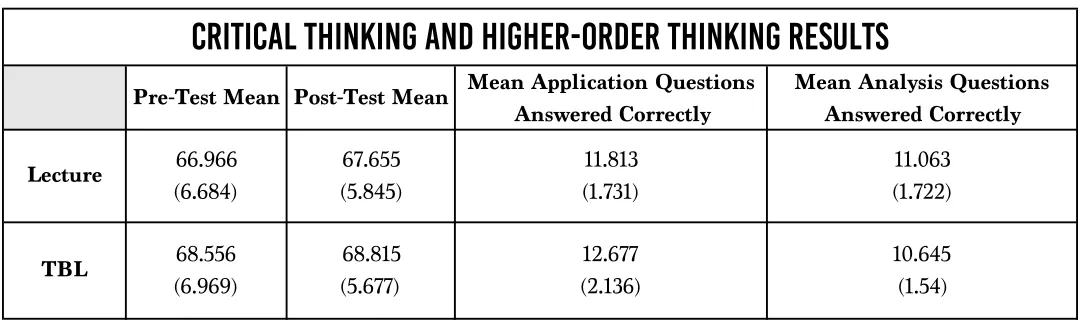
Team-based learning (TBL) classes utilize techniques believed to foster increases in critical and higher-order thinking skills when compared to lecture classes. This study compares increases in critical and higher-order thinking skills in a TBL class and a lecture class covering identical subject matter and taught by the same professor during a single semester. Raw score changes on the the Halpern Critical Thinking Assessment S2 (HCTA S2) were used to measure critical thinking skill changes and Bloom’s Taxonomy was used to differentiate higher-order questions on the final exam. No significant difference was found between the two classes when comparing raw score changes on the HCTA S2 or higher-order thinking analysis questions. A significant difference was found when comparing the number of correct answers on the higher-order thinking application questions on the final exam. A significant negative correlation was found between raw score changes on the HCTA S2 and correct higher-order thinking questions on the final exam. These findings suggest the need for future studies that assess the increase in higher-order application skills in team-based learning classes and reassess the effect of class structure on critical thinking skills.
JMURJ
ABSTRACT
CRITICAL THINKING SKILLS ACROSS
THE SEMESTER IN LECTURE- AND
TEAM-BASED LEARNING CLASSES
Educators, professors, and researchers alike believe that critical and higher-order thinking are valuable skills for students to develop because of their academic and real-world applications (Browne & Keeley, 1988; Halpern & Nummedal, 1995; Lawson, 1999; Penningroth, Despain, & Gray, 2007). Although the exact definition of critical thinking is widely debated, most agree that it is a component of higher-order thinking (Lewis & Smith, 1993), a sought- after educational skill that combines argument analysis and decision-making (Astleitner, 2002; Ennis, 1993; Fisher & Scriven, 1997; Gold, Holman, & Thorpe, 2002; Halpern & Riggio, 2003; McPeck, 1990; Missimer, 1986; Moore, 1989; Morris & Ennis, 1989; Paul & Elder, 2008; Paul, Fisher, & Nosich, 1993). Critical thinking can be increased through active and collaborative learning (Burbach, Matkin, & Fritz, 2004; Gokhale, 1995; Johnson & Johnson, 1989; Laal & Ghodsi, 2012; Panitz, 1999; Penningroth et al., 2007; Roberts, 2004).
Critical and higher-order thinking are considered important skills; therefore, it is necessary to examine how they can be promoted in the classroom (Browne & Keeley, 1988). The purpose of this study was to assess changes in critical thinking and higher-order thinking skills as a result of different pedagogical methods. Specifically, I examined the impact of Team-Based Learning (TBL) on changes in critical and higher-order thinking skills throughout the course of a semester compared to a traditional lecture method (Michaelson, Knight, & Fink, 2002).
LITERATURE REVIEW
TEAM-BASED LEARNING
TBL is an instructional strategy that employs active and collaborative learning through a sequence of activities which includes individual work, teamwork, and immediate feedback (Michaelson et al., 2002; Parmelee, Michaelsen, Cook, & Hudes, 2012). TBL’s prescribed structure should enhance the learning process through teamwork and application activities. These styles of learning stimulate and challenge students while promoting higher-order thinking and critical thinking, which include argument analysis and decision-making skills.
The TBL structure includes two main components: the first ensures that students have a solid foundation in the primary course content, while the second requires students to apply the knowledge. The Readiness Assurance Process (RAP) is a basic mechanism used in TBL which ensures that students learn and understand the primary course content for each unit (Michaelsen et al., 2002). The RAP consists of completing take-home assignments for initial exposure to primary course content. In the classroom, students take an individual quiz and then take the same quiz with their
teams to ensure they understand the primary course content. A short clarification lecture further ensures students’ understanding of the primary course content. The RAP provides students with the foundational understanding of the concepts and prepares them for engaging in stimulating discussion during the application activities (Michaelsen et al., 2002).
After students complete the RAP for each unit, they work in their teams to complete activities that require teams to apply course concepts (see Appendix A for an example). The application activities are set up in a structure that allows students to work on the same specific-choice problem, case, or question (Michaelsen et al., 2002). The specific-choices are all correct answers, but students within the teams need to decide which option they think is most appropriate (Michaelsen et al., 2002). After choosing, teams must provide evidence to support their decision (Michaelsen et al., 2002). Having the same specific-choice questions with all correct answers requires the teams to simultaneously report their answers and solidify their commitment to the choice (Michaelsen et al., 2002). After teams simultaneously report their choices, they engage in a debate which requires them to defend their answer. The RAP and the application activities promote components of critical thinking and higher-order thinking; therefore, I expected that TBL students would show greater gains in critical thinking and higher-order thinking than lecture students.
TBL, HIGHER-ORDER THINKING, AND CRITICAL THINKING
This section elaborates on the key components of higher-order and critical thinking and describes how each may be enhanced with TBL.
Higher-order thinking. Higher-order thinking is a
concept with varying definitions (Garrison et al., 1999; Lewis & Smith, 1993; Miri, David, & Uri, 2007). I will refer to higher-order thinking as constructing meaning while yielding multiple solutions, each with costs and benefits, rather than one simple solution (Garrison et al., 1999; Paul, 1993; Resnick, 1987).
Identifying higher-order thinking can be done by using Bloom’s Taxonomy, a framework used to categorize levels of reasoning skills (Bloom, 1956)1. There are six levels
in the taxonomy, which gradually increase in the level of abstraction and thinking (Bloom, 1956). Knowledge