Northeast Historical Archaeology
Volume 22
From Prehistory to the Present: Studies in
Northeastern Archaeology in Honor of Bert Salwen
Article 11
1993
An Archaeological Analysis of Spatial Patterning in
College Dormitory Rooms
Rose Garvin-Jackson
Follow this and additional works at:
http://orb.binghamton.edu/neha
Part of the
Archaeological Anthropology Commons
This Article is brought to you for free and open access by The Open Repository @ Binghamton (The ORB). It has been accepted for inclusion in Northeast Historical Archaeology by an authorized editor of The Open Repository @ Binghamton (The ORB). For more information, please contact
Recommended Citation
Garvin-Jackson, Rose (1993) "An Archaeological Analysis of Spatial Patterning in College Dormitory Rooms,"Northeast Historical Archaeology: Vol. 22 22, Article 11.
An Archaeological Analysis of Spatial Patterning in College Dormitory
Rooms
Cover Page Footnote
This paper is drawn from my M.A. thesis, "The Use of Space and Territoriality in Dormitory Rooms: An Archaeological Approach" (1989) on file in the Department of Anthropology, New York University. I would like to thank Bruce Jackson and Ellen Snyder-Grenier for reading earlier drafts of this paper.
Northeast Historical ArchaeologyNol. 21-22, 1992-1993 161
AN ARCHAEOLOGICAL ANALYSIS OF SPATIAL
PATTERNING IN COLLEGE DORMITORY ROOMS
Rose Garvin-Jackson
Bert Salwen's (1973) pilot study of dormitory residents' behavior is used to demonstrate that patterning in a modern, above-ground site can be investigated with archaeological techniques. The spatial patterning in 89 dormitory rooms is analyzed to identify the. various types of territories maintained by the residents. Several sociocultural variables are then selected to see if specific spatial behav-ior can be linked with given attributes.
L'etude pilote (1973) de Bert Salwen concernant le comportement de residents de maisons d'etudiants est utilisee pour demontrer que les methodes archeologiques peuvent servir ·it faire des investigations sur l' organisation dans un site contemporain situ{ au-dessus du sol. L'article examine I' organisation spa-tiale de 89 chambres de maisons d'etudiants pour cerner les divers types de terri-toires maintenus par les residants. Il choisit ensuite un certain nombre de vari-ables socioculturelles pour voir s'il est possible de rattacher un comportement spa-tial particulier
a
certains attributs.Introduction
In "Archeology in Megalopolis" Bert Salwen (1973) argued that modem, above-ground sites are suitable for ar-chaeological inquiry if they exhibit patterns of sociocultural behavior. The contemporary city-"a giant product of human behavior" (Salwen 1973: 162)-held a particular fascination for Sal-wen. On one level, modem urban com-munities provide laboratories for re-searchers to test and refine archaeolog-ical techniques, methodologies, and hypotheses about human-material be-havior (})ow people interact with ma-terial culture). On another level, the contemporary city provides a closer analogy to past urban communities than prehistoric ones. Salwen also contended thatarchaeological study of the urban experience, past or present, should be interdisciplinary because
researchers in other fields
(environmental and social
psychologists, sociologists, behavioral geographers, planners, designers, architects, historians, and anthropologists) already focus on the phenomenon of the city.
To illustrate his arguments, Salwen described a pilot project to study urban housing patterns conducted by a New
York University graduate
162 Spatinl Patterning in College Dor.ms/Garvin-Jackson
behavior. A dormitory was chosen because it provided a more readily available laboratory than apartment complexes, and Brittany was selected over other residences for its simila.rities with highrise urban apartment buildings.l . Highrise residences, whether they contain stu-dent dormitory rooms or farrlily apart-ments, provide a unique opportunity to study and compare the different uses of identical spaces, particularly if the inhabitants represent a variety. of cultural and economic backgrounds.
Using archaeological data-collect-ing techniques, the students compiled a series of room. diagrams, or maps, and questionnaires completed by the dormi-tory residents. The underlying assump-tion of the project was that "furniture layout and use of space in particular rooms [were] related in patterned ways to sociocultural attributes (statuses and personality types) of the occupants of these rooms" (Salwen 1973: 157). While data collection was thorough, the graduate students were faced with the time restrictions of the academic semester and thus performed little analysis of.· the data (Flinn 1972; Berman 1972).
In this article I use the previously unanalyzed data (diagrams and ques-tionnaires) generated from the dormi-tory project to explore some of the issues raised by Salwen (1973). My analysis demonstrates that hu:rnan-material patterning in a modem site can be inves-tigated with traditional archaeologi-cal techniques and can also provide in-sight into archaeological questions. In addition, I follow up on Salwen's (1973:
1 Brittany Residence Hall was the only NYU undergraduate dormitory that was both cO.:.educational and contained movable furniture. Built in 1929 as an ''apartment hotel," Brittany also shared many architec- . tural features with apartment buildings. ·
158, 162) early suggestion that the work of environmental psychologists on terri-torial behavior could be useful to ar-chaeologists·. exploring human-material relationships within an urban context. Combining archaeological techniques and methods within an environmental psychological model, my analysis of the dormitory project works from the hypothesis that the dormitory
resi-dents were maintaining territories and that patterning in territorial behavior could be linked to various sociocultural attributes and roommate relationships.
A Model for Human-Material
Behavior
In discussing human-material be-havior, it is necessary to establish what is meant by "material culture" and "material patterning." Material culture is defined here as objects made, modified, or used. by humans (Deetz 1977: 24; Hodder 1986: 6). But material culture is also the patternS and contexts in which the objects occur (Miller 1982: 17, 19; Hodder 1985: 5; Hodder 1987: 444-447). In looking at. human-material behavior, "space" is a central concept. Simply put, space means the "intel'Vals, distances, and relationships between people and people, people and things, and things and things" (Rapoport 1982: 179). But why do people choose certain "things" and organize them in specific ways?
Northeast Historical ArchaeologyNol. 21-22, 1992-1993 163
amount of time....:....as a basic human be-havior (Hall 1959; Altman 1975; Proshansky, Ittelson, and Rivlin 1976). These researchers argue that territori-ality allows individuals and groups to maintain social relations with others because the behavior ensures privacy and serves as a means for expressing identity. One particular aspect that environmental psychologists have fo-cused on is how people use and are in-fluenced by material culture (architecture, objects, furniture, etc.) in defining territories. Researchers have found that there are cultural and sub-cultural variations as well as sex, age, economic, and even individual differ-ences in the use of space and material culture (for example, Ardener 1981; Aiello and Thompson 1980; Rapoport 1980; Gauvain, Altman, and Fahim 1983).
The specific model used to examine the dormitory project is one developed by Irwin Altman (1975). Altman sees the physical environment and social behavior as mutually defining. In other words, the environment is defined as both "a determinant of behavior and as a form or extension of behavior" (Altman 1975: 5). While people use their material surroundings during so-cial interaction, they also rely on the physical setting for "cues" on how to behave.
Altman argues that social behavior is guided by people's attempt to achieve desired levels of privacy. Pri-vacy is the ability to control social in-teraction between oneself and others, and this control is accomplished by erecting as well as taking down bound-aries. The boundaries can be physical, social, or both.
According to Altman, personal space and territoriality are "privacy-regulation mechanisms" through which an individual or group attains privacy.
Crowding and social isolation occur when privacy mechanisms fail, result-ing in too much or too little social inter-action. As behavioral systems, per-sonal space and territoriality are "privacy-regulation mechanisms" be-cause they enable people to maintain boundaries.
Like a protective bubble, personal space is the "area with invisible boundaries surrounding a person's body into which intruders may not come" (Sommer 1969: 26). The need for per-sonal space is dynamic and influenced by sociocultural factors, personal pref-erences, and immediate circumstances.
Territoriality is the ownership, control, or use of a location or thing (Maxwell 1983: 20T-208). While the earliest research on territorial behav-ior focused on hostile control and de-fense of spaces, more recent studies have begun to focus on how territoriality allows individuals and groups to express identity and selfhood (Altman 1975; Rapoport 1982: 93; Maxwell 1983). Personal and group identity can be observed in how individuals and groups decorate their rooms, homes, offices, clubs, buildings, etc.
164 Spatial Patterning in College Dorms/Garvin-Jackson
Silverstein 1972: 371; Heilweil 1973: 379-380).
The Site
In 1972 Brittany Residence Hall was a co-educational dormitory~ hous'-ing approximately 400 students. The building contained 15 floors though only 13 were used for housing. There were 17 rooms per floor. The rooms were rectangular in shape with a door on the short wall and a large window on the opposite wall. The longer walls were devoid of major architectural features; Each occupant was assigned a single bed, bureau, bookcase, desk, desk chair, and "comfortable" c;hair (Salwen 1973: 157). Additional furniture and decora-tions could be brought in by the students. Each room housed one, two, or three students, though only "doubles" were used in the analysis.
Archaeological Data
Using room plans made from the building floor plans, the 1972 graduate students drew the locations of furniture and other objects including wall, floor, and ceiling decorations (Salwen 1973).
In the following analysis I have treated the diagrams (maps of artifact patterning) as the "archaeological record" of the dormitory residents' be-havior.
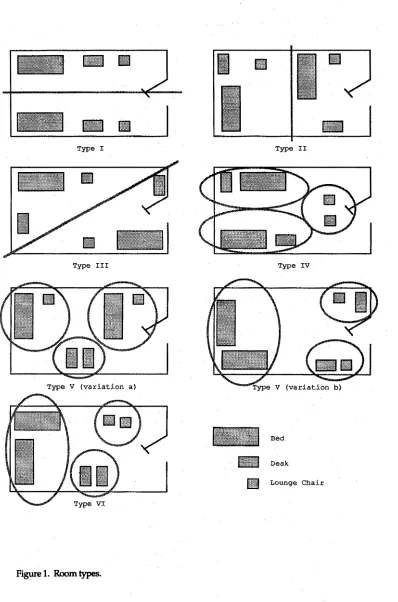
The diagrams of 89 doubles were analyzed by plotting the relative placement of the roommates' sets of fur-niture and other objects. Six room types were discerned (FIG. 1). This typology suggested that each student was using his or her own area in the room, pre-sumably to maintain a sense of privacy. It was hypothesized that variations in the need for privacy were reflected in
the. different room types and were shaped ]:)oth by the relationships be-tween the roommates and by the stu-dents' sociocultural attributes (age, sex, major, study habits, etc.). .
In 59 rooms (66% of the doubles) the occupants completely divided the space into two "use zones" (Salwen 1973: 158)
or territories. In other words, the furni-ture of one roommate was placed on one side of the room while the furniture of the other roommate was placed on the other side, as if an invisible line split the room in half. Rooms exhibiting this "split arrangement" {Salwen 1973: 158) were further separated into three types (I, II, and III) based on the specific way in which the space was divided.
Occupants of Type I rooms organized their space in ·a manner that gave each roommate approximately half the door, window, and wall space. This pattern occured most frequently and accounted for 39 of the doubles
(44%).
In contrast, the residents of Type II rooms divided the space along the other axis creating a "window zone" and a "corridor zone" (Salwen 1973: 158). Although occurring less frequently than Type I, the percentage of rooms exhibiting the Type II pattern
(19%) seems particularly significant given the rather unequal distribution of space. The individual occupying· the corridor zone not only lost access to the window but also had to allow the roommate to pass through his or her own territory when entering and exiting the room.
Type I
Type III
Type V (variationa)
Figure 1. Room types.
Northeast Historietil ArchaeologyNol. 21-22, 1992-1993 165
I
Type II
Type IV
Bed
Deak
!B
Lounge Chairmm
166 Spatial Patterning in College Dorms/Garvin-Jackson
The remaining types diverge from the split arrangement in varying de-grees and form a gradual transition to the full division of space into activity areas. To differentiate them from the first three types, these types are re-ferred to as "less split."
The occupants of Type IV rooms
cre-ated three areas or zones. Two of the areas each contained a bed and desk while. the third area included the lounge chairs With other categories of material such as couches, stereos, and television sets. Type IV rooms occurred with the same frequency as Type li rooms (19%).
Type V rooms occurred in two vari-ations. In the first; the beds were placed together while the desks were separated; there may have been a "social" or "communal" area. In the second· variant, desks were placed together but the beds were apart. Again, there may or may not have been a social area. Pattern V comprised nine of the doubles (10%).
In the final pattern, Type VI,· space was divided according to furniture type creating "activity areas." The beds were placed in one area, desks (and bul-letin boards, maps, lamps, etc.) in an-other, and the lounge chairs (along with couches, stereos, televisions, etc.) ina third. Only two rooms (2%) exhib-ited this type of spatial organization.
In summary, the room types ranged from a complete division of the room into two halves (Types I, II, and III) to the separation of the room into ·shared activity areas (Type VI). ·A number of roommates also maintained both indi-vidual territories and communal areas (Types IV and V).
Historical Data
Salwen's graduate students de-signed a two-page, standardized
ques-tionnaire to elicit information about the residents' sociocultural attributes, family background, roommate relation-ships, and attitudes towards their room and dormitory. The questionnaires were administered on an interview basis, with the researchers recording the residents' answers to the questions. Although not traditional sources of historical data, I have used the questionnaires as the archival record of the dormitory residents' behavior.
Eighty-four questionnaires were available from the residents of 65 dou-ble rooms. I entered the responses'into a computerized database and then sorted them to identify patterns in the occu-pants' answers and to gain a better un-derstanding of both the student popula-tion and environment of Brittany.
Findings
In looking at the data from the dia-grams and the questionnaires, I ob-served that there were differences be-tween how the students perceived their own territorial behavior and how this behavior was interpreted from the dia-grams. The students' responses to the question "Do you consider pa.rt of the room to be yours as opposed to your roommate's?" were 42%, positive and
54% negative (4% did not answer). In
contrast, the room types identified from the diagram analysis indicated that the vast majority of residents (98%) were forming individual territories in at least part Of the room (Types I, II,
III, IV, and V).
Northeast Historical Archaeology/Val. 21-22, 1992-1993 167
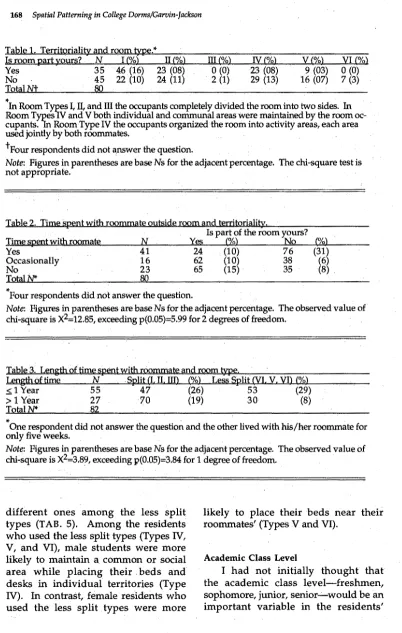
questions. In.synthesizing the informa-tion from the diagrams and the ques-tionnaires, however, I found that resi-dents' perceptions of their rooms did correlate, in part, with their use of space (TAB. 1). The majority of resi-dents who perceived the room as part "theirs" (as opposed to their room-mates') ch,ose one of the split arrange-ments (69%). Students who did not see the room as part "theirs" were almost evenly divided between the split and less split arrangements (46% vs. 52%).
In order to better understand the residents' behavior, several sociocul-tural variables-roommate ·relation-ships, sex, and academic class level-were selected to see if specific spatial behavior could be linked with given at-tributes. Other factors such as ethnic-ity and economic class could not be ex-amined because this information was not made available through the ques-tionnaires. 2
Roommates
Roommate relationships were a key variable in understanding the spatial behavior of the student residents. Presumably, roommates would have to work out a living arrangement, physically and socially, that would allow two people to cohabit one room for approximately nine months.
Socializing behavior between roommates was examined first. Accord-ing to the analysis of the question-naires, half the respondents (50%)fre-quently spent time with their room-mates outside the room, while 27% did
2 At the request of the Brittany Student Council, the 1972 researchers d1d not ask questions about ethnicity, religion, or economic background. Sucn questions were ·thought to be invasions of privacy (Bertram
Salwen, personal commumcation, 1988).
not. The remaining 22% "occasionally" spent time together. When this behav-ior was correlated with territoriality, a significant relationship was demon-strated (TAB. 2). Residents who social-ized with their roommates were less likely to feel territorial about the space in their rooms (76%). Conversely, residents who did not spend much tim-e
with their roommatE,'!s tended to feel more territorial about their living space (62% for "occasionally" and 65% for "no"). Further, roommates who so-cialized together outside the room were less likely to use one of the split
ar-rangements (43%) than roommates who did not spend time together (69%).
The amount of time spent living with a roommate also seemed to be a good indicator of roommate relation-ships. In comparing the data from dia-grams and questionnaires, there was a significant relationship between the number of semesters spent living to-gether and room types (TAB. 3). Room-mates who lived together for one or two semesters were closely divided between split and less split arrangements. Roommates who lived together for more than one year were more likely to chose one of the split arrangements.
Sex
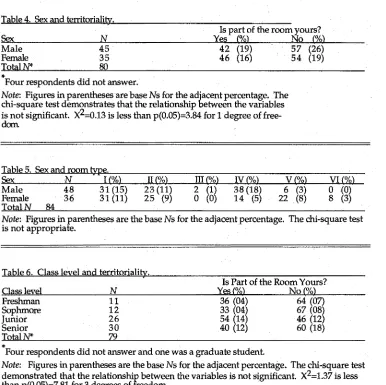
While there appeared to be a lim'-ited connection between sex and territo-rial feelings about the rooms, the rela-tionship did not prove statistically sig-nificant (TAB. 4). Other researchers have observed that women tend to feel more territorial about their residences than men, however (Van der Ryn and Silverstein 1972: 375; Aiello and Thompson 1980; Goves and Hughes 1983).
168 Spatial Patterning in College Dorms/Garvin-Jackson
Table 1. Territoriality and room type.*
Is room part yours? N I(%)
Yes 35 46. (16}
No 45 22 (10)
TotalNt 80
*
II{%)
23 (08}
24 (11}
ITI(%)
0 (0)
2 (1)
IV(%)
23 (08} 29 (13)
V(%) 9 (03) 16 (07)
VI(%) 0 (0) 7 (3)
In Room Types I, II, and lli the occupants completely divided the room into two sides. In
Room Types lV and V both individual and communal areas were maintained by the room
oc-cupants: ln Room Type IV the occupants organized· the room into activity areas, each area
used jointly by both roommates.
+Four respondents did not answer the question.
Note: Figures in parentheses are base Ns for the adjacent percentage. The chi-square test is
not appropriate. .
Table 2. Time spent with roommate outside room and territoriality.
Time &pent with rooroate N
Is part of the room yours?
Yes (%) No (%)
Yes
Occasionally No
TotalN"'
41 16 23 80
* Four respondents did not answer the question.
24 (10) 76
62 (10) 38
65 (15) 35
(31)
(6) (8)
Note: Figures in parentheses are base Ns for the adjacent percentage. The observed value of
chi-square is X2=12.85, exceeding p(0.05)=5.99 for 2 degrees of freedom. .
Table 3. Length of time &pent with roommate and room type.
Length of time N . Split (I. II. liD (%) Less Split (VI. V. VI) (%)
.::;; 1 Year 55 47 (26) 53 (29}
> 1 Year 27 70 (19) 30 (8}
Total N"' 82
* One respondent did not answer the question and the other lived with his/her roommate for
only five weeks. .
Note: Figures in parentheses are base Ns for the adjacent percentage. The observed value of chi~square is x2=3.89, exceeding p(0.05)=3.84 for 1 degree of freedom.
different ones among the less split types (TAB. 5). Among the residents who used the less split types (Types IV, V, and VI), male students were more likely to maintain a. common or social area while placing their. beds and desks in individual territories (Type
IV). In contrast, female residents who
used the less split types were more
likely to place their beds near their roommates' (Types V and VI).
Academic Class Level
Northeast Historical Archaeology/Val. 21-22, 1992-1993 169
Table 4. Sex and territoriality.
Sex
Male Female TotalN*
..
N
45 35 80
Four respondents did not answer.
Is part of the room yours?
Yes (%) No (%)
42 (19) . 57 (26}
46 (16) 54 (19)
Note: Figures in parentheses are base Ns for the adjacent percentage. The chi-square test demonstrates that the relationship between the variables is not significant. x2::::0.13 is less than p(0.05)=3.84 for 1 degree of
free-dom
Table 5. Sex and room type.
Sex N I(%)
Male 48 31 (15)
Female 36 31 (11)
TotalN 84
II(%) 23 (11) 25 (9)
IV(%) 38 (18) 14 (5)
V(%) 6 . (3) 22 (8)
VI(%)
Note: Figures in parentheses are the base Ns for the adjacent percentage. The chi-square test is not appropriate.
Table 6. Class level and territoriality.
Classleyel Freshman l)ophmore Junior Senior TotalN*
..
N
11
12 26 30
79
Is Part of the Room Yours?
Yes(%) No(%)
36 (04) 64 (07)
33 (04) 67 (08)
54 (14) 46 (12)
40 (12) 60 (18)
Four respondents did not answer and one was a graduate student.
Note: Figures in parentheses are the base Ns for the adjacent percentage. The chi-square test demonstrated that the relationship between the variables is not significant. x2:::::1.37 is less than p(0.05)=7.81 for 3 degrees of freedom.
territorial behavior because the age range of the respondents (17 to 24) was relatively sma11.3 Academic level, however, proved to be the most reveal-ing of the students' attributes in under-standing their spatial behavior.
While it appeared that juniors were more likely to feel territorial about their. living space than freshmen,
3The average age for freshmen was 18.9, sophomores 19.6, juniors 20.0, and seniors 21.5.
170 Spatial Patterning in College Donns/Garvin-fackson
Table 7. Class level and room type.
Class level N I (%) II (%) III(%) IV(%)
v
(%) Vl(%)Freshman 11 . 27 (03) 9 (01) Sophmore 13 46 (06) 23 (03) Junior 28 36 (10) 25 (07) Senior 31 23 (07) 26 (08) TotalN 83 .
0 (0) 0 (0)
4 (1)
0 (0)
46 (05) 0 (00)
29 (08)
32 (10)
18 (2)
31 (4)
7 (2)
10 (3)
0 (0) 0 (0) 0 (0)
10 (3)
!"Jote: Figures i!l parentheses are the base Ns for the adjacent percentage. The chi-square test
IS not appropnate.
were less likely to be . territorial in their dormitory rooms. At the same time, seniors also seemed less ter-ritorial.
Discussion
There are several explanations for the spatial behavior patterns of the dormitory residents. The work of vari-ous researchers (Gauvain, Altman, and Fahim 1983; Potash 1985) suggests that the freshmen may have been copying the spatial arrangement in their par-ents' homes and adapting it to their own rooms. The most common arrange-ment among freshmen was Type IV, in which roommates maintained personal territories for sleeping and studying but also had a third communal area. Freshmen were more likely to use this arrangement than upper level students. The Type IV arrangement is most simi-lar to the American standard of spatial divisions within the home: personal territories in the bedrooms and bath-rooms and communal or family territo-ries in the living rooms, dens, and kitchens (Wallace 1980: 278).
Another possibility is that incom-ing freshmen felt hesitant about beincom-ing territorial, fearing such behavior would be perceived as hostile and un-friendly. Similarly, roommates who socialized together outside the room-thus probably "friends"-also may not have wanted to appear overly territo-rial about their living space. Indeed,
Hall (1959: 188-189) notes that Ameri-cans tended to be embarrassed by their territorial feelings: "we treat space somewhat as we treat sex. It is there but we don't talk about it."
In contrast, sophomores and juniors, presumably with more experience liv-ing in dormitories and with roommates, seemed to have a greater need or desire for privacy. This pattern was also ob-served in analyzing roommate relation-ships; roommates who lived together for more than one year tended to be more territorial. Perhaps these older, mid-level students had learned the importance of creating personal territories to secure privacy and maintain good roommate relationships (Altman 1975).
The patterning among seniors, who exhibited a lack of territoriality simi-lar to that displayed by the freshmen, is more difficult to interpret. It should be noted that only female seniors used Type VI in which the room was divided into activity areas, each used jointly by both roommates. Perhaps the need .for personal areas within the room was simply no longer important to these students who were soon to graduate and leave the dormitory environment for good.
Conclusion
Northeast Historical ArchaeologyNol. 21-22, 1992-1993 171
(1973), are suitable for archaeological study. Second, I showed that an inter-disciplinary approach to investigate a modern archaeological site could be productive. These goals were applied to Salwen's (1973) pilot project to study space utilization by college dormitory roommates. My analysis of the dormi-tory project data provided insight into dormitory resident behavior in particu-lar and human-material behavior in general. It would be interesting to ex-tend the approach used in this paper to historical and possibly prehistoric liv-ing sites and their spatial patterns.
Acknowledgments
This paper is drawn from my M.A. thesis,. "The Use of Space and Territo-riality in Dormitory Rooms: An Ar-chaeological Approach" (1989) on file in the Department of Anthropology, New York University. I would like to thank Bruce Jackson and Ellen Snyder-Grenier for reading earlier drafts of this paper.
References
Aiello, John R., and Donna E. Thompson 1980 Personal SJ?ace, Crowding, and
Spa-tial BehaviOr in Cultural Context. In Vol. 4 of Human Behavior and En-vironment, ed. by Irwin Altman, Amos Rapoport, and Joachim F. Wohlwill, 107-178. Plenum Press, New York.
Altman, Irwin
1975 The Environment and Social Behav-ior: Privacy, Personal Space, Terri-tory, Crowding. Brooks/Cole Pub. Co., Monterey, CA. 1
Ardener, Shirley
1981 Ground Rules and Social Maps for Women: An Introduction. In Women and Space: Ground Rules for Women,
ed. by Shirley Ardener. St. Martin's Press, New York.
Berman, Ira
1972 Untitled research paJ>er for a gradu-ate course, 11
Archaeology and Envi-ronment," taught by Bert Salwen, Department of Anthropology, New York University, Spring semester.
Deetz, James
1977 In Small Things Forgotten: The Ar-chaeology of Early American Life.
Anchor Books, Garden City, NY.
Flinn, Karen
1972 Untitled research paper for a gradu-ate course, 11 Archaeology and En
vi-, ronmentvi-," taught by Bert Salwenvi-, Department of Anthropology, New York University, Spring semester.
Gauvain, Mary,. Irwin Altman, and Hussein Fahim
1983 Homes and Social Change: A Cross-Cultural Analysis. In Environmental Psychology: Directions and Perspec-tives, ed. by Nickolaus R. Feimer and E. Scott Geller, 180-218. Praeger Publishers, New York.
· Goves, Walter R. and Michael Hughes 1983 Overcrowding in the Household: An
Analysis of Determinants and Ef-fects. Academic Press, New York.
Hall, Edward T.
1959 The· Silent Language. Doubleday & Co., Inc., Garden Oty, NY.
Hayes, Harriet
1932 Planning Residence Halls for Under-;rraduate Students in American Col-leges and Universities. Bureau of Publications, Teachers College, Columbia University, New York.
Heilweil, Martin
1973 The Influence of Dormitory Archi-tecture on Resident Behavior. Envi-ronment and Behavior 5(4): 377-412.
Hodder, Ian
1985 Postprocessual Archaeology. In
Symbolic and Structural
Archaeol-ogy,
ed. by Ian Hodder, 17-25. Cam-budge University Press, Cambridge. 1986 Reading the Past: Current Ap-proaches to Interpretation in Archae-ology. Cambridge University Press, Cairibridge.172 Spatial Patterning in College Dorms/Garvin-Jackson
. Method and Theory for Activity
Area Reseacli: An
Ethnoarchaeological Approach, ed. by Susan Kent, 424-448. Columbia University Press, Ne:w York.
Rapoport, Amos . ·
1980 Cross-Cultural Aspects of Environ-mental Design. In Vol. 4 of Human
Maxwell, Robert J.
1983 Contexts
of
Behavior: Anthropologi-cal Dimensions. Nelson-Hall, Chicago.Miller, Daniel
1982 Artefacts as Products of Human Cat-. egorisation Processes. In Symbolic
and Structural Archaeology, ed. by
Ian Hodder, 17-25. Cambndge Uru-versity Press, Cambridge. .
Potash, BeJ:ty
1985 Kitchens are for Sleeping: Anthro-pology and the Training of Archi-tects. In Anthropology and Appro-priate Education, ed. by Frank Sala-mone, 143-161. College of William and Mary, Williamsburg, VA.
Proshansky, Harold M., William H. Ittelson, , and Leanne G. Rivlin
197 6 Freedom of Choice and Behavior in a Physical Setting. In Environmental Psychology: People and Their Physi-ca[Settings (2nd edn.), ed. by Harold M. ·Prosnansky, William H. Ittelson, and Leanne G. Rivlin, 170-181. Holt, Rinehardt and Winston, New York.
· Behavior ana Environment, ed. by Irwin Altman, Amos Rapoport, and Joachim F. Wohlwill, 7-46. Plenum Press, New York.
1982 The Meaning of the Built Environ-ment: A Nonverbal Communication Approach. Sage Publications, Bev-erly Hills, CA. . ·
Salwen, Bert
1973 Archeology in Megalopolis. In Re-search and Theory m Current. Arche-ology, ed. by Charles L. Redman, 151-163. A Wiley-Interscience Pub-lication, New York.
Sommer, Robert
1969 Personal Space: The Behavioral Ba-.sis of Destgn. Prentice-Hall, hie., Engfewood Cliffs, NJ. ·
Vander Ryn, Sim, and Murray Silverstein 1972 The Room, A Student's Personal
En-vironment. In People and Buildings,
ed. by Robert Gutman, 370-383. Ba-sic Books, New York.
Wallace,Samuel E.
1980 The Urban Environment. The Dorsey Press, Homewood, IL.
Ruth Garvin-Jackson
The Arthur M. Sackler Foundation 461 East 57th Street