International Journal of Advances in Engineering Research http://www.ijaer.com
(IJAER) 2015, Vol. No. 10, Issue No. III, September e-ISSN: 2231-5152/ p-ISSN: 2454-1796
1
INTERNATIONAL JOURNAL OF ADVANCES IN ENGINEERING RESEARCH
AN EXPERIMENTAL INVESTIGATION ON THE
PERFORMANCE CHARACTERISTIC OF C.I ENGINE
USING MULTIPLE BLENDS OF METHYL CASTOR OIL
IN DIFFERENT PISTON SHAPES
*Vincent.H.Wilson, **V.Yalini
* Dean, Department of Mechanical Engineering, PRIST University, Tamilnadu, INDIA ** Research scholar, Department of Mechanical Engineering, PRIST University, Tamilnadu, INDIA
ABSTRACT
The world energy demand has increased radically in few decades. The price of conventional fossil fuel is rising rapidly and also increase of carbon dioxide (Co2) level in the atmosphere leads acid rain, global warming and health hazards. Diesel is fossil fuel that is getting exhausted at a fast rate. The fossil fuels are non-renewable energy. Hence alternative fuels are necessary and a need of an hour. Biodiesel has better performance than petroleum diesel, because, it is a clean burning fuel that does not contribute to the increase of carbon dioxide, being environmentally friendly. Castor oil is cultivated in India at huge amount, has a high potential to become an alternative fuel to replace diesel fuel. To reduce the amount of free fatty acid below 1 %( as more than 1% leads to soap formation, thereby affecting the transesterification process, hence the biodiesel production is done in two steps... The first step of acid catalyzed esterification process to reduces the free fatty acid content of castor oil to below1%.The next base catalyzed transesterification process converts the preheated oil to castor biodiesel. This two-step process gave an average yield of 90%.The castor biodiesel is blended with diesel on volume basis in different proportions. The blend proportions are used in 15:85(B15), 35:65(B35), and 45:55 (B45). These blended oils are used to run a single cylinder four stroke Compression ignition engine, to study and compare the different performance and emission characteristics at different load conditions with different shapes of pistons.
Keywords:Biodiesel, Esterification, Free fatty acid, internal combustion, Transesterification
I. INTRODUCTION
International Journal of Advances in Engineering Research http://www.ijaer.com
(IJAER) 2015, Vol. No. 10, Issue No. III, September e-ISSN: 2231-5152/ p-ISSN: 2454-1796
13
INTERNATIONAL JOURNAL OF ADVANCES IN ENGINEERING RESEARCH
economically and technically feasible. Bio diesel is best suitable for alternative energy sources because it is an oxygenate, sulphur- free and biodegradable fuel, and its content of oxygen helps improve its combustion efficiency. Therefore, fewer green house gases such as carbon di- oxide are released into the atmosphere. Biodiesel has more lubricating than diesel fuel, it also increases engine life and it can be used to replace sulphur a lubricating agent, that when burned, produces sulphur oxide, the primary element in acid rain.
Biodiesel is produced from vegetable oils and animal fats. In most established countries, biodiesel is produced from soya bean, sunflower, rapeseed, etc., which in the Indian context are basically edible oils. In India, edible oils supply are in short and are too costly, hence non edible oils; like jatropha,pongamia, castor, neem and mahua have been found to be promising biodiesel feed stocks [2]. Vegetable oils have become more attractive in the current past owing to its environmental benefits and the fact that it is prepared from renewable resources.
Vegetable oils are renewable and possibly inexhaustible source of energy with an energetic are closer to diesel fuel. The use of vegetable oils, such as Castor, mustard oil, palm oil, neem oil, olive oil, coconut husk, rice husk, and soya bean, as alternative fuels for diesel is being supported in many countries, depending upon the environment conditions. Different countries are looking for different types of vegetable oils as substitutes for diesel fuels. For example, Soya bean oil in the United states, rapeseed and sunflower oils in Europe countries, palm oil in Malaysia and Indonesia and coconut oil in the Philippines are being considered.
The castor oil plant is anevergreen plant in Indian sub-continent and South- East Asian countries. It grows in almost every state of India and in all kinds of soil. The high calorific value of castor oil matches with diesel [4]. It blends with diesel, replacing for nearly 50% and has been suggested for use without any major engine modification.
Vegetable oils are very high viscosity. Hence it cannot be used directly in diesel engine. The high viscosity may cause blockage in the fuel lines, filters, nozzles, valve opening passage. Hence poor atomization takes place, inside of the combustion chamber. The problems of high viscosity of vegetable oil can be overcome by heating, esterifying and blending them.
International Journal of Advances in Engineering Research http://www.ijaer.com
(IJAER) 2015, Vol. No. 10, Issue No. III, September e-ISSN: 2231-5152/ p-ISSN: 2454-1796
14
INTERNATIONAL JOURNAL OF ADVANCES IN ENGINEERING RESEARCH Name of
oil seed
Plant name
Oil content (%) Jatropha Jatropha curcas 50-60
Mahua Madhuca indica 35-40
Pongamia Pongamia pinnata 30-40
Castor Ricinus
communis
45-50
Linseed Gynocardia odorata
35-45
Sal Shorea robusta 10-12
Neem Azadirachta india 20-30
Polanga Calophyllum 20
Fig 1.1 Some of the potential Non-edible oils seeds
II. RELATED WORK
2.1 Problem Formulation
The problem formulation is mainly considered in two parts:
1. Study of methods employed in extraction of biodiesel. The methods employed in extraction of biodiesel are: direct blending, pyrolysis, micro emulsion and transesterification.
2. Study on properties of different blends of biodiesel derived from castor oil and selection of optimum blend.
During the course of this work, a study of different methods employed in production of biodiesel was observed. The four methods are examined were direct blending, pyrolysis, micro emulsion and transesterification. Although all these methods are used for production of biodiesel but each method have their own drawbacks. The drawbacks of these methods are given below:
2.1.1 Direct Mixing: In this method, castor oil is directly mixed with diesel. The difficulties of castor oils as diesel fuel are higher viscosity, lesser volatility and reactivity of unsaturated hydrocarbons. Problems seems only after the engine has been working on castor oils for longer periods of time, particularly with direct-injection engines. The problems are fuel atomization does not occur properly, carbon deposits, Oil ring sticking, thickening and gelling of the fuel as a result of contamination of the engine.
International Journal of Advances in Engineering Research http://www.ijaer.com
(IJAER) 2015, Vol. No. 10, Issue No. III, September e-ISSN: 2231-5152/ p-ISSN: 2454-1796
15
INTERNATIONAL JOURNAL OF ADVANCES IN ENGINEERING RESEARCH
the process decreases the benefits of an oxygenated fuel, reducing its environmental benefits. By the international terminology, the fuel produced by thermal cracking is not considered as biodiesel, in spite of being a biofuel related to the diesel oil.
Fig1.2 Architecture diagram for Biodiesel Production
2.1.3 Micro emulsion: Micro emulsification, process to increase the cetane number and reduce the viscosity of the oil. Diesel fuel, castor oil, alcohol, additive for increasing of cetane number are mixed in suitable proportions and the mixture transformed, under vigorous stirring, into a micro emulsion with lower viscosity. Alcohols as methanol, ethanol and propanol are used as additives for reducing the viscosity, higher ones as surfactants and alkyl nitrates as to increases the cetane
Raw Material
Alcohol
Reactor
Settler
Washing
Purification
Evaporation
Biodiesel
Catalyst
Neutralizat ion
Glycerin
International Journal of Advances in Engineering Research http://www.ijaer.com
(IJAER) 2015, Vol. No. 10, Issue No. III, September e-ISSN: 2231-5152/ p-ISSN: 2454-1796
16
INTERNATIONAL JOURNAL OF ADVANCES IN ENGINEERING RESEARCH
number. The drawbacks of this method are laboratory tests for motors operating on fuels created by micro emulsion to show the carbon deposits due to incomplete combustion, injector needle sticking.
2.1.4 Transesterification: In this method, the castor oil is subjected to a chemical reaction. In that reaction, the castor oil is reacted in the presence of a catalyst (usually a base) with an alcohol (usually methanol) to give the corresponding alkyl esters of the free fatty acid mixture that is found in the castor oil.
2.2. Preparation of Bio-diesel
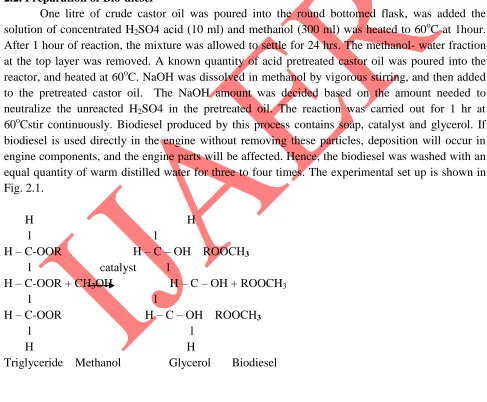
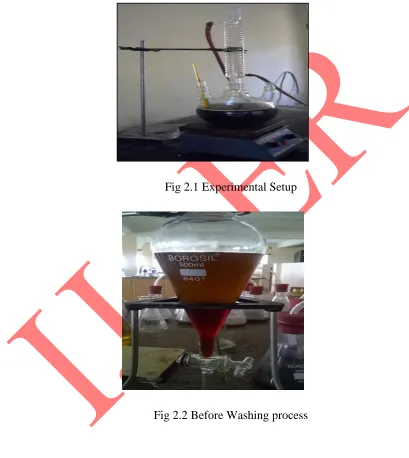
One litre of crude castor oil was poured into the round bottomed flask, was added the solution of concentrated H2SO4 acid (10 ml) and methanol (300 ml) was heated to 60oC at 1hour. After 1 hour of reaction, the mixture was allowed to settle for 24 hrs. The methanol- water fraction at the top layer was removed. A known quantity of acid pretreated castor oil was poured into the reactor, and heated at 60oC. NaOH was dissolved in methanol by vigorous stirring, and then added to the pretreated castor oil. The NaOH amount was decided based on the amount needed to neutralize the unreacted H2SO4 in the pretreated oil. The reaction was carried out for 1 hr at 60oCstir continuously. Biodiesel produced by this process contains soap, catalyst and glycerol. If biodiesel is used directly in the engine without removing these particles, deposition will occur in engine components, and the engine parts will be affected. Hence, the biodiesel was washed with an equal quantity of warm distilled water for three to four times. The experimental set up is shown in Fig. 2.1.
H H
l l
H – C-OOR H – C – OH ROOCH3
l catalyst l
H – C-OOR + CH3OH H – C – OH + ROOCH3 l l
H – C-OOR H – C – OH ROOCH3
l l H H
Triglyceride Methanol Glycerol Biodiesel
2.4. Washing of product
International Journal of Advances in Engineering Research http://www.ijaer.com
(IJAER) 2015, Vol. No. 10, Issue No. III, September e-ISSN: 2231-5152/ p-ISSN: 2454-1796
17
INTERNATIONAL JOURNAL OF ADVANCES IN ENGINEERING RESEARCH
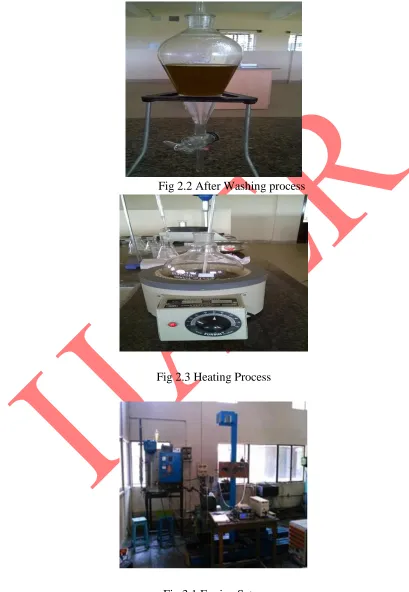
engine components, the residual catalyst (NaOH) can damage engine components, and glycerol in the biodiesel can reduce fuel lubricity and cause injector choking and other deposits [2], they were being removed by washing the biodiesel with warm water up to pure water is deposited in the bottom of the separating funnel as shown in Fig 2.2.The moisture from the biodiesel was removed by heating it on a hot plate at 100-110oC as shown in Fig 2.3. Finally glycerin is obtained as a byproduct in case of alkali transesterification process.
III. Experimental Setup And Procedure
The Specifications of the Diesel Engine used for doing performance analysis are as follows:
PARTICULARS DETAILS
Make Kirloskar
No. of cylinder Single
Power 4.4 Kw
Speed 1500 rpm
Bore 87.5 mm
Stroke 110 mm
Orifice Diameter 13.6 mm
Type of loading Electrical load Table.3. 1
A single cylinder horizontal air cooled kirloskar oil engine was used in this investigation as shown in Fig.3.1.The performance tests were conducted in constant speed air cooled 4 HP greaves engine. The test has been conducted for various blends (such as B0, B15, B35, B45, and B100) at various loads. The specifications of this engine are summarized in Table 1. The engine was coupled to mechanical loading through a transmission shaft. The maximum load which the engine could take at 1500 rpm was found to be 70 N. This was taken as the 100 percent load for this investigation and the various loads were calculated for 0%, 25%, 50%, 75% and 100% of maximum load. Emission test was conducted using the exhausted gas analyzer coupled to the test engine. In this test the output result from exhaust gas analyzer was noted for each set of loads.
International Journal of Advances in Engineering Research http://www.ijaer.com
(IJAER) 2015, Vol. No. 10, Issue No. III, September e-ISSN: 2231-5152/ p-ISSN: 2454-1796
18
INTERNATIONAL JOURNAL OF ADVANCES IN ENGINEERING RESEARCH
shown in Fig.3.1. The performance data were then analyzed from the graphs regarding brake thermal efficiency, specific fuel consumption for different blends of fuel with different shapes of piston as shown in Fig 3.2.
Fig 2.1 Experimental Setup
International Journal of Advances in Engineering Research http://www.ijaer.com
(IJAER) 2015, Vol. No. 10, Issue No. III, September e-ISSN: 2231-5152/ p-ISSN: 2454-1796
19
INTERNATIONAL JOURNAL OF ADVANCES IN ENGINEERING RESEARCH Fig 2.2 After Washing process
Fig 2.3 Heating Process
International Journal of Advances in Engineering Research http://www.ijaer.com
(IJAER) 2015, Vol. No. 10, Issue No. III, September e-ISSN: 2231-5152/ p-ISSN: 2454-1796
20
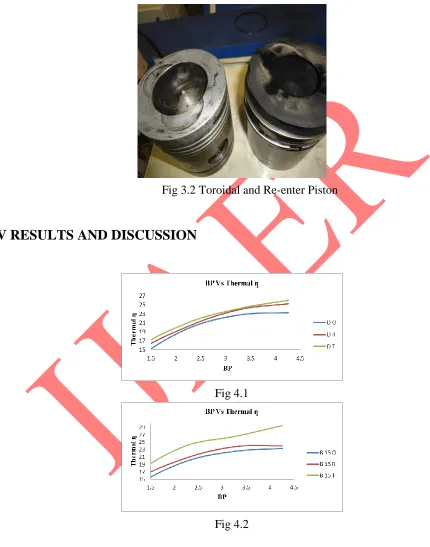
INTERNATIONAL JOURNAL OF ADVANCES IN ENGINEERING RESEARCH Fig 3.2 Toroidal and Re-enter Piston
IV RESULTS AND DISCUSSION
Fig 4.1
International Journal of Advances in Engineering Research http://www.ijaer.com
(IJAER) 2015, Vol. No. 10, Issue No. III, September e-ISSN: 2231-5152/ p-ISSN: 2454-1796
21
INTERNATIONAL JOURNAL OF ADVANCES IN ENGINEERING RESEARCH Fig 4.3
Fig 4.4
Fig 4.5
International Journal of Advances in Engineering Research http://www.ijaer.com
(IJAER) 2015, Vol. No. 10, Issue No. III, September e-ISSN: 2231-5152/ p-ISSN: 2454-1796
22
INTERNATIONAL JOURNAL OF ADVANCES IN ENGINEERING RESEARCH Fig 4.7
Fig 4.8
Fig 4.9
Fig 4.10
International Journal of Advances in Engineering Research http://www.ijaer.com
(IJAER) 2015, Vol. No. 10, Issue No. III, September e-ISSN: 2231-5152/ p-ISSN: 2454-1796
23
INTERNATIONAL JOURNAL OF ADVANCES IN ENGINEERING RESEARCH
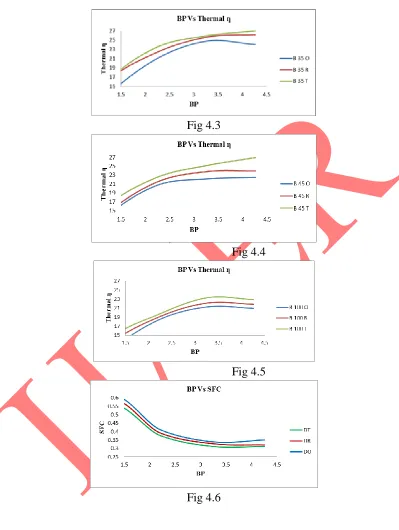
observed that thermal efficiency of toroidal piston is higher than thermal efficiency of remaining pistons like ordinary piston and re-enter piston as shown in Fig 4.1 to Fig 4.5
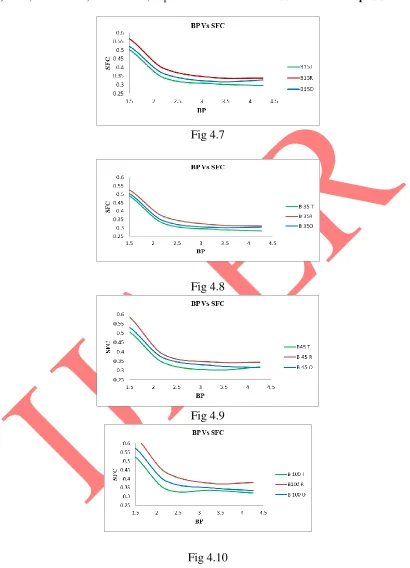
Specific fuel consumption at different loads with all percentage of blending was found slightly decreased because of extra oxygen present in the blend is taking part in combustion process. Due to which extra amount of fuel is burning inside cylinder which improves the efficiency which results decreased specific fuel consumption. Estrification also helps to lower the temperature reaction and viscosity of fuel which results the better combustion. As increase the brake power, specific fuel consumption is decreasing for all the blends because of brake power is increasing due to better combustion which may be attributed to extra oxygen present in the blend and specific fuel consumption is quantity of fuel burned inside the cylinder for unit brake power. The specific fuel consumption is very fewer in toroidal piston as compare to the other pistons for all blends of castor oil and diesel. It is found that toroidal piston is having lower specific fuel consumption as shown in Fig 4.6 to Fig 4.10.
IV- CONCLUSION
1) Methyl esters of castor oil can give better performance when blended with diesel and toroidal piston gives better performance than other pistons.
2) The cost can be reduced drastically of bio fuel by producing them on large scale. Since the properties of bio-diesel and diesel are very close to each other it gives better combustion which may be attributed to extra oxygen present in the blend and specific fuel consumption is quantity of fuel burned inside the cylinder for unit brake power. The specific fuel consumption is very fewer in toroidal piston as compare to the other pistons for all blends of castor oil and diesel. It is found that toroidal piston is having lower specific fuel consumption.
V. REFERENCES
1. Dr.P. Vijaya Kumar and V. Dhanaraju, have done their work on the “Experimental investigation on four stroke diesel engine fuelled with bio-diesel”, International Journal of Research in Mechanical Engineering, Volume 2, Issue 4, July-August, 2014, pp. 19-26
International Journal of Advances in Engineering Research http://www.ijaer.com
(IJAER) 2015, Vol. No. 10, Issue No. III, September e-ISSN: 2231-5152/ p-ISSN: 2454-1796
24
INTERNATIONAL JOURNAL OF ADVANCES IN ENGINEERING RESEARCH
3. Suvendu Mohanty and Dr.Om Prakash have done their research on the “Analysis of the exhaust emission of the IC Engines using biodiesel blends”,International Journal of Emerging Technology and Advanced Engineering, Volume 3, Issue 5, May 2013
4. A. Forhad, A. R. Rowshan, M. A. Habib and M. A. Islam et al, “Production and Performance of Biodiesel as an Alternative to Diesel,” in International Conference on Mechanical Engineering, at London, 2009